

Classroom Gamification
 |
Description
Book Introduction
The Ultimate Introduction to Game-Based Classes
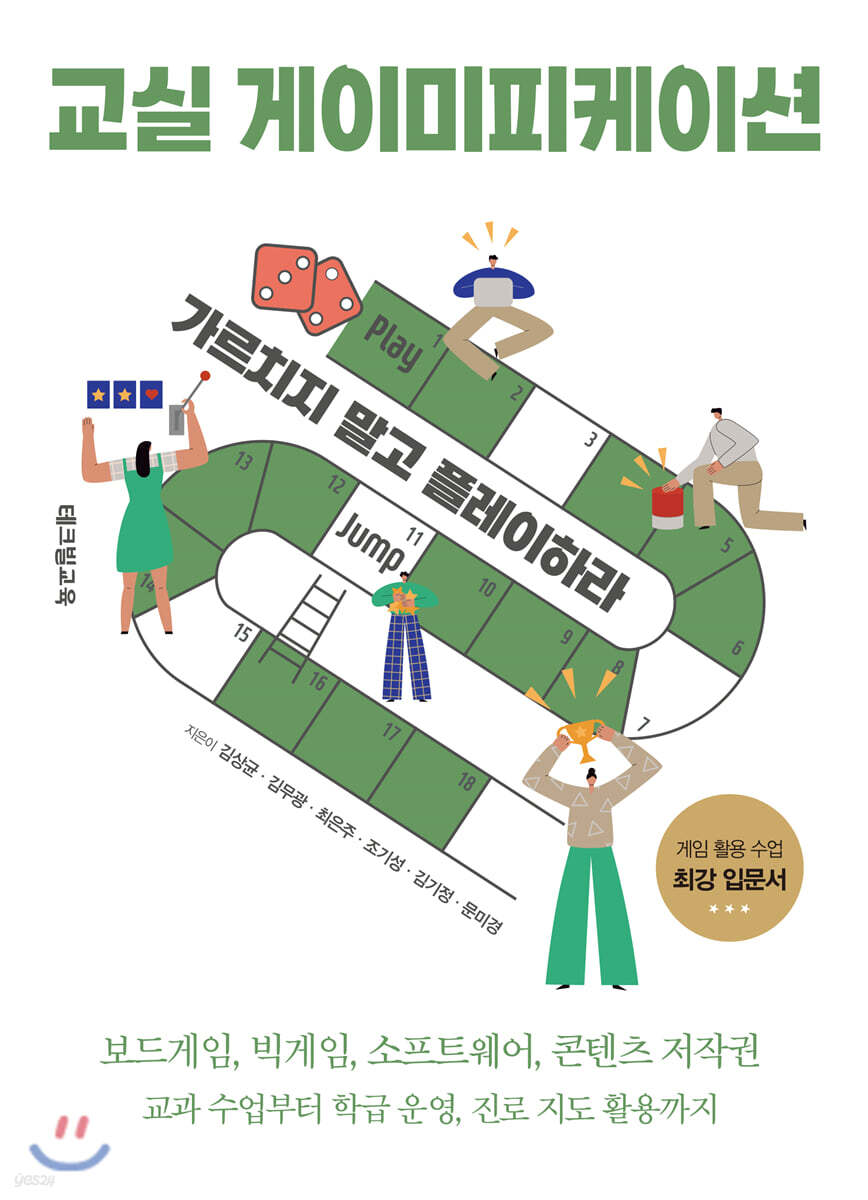
Board games, big games, software, and content copyrights
From curriculum learning to classroom management and career guidance
Everything you need to know about classroom gamification from six leading gamification experts.
This book covers games that can be used in classes such as Korean, math, science, and social studies, as well as games that can be used for classroom management and career guidance, as well as key information about excellent educational gamification tools and content copyrights available online.
Furthermore, the leader and expert in domestic gamification theory and application also concisely compiles basic knowledge on classroom gamification theory.
If you want to solidify your foundation in classroom gamification, from its fundamentals to its theories and various applications, this is the first introductory and essential book you should read.
Board games, big games, software, and content copyrights
From curriculum learning to classroom management and career guidance
Everything you need to know about classroom gamification from six leading gamification experts.
This book covers games that can be used in classes such as Korean, math, science, and social studies, as well as games that can be used for classroom management and career guidance, as well as key information about excellent educational gamification tools and content copyrights available online.
Furthermore, the leader and expert in domestic gamification theory and application also concisely compiles basic knowledge on classroom gamification theory.
If you want to solidify your foundation in classroom gamification, from its fundamentals to its theories and various applications, this is the first introductory and essential book you should read.
- You can preview some of the book's contents.
Preview
index
Opening the book
Part 1
Play, Don't Teach: Classroom Gamification
1.
Our village looks peaceful: Is our classroom okay?
Is our learning happy? / How should learning change today?
[Q&A] Are game-based classes future-oriented education?
2.
The Journey Begins: What is Gamification?
Games, aren't they bad? / Are gamification, GBL, and recreation different? / Class participation, immersion, and fun / Quantity vs. depth of learning / Pre-prep time and indifferent students
[Q&A] How can I get my child to play games less?
3.
The Ordeal We Face: Gamification: What Should We Watch Out For?
Another memory game? / Rules explained in 5 minutes / Revenge strikes back / Infinite competition in games too?
[Q&A] What if an educational game doesn't work well?
Part 2
How to Play in the Classroom: Classroom Heroes
1.
Think, Collaborate, Play, and Learn: The Fundamentals of Gamification
Human characteristics and board games / The thought process of gamification (board games) / The educational use of board games / Classes using board games / The effect of immersion through games
2.
Killing Two Birds: Fun and Meaning: The Expansion of Gamification
Teacher, can we do just one more round? / Make class a game with simple changes / Play the class / Gamification for a month?
3.
Online Weapons for Players: Gamification Software
Gamification and GBL / Online Tools for Classroom Gamification / Learning Sites with Gamification Elements / Simple Game-Based Learning Tools Using Apps / Learning Math Using Games
4.
Our Classroom Has Changed: Gamification of Classroom Management
Benefits of using games to run a classroom / Scope of gamification in classroom management / Points to consider when gamifying classroom management / Gamification that helps create a class atmosphere at the beginning of the semester / Gamification that helps create a class atmosphere during the semester / Designing gamification with the Golden Circle
5.
Creative and Innovative Education for the Future: Learning Entrepreneurship Through Games
The Rules of the Game Are Changing / Lesson 1: The Beginning of Entrepreneurship: Stimulate Your Imagination / Lesson 2: Solve Problems with Creative Ideas / Lesson 3: Innovate with a Value Proposition / Lesson 4: Define Your Inner Entrepreneurship
Part 1
Play, Don't Teach: Classroom Gamification
1.
Our village looks peaceful: Is our classroom okay?
Is our learning happy? / How should learning change today?
[Q&A] Are game-based classes future-oriented education?
2.
The Journey Begins: What is Gamification?
Games, aren't they bad? / Are gamification, GBL, and recreation different? / Class participation, immersion, and fun / Quantity vs. depth of learning / Pre-prep time and indifferent students
[Q&A] How can I get my child to play games less?
3.
The Ordeal We Face: Gamification: What Should We Watch Out For?
Another memory game? / Rules explained in 5 minutes / Revenge strikes back / Infinite competition in games too?
[Q&A] What if an educational game doesn't work well?
Part 2
How to Play in the Classroom: Classroom Heroes
1.
Think, Collaborate, Play, and Learn: The Fundamentals of Gamification
Human characteristics and board games / The thought process of gamification (board games) / The educational use of board games / Classes using board games / The effect of immersion through games
2.
Killing Two Birds: Fun and Meaning: The Expansion of Gamification
Teacher, can we do just one more round? / Make class a game with simple changes / Play the class / Gamification for a month?
3.
Online Weapons for Players: Gamification Software
Gamification and GBL / Online Tools for Classroom Gamification / Learning Sites with Gamification Elements / Simple Game-Based Learning Tools Using Apps / Learning Math Using Games
4.
Our Classroom Has Changed: Gamification of Classroom Management
Benefits of using games to run a classroom / Scope of gamification in classroom management / Points to consider when gamifying classroom management / Gamification that helps create a class atmosphere at the beginning of the semester / Gamification that helps create a class atmosphere during the semester / Designing gamification with the Golden Circle
5.
Creative and Innovative Education for the Future: Learning Entrepreneurship Through Games
The Rules of the Game Are Changing / Lesson 1: The Beginning of Entrepreneurship: Stimulate Your Imagination / Lesson 2: Solve Problems with Creative Ideas / Lesson 3: Innovate with a Value Proposition / Lesson 4: Define Your Inner Entrepreneurship
Into the book
Phajaan refers to the cruel and abusive practice of taming elephants.
This is a practice of confining baby elephants within 2 to 3 years of birth in narrow enclosures and abusing them.
It is a method of removing the wildness of elephants and making them obedient to human commands, but in the process, about 50% of baby elephants die.
Most of the education I experienced from elementary school to college was not much different from Pajan's.
---From "Our Peaceful-Looking Town: Is Our Classroom Alright?"
The goal of my board game-based class is 'Happy MEAL'.
Happy MEAL is a student-centered learning class L (learning) in which all students A (all) happily participate to develop students' mathematical thinking ability M (mathematics) and creativity and personality ability E (emotion) using board games.
---From "Think, Collaborate, Play, and Learn: The Basics of Gamification"
Elementary school students always want to move and talk.
However, since that is often not possible during class time, there are students who sit slumped over and twist their bodies with expressions that show they are bored and can't stand it anymore.
I don't know if there's anything that makes a teacher nervous as much as this.
I start preparing for classes with the idea of immersion and voluntary participation, but as I do, I often find myself wondering, "What fun activities are there?" because I don't want to see my students like that.
---From "Catching Two Rabbits: Fun and Meaning: The Expansion of Gamification"
While gamification is an educational method that utilizes game elements to increase students' interest and participation, GBL (Game Based Learning) is an educational method that enhances learning effectiveness through direct game play.
Both methods have one thing in common: they can increase students' interest and concentration.
Gamification can be applied not only to teaching and learning but also to classroom management, and can be utilized both online and offline. GBL is a method that enhances educational effectiveness by incorporating all types of games, including online games, game apps, and board games, into learning through learners' direct participation in the game.
---From "Online Weapons for Players: Gamification Software"
One of the reasons for the negative perception of games may be unhealthy immersion.
Unhealthy immersion involves playing games to relieve dissatisfaction in reality, disrupting normal daily life and severing relationships.
So what is healthy immersion? It's playing games to seek psychological satisfaction and to revitalize your life.
Classroom management gamification aims for emotional engagement, where students feel emotionally attached to the class.
Gamifying classroom management creates a sense of attachment, belonging, and happiness.
This emotional engagement creates stronger bonds between members.
---From "Our Classroom Has Changed: Gamification of Classroom Management"
Many developed countries are pinning their hopes on entrepreneurship education.
Entrepreneurship is the spirit of the times that drives change and innovation through 'the motivation and practical activities to create new value.'
In a society where individuals are required to creatively pioneer and adapt to changing times and personal circumstances, entrepreneurship is a core competency that can be utilized in various areas of life.
The experience of solving problems by collaborating with others not only fosters the ability to create new value and discover opportunities, but also enhances self-efficacy, fostering career development capabilities that foster interest in one's future and proactive problem-solving.
This is a practice of confining baby elephants within 2 to 3 years of birth in narrow enclosures and abusing them.
It is a method of removing the wildness of elephants and making them obedient to human commands, but in the process, about 50% of baby elephants die.
Most of the education I experienced from elementary school to college was not much different from Pajan's.
---From "Our Peaceful-Looking Town: Is Our Classroom Alright?"
The goal of my board game-based class is 'Happy MEAL'.
Happy MEAL is a student-centered learning class L (learning) in which all students A (all) happily participate to develop students' mathematical thinking ability M (mathematics) and creativity and personality ability E (emotion) using board games.
---From "Think, Collaborate, Play, and Learn: The Basics of Gamification"
Elementary school students always want to move and talk.
However, since that is often not possible during class time, there are students who sit slumped over and twist their bodies with expressions that show they are bored and can't stand it anymore.
I don't know if there's anything that makes a teacher nervous as much as this.
I start preparing for classes with the idea of immersion and voluntary participation, but as I do, I often find myself wondering, "What fun activities are there?" because I don't want to see my students like that.
---From "Catching Two Rabbits: Fun and Meaning: The Expansion of Gamification"
While gamification is an educational method that utilizes game elements to increase students' interest and participation, GBL (Game Based Learning) is an educational method that enhances learning effectiveness through direct game play.
Both methods have one thing in common: they can increase students' interest and concentration.
Gamification can be applied not only to teaching and learning but also to classroom management, and can be utilized both online and offline. GBL is a method that enhances educational effectiveness by incorporating all types of games, including online games, game apps, and board games, into learning through learners' direct participation in the game.
---From "Online Weapons for Players: Gamification Software"
One of the reasons for the negative perception of games may be unhealthy immersion.
Unhealthy immersion involves playing games to relieve dissatisfaction in reality, disrupting normal daily life and severing relationships.
So what is healthy immersion? It's playing games to seek psychological satisfaction and to revitalize your life.
Classroom management gamification aims for emotional engagement, where students feel emotionally attached to the class.
Gamifying classroom management creates a sense of attachment, belonging, and happiness.
This emotional engagement creates stronger bonds between members.
---From "Our Classroom Has Changed: Gamification of Classroom Management"
Many developed countries are pinning their hopes on entrepreneurship education.
Entrepreneurship is the spirit of the times that drives change and innovation through 'the motivation and practical activities to create new value.'
In a society where individuals are required to creatively pioneer and adapt to changing times and personal circumstances, entrepreneurship is a core competency that can be utilized in various areas of life.
The experience of solving problems by collaborating with others not only fosters the ability to create new value and discover opportunities, but also enhances self-efficacy, fostering career development capabilities that foster interest in one's future and proactive problem-solving.
---From "Creative and Innovative Education for the Future: Learning Entrepreneurship through Games"
Publisher's Review
Does learning need gamification?
: Thinking about children these days
Many parents control their children in the hope that they will study more instead of playing games.
There are also concerns about using games in learning.
The authors of this book speak with one voice.
"Should we study more just because our children don't play games? Games are virtually the only way our children can relax, play, and communicate.
“We tell adults to exercise or read instead of playing games, but do they actually enjoy reading as a form of relaxation and play?” (Page 38 of this book)
It also says this:
“What I’ve recently felt in the classroom is that we need to understand the characteristics of Generation Z and incorporate them into the field.
“Generation Z has been using smartphones since birth, and they acquire all their information and consumption through YouTube videos.” (pp. 6-7 of this book)
Classroom gamification is ultimately one way to learn for a changing world and changing children.
This is the result of teachers and researchers who believe that 'education that makes students happy is the education of the future' and have continuously studied students and classes.
The authors of this book, "Classroom Gamification: Play, Don't Teach," believe that "teachers should research and utilize various methods and media that can immerse learners." Based on their research on "how to immerse learners by adding the fun elements of games to learning," and the results of applying them in actual fields, they have organized theories and specific utilization methods for classroom gamification.
We've seen remarkable results both in and outside of school, and we'll cover everything from games that can be used for classroom learning to games that can be used for classroom management and career guidance, to some of the best educational gamification tools available online, along with key takeaways about content copyright.
From curriculum learning to classroom management and career guidance
: All About Classroom Gamification
Our children are a generation that is exposed to digital devices and online and offline knowledge and information from the moment they are born, and they naturally utilize them.
In other words, they are ‘digital natives.’
A variety of new learning methods are emerging to suit the characteristics of these children, and games are one of them that are gaining attention.
The game contains all the learning elements suitable for digital natives.
These include short-term goals for leveling up, new goals upon achieving them, the attitude and mindset to try again even after failure, a reward system (points, badges, etc.) that emphasizes the process as well as the goal, and teamwork (collaboration). (Page 8 of this book)
There are many different games that can be used in the classroom.
Games have been developed for classes in subjects such as Korean, math, science, and social studies, as well as games that can be used for class management and career guidance.
There are many different types of games.
There are board games, RPGs, big games, GBL, etc., and there are various game programs and tools available both offline and online.
In this book, various cases of educational gamification are shared by Kim Mu-gwang, who has been working on research and expansion of the educational use of board games for over 10 years through Indie School; Choi Eun-ju, who is researching cases of gamification-based classes at Nolgongneulgong; Jo Ki-seong, the president of the Smart Education Society and participating in smart classroom research and future school projects; Kim Ki-jeong, who is active as a researcher at the Gyeonggi-do Discussion Research Association, Picture Book Love Teachers’ Group, and Career Education Research Association; and Moon Mi-kyung, the president of the Career Education Research Association and a director of the Korean Career Education Association and the Korean Venture Startup Association. The theoretical foundation is supported by Kim Sang-gyun, a current university professor who has been at the forefront of research on the educational and industrial use of games and laying the foundation for it as a game developer.
And the games introduced in this book are core educational gamifications that can help children learn and develop their character.
Its effectiveness has been proven by applying it in actual educational settings for a short period of several years, or as long as 10 years or more.
Whether you follow it as is or modify it, you will be able to achieve what you want.
Above all, children's immersion in these gamifications is truly extraordinary.
: Thinking about children these days
Many parents control their children in the hope that they will study more instead of playing games.
There are also concerns about using games in learning.
The authors of this book speak with one voice.
"Should we study more just because our children don't play games? Games are virtually the only way our children can relax, play, and communicate.
“We tell adults to exercise or read instead of playing games, but do they actually enjoy reading as a form of relaxation and play?” (Page 38 of this book)
It also says this:
“What I’ve recently felt in the classroom is that we need to understand the characteristics of Generation Z and incorporate them into the field.
“Generation Z has been using smartphones since birth, and they acquire all their information and consumption through YouTube videos.” (pp. 6-7 of this book)
Classroom gamification is ultimately one way to learn for a changing world and changing children.
This is the result of teachers and researchers who believe that 'education that makes students happy is the education of the future' and have continuously studied students and classes.
The authors of this book, "Classroom Gamification: Play, Don't Teach," believe that "teachers should research and utilize various methods and media that can immerse learners." Based on their research on "how to immerse learners by adding the fun elements of games to learning," and the results of applying them in actual fields, they have organized theories and specific utilization methods for classroom gamification.
We've seen remarkable results both in and outside of school, and we'll cover everything from games that can be used for classroom learning to games that can be used for classroom management and career guidance, to some of the best educational gamification tools available online, along with key takeaways about content copyright.
From curriculum learning to classroom management and career guidance
: All About Classroom Gamification
Our children are a generation that is exposed to digital devices and online and offline knowledge and information from the moment they are born, and they naturally utilize them.
In other words, they are ‘digital natives.’
A variety of new learning methods are emerging to suit the characteristics of these children, and games are one of them that are gaining attention.
The game contains all the learning elements suitable for digital natives.
These include short-term goals for leveling up, new goals upon achieving them, the attitude and mindset to try again even after failure, a reward system (points, badges, etc.) that emphasizes the process as well as the goal, and teamwork (collaboration). (Page 8 of this book)
There are many different games that can be used in the classroom.
Games have been developed for classes in subjects such as Korean, math, science, and social studies, as well as games that can be used for class management and career guidance.
There are many different types of games.
There are board games, RPGs, big games, GBL, etc., and there are various game programs and tools available both offline and online.
In this book, various cases of educational gamification are shared by Kim Mu-gwang, who has been working on research and expansion of the educational use of board games for over 10 years through Indie School; Choi Eun-ju, who is researching cases of gamification-based classes at Nolgongneulgong; Jo Ki-seong, the president of the Smart Education Society and participating in smart classroom research and future school projects; Kim Ki-jeong, who is active as a researcher at the Gyeonggi-do Discussion Research Association, Picture Book Love Teachers’ Group, and Career Education Research Association; and Moon Mi-kyung, the president of the Career Education Research Association and a director of the Korean Career Education Association and the Korean Venture Startup Association. The theoretical foundation is supported by Kim Sang-gyun, a current university professor who has been at the forefront of research on the educational and industrial use of games and laying the foundation for it as a game developer.
And the games introduced in this book are core educational gamifications that can help children learn and develop their character.
Its effectiveness has been proven by applying it in actual educational settings for a short period of several years, or as long as 10 years or more.
Whether you follow it as is or modify it, you will be able to achieve what you want.
Above all, children's immersion in these gamifications is truly extraordinary.
GOODS SPECIFICS
- Date of issue: March 20, 2020
- Page count, weight, size: 252 pages | 416g | 152*210*20mm
- ISBN13: 9791163460770
- ISBN10: 116346077X
You may also like
카테고리
korean


korean

![GQ KOREA Mark (Monthly): December [2025]](http://librairie.coreenne.fr/cdn/shop/files/8ef265dbbfbf186523ed75ba7319009d.jpg?v=1765340328&width=3840)


