

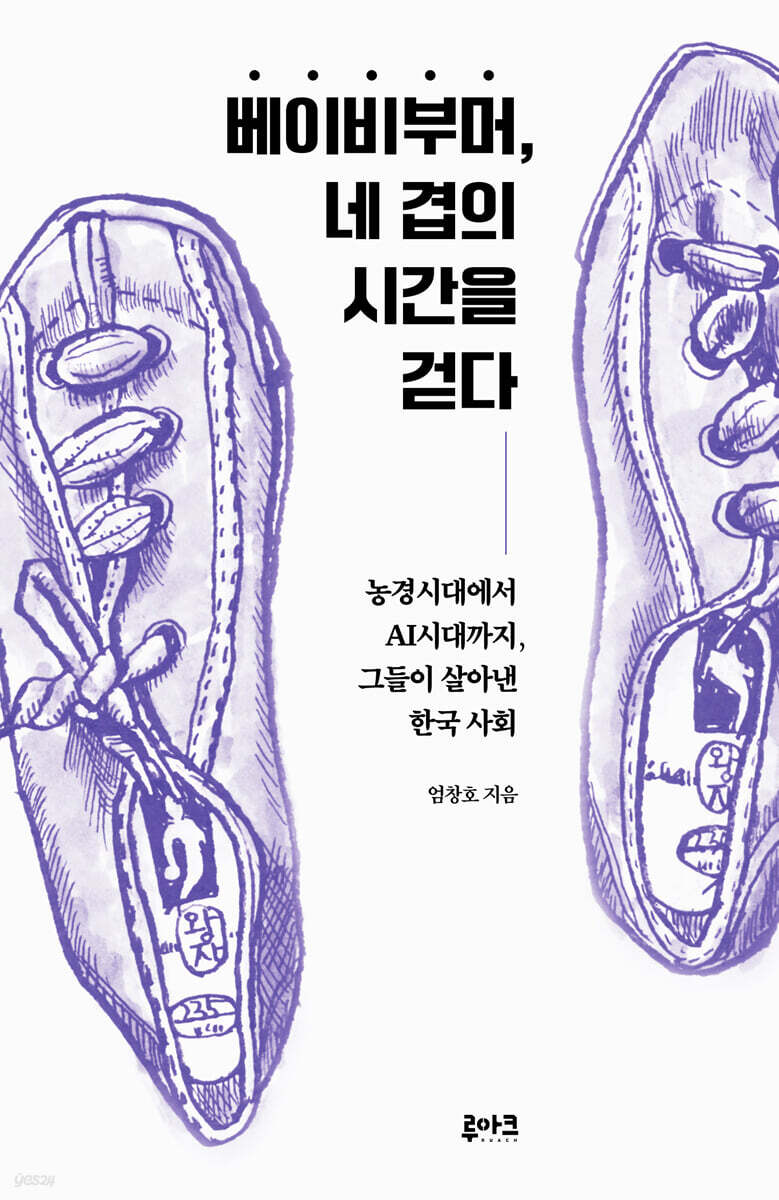
Baby Boomers, Walking Through Four Layers of Time
 |
Description
Book Introduction
A record of humanistic reflections that closely examine the past and present of Korean society.
The individual experiences of the baby boomer generation, who lived through the "four-fold time" of agriculture, industry, information technology, and AI, intertwined with the common experiences of the community, took on special social and historical significance.
Author Eom Chang-ho focuses on these common experiences and retraces scenes from life that transcend time, one by one.
From alleyways and school scenes, memories of poverty and labor, shifts in consumer culture, the fervor and frustration of democratization, to the daily lives transformed by technological innovation, the author's memories vividly capture the turning points of Korean society.
The book is a humanistic map that precisely examines the past and present of Korean society, and a record of reflection asking, “Where did we come from, and where are we going?” at the doorstep of the great change called AI.
The individual experiences of the baby boomer generation, who lived through the "four-fold time" of agriculture, industry, information technology, and AI, intertwined with the common experiences of the community, took on special social and historical significance.
Author Eom Chang-ho focuses on these common experiences and retraces scenes from life that transcend time, one by one.
From alleyways and school scenes, memories of poverty and labor, shifts in consumer culture, the fervor and frustration of democratization, to the daily lives transformed by technological innovation, the author's memories vividly capture the turning points of Korean society.
The book is a humanistic map that precisely examines the past and present of Korean society, and a record of reflection asking, “Where did we come from, and where are we going?” at the doorstep of the great change called AI.
- You can preview some of the book's contents.
Preview
index
At the beginning of the book
Chapter 1: A Seven-Year-Old Walker Meets Modernity - Memories of Place
A seven-year-old walker meets modern times
A social networking service called Hole Shop
Answer Me, Radioman
The problem is still 'one room on the ground'
The Shadow of the Success Story Created by Schools
Memories of the Alley, “We Didn’t Do That” and “It’s Never Gone.”
The history of the Dodol-i-pyo seen from the square
The story of a poor person
Chapter 2: The Sweet and Sour Taste of Privilege - A Memoir of Concepts
The bittersweet taste of privilege
The ability to work and the courage not to work
The origin of static annihilation, “Smash the thrush.”
The Specters of Totalitarianism Looming Behind 'Enlightenment'
The brand that raised me is Pal Hali
Breaking free from the magic of the number called GDP
Who was the test for, and what was the competition for?
Again, the faint shadow of an old love
The irony of 'well-being'
Crossing the River of Unmarriage
Chapter 3: Can "We" and "I" Meet? - A Human Memoir
Can 'we' and 'I' meet?
Memories of Giho's Neighbors Who Hurt When They Buy Land
The parameter called 'Kim Min-ki'
The Maid and Two Distorted Desires
Four Layers of Time, "TV Carries Love"
Song Hae, the man who became the best because he wasn't the best
The distance between 'seungmu' and 'nongmu'
Was “The Day the Sun Rises” a propaganda song of the Yushin regime?
The Unreachable Dream: The Benetton Advertising Story
A very personal memory about the origins of 'New Right'
Chapter 4: Where Has the Meaning of Cigarettes Gone? - Memories of Things
Where has the meaning of cigarettes disappeared?
My Used Book Disposal Machine
The Cartel of Dissertations and Twisted Desires
Briquettes, the first modern experience I felt with my own body
Does happiness really come by bicycle?
Do you trust the phone?
References
Chapter 1: A Seven-Year-Old Walker Meets Modernity - Memories of Place
A seven-year-old walker meets modern times
A social networking service called Hole Shop
Answer Me, Radioman
The problem is still 'one room on the ground'
The Shadow of the Success Story Created by Schools
Memories of the Alley, “We Didn’t Do That” and “It’s Never Gone.”
The history of the Dodol-i-pyo seen from the square
The story of a poor person
Chapter 2: The Sweet and Sour Taste of Privilege - A Memoir of Concepts
The bittersweet taste of privilege
The ability to work and the courage not to work
The origin of static annihilation, “Smash the thrush.”
The Specters of Totalitarianism Looming Behind 'Enlightenment'
The brand that raised me is Pal Hali
Breaking free from the magic of the number called GDP
Who was the test for, and what was the competition for?
Again, the faint shadow of an old love
The irony of 'well-being'
Crossing the River of Unmarriage
Chapter 3: Can "We" and "I" Meet? - A Human Memoir
Can 'we' and 'I' meet?
Memories of Giho's Neighbors Who Hurt When They Buy Land
The parameter called 'Kim Min-ki'
The Maid and Two Distorted Desires
Four Layers of Time, "TV Carries Love"
Song Hae, the man who became the best because he wasn't the best
The distance between 'seungmu' and 'nongmu'
Was “The Day the Sun Rises” a propaganda song of the Yushin regime?
The Unreachable Dream: The Benetton Advertising Story
A very personal memory about the origins of 'New Right'
Chapter 4: Where Has the Meaning of Cigarettes Gone? - Memories of Things
Where has the meaning of cigarettes disappeared?
My Used Book Disposal Machine
The Cartel of Dissertations and Twisted Desires
Briquettes, the first modern experience I felt with my own body
Does happiness really come by bicycle?
Do you trust the phone?
References
Detailed image
Into the book
Paris in the late 19th century, Gyeongseong in the 1930s, and a small provincial town in the late 1960s.
Although they are completely different times and places, strangely enough, these three spaces are placed side by side in my mind.
Paris in the late 19th century was the city where Walter Benjamin, who strolled leisurely and lost in deep thought, was forming the prototype.
In the 1930s, Gyeongseong was a place where novelist Park Tae-won wandered the streets under the name of 'Gubo', trying to find the meaning of the times.
And that small town in the late 1960s was where I first saw the world with a mixture of wonder and fear as a child.
Although seemingly different, these three cities share a common origin: the dawn of capitalism (i.e., modernity).
Rural communities collapsed, society became increasingly wealth-centered, and money and goods began to infiltrate people's daily lives.
Paris was the center where capitalism first blossomed, and Gyeongseong was a frontier that was forcibly modernized under the name of a colony.
In the 1960s, small Korean cities were places where state-led industrialization was slowly progressing.
--- From "A Seven-Year-Old Walker Meets Modernity"
Many people are taught that the greatest success is to study hard, go to Seoul National University Law School, pass the bar exam at Seoul National University Law School, become a judge, prosecutor, or member of the National Assembly, and ultimately live a life of luxury while amassing money and fame.
If it doesn't work out that way, many people consider it a small success to get something similar, or if that doesn't work out, to get to know someone through blood ties, regional ties, or school ties.
If neither of these is the case, there are many people who believe that blindly following or sympathizing with such 'successful people' is the way to live a life without failure.
It would not be an exaggeration to say that over the past several decades, our society has been dominated by "successful people" and their sympathizers.
We pride ourselves on being an advanced nation and a cultural powerhouse, but behind this lies a distorted success myth created by schools.
The academic elitism and meritocracy centered around Seoul Law School may have produced "successful individuals," but didn't they ultimately create a failed society? Could it be that the success myths created by schools have become a shackle for failure?
--- From "The Shadow of the Success Myth Created by School"
Let's go back to the classroom one day when I was in the 5th grade of elementary school, where the class president, who was my classmate, was checking homework.
As the class president's closest confidant, I was exempt from the homework obligations that should have applied to all my classmates, but what I briefly enjoyed was a special right, a privilege, that was available only to a select few.
What I learned in that classroom that day was that it is much freer to choose a life without privilege than to pursue it.
Since then, in my social life, I have never tried to enjoy privileges myself, nor have I tried to give privileges to anyone else.
This is partly because of the fear of the bitter consequences of privilege, but more importantly because I believed that a life without privilege was much freer.
--- From "The Sweet and Sour Taste of Privilege"
The alleys and empty lots where I used to play with my neighborhood friends as a child have been buried under brand-name apartments built by large corporations.
In the corner store where my mother used to go to buy tofu or soy sauce and chat for a long time, the same convenience store part-timers from all over the country are greeting customers with indifference.
The local electronics store that would fix your broken radio or record player without a second thought is long gone.
But can we truly say we're happier now, without alleyways, corner stores, or radio stations? What we need isn't more apartments, more consumption, or higher exports, but the conditions for a sustainable life where we care for one another. GDP may still be a useful indicator, but it shouldn't be the whole story.
True progress and happiness can never be measured by GDP figures.
--- From "Freeing Yourself from the Magic of the Number Called GDP"
It was one day, not long after I graduated from college, became a working adult, and started a family.
I came across a word that overturned the 'we' that had previously dominated much of my life.
It was 'me'.
“Even if I change a million times, I am myself, and I don’t think about reasons.” These words, which appeared in a fashion advertisement at the beginning of the 1990s, sounded like a majestic declaration that “my time” had arrived.
He said that 'we' cannot be like you and that there is no reason for us to be included in the group called 'us'.
There was not even the slightest chance of being considered as someone other than 'me'.
'I' was a high and solid sanctuary that no one could enter.
--- From "Can 'we' and 'I' meet?"
The desire of girls to rise from being poor farmers to becoming modern citizens, and the desire of urban middle-class women to recreate the hierarchy of class society and enjoy the status of nobles (yangban).
The former was a capitalist desire, but it was an ideal divorced from reality, and the latter was an anachronistic fantasy that remained a feudal remnant.
The profession or institution of maid was a deformed phenomenon that lasted about 30 years, born from the exquisite meeting of these two distorted desires.
This clearly captures the characteristics of South Korea, where industrialization (capitalization) has progressed rapidly.
Eventually, the profession or institution of housekeeper was destined to disappear as the two twisted desires each found their own outlet.
--- From "The Housekeeper and Two Distorted Desires"
Cigarettes were 'meaningful'.
This means that it was more than just a simple product or symbol, but rather something that had various meanings across time and culture.
Cigarettes were a rite of passage from boyhood to adulthood, and also a companion of thought and leisure.
Sometimes it was a medium of exchange and communication, and sometimes it was a companion in loneliness and worries.
Smokers enjoyed cigarettes, savoring these meanings in their own time and space.
But at some point, cigarettes began to be consumed only with negative images such as disease, decadence, uncivilization, and bad things.
Now, cigarettes remain only as an anti-civilization symbol.
This could be called a 'unipolar system in the sense of tobacco'.
With the media constantly emphasizing the negative connotations of smoking, I eventually quit.
I have given up cigarettes without any regrets, having been with me through all the ups and downs of life for over forty years since I learned them when I was a nineteen-year-old repeating a college entrance exam.
I've tried to quit smoking a couple of times in the past but failed, but I think I can succeed this time.
It's not just for health reasons.
Because I don't have the confidence to resist the 'unipolar system of tobacco meaning'.
--- From "Where Has the Meaning of Cigarettes Gone?"
The four conditions for disposing of used books mentioned above are preservation of cultural significance, public interest, convenience, and liquidity.
Unfortunately, among these, the only thing that has been clearly maintained is convenience.
Perhaps when the next disposal time comes, it will be difficult to even expect that.
“Everything solid melts into air, everything sacred becomes vulgar.” I ponder the meaning of these words spoken by Karl Marx some 150 years ago.
Anyway, after many twists and turns, my 80 or so books, which I had been wandering around without being able to find a way to dispose of, finally escaped my arms safely.
Farewell, friends who once embraced my passion.
May you meet a good master and enrich this world.
Although they are completely different times and places, strangely enough, these three spaces are placed side by side in my mind.
Paris in the late 19th century was the city where Walter Benjamin, who strolled leisurely and lost in deep thought, was forming the prototype.
In the 1930s, Gyeongseong was a place where novelist Park Tae-won wandered the streets under the name of 'Gubo', trying to find the meaning of the times.
And that small town in the late 1960s was where I first saw the world with a mixture of wonder and fear as a child.
Although seemingly different, these three cities share a common origin: the dawn of capitalism (i.e., modernity).
Rural communities collapsed, society became increasingly wealth-centered, and money and goods began to infiltrate people's daily lives.
Paris was the center where capitalism first blossomed, and Gyeongseong was a frontier that was forcibly modernized under the name of a colony.
In the 1960s, small Korean cities were places where state-led industrialization was slowly progressing.
--- From "A Seven-Year-Old Walker Meets Modernity"
Many people are taught that the greatest success is to study hard, go to Seoul National University Law School, pass the bar exam at Seoul National University Law School, become a judge, prosecutor, or member of the National Assembly, and ultimately live a life of luxury while amassing money and fame.
If it doesn't work out that way, many people consider it a small success to get something similar, or if that doesn't work out, to get to know someone through blood ties, regional ties, or school ties.
If neither of these is the case, there are many people who believe that blindly following or sympathizing with such 'successful people' is the way to live a life without failure.
It would not be an exaggeration to say that over the past several decades, our society has been dominated by "successful people" and their sympathizers.
We pride ourselves on being an advanced nation and a cultural powerhouse, but behind this lies a distorted success myth created by schools.
The academic elitism and meritocracy centered around Seoul Law School may have produced "successful individuals," but didn't they ultimately create a failed society? Could it be that the success myths created by schools have become a shackle for failure?
--- From "The Shadow of the Success Myth Created by School"
Let's go back to the classroom one day when I was in the 5th grade of elementary school, where the class president, who was my classmate, was checking homework.
As the class president's closest confidant, I was exempt from the homework obligations that should have applied to all my classmates, but what I briefly enjoyed was a special right, a privilege, that was available only to a select few.
What I learned in that classroom that day was that it is much freer to choose a life without privilege than to pursue it.
Since then, in my social life, I have never tried to enjoy privileges myself, nor have I tried to give privileges to anyone else.
This is partly because of the fear of the bitter consequences of privilege, but more importantly because I believed that a life without privilege was much freer.
--- From "The Sweet and Sour Taste of Privilege"
The alleys and empty lots where I used to play with my neighborhood friends as a child have been buried under brand-name apartments built by large corporations.
In the corner store where my mother used to go to buy tofu or soy sauce and chat for a long time, the same convenience store part-timers from all over the country are greeting customers with indifference.
The local electronics store that would fix your broken radio or record player without a second thought is long gone.
But can we truly say we're happier now, without alleyways, corner stores, or radio stations? What we need isn't more apartments, more consumption, or higher exports, but the conditions for a sustainable life where we care for one another. GDP may still be a useful indicator, but it shouldn't be the whole story.
True progress and happiness can never be measured by GDP figures.
--- From "Freeing Yourself from the Magic of the Number Called GDP"
It was one day, not long after I graduated from college, became a working adult, and started a family.
I came across a word that overturned the 'we' that had previously dominated much of my life.
It was 'me'.
“Even if I change a million times, I am myself, and I don’t think about reasons.” These words, which appeared in a fashion advertisement at the beginning of the 1990s, sounded like a majestic declaration that “my time” had arrived.
He said that 'we' cannot be like you and that there is no reason for us to be included in the group called 'us'.
There was not even the slightest chance of being considered as someone other than 'me'.
'I' was a high and solid sanctuary that no one could enter.
--- From "Can 'we' and 'I' meet?"
The desire of girls to rise from being poor farmers to becoming modern citizens, and the desire of urban middle-class women to recreate the hierarchy of class society and enjoy the status of nobles (yangban).
The former was a capitalist desire, but it was an ideal divorced from reality, and the latter was an anachronistic fantasy that remained a feudal remnant.
The profession or institution of maid was a deformed phenomenon that lasted about 30 years, born from the exquisite meeting of these two distorted desires.
This clearly captures the characteristics of South Korea, where industrialization (capitalization) has progressed rapidly.
Eventually, the profession or institution of housekeeper was destined to disappear as the two twisted desires each found their own outlet.
--- From "The Housekeeper and Two Distorted Desires"
Cigarettes were 'meaningful'.
This means that it was more than just a simple product or symbol, but rather something that had various meanings across time and culture.
Cigarettes were a rite of passage from boyhood to adulthood, and also a companion of thought and leisure.
Sometimes it was a medium of exchange and communication, and sometimes it was a companion in loneliness and worries.
Smokers enjoyed cigarettes, savoring these meanings in their own time and space.
But at some point, cigarettes began to be consumed only with negative images such as disease, decadence, uncivilization, and bad things.
Now, cigarettes remain only as an anti-civilization symbol.
This could be called a 'unipolar system in the sense of tobacco'.
With the media constantly emphasizing the negative connotations of smoking, I eventually quit.
I have given up cigarettes without any regrets, having been with me through all the ups and downs of life for over forty years since I learned them when I was a nineteen-year-old repeating a college entrance exam.
I've tried to quit smoking a couple of times in the past but failed, but I think I can succeed this time.
It's not just for health reasons.
Because I don't have the confidence to resist the 'unipolar system of tobacco meaning'.
--- From "Where Has the Meaning of Cigarettes Gone?"
The four conditions for disposing of used books mentioned above are preservation of cultural significance, public interest, convenience, and liquidity.
Unfortunately, among these, the only thing that has been clearly maintained is convenience.
Perhaps when the next disposal time comes, it will be difficult to even expect that.
“Everything solid melts into air, everything sacred becomes vulgar.” I ponder the meaning of these words spoken by Karl Marx some 150 years ago.
Anyway, after many twists and turns, my 80 or so books, which I had been wandering around without being able to find a way to dispose of, finally escaped my arms safely.
Farewell, friends who once embraced my passion.
May you meet a good master and enrich this world.
--- From "My Book Disposal Memoir"
Publisher's Review
How do times and an individual's life intersect?
As a first-hand experience for the baby boomer generation
Reading Today's Korean Society
The only generation that has witnessed the process of change by going through the so-called 'four-fold time' of the agricultural era, industrial era, information era, and AI era with their whole body is the 'baby boomer generation' (in Korea, the baby boomer generation refers to the generation born between 1955 and 1974, including the first and second generations).
This also means that the 60 years since the baby boomer generation passed have coincided with a major turning point in Korean society.
For this reason, their individual experiences intertwine with the common experiences of the community members and become 'special experiences' with significant social and historical significance.
Author Eom Chang-ho, a baby boomer, focuses on that common experience, the so-called 'original experience', and asks the question, 'How do the times and an individual's life intersect?'
It is believed that these common experiences have become an important foundation for today's Korean society.
He retraces scenes of life that span the ages through four windows: place, concept, person, and object.
These scenes go beyond the private memories of individuals; they are expressions of the times experienced by the community, and they are also signs of the times that capture and reveal the subtle cracks.
The author gives meaning to this series of processes as follows:
“Salmon swim upstream not to die, but to conceive new life.
In this book, I tried to look back into the past with the salmon's heart, and find clues to the present and the future within it."
The author's memories, including the alleys and school scenes of his childhood, memories of poverty and labor, the changes in consumer culture created by brands and advertising, the fervor and frustration of democratization, and the changes in daily life brought about by technological innovation, vividly depict important turning points in Korean society.
His memoirs are not a simple list of memories, but a process of exploration that provides clues to the future.
The author questions the belief that history progresses in a straight line.
The remnants of pre-modernity that persist beneath the guise of progress and innovation, the inequality that remains in the shadow of industrialization, and the signs of regression that appear simultaneously with the expansion of democracy—all show that the past is not a thing of the past, but rather a problem deeply embedded in today's reality.
He finds the same paradox of history that Charles Dickens captured in A Tale of Two Cities (a world where hope and despair, progress and regression coexist) in today's Korea.
Therefore, he emphasizes that looking back on the past is not a retrospective, but rather a task to prepare for the future, and a journey to find coordinates for crossing a new era.
The book is not just a record for the baby boomer generation.
The author seeks to find common ground for understanding across the generational gap.
In the midst of this whirlwind of radical change, I hope that past experiences will serve as an opportunity for the MZ generation to reflect on “what remains constant in the changing and what changes in the unchanging.”
Moreover, it calmly reveals the intersections of past and present, individual and society, tradition and future, leading both generations to look together at the conditions we face today and the challenges of tomorrow.
Korean society yesterday and today
A record of humanistic reflections, meticulously examined
This book is not simply a generational memoir.
This is a humanistic map that precisely observes the past and present of Korean society through the four windows that make up the layers of life (place, concept, person, and thing), and it is a record of thoughts asking, “Where did we come from and where are we going?” at the door of the great change called AI.
For baby boomers on the brink of retirement, it provides comfort and an opportunity for rediscovery, allowing them to reconnect with the times they have passed, and for the younger generation, it provides a new starting point for understanding the origins and structure of Korean society.
The answer to the previously posed question, "How do the times and an individual's life intersect?" will be revealed more deeply and clearly through this book.
As a first-hand experience for the baby boomer generation
Reading Today's Korean Society
The only generation that has witnessed the process of change by going through the so-called 'four-fold time' of the agricultural era, industrial era, information era, and AI era with their whole body is the 'baby boomer generation' (in Korea, the baby boomer generation refers to the generation born between 1955 and 1974, including the first and second generations).
This also means that the 60 years since the baby boomer generation passed have coincided with a major turning point in Korean society.
For this reason, their individual experiences intertwine with the common experiences of the community members and become 'special experiences' with significant social and historical significance.
Author Eom Chang-ho, a baby boomer, focuses on that common experience, the so-called 'original experience', and asks the question, 'How do the times and an individual's life intersect?'
It is believed that these common experiences have become an important foundation for today's Korean society.
He retraces scenes of life that span the ages through four windows: place, concept, person, and object.
These scenes go beyond the private memories of individuals; they are expressions of the times experienced by the community, and they are also signs of the times that capture and reveal the subtle cracks.
The author gives meaning to this series of processes as follows:
“Salmon swim upstream not to die, but to conceive new life.
In this book, I tried to look back into the past with the salmon's heart, and find clues to the present and the future within it."
The author's memories, including the alleys and school scenes of his childhood, memories of poverty and labor, the changes in consumer culture created by brands and advertising, the fervor and frustration of democratization, and the changes in daily life brought about by technological innovation, vividly depict important turning points in Korean society.
His memoirs are not a simple list of memories, but a process of exploration that provides clues to the future.
The author questions the belief that history progresses in a straight line.
The remnants of pre-modernity that persist beneath the guise of progress and innovation, the inequality that remains in the shadow of industrialization, and the signs of regression that appear simultaneously with the expansion of democracy—all show that the past is not a thing of the past, but rather a problem deeply embedded in today's reality.
He finds the same paradox of history that Charles Dickens captured in A Tale of Two Cities (a world where hope and despair, progress and regression coexist) in today's Korea.
Therefore, he emphasizes that looking back on the past is not a retrospective, but rather a task to prepare for the future, and a journey to find coordinates for crossing a new era.
The book is not just a record for the baby boomer generation.
The author seeks to find common ground for understanding across the generational gap.
In the midst of this whirlwind of radical change, I hope that past experiences will serve as an opportunity for the MZ generation to reflect on “what remains constant in the changing and what changes in the unchanging.”
Moreover, it calmly reveals the intersections of past and present, individual and society, tradition and future, leading both generations to look together at the conditions we face today and the challenges of tomorrow.
Korean society yesterday and today
A record of humanistic reflections, meticulously examined
This book is not simply a generational memoir.
This is a humanistic map that precisely observes the past and present of Korean society through the four windows that make up the layers of life (place, concept, person, and thing), and it is a record of thoughts asking, “Where did we come from and where are we going?” at the door of the great change called AI.
For baby boomers on the brink of retirement, it provides comfort and an opportunity for rediscovery, allowing them to reconnect with the times they have passed, and for the younger generation, it provides a new starting point for understanding the origins and structure of Korean society.
The answer to the previously posed question, "How do the times and an individual's life intersect?" will be revealed more deeply and clearly through this book.
GOODS SPECIFICS
- Date of issue: November 25, 2025
- Page count, weight, size: 288 pages | 338g | 130*200*18mm
- ISBN13: 9791194391296
- ISBN10: 119439129X
You may also like
카테고리
korean


korean

![GQ KOREA Mark (Monthly): December [2025]](http://librairie.coreenne.fr/cdn/shop/files/8ef265dbbfbf186523ed75ba7319009d.jpg?v=1765340328&width=3840)


