

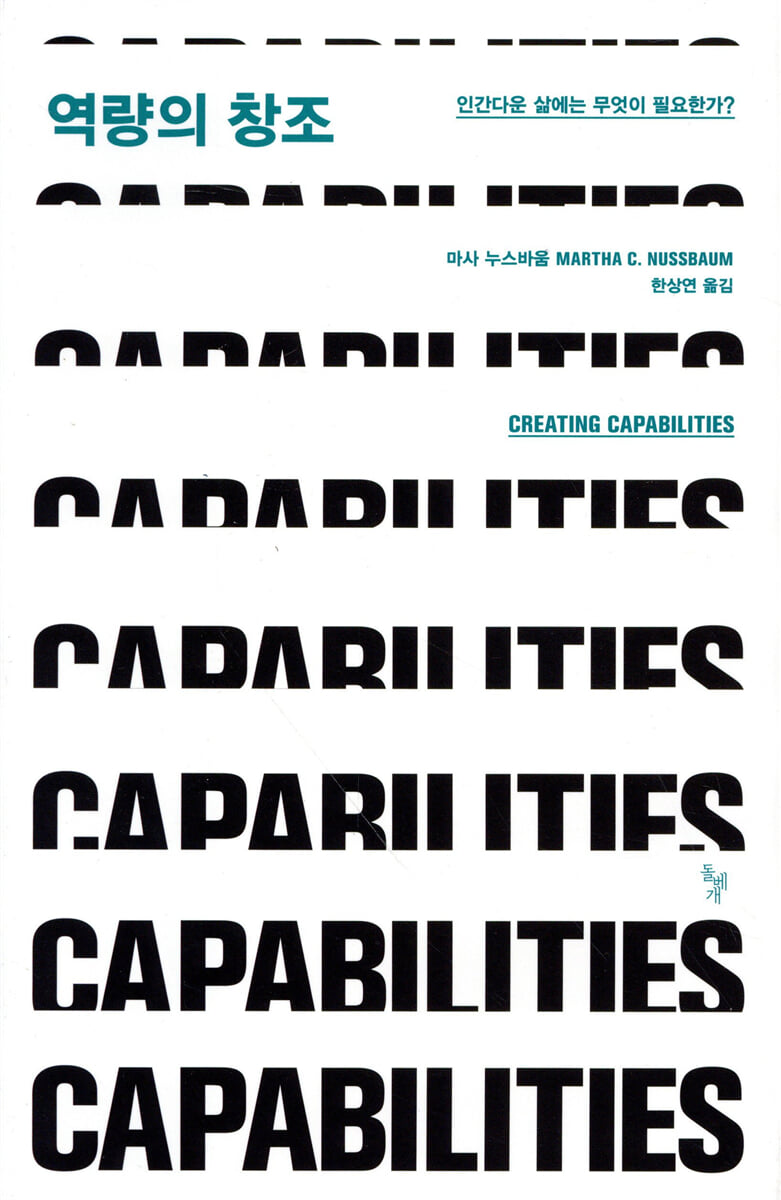
Creation of capabilities
 |
Description
Book Introduction
Ranked 22nd among the world's top 100 intellectuals (2005, 2008), and 22nd among the world's most influential thinkers in 2014
A new book by Martha Nussbaum, the intellectual of our time, is out!
What is needed to live a life that guarantees human dignity?
Nussbaum's proposed measure for a humane life: the competency approach
Martha Nussbaum, an influential intellectual of our time and a prolific writer whose work spans law, politics, philosophy, and literature, has published her book Creating Capabilities.
In this book, Nussbaum systematically organizes the 'capability theory' that she has been developing for over 20 years with Nobel Prize winners in economics, Amati and Sen, and boldly unfolds the essence of her own thought.
Since the 1990s, Nussbaum and Sen have been criticizing the mainstream theories of development economics and proposing the 'capability approach' as a counter-theory.
The capabilities approach is a theory that aims to realize social justice by comparing and evaluating the quality of life by focusing on individual happiness rather than economic growth.
Rather than remaining merely theoretical, it intervened in policies to address pressing real-world challenges, and to some extent, this has been recognized and is now exerting influence worldwide.
A new book by Martha Nussbaum, the intellectual of our time, is out!
What is needed to live a life that guarantees human dignity?
Nussbaum's proposed measure for a humane life: the competency approach
Martha Nussbaum, an influential intellectual of our time and a prolific writer whose work spans law, politics, philosophy, and literature, has published her book Creating Capabilities.
In this book, Nussbaum systematically organizes the 'capability theory' that she has been developing for over 20 years with Nobel Prize winners in economics, Amati and Sen, and boldly unfolds the essence of her own thought.
Since the 1990s, Nussbaum and Sen have been criticizing the mainstream theories of development economics and proposing the 'capability approach' as a counter-theory.
The capabilities approach is a theory that aims to realize social justice by comparing and evaluating the quality of life by focusing on individual happiness rather than economic growth.
Rather than remaining merely theoretical, it intervened in policies to address pressing real-world challenges, and to some extent, this has been recognized and is now exerting influence worldwide.
- You can preview some of the book's contents.
Preview
index
introduction
Chapter 1: A Woman Who Wants Justice
Being a Woman in India | Does GDP Really Measure Quality of Life?
Chapter 2 Core Competencies
Why the Competency Approach? | What is a Competency? | 10 Core Competencies | Tragic Choices and Ranking Competencies | Minimum Competency Levels | 'Productive Functions' and 'Toxic Weaknesses'
Chapter 3: Various Approaches
GDP Approach | Utilitarian Approach | Resource-Based Approach | Capabilities and Measurement Issues | Human Rights Approach
Chapter 4 Fundamental Rights
Freedom and Content | Political Justification | Need Welfare Under Perfect Information | Social Contract Theory: Rawls | Political Liberalism and Overlapping Agreements | Consequentialism and Deontology | Political Emotions and the Stability Problem | The Transition of Capabilities
Chapter 5 Cultural Diversity
The Relationship Between the Capabilities Approach and Human Rights | The Capabilities Approach and Cultural Pluralism
Chapter 6: States and International Justice
The State and the Capabilities Approach | Global Justice and the Capabilities Approach
Chapter 7: The Philosophical Roots of the Competency Approach
Aristotle and the Stoics | 17th and 18th Centuries: Natural Law Thought and Human Frailty | 19th and 20th Centuries: The Capabilities Approach Against Utilitarianism and Libertarianism
Chapter 8: Competence and Contemporary Issues
Socially vulnerable people | Gender | People with disabilities, the elderly, and the importance of care | Education | Animal rights | Environmental quality | Constitution and political structure | Capacity and human psychology
conclusion
How does Heckman view competence?
How does Sen view well-being and agency?
Postscript | Acknowledgments | Further Reading | References
Release: Exploring Inequality and Capability Approaches (Lee Yang-soo)
Search
Chapter 1: A Woman Who Wants Justice
Being a Woman in India | Does GDP Really Measure Quality of Life?
Chapter 2 Core Competencies
Why the Competency Approach? | What is a Competency? | 10 Core Competencies | Tragic Choices and Ranking Competencies | Minimum Competency Levels | 'Productive Functions' and 'Toxic Weaknesses'
Chapter 3: Various Approaches
GDP Approach | Utilitarian Approach | Resource-Based Approach | Capabilities and Measurement Issues | Human Rights Approach
Chapter 4 Fundamental Rights
Freedom and Content | Political Justification | Need Welfare Under Perfect Information | Social Contract Theory: Rawls | Political Liberalism and Overlapping Agreements | Consequentialism and Deontology | Political Emotions and the Stability Problem | The Transition of Capabilities
Chapter 5 Cultural Diversity
The Relationship Between the Capabilities Approach and Human Rights | The Capabilities Approach and Cultural Pluralism
Chapter 6: States and International Justice
The State and the Capabilities Approach | Global Justice and the Capabilities Approach
Chapter 7: The Philosophical Roots of the Competency Approach
Aristotle and the Stoics | 17th and 18th Centuries: Natural Law Thought and Human Frailty | 19th and 20th Centuries: The Capabilities Approach Against Utilitarianism and Libertarianism
Chapter 8: Competence and Contemporary Issues
Socially vulnerable people | Gender | People with disabilities, the elderly, and the importance of care | Education | Animal rights | Environmental quality | Constitution and political structure | Capacity and human psychology
conclusion
How does Heckman view competence?
How does Sen view well-being and agency?
Postscript | Acknowledgments | Further Reading | References
Release: Exploring Inequality and Capability Approaches (Lee Yang-soo)
Search
Publisher's Review
Ranked 22nd among the world's top 100 intellectuals (2005, 2008), and 22nd among the world's most influential thinkers in 2014
A new book by Martha Nussbaum, the intellectual of our time, is out!
What is needed to live a life that guarantees human dignity?
Nussbaum's proposed measure for a humane life: the competency approach
Martha Nussbaum, an influential intellectual of our time and a prolific writer whose work spans law, politics, philosophy, and literature, has published her book Creating Capabilities.
In this book, Nussbaum systematically organizes the 'capability theory' that she has been developing for over 20 years with Nobel Prize winners in economics, Amati and Sen, and boldly unfolds the essence of her own thought.
Since the 1990s, Nussbaum and Sen have been criticizing the mainstream theories of development economics and proposing the 'capability approach' as a counter-theory.
The capabilities approach is a theory that aims to realize social justice by comparing and evaluating the quality of life by focusing on individual happiness rather than economic growth.
Rather than remaining merely theoretical, it intervened in policies to address pressing real-world challenges, and to some extent, this has been recognized and is now exerting influence worldwide.
Readers interested in Nussbaum will have already heard of the core words of competency theory: 'competency,' 'competency approach,' 'human dignity,' 'justice,' and 'opportunity.'
For example, in 『Poetic Justice』, which was translated and published in Korea, the belief that literature can foster individual capabilities is embedded throughout the book, and in 『The Twilight of Emotions』, it is emphasized that laws and systems must be reformed to ultimately strengthen individual capabilities.
However, the competency theory that Nussbaum had been developing for a considerable period of time had not been fully introduced in Korea.
Nussbaum's 'capability' refers to a person's innate abilities and talents, as well as a set of opportunities to choose and act in political, social, and economic environments.
While we often use the term competence without distinction between ability and talent and limit it to the internal realm of an individual, Nussbaum expands the concept of competence to mean the state in which an individual and various social environments are connected.
And he says that we must use competency as a framework to compare the quality of each individual's life and find out what a human life is and what is needed to guarantee human dignity.
This process is also part of the search for social justice.
In this book, Nussbaum clearly explains the philosophical and political foundations of competency theory, as well as its core elements.
Therefore, it provides a readily usable framework for policymakers and researchers who want to analyze the level of national development and develop policies related to human development.
At the same time, it can serve as a useful guide for readers who wish to gain a deeper understanding of Nussbaum's overall thought, including her theory of justice.
A counter-theory that seeks social justice by focusing on the quality of life of each individual.
In Ahmedabad, a large city in the northwestern Indian state of Gujarat, lives a woman in her 30s named Vasanti.
Her ex-husband was a gambler and a drunkard.
Not only did he commit periodic violence, he also robbed Vasanti of the opportunity to have children by having her undergo a vasectomy in exchange for money paid to encourage birth control.
Vasanti, who could no longer maintain her marriage, went through a difficult process to obtain a divorce and returned to her parents' home, but her living conditions and financial situation were not good, making it difficult for her to stand on her own two feet.
Since getting married, I have lost all contact with my friends and have never received a proper education, so I am at a loss as to what I should do to make a living.
How will Vasanti live from now on?
"Creating Power" begins by telling the story of a woman named Vasanti living in India.
Nussbaum examines in detail the legal system, policies, and economic situation of the city where Vasanti lives, including her physical condition, nutritional status, her family's financial power and family relationships, her level of education, her political awareness, her emotional volatility, and how she spends her free time.
Throughout the book, the author asks what stands out most in Vasanti's life, explores the origins of her current situation and environment, how she differs from other women in India, and how she built a foundation for her life with the help of the NGO Self-Employed Women's Association (SEWA).
This deep focus and observation of a person raises fundamental questions that the competency approach poses.
These are the questions: "What can people actually do and become? What is needed to live a life that guarantees human dignity?"
This inevitably leads to complex answers that cannot be reduced to a single answer, and analyzing them in detail is precisely the essence of the competency approach.
Here, Nussbaum presents ten core competencies: 'life, physical health, physical integrity, sensation, imagination, thought, emotion, practical reason, relationships, non-human species, play, and environment' (pp. 48-50).
If even one or two of the ten competencies are not guaranteed at a minimum level, it is no different from not being guaranteed dignity.
There are many factors that make up the quality of human life, and the possibility of realizing social justice can be found when each capability is guaranteed at a minimum level or higher.
It is in this context that we can understand why Nussbaum said that the plural form 'competencies' is a more accurate expression than 'competencies'.
This approach of the capabilities approach corrects the flaws of existing dominant approaches such as the GDP approach and the utilitarian approach.
When a country's development is evaluated solely by the yardstick of economic growth, the alienation and suffering experienced by individuals can easily be ignored.
Inequality and deprivation are not properly captured.
The competency approach is a new counter-theory that seeks to overcome these limitations and realize justice by focusing on the individual.
Value choice and freedom, and guarantee opportunity and equality.
How can competence become a political goal?
Competency criticizes the method of quantifying and ranking a country's level of development and presents a new standard.
First, it is emphasized that it is necessary to distinguish between ‘combining capacity’ and ‘internal capacity.’
If combined capacity is “the sum total of opportunities to choose and act in specific political, social, and economic situations,” then intrinsic capacity refers to “a person’s state that is not fixed but fluid and dynamic.”
For example, many societies teach that there is freedom of speech on political issues, but in reality they suppress the press and prevent free expression of opinions.
In this case, the state fostered internal capabilities through education, but failed to support combined capabilities because it deprived people of freedom and opportunity.
This analytical framework allows for an intuitive diagnosis of a society's achievements and shortcomings.
Moreover, the competency approach values choice and freedom above all else and emphasizes what opportunities people can take advantage of.
At this time, choice and freedom belong solely to each individual.
Because everyone may or may not have access to opportunities and real freedom.
Nussbaum explains these principles of the capabilities approach by linking them to the political goals of the state.
It's easy to think that if citizens live healthy lives and do meaningful work, the government has done its part.
But Nussbaum says that is absolutely not the case.
The state should prioritize the capacity to improve health capacity over policies that can improve health as a political goal.
In other words, rather than developing one or two health-related policies and applying them to all citizens, we need a method that provides individuals with opportunities to improve their health through a process of free personal choice.
This logic of capabilities theory helps us question the role of the state and decide which policies to choose and implement.
Nussbaum's representative works, containing her ideological roots from Aristotle to Amartya Sen.
This book features several thinkers and books that influenced Nussbaum.
Beginning with ancient Greek and Roman philosophy, we encounter many thinkers who form the basis of Nussbaum's thought, including Smith, Kant, Mill, and Marx.
In particular, by focusing on Rawls's 'political liberalism' and Sen's research, it shows the connection with the theory of capabilities and attempts to overcome the limitations of these theories.
As mentioned earlier, Nussbaum has been working with Sen on the competency approach.
However, the two men have different views on competency theory.
For example, while Sen placed more emphasis on comprehensively assessing the quality of life through the concept of competency, Nussbaum attempts to assess whether a minimum level of social justice has been achieved based on a list of core competencies.
Moreover, while Sen was only interested in human capabilities, Nussbaum gives significant weight to the capabilities of animals as well as humans.
Nussbaum argues that the competency approach is not yet complete, despite systematizing theories that span both ancient and modern times.
It means accepting questions about the theory and embracing new perspectives.
It can be said that competency theory has the potential to expand and develop infinitely in the future.
We all live in developing countries
From public debate to legislation, what is needed for true progress?
Nussbaum's capabilities approach, while grounded in case studies from poor countries, needs to be expanded and embraced.
This is because the theory of capabilities can be applied to all countries, as all citizens of any country strive to live a life worthy of human dignity and value justice and equality.
Both poor and rich countries face the challenge of human development and must strive for a decent quality of life and a minimum level of social justice, so they can all be considered developing countries.
In fact, the capabilities approach is used to implement policies not only in developing countries but also in many international organizations concerned with welfare.
Since 1990, under the influence of the 『Human Development Report』 published annually by the United Nations Development Programme Secretariat, reports have been published that study various regions and groups within their countries using the capabilities approach. In France, the 『Sarkozy Commission Report』 was published, which addressed the issue of measuring economic growth and social development under the influence of the capabilities approach.
In the final eight chapters of this book, Nussbaum addresses key challenges facing modern society—gender, disability, elder care, and animal rights—and explores how the capabilities approach can play a role.
While discussing the utility and applicability of the theory, it also highlights the need for meaningful public discussion and legislation on capacity, using the constitutions of India and South Africa as examples.
However, he added that we must not forget that these attempts are only the minimum steps to guarantee a humane life for the people.
The competency approach, which guarantees the human dignity of each individual and seeks to realize social justice, will inevitably receive more attention both domestically and internationally as inequality worsens worldwide.
A new book by Martha Nussbaum, the intellectual of our time, is out!
What is needed to live a life that guarantees human dignity?
Nussbaum's proposed measure for a humane life: the competency approach
Martha Nussbaum, an influential intellectual of our time and a prolific writer whose work spans law, politics, philosophy, and literature, has published her book Creating Capabilities.
In this book, Nussbaum systematically organizes the 'capability theory' that she has been developing for over 20 years with Nobel Prize winners in economics, Amati and Sen, and boldly unfolds the essence of her own thought.
Since the 1990s, Nussbaum and Sen have been criticizing the mainstream theories of development economics and proposing the 'capability approach' as a counter-theory.
The capabilities approach is a theory that aims to realize social justice by comparing and evaluating the quality of life by focusing on individual happiness rather than economic growth.
Rather than remaining merely theoretical, it intervened in policies to address pressing real-world challenges, and to some extent, this has been recognized and is now exerting influence worldwide.
Readers interested in Nussbaum will have already heard of the core words of competency theory: 'competency,' 'competency approach,' 'human dignity,' 'justice,' and 'opportunity.'
For example, in 『Poetic Justice』, which was translated and published in Korea, the belief that literature can foster individual capabilities is embedded throughout the book, and in 『The Twilight of Emotions』, it is emphasized that laws and systems must be reformed to ultimately strengthen individual capabilities.
However, the competency theory that Nussbaum had been developing for a considerable period of time had not been fully introduced in Korea.
Nussbaum's 'capability' refers to a person's innate abilities and talents, as well as a set of opportunities to choose and act in political, social, and economic environments.
While we often use the term competence without distinction between ability and talent and limit it to the internal realm of an individual, Nussbaum expands the concept of competence to mean the state in which an individual and various social environments are connected.
And he says that we must use competency as a framework to compare the quality of each individual's life and find out what a human life is and what is needed to guarantee human dignity.
This process is also part of the search for social justice.
In this book, Nussbaum clearly explains the philosophical and political foundations of competency theory, as well as its core elements.
Therefore, it provides a readily usable framework for policymakers and researchers who want to analyze the level of national development and develop policies related to human development.
At the same time, it can serve as a useful guide for readers who wish to gain a deeper understanding of Nussbaum's overall thought, including her theory of justice.
A counter-theory that seeks social justice by focusing on the quality of life of each individual.
In Ahmedabad, a large city in the northwestern Indian state of Gujarat, lives a woman in her 30s named Vasanti.
Her ex-husband was a gambler and a drunkard.
Not only did he commit periodic violence, he also robbed Vasanti of the opportunity to have children by having her undergo a vasectomy in exchange for money paid to encourage birth control.
Vasanti, who could no longer maintain her marriage, went through a difficult process to obtain a divorce and returned to her parents' home, but her living conditions and financial situation were not good, making it difficult for her to stand on her own two feet.
Since getting married, I have lost all contact with my friends and have never received a proper education, so I am at a loss as to what I should do to make a living.
How will Vasanti live from now on?
"Creating Power" begins by telling the story of a woman named Vasanti living in India.
Nussbaum examines in detail the legal system, policies, and economic situation of the city where Vasanti lives, including her physical condition, nutritional status, her family's financial power and family relationships, her level of education, her political awareness, her emotional volatility, and how she spends her free time.
Throughout the book, the author asks what stands out most in Vasanti's life, explores the origins of her current situation and environment, how she differs from other women in India, and how she built a foundation for her life with the help of the NGO Self-Employed Women's Association (SEWA).
This deep focus and observation of a person raises fundamental questions that the competency approach poses.
These are the questions: "What can people actually do and become? What is needed to live a life that guarantees human dignity?"
This inevitably leads to complex answers that cannot be reduced to a single answer, and analyzing them in detail is precisely the essence of the competency approach.
Here, Nussbaum presents ten core competencies: 'life, physical health, physical integrity, sensation, imagination, thought, emotion, practical reason, relationships, non-human species, play, and environment' (pp. 48-50).
If even one or two of the ten competencies are not guaranteed at a minimum level, it is no different from not being guaranteed dignity.
There are many factors that make up the quality of human life, and the possibility of realizing social justice can be found when each capability is guaranteed at a minimum level or higher.
It is in this context that we can understand why Nussbaum said that the plural form 'competencies' is a more accurate expression than 'competencies'.
This approach of the capabilities approach corrects the flaws of existing dominant approaches such as the GDP approach and the utilitarian approach.
When a country's development is evaluated solely by the yardstick of economic growth, the alienation and suffering experienced by individuals can easily be ignored.
Inequality and deprivation are not properly captured.
The competency approach is a new counter-theory that seeks to overcome these limitations and realize justice by focusing on the individual.
Value choice and freedom, and guarantee opportunity and equality.
How can competence become a political goal?
Competency criticizes the method of quantifying and ranking a country's level of development and presents a new standard.
First, it is emphasized that it is necessary to distinguish between ‘combining capacity’ and ‘internal capacity.’
If combined capacity is “the sum total of opportunities to choose and act in specific political, social, and economic situations,” then intrinsic capacity refers to “a person’s state that is not fixed but fluid and dynamic.”
For example, many societies teach that there is freedom of speech on political issues, but in reality they suppress the press and prevent free expression of opinions.
In this case, the state fostered internal capabilities through education, but failed to support combined capabilities because it deprived people of freedom and opportunity.
This analytical framework allows for an intuitive diagnosis of a society's achievements and shortcomings.
Moreover, the competency approach values choice and freedom above all else and emphasizes what opportunities people can take advantage of.
At this time, choice and freedom belong solely to each individual.
Because everyone may or may not have access to opportunities and real freedom.
Nussbaum explains these principles of the capabilities approach by linking them to the political goals of the state.
It's easy to think that if citizens live healthy lives and do meaningful work, the government has done its part.
But Nussbaum says that is absolutely not the case.
The state should prioritize the capacity to improve health capacity over policies that can improve health as a political goal.
In other words, rather than developing one or two health-related policies and applying them to all citizens, we need a method that provides individuals with opportunities to improve their health through a process of free personal choice.
This logic of capabilities theory helps us question the role of the state and decide which policies to choose and implement.
Nussbaum's representative works, containing her ideological roots from Aristotle to Amartya Sen.
This book features several thinkers and books that influenced Nussbaum.
Beginning with ancient Greek and Roman philosophy, we encounter many thinkers who form the basis of Nussbaum's thought, including Smith, Kant, Mill, and Marx.
In particular, by focusing on Rawls's 'political liberalism' and Sen's research, it shows the connection with the theory of capabilities and attempts to overcome the limitations of these theories.
As mentioned earlier, Nussbaum has been working with Sen on the competency approach.
However, the two men have different views on competency theory.
For example, while Sen placed more emphasis on comprehensively assessing the quality of life through the concept of competency, Nussbaum attempts to assess whether a minimum level of social justice has been achieved based on a list of core competencies.
Moreover, while Sen was only interested in human capabilities, Nussbaum gives significant weight to the capabilities of animals as well as humans.
Nussbaum argues that the competency approach is not yet complete, despite systematizing theories that span both ancient and modern times.
It means accepting questions about the theory and embracing new perspectives.
It can be said that competency theory has the potential to expand and develop infinitely in the future.
We all live in developing countries
From public debate to legislation, what is needed for true progress?
Nussbaum's capabilities approach, while grounded in case studies from poor countries, needs to be expanded and embraced.
This is because the theory of capabilities can be applied to all countries, as all citizens of any country strive to live a life worthy of human dignity and value justice and equality.
Both poor and rich countries face the challenge of human development and must strive for a decent quality of life and a minimum level of social justice, so they can all be considered developing countries.
In fact, the capabilities approach is used to implement policies not only in developing countries but also in many international organizations concerned with welfare.
Since 1990, under the influence of the 『Human Development Report』 published annually by the United Nations Development Programme Secretariat, reports have been published that study various regions and groups within their countries using the capabilities approach. In France, the 『Sarkozy Commission Report』 was published, which addressed the issue of measuring economic growth and social development under the influence of the capabilities approach.
In the final eight chapters of this book, Nussbaum addresses key challenges facing modern society—gender, disability, elder care, and animal rights—and explores how the capabilities approach can play a role.
While discussing the utility and applicability of the theory, it also highlights the need for meaningful public discussion and legislation on capacity, using the constitutions of India and South Africa as examples.
However, he added that we must not forget that these attempts are only the minimum steps to guarantee a humane life for the people.
The competency approach, which guarantees the human dignity of each individual and seeks to realize social justice, will inevitably receive more attention both domestically and internationally as inequality worsens worldwide.
GOODS SPECIFICS
- Date of issue: December 4, 2015
- Page count, weight, size: 295 pages | 460g | 140*215*20mm
- ISBN13: 9788971996973
- ISBN10: 8971996978
You may also like
카테고리
korean


korean

![GQ KOREA Mark (Monthly): December [2025]](http://librairie.coreenne.fr/cdn/shop/files/8ef265dbbfbf186523ed75ba7319009d.jpg?v=1765340328&width=3840)


