

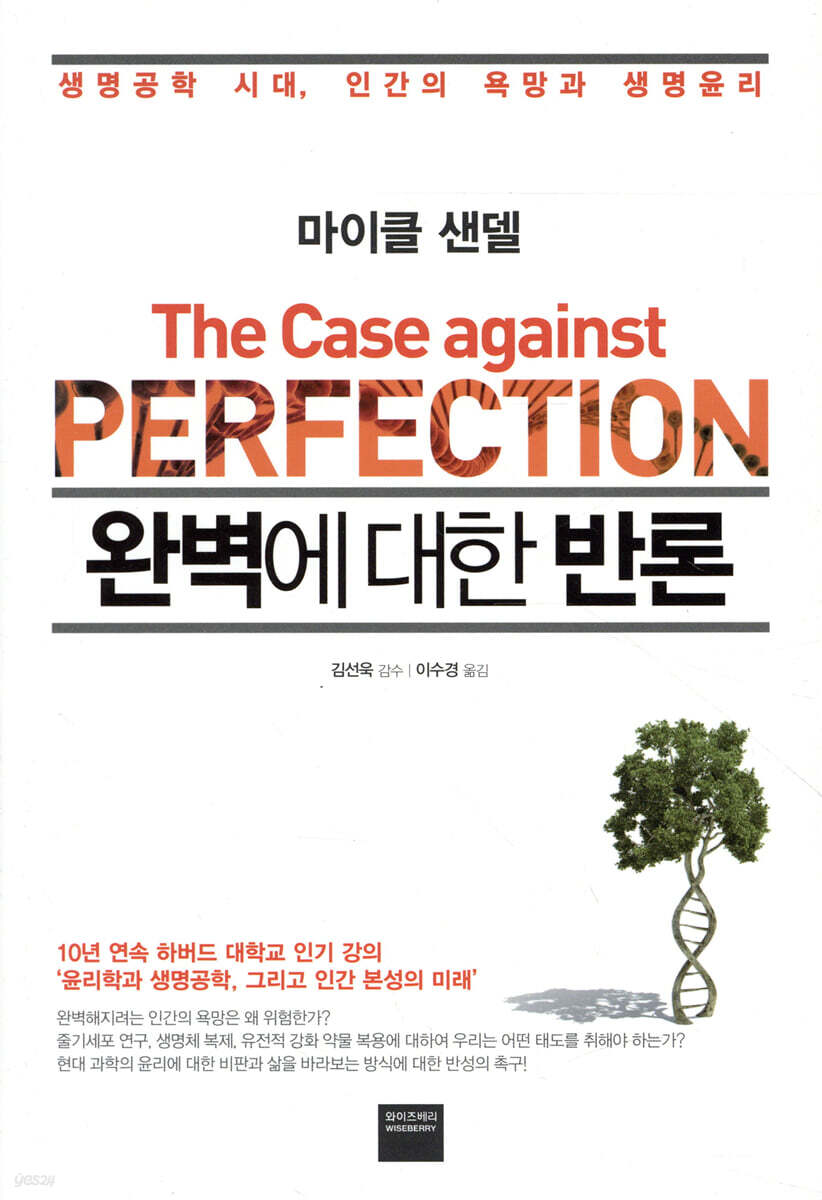
The Argument Against Perfection
 |
Description
Book Introduction
Why is the human desire for perfection dangerous?
Michael Sandel's New Ethics for the Biotechnology Era!
Harvard University's most popular lecture for 10 consecutive years: "Ethics, Biotechnology, and the Future of Human Nature."
In this era of rapidly developing life sciences, what ethical attitude should we have?
Through the power of biotechnology, humans have accelerated their quest for perfection, and have finally reached the threshold of the possibility of cloning humans.
Professor Michael Sandel, author of the bestselling books “Justice: What’s the Right Thing to Do?” and “What Money Can’t Buy,” says that advances in biotechnology bring both bright prospects and dark concerns.
The bright side is that it opens the way to treating and preventing the various diseases that plague humanity, while the dark side is that we may be able to manipulate our genetic makeup at will.
Sandel emphasizes that we can no longer postpone decisions about what ethical stance to take on the various issues of genetic engineering, including human cloning, the use of muscle, kidney, and memory-enhancing drugs, and stem cell research.
And by presenting various moral dilemmas surrounding bioethics, it urges moral judgment on whether it is right to redesign the origins of human life.
In this new era of life sciences, what are the proper values and virtues we should possess regarding life and living beings?
Sandel is George W.
From 2002, during the Bush administration, he served as a member of the U.S. Bioethics Commission for four years, advising the president on the ethical implications of advances in biomedical science and technology.
This book is the result of Sandel's continued research on the topic after the committee's work ended and the lectures he gave at Harvard University titled "Ethics, Biotechnology, and the Future of Human Nature."
In addition, this book is a new translation of the existing book titled “Speaking of the Ethics of Life,” and through a comprehensive review and commentary by Professor Kim Seon-wook of the Department of Philosophy at Soongsil University, we have tried to convey the original intention of Sandel’s book without distortion as much as possible.
Michael Sandel's New Ethics for the Biotechnology Era!
Harvard University's most popular lecture for 10 consecutive years: "Ethics, Biotechnology, and the Future of Human Nature."
In this era of rapidly developing life sciences, what ethical attitude should we have?
Through the power of biotechnology, humans have accelerated their quest for perfection, and have finally reached the threshold of the possibility of cloning humans.
Professor Michael Sandel, author of the bestselling books “Justice: What’s the Right Thing to Do?” and “What Money Can’t Buy,” says that advances in biotechnology bring both bright prospects and dark concerns.
The bright side is that it opens the way to treating and preventing the various diseases that plague humanity, while the dark side is that we may be able to manipulate our genetic makeup at will.
Sandel emphasizes that we can no longer postpone decisions about what ethical stance to take on the various issues of genetic engineering, including human cloning, the use of muscle, kidney, and memory-enhancing drugs, and stem cell research.
And by presenting various moral dilemmas surrounding bioethics, it urges moral judgment on whether it is right to redesign the origins of human life.
In this new era of life sciences, what are the proper values and virtues we should possess regarding life and living beings?
Sandel is George W.
From 2002, during the Bush administration, he served as a member of the U.S. Bioethics Commission for four years, advising the president on the ethical implications of advances in biomedical science and technology.
This book is the result of Sandel's continued research on the topic after the committee's work ended and the lectures he gave at Harvard University titled "Ethics, Biotechnology, and the Future of Human Nature."
In addition, this book is a new translation of the existing book titled “Speaking of the Ethics of Life,” and through a comprehensive review and commentary by Professor Kim Seon-wook of the Department of Philosophy at Soongsil University, we have tried to convey the original intention of Sandel’s book without distortion as much as possible.
- You can preview some of the book's contents.
Preview
index
introduction
1.
Ethics of Strengthening
Sources of Anxiety | Genetic Engineering
2.
bionic athlete
The Ideal of Sports: Effort or Talent? | Means of Enhancing Performance: High-Tech and Low-Tech | The Essence of Sports Competition
3.
Parents Designing Custom Babies
Fitting in and Watching Things Go | Pressure to Perform
4.
Eugenics Yesterday and Today
Eugenics of the Past | Free Market Eugenics | Liberal Eugenics
5.
Conquest and Gift
Humility, Responsibility, and Solidarity | Counterarguments to Counterarguments | Projects for Conquest
main
clear
Search
1.
Ethics of Strengthening
Sources of Anxiety | Genetic Engineering
2.
bionic athlete
The Ideal of Sports: Effort or Talent? | Means of Enhancing Performance: High-Tech and Low-Tech | The Essence of Sports Competition
3.
Parents Designing Custom Babies
Fitting in and Watching Things Go | Pressure to Perform
4.
Eugenics Yesterday and Today
Eugenics of the Past | Free Market Eugenics | Liberal Eugenics
5.
Conquest and Gift
Humility, Responsibility, and Solidarity | Counterarguments to Counterarguments | Projects for Conquest
main
clear
Search
Into the book
Breakthroughs in genetics offer both bright prospects and dark concerns.
Genetics offers a bright future in that it opens the way to treating or preventing various diseases that plague humans.
The concern is that new genetic knowledge could allow us to manipulate our natural state at will.
For example, it becomes possible to improve muscle strength, memory, and mood; to select genetic traits, including the gender and height of our children; to improve physical and cognitive abilities; and to achieve our "unparalleled best."
--- p.20
To grapple with this problem, we need to confront issues that are largely overlooked in modern society.
It is a question of the moral status of nature, of the appropriate attitude humanity should take in this given world.
Because such issues are almost entirely theological, modern philosophers and political scientists tend to avoid them.
But now that we have the new power of biotechnology, we can no longer ignore such problems.
--- p.24
I don't think the main problem with augmentation and genetic engineering is that it undermines human effort and agency.
What is even more dangerous is that such technologies represent a kind of excessive agency, a Promethean desire to reshape nature, including human nature, to serve our own purposes and desires.
The problem is not the mechanization of human beings, but the impulse to conquer nature and our own nature.
And such an attitude misses, and can even destroy, the perspective that human abilities and achievements are gifts given to each of us.
--- p.45
There is some truth to the argument that enhancing children's abilities with biotechnology is psychologically similar to today's parenting styles, which involve excessive intervention and supervision.
However, even if the two are similar, this does not constitute grounds for endorsing genetic manipulation of children.
Rather, it is a reason to question the parenting practices that we commonly accept, such as over-managing parents.
The over-parenting we often see today is a sign of a psychology that seeks to control and dominate excessively, while losing sight of the perspective of life as a gift.
This is also a disturbing sign that we are moving closer to eugenics.
--- p.80
Some believe that genetic enhancement weakens human responsibility by diminishing the meaning of effort and struggle.
But the real problem is not the weakening of accountability, but its amplification.
As humility disintegrates, responsibility expands to a tremendous level.
We increasingly place more weight on choice than on luck.
Parents are held responsible for choosing or not choosing the right genetic traits for their children.
Again, the responsibility for acquiring or failing to acquire talents that would help the team win falls on the athlete himself.
--- p.113
As the use of performance-enhancing drugs in professional sports becomes more frequent, the expectations athletes have of each other are subtly changing.
In the past, if a starting pitcher's team was struggling with scoring, it was taken lightly, blaming it on bad luck.
However, these days, the use of amphetamines and other stimulants has increased significantly, and players who compete without taking such drugs are sometimes criticized for “playing naked.”
--- p.115
Let's take insurance as an example.
(…) The insurance market is a space where solidarity emerges only when people are unaware of or unable to control the risk factors associated with illness or accident.
Let's assume that genetic testing technology has advanced to the point where it is now possible to reliably predict an individual's medical history and life expectancy.
People who are confident they will live long and healthy lives will be less likely to buy insurance, and those who are destined to be unhealthy will pay exorbitant premiums.
The solidarity aspect of insurance will disappear as people with good genes start leaving the insurance companies that people with bad genes belong to.
--- p.117
What I want to say is that the moral implications of the debate surrounding reinforcement cannot be adequately explained by familiar concepts like autonomy or rights, or by cost-benefit calculations alone.
My concern about reinforcement is not whether it is a personal vice or not, but rather a matter of habits of mind and a way of being.
--- p.123
Changing our nature to fit the world, rather than changing the world to fit our nature, is actually a loss of our power and autonomy.
This makes it difficult for us to think critically about the world and dulls our impulses toward political and social improvement.
Rather than trying to straighten the “crooked timber of humanity” using new genetic powers, we should strive to create social and political institutions that generously accept the talents and limitations of imperfect human beings.
--- p.124
Those who warn of slippery slope fallacies, embryo factories, and the commodification of eggs and embryos have valid concerns.
However, it is incorrect to assume that embryo research will inevitably lead to such risks.
Rather than outright banning embryonic stem cell research and cloning for research, such research should be permitted, with appropriate moral regulations in place to preserve the mystery of early human life.
(…) Only by taking this approach can we prevent the malicious exploitation of human life in its early stages, and ensure that advances in biomedicine become a blessing that promotes human health rather than an erosion of human sensibility.
Genetics offers a bright future in that it opens the way to treating or preventing various diseases that plague humans.
The concern is that new genetic knowledge could allow us to manipulate our natural state at will.
For example, it becomes possible to improve muscle strength, memory, and mood; to select genetic traits, including the gender and height of our children; to improve physical and cognitive abilities; and to achieve our "unparalleled best."
--- p.20
To grapple with this problem, we need to confront issues that are largely overlooked in modern society.
It is a question of the moral status of nature, of the appropriate attitude humanity should take in this given world.
Because such issues are almost entirely theological, modern philosophers and political scientists tend to avoid them.
But now that we have the new power of biotechnology, we can no longer ignore such problems.
--- p.24
I don't think the main problem with augmentation and genetic engineering is that it undermines human effort and agency.
What is even more dangerous is that such technologies represent a kind of excessive agency, a Promethean desire to reshape nature, including human nature, to serve our own purposes and desires.
The problem is not the mechanization of human beings, but the impulse to conquer nature and our own nature.
And such an attitude misses, and can even destroy, the perspective that human abilities and achievements are gifts given to each of us.
--- p.45
There is some truth to the argument that enhancing children's abilities with biotechnology is psychologically similar to today's parenting styles, which involve excessive intervention and supervision.
However, even if the two are similar, this does not constitute grounds for endorsing genetic manipulation of children.
Rather, it is a reason to question the parenting practices that we commonly accept, such as over-managing parents.
The over-parenting we often see today is a sign of a psychology that seeks to control and dominate excessively, while losing sight of the perspective of life as a gift.
This is also a disturbing sign that we are moving closer to eugenics.
--- p.80
Some believe that genetic enhancement weakens human responsibility by diminishing the meaning of effort and struggle.
But the real problem is not the weakening of accountability, but its amplification.
As humility disintegrates, responsibility expands to a tremendous level.
We increasingly place more weight on choice than on luck.
Parents are held responsible for choosing or not choosing the right genetic traits for their children.
Again, the responsibility for acquiring or failing to acquire talents that would help the team win falls on the athlete himself.
--- p.113
As the use of performance-enhancing drugs in professional sports becomes more frequent, the expectations athletes have of each other are subtly changing.
In the past, if a starting pitcher's team was struggling with scoring, it was taken lightly, blaming it on bad luck.
However, these days, the use of amphetamines and other stimulants has increased significantly, and players who compete without taking such drugs are sometimes criticized for “playing naked.”
--- p.115
Let's take insurance as an example.
(…) The insurance market is a space where solidarity emerges only when people are unaware of or unable to control the risk factors associated with illness or accident.
Let's assume that genetic testing technology has advanced to the point where it is now possible to reliably predict an individual's medical history and life expectancy.
People who are confident they will live long and healthy lives will be less likely to buy insurance, and those who are destined to be unhealthy will pay exorbitant premiums.
The solidarity aspect of insurance will disappear as people with good genes start leaving the insurance companies that people with bad genes belong to.
--- p.117
What I want to say is that the moral implications of the debate surrounding reinforcement cannot be adequately explained by familiar concepts like autonomy or rights, or by cost-benefit calculations alone.
My concern about reinforcement is not whether it is a personal vice or not, but rather a matter of habits of mind and a way of being.
--- p.123
Changing our nature to fit the world, rather than changing the world to fit our nature, is actually a loss of our power and autonomy.
This makes it difficult for us to think critically about the world and dulls our impulses toward political and social improvement.
Rather than trying to straighten the “crooked timber of humanity” using new genetic powers, we should strive to create social and political institutions that generously accept the talents and limitations of imperfect human beings.
--- p.124
Those who warn of slippery slope fallacies, embryo factories, and the commodification of eggs and embryos have valid concerns.
However, it is incorrect to assume that embryo research will inevitably lead to such risks.
Rather than outright banning embryonic stem cell research and cloning for research, such research should be permitted, with appropriate moral regulations in place to preserve the mystery of early human life.
(…) Only by taking this approach can we prevent the malicious exploitation of human life in its early stages, and ensure that advances in biomedicine become a blessing that promotes human health rather than an erosion of human sensibility.
--- p.158~159
Publisher's Review
Why is the human desire for perfection dangerous?
Michael Sandel's New Ethics for the Biotechnology Era!
Harvard University's most popular lecture for 10 consecutive years: "Ethics, Biotechnology, and the Future of Human Nature."
In this era of rapidly developing life sciences, what ethical attitude should we have?
In March 2016, there was a 'match of the century' between Lee Sedol and the artificial intelligence Go program AlphaGo.
The result was 4 wins and 1 loss.
It was an overwhelming victory for AlphaGo.
The media and the public both praised the dazzling pace of AI's development and feared the changes it would bring to our lives.
But it's not just artificial intelligence that's developing rapidly.
Advances in biotechnology are even more dramatic.
Less than 20 years after the birth of Dolly the cloned sheep, it was reported in May that 150 scientists gathered at Harvard Medical School in the United States to hold a secret meeting on human gene synthesis.
Human gene synthesis holds the potential for the creation of 'custom-made humans'.
While scientists attending the meeting claimed that it was a challenge to uncover the mystery of life, the New York Times pointed out that “it is problematic that a meeting that could lead to the creation of humans was held in secret,” and some scientists criticized that humans are trying to interfere in the creation of life, which is the realm of God, and the controversy is heated.
In this way, humans have accelerated their quest for perfection through the power of biotechnology, and have finally reached the threshold of the possibility of cloning humans.
Professor Michael Sandel, author of the bestselling books “Justice: What’s the Right Thing to Do?” and “What Money Can’t Buy,” says that advances in biotechnology bring both bright prospects and dark concerns.
The bright side is that it opens the way to treating and preventing the various diseases that plague humanity, while the dark side is that we may be able to manipulate our genetic makeup at will.
Sandel emphasizes that we can no longer postpone decisions about what ethical stance to take on the various issues of genetic engineering, including human cloning, the use of muscle, kidney, and memory-enhancing drugs, and stem cell research.
And by presenting various moral dilemmas surrounding bioethics, it urges moral judgment on whether it is right to redesign the origins of human life.
In this new era of life sciences, what are the proper values and virtues we should possess regarding life and living beings?
“To grapple with this problem, we need to confront issues that are largely overlooked in modern society.
It is a question of the moral status of nature, of the appropriate attitude humanity should take in this given world.
Because such issues are almost entirely theological, modern philosophers and political scientists tend to avoid them.
But now that we have the new power of biotechnology, we can no longer ignore such problems.” (From the text)
Sandel is George W.
From 2002, during the Bush administration, he served as a member of the U.S. Bioethics Commission for four years, advising the president on the ethical implications of advances in biomedical science and technology.
This book is the result of Sandel's continued research on the topic after the committee's work ended and the lectures he gave at Harvard University titled "Ethics, Biotechnology, and the Future of Human Nature."
In addition, this book is a new translation of the existing book titled “Speaking of the Ethics of Life,” and through a comprehensive review and commentary by Professor Kim Seon-wook of the Department of Philosophy at Soongsil University, we have tried to convey the original intention of Sandel’s book without distortion as much as possible.
Is the human desire to become perfect through the power of genetic engineering really right?
A fascinating philosophical debate on the moral challenges surrounding the new bioethics!
A couple who received eggs from a Harvard graduate to have a child with exceptional intelligence
Athletes who receive muscle-strengthening injections to improve performance
? A student who intentionally takes ADHD medication to improve concentration in preparation for the entrance exam.
The government encourages childbirth among highly educated women and sterilization among low-educated and low-income women.
Society is increasingly moving towards a winner-take-all, infinitely competitive society.
Eventually, humans began a dangerous voyage toward perfection, using the power of genetic engineering.
People get plastic surgery to look prettier, athletes take drugs to win, and students take stimulants to prepare for exams.
Is that all?
In order to have a child with 'good genes', sperm is donated from men who graduated from prestigious universities, and diseases such as dementia and diabetes are also prevented through the power of medical technology.
In this book, Sandel argues that advances in biotechnology offer both bright prospects and dark concerns.
The bright side is that it opens the way to treating and preventing the various diseases that plague humanity, while the dark side is that we may be able to manipulate our genetic makeup at will.
So what is the nature of the moral discomfort we feel about the use of certain biotechnology? Through his signature Socratic style, Sandel constantly challenges and questions the various bioethical issues we take for granted, forcing us to search for answers.
A deaf lesbian couple received sperm donation from a man from a family that has been deaf for five generations, in hopes of having a child with the same disability.
After this incident was reported, people around the world were very outraged that parents would intentionally cause a disability in their child.
Meanwhile, Harvard University's campus newspaper ran an ad seeking an egg donor who was "175 centimeters tall, with a fit body, no family history of infertility, and had an SAT score of 1400 or higher."
Although the ad didn't receive a huge public outcry, it's still morally objectionable.
What is the identity of this emotion?
Those who oppose genetic enhancement or cloning using biotechnology cite it as an "infringement on freedom of choice."
By pre-selecting the genetic makeup of their children, parents are depriving them of the right to shape their own future.
But Sandel counters that no one is born with a choice in their genetic makeup or abilities, and that this "autonomy" logic fails to explain the moral qualms about those who use these technologies to enhance their own abilities, rather than those of their children.
Let's take another example.
Several biotechnology companies are actively pursuing the development of cognitive enhancers that improve memory.
The drug straddles the line between "treatment" for patients with severe memory impairments like Alzheimer's and "enhancement" for middle-aged people experiencing natural memory decline, but it could also have entirely non-therapeutic uses.
For example, a lawyer who needs to memorize a lot of information while preparing for a trial, or an office worker who wants to learn Chinese in a hurry the night before leaving for a business trip to China.
Here, critics present a second rationale: 'fairness'.
In other words, if the general public is allowed to take memory-enhancing drugs, humans will be divided into two classes: the wealthy who have easy access to memory-enhancing drugs and those who do not.
Furthermore, if enhanced memory is inherited, humanity may eventually be divided into species with enhanced memories and those without.
However, Sandel counters that these criticisms are inconclusive, as technological advances could address this inequity by ensuring equal access to memory-enhancing drugs for all.
Sandel emphasizes that the important question to consider in the ethics of using genetic engineering is not whether autonomy and equality can be secured.
The question we must ask is, 'Should we really aspire to that technology?'
Do we want to live in a society where we use biotechnology to enhance our memory, make us taller, and make us better at sports, even though we are already healthy?
The era of biotechnology has entered a new phase.
What are the right values and virtues we should have?
Critics often say that genetic engineering threatens human dignity.
But how, and what aspects of human dignity are threatened?
What's notable about this book is that, unlike previous books that pose questions for readers to ponder and find their own answers, it clearly reveals Sandel's own views and positions.
Sandel argues that the reason we feel uncomfortable with some attempts to perfect ourselves through genetic engineering is because of an arrogance that seeks to conquer and control life and talent rather than to regard them as "gifts."
Parents manipulating their children's genes to obtain children with desired characteristics, or taking drugs to enhance memory while still young and healthy, are "Promethean desires" and "eugenic desires" to pursue perfection by recreating one's own nature.
In this regard, Sandel also takes a dig at overparenting and overly demanding parents who put pressure on their children to perform well.
Some parents are reportedly prescribing medications developed to treat attention-deficit hyperactivity disorder (ADHD) to their children, even if they have normal attention spans.
Taking these drugs “involves an attitude of trying to create a certain framework and transform oneself to fit it, rather than an attitude of seeing and accepting the world as it is.”
So what do we lose when biotechnology undermines our appreciation of life as a gift, and when an attitude of conquest overshadows an attitude of awe?
What Sandel is concerned about is the erosion of humility and responsibility.
If we do not acknowledge the randomness of innate talent, the realm of destiny will be replaced by the realm of choice and effort, reinforcing the perception that success depends solely on one's own abilities.
Therefore, people born with disadvantages will be seen as incompetent, unwilling, and unworthy, rather than as in need of consideration.
Some believe that genetic enhancement weakens human responsibility by diminishing the meaning of effort and struggle.
But the real problem is not the weakening of accountability, but its amplification.
As humility disintegrates, responsibility expands to a tremendous level.
We increasingly place more weight on choice than on luck.
Parents are held responsible for choosing or not choosing the right genetic traits for their children.
Again, the responsibility for acquiring or failing to acquire talents that would help the team win falls on the athlete himself.
(Page 113)
As the use of performance-enhancing drugs in professional sports becomes more frequent, the expectations athletes have of each other are subtly changing.
In the past, if a starting pitcher's team was struggling with scoring, it was taken lightly, blaming it on bad luck.
However, these days, the use of amphetamines and other stimulants has increased significantly, and players who compete without taking such drugs are sometimes criticized for “playing naked.”
(Page 115)
Paradoxically, the increased responsibility for one's own fate and that of one's children leads to a weakening of social solidarity.
The recognition that success is not solely the result of our own choices and efforts fosters a sense of solidarity, a sense that we have a duty to share the harvest of the market economy with those born with comparatively less talent.
But if we ignore the randomness of gifted talents, we risk falling into the false assumption that "success is a crown that only the virtuous and capable can wear, and that the rich are rich because they are more qualified than the poor."
Let's take insurance as an example.
(…) The insurance market is a space where solidarity emerges only when people are unaware of or unable to control the risk factors associated with illness or accident.
Let's assume that genetic testing technology has advanced to the point where it is now possible to reliably predict an individual's medical history and life expectancy.
People who are confident they will live long and healthy lives will be less likely to buy insurance, and those who are destined to be unhealthy will pay exorbitant premiums.
The solidarity aspect of insurance will disappear as people with good genes start leaving the insurance companies that people with bad genes belong to.
(Page 117)
While this book addresses ethical issues in various biotechnology technologies, the direction of our attitudes and perceptions that Sandel proposes extends beyond the field of biotechnology.
The questions and counterarguments he constantly raises prompt criticism and reflection on the ethical stances held by modern science, and further prompt us to ponder the answers to questions such as: what kind of society do we want to live in? What is the desirable attitude toward existence? What are the right mental habits for life?
As Sandel points out, because the pace of technological advancement is faster than the pace of advancement in moral understanding, we cannot clearly explain why some human attempts at genetic perfection are ethically unsettling.
"A Counterargument to Perfection" will serve as a guide to dispelling that moral dizziness.
Michael Sandel's New Ethics for the Biotechnology Era!
Harvard University's most popular lecture for 10 consecutive years: "Ethics, Biotechnology, and the Future of Human Nature."
In this era of rapidly developing life sciences, what ethical attitude should we have?
In March 2016, there was a 'match of the century' between Lee Sedol and the artificial intelligence Go program AlphaGo.
The result was 4 wins and 1 loss.
It was an overwhelming victory for AlphaGo.
The media and the public both praised the dazzling pace of AI's development and feared the changes it would bring to our lives.
But it's not just artificial intelligence that's developing rapidly.
Advances in biotechnology are even more dramatic.
Less than 20 years after the birth of Dolly the cloned sheep, it was reported in May that 150 scientists gathered at Harvard Medical School in the United States to hold a secret meeting on human gene synthesis.
Human gene synthesis holds the potential for the creation of 'custom-made humans'.
While scientists attending the meeting claimed that it was a challenge to uncover the mystery of life, the New York Times pointed out that “it is problematic that a meeting that could lead to the creation of humans was held in secret,” and some scientists criticized that humans are trying to interfere in the creation of life, which is the realm of God, and the controversy is heated.
In this way, humans have accelerated their quest for perfection through the power of biotechnology, and have finally reached the threshold of the possibility of cloning humans.
Professor Michael Sandel, author of the bestselling books “Justice: What’s the Right Thing to Do?” and “What Money Can’t Buy,” says that advances in biotechnology bring both bright prospects and dark concerns.
The bright side is that it opens the way to treating and preventing the various diseases that plague humanity, while the dark side is that we may be able to manipulate our genetic makeup at will.
Sandel emphasizes that we can no longer postpone decisions about what ethical stance to take on the various issues of genetic engineering, including human cloning, the use of muscle, kidney, and memory-enhancing drugs, and stem cell research.
And by presenting various moral dilemmas surrounding bioethics, it urges moral judgment on whether it is right to redesign the origins of human life.
In this new era of life sciences, what are the proper values and virtues we should possess regarding life and living beings?
“To grapple with this problem, we need to confront issues that are largely overlooked in modern society.
It is a question of the moral status of nature, of the appropriate attitude humanity should take in this given world.
Because such issues are almost entirely theological, modern philosophers and political scientists tend to avoid them.
But now that we have the new power of biotechnology, we can no longer ignore such problems.” (From the text)
Sandel is George W.
From 2002, during the Bush administration, he served as a member of the U.S. Bioethics Commission for four years, advising the president on the ethical implications of advances in biomedical science and technology.
This book is the result of Sandel's continued research on the topic after the committee's work ended and the lectures he gave at Harvard University titled "Ethics, Biotechnology, and the Future of Human Nature."
In addition, this book is a new translation of the existing book titled “Speaking of the Ethics of Life,” and through a comprehensive review and commentary by Professor Kim Seon-wook of the Department of Philosophy at Soongsil University, we have tried to convey the original intention of Sandel’s book without distortion as much as possible.
Is the human desire to become perfect through the power of genetic engineering really right?
A fascinating philosophical debate on the moral challenges surrounding the new bioethics!
A couple who received eggs from a Harvard graduate to have a child with exceptional intelligence
Athletes who receive muscle-strengthening injections to improve performance
? A student who intentionally takes ADHD medication to improve concentration in preparation for the entrance exam.
The government encourages childbirth among highly educated women and sterilization among low-educated and low-income women.
Society is increasingly moving towards a winner-take-all, infinitely competitive society.
Eventually, humans began a dangerous voyage toward perfection, using the power of genetic engineering.
People get plastic surgery to look prettier, athletes take drugs to win, and students take stimulants to prepare for exams.
Is that all?
In order to have a child with 'good genes', sperm is donated from men who graduated from prestigious universities, and diseases such as dementia and diabetes are also prevented through the power of medical technology.
In this book, Sandel argues that advances in biotechnology offer both bright prospects and dark concerns.
The bright side is that it opens the way to treating and preventing the various diseases that plague humanity, while the dark side is that we may be able to manipulate our genetic makeup at will.
So what is the nature of the moral discomfort we feel about the use of certain biotechnology? Through his signature Socratic style, Sandel constantly challenges and questions the various bioethical issues we take for granted, forcing us to search for answers.
A deaf lesbian couple received sperm donation from a man from a family that has been deaf for five generations, in hopes of having a child with the same disability.
After this incident was reported, people around the world were very outraged that parents would intentionally cause a disability in their child.
Meanwhile, Harvard University's campus newspaper ran an ad seeking an egg donor who was "175 centimeters tall, with a fit body, no family history of infertility, and had an SAT score of 1400 or higher."
Although the ad didn't receive a huge public outcry, it's still morally objectionable.
What is the identity of this emotion?
Those who oppose genetic enhancement or cloning using biotechnology cite it as an "infringement on freedom of choice."
By pre-selecting the genetic makeup of their children, parents are depriving them of the right to shape their own future.
But Sandel counters that no one is born with a choice in their genetic makeup or abilities, and that this "autonomy" logic fails to explain the moral qualms about those who use these technologies to enhance their own abilities, rather than those of their children.
Let's take another example.
Several biotechnology companies are actively pursuing the development of cognitive enhancers that improve memory.
The drug straddles the line between "treatment" for patients with severe memory impairments like Alzheimer's and "enhancement" for middle-aged people experiencing natural memory decline, but it could also have entirely non-therapeutic uses.
For example, a lawyer who needs to memorize a lot of information while preparing for a trial, or an office worker who wants to learn Chinese in a hurry the night before leaving for a business trip to China.
Here, critics present a second rationale: 'fairness'.
In other words, if the general public is allowed to take memory-enhancing drugs, humans will be divided into two classes: the wealthy who have easy access to memory-enhancing drugs and those who do not.
Furthermore, if enhanced memory is inherited, humanity may eventually be divided into species with enhanced memories and those without.
However, Sandel counters that these criticisms are inconclusive, as technological advances could address this inequity by ensuring equal access to memory-enhancing drugs for all.
Sandel emphasizes that the important question to consider in the ethics of using genetic engineering is not whether autonomy and equality can be secured.
The question we must ask is, 'Should we really aspire to that technology?'
Do we want to live in a society where we use biotechnology to enhance our memory, make us taller, and make us better at sports, even though we are already healthy?
The era of biotechnology has entered a new phase.
What are the right values and virtues we should have?
Critics often say that genetic engineering threatens human dignity.
But how, and what aspects of human dignity are threatened?
What's notable about this book is that, unlike previous books that pose questions for readers to ponder and find their own answers, it clearly reveals Sandel's own views and positions.
Sandel argues that the reason we feel uncomfortable with some attempts to perfect ourselves through genetic engineering is because of an arrogance that seeks to conquer and control life and talent rather than to regard them as "gifts."
Parents manipulating their children's genes to obtain children with desired characteristics, or taking drugs to enhance memory while still young and healthy, are "Promethean desires" and "eugenic desires" to pursue perfection by recreating one's own nature.
In this regard, Sandel also takes a dig at overparenting and overly demanding parents who put pressure on their children to perform well.
Some parents are reportedly prescribing medications developed to treat attention-deficit hyperactivity disorder (ADHD) to their children, even if they have normal attention spans.
Taking these drugs “involves an attitude of trying to create a certain framework and transform oneself to fit it, rather than an attitude of seeing and accepting the world as it is.”
So what do we lose when biotechnology undermines our appreciation of life as a gift, and when an attitude of conquest overshadows an attitude of awe?
What Sandel is concerned about is the erosion of humility and responsibility.
If we do not acknowledge the randomness of innate talent, the realm of destiny will be replaced by the realm of choice and effort, reinforcing the perception that success depends solely on one's own abilities.
Therefore, people born with disadvantages will be seen as incompetent, unwilling, and unworthy, rather than as in need of consideration.
Some believe that genetic enhancement weakens human responsibility by diminishing the meaning of effort and struggle.
But the real problem is not the weakening of accountability, but its amplification.
As humility disintegrates, responsibility expands to a tremendous level.
We increasingly place more weight on choice than on luck.
Parents are held responsible for choosing or not choosing the right genetic traits for their children.
Again, the responsibility for acquiring or failing to acquire talents that would help the team win falls on the athlete himself.
(Page 113)
As the use of performance-enhancing drugs in professional sports becomes more frequent, the expectations athletes have of each other are subtly changing.
In the past, if a starting pitcher's team was struggling with scoring, it was taken lightly, blaming it on bad luck.
However, these days, the use of amphetamines and other stimulants has increased significantly, and players who compete without taking such drugs are sometimes criticized for “playing naked.”
(Page 115)
Paradoxically, the increased responsibility for one's own fate and that of one's children leads to a weakening of social solidarity.
The recognition that success is not solely the result of our own choices and efforts fosters a sense of solidarity, a sense that we have a duty to share the harvest of the market economy with those born with comparatively less talent.
But if we ignore the randomness of gifted talents, we risk falling into the false assumption that "success is a crown that only the virtuous and capable can wear, and that the rich are rich because they are more qualified than the poor."
Let's take insurance as an example.
(…) The insurance market is a space where solidarity emerges only when people are unaware of or unable to control the risk factors associated with illness or accident.
Let's assume that genetic testing technology has advanced to the point where it is now possible to reliably predict an individual's medical history and life expectancy.
People who are confident they will live long and healthy lives will be less likely to buy insurance, and those who are destined to be unhealthy will pay exorbitant premiums.
The solidarity aspect of insurance will disappear as people with good genes start leaving the insurance companies that people with bad genes belong to.
(Page 117)
While this book addresses ethical issues in various biotechnology technologies, the direction of our attitudes and perceptions that Sandel proposes extends beyond the field of biotechnology.
The questions and counterarguments he constantly raises prompt criticism and reflection on the ethical stances held by modern science, and further prompt us to ponder the answers to questions such as: what kind of society do we want to live in? What is the desirable attitude toward existence? What are the right mental habits for life?
As Sandel points out, because the pace of technological advancement is faster than the pace of advancement in moral understanding, we cannot clearly explain why some human attempts at genetic perfection are ethically unsettling.
"A Counterargument to Perfection" will serve as a guide to dispelling that moral dizziness.
GOODS SPECIFICS
- Date of publication: June 27, 2016
- Page count, weight, size: 200 pages | 400g | 153*224*20mm
- ISBN13: 9788937838774
- ISBN10: 893783877X
You may also like
카테고리
korean


korean

![GQ KOREA Mark (Monthly): December [2025]](http://librairie.coreenne.fr/cdn/shop/files/8ef265dbbfbf186523ed75ba7319009d.jpg?v=1765340328&width=3840)


