

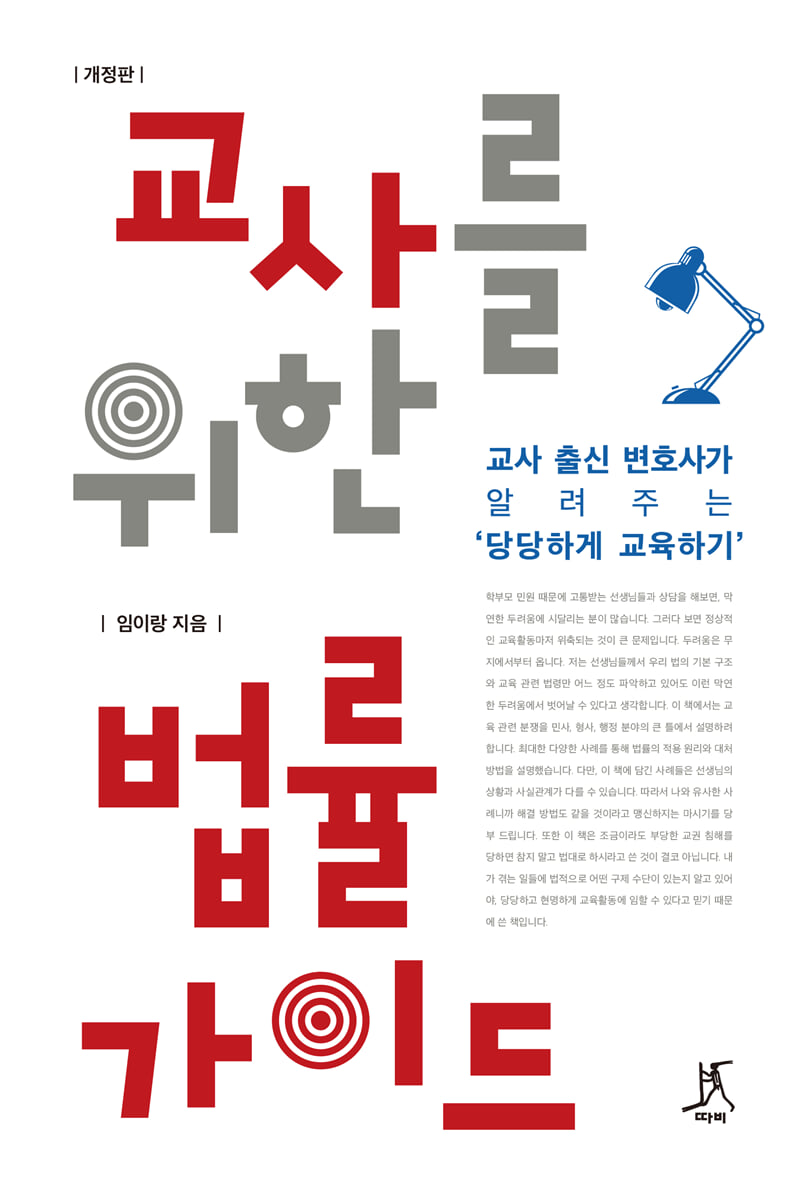
Legal Guide for Teachers
 |
Description
Book Introduction
“In this situation, the only thing I can say to teachers is, ‘Now, teachers must know the law and prepare in advance to avoid being treated unfairly.’
“Law is a very difficult and complex field, but I hope this small book will serve as a solid guide that brings comfort to teachers.”
When "Legal Guide for Teachers - 'Teaching with Confidence' from a Lawyer-Teacher" was published in 2021, the reactions from non-teacher readers were "No way!" and "Really?"
While there was surprise at the thought that teachers could really be pushed to such extremes, there was also suspicion that the case of Sarun in this book was an exaggeration of the conflict between some ignorant parents and irresponsible teachers.
The fact that what was covered in this book was actually an 'ordinary' case was revealed through testimonies and reports that broke out after the unfortunate incident involving a teacher at Seo-i Elementary School in 2023.
Afterwards, in a very unusual move in the political world, the ruling and opposition parties reached an agreement to revise the five laws protecting teachers' rights (the Basic Education Act, the Elementary and Secondary Education Act, the Early Childhood Education Act, the Teachers' Status Act, and the Child Abuse Punishment Act), and the Ministry of Education issued the 'Notice on Teachers' Guidance on Student Life' and prepared various measures to protect teachers' educational activities.
Reflecting these changes, the revised edition of "Legal Guide for Teachers - 'Teaching with Confidence' from a former teacher and lawyer" was published.
“Law is a very difficult and complex field, but I hope this small book will serve as a solid guide that brings comfort to teachers.”
When "Legal Guide for Teachers - 'Teaching with Confidence' from a Lawyer-Teacher" was published in 2021, the reactions from non-teacher readers were "No way!" and "Really?"
While there was surprise at the thought that teachers could really be pushed to such extremes, there was also suspicion that the case of Sarun in this book was an exaggeration of the conflict between some ignorant parents and irresponsible teachers.
The fact that what was covered in this book was actually an 'ordinary' case was revealed through testimonies and reports that broke out after the unfortunate incident involving a teacher at Seo-i Elementary School in 2023.
Afterwards, in a very unusual move in the political world, the ruling and opposition parties reached an agreement to revise the five laws protecting teachers' rights (the Basic Education Act, the Elementary and Secondary Education Act, the Early Childhood Education Act, the Teachers' Status Act, and the Child Abuse Punishment Act), and the Ministry of Education issued the 'Notice on Teachers' Guidance on Student Life' and prepared various measures to protect teachers' educational activities.
Reflecting these changes, the revised edition of "Legal Guide for Teachers - 'Teaching with Confidence' from a former teacher and lawyer" was published.
- You can preview some of the book's contents.
Preview
index
Revised edition 4
Publishing a book 6
Part 1: The teacher is wronged
Chapter 1: Criminal Charges a Teacher May Face 16
01 Child Abuse 18
Suffering from too long litigation period 21
Getting sued for something trivial 31
02 Child Sexual Harassment, Sexual Assault 36
Are comments about appearance sexual harassment? 40
If encouraging a student is accused of sexual harassment, 42
03 Complaints/Indictments Related to School Violence 46
50 When it is reported that the parents of the victimized student were informed of the perpetrator's actions
54 When a school violence investigation report was accused of being fabricated
Chapter 2 Civil Litigation Against Teachers 60
01 Compensation for damages resulting from school safety accidents 62
Accidents that Occurred During Scientific Experiments 64
68 accidents involving school facilities
Accident during physical education class 71
74 accidents that occurred outside of school, such as during school trips or field trips
76 accidents that occurred outside of class hours
Teacher Responsibility for School Safety Accidents 79
02 Compensation for damages resulting from school violence 81
84 When a student committed suicide due to bullying
03 Compensation for damages under criminal liability 88
Even if the indictment is suspended, when civil damages are to be paid, 89
Chapter 3 Administrative Litigation Teachers May Face 94
01 Administrative Litigation Related to School Violence 96
Case 105 where a disposition was cancelled due to procedural defects
Case 108 where a disposition was cancelled due to a defect in the content
02 Administrative Litigation to Avoid Student Disadvantages 111
Administrative litigation related to student discipline_
Case 112: Schools' inadequate response prevented students from being properly disciplined.
Administrative litigation related to information disclosure requests 1_
Case 117: Requesting Disclosure of Information to Harass Schools
Administrative litigation related to information disclosure requests 2_
120 Cases of Requesting Freedom of Information to Identify School Mistakes
Dispute over correction of school records 1_
Case 123: Request for correction of negative evaluation written by teacher
Dispute over correction of school records 2_
Case 127: Correction of school records due to acknowledgement of school error
Part 2: The teacher is afraid
Chapter 4: Violations of Teachers' Rights by Students 132
134 When a student swears at a teacher
139 When a student assaulted a teacher
146 When a student tries to harm a teacher
149 When a student swears when alone with the teacher
155 When a student sexually harasses a teacher
Chapter 5: Violations of Teachers' Rights by Parents 160
Case 162: Parents Unilaterally Assault a Teacher
164 Cases of Teachers' Disparaging Comments in Parents' Group Chats
166 When Parents Use Abuse Online
168 When trying to harass a teacher by reporting false facts
Part 3 Teacher is frustrated
Chapter 6: Teachers' Rights: Frustrating Due to Lack of Knowledge 176
Disciplinary Action: Non-Work-Related Traffic Accident 178
Complaints_Recognition of Degrees Obtained During Companion Leave 188
Work-related accidents: Traffic accidents on the way to work 193
Chapter 7: Schools are also small societies 198
200 Criminal Cases Between Teachers
Conflict with Manager 202
Cancellation of appointments at private schools 207
Essential School Life Laws: Part 4 Q&A
Can teachers become YouTubers? 212
How far should I go in responding to parental contact? 216
Kim Young-ran Act: How far should we be cautious? 218
A child with a food allergy wants to eat school meals 228
How can the Teachers' Rights Protection Committee help? 231
What evidence can be used in a dispute? 244
How can I provide guidance without being accused of child abuse? 250
Appendix 1.
When seeking legal assistance, 256
Appendix 2.
258 Sites to Consider
Publishing a book 6
Part 1: The teacher is wronged
Chapter 1: Criminal Charges a Teacher May Face 16
01 Child Abuse 18
Suffering from too long litigation period 21
Getting sued for something trivial 31
02 Child Sexual Harassment, Sexual Assault 36
Are comments about appearance sexual harassment? 40
If encouraging a student is accused of sexual harassment, 42
03 Complaints/Indictments Related to School Violence 46
50 When it is reported that the parents of the victimized student were informed of the perpetrator's actions
54 When a school violence investigation report was accused of being fabricated
Chapter 2 Civil Litigation Against Teachers 60
01 Compensation for damages resulting from school safety accidents 62
Accidents that Occurred During Scientific Experiments 64
68 accidents involving school facilities
Accident during physical education class 71
74 accidents that occurred outside of school, such as during school trips or field trips
76 accidents that occurred outside of class hours
Teacher Responsibility for School Safety Accidents 79
02 Compensation for damages resulting from school violence 81
84 When a student committed suicide due to bullying
03 Compensation for damages under criminal liability 88
Even if the indictment is suspended, when civil damages are to be paid, 89
Chapter 3 Administrative Litigation Teachers May Face 94
01 Administrative Litigation Related to School Violence 96
Case 105 where a disposition was cancelled due to procedural defects
Case 108 where a disposition was cancelled due to a defect in the content
02 Administrative Litigation to Avoid Student Disadvantages 111
Administrative litigation related to student discipline_
Case 112: Schools' inadequate response prevented students from being properly disciplined.
Administrative litigation related to information disclosure requests 1_
Case 117: Requesting Disclosure of Information to Harass Schools
Administrative litigation related to information disclosure requests 2_
120 Cases of Requesting Freedom of Information to Identify School Mistakes
Dispute over correction of school records 1_
Case 123: Request for correction of negative evaluation written by teacher
Dispute over correction of school records 2_
Case 127: Correction of school records due to acknowledgement of school error
Part 2: The teacher is afraid
Chapter 4: Violations of Teachers' Rights by Students 132
134 When a student swears at a teacher
139 When a student assaulted a teacher
146 When a student tries to harm a teacher
149 When a student swears when alone with the teacher
155 When a student sexually harasses a teacher
Chapter 5: Violations of Teachers' Rights by Parents 160
Case 162: Parents Unilaterally Assault a Teacher
164 Cases of Teachers' Disparaging Comments in Parents' Group Chats
166 When Parents Use Abuse Online
168 When trying to harass a teacher by reporting false facts
Part 3 Teacher is frustrated
Chapter 6: Teachers' Rights: Frustrating Due to Lack of Knowledge 176
Disciplinary Action: Non-Work-Related Traffic Accident 178
Complaints_Recognition of Degrees Obtained During Companion Leave 188
Work-related accidents: Traffic accidents on the way to work 193
Chapter 7: Schools are also small societies 198
200 Criminal Cases Between Teachers
Conflict with Manager 202
Cancellation of appointments at private schools 207
Essential School Life Laws: Part 4 Q&A
Can teachers become YouTubers? 212
How far should I go in responding to parental contact? 216
Kim Young-ran Act: How far should we be cautious? 218
A child with a food allergy wants to eat school meals 228
How can the Teachers' Rights Protection Committee help? 231
What evidence can be used in a dispute? 244
How can I provide guidance without being accused of child abuse? 250
Appendix 1.
When seeking legal assistance, 256
Appendix 2.
258 Sites to Consider
Into the book
Unlike general criminal cases, criminal complaints against teachers present a significant challenge in that the "complainant" is someone who was not present at the scene of the incident.
What this means is that parents file complaints or accusations based on information they have received from their children, even though they did not directly experience or witness the problematic situation.
--- p.16
People around me don't know anything about the law.
People often post legal advice on online communities, which is a very dangerous practice.
This applies whether it's a general community or a community of teachers.
It's so often the case that what principals and other administrators say is untrue, so I strongly urge you to seek legal advice from a legal professional.
--- p.34
Unlike criminal proceedings, civil litigation is difficult because the teacher is a party to the lawsuit and directly fights the case.
Especially when the other party hires a lawyer to file a lawsuit, it is not easy to go to court alone and argue your case.
Because the 'principle of advocacy' applies to civil litigation, it is particularly difficult for the parties to file a lawsuit directly.
--- p.60~61
In particular, as parents' awareness of their rights increases, there is a sharp increase in cases where even student disciplinary actions based on teachers' legitimate guidance are being challenged through administrative litigation.
If teachers lose this lawsuit, they will inevitably lose the driving force behind guiding students.
--- p.95
If disciplinary action must be suspended every time a student files an administrative appeal or lawsuit, it means that the school must turn a blind eye to student guidance during the litigation period, which can last from six months to over a year.
If you graduate in the meantime, as in the above case, disciplinary action will become impossible.
--- p.115
It's not well known, but there are surprisingly many teachers who are assaulted by students.
There are many cases where the teachers who suffered damage do not want the matter to be known to the public, so they just end up taking sick leave.
--- p.140
However, if the party responsible for the violation of educational rights is a parent, the story is different.
I think we just need to follow the established procedures as humans.
The Teachers' Rights Protection Committee can be established not only when teachers' rights are violated by students, but also when teachers' rights are violated by parents.
The problem is that there is little practical benefit to it.
For parental actions such as assault or injury, it is effective to file a criminal complaint.
--- p.160
Article 19 of the Teachers' Status Act reads as if it imposes a 'time limit' on acts committed against 'teachers engaged in educational activities.'
In this case, the vice principal's statement that the defamatory message posted by the parent on social media at 10 p.m. was not an infringement on educational activities seems to have originated from this thinking.
--- p.243
Let me give you an example.
A teacher has been accused of child abuse, with parents alleging the teacher assaulted a child with a xylophone during second period on October 5, 2020.
If the teacher's notebook contains a detailed record of the class content or special events that occurred at the time, it can be argued that there were no xylophone sticks in the classroom because all xylophones used at the time had already been returned to the music room.
What this means is that parents file complaints or accusations based on information they have received from their children, even though they did not directly experience or witness the problematic situation.
--- p.16
People around me don't know anything about the law.
People often post legal advice on online communities, which is a very dangerous practice.
This applies whether it's a general community or a community of teachers.
It's so often the case that what principals and other administrators say is untrue, so I strongly urge you to seek legal advice from a legal professional.
--- p.34
Unlike criminal proceedings, civil litigation is difficult because the teacher is a party to the lawsuit and directly fights the case.
Especially when the other party hires a lawyer to file a lawsuit, it is not easy to go to court alone and argue your case.
Because the 'principle of advocacy' applies to civil litigation, it is particularly difficult for the parties to file a lawsuit directly.
--- p.60~61
In particular, as parents' awareness of their rights increases, there is a sharp increase in cases where even student disciplinary actions based on teachers' legitimate guidance are being challenged through administrative litigation.
If teachers lose this lawsuit, they will inevitably lose the driving force behind guiding students.
--- p.95
If disciplinary action must be suspended every time a student files an administrative appeal or lawsuit, it means that the school must turn a blind eye to student guidance during the litigation period, which can last from six months to over a year.
If you graduate in the meantime, as in the above case, disciplinary action will become impossible.
--- p.115
It's not well known, but there are surprisingly many teachers who are assaulted by students.
There are many cases where the teachers who suffered damage do not want the matter to be known to the public, so they just end up taking sick leave.
--- p.140
However, if the party responsible for the violation of educational rights is a parent, the story is different.
I think we just need to follow the established procedures as humans.
The Teachers' Rights Protection Committee can be established not only when teachers' rights are violated by students, but also when teachers' rights are violated by parents.
The problem is that there is little practical benefit to it.
For parental actions such as assault or injury, it is effective to file a criminal complaint.
--- p.160
Article 19 of the Teachers' Status Act reads as if it imposes a 'time limit' on acts committed against 'teachers engaged in educational activities.'
In this case, the vice principal's statement that the defamatory message posted by the parent on social media at 10 p.m. was not an infringement on educational activities seems to have originated from this thinking.
--- p.243
Let me give you an example.
A teacher has been accused of child abuse, with parents alleging the teacher assaulted a child with a xylophone during second period on October 5, 2020.
If the teacher's notebook contains a detailed record of the class content or special events that occurred at the time, it can be argued that there were no xylophone sticks in the classroom because all xylophones used at the time had already been returned to the music room.
--- p.245~246
Publisher's Review
How to protect teachers who are still being forced out
The reality of the decline of teachers' authority is not that students disregard school teachers more than private tutors or that they trust the knowledge imparted by YouTubers more than the content of teachers' classes.
Unfortunately, teachers are exposed to insults and sexual harassment from students, as well as lawsuits, accusations, and assault from parents.
It is welcome that students and parents are becoming more aware of their rights and have easier access to legal services.
However, if 'normal' educational activities are discouraged by the excessive 'I'm suing you!', it cannot be said that the damage is only felt by teachers.
The author points out that despite revised laws and the Ministry of Education's measures following the unfortunate events of 2023, the anxiety felt by teachers in schools has not been significantly alleviated.
The author, a former teacher and former lawyer, emphasizes that teachers need to know the law to avoid the fear caused by excessive complaints and excessive lawsuits and accusations from parents.
This means that even though teachers have not done anything wrong, they can avoid being dragged around by unreasonable demands from parents due to vague thoughts such as, "If parents sue, only the teacher will be harmed," or "If they go to court, it will cost a lot of money."
To the teachers who feel wronged, scared, and frustrated
In Part 1, this book deals with the injustices teachers experience.
Many teachers are facing criminal charges, civil lawsuits, or administrative litigation.
The problem is that this often hinders normal educational activities.
This book states that the criminal charges against teachers are mainly for child abuse, child sexual harassment, and sexual assault.
This book presents real-life cases of people being sued for these charges, interprets the legal provisions, explains the procedures involved in police investigations, and advises on remedies for each case.
Teachers are subject to civil lawsuits when a student is injured or dies due to a school safety accident or school violence.
In the case of various safety accidents occurring inside and outside of school, or school violence resulting in injury or death of a student, the scope of responsibility of teachers is explained by comparing cases in which the negligence of teachers (and schools) is acknowledged with cases in which it is not, and also providing advice on relief measures in the event of a school safety accident.
Schools are institutions that create school records and take administrative actions such as disciplining students, and as a result, they often become embroiled in administrative lawsuits or administrative trials.
The final part of Part 1 covers how to respond to administrative appeals and lawsuits filed by parents regarding student discipline, information disclosure requests, and the entry and correction of school records.
To ensure confident and confident educational activities
Part 2 is a guide for teachers who are struggling with fear due to infringements on their teaching authority.
While parents are pressuring teachers with civil and criminal lawsuits, demanding "follow the law!", teachers are unable to properly respond to the insults, defamation, and assault from students and parents.
First of all, the shock of experiencing such a thing from a student you teach or their parent is too great, and there is pressure from both inside and outside the school to know how the teacher can sue the student.
The helplessness of teachers who are unable to properly deal with the infringement of their rights that could constitute a criminal offense is causing them to leave the classroom.
This book introduces the violations of educational activities (violations of teachers' rights) suffered by students and parents, dividing them into "actions that could constitute criminal offenses" and "actions that do not amount to crimes but occur frequently," and explains how to deal with them.
Schools are increasingly becoming another court of law.
When dealing with school violence issues or disciplining students, ‘evidence’ is necessary.
The same applies when dealing with violations of teaching rights.
It is not easy to open a committee to protect teachers' rights, and even if it is opened, there are many cases where the teacher's statement alone does not acknowledge the student's violation of teachers' rights.
This book provides practical tips on how to request the establishment of a teacher's rights protection committee when teachers' rights are violated, and how to respond civilly and criminally.
Part 3 of this book covers the rights of teachers, which can be easily overlooked if not well-informed, such as disciplinary action, grievances, and occupational accidents.
It also introduces ways to deal with conflicts between fellow teachers that inevitably arise within the small society of a school, such as how to deal with the tyranny of administrators.
Additionally, Part 4 provides essential laws that teachers must know through Q&A.
As a former teacher, the author understands the school community and the feelings of teachers better than anyone else.
However, the author is not shouting ‘unconditionally on the teacher’s side.’
The author emphasizes that teachers have obligations as educators and public officials.
Furthermore, this book was not written to say, "If you experience even the slightest unfair infringement of your teaching rights, don't tolerate it and take legal action." Rather, it emphasizes the responsibility of writing it because we believe that you should at least be aware of the legal remedies available to you for the things you experience, so that you can confidently and wisely engage in your teaching activities.
This is why we argue that meticulous records of daily teaching activities are the best evidence a teacher can use to protect themselves.
The reality of the decline of teachers' authority is not that students disregard school teachers more than private tutors or that they trust the knowledge imparted by YouTubers more than the content of teachers' classes.
Unfortunately, teachers are exposed to insults and sexual harassment from students, as well as lawsuits, accusations, and assault from parents.
It is welcome that students and parents are becoming more aware of their rights and have easier access to legal services.
However, if 'normal' educational activities are discouraged by the excessive 'I'm suing you!', it cannot be said that the damage is only felt by teachers.
The author points out that despite revised laws and the Ministry of Education's measures following the unfortunate events of 2023, the anxiety felt by teachers in schools has not been significantly alleviated.
The author, a former teacher and former lawyer, emphasizes that teachers need to know the law to avoid the fear caused by excessive complaints and excessive lawsuits and accusations from parents.
This means that even though teachers have not done anything wrong, they can avoid being dragged around by unreasonable demands from parents due to vague thoughts such as, "If parents sue, only the teacher will be harmed," or "If they go to court, it will cost a lot of money."
To the teachers who feel wronged, scared, and frustrated
In Part 1, this book deals with the injustices teachers experience.
Many teachers are facing criminal charges, civil lawsuits, or administrative litigation.
The problem is that this often hinders normal educational activities.
This book states that the criminal charges against teachers are mainly for child abuse, child sexual harassment, and sexual assault.
This book presents real-life cases of people being sued for these charges, interprets the legal provisions, explains the procedures involved in police investigations, and advises on remedies for each case.
Teachers are subject to civil lawsuits when a student is injured or dies due to a school safety accident or school violence.
In the case of various safety accidents occurring inside and outside of school, or school violence resulting in injury or death of a student, the scope of responsibility of teachers is explained by comparing cases in which the negligence of teachers (and schools) is acknowledged with cases in which it is not, and also providing advice on relief measures in the event of a school safety accident.
Schools are institutions that create school records and take administrative actions such as disciplining students, and as a result, they often become embroiled in administrative lawsuits or administrative trials.
The final part of Part 1 covers how to respond to administrative appeals and lawsuits filed by parents regarding student discipline, information disclosure requests, and the entry and correction of school records.
To ensure confident and confident educational activities
Part 2 is a guide for teachers who are struggling with fear due to infringements on their teaching authority.
While parents are pressuring teachers with civil and criminal lawsuits, demanding "follow the law!", teachers are unable to properly respond to the insults, defamation, and assault from students and parents.
First of all, the shock of experiencing such a thing from a student you teach or their parent is too great, and there is pressure from both inside and outside the school to know how the teacher can sue the student.
The helplessness of teachers who are unable to properly deal with the infringement of their rights that could constitute a criminal offense is causing them to leave the classroom.
This book introduces the violations of educational activities (violations of teachers' rights) suffered by students and parents, dividing them into "actions that could constitute criminal offenses" and "actions that do not amount to crimes but occur frequently," and explains how to deal with them.
Schools are increasingly becoming another court of law.
When dealing with school violence issues or disciplining students, ‘evidence’ is necessary.
The same applies when dealing with violations of teaching rights.
It is not easy to open a committee to protect teachers' rights, and even if it is opened, there are many cases where the teacher's statement alone does not acknowledge the student's violation of teachers' rights.
This book provides practical tips on how to request the establishment of a teacher's rights protection committee when teachers' rights are violated, and how to respond civilly and criminally.
Part 3 of this book covers the rights of teachers, which can be easily overlooked if not well-informed, such as disciplinary action, grievances, and occupational accidents.
It also introduces ways to deal with conflicts between fellow teachers that inevitably arise within the small society of a school, such as how to deal with the tyranny of administrators.
Additionally, Part 4 provides essential laws that teachers must know through Q&A.
As a former teacher, the author understands the school community and the feelings of teachers better than anyone else.
However, the author is not shouting ‘unconditionally on the teacher’s side.’
The author emphasizes that teachers have obligations as educators and public officials.
Furthermore, this book was not written to say, "If you experience even the slightest unfair infringement of your teaching rights, don't tolerate it and take legal action." Rather, it emphasizes the responsibility of writing it because we believe that you should at least be aware of the legal remedies available to you for the things you experience, so that you can confidently and wisely engage in your teaching activities.
This is why we argue that meticulous records of daily teaching activities are the best evidence a teacher can use to protect themselves.
GOODS SPECIFICS
- Date of issue: August 15, 2024
- Page count, weight, size: 260 pages | 140*210*15mm
- ISBN13: 9791192169392
- ISBN10: 1192169395
You may also like
카테고리
korean


korean

![GQ KOREA Mark (Monthly): December [2025]](http://librairie.coreenne.fr/cdn/shop/files/8ef265dbbfbf186523ed75ba7319009d.jpg?v=1765340328&width=3840)


