

Adler's Emotional Education
 |
Description
Book Introduction
If "The Courage to be Hated" motivated us to live a proactive life,
Adler's Emotional Class presents a way to live as the master of your emotions!
The Adlerian psychology craze that began after “The Courage to be Disliked” shows no signs of abating.
This may be because Adler's theory instilled self-esteem in people and motivated them to live their lives proactively.
However, the usefulness of Adlerian psychology in emotional problems is not well known.
This may be because there is no book that deals with emotional issues in depth based on Adlerian psychology.
In that sense, Adler's Emotional Education is a very timely book.
Gary McKay and Don Dinkmeyer, both Adlerian Psychology Association (NASAP) scholars, are counselors who lecture and write extensively in the United States and Europe.
Based on Adlerian psychology, they have helped tens of thousands of people acquire the ability to choose their emotions, and have compiled and summarized their experiences and research results from actual psychological counseling sessions into the book "Adler's Emotion Class," which has remained a steady seller on Amazon's US bookstore since its publication.
Through this book, the authors reveal the purpose of the most problematic emotions for modern people, such as anger, depression, anxiety, and guilt, and ask readers whether they will passively follow those purposes and emotions or choose new purposes and emotions for a constructive and happy life.
It also reveals the benefits of positive emotions like joy and happiness and suggests various ways to achieve them.
By providing stress management techniques, the Adlerian method of effective emotional communication, and conflict resolution techniques, this book systematically provides a detailed methodology for living as the master of one's emotions.
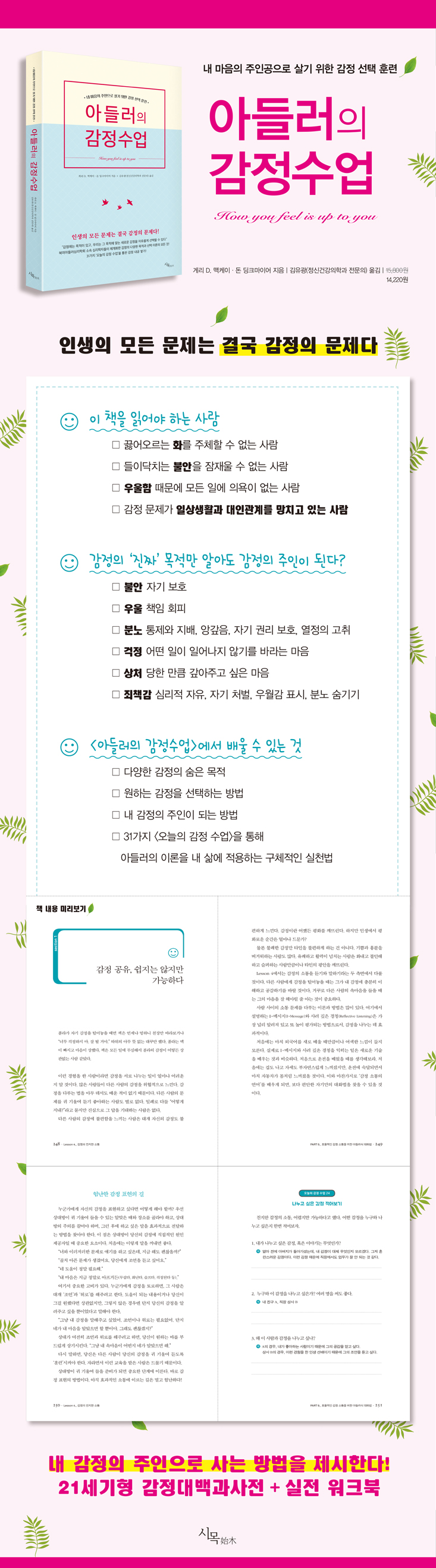
Adler's Emotional Lessons, which combines solid theory, detailed methodology, and 31 "Today's Emotional Lessons" designed to help readers directly apply these teachings to their lives, can be considered a 21st-century encyclopedia of emotions + practical workbook.
Adler's Emotional Class presents a way to live as the master of your emotions!
The Adlerian psychology craze that began after “The Courage to be Disliked” shows no signs of abating.
This may be because Adler's theory instilled self-esteem in people and motivated them to live their lives proactively.
However, the usefulness of Adlerian psychology in emotional problems is not well known.
This may be because there is no book that deals with emotional issues in depth based on Adlerian psychology.
In that sense, Adler's Emotional Education is a very timely book.
Gary McKay and Don Dinkmeyer, both Adlerian Psychology Association (NASAP) scholars, are counselors who lecture and write extensively in the United States and Europe.
Based on Adlerian psychology, they have helped tens of thousands of people acquire the ability to choose their emotions, and have compiled and summarized their experiences and research results from actual psychological counseling sessions into the book "Adler's Emotion Class," which has remained a steady seller on Amazon's US bookstore since its publication.
Through this book, the authors reveal the purpose of the most problematic emotions for modern people, such as anger, depression, anxiety, and guilt, and ask readers whether they will passively follow those purposes and emotions or choose new purposes and emotions for a constructive and happy life.
It also reveals the benefits of positive emotions like joy and happiness and suggests various ways to achieve them.
By providing stress management techniques, the Adlerian method of effective emotional communication, and conflict resolution techniques, this book systematically provides a detailed methodology for living as the master of one's emotions.
Adler's Emotional Lessons, which combines solid theory, detailed methodology, and 31 "Today's Emotional Lessons" designed to help readers directly apply these teachings to their lives, can be considered a 21st-century encyclopedia of emotions + practical workbook.
- You can preview some of the book's contents.
Preview
index
Translator's Note
Author's Note
Lesson 1: You Can Choose Your Emotions
PART 1 I am the master of my emotions!
1.
Everyone lives with emotional issues.
2.
I can choose my emotions
3.
Emotions have a special purpose
4.
My emotions are determined by my beliefs and perspectives.
5.
When you learn new facts, your feelings change.
6.
Don't force your feelings on others
PART 2: 8 Principles of Emotional Choice
1.
Explore lifestyles
2.
Accept my feelings as they are
3.
Don't be stuck in the past
4.
Realize what I'm thinking
5.
Recognizing the Purpose of Emotions
6.
Change negative thoughts into positive ones
7.
Changing your language habits
8.
Make a concrete plan to change your emotions
Review: 8 Principles of Emotional Choice
Lesson 2: Facing Different Emotions
PART 3: Anger, the Dangerous Race to Reclaim Rights
1.
Life can be a powder keg of anger.
2.
Misconceptions and Truths About Anger
3.
Anger has many purposes.
4.
The process by which the emotion of anger is created
5.
Anger also has conditions.
6.
Practice not getting angry
7.
3-Step Process to Anger
8.
How to Teach a Child Without Getting Angry
9.
If you are angry at yourself
PART 4 Depression, a Cold of the Mind
1.
An occasional visitor, depression
2.
4 Types of People Who Are More Prone to Depression
3.
5 Mindsets to Overcome Depression
4.
Daily Efforts to Overcome Depression
PART 5: GUILT, THE SHADOW OF PERFECTIONISM
Guilt is more painful than regret or self-reproach
The various purposes hidden in guilt
The type that is prone to feeling guilty
How to overcome guilt
PART 6 Anxiety, Exaggerated Feelings About Fearful Situations
1.
There is no one who is not anxious
2.
Wise Ways to Deal with Anxiety
3.
4 Ways to Prepare for Uncertainty
4.
Effective ways to help when you're anxious
PART 7 Joy and Happiness, Emotions That Come from Believing in Yourself
1.
What makes me happy and joyful?
2.
The benefits of joy
3.
Joy and happiness also require practice.
4.
Practical exercises to improve your sense of humor
5.
Joy and happiness are what I create
Review_The Purpose of Emotions
Lesson 3: Stress Management and Positive Self-Discovery
PART 8: Stress: A Lifelong Friend
1.
Moderate stress is motivating.
2.
Factors that cause stress
3.
Attitude towards stress
4.
Building a stress-resistant body
5.
Building a Stress-Resilient Mind with Self-Affirmation
Lesson 4: Serious Communication of Emotions
PART 9: Adlerian Conversation: Sharing Emotions Correctly
1.
Sharing Emotions: Not Easy, But Possible
2.
'You-Messages' That Ruin Interpersonal Relationships
3.
'I-Messages': An Effective Way to Express Emotions
4.
Empathize with other people's feelings
5.
Express good feelings without hesitation
PART 10: How to Resolve Conflict Properly
1.
Conflicts also involve emotional issues.
2.
The root cause of the conflict
3.
Resolving conflict requires cooperation.
4.
Four Steps to Effective Conflict Resolution
5.
Examples of dialogue that resolves conflict
6.
How to overcome the deadlock in conflict
PART 11 Drawing Yourself, Communicating with Yourself
1.
The magic of changing a negative self-image into a positive one
2.
Self-Drawing Basics: Imagination Exercises
3.
Self-portrait practice: Changing the scene in your mind
4.
Making rational choices by drawing your own image
5.
Create an optimistic self by drawing yourself
6.
Doing things you don't want to do by drawing yourself
7.
Creating a chute of emotions
8.
Controlling Negative Fixations
Appendix_ ACE, a useful tool for emotion regulation
*Today's Emotions Lesson Collection*
PART 1 I am the master of my emotions!
1. Transcribe and memorize key sentences from the Emotions class.
PART 2: 8 Principles of Emotional Choice
2 Check how I express my emotions
3. Acknowledge feelings you don't want to acknowledge
4 Reinterpreting Trauma
5 Self-Diagnosis of Thoughts and Emotions
6. Create an alternative perspective
7. Create an Emotion Change Schedule
PART 3: Anger, the Dangerous Race to Reclaim Rights
8. Find out why I was angry
9. Practice not getting angry
10 Write down an experience when you were angry at yourself.
PART 4 Depression, a Cold of the Mind
11 Self-Diagnosis for Depression
12 Check what type of person I am
13 Ways to Overcome Depression
PART 5: GUILT, THE SHADOW OF PERFECTIONISM
14 Overcoming Guilt
PART 6 Anxiety, Exaggerated Feelings About Fearful Situations
15 Check the purpose of anxious feelings
16 Sentences to Overcome Anxiety
17 Try abdominal breathing
PART 7 Joy and Happiness, Emotions That Come from Believing in Yourself
19 Write down the wrong thoughts you need to get rid of.
20. Interpreting Past Events Humorously
21 Ways to Be Happy
PART 8: Stress: A Lifelong Friend
22. Try a stress self-assessment
23 Finding My Strengths
PART 9: Adlerian Conversation: Sharing Emotions Correctly
24 Write down the feelings you want to share
25 Expressing Negative Emotions with I-Messages
26 Practice Thoughtful Listening
27 Expressing Positive Emotions with I-Messages
PART 10: How to Resolve Conflict Properly
28 Reflecting on a recent conflict
29 Revisiting Unresolved Conflicts
PART 11 Drawing Yourself, Communicating with Yourself
30. Create a 30-point emotional quotient
31. Eliminate Negative Fixations
Author's Note
Lesson 1: You Can Choose Your Emotions
PART 1 I am the master of my emotions!
1.
Everyone lives with emotional issues.
2.
I can choose my emotions
3.
Emotions have a special purpose
4.
My emotions are determined by my beliefs and perspectives.
5.
When you learn new facts, your feelings change.
6.
Don't force your feelings on others
PART 2: 8 Principles of Emotional Choice
1.
Explore lifestyles
2.
Accept my feelings as they are
3.
Don't be stuck in the past
4.
Realize what I'm thinking
5.
Recognizing the Purpose of Emotions
6.
Change negative thoughts into positive ones
7.
Changing your language habits
8.
Make a concrete plan to change your emotions
Review: 8 Principles of Emotional Choice
Lesson 2: Facing Different Emotions
PART 3: Anger, the Dangerous Race to Reclaim Rights
1.
Life can be a powder keg of anger.
2.
Misconceptions and Truths About Anger
3.
Anger has many purposes.
4.
The process by which the emotion of anger is created
5.
Anger also has conditions.
6.
Practice not getting angry
7.
3-Step Process to Anger
8.
How to Teach a Child Without Getting Angry
9.
If you are angry at yourself
PART 4 Depression, a Cold of the Mind
1.
An occasional visitor, depression
2.
4 Types of People Who Are More Prone to Depression
3.
5 Mindsets to Overcome Depression
4.
Daily Efforts to Overcome Depression
PART 5: GUILT, THE SHADOW OF PERFECTIONISM
Guilt is more painful than regret or self-reproach
The various purposes hidden in guilt
The type that is prone to feeling guilty
How to overcome guilt
PART 6 Anxiety, Exaggerated Feelings About Fearful Situations
1.
There is no one who is not anxious
2.
Wise Ways to Deal with Anxiety
3.
4 Ways to Prepare for Uncertainty
4.
Effective ways to help when you're anxious
PART 7 Joy and Happiness, Emotions That Come from Believing in Yourself
1.
What makes me happy and joyful?
2.
The benefits of joy
3.
Joy and happiness also require practice.
4.
Practical exercises to improve your sense of humor
5.
Joy and happiness are what I create
Review_The Purpose of Emotions
Lesson 3: Stress Management and Positive Self-Discovery
PART 8: Stress: A Lifelong Friend
1.
Moderate stress is motivating.
2.
Factors that cause stress
3.
Attitude towards stress
4.
Building a stress-resistant body
5.
Building a Stress-Resilient Mind with Self-Affirmation
Lesson 4: Serious Communication of Emotions
PART 9: Adlerian Conversation: Sharing Emotions Correctly
1.
Sharing Emotions: Not Easy, But Possible
2.
'You-Messages' That Ruin Interpersonal Relationships
3.
'I-Messages': An Effective Way to Express Emotions
4.
Empathize with other people's feelings
5.
Express good feelings without hesitation
PART 10: How to Resolve Conflict Properly
1.
Conflicts also involve emotional issues.
2.
The root cause of the conflict
3.
Resolving conflict requires cooperation.
4.
Four Steps to Effective Conflict Resolution
5.
Examples of dialogue that resolves conflict
6.
How to overcome the deadlock in conflict
PART 11 Drawing Yourself, Communicating with Yourself
1.
The magic of changing a negative self-image into a positive one
2.
Self-Drawing Basics: Imagination Exercises
3.
Self-portrait practice: Changing the scene in your mind
4.
Making rational choices by drawing your own image
5.
Create an optimistic self by drawing yourself
6.
Doing things you don't want to do by drawing yourself
7.
Creating a chute of emotions
8.
Controlling Negative Fixations
Appendix_ ACE, a useful tool for emotion regulation
*Today's Emotions Lesson Collection*
PART 1 I am the master of my emotions!
1. Transcribe and memorize key sentences from the Emotions class.
PART 2: 8 Principles of Emotional Choice
2 Check how I express my emotions
3. Acknowledge feelings you don't want to acknowledge
4 Reinterpreting Trauma
5 Self-Diagnosis of Thoughts and Emotions
6. Create an alternative perspective
7. Create an Emotion Change Schedule
PART 3: Anger, the Dangerous Race to Reclaim Rights
8. Find out why I was angry
9. Practice not getting angry
10 Write down an experience when you were angry at yourself.
PART 4 Depression, a Cold of the Mind
11 Self-Diagnosis for Depression
12 Check what type of person I am
13 Ways to Overcome Depression
PART 5: GUILT, THE SHADOW OF PERFECTIONISM
14 Overcoming Guilt
PART 6 Anxiety, Exaggerated Feelings About Fearful Situations
15 Check the purpose of anxious feelings
16 Sentences to Overcome Anxiety
17 Try abdominal breathing
PART 7 Joy and Happiness, Emotions That Come from Believing in Yourself
19 Write down the wrong thoughts you need to get rid of.
20. Interpreting Past Events Humorously
21 Ways to Be Happy
PART 8: Stress: A Lifelong Friend
22. Try a stress self-assessment
23 Finding My Strengths
PART 9: Adlerian Conversation: Sharing Emotions Correctly
24 Write down the feelings you want to share
25 Expressing Negative Emotions with I-Messages
26 Practice Thoughtful Listening
27 Expressing Positive Emotions with I-Messages
PART 10: How to Resolve Conflict Properly
28 Reflecting on a recent conflict
29 Revisiting Unresolved Conflicts
PART 11 Drawing Yourself, Communicating with Yourself
30. Create a 30-point emotional quotient
31. Eliminate Negative Fixations
Detailed image
Into the book
Freud believed that emotions were inevitable and arising from past events.
This is called causal theory.
Humans were seen as victims of past events or given circumstances, and the emotions that arise as a result are uncontrollable.
He pointed out the contradiction between body and mind, consciousness and unconsciousness, reason and emotion with the words, “I know, but I can’t stop.”
But Adler's way of looking at emotions is completely different.
First of all, Adler believed that all human behavior and emotions have their own unique purpose.
This is called 'Adler's teleology'.
Humans use all means, including reason, emotions, and the body, to achieve the goals they have set for themselves.
That is, even though my reason and emotions may seem contradictory on the surface, in reality they are running together toward one goal.
--- p.26
How would you feel if you heard that a college student was involved in a car accident while riding a bicycle? You might feel compassion for the student and anger at the driver.
But your neighbor might be more angry at the college student and sympathetic to the driver.
Why does this difference occur?
The reason cannot be in the incident itself.
You and your neighbor heard the same news.
However, the reason for the different reactions is because there are different views on riding a bicycle on the road.
If you feel completely different emotions when looking at the same event, it means that your perspective ultimately determines your emotions.
Then my feelings can be freely determined by changing my perspective.
--- p.29
There is a preconception that emotions cannot be controlled by oneself.
Many people believe that, like being on an airplane that flies on autopilot, they cannot directly 'control' their emotions.
But as we have seen, emotions can be changed at will, depending on our judgment.
In particular, people act emotionally and change their emotions without hesitation if they judge that the outcome will not be good.
The stereotype that emotions are automatic psychological reactions that we cannot control is simply a result of the old habit of reflexively expressing our emotions.
--- p.32
When we believe that our emotions are influenced by other people or our surroundings, we often say, “That’s why I feel like…”
This is when you depend on other people or your surroundings for your feelings.
If that's the case, then you can't choose new emotions unless your surroundings change.
This statement also implies an attitude of not wanting to take responsibility for one's own feelings.
However, the responsibility for one's emotions lies with the person involved, and no one can control one's emotions without active change on their part.
However, many counselors frequently ask their clients, “How did that make you feel?”, which can lead to confusion about the issue of emotional responsibility.
--- p.66
The reason depression is difficult to treat is because depression actually has some useful properties for the person suffering from it.
That is, because of the purpose that depression contains.
That is precisely why depression becomes the basis for avoiding responsibility for one's own actions.
Some people try to lower others' expectations by emphasizing their own weaknesses, thereby reducing the pressure to get things done.
And we secretly hope for the protection and consideration of others.
Furthermore, some people use depression as an excuse for failure and a defense mechanism against criticism.
--- p.122
Guilt is a painful emotion.
But changing ourselves is more difficult and painful.
We've all had experiences where we didn't do what we were supposed to do, or where we betrayed our own or someone else's expectations.
If that happens, I feel guilty.
I feel a deep regret about why I didn't do it, or why I did it.
But soon, they start making excuses about themselves and their faults, such as, "I'm too busy," "I forget," or "You expect too much of me."
Guilt is also a type of excuse.
When you admit your mistakes, you feel guilty, and guilt 'excuses' you for your mistakes.
But guilt is not enough to compensate for wrongdoing.
--- p.153
It would be strange if you didn't feel fear and anxiety when driving on narrow, winding mountain roads.
Anxiety can actually be beneficial to you, as long as you don't become overwhelmed.
In this case, it would be an opportunity to drive more carefully.
Speaking in front of people, or giving public speeches, is also a common source of anxiety.
However, through thorough preparation and prior practice, you can reduce your anxiety and appear competent.
In other words, if you don't let anxiety overwhelm you and use it well, it has many positive aspects, such as helping you protect yourself and taking steps to prepare for danger.
--- p.168
What makes me happy and joyful? A perfect job or lover? A shiny new car? A dream home? But even those things that make me happy have their drawbacks.
Even in the 'perfect' job, there are things we hate waiting for us.
Even if you are a perfect couple, if you live with them every day, you will start to see their flaws.
Having a new car and a beautiful home doesn't come cheap.
Let me ask you again.
“What makes me happy and joyful?”
The answer is simple.
It is yourself.
Like other emotions, joy does not come from external events, but from within ourselves.
Joy is an emotion that arises from one's beliefs and attitude toward life.
Your emotions are influenced by your purpose, beliefs, and thoughts, and therefore you can create your own joy.
--- p.189
The reason why we feel embarrassed when we do something that the other person doesn't like is because we are embarrassed and try to get the other person to forgive us.
It is to save.
Conversely, when we are embarrassed by someone else's actions, we often think that they did something stupid.
In other words, it is an expression of superiority.
Or they may show confusion with the intention of controlling the other person's behavior.
For example, you try to control the other person's behavior in advance by saying, "If you do that, I will be embarrassed."
--- p.212
The message means using 'I' as the subject of the sentence.
This is an expression of taking responsibility for one's emotions by clearly stating that the subject of one's emotions is 'me'.
You can express your feelings without attacking, blaming, mocking, or judging the other person.
“It breaks my heart to hear such words.”
“I feel like I’m being pushed around somehow.
I don't think I can do what you want.
“I hope so, you know.”
“I’m worried and panicked because the guests are arriving soon.
I'm worried if you've finished all your chores.
“I’m saying this because I don’t want to ask you twice.”
The difference is clear when compared to the following You-Message.
“Don’t talk to me like that!”
“Don’t push me like that!”
“How many times do I have to tell you before you understand?”
Can you see the difference? When you hear the I-message above, don't you want to respect others even more?
This is called causal theory.
Humans were seen as victims of past events or given circumstances, and the emotions that arise as a result are uncontrollable.
He pointed out the contradiction between body and mind, consciousness and unconsciousness, reason and emotion with the words, “I know, but I can’t stop.”
But Adler's way of looking at emotions is completely different.
First of all, Adler believed that all human behavior and emotions have their own unique purpose.
This is called 'Adler's teleology'.
Humans use all means, including reason, emotions, and the body, to achieve the goals they have set for themselves.
That is, even though my reason and emotions may seem contradictory on the surface, in reality they are running together toward one goal.
--- p.26
How would you feel if you heard that a college student was involved in a car accident while riding a bicycle? You might feel compassion for the student and anger at the driver.
But your neighbor might be more angry at the college student and sympathetic to the driver.
Why does this difference occur?
The reason cannot be in the incident itself.
You and your neighbor heard the same news.
However, the reason for the different reactions is because there are different views on riding a bicycle on the road.
If you feel completely different emotions when looking at the same event, it means that your perspective ultimately determines your emotions.
Then my feelings can be freely determined by changing my perspective.
--- p.29
There is a preconception that emotions cannot be controlled by oneself.
Many people believe that, like being on an airplane that flies on autopilot, they cannot directly 'control' their emotions.
But as we have seen, emotions can be changed at will, depending on our judgment.
In particular, people act emotionally and change their emotions without hesitation if they judge that the outcome will not be good.
The stereotype that emotions are automatic psychological reactions that we cannot control is simply a result of the old habit of reflexively expressing our emotions.
--- p.32
When we believe that our emotions are influenced by other people or our surroundings, we often say, “That’s why I feel like…”
This is when you depend on other people or your surroundings for your feelings.
If that's the case, then you can't choose new emotions unless your surroundings change.
This statement also implies an attitude of not wanting to take responsibility for one's own feelings.
However, the responsibility for one's emotions lies with the person involved, and no one can control one's emotions without active change on their part.
However, many counselors frequently ask their clients, “How did that make you feel?”, which can lead to confusion about the issue of emotional responsibility.
--- p.66
The reason depression is difficult to treat is because depression actually has some useful properties for the person suffering from it.
That is, because of the purpose that depression contains.
That is precisely why depression becomes the basis for avoiding responsibility for one's own actions.
Some people try to lower others' expectations by emphasizing their own weaknesses, thereby reducing the pressure to get things done.
And we secretly hope for the protection and consideration of others.
Furthermore, some people use depression as an excuse for failure and a defense mechanism against criticism.
--- p.122
Guilt is a painful emotion.
But changing ourselves is more difficult and painful.
We've all had experiences where we didn't do what we were supposed to do, or where we betrayed our own or someone else's expectations.
If that happens, I feel guilty.
I feel a deep regret about why I didn't do it, or why I did it.
But soon, they start making excuses about themselves and their faults, such as, "I'm too busy," "I forget," or "You expect too much of me."
Guilt is also a type of excuse.
When you admit your mistakes, you feel guilty, and guilt 'excuses' you for your mistakes.
But guilt is not enough to compensate for wrongdoing.
--- p.153
It would be strange if you didn't feel fear and anxiety when driving on narrow, winding mountain roads.
Anxiety can actually be beneficial to you, as long as you don't become overwhelmed.
In this case, it would be an opportunity to drive more carefully.
Speaking in front of people, or giving public speeches, is also a common source of anxiety.
However, through thorough preparation and prior practice, you can reduce your anxiety and appear competent.
In other words, if you don't let anxiety overwhelm you and use it well, it has many positive aspects, such as helping you protect yourself and taking steps to prepare for danger.
--- p.168
What makes me happy and joyful? A perfect job or lover? A shiny new car? A dream home? But even those things that make me happy have their drawbacks.
Even in the 'perfect' job, there are things we hate waiting for us.
Even if you are a perfect couple, if you live with them every day, you will start to see their flaws.
Having a new car and a beautiful home doesn't come cheap.
Let me ask you again.
“What makes me happy and joyful?”
The answer is simple.
It is yourself.
Like other emotions, joy does not come from external events, but from within ourselves.
Joy is an emotion that arises from one's beliefs and attitude toward life.
Your emotions are influenced by your purpose, beliefs, and thoughts, and therefore you can create your own joy.
--- p.189
The reason why we feel embarrassed when we do something that the other person doesn't like is because we are embarrassed and try to get the other person to forgive us.
It is to save.
Conversely, when we are embarrassed by someone else's actions, we often think that they did something stupid.
In other words, it is an expression of superiority.
Or they may show confusion with the intention of controlling the other person's behavior.
For example, you try to control the other person's behavior in advance by saying, "If you do that, I will be embarrassed."
--- p.212
The message means using 'I' as the subject of the sentence.
This is an expression of taking responsibility for one's emotions by clearly stating that the subject of one's emotions is 'me'.
You can express your feelings without attacking, blaming, mocking, or judging the other person.
“It breaks my heart to hear such words.”
“I feel like I’m being pushed around somehow.
I don't think I can do what you want.
“I hope so, you know.”
“I’m worried and panicked because the guests are arriving soon.
I'm worried if you've finished all your chores.
“I’m saying this because I don’t want to ask you twice.”
The difference is clear when compared to the following You-Message.
“Don’t talk to me like that!”
“Don’t push me like that!”
“How many times do I have to tell you before you understand?”
Can you see the difference? When you hear the I-message above, don't you want to respect others even more?
--- p.255
Publisher's Review
To you who find life difficult and painful…
“All problems in life are ultimately problems of emotion!”
“I can’t stand it, I’m so angry because of that guy!”
“Even if I just stay still, I feel depressed and start crying.”
“It’s my first day at work tomorrow… I’m so anxious I can’t even sleep.”
“I feel like I’m the most pathetic person in the world.
“My self-esteem is at rock bottom.”
“I was so stressed out from dieting that I ended up binge eating again.
“I feel like I want to die.”
“Yelling at everyone, getting angry… I think I’m crazy.
How do I fix it?
If you think about it, 'almost all problems in life are problems of emotions.'
Countless instances of businesses and interpersonal relationships being ruined by the inability to resolve negative emotions such as anger, anxiety, guilt, depression, and stress.
That means you're going to have problems in a significant part of your life.
We modern people, who 'get angry because of you, get depressed without knowing it, and get anxious for no reason', are 'slaves and victims of emotions'.
Adler's Emotional Education, which deals with the issue of emotions in earnest based on orthodox Adlerian psychology, completely opposes the views that the psychology community and the public have had on emotions.
We argue that we can no longer live as slaves or victims of our emotions, but as 'masters of our own emotions.'
By reading this book and practicing the 31 "Today's Emotional Lessons," you will discover the "surprising hidden purpose of (negative) emotions that you were previously unaware of," and become the master of your emotions by choosing new, positive emotions.
To live as the master of your emotions is to live freely and happily! Who could resist this life?
If "The Courage to be Hated" motivated us to live a proactive life,
Adler's Emotional Class presents a way to live as the master of your emotions!
The Adlerian psychology craze that began after “The Courage to be Disliked” shows no signs of abating.
This may be because Adler's theory instilled self-esteem in people and motivated them to live their lives proactively.
However, the usefulness of Adlerian psychology in emotional problems is not well known.
This may be because there is no book that deals with emotional issues in depth based on Adlerian psychology.
In that sense, Adler's Emotional Education is a very timely book.
Gary McKay and Don Dinkmeyer, both Adlerian Psychology Association (NASAP) scholars, are counselors who lecture and write extensively in the United States and Europe.
Based on Adlerian psychology, they have helped tens of thousands of people acquire the ability to choose their emotions, and have compiled and summarized their experiences and research results from actual psychological counseling sessions into the book "Adler's Emotion Class," which has remained a steady seller on Amazon's US bookstore since its publication.
Adler's Emotional Class
A 21st-century emotional encyclopedia + practical workbook!
Through this book, the authors reveal the purpose of the most problematic emotions for modern people, such as anger, depression, anxiety, and guilt, and ask readers whether they will passively follow those purposes and emotions or choose new purposes and emotions for a constructive and happy life.
It also reveals the benefits of positive emotions like joy and happiness and suggests various ways to achieve them.
By providing stress management techniques, the Adlerian method of effective emotional communication, and conflict resolution techniques, this book systematically provides a detailed methodology for living as the master of one's emotions.
Adler's Emotional Lessons, which combines solid theory, detailed methodology, and 31 "Today's Emotional Lessons" designed to help readers directly apply these teachings to their lives, can be considered a 21st-century encyclopedia of emotions + practical workbook.
Emotions have a purpose,
We can choose the emotions that suit our purpose!
Alfred Adler argued that since humans are subjective and active beings, they should not be influenced by past experiences, trauma, or external circumstances, but rather the meaning (interpretation) they give to them is important.
He also argued that since all human actions and emotions have a purpose, we must actively act in accordance with that purpose.
If we interpret this in terms of the problem of emotions, it means that each emotion has its own purpose, and we can live as the masters of our emotions by choosing the emotions that fit that purpose.
For example, when an unpleasant feeling arises, you should carefully consider its purpose and what the consequences will be if you continue to pursue that purpose.
If you ask yourself, "What do I want to achieve through this emotion? What do I hope will happen? Will this purpose bring me positive results?", you will be able to choose new purposes and emotions, ultimately becoming the master of your own mind.
Compared to conventional psychology, which viewed humans as 'passive beings who accept emotions,' Adler's perspective, which first proposed the theory of emotional selection, can be considered groundbreaking.
Why? Are you angry and depressed?
Anger and depression have a purpose too!
The authors say, “Emotions have a clear purpose, but people often forget that purpose and only see the results, so even when they get angry, they don’t know why they are angry.”
They simply think they are upset because something went wrong or because the other person did something wrong.
However, anger is mainly aimed at controlling and dominating others, or avoiding being controlled by others.
It also has the purpose of seeking revenge on those who have hurt or harmed me, and the purpose of protecting my own rights.
We, living in modern times, are often overcome by feelings of depression.
There are many factors that cause feelings of depression, but there is a common goal that runs through all feelings of depression, and that is 'avoiding responsibility.'
Depression becomes a basis for avoiding responsibility for one's own actions.
This is because by showing your weakness, you can lower other people's expectations, thereby reducing the pressure to get things done.
Anger and depression, as well as anxiety, guilt, stress, joy and happiness, each have their own purpose.
While recognizing the purpose of your emotions isn't easy, understanding the purpose of unpleasant emotions will allow you to choose new emotions that can bring positive and happy outcomes for you.
Build your emotional strength through 31 "Today's Emotion Lessons."
Check how you express your emotions, reinterpret trauma, find out why you got angry, practice not getting angry, self-diagnose depression, overcome guilt, write down sentences to overcome anxiety, practice ways to become happy, self-evaluate stress, find your strengths, look back on conflicts you've recently experienced, etc.
The "Today's Emotion Lesson" section in each part will serve as a practical guide to help you effectively apply the book's theories to your own mind and life.
Humans are not victims of their emotions.
With Adlerian psychology, you will gain the power to choose the emotions you want in any situation.
And anyone can become the master of their emotions and live happily.
Right now, let's choose our emotions.
“All problems in life are ultimately problems of emotion!”
“I can’t stand it, I’m so angry because of that guy!”
“Even if I just stay still, I feel depressed and start crying.”
“It’s my first day at work tomorrow… I’m so anxious I can’t even sleep.”
“I feel like I’m the most pathetic person in the world.
“My self-esteem is at rock bottom.”
“I was so stressed out from dieting that I ended up binge eating again.
“I feel like I want to die.”
“Yelling at everyone, getting angry… I think I’m crazy.
How do I fix it?
If you think about it, 'almost all problems in life are problems of emotions.'
Countless instances of businesses and interpersonal relationships being ruined by the inability to resolve negative emotions such as anger, anxiety, guilt, depression, and stress.
That means you're going to have problems in a significant part of your life.
We modern people, who 'get angry because of you, get depressed without knowing it, and get anxious for no reason', are 'slaves and victims of emotions'.
Adler's Emotional Education, which deals with the issue of emotions in earnest based on orthodox Adlerian psychology, completely opposes the views that the psychology community and the public have had on emotions.
We argue that we can no longer live as slaves or victims of our emotions, but as 'masters of our own emotions.'
By reading this book and practicing the 31 "Today's Emotional Lessons," you will discover the "surprising hidden purpose of (negative) emotions that you were previously unaware of," and become the master of your emotions by choosing new, positive emotions.
To live as the master of your emotions is to live freely and happily! Who could resist this life?
If "The Courage to be Hated" motivated us to live a proactive life,
Adler's Emotional Class presents a way to live as the master of your emotions!
The Adlerian psychology craze that began after “The Courage to be Disliked” shows no signs of abating.
This may be because Adler's theory instilled self-esteem in people and motivated them to live their lives proactively.
However, the usefulness of Adlerian psychology in emotional problems is not well known.
This may be because there is no book that deals with emotional issues in depth based on Adlerian psychology.
In that sense, Adler's Emotional Education is a very timely book.
Gary McKay and Don Dinkmeyer, both Adlerian Psychology Association (NASAP) scholars, are counselors who lecture and write extensively in the United States and Europe.
Based on Adlerian psychology, they have helped tens of thousands of people acquire the ability to choose their emotions, and have compiled and summarized their experiences and research results from actual psychological counseling sessions into the book "Adler's Emotion Class," which has remained a steady seller on Amazon's US bookstore since its publication.
Adler's Emotional Class
A 21st-century emotional encyclopedia + practical workbook!
Through this book, the authors reveal the purpose of the most problematic emotions for modern people, such as anger, depression, anxiety, and guilt, and ask readers whether they will passively follow those purposes and emotions or choose new purposes and emotions for a constructive and happy life.
It also reveals the benefits of positive emotions like joy and happiness and suggests various ways to achieve them.
By providing stress management techniques, the Adlerian method of effective emotional communication, and conflict resolution techniques, this book systematically provides a detailed methodology for living as the master of one's emotions.
Adler's Emotional Lessons, which combines solid theory, detailed methodology, and 31 "Today's Emotional Lessons" designed to help readers directly apply these teachings to their lives, can be considered a 21st-century encyclopedia of emotions + practical workbook.
Emotions have a purpose,
We can choose the emotions that suit our purpose!
Alfred Adler argued that since humans are subjective and active beings, they should not be influenced by past experiences, trauma, or external circumstances, but rather the meaning (interpretation) they give to them is important.
He also argued that since all human actions and emotions have a purpose, we must actively act in accordance with that purpose.
If we interpret this in terms of the problem of emotions, it means that each emotion has its own purpose, and we can live as the masters of our emotions by choosing the emotions that fit that purpose.
For example, when an unpleasant feeling arises, you should carefully consider its purpose and what the consequences will be if you continue to pursue that purpose.
If you ask yourself, "What do I want to achieve through this emotion? What do I hope will happen? Will this purpose bring me positive results?", you will be able to choose new purposes and emotions, ultimately becoming the master of your own mind.
Compared to conventional psychology, which viewed humans as 'passive beings who accept emotions,' Adler's perspective, which first proposed the theory of emotional selection, can be considered groundbreaking.
Why? Are you angry and depressed?
Anger and depression have a purpose too!
The authors say, “Emotions have a clear purpose, but people often forget that purpose and only see the results, so even when they get angry, they don’t know why they are angry.”
They simply think they are upset because something went wrong or because the other person did something wrong.
However, anger is mainly aimed at controlling and dominating others, or avoiding being controlled by others.
It also has the purpose of seeking revenge on those who have hurt or harmed me, and the purpose of protecting my own rights.
We, living in modern times, are often overcome by feelings of depression.
There are many factors that cause feelings of depression, but there is a common goal that runs through all feelings of depression, and that is 'avoiding responsibility.'
Depression becomes a basis for avoiding responsibility for one's own actions.
This is because by showing your weakness, you can lower other people's expectations, thereby reducing the pressure to get things done.
Anger and depression, as well as anxiety, guilt, stress, joy and happiness, each have their own purpose.
While recognizing the purpose of your emotions isn't easy, understanding the purpose of unpleasant emotions will allow you to choose new emotions that can bring positive and happy outcomes for you.
Build your emotional strength through 31 "Today's Emotion Lessons."
Check how you express your emotions, reinterpret trauma, find out why you got angry, practice not getting angry, self-diagnose depression, overcome guilt, write down sentences to overcome anxiety, practice ways to become happy, self-evaluate stress, find your strengths, look back on conflicts you've recently experienced, etc.
The "Today's Emotion Lesson" section in each part will serve as a practical guide to help you effectively apply the book's theories to your own mind and life.
Humans are not victims of their emotions.
With Adlerian psychology, you will gain the power to choose the emotions you want in any situation.
And anyone can become the master of their emotions and live happily.
Right now, let's choose our emotions.
GOODS SPECIFICS
- Date of publication: September 14, 2017
- Page count, weight, size: 360 pages | 546g | 152*225*30mm
- ISBN13: 9791187292722
- ISBN10: 1187292729
You may also like
카테고리
korean


korean

![GQ KOREA Mark (Monthly): December [2025]](http://librairie.coreenne.fr/cdn/shop/files/8ef265dbbfbf186523ed75ba7319009d.jpg?v=1765340328&width=3840)


