

Skin in the Game
 |
Description
Book Introduction
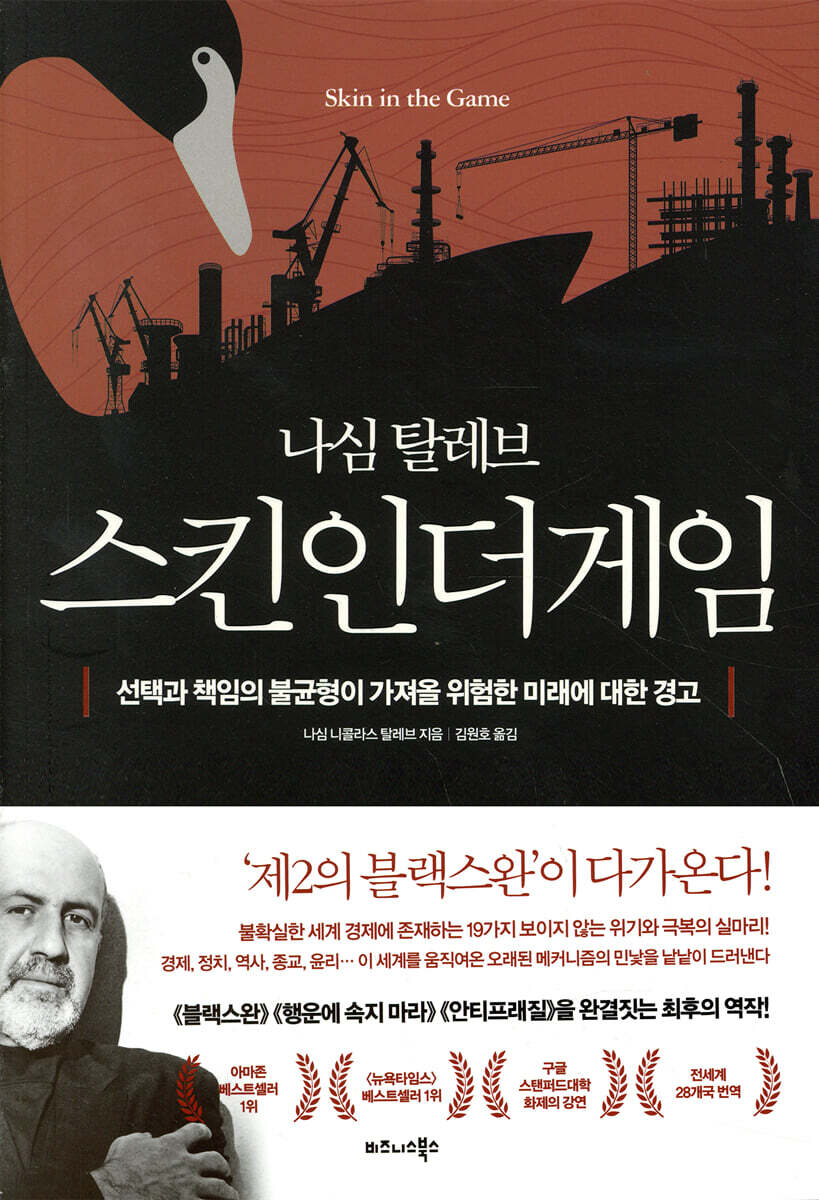
“The most daring and powerful topic of 2019, the most talked-about work that has captured the world’s attention!” The long-awaited final story in the 25-year-long [Incerto] series by Nassim Taleb, the "Sage of Wall Street"! Nassim Taleb, who predicted the 2008 global financial crisis, is back. The last keyword suggested by Nassim Taleb, who has discussed how to survive in an unpredictable and uncertain world through 『Black Swan』, 『Fooled by Randomness』, and 『Antifragile』, is ‘Skin in the Game.’ Skin in the game is a term that means 'take responsibility and directly participate in reality (problems)', and is often used to refer to the phenomenon of avoiding the risks and failures inherent in certain choices and actions. This problematic phenomenon, created by people who are free from responsibility and in positions where they are not responsible for the consequences of their own choices, is appearing across various aspects of society, including the global economy, politics, academia, and the media, and is causing serious social divisions. Why does the United States decide on regime change in third countries like Libya and Iraq? Have the so-called investment experts discussing Microsoft, Samsung, and Amazon actually bought those stocks? Do professors and scholars proposing complex calculations for complex social issues truly understand and experience the dynamics of real-world social structures outside the lab? Nassim Taleb strongly criticizes those who offer plausible rhetoric without staking their core interests: "Show us how much risk you're taking on!" The final series of [Incerto], 『Nassim Taleb Skin in the Game』, clearly exposes how experts, fake intellectuals, and those in power who only care about profits and avoid losses are deceiving the public, and warns of the 'second Black Swan' that their irresponsibility will bring about. It warns of the 19 invisible crises that exist in the uncertain global economy and the dangerous future that will be brought about by the imbalance of choice and responsibility, and conveys the clues to overcoming them, captured through Nassim Taleb's sharp and keen eye. |
- You can preview some of the book's contents.
Preview
index
Entering.
The unseen imbalance between actions and responsibilities in everyday life
Introducing the "Incerto" series
Part 1 Introduction
Introduction 1 The Death of Antaeus
The Real World Projected on Libya Today / Interventionists Play with Life / Acting Monarchs Still Exist / Responsible Action Creates Trust / System Learning to Eliminate the Inappropriate
Introduction 2 Balancing Action and Responsibility
Rethinking Hammurabi's Code / The difference between the silver standard and the golden rule / Forget the universal law / From Kant to Fat Tony / The charlatan and the fool / Real experience and knowledge are different / It doesn't mean that we should always seek balance / The influence of modernism / Light and lecturers / The pursuit of simple solutions / Brain activity dulls when core interests are not at stake / Regulation and the judiciary / Responsibility and dignity / Craftsmen / Real and fake innovators / Pride in one's work / Those who only seek profit / Heroes are not made at a desk / Globalization and passive protectionism / The responsibility of social leaders
Introduction 3 The Incerto Series
The story in this book / The lies of intellectuals / Stories from the publishing world / Summary of the book's structure
Appendix 1. The Imbalances That Exist in Our Lives and the World
Part 2: The Agency Problem
Chapter 1: Whoever catches a turtle, eat the turtle.
A new customer is born every day / The price of corn in Rhodes / The equality of uncertainty / Rav Safra and the Swiss / Can there be a universal ethic? / Neither mine nor yours, but ours / Which side are you on? / People in the same boat / Beware of advice from those who have not actually invested / The imbalance in the medical field / The story of the next chapter
Part 3: Serious Imbalance Problems
Chapter 2: A Society Led by an Uncompromising Minority
Airlines that don't serve peanuts / Renormalization groups / The safest option / How English became an international lingua franca / Genes and language / Religious fundamentalism / Decentralization in the end / A value system led by the few / Is control by the few more stable? / The contradictions of Popper and Gödel / Control by the few as seen in the market and science / The power of the willful few / The story of the next chapter
Appendix 2. Some counterintuitive phenomena regarding group movement.
Part 4: The Wolf and the Dog
Chapter 3 How to Legally Own Others
How to tame an organization / There are no more corporate people / The reason for the existence of a company / The rise of complexity / Expatriates do not want to return to headquarters / Freedom is not something that can be freely obtained / Wolves and dogs / On loss aversion / The return of Catherine the Great? / The problem of high-ranking officials / The story of the next chapter
Chapter 4: People I Am Responsible For
Even Heroes Have Weaknesses / Wittgenstein's Self / Those Who Carry Out Suicide Attacks / The Story of the Next Chapter
Part 5: Living is a Risk
Chapter 5: Why Virtual Experiences Cannot Be Real
Jesus was also a man who boldly took on challenges. / Pascal's Gamble / Dreams can never become reality. / Why Donald Trump was chosen. / The story of the next chapter.
Chapter 6: Fools Who Look Smart
Intellectuals who cannot distinguish between science and scientism / People who have studied but lack culture / Characteristics of foolish intellectuals / Conclusion of this chapter / Story of the next chapter
Chapter 7 Inequality and Responsibility
Static and dynamic inequality / Piketty and the rebellion of the Mandarin class / Jealousy is directed at those similar to oneself / Inequality, wealth, and social class / Empathy and group consciousness / Data reduced to a means of deception / Ethics of public officials / The story of the next chapter
Chapter 8: The Lindy Effect and Real Experts
Who is the 'real' expert? / The ancient Lindy effect / Who evaluates whom / Tea time with the Queen of England / Academic institutions reduced to mere publishers of papers / Arguments that stake their own core interests / How to filter out bogus research / The Lindy effect in science / Empirical or theoretical? / Grandmothers vs. scholars / Humanity's age-old wisdom / The paradox of success
Part 6: The Agent Problem Again
Chapter 9: Doctors Shouldn't Look Like Doctors
Green Lumber Falsehood / The Glamorous Business Plan / Bishops in Glamorous Clothes / The Gordian Knot / Humans Are Not That Intelligent / The Problems Caused by Complex Solutions / Rice and Vitamins / The Distortion of Evaluation / The Traditional Education System as a Luxury / The Reputation of Universities / A Real Gym Doesn't Look Like a Gym / The Story of the Next Chapter
Chapter 10: Poison is served in a golden cup.
The price of seemingly expensive solutions / Too much to bear / Advice for social relationships / Progress doesn't always lead to progress / The story of the next chapter
Chapter 11: Actions speak louder than words.
Two Types of Terrorism / Assassin Organization / Attacks to Deliver a Message / Democracy and Assassination / Cameras Are Powerful Weapons
Chapter 12: Facts are true and news is fake.
The problem of agency in the media / Ethics of debate / The story of the next chapter
Chapter 13: Selling Morality
Public and Private Appearances / Business with Morality / Substance and Appearance: What Should We Pursue? / Moral Transactions / Moral Behavior Doesn't Have to Be Grand / Criticized Moral Behavior / Take Risks and Do Business
Chapter 14: Peace and War in Historical Records
This is not a proxy war. / The lions are a very small minority. / Even if the emergency room is crowded, most live peacefully. / The story of the next chapter.
Part 7: Religion, Belief, and the Agency Problem
Chapter 15: In fact, they don't know much about faith either.
History of Religion / Faith vs. Faith / Churchless Religion and Libertarianism / The Story of the Next Chapter
Chapter 16: Faith Has a Price
The gods do not like cheap sacrifices/ Symbolizes sacrifice/ The power of religion
Chapter 17: Is the Pope an Atheist?
Who is a believer and who is an atheist? / Actions speak louder than words / The story of the next chapter
Part 8: Risk and Rationality
Chapter 18: What is Rationality?
The illusions our eyes create / Survival is the priority / From Simon to Gigerenzer / Expressing preferences / The reason for religion / Demonstrative faith and true faith / Ancient rationality and modern rationality / The reason for the existence of demonstrative faith
Chapter 19: The Logic of Risk Taking
How to understand real-world probability / Ergodic state / Repeated attempts / Who are you? / Courage and discernment / It is rational to avoid tail risks / Love common risks anyway / An overly simplistic interpretation of risk / Summary of this chapter
In conclusion, what the Lindy effect tells us
A story that our society needs to pay attention to in this day and age.
Glossary of Terms
main
Technical appendix
References
Search
The unseen imbalance between actions and responsibilities in everyday life
Introducing the "Incerto" series
Part 1 Introduction
Introduction 1 The Death of Antaeus
The Real World Projected on Libya Today / Interventionists Play with Life / Acting Monarchs Still Exist / Responsible Action Creates Trust / System Learning to Eliminate the Inappropriate
Introduction 2 Balancing Action and Responsibility
Rethinking Hammurabi's Code / The difference between the silver standard and the golden rule / Forget the universal law / From Kant to Fat Tony / The charlatan and the fool / Real experience and knowledge are different / It doesn't mean that we should always seek balance / The influence of modernism / Light and lecturers / The pursuit of simple solutions / Brain activity dulls when core interests are not at stake / Regulation and the judiciary / Responsibility and dignity / Craftsmen / Real and fake innovators / Pride in one's work / Those who only seek profit / Heroes are not made at a desk / Globalization and passive protectionism / The responsibility of social leaders
Introduction 3 The Incerto Series
The story in this book / The lies of intellectuals / Stories from the publishing world / Summary of the book's structure
Appendix 1. The Imbalances That Exist in Our Lives and the World
Part 2: The Agency Problem
Chapter 1: Whoever catches a turtle, eat the turtle.
A new customer is born every day / The price of corn in Rhodes / The equality of uncertainty / Rav Safra and the Swiss / Can there be a universal ethic? / Neither mine nor yours, but ours / Which side are you on? / People in the same boat / Beware of advice from those who have not actually invested / The imbalance in the medical field / The story of the next chapter
Part 3: Serious Imbalance Problems
Chapter 2: A Society Led by an Uncompromising Minority
Airlines that don't serve peanuts / Renormalization groups / The safest option / How English became an international lingua franca / Genes and language / Religious fundamentalism / Decentralization in the end / A value system led by the few / Is control by the few more stable? / The contradictions of Popper and Gödel / Control by the few as seen in the market and science / The power of the willful few / The story of the next chapter
Appendix 2. Some counterintuitive phenomena regarding group movement.
Part 4: The Wolf and the Dog
Chapter 3 How to Legally Own Others
How to tame an organization / There are no more corporate people / The reason for the existence of a company / The rise of complexity / Expatriates do not want to return to headquarters / Freedom is not something that can be freely obtained / Wolves and dogs / On loss aversion / The return of Catherine the Great? / The problem of high-ranking officials / The story of the next chapter
Chapter 4: People I Am Responsible For
Even Heroes Have Weaknesses / Wittgenstein's Self / Those Who Carry Out Suicide Attacks / The Story of the Next Chapter
Part 5: Living is a Risk
Chapter 5: Why Virtual Experiences Cannot Be Real
Jesus was also a man who boldly took on challenges. / Pascal's Gamble / Dreams can never become reality. / Why Donald Trump was chosen. / The story of the next chapter.
Chapter 6: Fools Who Look Smart
Intellectuals who cannot distinguish between science and scientism / People who have studied but lack culture / Characteristics of foolish intellectuals / Conclusion of this chapter / Story of the next chapter
Chapter 7 Inequality and Responsibility
Static and dynamic inequality / Piketty and the rebellion of the Mandarin class / Jealousy is directed at those similar to oneself / Inequality, wealth, and social class / Empathy and group consciousness / Data reduced to a means of deception / Ethics of public officials / The story of the next chapter
Chapter 8: The Lindy Effect and Real Experts
Who is the 'real' expert? / The ancient Lindy effect / Who evaluates whom / Tea time with the Queen of England / Academic institutions reduced to mere publishers of papers / Arguments that stake their own core interests / How to filter out bogus research / The Lindy effect in science / Empirical or theoretical? / Grandmothers vs. scholars / Humanity's age-old wisdom / The paradox of success
Part 6: The Agent Problem Again
Chapter 9: Doctors Shouldn't Look Like Doctors
Green Lumber Falsehood / The Glamorous Business Plan / Bishops in Glamorous Clothes / The Gordian Knot / Humans Are Not That Intelligent / The Problems Caused by Complex Solutions / Rice and Vitamins / The Distortion of Evaluation / The Traditional Education System as a Luxury / The Reputation of Universities / A Real Gym Doesn't Look Like a Gym / The Story of the Next Chapter
Chapter 10: Poison is served in a golden cup.
The price of seemingly expensive solutions / Too much to bear / Advice for social relationships / Progress doesn't always lead to progress / The story of the next chapter
Chapter 11: Actions speak louder than words.
Two Types of Terrorism / Assassin Organization / Attacks to Deliver a Message / Democracy and Assassination / Cameras Are Powerful Weapons
Chapter 12: Facts are true and news is fake.
The problem of agency in the media / Ethics of debate / The story of the next chapter
Chapter 13: Selling Morality
Public and Private Appearances / Business with Morality / Substance and Appearance: What Should We Pursue? / Moral Transactions / Moral Behavior Doesn't Have to Be Grand / Criticized Moral Behavior / Take Risks and Do Business
Chapter 14: Peace and War in Historical Records
This is not a proxy war. / The lions are a very small minority. / Even if the emergency room is crowded, most live peacefully. / The story of the next chapter.
Part 7: Religion, Belief, and the Agency Problem
Chapter 15: In fact, they don't know much about faith either.
History of Religion / Faith vs. Faith / Churchless Religion and Libertarianism / The Story of the Next Chapter
Chapter 16: Faith Has a Price
The gods do not like cheap sacrifices/ Symbolizes sacrifice/ The power of religion
Chapter 17: Is the Pope an Atheist?
Who is a believer and who is an atheist? / Actions speak louder than words / The story of the next chapter
Part 8: Risk and Rationality
Chapter 18: What is Rationality?
The illusions our eyes create / Survival is the priority / From Simon to Gigerenzer / Expressing preferences / The reason for religion / Demonstrative faith and true faith / Ancient rationality and modern rationality / The reason for the existence of demonstrative faith
Chapter 19: The Logic of Risk Taking
How to understand real-world probability / Ergodic state / Repeated attempts / Who are you? / Courage and discernment / It is rational to avoid tail risks / Love common risks anyway / An overly simplistic interpretation of risk / Summary of this chapter
In conclusion, what the Lindy effect tells us
A story that our society needs to pay attention to in this day and age.
Glossary of Terms
main
Technical appendix
References
Search
Detailed image
Into the book
There are four main keywords in this book.
First of all, it is ‘knowledge.’
We will examine the problems of uncertainty and reliability inherent in common sense and scientific knowledge, and discuss the nonsense spouted by so-called intellectuals.
Second, it addresses the issue of ‘balance’, which is often overlooked in areas such as justice, responsibility, fairness, and reciprocity.
Third, I wrote about 'information sharing' in transactions, and lastly, about complex systems (a collection of complex phenomena resulting from the diverse and organic interactions between various components that make up the natural world - Editor) and 'rationality' in the real world.
These four concepts cannot be considered in isolation from one another, but converge on the single theme: "When anyone participates in reality (problems), they must also take responsibility for the consequences." From "Introduction - The Imbalance of Invisible Actions and Responsibilities in Everyday Life"
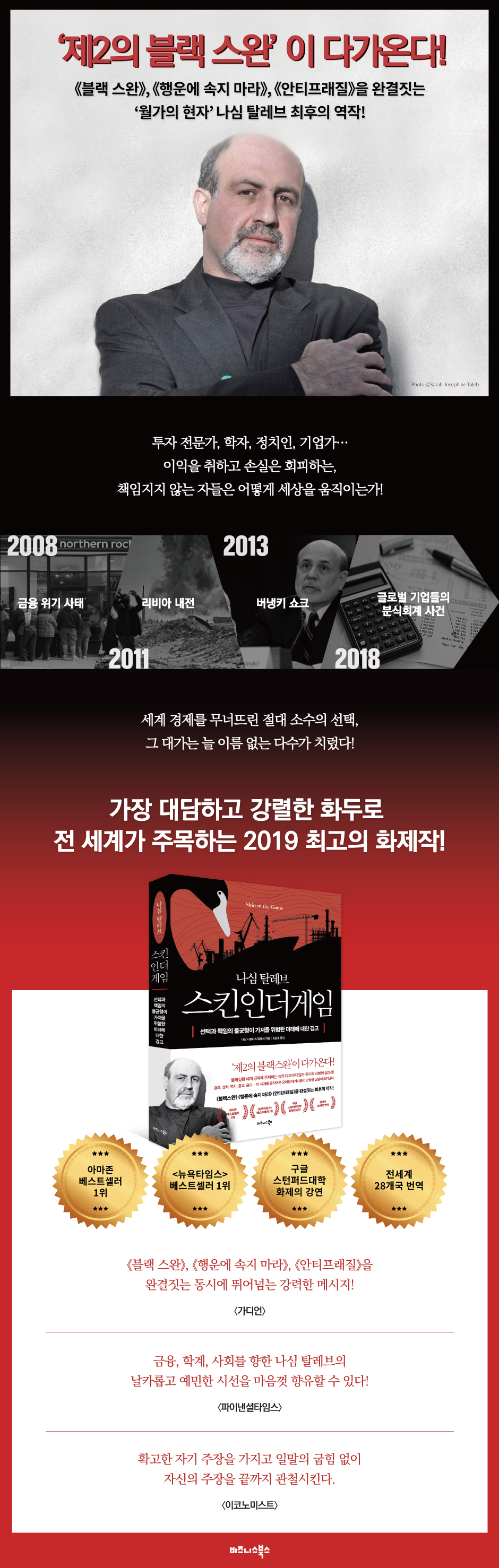
A representative example of an event caused by irresponsible behavior is the 2008 financial crisis.
Before the financial crisis, people in finance made a fortune by hiding catastrophic risks using risk models that didn't work outside of university research papers.
In fact, scholars working at universities know nothing about the actual risks that may arise.
Then the financial crisis hit and uncertainty spread across financial markets, yet people in the financial industry continued to make the same amount of money as before.
--- From "Part 1 - 'Introduction 1 The Death of Antaeus'"
The market never moves in proportion to the power it possesses.
The total market capitalization of the stock market is over $30 trillion, but as the 2008 example shows, a sell order of less than 0.2 percent can instantly wipe out 10 percent of market value.
As I mentioned in Antifragile, the 2008 stock market turmoil was triggered by the revelation of hidden bad trading at Société Générale.
So why do markets move so irrationally? It's all about direction.
Once a direction is established, there is nothing more that can be done.
When the atmosphere becomes such that everyone seems to be selling, there is no other way to respond than to sell too.
So this is how I describe the stock market.
"The stock market is like a giant theater with only one small door." --- From "Chapter 2 - 'A Society Led by a Few Who Do Not Compromise'"
Modern intellectuals who have never lived real, real lives think they have to tell others how to live, but in fact they are not smart at all.
They can't even distinguish between science and scientism.
What is more serious is that scientism is considered more scientific than science itself.
American economists Cass Sunstein and Richard Thaler are prime examples of people who impose their principles on the behavior of others.
They classified what is rational behavior, what is irrational behavior, and what is deviant behavior, but the effectiveness of these classifications is questionable because they are based on superficial logic and one-dimensional models.
The majority of contemporary intellectuals routinely make the mistake of extending their understanding of one part to the whole.
The actions of some members of a specific group are considered as movements of the entire group, and the actions of some members of the market are considered as movements of the entire market.
This is as foolish as claiming that you can understand the movements of an entire colony of ants by observing the behavior of a few ants.
--- From "Chapter 6 - 'Fools Who Look Smart'"
In a society in which the state is blocked, the state steps in to support the wealthy class with vested interests in maintaining their status.
A representative country is France.
The French government takes it for granted that it will support big business, its managers and shareholders, and prevent their downfall.
Even France provides government support to the privileged class to amass even greater wealth.
But the absence of a decline in the wealthy in a society also means that the rise of the lower classes is virtually impossible.
First of all, it is ‘knowledge.’
We will examine the problems of uncertainty and reliability inherent in common sense and scientific knowledge, and discuss the nonsense spouted by so-called intellectuals.
Second, it addresses the issue of ‘balance’, which is often overlooked in areas such as justice, responsibility, fairness, and reciprocity.
Third, I wrote about 'information sharing' in transactions, and lastly, about complex systems (a collection of complex phenomena resulting from the diverse and organic interactions between various components that make up the natural world - Editor) and 'rationality' in the real world.
These four concepts cannot be considered in isolation from one another, but converge on the single theme: "When anyone participates in reality (problems), they must also take responsibility for the consequences." From "Introduction - The Imbalance of Invisible Actions and Responsibilities in Everyday Life"
A representative example of an event caused by irresponsible behavior is the 2008 financial crisis.
Before the financial crisis, people in finance made a fortune by hiding catastrophic risks using risk models that didn't work outside of university research papers.
In fact, scholars working at universities know nothing about the actual risks that may arise.
Then the financial crisis hit and uncertainty spread across financial markets, yet people in the financial industry continued to make the same amount of money as before.
--- From "Part 1 - 'Introduction 1 The Death of Antaeus'"
The market never moves in proportion to the power it possesses.
The total market capitalization of the stock market is over $30 trillion, but as the 2008 example shows, a sell order of less than 0.2 percent can instantly wipe out 10 percent of market value.
As I mentioned in Antifragile, the 2008 stock market turmoil was triggered by the revelation of hidden bad trading at Société Générale.
So why do markets move so irrationally? It's all about direction.
Once a direction is established, there is nothing more that can be done.
When the atmosphere becomes such that everyone seems to be selling, there is no other way to respond than to sell too.
So this is how I describe the stock market.
"The stock market is like a giant theater with only one small door." --- From "Chapter 2 - 'A Society Led by a Few Who Do Not Compromise'"
Modern intellectuals who have never lived real, real lives think they have to tell others how to live, but in fact they are not smart at all.
They can't even distinguish between science and scientism.
What is more serious is that scientism is considered more scientific than science itself.
American economists Cass Sunstein and Richard Thaler are prime examples of people who impose their principles on the behavior of others.
They classified what is rational behavior, what is irrational behavior, and what is deviant behavior, but the effectiveness of these classifications is questionable because they are based on superficial logic and one-dimensional models.
The majority of contemporary intellectuals routinely make the mistake of extending their understanding of one part to the whole.
The actions of some members of a specific group are considered as movements of the entire group, and the actions of some members of the market are considered as movements of the entire market.
This is as foolish as claiming that you can understand the movements of an entire colony of ants by observing the behavior of a few ants.
--- From "Chapter 6 - 'Fools Who Look Smart'"
In a society in which the state is blocked, the state steps in to support the wealthy class with vested interests in maintaining their status.
A representative country is France.
The French government takes it for granted that it will support big business, its managers and shareholders, and prevent their downfall.
Even France provides government support to the privileged class to amass even greater wealth.
But the absence of a decline in the wealthy in a society also means that the rise of the lower classes is virtually impossible.
--- From Chapter 7 - 'Inequality and Responsibility'
Publisher's Review
The world economy is approaching quietly
Warning of the emergence of a 'second Black Swan'
In January 2019, Chinese President Xi Jinping directly addressed the grave crisis, saying, “We are facing the worst economic growth rate in the past 28 years,” and ordered, “Prevent the emergence of black swans and gray rhinos.”
It's not just China that's facing its worst economic crisis ever.
Economies around the world, including the United States, which is embroiled in a trade war with China, Japan, which has the world's highest national debt ratio, and South Korea, which is under the shadow of high oil prices and low exchange rates, are revealing clear limits to growth and searching for an invisible escape route.
With the economic outlook shrouded in darkness, global economic experts are once again turning their attention to Nassim Taleb.
Nassim Taleb, who has been talking about solutions and responses to unpredictable crises, especially in the field of investment and risk management, concludes the "Incerto" series he has been writing for 25 years, emphasizing the message he ultimately wanted to convey: "Skin in the Game."
After "Black Swan," "Fooled by Randomness," "Antifragile," and "Go with the Black Swan," why did he finally bring up this concept now?
“Unless responsible people step up and promote decentralization and distribution of responsibility, the society will eventually fall apart.
A society with mechanisms where action and responsibility are separate will face a major rupture due to structural imbalances and will have a very difficult time moving towards decentralization.
“If only it didn’t lead to collapse.”
The concept that runs through the concepts he has presented so far, explaining luck, uncertainty, and possibility through probability, is skin in the game, the 'balance between action and responsibility.'
The most fundamental factor that causes all the crises in the world we live in is 'irresponsible humans.'
What caused the 2008 global financial crisis, that is, what caused the massive flapping of the black swan's wings around the world, was not the corruption and cronyism of the American free market, but rather the then-bankrupt Citibank Chairman Robert Rubin and the government's decision to inject massive amounts of national finances to rescue him and the bank.
It was the taxpayers who were responsible for the massive losses left behind by Robert Rubin, who ran away with only his own interests after the government's decision to remove all risks from those who should have been responsible for the bailout process.
Nassim Taleb strongly warns of the emergence of a "second Black Swan" caused by the behavior of interventionists and fake experts who only make irresponsible remarks and do not take responsibility for their words in an increasingly unpredictable international situation and complex and sensitive environment.
Economics, politics, society, religion, ethics…
Beware of the dark logic behind your choices and decisions.
Nassim Taleb's Skin in the Game closely examines 19 invisible crises in our daily lives and offers clues to prevent the devastating impact of these crises.
Here are some of the questions Nassim Taleb poses to us:
“Why are the individual tendencies of market participants unrelated to market movements?”, “Why are the studies of individual behavior unrelated to behavioral economics?”, “Why do politicians with obvious flaws win elections rather than politicians who seem perfect?”, “How should diplomacy between nations be conducted?”, “How has universalism, contrary to its original intention, ended up harming people?”, “What does the size of the human group mean?”, “What is the most fundamental reason for taking risks?”
Nassim Taleb's sharp and penetrating view across various fields reveals that the imbalance between choices and decisions in our lives and the world has been neglected for too long, and the crisis this imbalance has built up has now grown into a threat that threatens to collapse society.
Behind the choices of the absolute minority who make the world's most important decisions, the logic of protecting their own desires and core interests is paramount.
For example, they even use the word 'democracy' to describe things that could lead to mass murder.
Innocent people around the world are paying the price of their lives for the mistakes of interventionists who make decisions from the comfort of their air-conditioned offices.
They don't try to learn from their mistakes.
Because they will never be the victims of that mistake.
They only care about the benefits they can gain.
Nassim Taleb criticizes the behavior of these people and cites the ancient Greek saying, "pathemata mathemata," as a clue to warning against it.
'Pathemata matemata' means learning through pain, and Nassim Taleb explains that this is how organisms truly learn, saying:
“When you get involved in worldly affairs, you are naturally exposed to the risks that come with it.
Therefore, you must be able to accept the results of your involvement, whether good or bad.
“People learn and grow through exposure to danger and through experiences that are so damaging to their skin.”
The final story of a 25-year journey
Love risks, but avoid those that lead to ruin.
This book completes the story that Nassim Taleb has been telling for 25 years, while also boasting a high level of perfection, freely crossing over diverse fields to contain new and diverse stories that surpass his previous works.
In particular, Nassim Taleb's Skin in the Game, which has been translated and published in 28 countries around the world, has been praised as "a bold and new work that provides a long-term and broad perspective and beliefs for understanding this era, including risk, reward, politics, religion, finance, and personal debt," and is receiving a hot response from readers in the media, academia, and companies who have been waiting for Nassim Taleb's new work.
Nassim Taleb's Skin in the Game, which has become a hot topic especially because it is the last book in the "Incerto" series that has been a million-seller for a long time, was even said by Nassim Taleb himself to be "the book he has put the most effort into writing."
Nassim Taleb has a special message for young people through this book.
“Take risks and do business.
The people our society needs most are those who take on challenges.
You don't have to be rich, but make money anyway and use it to help others.
The people our society needs most are those who take on challenges.
Don't pursue macro statistics, abstract global goals, or social engineering that transfers risk to society.
The surest way to contribute to the world is to start a business.
This is the most effective way to stimulate the economy.
(…) The courage to challenge is the greatest virtue.
“What our society needs are entrepreneurs who take on challenges.”
In his final chapter, Nassim Taleb argues that the most important thing needed to create a society that takes risks and challenges is 'rationality.'
The best way to understand the probabilities of the real world is through 'rationality', and the standard of this rationality should be our 'survival'.
He points out that the standard that guides our lives under any conditions and circumstances should be 'survival', and that any choice that does not prioritize survival is unfair.
Therefore, “in order to create a fair society, a balance of responsibilities must be achieved.
“Any logic that goes against the balance of responsibility is false,” he emphasizes.
All the stories Nassim Taleb told in his previous works and the conclusions he ultimately wanted to convey are condensed into Nassim Taleb's Skin in the Game.
You will be able to fully enjoy Nassim Taleb's sharp and keen perspective and profound intellectual feast that surveys the era we have seen so far.
Warning of the emergence of a 'second Black Swan'
In January 2019, Chinese President Xi Jinping directly addressed the grave crisis, saying, “We are facing the worst economic growth rate in the past 28 years,” and ordered, “Prevent the emergence of black swans and gray rhinos.”
It's not just China that's facing its worst economic crisis ever.
Economies around the world, including the United States, which is embroiled in a trade war with China, Japan, which has the world's highest national debt ratio, and South Korea, which is under the shadow of high oil prices and low exchange rates, are revealing clear limits to growth and searching for an invisible escape route.
With the economic outlook shrouded in darkness, global economic experts are once again turning their attention to Nassim Taleb.
Nassim Taleb, who has been talking about solutions and responses to unpredictable crises, especially in the field of investment and risk management, concludes the "Incerto" series he has been writing for 25 years, emphasizing the message he ultimately wanted to convey: "Skin in the Game."
After "Black Swan," "Fooled by Randomness," "Antifragile," and "Go with the Black Swan," why did he finally bring up this concept now?
“Unless responsible people step up and promote decentralization and distribution of responsibility, the society will eventually fall apart.
A society with mechanisms where action and responsibility are separate will face a major rupture due to structural imbalances and will have a very difficult time moving towards decentralization.
“If only it didn’t lead to collapse.”
The concept that runs through the concepts he has presented so far, explaining luck, uncertainty, and possibility through probability, is skin in the game, the 'balance between action and responsibility.'
The most fundamental factor that causes all the crises in the world we live in is 'irresponsible humans.'
What caused the 2008 global financial crisis, that is, what caused the massive flapping of the black swan's wings around the world, was not the corruption and cronyism of the American free market, but rather the then-bankrupt Citibank Chairman Robert Rubin and the government's decision to inject massive amounts of national finances to rescue him and the bank.
It was the taxpayers who were responsible for the massive losses left behind by Robert Rubin, who ran away with only his own interests after the government's decision to remove all risks from those who should have been responsible for the bailout process.
Nassim Taleb strongly warns of the emergence of a "second Black Swan" caused by the behavior of interventionists and fake experts who only make irresponsible remarks and do not take responsibility for their words in an increasingly unpredictable international situation and complex and sensitive environment.
Economics, politics, society, religion, ethics…
Beware of the dark logic behind your choices and decisions.
Nassim Taleb's Skin in the Game closely examines 19 invisible crises in our daily lives and offers clues to prevent the devastating impact of these crises.
Here are some of the questions Nassim Taleb poses to us:
“Why are the individual tendencies of market participants unrelated to market movements?”, “Why are the studies of individual behavior unrelated to behavioral economics?”, “Why do politicians with obvious flaws win elections rather than politicians who seem perfect?”, “How should diplomacy between nations be conducted?”, “How has universalism, contrary to its original intention, ended up harming people?”, “What does the size of the human group mean?”, “What is the most fundamental reason for taking risks?”
Nassim Taleb's sharp and penetrating view across various fields reveals that the imbalance between choices and decisions in our lives and the world has been neglected for too long, and the crisis this imbalance has built up has now grown into a threat that threatens to collapse society.
Behind the choices of the absolute minority who make the world's most important decisions, the logic of protecting their own desires and core interests is paramount.
For example, they even use the word 'democracy' to describe things that could lead to mass murder.
Innocent people around the world are paying the price of their lives for the mistakes of interventionists who make decisions from the comfort of their air-conditioned offices.
They don't try to learn from their mistakes.
Because they will never be the victims of that mistake.
They only care about the benefits they can gain.
Nassim Taleb criticizes the behavior of these people and cites the ancient Greek saying, "pathemata mathemata," as a clue to warning against it.
'Pathemata matemata' means learning through pain, and Nassim Taleb explains that this is how organisms truly learn, saying:
“When you get involved in worldly affairs, you are naturally exposed to the risks that come with it.
Therefore, you must be able to accept the results of your involvement, whether good or bad.
“People learn and grow through exposure to danger and through experiences that are so damaging to their skin.”
The final story of a 25-year journey
Love risks, but avoid those that lead to ruin.
This book completes the story that Nassim Taleb has been telling for 25 years, while also boasting a high level of perfection, freely crossing over diverse fields to contain new and diverse stories that surpass his previous works.
In particular, Nassim Taleb's Skin in the Game, which has been translated and published in 28 countries around the world, has been praised as "a bold and new work that provides a long-term and broad perspective and beliefs for understanding this era, including risk, reward, politics, religion, finance, and personal debt," and is receiving a hot response from readers in the media, academia, and companies who have been waiting for Nassim Taleb's new work.
Nassim Taleb's Skin in the Game, which has become a hot topic especially because it is the last book in the "Incerto" series that has been a million-seller for a long time, was even said by Nassim Taleb himself to be "the book he has put the most effort into writing."
Nassim Taleb has a special message for young people through this book.
“Take risks and do business.
The people our society needs most are those who take on challenges.
You don't have to be rich, but make money anyway and use it to help others.
The people our society needs most are those who take on challenges.
Don't pursue macro statistics, abstract global goals, or social engineering that transfers risk to society.
The surest way to contribute to the world is to start a business.
This is the most effective way to stimulate the economy.
(…) The courage to challenge is the greatest virtue.
“What our society needs are entrepreneurs who take on challenges.”
In his final chapter, Nassim Taleb argues that the most important thing needed to create a society that takes risks and challenges is 'rationality.'
The best way to understand the probabilities of the real world is through 'rationality', and the standard of this rationality should be our 'survival'.
He points out that the standard that guides our lives under any conditions and circumstances should be 'survival', and that any choice that does not prioritize survival is unfair.
Therefore, “in order to create a fair society, a balance of responsibilities must be achieved.
“Any logic that goes against the balance of responsibility is false,” he emphasizes.
All the stories Nassim Taleb told in his previous works and the conclusions he ultimately wanted to convey are condensed into Nassim Taleb's Skin in the Game.
You will be able to fully enjoy Nassim Taleb's sharp and keen perspective and profound intellectual feast that surveys the era we have seen so far.
GOODS SPECIFICS
- Date of issue: April 29, 2019
- Page count, weight, size: 444 pages | 737g | 162*235*22mm
- ISBN13: 9791162540800
- ISBN10: 116254080X
You may also like
카테고리
korean


korean

![GQ KOREA Mark (Monthly): December [2025]](http://librairie.coreenne.fr/cdn/shop/files/8ef265dbbfbf186523ed75ba7319009d.jpg?v=1765340328&width=3840)


