

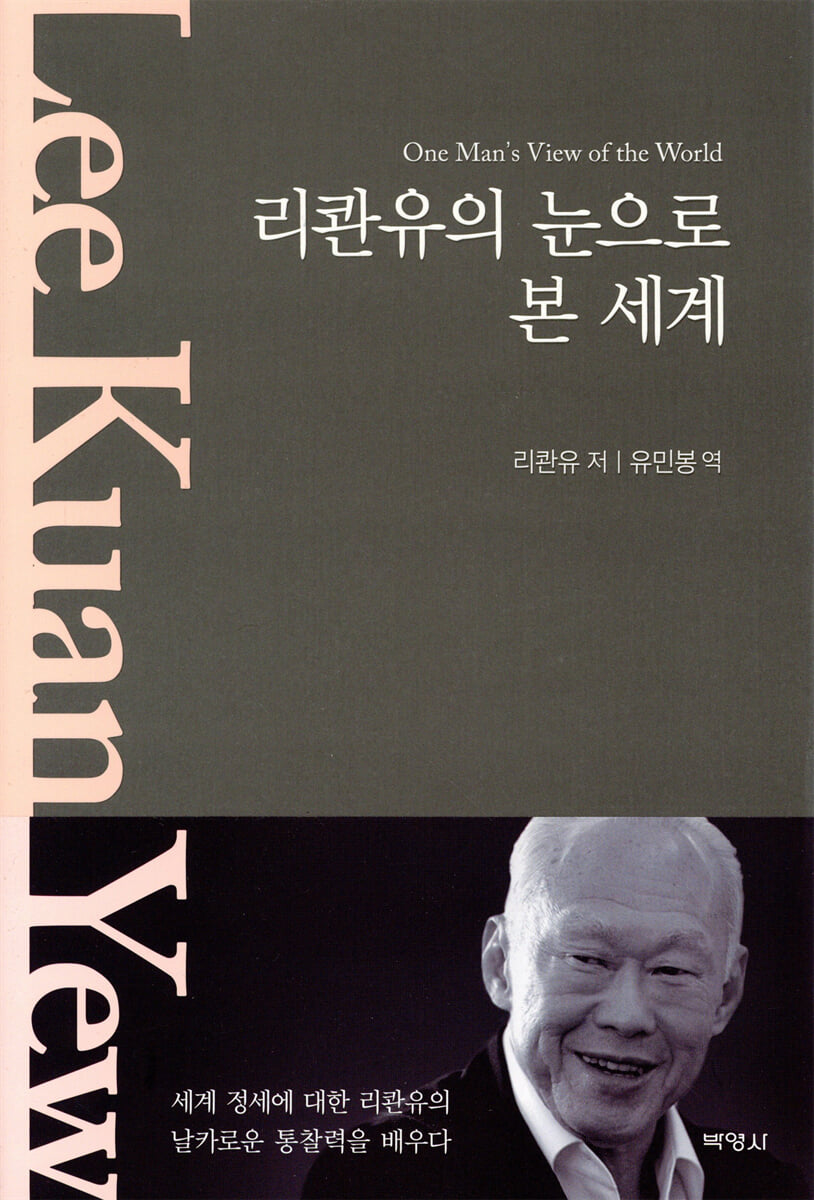
The World Through Lee Kuan Yew's Eyes
 |
Description
Book Introduction
This book is my view on the world we foresee and the major powers that will play a significant role in the future.
To understand how the future will unfold, a clear understanding of what is happening now and its causes is a prerequisite.
My understanding of international affairs is based on my observations of the many foreign figures I have met during my 50 years of public service.
During this period, I worked on Singapore's foreign policy and interacted with people who directly dealt with global issues.
The two countries whose decisions and actions have the greatest global impact are the United States and China.
But Singapore needs to maintain relationships with as many countries as possible, including Europe, Japan, Korea, Southeast Asia, India, and the Middle East, in addition to these two countries.
In this book, I have included my views on the major issues facing these countries and how their futures may unfold.
To understand how the future will unfold, a clear understanding of what is happening now and its causes is a prerequisite.
My understanding of international affairs is based on my observations of the many foreign figures I have met during my 50 years of public service.
During this period, I worked on Singapore's foreign policy and interacted with people who directly dealt with global issues.
The two countries whose decisions and actions have the greatest global impact are the United States and China.
But Singapore needs to maintain relationships with as many countries as possible, including Europe, Japan, Korea, Southeast Asia, India, and the Middle East, in addition to these two countries.
In this book, I have included my views on the major issues facing these countries and how their futures may unfold.
index
chapter
01
China
The Power of the Center: Central Control 3
Political Change 6
Interview 13
Hide your light and cultivate your leisure time
Build strength quietly so people don't become wary 18
Interview 30
The New China
People, Society, Economy 40
chapter
02
America
Problems but still the world's best 57
American Power: Dynamics 62
America's 70 Trouble Spots
America 73 I Know
Interview 78
chapter
03
EUROPE
Decline and Dissonance 85
The Shadow of Welfare and Labor Policy 91
The Special Characteristics of the Scandinavian Countries 97
Immigrant Issues 100
Vision and Reality of European Integration 103
Going out 106
Interview 108
chapter
04
Japan JAPAN Korean Peninsula KOREA India INDIA
-japan
From a developed country to an ordinary country, slowly slipping away 115
Interview 123
-Korean Peninsula
North Korea: Blatant Liar 127
South Korea (Republic of Korea) 133
Interview 135
-India
Trapped by the Caste System 137
Interview 144
chapter
05
Southeast Asia
-malaysia
Taking a Different Path from Singapore 149
Interview 159
-Indonesia
Promoting Decentralization: From the Central to the Local 163
Interview 175
-thailand
The lower classes are in turmoil 176
Interview 180
-vietnam
Trapped in the Socialist Ideological Framework 182
Interview 185
-Myanmar
The military changes the course of the nation 186
Interview 190
chapter
06
Singapore at a crossroads
Political Issues 193
Interview 203
Population Problem 206
Interview 212
Economic Issues 215
Interview 219
chapter
07
MIDDLE EAST
Spring Without Summer 225
Interview 233
The Powder Keg of the Middle East: The Israeli-Palestinian Conflict 235
Interview 240
Land of Opportunity 242
chapter
08
Global Economy
When's next? 245
Interview 253
Globalization 257
Interview 264
chapter
09
Energy & Climate Change
267 When preparing for the worst
Interview 276
chapter
10
MY LIFE
279 On the day of departure
At the end of his life 283
Interview 287
chapter
11
CONVERSATION
293 with old friend Helmut Schmidt
Leadership Lesson 294
Vision for Europe 311
Seokbyeol 324
Search 326
01
China
The Power of the Center: Central Control 3
Political Change 6
Interview 13
Hide your light and cultivate your leisure time
Build strength quietly so people don't become wary 18
Interview 30
The New China
People, Society, Economy 40
chapter
02
America
Problems but still the world's best 57
American Power: Dynamics 62
America's 70 Trouble Spots
America 73 I Know
Interview 78
chapter
03
EUROPE
Decline and Dissonance 85
The Shadow of Welfare and Labor Policy 91
The Special Characteristics of the Scandinavian Countries 97
Immigrant Issues 100
Vision and Reality of European Integration 103
Going out 106
Interview 108
chapter
04
Japan JAPAN Korean Peninsula KOREA India INDIA
-japan
From a developed country to an ordinary country, slowly slipping away 115
Interview 123
-Korean Peninsula
North Korea: Blatant Liar 127
South Korea (Republic of Korea) 133
Interview 135
-India
Trapped by the Caste System 137
Interview 144
chapter
05
Southeast Asia
-malaysia
Taking a Different Path from Singapore 149
Interview 159
-Indonesia
Promoting Decentralization: From the Central to the Local 163
Interview 175
-thailand
The lower classes are in turmoil 176
Interview 180
-vietnam
Trapped in the Socialist Ideological Framework 182
Interview 185
-Myanmar
The military changes the course of the nation 186
Interview 190
chapter
06
Singapore at a crossroads
Political Issues 193
Interview 203
Population Problem 206
Interview 212
Economic Issues 215
Interview 219
chapter
07
MIDDLE EAST
Spring Without Summer 225
Interview 233
The Powder Keg of the Middle East: The Israeli-Palestinian Conflict 235
Interview 240
Land of Opportunity 242
chapter
08
Global Economy
When's next? 245
Interview 253
Globalization 257
Interview 264
chapter
09
Energy & Climate Change
267 When preparing for the worst
Interview 276
chapter
10
MY LIFE
279 On the day of departure
At the end of his life 283
Interview 287
chapter
11
CONVERSATION
293 with old friend Helmut Schmidt
Leadership Lesson 294
Vision for Europe 311
Seokbyeol 324
Search 326
Publisher's Review
Author's Preface
The world has changed beyond imagination over the past 100 years.
When I was a child in the 1920s, it took an hour to get to my grandfather's house, which was less than ten miles away.
What's even more surprising is the way we communicate with each other today.
When I was going to school in Singapore in the 1930s, to receive the English magazines I loved, I had to wait for a ship that arrived from England once a week for five or six weeks.
Today, letters can be received in a matter of hours via fast airmail.
If that's too much trouble, you can use internet email or smartphone text messaging, which is fast and easy at the speed of light.
I didn't expect all these changes.
I was just watching the changes in Singapore.
What will the world look like 50 years from now? There's no way to know, except that it will change faster than it has in the past 50 years.
Rather, it would be more realistic to try to predict what will happen in 15 or 30 years.
Rather than a specific event, it is to the extent of predicting what major trends will dominate.
Even in this case, uncertainty cannot be ruled out.
This book is my view on the world we foresee and the major powers that will play a significant role in the future.
To understand how the future will unfold, a clear understanding of what is happening now and its causes is a prerequisite.
My understanding of international affairs is based on my observations of the many foreign figures I have met during my 50 years of public service.
During this period, I worked on Singapore's foreign policy and interacted with people who directly dealt with global issues.
The two countries whose decisions and actions have the greatest global impact are the United States and China.
But Singapore needs to maintain relationships with as many countries as possible, including Europe, Japan, Korea, Southeast Asia, India, and the Middle East, in addition to these two countries.
In this book, I have included my views on the major issues facing these countries and how their futures may unfold.
Singapore must accept the world as it is.
It's too small a country to change the world.
However, efforts can be made to maximize room for maneuver between these countries.
That is our strategy, and we must be clever in making it happen.
Domestically, three characteristics can explain Singapore's success story: creating the world's safest society, treating all citizens equally, and ensuring that success continues for future generations.
Without these three things that Singapore has built up to now, we would not have the advantages we enjoy today.
Whether you are a domestic or foreign investor, you need to be confident when investing in Singapore.
These three factors will ensure continued future returns on your investment.
If we fail to maintain these relationships with other nations, we risk being left out of the world's spotlight.
Translator's Preface
As I write this preface, China continues to take economic retaliatory measures in various forms, including banning Chinese groups from traveling to Korea and extending the suspension of Lotte Mart operations in China, claiming that the deployment of THAAD in Korea undermines its core interests.
Meanwhile, the United States is demonstrating its solid military alliance by deploying the B-1B supersonic strategic bomber and the nuclear-powered aircraft carrier Carl Vinson to the ROK-US joint military exercises, while raising the possibility of import restrictions on Korean steel products and renegotiation of the FTA, citing Korea's trade surplus with the US.
This is the reality of South Korea, caught between great powers in July 2017.
Many of our citizens have viewed China's political and economic statements and actions since the government's official announcement of the THAAD deployment in July 2016 as a diplomatic discourtesy that interferes with our sovereignty and an unfair response that offends our national pride.
While empathizing with the sentiments of the majority of the people, as a representative of the people, I could not help but ponder how to understand the two superpowers, China and the United States, and what alternatives Korea should take.
The book I took out from the bookshelf at that time was One Man's View of the World.
Through this book, I was able to gain a more balanced understanding of the United States and China, not through my own vague preconceptions and nationalistic sentiments, but through the eyes of former Singapore Prime Minister Lee Kuan Yew, who has interacted with many leaders of both countries on the international stage for over 50 years, from US Presidents Nixon to Obama and from China's Presidents Deng Xiaoping and Xi Jinping.
I translated this book because I wanted to share my experiences with many people.
This book is not an academic book.
This book is a personal account of Lee Kuan Yew's observations and interpretations of the world situation.
I was deeply impressed by Lee Kuan Yew's vision and philosophy of life as a leader.
Lee Kuan Yew's views are deeply rooted in Asian Confucian values and American capitalist economics.
Lee Kuan Yew, while believing in American market capitalism, also considered the historical and cultural specificities of each country and analyzed the political and economic phenomena of countries around the world, including the United States and China, and talked about the future.
Above all, I was deeply impressed by his unique insight, which is different from the opinions of any other foreign affairs expert or scholar, as it is a view gained through extensive interaction with leaders around the world for over 50 years and continuous observation of both leaders and their countries over a long period of time.
Also, his physical strength and clear mind to write this book at the age of 89, and his detached attitude to leave life without regrets, two years before his death at the age of 91, left a deep impression on my heart.
This book helped me clarify my vague understanding of China and the United States.
From Lee Kuan Yew's perspective, both the United States and China share a common goal of maintaining world order by prioritizing their own interests based on military and economic power.
However, while the US's method of exercising power is rational and therefore naive, China's is rough and emotional.
The United States treats foreign countries as sovereign states and in accordance with international norms, but it is making the mistake of overconfiding in absolute values such as freedom, democracy, and human rights when it comes to abnormal states and ignoring the historical, religious, and cultural uniqueness of these countries.
China does not impose any values or systems on other countries, but it displays the appearance of a hegemonic power that uses force to subdue countries that infringe on its interests, disregarding its status as a sovereign state and international norms.
Looking at the series of measures China has taken against Korea recently, it is easy to understand, and as Chinese psychologist Wu Zhihong pointed out, it is a country that is like a big child (巨?國).
Meanwhile, in the case of the United States, as Lee Kuan Yew observed, predictability and rationality according to international norms were important national assets.
However, since President Trump took office, a situation has emerged in which existing international norms are being shaken by America First policy.
If Lee Kuan Yew were alive today, he would also be perplexed by this American attitude.
We must clearly understand the reality that neither the United States nor China sacrifices its own interests to consider the interests of others, and that they are concentrating their national power, whether military or economic, to maintain greater power than their rivals.
Therefore, we, caught between great powers, must unite across political parties to protect our sovereignty, interests, and national pride, not through our own efforts alone, but through the power of a collective network of alliances, partnerships, and cooperation.
This book includes Lee Kuan Yew's understanding and arguments on not only the United States and China, but also Korea, Japan, India, Singapore, Europe, the Middle East, Southeast Asian countries, and the global economy, climate change, and energy.
Above all, his views on the causes and countermeasures for the low birth rate problem that countries around the world are experiencing, the background and limitations of the emergence of the European welfare state model, and especially the unique characteristics of the welfare model of the Scandinavian countries in Northern Europe provide many implications for us who are facing the problem of low birth rates and the pressure to expand welfare services.
Another area of interest was Lee Kuan Yew's keen analysis of the politics, economy, and history of Southeast Asian countries such as Malaysia, Indonesia, Vietnam, Thailand, and Myanmar.
South Korea, which has been running forward with its eyes fixed on national development, has been looking only at countries that are ahead of us and trying to catch up with them.
Southeast Asian countries that follow us in terms of national income and economic scale were out of our interest.
However, looking at the political systems and current affairs of these countries, I have come to realize that although our country may be ahead economically, we are not much different from these countries in terms of politics.
These countries are all emerging developing nations that have achieved clear results in political development and economic growth.
However, the degree of difference is only one, and the patriarchal and imperial power of one person dominates, so there is no check and balance between the legislative, executive, and judicial branches, and the opposition between the ruling and opposition parties is so sharp that the parliamentary politics of cooperation is not working.
While each political party in South Korea is proposing constitutional amendments by benchmarking the power structures and political systems of advanced nations like Germany, Austria, and France, we have also seen that there are many lessons we can learn from the political phenomena experienced by these countries, which share our Eastern culture.
As I complete the translation, I would like to express my gratitude to KPMG Advisor Kyung-Rae Cho, who recognized the value of this book and gifted me the original copy.
The original book contains many characters, place names, and technical terms.
To help readers understand, these are provided in footnotes.
Assistant Shin Jae-kyung, Dr. Lee Sun-ho, and Dr. Jo Yeon-kyung, who assisted with this work and proofreading.
I would like to express my gratitude to the staff of the Assemblyman's office, including Secretary Choi Woo-young, Secretary Lim Hee-yeon, Secretary Kim Hyo-jun, and Secretary Seong Min-woo.
Finally, I would like to express my deepest gratitude to editor Jeon Chae-rin and sales team member Kang Sang-hee for their tireless efforts in editing this book.
July 2017
Yoo Min-bong
Acknowledgements
The publication of this book would not have been possible without the assistance of the editorial staff of The Straits Times.
Hanhuk Kwang, Eljin Do, Zuraida Ibrahim, Chua Mui Hung, and Shashi Jayakmar contributed research and editing materials.
They also conducted several interviews with me, excerpts of which are included in each chapter of the book.
I would also like to thank my personal special assistant, Anthony Tan, my press secretary, Young Yunying, and the staff of various supporting organizations for their assistance in ensuring the smooth and timely publication of this book.
The world has changed beyond imagination over the past 100 years.
When I was a child in the 1920s, it took an hour to get to my grandfather's house, which was less than ten miles away.
What's even more surprising is the way we communicate with each other today.
When I was going to school in Singapore in the 1930s, to receive the English magazines I loved, I had to wait for a ship that arrived from England once a week for five or six weeks.
Today, letters can be received in a matter of hours via fast airmail.
If that's too much trouble, you can use internet email or smartphone text messaging, which is fast and easy at the speed of light.
I didn't expect all these changes.
I was just watching the changes in Singapore.
What will the world look like 50 years from now? There's no way to know, except that it will change faster than it has in the past 50 years.
Rather, it would be more realistic to try to predict what will happen in 15 or 30 years.
Rather than a specific event, it is to the extent of predicting what major trends will dominate.
Even in this case, uncertainty cannot be ruled out.
This book is my view on the world we foresee and the major powers that will play a significant role in the future.
To understand how the future will unfold, a clear understanding of what is happening now and its causes is a prerequisite.
My understanding of international affairs is based on my observations of the many foreign figures I have met during my 50 years of public service.
During this period, I worked on Singapore's foreign policy and interacted with people who directly dealt with global issues.
The two countries whose decisions and actions have the greatest global impact are the United States and China.
But Singapore needs to maintain relationships with as many countries as possible, including Europe, Japan, Korea, Southeast Asia, India, and the Middle East, in addition to these two countries.
In this book, I have included my views on the major issues facing these countries and how their futures may unfold.
Singapore must accept the world as it is.
It's too small a country to change the world.
However, efforts can be made to maximize room for maneuver between these countries.
That is our strategy, and we must be clever in making it happen.
Domestically, three characteristics can explain Singapore's success story: creating the world's safest society, treating all citizens equally, and ensuring that success continues for future generations.
Without these three things that Singapore has built up to now, we would not have the advantages we enjoy today.
Whether you are a domestic or foreign investor, you need to be confident when investing in Singapore.
These three factors will ensure continued future returns on your investment.
If we fail to maintain these relationships with other nations, we risk being left out of the world's spotlight.
Translator's Preface
As I write this preface, China continues to take economic retaliatory measures in various forms, including banning Chinese groups from traveling to Korea and extending the suspension of Lotte Mart operations in China, claiming that the deployment of THAAD in Korea undermines its core interests.
Meanwhile, the United States is demonstrating its solid military alliance by deploying the B-1B supersonic strategic bomber and the nuclear-powered aircraft carrier Carl Vinson to the ROK-US joint military exercises, while raising the possibility of import restrictions on Korean steel products and renegotiation of the FTA, citing Korea's trade surplus with the US.
This is the reality of South Korea, caught between great powers in July 2017.
Many of our citizens have viewed China's political and economic statements and actions since the government's official announcement of the THAAD deployment in July 2016 as a diplomatic discourtesy that interferes with our sovereignty and an unfair response that offends our national pride.
While empathizing with the sentiments of the majority of the people, as a representative of the people, I could not help but ponder how to understand the two superpowers, China and the United States, and what alternatives Korea should take.
The book I took out from the bookshelf at that time was One Man's View of the World.
Through this book, I was able to gain a more balanced understanding of the United States and China, not through my own vague preconceptions and nationalistic sentiments, but through the eyes of former Singapore Prime Minister Lee Kuan Yew, who has interacted with many leaders of both countries on the international stage for over 50 years, from US Presidents Nixon to Obama and from China's Presidents Deng Xiaoping and Xi Jinping.
I translated this book because I wanted to share my experiences with many people.
This book is not an academic book.
This book is a personal account of Lee Kuan Yew's observations and interpretations of the world situation.
I was deeply impressed by Lee Kuan Yew's vision and philosophy of life as a leader.
Lee Kuan Yew's views are deeply rooted in Asian Confucian values and American capitalist economics.
Lee Kuan Yew, while believing in American market capitalism, also considered the historical and cultural specificities of each country and analyzed the political and economic phenomena of countries around the world, including the United States and China, and talked about the future.
Above all, I was deeply impressed by his unique insight, which is different from the opinions of any other foreign affairs expert or scholar, as it is a view gained through extensive interaction with leaders around the world for over 50 years and continuous observation of both leaders and their countries over a long period of time.
Also, his physical strength and clear mind to write this book at the age of 89, and his detached attitude to leave life without regrets, two years before his death at the age of 91, left a deep impression on my heart.
This book helped me clarify my vague understanding of China and the United States.
From Lee Kuan Yew's perspective, both the United States and China share a common goal of maintaining world order by prioritizing their own interests based on military and economic power.
However, while the US's method of exercising power is rational and therefore naive, China's is rough and emotional.
The United States treats foreign countries as sovereign states and in accordance with international norms, but it is making the mistake of overconfiding in absolute values such as freedom, democracy, and human rights when it comes to abnormal states and ignoring the historical, religious, and cultural uniqueness of these countries.
China does not impose any values or systems on other countries, but it displays the appearance of a hegemonic power that uses force to subdue countries that infringe on its interests, disregarding its status as a sovereign state and international norms.
Looking at the series of measures China has taken against Korea recently, it is easy to understand, and as Chinese psychologist Wu Zhihong pointed out, it is a country that is like a big child (巨?國).
Meanwhile, in the case of the United States, as Lee Kuan Yew observed, predictability and rationality according to international norms were important national assets.
However, since President Trump took office, a situation has emerged in which existing international norms are being shaken by America First policy.
If Lee Kuan Yew were alive today, he would also be perplexed by this American attitude.
We must clearly understand the reality that neither the United States nor China sacrifices its own interests to consider the interests of others, and that they are concentrating their national power, whether military or economic, to maintain greater power than their rivals.
Therefore, we, caught between great powers, must unite across political parties to protect our sovereignty, interests, and national pride, not through our own efforts alone, but through the power of a collective network of alliances, partnerships, and cooperation.
This book includes Lee Kuan Yew's understanding and arguments on not only the United States and China, but also Korea, Japan, India, Singapore, Europe, the Middle East, Southeast Asian countries, and the global economy, climate change, and energy.
Above all, his views on the causes and countermeasures for the low birth rate problem that countries around the world are experiencing, the background and limitations of the emergence of the European welfare state model, and especially the unique characteristics of the welfare model of the Scandinavian countries in Northern Europe provide many implications for us who are facing the problem of low birth rates and the pressure to expand welfare services.
Another area of interest was Lee Kuan Yew's keen analysis of the politics, economy, and history of Southeast Asian countries such as Malaysia, Indonesia, Vietnam, Thailand, and Myanmar.
South Korea, which has been running forward with its eyes fixed on national development, has been looking only at countries that are ahead of us and trying to catch up with them.
Southeast Asian countries that follow us in terms of national income and economic scale were out of our interest.
However, looking at the political systems and current affairs of these countries, I have come to realize that although our country may be ahead economically, we are not much different from these countries in terms of politics.
These countries are all emerging developing nations that have achieved clear results in political development and economic growth.
However, the degree of difference is only one, and the patriarchal and imperial power of one person dominates, so there is no check and balance between the legislative, executive, and judicial branches, and the opposition between the ruling and opposition parties is so sharp that the parliamentary politics of cooperation is not working.
While each political party in South Korea is proposing constitutional amendments by benchmarking the power structures and political systems of advanced nations like Germany, Austria, and France, we have also seen that there are many lessons we can learn from the political phenomena experienced by these countries, which share our Eastern culture.
As I complete the translation, I would like to express my gratitude to KPMG Advisor Kyung-Rae Cho, who recognized the value of this book and gifted me the original copy.
The original book contains many characters, place names, and technical terms.
To help readers understand, these are provided in footnotes.
Assistant Shin Jae-kyung, Dr. Lee Sun-ho, and Dr. Jo Yeon-kyung, who assisted with this work and proofreading.
I would like to express my gratitude to the staff of the Assemblyman's office, including Secretary Choi Woo-young, Secretary Lim Hee-yeon, Secretary Kim Hyo-jun, and Secretary Seong Min-woo.
Finally, I would like to express my deepest gratitude to editor Jeon Chae-rin and sales team member Kang Sang-hee for their tireless efforts in editing this book.
July 2017
Yoo Min-bong
Acknowledgements
The publication of this book would not have been possible without the assistance of the editorial staff of The Straits Times.
Hanhuk Kwang, Eljin Do, Zuraida Ibrahim, Chua Mui Hung, and Shashi Jayakmar contributed research and editing materials.
They also conducted several interviews with me, excerpts of which are included in each chapter of the book.
I would also like to thank my personal special assistant, Anthony Tan, my press secretary, Young Yunying, and the staff of various supporting organizations for their assistance in ensuring the smooth and timely publication of this book.
GOODS SPECIFICS
- Date of issue: July 15, 2017
- Page count, weight, size: 335 pages | Checking size
- ISBN13: 9791130304212
- ISBN10: 1130304213
You may also like
카테고리
korean


korean

![GQ KOREA Mark (Monthly): December [2025]](http://librairie.coreenne.fr/cdn/shop/files/8ef265dbbfbf186523ed75ba7319009d.jpg?v=1765340328&width=3840)


