

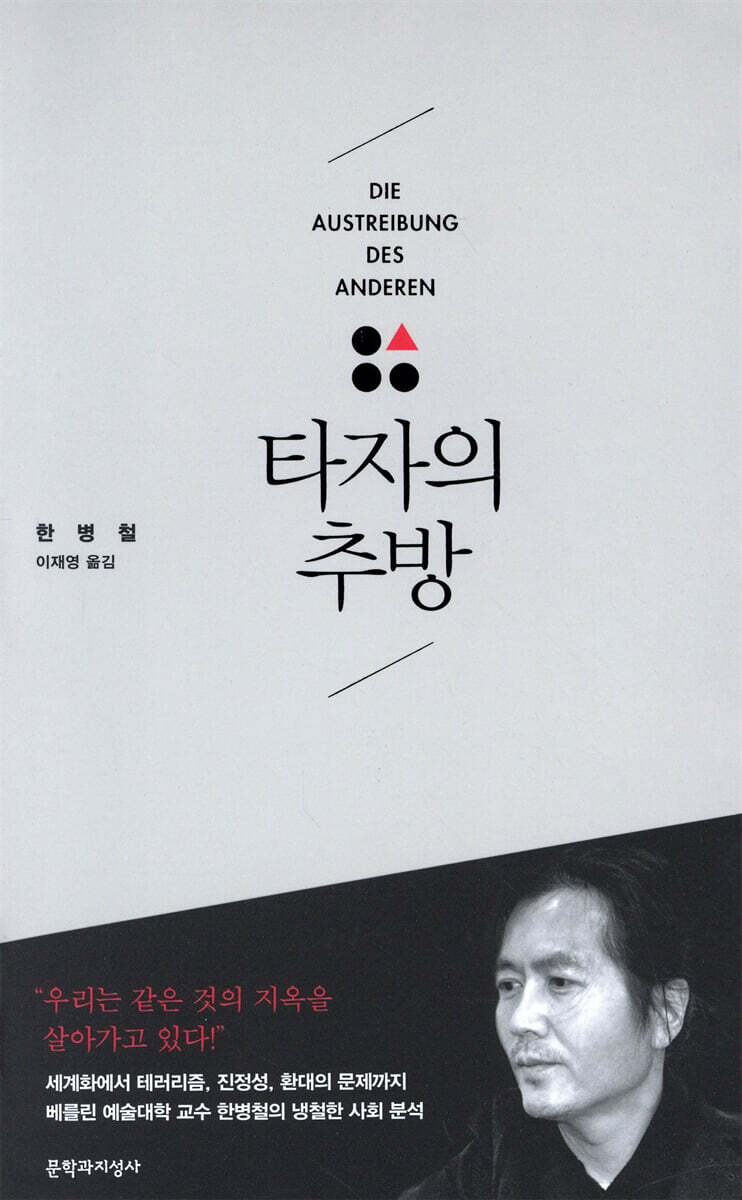
The expulsion of the typist
 |
Description
Book Introduction
“We are living in the same hell right now!”
From globalization to terrorism, authenticity, and hospitality
A sobering social analysis by Han Byung-chul, a professor at the Berlin University of the Arts.
The days of typing are over.
The other as secret, the other as temptation, the other as Eros, the other as desire, the other as pain disappear.
Today, the negativity of the other is being pushed out by the positivity of the same.
The proliferation of the same thing produces pathological changes that engulf the social body.
It is not deprivation or prohibition, but overcommunication and overconsumption, and it is not change and negation, but acceptance and affirmation that make society sick.
Han Byung-chul traces the violence of the same in phenomena such as fear, globalization, terrorism, and the pursuit of authenticity that characterize today's society.
If Professor Han Byeong-cheol, the author of his previous work, "The Burnout Society," critically observed the modern people who exploit themselves under the command "I can do it," and "The End of Eros" spoke of an era in which love has become impossible, this book delves into the phenomenon of "the disappearance of the other," which the author pointed out as the fundamental cause of such a situation.
The author argues that while today's world appears to value freedom and diversity, it is actually a "hell ruled by the same," dominated by the violence of the global, which standardizes and makes everything interchangeable.
He shows in detail how this violence disempowers humans.
It also analyzes the relationship between socio-political phenomena such as 'terrorism,' 'refugees,' 'hospitality,' and 'the pursuit of authenticity' and the disappearance of the other.
This small book, a sharp reflection on our era dominated by neoliberalism and globalization, makes us painfully reflect on the challenges our world faces.
From globalization to terrorism, authenticity, and hospitality
A sobering social analysis by Han Byung-chul, a professor at the Berlin University of the Arts.
The days of typing are over.
The other as secret, the other as temptation, the other as Eros, the other as desire, the other as pain disappear.
Today, the negativity of the other is being pushed out by the positivity of the same.
The proliferation of the same thing produces pathological changes that engulf the social body.
It is not deprivation or prohibition, but overcommunication and overconsumption, and it is not change and negation, but acceptance and affirmation that make society sick.
Han Byung-chul traces the violence of the same in phenomena such as fear, globalization, terrorism, and the pursuit of authenticity that characterize today's society.
If Professor Han Byeong-cheol, the author of his previous work, "The Burnout Society," critically observed the modern people who exploit themselves under the command "I can do it," and "The End of Eros" spoke of an era in which love has become impossible, this book delves into the phenomenon of "the disappearance of the other," which the author pointed out as the fundamental cause of such a situation.
The author argues that while today's world appears to value freedom and diversity, it is actually a "hell ruled by the same," dominated by the violence of the global, which standardizes and makes everything interchangeable.
He shows in detail how this violence disempowers humans.
It also analyzes the relationship between socio-political phenomena such as 'terrorism,' 'refugees,' 'hospitality,' and 'the pursuit of authenticity' and the disappearance of the other.
This small book, a sharp reflection on our era dominated by neoliberalism and globalization, makes us painfully reflect on the challenges our world faces.
- You can preview some of the book's contents.
Preview
index
terror of the same thing
Global violence and terrorism
The terror of authenticity
awe
threshold
alienation
anti-body
gaze
voice
The language of the typist
The typist's thoughts
Listen
Americas
Translator's Note
Global violence and terrorism
The terror of authenticity
awe
threshold
alienation
anti-body
gaze
voice
The language of the typist
The typist's thoughts
Listen
Americas
Translator's Note
Into the book
The era of typists is over.
The other as secret, the other as temptation, the other as Eros, the other as desire, the other as hell, the other as pain disappear.
Today, the negativity of the other is being pushed out by the positivity of the same.
The proliferation of the same thing produces pathological changes that engulf the social body.
It is not deprivation or prohibition, but overcommunication and overconsumption, and it is not exclusion and denial, but acceptance and affirmation that make society sick.
Depression, not oppression, is the sign of today's morbid times. --- p.7
Globalization has the violent power to make everything interchangeable, comparable, and therefore identical.
Ver-Gleichen ultimately leads to the disappearance of meaning.
Meaning is something incomparable.
Money alone does not create meaning or identity. --- p.21
The word authenticity is often used today.
Authenticity, like all neoliberal advertisements, comes dressed in the garb of liberation.
Being authentic means being free from the externally determined framework of expression and attitude that has already been created in advance.
Authenticity demands that we be like ourselves only, that we define ourselves only through ourselves, that we are our own author and creator. --- p.34
Is suicide terrorism a perverse attempt to feel self-conscious, to restore shattered self-esteem, to blast or destroy the emptiness that weighs heavily on us? If so, are the psychology of selfies and self-harm, which are also ways to deal with a hollow self, similar to that of terrorism? Do terrorists share the same psychological characteristics as adolescents who turn their aggression against themselves and harm themselves? As is well known, unlike girls, boys' aggression is directed outward, toward others.
--- p.43
Today, we live in a neoliberal system that demolishes the stable structure of time, fragments our lives, and destroys connections and bonds in the name of increasing productivity.
This neoliberal time policy breeds fear and anxiety.
And neoliberalism individualizes humans into isolated managers of their own affairs.
The individualization brought about by de-solidarization and all-out competition breeds fear.
The deceptive logic of neoliberalism argues that:
Fear increases productivity. --- p.54
Today, the Ubergang, a passage with many thresholds, is being replaced by the Durchgang, a passage without thresholds.
On the Internet, we are more tourists than ever before.
We are no longer homo doloris--- p. human of sorrow) who dwell on the threshold.
Tourists do not undergo experiences that involve transformation and pain.
So they stay in the same state.
They travel through the same hell.--- p.56
Under neoliberalism, exploitation no longer leads to alienation or self-derealization, but to freedom, self-realization, and self-optimization.
Here there is no other as an exploiter who forces me to work and alienates me from myself.
Rather, I voluntarily exploit myself in the belief that I am realizing myself.
This is the vile logic of neoliberalism.
[… … ] The dominance of neoliberalism hides behind an illusion of freedom.
Domination is complete the moment it coincides with freedom.
This perceived freedom is fatal in that it makes all resistance, all revolution, impossible.
What is there to resist? When the oppressive others no longer exist. --- p.61-62
We must see life anew from the perspective of others and from our relationships with others, and recognize the ethical priority of others.
Furthermore, we must relearn the language of responsibility, of listening to others and responding to them.
Levinas saw language as “speaking” as nothing other than “one person’s responsibility for another.” --- p.107
In the future, there may be a profession called listener.
He listens to other people's stories for money.
People go to the listener because there are few people who listen to what others have to say.
Today, we are increasingly losing the ability to listen.
Above all, the growing focus on the ego and the narcissism of society make listening difficult.
Narcissus does not respond to the nymph Echo's loving voice, which must truly be the voice of the other.
The other as secret, the other as temptation, the other as Eros, the other as desire, the other as hell, the other as pain disappear.
Today, the negativity of the other is being pushed out by the positivity of the same.
The proliferation of the same thing produces pathological changes that engulf the social body.
It is not deprivation or prohibition, but overcommunication and overconsumption, and it is not exclusion and denial, but acceptance and affirmation that make society sick.
Depression, not oppression, is the sign of today's morbid times. --- p.7
Globalization has the violent power to make everything interchangeable, comparable, and therefore identical.
Ver-Gleichen ultimately leads to the disappearance of meaning.
Meaning is something incomparable.
Money alone does not create meaning or identity. --- p.21
The word authenticity is often used today.
Authenticity, like all neoliberal advertisements, comes dressed in the garb of liberation.
Being authentic means being free from the externally determined framework of expression and attitude that has already been created in advance.
Authenticity demands that we be like ourselves only, that we define ourselves only through ourselves, that we are our own author and creator. --- p.34
Is suicide terrorism a perverse attempt to feel self-conscious, to restore shattered self-esteem, to blast or destroy the emptiness that weighs heavily on us? If so, are the psychology of selfies and self-harm, which are also ways to deal with a hollow self, similar to that of terrorism? Do terrorists share the same psychological characteristics as adolescents who turn their aggression against themselves and harm themselves? As is well known, unlike girls, boys' aggression is directed outward, toward others.
--- p.43
Today, we live in a neoliberal system that demolishes the stable structure of time, fragments our lives, and destroys connections and bonds in the name of increasing productivity.
This neoliberal time policy breeds fear and anxiety.
And neoliberalism individualizes humans into isolated managers of their own affairs.
The individualization brought about by de-solidarization and all-out competition breeds fear.
The deceptive logic of neoliberalism argues that:
Fear increases productivity. --- p.54
Today, the Ubergang, a passage with many thresholds, is being replaced by the Durchgang, a passage without thresholds.
On the Internet, we are more tourists than ever before.
We are no longer homo doloris--- p. human of sorrow) who dwell on the threshold.
Tourists do not undergo experiences that involve transformation and pain.
So they stay in the same state.
They travel through the same hell.--- p.56
Under neoliberalism, exploitation no longer leads to alienation or self-derealization, but to freedom, self-realization, and self-optimization.
Here there is no other as an exploiter who forces me to work and alienates me from myself.
Rather, I voluntarily exploit myself in the belief that I am realizing myself.
This is the vile logic of neoliberalism.
[… … ] The dominance of neoliberalism hides behind an illusion of freedom.
Domination is complete the moment it coincides with freedom.
This perceived freedom is fatal in that it makes all resistance, all revolution, impossible.
What is there to resist? When the oppressive others no longer exist. --- p.61-62
We must see life anew from the perspective of others and from our relationships with others, and recognize the ethical priority of others.
Furthermore, we must relearn the language of responsibility, of listening to others and responding to them.
Levinas saw language as “speaking” as nothing other than “one person’s responsibility for another.” --- p.107
In the future, there may be a profession called listener.
He listens to other people's stories for money.
People go to the listener because there are few people who listen to what others have to say.
Today, we are increasingly losing the ability to listen.
Above all, the growing focus on the ego and the narcissism of society make listening difficult.
Narcissus does not respond to the nymph Echo's loving voice, which must truly be the voice of the other.
--- p.108
Publisher's Review
“We are living in the same hell right now!”
From globalization to terrorism, authenticity, and hospitality
A sobering social analysis by Han Byung-chul, a professor at the Berlin University of the Arts.
Professor Han Byeong-cheol, author of “The Fatigued Society” and “The Transparent Society,” has published his new book, “The Expulsion of the Other.”
If the previous work, "The Burnout Society," critically observed the modern man who exploits himself under the command of "I can do it," and "The End of Eros" spoke of an era in which love has become impossible, this book delves into the phenomenon of "the disappearance of the other," which the author pointed out as the fundamental cause of such a situation.
The author argues that while today's world appears to value freedom and diversity, it is actually a "hell ruled by the same," dominated by the violence of the global, which standardizes and makes everything interchangeable.
He shows in detail how this violence disempowers humans.
It also analyzes the relationship between socio-political phenomena such as 'terrorism,' 'refugees,' 'hospitality,' and 'the pursuit of authenticity' and the disappearance of the other.
This small book, a sharp reflection on our era dominated by neoliberalism and globalization, makes us painfully reflect on the challenges our world faces.
“The Other as Secret, the Other as Temptation, the Other as Eros
“The other as desire, the other as pain, disappears.”
The book begins with the powerful sentence, “The era of the other is over.”
Here, the word 'other' has various meanings, but if I were to choose its core meaning, I would say it is 'a stranger, a being that I cannot understand and that makes me uncomfortable, a being that does not do as I wish.'
In other words, the other is an object of fear, and in a sense, it can be said that the history of mankind is a history of struggle with this other.
But on the other hand, the typist has performed an important function of giving human life a certain shape, direction, and meaning.
Han Byung-chul is declaring that such types of people have disappeared today.
The author chillingly portrays today's narcissistic society, where opportunities to encounter unfamiliar others are reduced, only similarities are rampant, and we can only survive by dealing with what we have become accustomed to.
Sartre said, “Hell is other people,” but today, hell is the same.
This hell is ruled in a different way than in the past.
In the past, oppression, prohibition, and denial were used to exploit humans, whereas now freedom, permission, and affirmation lead humans to self-exploitation.
Humans who are homogenized as the same being are trapped within themselves and are unable to achieve true awareness, and they also lose the ability to reflect on themselves and the world.
They simply strive to optimize themselves for production in order to survive the competition.
“The more humans, governed by the constant anxiety of being left behind, exploit themselves, the more capital profits are maximized.” Making one’s own systematic oppression invisible and disguising it as freedom and growth is precisely the deceptive logic of neoliberalism.
According to the author, “this perceived freedom is fatal because it makes all resistance, all revolution, impossible.” When there is no longer an oppressive other, what is there to resist?
“The madness of globalization creates madmen called terrorists.”
Han Byung-chul traces the violence of the same thing even in seemingly disparate phenomena that characterize today's society: terrorism, nationalism, the pursuit of authenticity, and selfie addiction.
The violence of the global, which renders everything interchangeable, comparable, and therefore identical, produces a destructive force that opposes it.
Here the author quotes Baudrillard, who said, “The madness of globalization creates madmen called terrorists.”
Terrorist attacks can be seen as 'extreme' attempts to create cracks in the system of the same.
The social unrest brought about by despair and lack of prospects creates fertile ground for terrorist forces.
Likewise, the resurgence of nationalism and the neo-right wing today can be seen as a backlash against the dominance of the global.
“Islamic terrorists and chauvinistic nationalists are not actually enemies, but brothers who have gone through the same origins.” The various hate phenomena currently sweeping our society can be examined in a similar context.
Han Byung-chul goes further and links terrorism to self-harm and selfie addiction.
In today's society, all forms of hurt that can arise from encounters with others are avoided, but they are resurrected as self-harm.
As the gaze of others who acknowledge and love us disappears, people lose their sense of presence, and this lack becomes the cause of self-harm.
People try in vain to confirm their existence when faced with an inner emptiness.
A selfie is a smooth surface of an empty, insecure self.
People “pick up a razor blade or a smartphone” to escape the painful emptiness. Suicide terrorism is a paradoxical act where self-attack and other-attack, self-production and self-destruction overlap, and it is imagined as the final selfie.
According to the author, “Press-and-hold the button to detonate a bomb is similar to pressing the shutter on a camera.”
The demand for 'authenticity', which is often heard today, is also put on trial.
According to Han Byung-chul, “authenticity, like all neoliberal advertisements, appears dressed in the garb of liberation.” But authenticity is merely a sales pitch.
This authenticity “allows only differences that are consistent with the system, that is, only miscellaneous.”
In neoliberal terms, clutter is an exploitable resource.
Nowadays, everyone wants to be different from others.
However, the author sees that in this desire to be different from others, the same thing continues.
Diversity and choice are even more dangerous because they make us feel like there are differences where there really are not, and thus blind us to the violence of sameness.
Salvation comes from others!
How can humans find a way out in the midst of the proliferation of the same, the terror of the same?
The author believes that salvation from the hell of the same ultimately comes from others.
Only the other can enable us to perceive and reflect on ourselves and the world, restore meaning, and escape from isolation.
According to the author, hospitality is “a measure of the degree of civilization of a society.”
He asserts firmly that “today’s refugee crisis exposes the European Union as nothing more than an economic and commercial bloc pursuing selfish objectives.”
The author says that we should welcome others with hospitality, rather than rejecting and hating them.
We must look at life anew from the perspective of others and from our relationships with others, and recognize the ethical priority of others.
Furthermore, we must relearn the language of responsibility, of listening to others and responding to them.
This book strongly argues that the most urgent task for us is to give back to the Others we have banished.
Han Byung-chul's writing, through short, concise, yet provocative sentences that strike at the heart of the matter, keenly observes crucial aspects of our times that we often overlook or are unaware of, and delves into their roots.
He also combines his controversial arguments with compelling examples drawn from a variety of sources.
It is also interesting to see how the films of Charlie Kaufman, Federico Fellini, Alfred Hitchcock, and Lars von Trier, as well as the literary works of Maurice Blanchot, George Orwell, Franz Kafka, Paul Celan, Albert Camus, Peter Handke, and Michael Ende, appear in this book.
Professor Han Byung-chul's books, published in German, have been introduced in over 15 countries, including the United States, Italy, France, Turkey, and Greece, and have recently gained unusual popularity in Spanish-speaking countries as well.
In 2015, his essay "In the Crowd" won the Prix Bristol des Lumières (Foreign Essay) in France, and in 2016, he won the Futurology Research Award from the Salzburg State Government in Austria.
Recommended articles
Han Byeong-cheol's book seeks to shake us up rather than satisfy us.
[… …] His cool intellect makes us reconsider globalization, terrorism, and nationalism._『Deutschlandfunk』
It would be fair to say that Han Byung-chul created his own unique tradition of thought. _『Welt am Sonntag』
This book continues Adorno's Minima Moralia in a fresh and timely manner in a new form. _Philozofische Magatzin
We should be grateful for Han Byung-chul's boldness in taking a holistic view of these turbulent times. _Der Spiegel
He is considered a new star in the world of philosophy.
With just a few sentences, it destroys the structures of thought that support our daily lives._『Die Zeit』
From globalization to terrorism, authenticity, and hospitality
A sobering social analysis by Han Byung-chul, a professor at the Berlin University of the Arts.
Professor Han Byeong-cheol, author of “The Fatigued Society” and “The Transparent Society,” has published his new book, “The Expulsion of the Other.”
If the previous work, "The Burnout Society," critically observed the modern man who exploits himself under the command of "I can do it," and "The End of Eros" spoke of an era in which love has become impossible, this book delves into the phenomenon of "the disappearance of the other," which the author pointed out as the fundamental cause of such a situation.
The author argues that while today's world appears to value freedom and diversity, it is actually a "hell ruled by the same," dominated by the violence of the global, which standardizes and makes everything interchangeable.
He shows in detail how this violence disempowers humans.
It also analyzes the relationship between socio-political phenomena such as 'terrorism,' 'refugees,' 'hospitality,' and 'the pursuit of authenticity' and the disappearance of the other.
This small book, a sharp reflection on our era dominated by neoliberalism and globalization, makes us painfully reflect on the challenges our world faces.
“The Other as Secret, the Other as Temptation, the Other as Eros
“The other as desire, the other as pain, disappears.”
The book begins with the powerful sentence, “The era of the other is over.”
Here, the word 'other' has various meanings, but if I were to choose its core meaning, I would say it is 'a stranger, a being that I cannot understand and that makes me uncomfortable, a being that does not do as I wish.'
In other words, the other is an object of fear, and in a sense, it can be said that the history of mankind is a history of struggle with this other.
But on the other hand, the typist has performed an important function of giving human life a certain shape, direction, and meaning.
Han Byung-chul is declaring that such types of people have disappeared today.
The author chillingly portrays today's narcissistic society, where opportunities to encounter unfamiliar others are reduced, only similarities are rampant, and we can only survive by dealing with what we have become accustomed to.
Sartre said, “Hell is other people,” but today, hell is the same.
This hell is ruled in a different way than in the past.
In the past, oppression, prohibition, and denial were used to exploit humans, whereas now freedom, permission, and affirmation lead humans to self-exploitation.
Humans who are homogenized as the same being are trapped within themselves and are unable to achieve true awareness, and they also lose the ability to reflect on themselves and the world.
They simply strive to optimize themselves for production in order to survive the competition.
“The more humans, governed by the constant anxiety of being left behind, exploit themselves, the more capital profits are maximized.” Making one’s own systematic oppression invisible and disguising it as freedom and growth is precisely the deceptive logic of neoliberalism.
According to the author, “this perceived freedom is fatal because it makes all resistance, all revolution, impossible.” When there is no longer an oppressive other, what is there to resist?
“The madness of globalization creates madmen called terrorists.”
Han Byung-chul traces the violence of the same thing even in seemingly disparate phenomena that characterize today's society: terrorism, nationalism, the pursuit of authenticity, and selfie addiction.
The violence of the global, which renders everything interchangeable, comparable, and therefore identical, produces a destructive force that opposes it.
Here the author quotes Baudrillard, who said, “The madness of globalization creates madmen called terrorists.”
Terrorist attacks can be seen as 'extreme' attempts to create cracks in the system of the same.
The social unrest brought about by despair and lack of prospects creates fertile ground for terrorist forces.
Likewise, the resurgence of nationalism and the neo-right wing today can be seen as a backlash against the dominance of the global.
“Islamic terrorists and chauvinistic nationalists are not actually enemies, but brothers who have gone through the same origins.” The various hate phenomena currently sweeping our society can be examined in a similar context.
Han Byung-chul goes further and links terrorism to self-harm and selfie addiction.
In today's society, all forms of hurt that can arise from encounters with others are avoided, but they are resurrected as self-harm.
As the gaze of others who acknowledge and love us disappears, people lose their sense of presence, and this lack becomes the cause of self-harm.
People try in vain to confirm their existence when faced with an inner emptiness.
A selfie is a smooth surface of an empty, insecure self.
People “pick up a razor blade or a smartphone” to escape the painful emptiness. Suicide terrorism is a paradoxical act where self-attack and other-attack, self-production and self-destruction overlap, and it is imagined as the final selfie.
According to the author, “Press-and-hold the button to detonate a bomb is similar to pressing the shutter on a camera.”
The demand for 'authenticity', which is often heard today, is also put on trial.
According to Han Byung-chul, “authenticity, like all neoliberal advertisements, appears dressed in the garb of liberation.” But authenticity is merely a sales pitch.
This authenticity “allows only differences that are consistent with the system, that is, only miscellaneous.”
In neoliberal terms, clutter is an exploitable resource.
Nowadays, everyone wants to be different from others.
However, the author sees that in this desire to be different from others, the same thing continues.
Diversity and choice are even more dangerous because they make us feel like there are differences where there really are not, and thus blind us to the violence of sameness.
Salvation comes from others!
How can humans find a way out in the midst of the proliferation of the same, the terror of the same?
The author believes that salvation from the hell of the same ultimately comes from others.
Only the other can enable us to perceive and reflect on ourselves and the world, restore meaning, and escape from isolation.
According to the author, hospitality is “a measure of the degree of civilization of a society.”
He asserts firmly that “today’s refugee crisis exposes the European Union as nothing more than an economic and commercial bloc pursuing selfish objectives.”
The author says that we should welcome others with hospitality, rather than rejecting and hating them.
We must look at life anew from the perspective of others and from our relationships with others, and recognize the ethical priority of others.
Furthermore, we must relearn the language of responsibility, of listening to others and responding to them.
This book strongly argues that the most urgent task for us is to give back to the Others we have banished.
Han Byung-chul's writing, through short, concise, yet provocative sentences that strike at the heart of the matter, keenly observes crucial aspects of our times that we often overlook or are unaware of, and delves into their roots.
He also combines his controversial arguments with compelling examples drawn from a variety of sources.
It is also interesting to see how the films of Charlie Kaufman, Federico Fellini, Alfred Hitchcock, and Lars von Trier, as well as the literary works of Maurice Blanchot, George Orwell, Franz Kafka, Paul Celan, Albert Camus, Peter Handke, and Michael Ende, appear in this book.
Professor Han Byung-chul's books, published in German, have been introduced in over 15 countries, including the United States, Italy, France, Turkey, and Greece, and have recently gained unusual popularity in Spanish-speaking countries as well.
In 2015, his essay "In the Crowd" won the Prix Bristol des Lumières (Foreign Essay) in France, and in 2016, he won the Futurology Research Award from the Salzburg State Government in Austria.
Recommended articles
Han Byeong-cheol's book seeks to shake us up rather than satisfy us.
[… …] His cool intellect makes us reconsider globalization, terrorism, and nationalism._『Deutschlandfunk』
It would be fair to say that Han Byung-chul created his own unique tradition of thought. _『Welt am Sonntag』
This book continues Adorno's Minima Moralia in a fresh and timely manner in a new form. _Philozofische Magatzin
We should be grateful for Han Byung-chul's boldness in taking a holistic view of these turbulent times. _Der Spiegel
He is considered a new star in the world of philosophy.
With just a few sentences, it destroys the structures of thought that support our daily lives._『Die Zeit』
GOODS SPECIFICS
- Date of publication: February 27, 2017
- Page count, weight, size: 236 pages | 168g | 145*210*14mm
- ISBN13: 9788932029863
- ISBN10: 8932029865
You may also like
카테고리
korean


korean

![GQ KOREA Mark (Monthly): December [2025]](http://librairie.coreenne.fr/cdn/shop/files/8ef265dbbfbf186523ed75ba7319009d.jpg?v=1765340328&width=3840)


