

Minimum literacy for adults today
 |
Description
Book Introduction
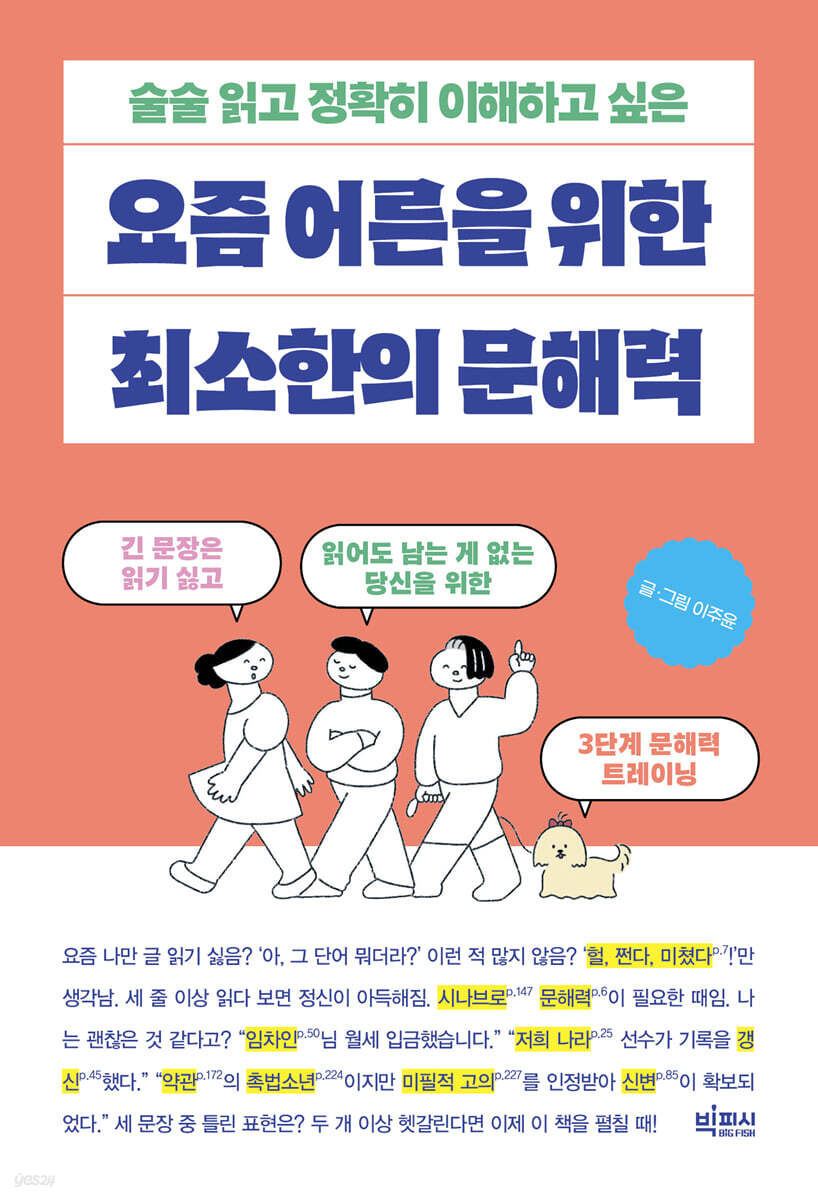
What if you don't want to read long sentences and don't get anything out of them?
Upgrade your reading, writing, vocabulary, and grammar skills all at once!
Author Lee Ju-yoon, who received praise for “no other author has explained spelling so delightfully,” now introduces essential vocabulary that must be known to develop literacy skills.
As you read the text, you will naturally clear up any confusing expressions in your head with humorous illustrations and clear, one-point lessons that hit the nail on the head.
In particular, the usability has been increased so that it can be applied directly in real life through ‘one-line summary, true or false quiz, and literacy test.’
If you are a reader who finds it difficult to read long texts or cannot retain information these days, this is a must-read book.
Upgrade your reading, writing, vocabulary, and grammar skills all at once!
Author Lee Ju-yoon, who received praise for “no other author has explained spelling so delightfully,” now introduces essential vocabulary that must be known to develop literacy skills.
As you read the text, you will naturally clear up any confusing expressions in your head with humorous illustrations and clear, one-point lessons that hit the nail on the head.
In particular, the usability has been increased so that it can be applied directly in real life through ‘one-line summary, true or false quiz, and literacy test.’
If you are a reader who finds it difficult to read long texts or cannot retain information these days, this is a must-read book.
- You can preview some of the book's contents.
Preview
index
Introduction
PART 1.
Basics
“I found out that this expression was wrong?”
Spelling mistakes that are easy to make in everyday life
01.
shell and husk
02.
Wind and Wish
03.
Us and us
04.
width and depth
05.
Double and multiply
06.
When you're upset
07.
Renewal and renewal
08.
Landlord and tenant
09 Bags, envelopes, and bags
10.
smell, scent, and fragrance
11.
Ideals and Excesses
12.
When to refuse
13.
As much as possible and as much as possible
14.
Actions and measures
15.
Division and Sadal
16.
Personal safety and personal safety
17.
Development and Enlightenment
18.
When apologizing
PART 2.
Usage section
“I don’t understand what you’re saying even after reading it...”
Essential vocabulary to break through literacy barriers
19.
Bold and thick
20.
All and nothing
21.
losing streak and losing streak
22.
I think so, I think so
23.
Year and year
24.
When you're anxious
25.
Face to face and face to face
26.
Suitable and appropriate
27.
Latecomer and latecomer
28.
Come on, wake up
29.
Better than Sinabro and Galma
30.
When you're tired
31.
Clarity and weaving
32.
Admire
33.
Quantitative and qualitative
34.
Terms and Conditions
35.
Great-grandfather and great-great-grandfather
36.
Uncle and uncle
37.
When you feel sad
38.
Iceberg and Icecap Awards
39.
Plate and tower types
40.
Reciprocal and altruistic
41.
Change and retroactivity
42.
To ignore, to ignore, and to look with a blank stare
43.
When you're happy
PART 3.
Advanced
“What was this word?”
An ambiguous expression to ask others when you don't really know
44.
Juvenile offenders and negligent culpability
45.
Suspended indictment and suspended sentence
46.
Appeals and appeals, appeals and complaints
47.
creative accounting
48.
Evidence and testimony
49.
Deduction, induction, and abduction
50.
When you're lonely
51.
Reappointment, reappointment, and reappointment
52.
You have beautiful hands
53.
Havruta
54.
filibuster
55.
sabotage
56.
cliché
57.
When you're embarrassed
58.
Concierge
59.
metacognition
60.
bridgehead
61.
Golden Pagoda
62.
Giraffe
63.
When you admire
Outgoing post
Appendix │ A Table of Confusing Family Relationship Terms
PART 1.
Basics
“I found out that this expression was wrong?”
Spelling mistakes that are easy to make in everyday life
01.
shell and husk
02.
Wind and Wish
03.
Us and us
04.
width and depth
05.
Double and multiply
06.
When you're upset
07.
Renewal and renewal
08.
Landlord and tenant
09 Bags, envelopes, and bags
10.
smell, scent, and fragrance
11.
Ideals and Excesses
12.
When to refuse
13.
As much as possible and as much as possible
14.
Actions and measures
15.
Division and Sadal
16.
Personal safety and personal safety
17.
Development and Enlightenment
18.
When apologizing
PART 2.
Usage section
“I don’t understand what you’re saying even after reading it...”
Essential vocabulary to break through literacy barriers
19.
Bold and thick
20.
All and nothing
21.
losing streak and losing streak
22.
I think so, I think so
23.
Year and year
24.
When you're anxious
25.
Face to face and face to face
26.
Suitable and appropriate
27.
Latecomer and latecomer
28.
Come on, wake up
29.
Better than Sinabro and Galma
30.
When you're tired
31.
Clarity and weaving
32.
Admire
33.
Quantitative and qualitative
34.
Terms and Conditions
35.
Great-grandfather and great-great-grandfather
36.
Uncle and uncle
37.
When you feel sad
38.
Iceberg and Icecap Awards
39.
Plate and tower types
40.
Reciprocal and altruistic
41.
Change and retroactivity
42.
To ignore, to ignore, and to look with a blank stare
43.
When you're happy
PART 3.
Advanced
“What was this word?”
An ambiguous expression to ask others when you don't really know
44.
Juvenile offenders and negligent culpability
45.
Suspended indictment and suspended sentence
46.
Appeals and appeals, appeals and complaints
47.
creative accounting
48.
Evidence and testimony
49.
Deduction, induction, and abduction
50.
When you're lonely
51.
Reappointment, reappointment, and reappointment
52.
You have beautiful hands
53.
Havruta
54.
filibuster
55.
sabotage
56.
cliché
57.
When you're embarrassed
58.
Concierge
59.
metacognition
60.
bridgehead
61.
Golden Pagoda
62.
Giraffe
63.
When you admire
Outgoing post
Appendix │ A Table of Confusing Family Relationship Terms
Detailed image

Into the book
While we're at it, let me tell you one more thing. In Noh Sa-yeon's song "Meeting," there's also an error in the line "Our meeting / was not a coincidence / it was our / wish."
The correct word is 'wind', not 'hope'.
The word 'baram' is derived from 'baraeda', meaning to change color due to exposure to sunlight or moisture.
(Omitted) In fact, I think I know why the lyricist chose wish instead of wind.
The wind has many meanings other than wishing.
It means the movement of air, inciting others, and even having secret relationships with the opposite sex.
If it were misinterpreted as the third meaning, it could have been criticized as being about meeting someone on a hot topic.
--- p.22~23, from “Wind and Desire”
When you pour out your inner flames in a secret diary that no one sees, it's okay to use harsh words like "I'm going crazy," "I'm so pissed," and "I'm so annoyed."
If you vent your anger like that, your anger will subside to some extent.
In such cases, try cosplaying as a tragic heroine by using expressions like 'I'm upset, I'm depressed, I keep crying.'
However, if you use words like this in places where others can see them, like a blog or Instagram, it might come across as a bit emotional.
Rather, refined words like 'bitter', 'hurt', and 'bitter in the mouth' would be more appropriate.
Also, even if you are so angry that you are going crazy, I recommend that you express it in a slightly rounded way, such as saying, "I am so upset, I am so angry, I am so frustrated."
Here's a quick tip! "Bua" is a pure Korean word meaning lung.
They say the expression 'getting angry' came from the way your chest heaves when you're out of breath because you're angry.
so
You can think of it as a similar word to '쒸익쒸익'.
--- p.41~42, from “When I’m Upset”
I read something like this on the Internet one day.
The writer, a tenant, sent a text message to the landlord.
"Hello, sir! It's just that the toilet is broken." After hitting the send button, the writer couldn't shake the feeling of being a servant and asked what on earth he should call the landlord.
Since tenants receive housing from the landlord, it is somewhat similar to living as servants, but unlike servants, they are paying a fair wage, so they should not call the landlord “master.”
To prevent situations where people unknowingly take on the role of servants, I wonder if we could replace the words landlord and tenant with the words landlord and tenant.
The word 'rent' means 'to lend one's belongings to someone else in exchange for money.'
So, a ‘landlord’ would be ‘a person who lends his/her belongings to someone else in return for money.’
On the other hand, 'rent' means 'to pay money and borrow someone else's property'.
Therefore, a ‘tenant’ would be ‘a person who pays money and borrows someone else’s property.’
--- p.51, from “Landlord and Tenant”
There must be a reason why there is a word called 'myo-ryeong', which means 'the age of a woman in her twenties'.
Mysterious, mysterious, old age.
Here, the character ‘묘’ means ‘mysterious’ as well as ‘young and pretty’, so it would be correct to interpret it as ‘young and pretty age’ rather than ‘mysterious age’.
Some people think of this in the former sense and use expressions such as 'grandmother of a mysterious age'.
If your intention was to make your grandmother feel better, I'll give you a perfect 10 out of 10, but if you made a mistake because you didn't understand what I meant, then you should stop now.
(Omitted) In the past, when a man turned twenty, there was a custom of taking off his child's clothes, tying his hair into a topknot, and putting a hat on him, which is what we would call a coming-of-age ceremony these days.
However, it is said that they are still too young to be called adults even though they are going through the ceremony, so they are called young children.
If we look at the etymology alone, it is a word that is suitable for men, but today it is used without distinction between genders.
--- p.173~174, from “Terms and Conditions”
So what does ‘creative accounting’ mean?
Could it mean "accounting for powdered food?" I looked it up in the dictionary, but it was half correct.
The powder used was the same as the edible snack, but the food used was different.
Same as the expression ‘pretense, decoration, and empty formality’.
I was using none other than the character for decoration.
So, if we were to break down creative accounting, we could say it is 'powdered accounting'.
I think that applying powder is the same as putting on makeup.
Just as we put on makeup to make our faces look pretty, we manipulate our accounting books to make our company's performance look better than it actually is, and this is called 'creative accounting.'
That way, it's easier to get investments and loans.
This is it.
In the United States, this is called 'Cosmetic Accounting' or 'Make up Accounting'.
This was brought to our country via Japan and became known as creative accounting.
--- p.241~242, from “Creative Accounting”
'Cliche' is a French word meaning 'an expression or idea that is so often used that it has become a habit or is not new.'
In the days of letterpress printing, it was a printing term that meant pre-setting frequently used words, but its use changed over time.
If we were to translate it into Korean, we could say it is a 'stereotypical expression'.
In particular, cliches that are often used in dramas and scripts include, “My lover turns out to be a conglomerate,” “My crush turns out to be my older brother who I broke up with when I was young,” “Why are you acting like this so unlike yourself?” followed by “What’s so unique about me?”, and splashing water on the other person’s face while having a calm conversation in a cafe.
The correct word is 'wind', not 'hope'.
The word 'baram' is derived from 'baraeda', meaning to change color due to exposure to sunlight or moisture.
(Omitted) In fact, I think I know why the lyricist chose wish instead of wind.
The wind has many meanings other than wishing.
It means the movement of air, inciting others, and even having secret relationships with the opposite sex.
If it were misinterpreted as the third meaning, it could have been criticized as being about meeting someone on a hot topic.
--- p.22~23, from “Wind and Desire”
When you pour out your inner flames in a secret diary that no one sees, it's okay to use harsh words like "I'm going crazy," "I'm so pissed," and "I'm so annoyed."
If you vent your anger like that, your anger will subside to some extent.
In such cases, try cosplaying as a tragic heroine by using expressions like 'I'm upset, I'm depressed, I keep crying.'
However, if you use words like this in places where others can see them, like a blog or Instagram, it might come across as a bit emotional.
Rather, refined words like 'bitter', 'hurt', and 'bitter in the mouth' would be more appropriate.
Also, even if you are so angry that you are going crazy, I recommend that you express it in a slightly rounded way, such as saying, "I am so upset, I am so angry, I am so frustrated."
Here's a quick tip! "Bua" is a pure Korean word meaning lung.
They say the expression 'getting angry' came from the way your chest heaves when you're out of breath because you're angry.
so
You can think of it as a similar word to '쒸익쒸익'.
--- p.41~42, from “When I’m Upset”
I read something like this on the Internet one day.
The writer, a tenant, sent a text message to the landlord.
"Hello, sir! It's just that the toilet is broken." After hitting the send button, the writer couldn't shake the feeling of being a servant and asked what on earth he should call the landlord.
Since tenants receive housing from the landlord, it is somewhat similar to living as servants, but unlike servants, they are paying a fair wage, so they should not call the landlord “master.”
To prevent situations where people unknowingly take on the role of servants, I wonder if we could replace the words landlord and tenant with the words landlord and tenant.
The word 'rent' means 'to lend one's belongings to someone else in exchange for money.'
So, a ‘landlord’ would be ‘a person who lends his/her belongings to someone else in return for money.’
On the other hand, 'rent' means 'to pay money and borrow someone else's property'.
Therefore, a ‘tenant’ would be ‘a person who pays money and borrows someone else’s property.’
--- p.51, from “Landlord and Tenant”
There must be a reason why there is a word called 'myo-ryeong', which means 'the age of a woman in her twenties'.
Mysterious, mysterious, old age.
Here, the character ‘묘’ means ‘mysterious’ as well as ‘young and pretty’, so it would be correct to interpret it as ‘young and pretty age’ rather than ‘mysterious age’.
Some people think of this in the former sense and use expressions such as 'grandmother of a mysterious age'.
If your intention was to make your grandmother feel better, I'll give you a perfect 10 out of 10, but if you made a mistake because you didn't understand what I meant, then you should stop now.
(Omitted) In the past, when a man turned twenty, there was a custom of taking off his child's clothes, tying his hair into a topknot, and putting a hat on him, which is what we would call a coming-of-age ceremony these days.
However, it is said that they are still too young to be called adults even though they are going through the ceremony, so they are called young children.
If we look at the etymology alone, it is a word that is suitable for men, but today it is used without distinction between genders.
--- p.173~174, from “Terms and Conditions”
So what does ‘creative accounting’ mean?
Could it mean "accounting for powdered food?" I looked it up in the dictionary, but it was half correct.
The powder used was the same as the edible snack, but the food used was different.
Same as the expression ‘pretense, decoration, and empty formality’.
I was using none other than the character for decoration.
So, if we were to break down creative accounting, we could say it is 'powdered accounting'.
I think that applying powder is the same as putting on makeup.
Just as we put on makeup to make our faces look pretty, we manipulate our accounting books to make our company's performance look better than it actually is, and this is called 'creative accounting.'
That way, it's easier to get investments and loans.
This is it.
In the United States, this is called 'Cosmetic Accounting' or 'Make up Accounting'.
This was brought to our country via Japan and became known as creative accounting.
--- p.241~242, from “Creative Accounting”
'Cliche' is a French word meaning 'an expression or idea that is so often used that it has become a habit or is not new.'
In the days of letterpress printing, it was a printing term that meant pre-setting frequently used words, but its use changed over time.
If we were to translate it into Korean, we could say it is a 'stereotypical expression'.
In particular, cliches that are often used in dramas and scripts include, “My lover turns out to be a conglomerate,” “My crush turns out to be my older brother who I broke up with when I was young,” “Why are you acting like this so unlike yourself?” followed by “What’s so unique about me?”, and splashing water on the other person’s face while having a calm conversation in a cafe.
--- p.280, from "Cliche"
Publisher's Review
If you read just this one book
Complex sentences are understood at once!
Recently, posts criticizing 'literacy and context blindness' have been appearing frequently in online communities.
A restaurant posted a notice saying, “We sincerely apologize for any inconvenience caused during the reservation process.” However, some netizens misunderstood this as “sincerely sorry,” and attacked the restaurant, demanding a proper apology.
Lack of literacy means that one can read but ‘does not understand properly’, unlike ‘illiteracy’ which means not being able to read.
The case of someone calling the landlord "owner" because they couldn't remember what to call him/her may be a funny and sad episode, but if you don't understand or misinterpret the sentences in the notice, such as "Replaced with loan documents, retroactive to the end of this month," it could easily lead to big losses.
From basic daily life skills to improving performance at work, literacy is one of the essential skills we need to survive.
So, what's the first step to improving literacy? Knowing the exact meaning of vocabulary and how to use expressions is the first step.
As the title suggests, “Minimum Literacy for Today’s Adults” contains essential vocabulary and expressions that will help develop literacy skills for today’s adults.
We've carefully selected only the most essential vocabulary and expressions!
3-step literacy training in one book!
“I clearly read the text, but nothing sticks in my head.”, “I can’t think of the right word for the situation.”, “I find myself reading the same sentence over and over again.” If you feel like every sentence is about you, then your literacy skills are in serious trouble.
《Minimum Literacy for Today's Adults》 carefully selects the most confusing vocabulary and expressions that can be used immediately in news and everyday life.
In particular, we have carefully selected expressions that are difficult to ask others about but whose exact meaning is unknown, as well as vocabulary that is easy to confuse because of similar pronunciation.
It doesn't stop there, but it is structured in a three-part structure of 'clear explanation + one-line summary + true or false quiz' so that you can perfectly internalize the newly learned vocabulary and use it right away.
In the first stage, the exact meaning of the vocabulary is explained in detail, and like a 'daily instructor in the world of spelling', the key points are explained concisely so that it can be easily memorized just by reading.
Even if you change 'all' to 'whole', the meaning is roughly the same.
Since both "whole" and "all" contain the character "체," they're easy to relate, right? Another word that's often confused with "일체" is "일절."
It is a word used in a negative situation where one stops doing something or does nothing, as opposed to the all-embracing oneness.
Even if you change '일절' to '절대', the meaning is roughly the same.
Since both absolute and absolute contain the character '절', you can easily recall them, right?
All = Whole
All = Absolute _ [All and All], pages 106-107
In the second step, the content of the text is summarized in just 'one line'.
You can review the content of the text again through this section without having to summarize it separately.
It can also be useful for readers who are short on time and want to quickly resolve their curiosity.
Use "year" after numbers, and "year" after non-numeric words! _ [Year and Year], page 121
In the final third step, you will go through a review process to check if you really understood it correctly with an 'OX quiz'.
While I was laughing at the examples that were bursting with energy, my literacy skills were automatically upgraded without me realizing it.
I ended up ordering a bottle of soju because I heard that if you order a side dish, alcohol is free.
( O, X )
_ [All and Nothing], page 113
What is the difference between 'Sadan' and 'Sadal'? What is the meaning of 'Giraffe'?
If you can't answer within 3 seconds, now is the time to open this book!
The previous work, “Minimum Spelling Rules for Adults Today,” became a bestseller immediately after its publication, and readers poured in with reviews saying, “This book helped me finally conquer spelling, which had been confusing my whole life.”
Published with the enthusiastic support of readers and praised as a "daily instructor in the world of spelling," "Minimum Literacy for Adults Today" goes one step further than spelling to provide customized literacy tutoring for adults who "read but can't remember what they're reading."
Even more powerful than its predecessor, it teaches essential vocabulary and expressions to develop literacy through vivid illustrations and explosive episodes that will leave a lasting impression on your mind once you see them.
Also, if you have limited vocabulary to express your emotions with exclamations like “Wow, awesome, really?”, you can use a richer vocabulary of emotions appropriate to the situation through the “emotional vocabulary” corner inserted throughout the text.
In addition, we have included a 'literacy test' that will allow you to check your current literacy level.
You can use it to self-assess your literacy skills before reading the text, or as a review after reading the book.
The appendix contains a wealth of confusing expressions that could not be included in the main text.
For readers who read a text but have no idea what it means, or who feel suffocated when they see a long text, this book will be a valuable resource that can help them improve their literacy skills like a ray of light.
Complex sentences are understood at once!
Recently, posts criticizing 'literacy and context blindness' have been appearing frequently in online communities.
A restaurant posted a notice saying, “We sincerely apologize for any inconvenience caused during the reservation process.” However, some netizens misunderstood this as “sincerely sorry,” and attacked the restaurant, demanding a proper apology.
Lack of literacy means that one can read but ‘does not understand properly’, unlike ‘illiteracy’ which means not being able to read.
The case of someone calling the landlord "owner" because they couldn't remember what to call him/her may be a funny and sad episode, but if you don't understand or misinterpret the sentences in the notice, such as "Replaced with loan documents, retroactive to the end of this month," it could easily lead to big losses.
From basic daily life skills to improving performance at work, literacy is one of the essential skills we need to survive.
So, what's the first step to improving literacy? Knowing the exact meaning of vocabulary and how to use expressions is the first step.
As the title suggests, “Minimum Literacy for Today’s Adults” contains essential vocabulary and expressions that will help develop literacy skills for today’s adults.
We've carefully selected only the most essential vocabulary and expressions!
3-step literacy training in one book!
“I clearly read the text, but nothing sticks in my head.”, “I can’t think of the right word for the situation.”, “I find myself reading the same sentence over and over again.” If you feel like every sentence is about you, then your literacy skills are in serious trouble.
《Minimum Literacy for Today's Adults》 carefully selects the most confusing vocabulary and expressions that can be used immediately in news and everyday life.
In particular, we have carefully selected expressions that are difficult to ask others about but whose exact meaning is unknown, as well as vocabulary that is easy to confuse because of similar pronunciation.
It doesn't stop there, but it is structured in a three-part structure of 'clear explanation + one-line summary + true or false quiz' so that you can perfectly internalize the newly learned vocabulary and use it right away.
In the first stage, the exact meaning of the vocabulary is explained in detail, and like a 'daily instructor in the world of spelling', the key points are explained concisely so that it can be easily memorized just by reading.
Even if you change 'all' to 'whole', the meaning is roughly the same.
Since both "whole" and "all" contain the character "체," they're easy to relate, right? Another word that's often confused with "일체" is "일절."
It is a word used in a negative situation where one stops doing something or does nothing, as opposed to the all-embracing oneness.
Even if you change '일절' to '절대', the meaning is roughly the same.
Since both absolute and absolute contain the character '절', you can easily recall them, right?
All = Whole
All = Absolute _ [All and All], pages 106-107
In the second step, the content of the text is summarized in just 'one line'.
You can review the content of the text again through this section without having to summarize it separately.
It can also be useful for readers who are short on time and want to quickly resolve their curiosity.
Use "year" after numbers, and "year" after non-numeric words! _ [Year and Year], page 121
In the final third step, you will go through a review process to check if you really understood it correctly with an 'OX quiz'.
While I was laughing at the examples that were bursting with energy, my literacy skills were automatically upgraded without me realizing it.
I ended up ordering a bottle of soju because I heard that if you order a side dish, alcohol is free.
( O, X )
_ [All and Nothing], page 113
What is the difference between 'Sadan' and 'Sadal'? What is the meaning of 'Giraffe'?
If you can't answer within 3 seconds, now is the time to open this book!
The previous work, “Minimum Spelling Rules for Adults Today,” became a bestseller immediately after its publication, and readers poured in with reviews saying, “This book helped me finally conquer spelling, which had been confusing my whole life.”
Published with the enthusiastic support of readers and praised as a "daily instructor in the world of spelling," "Minimum Literacy for Adults Today" goes one step further than spelling to provide customized literacy tutoring for adults who "read but can't remember what they're reading."
Even more powerful than its predecessor, it teaches essential vocabulary and expressions to develop literacy through vivid illustrations and explosive episodes that will leave a lasting impression on your mind once you see them.
Also, if you have limited vocabulary to express your emotions with exclamations like “Wow, awesome, really?”, you can use a richer vocabulary of emotions appropriate to the situation through the “emotional vocabulary” corner inserted throughout the text.
In addition, we have included a 'literacy test' that will allow you to check your current literacy level.
You can use it to self-assess your literacy skills before reading the text, or as a review after reading the book.
The appendix contains a wealth of confusing expressions that could not be included in the main text.
For readers who read a text but have no idea what it means, or who feel suffocated when they see a long text, this book will be a valuable resource that can help them improve their literacy skills like a ray of light.
GOODS SPECIFICS
- Date of issue: February 7, 2024
- Page count, weight, size: 316 pages | 406g | 128*188*18mm
- ISBN13: 9791193128756
- ISBN10: 1193128757
You may also like
카테고리
korean


korean

![GQ KOREA Mark (Monthly): December [2025]](http://librairie.coreenne.fr/cdn/shop/files/8ef265dbbfbf186523ed75ba7319009d.jpg?v=1765340328&width=3840)


