

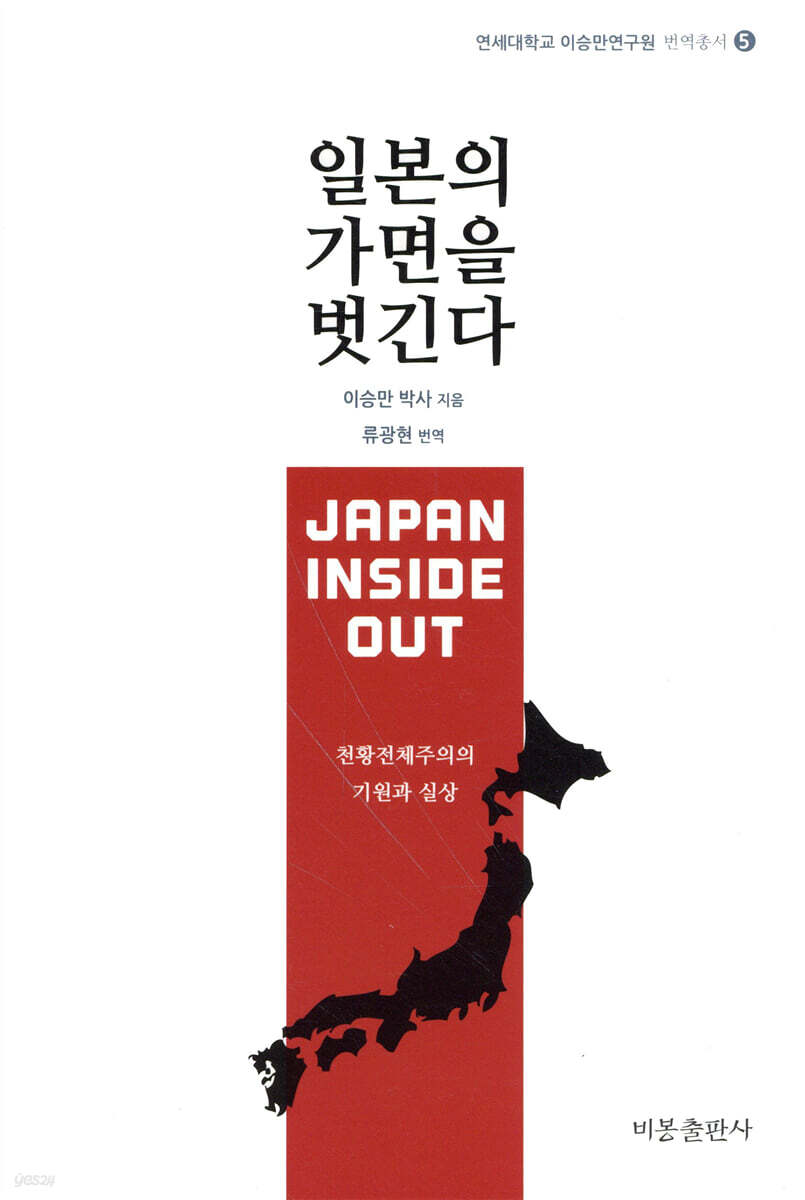
Unmasking Japan
 |
Description
Book Introduction
The conflict between Korea and Japan is intensifying due to Japan's militarization and denial of its past history of invasion.
As long as Japan maintains its imperial totalitarian system (Mikadoism), this is an inevitable phenomenon that will occur when combined with economic power.
We must clearly recognize that it is foolish to demand an apology from the Japanese for their past acts of aggression without understanding the true nature and roots of the desire for aggression that flows through their blood.
This book [Japan Inside Out] presents the essence and origin of Japanese imperial totalitarianism (Mikadoism), the truth behind their ambitions for invasion, and an effective way to stop their ambitions for invasion. Furthermore, it is the masterpiece of Dr. Syngman Rhee, the first [true progressive politician] of our people, who revealed for the first time in the world that the greatest enemies of liberal democracy are [communist totalitarianism] along with [imperial totalitarianism].
This book is a must-read for all citizens of the Republic of Korea to properly understand Dr. Syngman Rhee and the founding ideology of the Republic of Korea.
As long as Japan maintains its imperial totalitarian system (Mikadoism), this is an inevitable phenomenon that will occur when combined with economic power.
We must clearly recognize that it is foolish to demand an apology from the Japanese for their past acts of aggression without understanding the true nature and roots of the desire for aggression that flows through their blood.
This book [Japan Inside Out] presents the essence and origin of Japanese imperial totalitarianism (Mikadoism), the truth behind their ambitions for invasion, and an effective way to stop their ambitions for invasion. Furthermore, it is the masterpiece of Dr. Syngman Rhee, the first [true progressive politician] of our people, who revealed for the first time in the world that the greatest enemies of liberal democracy are [communist totalitarianism] along with [imperial totalitarianism].
This book is a must-read for all citizens of the Republic of Korea to properly understand Dr. Syngman Rhee and the founding ideology of the Republic of Korea.
- You can preview some of the book's contents.
Preview
index
Recommendation by Son Se-il
Preface to the Korean edition by the author (President Syngman Rhee)
Pearl Buck's review of [JAPAN INSIDE OUT]
West Gate
Chapter 1: Japan's "Holy War Mission" and the Psychology of War
Chapter 2 _ Tanaka's Memorandum
Chapter 3: Japan's Attempt to Unmask Its Aggressive Ambition
Chapter 4: The Beginning of the Sino-Japanese War
Chapter 5 - All foreign journalists should be expelled.
Chapter 6: Foreign Missionaries
Chapter 7: The Ladybird and Faney Incidents
Ladybird Incident (including British) / Faney Incident / Japanese Explanation /
Film / Japan Pays Reparations / Harry E.
Admiral Yarnell
Chapter 8 _ The American People and Their Rights
National flag incident
Chapter 9 _ Nine-nation talks
Chapter 10 - Japan's Continuing March of Conquest and Its Repercussions
Shanghai / Indochina / Hong Kong / Burma's road to China /
Dutch East Indies / Thailand / Philippine Islands / Guam /
Mandate Islands / Hawaii / Alaska /
Australia / Mexico / Argentina / Uruguay
Chapter 11: The Building Up of American Naval Power
Chapter 12: We Must Stop Japan's Propaganda
Chapter 13 _ American Pacifists
Chapter 14: Pacifists Are Like Spies
Chapter 15: Democracy vs. Totalitarianism
conclusion
Translator's Note
[Appendix 1] Inaugural Address of the First President
[Appendix 2] Chronology of the Author Syngman Rhee
Preface to the Korean edition by the author (President Syngman Rhee)
Pearl Buck's review of [JAPAN INSIDE OUT]
West Gate
Chapter 1: Japan's "Holy War Mission" and the Psychology of War
Chapter 2 _ Tanaka's Memorandum
Chapter 3: Japan's Attempt to Unmask Its Aggressive Ambition
Chapter 4: The Beginning of the Sino-Japanese War
Chapter 5 - All foreign journalists should be expelled.
Chapter 6: Foreign Missionaries
Chapter 7: The Ladybird and Faney Incidents
Ladybird Incident (including British) / Faney Incident / Japanese Explanation /
Film / Japan Pays Reparations / Harry E.
Admiral Yarnell
Chapter 8 _ The American People and Their Rights
National flag incident
Chapter 9 _ Nine-nation talks
Chapter 10 - Japan's Continuing March of Conquest and Its Repercussions
Shanghai / Indochina / Hong Kong / Burma's road to China /
Dutch East Indies / Thailand / Philippine Islands / Guam /
Mandate Islands / Hawaii / Alaska /
Australia / Mexico / Argentina / Uruguay
Chapter 11: The Building Up of American Naval Power
Chapter 12: We Must Stop Japan's Propaganda
Chapter 13 _ American Pacifists
Chapter 14: Pacifists Are Like Spies
Chapter 15: Democracy vs. Totalitarianism
conclusion
Translator's Note
[Appendix 1] Inaugural Address of the First President
[Appendix 2] Chronology of the Author Syngman Rhee
Publisher's Review
After 1940, Americans were completely unaware of the inside story of Japan's frenzied preparations for a full-scale war with the United States, and were caught up in a pro-Japanese atmosphere as if wandering in a dream.
The reason Americans were so ignorant about the real situation of the Japanese was the result of the false propaganda that Japanese militarists had been spreading against Americans.
However, Dr. Syngman Rhee, who had a clear understanding of the origins and reality of Japan's imperial totalitarianism and its behavior, knew that Japan would invade the United States soon and decided to inform the Americans of this so that they could prepare for a Japanese invasion.
He decided to write a book to inform Americans, who had been perceiving Japan through the mask it had been wearing, of the reality behind the mask. He began writing, and published the book [JAPAN INSIDE OUT] in July 1941.
In this book, he predicted that Japan would soon launch a surprise attack on the United States.
But at the time the book was published, few Americans believed in its potential and listened to Dr. Syngman Rhee.
However, on December 7, 1941, five months after the book was published, when the U.S. naval base in Pearl Harbor, Hawaii, was bombed by the Japanese, Americans finally realized that Dr. Syngman Rhee's prophecy was correct, and thus the book became an instant bestseller across the United States, as American political leaders and military commanders regarded it as essential reading for understanding their enemy, Japan.
However, this book does not simply analyze the origins and reality of Japan's [imperial totalitarianism] and the behavior of [militarism], and predicts Japan's invasion of the United States. It also contains discourses on the world's highest level of political philosophy at the time and the essence of diplomacy and international politics.
Before the publication of this book, no one paid attention to the dangers of Soviet communist totalitarianism because the Soviet Union was an ally of the liberal democratic bloc, including the United States and Britain, fighting against the Axis powers, including Nazi Germany, Japan, and Italy.
In this book, Dr. Syngman Rhee alone asserts that the systems that threaten the liberal democratic system based on individual freedom are [Japan's imperial totalitarianism] and [Soviet communist totalitarianism], and suggests political and diplomatic measures to not only protect the [liberal democratic] system, which is the best political system developed by human civilization over a long period of time, but also to spread it throughout the world.
And this book explains in detail the circumstances surrounding the loss of the country to [the Republic of Korea], which was the first victim of [the atrocities of Japanese militarism], the suffering suffered as a result of becoming a Japanese colony, and the means to break free from the Japanese colonial rule and achieve [the independence of the Republic of Korea].
But more importantly than all of these, it suggests the direction and values that the Republic of Korea, newly independent after liberation from Japanese oppression, should pursue.
The direction and values that Dr. Syngman Rhee presented in this book are the direction and values that the Republic of Korea should pursue right now, and are becoming the [founding ideology] of the Republic of Korea.
Looking at it this way, we can say that the first truly progressive politician in our national history was Dr. Syngman Rhee.
Today, the people of South Korea, far from expressing gratitude for the prophetic wisdom, knowledge, and leadership of Dr. Syngman Rhee, are denigrating him as a [dictator] and forgetting his contributions. This is the result of being fooled by the false propaganda of [Kim Il-sung's communist totalitarians] without knowing his true nature.
For reference, this book has been translated three times since liberation.
The first was translated by Maria Park in 1954 under the title [Japan's Inside Story], the second was translated by Jong-ik Lee in 1987 under the title [The Real Image of Japanese Military Nationalism], and the third was translated by the Korean Journalists Association in 2007 under the title [Japan, the Reality Behind the Mask].
However, since all three previous translations were woefully inadequate in conveying the content, this fourth translation has been published.
Finally, here are the recommendations from the two people who wrote the book's forewords to coincide with its publication, which are included on the back cover.
Why You Should Read [Japan Inside Out] Now
1.
In the midst of the turbulent times of the late Joseon Dynasty, when people were only looking at nearby China and Russia, or Japan across the Korea Strait, the young Syngman Rhee looked to the other side of what was visible, that is, beyond the horizon, and discovered America there.
That's why we often refer to Dr. Syngman Rhee as 'the Columbus of 19th-century Korea.'
The founding of the Republic of Korea is the result of Dr. Lee's decision to bring the United States into Korean history instead of Russia.
In Korea's thousands of years of history, the prosperity we enjoy today is due to the achievements of Dr. Syngman Rhee, the founder of the Republic of Korea.
But now, our people are too ignorant of this great leader.
Choi Jeong-ho, Professor Emeritus at Ulsan University
2.
The book was published in English in the United States in August 1941.
The book consistently argues that if the United States does not guard against Japan, it will soon be attacked by Japan.
In fact, four months later, in December 1941, Japan attacked Pearl Harbor in the United States.
It is surprising that Americans only realized the true value of this book after the so-called 'Pacific War' broke out.
Nobel Prize-winning author Pearl Buck knew in advance that this book would be truly remarkable.
Pearl Buck's book review in the September 1941 issue of the monthly magazine [Asia] is living proof of this.
3.
No other book summarizes the reality of the Japanese imperial system as concisely and persuasively as this one.
When we understand the true nature of imperial totalitarianism, we also see how similar it is to the communist totalitarianism represented by Stalin, as well as to the leader totalitarianism of North Korea.
Only by understanding this issue can we see the hypocrisy of the so-called 'pacifists' who claim to maintain peace with totalitarianism.
No book explains this issue better than this one.
Ryu Seok-chun, Director of the Syngman Rhee Research Institute at Yonsei University
The reason Americans were so ignorant about the real situation of the Japanese was the result of the false propaganda that Japanese militarists had been spreading against Americans.
However, Dr. Syngman Rhee, who had a clear understanding of the origins and reality of Japan's imperial totalitarianism and its behavior, knew that Japan would invade the United States soon and decided to inform the Americans of this so that they could prepare for a Japanese invasion.
He decided to write a book to inform Americans, who had been perceiving Japan through the mask it had been wearing, of the reality behind the mask. He began writing, and published the book [JAPAN INSIDE OUT] in July 1941.
In this book, he predicted that Japan would soon launch a surprise attack on the United States.
But at the time the book was published, few Americans believed in its potential and listened to Dr. Syngman Rhee.
However, on December 7, 1941, five months after the book was published, when the U.S. naval base in Pearl Harbor, Hawaii, was bombed by the Japanese, Americans finally realized that Dr. Syngman Rhee's prophecy was correct, and thus the book became an instant bestseller across the United States, as American political leaders and military commanders regarded it as essential reading for understanding their enemy, Japan.
However, this book does not simply analyze the origins and reality of Japan's [imperial totalitarianism] and the behavior of [militarism], and predicts Japan's invasion of the United States. It also contains discourses on the world's highest level of political philosophy at the time and the essence of diplomacy and international politics.
Before the publication of this book, no one paid attention to the dangers of Soviet communist totalitarianism because the Soviet Union was an ally of the liberal democratic bloc, including the United States and Britain, fighting against the Axis powers, including Nazi Germany, Japan, and Italy.
In this book, Dr. Syngman Rhee alone asserts that the systems that threaten the liberal democratic system based on individual freedom are [Japan's imperial totalitarianism] and [Soviet communist totalitarianism], and suggests political and diplomatic measures to not only protect the [liberal democratic] system, which is the best political system developed by human civilization over a long period of time, but also to spread it throughout the world.
And this book explains in detail the circumstances surrounding the loss of the country to [the Republic of Korea], which was the first victim of [the atrocities of Japanese militarism], the suffering suffered as a result of becoming a Japanese colony, and the means to break free from the Japanese colonial rule and achieve [the independence of the Republic of Korea].
But more importantly than all of these, it suggests the direction and values that the Republic of Korea, newly independent after liberation from Japanese oppression, should pursue.
The direction and values that Dr. Syngman Rhee presented in this book are the direction and values that the Republic of Korea should pursue right now, and are becoming the [founding ideology] of the Republic of Korea.
Looking at it this way, we can say that the first truly progressive politician in our national history was Dr. Syngman Rhee.
Today, the people of South Korea, far from expressing gratitude for the prophetic wisdom, knowledge, and leadership of Dr. Syngman Rhee, are denigrating him as a [dictator] and forgetting his contributions. This is the result of being fooled by the false propaganda of [Kim Il-sung's communist totalitarians] without knowing his true nature.
For reference, this book has been translated three times since liberation.
The first was translated by Maria Park in 1954 under the title [Japan's Inside Story], the second was translated by Jong-ik Lee in 1987 under the title [The Real Image of Japanese Military Nationalism], and the third was translated by the Korean Journalists Association in 2007 under the title [Japan, the Reality Behind the Mask].
However, since all three previous translations were woefully inadequate in conveying the content, this fourth translation has been published.
Finally, here are the recommendations from the two people who wrote the book's forewords to coincide with its publication, which are included on the back cover.
Why You Should Read [Japan Inside Out] Now
1.
In the midst of the turbulent times of the late Joseon Dynasty, when people were only looking at nearby China and Russia, or Japan across the Korea Strait, the young Syngman Rhee looked to the other side of what was visible, that is, beyond the horizon, and discovered America there.
That's why we often refer to Dr. Syngman Rhee as 'the Columbus of 19th-century Korea.'
The founding of the Republic of Korea is the result of Dr. Lee's decision to bring the United States into Korean history instead of Russia.
In Korea's thousands of years of history, the prosperity we enjoy today is due to the achievements of Dr. Syngman Rhee, the founder of the Republic of Korea.
But now, our people are too ignorant of this great leader.
Choi Jeong-ho, Professor Emeritus at Ulsan University
2.
The book was published in English in the United States in August 1941.
The book consistently argues that if the United States does not guard against Japan, it will soon be attacked by Japan.
In fact, four months later, in December 1941, Japan attacked Pearl Harbor in the United States.
It is surprising that Americans only realized the true value of this book after the so-called 'Pacific War' broke out.
Nobel Prize-winning author Pearl Buck knew in advance that this book would be truly remarkable.
Pearl Buck's book review in the September 1941 issue of the monthly magazine [Asia] is living proof of this.
3.
No other book summarizes the reality of the Japanese imperial system as concisely and persuasively as this one.
When we understand the true nature of imperial totalitarianism, we also see how similar it is to the communist totalitarianism represented by Stalin, as well as to the leader totalitarianism of North Korea.
Only by understanding this issue can we see the hypocrisy of the so-called 'pacifists' who claim to maintain peace with totalitarianism.
No book explains this issue better than this one.
Ryu Seok-chun, Director of the Syngman Rhee Research Institute at Yonsei University
GOODS SPECIFICS
- Date of issue: April 30, 2015
- Page count, weight, size: 322 pages | 544g | 153*224*30mm
- ISBN13: 9788937604256
- ISBN 10: 8937604256
You may also like
카테고리
korean


korean

![GQ KOREA Mark (Monthly): December [2025]](http://librairie.coreenne.fr/cdn/shop/files/8ef265dbbfbf186523ed75ba7319009d.jpg?v=1765340328&width=3840)


