

Unit operations
 |
Description
Book Introduction
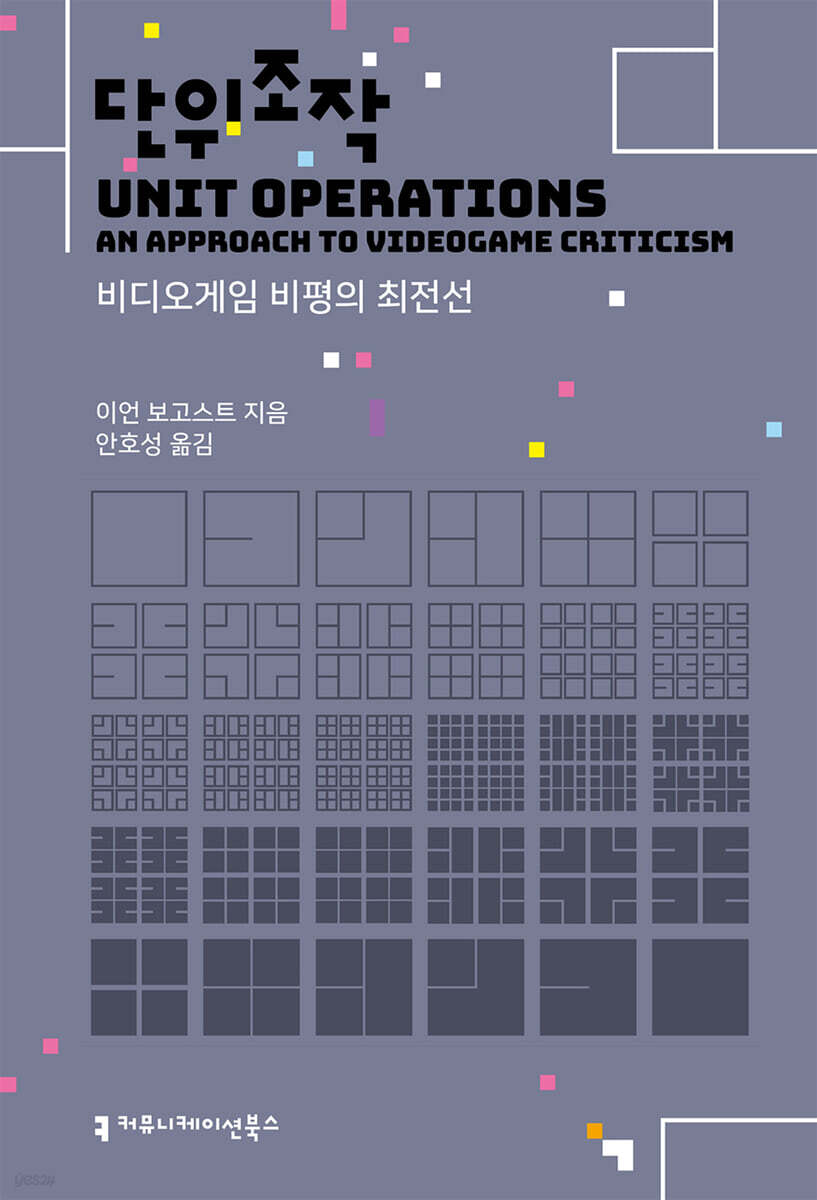
Unit operation is a concept that assumes an arrangement of expressive meaning units that are interlocked with each other.
It is a mode of meaning-making that prioritizes discrete and disconnected actions over deterministic systems, function over context, and instances over continuity.
This book, "Unit Operations," builds a critical methodology applicable to both the humanities and technology based on the unit operations of video games.
A rich analysis encompassing cases from a variety of fields allows us to capture dynamic relationships that holistic or formal approaches can never capture.
It is a mode of meaning-making that prioritizes discrete and disconnected actions over deterministic systems, function over context, and instances over continuity.
This book, "Unit Operations," builds a critical methodology applicable to both the humanities and technology based on the unit operations of video games.
A rich analysis encompassing cases from a variety of fields allows us to capture dynamic relationships that holistic or formal approaches can never capture.
- You can preview some of the book's contents.
Preview
index
introduction
From the 1st part system to the unit body
01 Unit Operation
Unit analysis
02 Structuralism and Computation
03 Humanism and Object Technology
Technical object
human object
Part 2 Procedural Criticism
04 Comparative Video Game Criticism
05 Video Games and Expression
game engine
Games and Narratives
06 Cross-platform encounters
Part 3 Procedural Subjectivity
07 Cellular Automata and Simulation
cellular automata
Video Games and Ideology
Simulation fever
08 Alternatives to Fun
Biased video games
Against fun
09 Simulation Gap
Gap in the Magic Circle
From the 4-part design to the weaving
10 Complex Networks
complex networks
11 Complex World
Structured literary space
12 Critical Networks
Acknowledgements
Translator's Note
References
Search
From the 1st part system to the unit body
01 Unit Operation
Unit analysis
02 Structuralism and Computation
03 Humanism and Object Technology
Technical object
human object
Part 2 Procedural Criticism
04 Comparative Video Game Criticism
05 Video Games and Expression
game engine
Games and Narratives
06 Cross-platform encounters
Part 3 Procedural Subjectivity
07 Cellular Automata and Simulation
cellular automata
Video Games and Ideology
Simulation fever
08 Alternatives to Fun
Biased video games
Against fun
09 Simulation Gap
Gap in the Magic Circle
From the 4-part design to the weaving
10 Complex Networks
complex networks
11 Complex World
Structured literary space
12 Critical Networks
Acknowledgements
Translator's Note
References
Search
Into the book
This book is an attempt to explore the nature of the relationship between computation, literature, and philosophy.
Here I will discuss the principles that underpin both modern literary analysis and computation.
Building on this commonality, I will analyze a field of discourse production that has yet to achieve a prestigious position anywhere in the world: video games.… I take a fundamentally comparative approach throughout this book, drawing on examples from all of the aforementioned fields as evidence of the utility and importance of comparative procedural criticism.
In particular, I will argue that all media—poetic, literary, cinematic, and computational—can be read as arrangements of discrete and interlocking expressive meaning units, or systems of texture.
I call these general instances of procedural expressions 'unit operations'.
--- From the "Introduction"
Since the successful decoding of the human genome in 2000, biology has entered a “postgenomic” phase, recognizing that knowledge about genes themselves is not very useful.
Scientists now seek to understand how the functions of individual genes and the intricate interweaving of genetic functions underlie complex behaviors.
The shift from genes being viewed as holistic regulatory systems to actors functioning within larger intergenetic play represents a shift from systemic to unitary operations.
Unit operations are characterized by being concise, discrete, referential, and dynamic.
System operations are characterized by being long-term, dependent, sequential, and static.
In general, unit operations prioritize function over context, and instances over persistence.
--- From "01 Unit Operation"
A game engine is not playable, only the game that encompasses and integrates that engine to create a work is playable.
In this sense, game engines are not transcendental to genres.
However, game engines occupy a different position in terms of authorship and critique. FPS is clearly a genre of video games, and for better or worse, it's probably the most prevalent genre in the medium.
However, FPS engines interpret the overall gameplay behavior to facilitate functional interactions separate from individual games.
Genre structures creative approaches to narrative.
A genre describes a kind of story.
While it is possible to imagine a conceptual description of the film genres just mentioned, it is much more difficult to imagine the operational basis of such genres.
A buddy cop movie has to include driving, gun handling, foot chases, and maybe even a bitter divorce battle.
Romantic comedies will require chance encounters, near misses in the city, embarrassing misunderstandings, and touching resolutions.
Game engines differ from genres in that they abstract these material requirements into their primary, perhaps only, formal component.
--- From "05 Video Games and Expression"
The game actually provides a protected space where players can avoid all physical consequences of their actions.
However, for the magic circle to connect with the world, it must not be sealed, but must have a breakthrough that allows the game world and the real world to cross over.
The residue of these interactions infects both realms, causing what I have previously called simulation fever, a nervous discomfort resulting from the interaction between the game's operational representation of a piece of the real world and the player's subjective understanding of that representation.
Hawijinga lamented the fact that in modern society, play has been relegated almost entirely to the realm of sports and mere entertainment.
The idea of simulation fever brings seriousness back into play, suggesting that games can help reveal and explore the complexities of the human condition rather than simply provide relaxation and distraction.
--- From "09 Simulation Gap"
<GTA 3> not only provides various forms of gameplay through the structure of unit operations, but also allows free switching between these play styles.
One moment, the player is a vicious criminal, firing a rifle at a group of thugs or mercilessly beating a homeless person with a bat; the next, they are transporting innocent victims to the hospital or enjoying a tranquil sunset over the ocean.
Although the player's decisions have various consequences within the game, the core feature of GTA III is not the variety of actions the player can perform, but the principles of transitioning between these actions.
These transitions take many forms, including introducing a new gang mission, encountering a parked ambulance, or taking a walk to a new area.
In each case, the player makes a conscious and rational decision to follow one direction instead of another.
Here I will discuss the principles that underpin both modern literary analysis and computation.
Building on this commonality, I will analyze a field of discourse production that has yet to achieve a prestigious position anywhere in the world: video games.… I take a fundamentally comparative approach throughout this book, drawing on examples from all of the aforementioned fields as evidence of the utility and importance of comparative procedural criticism.
In particular, I will argue that all media—poetic, literary, cinematic, and computational—can be read as arrangements of discrete and interlocking expressive meaning units, or systems of texture.
I call these general instances of procedural expressions 'unit operations'.
--- From the "Introduction"
Since the successful decoding of the human genome in 2000, biology has entered a “postgenomic” phase, recognizing that knowledge about genes themselves is not very useful.
Scientists now seek to understand how the functions of individual genes and the intricate interweaving of genetic functions underlie complex behaviors.
The shift from genes being viewed as holistic regulatory systems to actors functioning within larger intergenetic play represents a shift from systemic to unitary operations.
Unit operations are characterized by being concise, discrete, referential, and dynamic.
System operations are characterized by being long-term, dependent, sequential, and static.
In general, unit operations prioritize function over context, and instances over persistence.
--- From "01 Unit Operation"
A game engine is not playable, only the game that encompasses and integrates that engine to create a work is playable.
In this sense, game engines are not transcendental to genres.
However, game engines occupy a different position in terms of authorship and critique. FPS is clearly a genre of video games, and for better or worse, it's probably the most prevalent genre in the medium.
However, FPS engines interpret the overall gameplay behavior to facilitate functional interactions separate from individual games.
Genre structures creative approaches to narrative.
A genre describes a kind of story.
While it is possible to imagine a conceptual description of the film genres just mentioned, it is much more difficult to imagine the operational basis of such genres.
A buddy cop movie has to include driving, gun handling, foot chases, and maybe even a bitter divorce battle.
Romantic comedies will require chance encounters, near misses in the city, embarrassing misunderstandings, and touching resolutions.
Game engines differ from genres in that they abstract these material requirements into their primary, perhaps only, formal component.
--- From "05 Video Games and Expression"
The game actually provides a protected space where players can avoid all physical consequences of their actions.
However, for the magic circle to connect with the world, it must not be sealed, but must have a breakthrough that allows the game world and the real world to cross over.
The residue of these interactions infects both realms, causing what I have previously called simulation fever, a nervous discomfort resulting from the interaction between the game's operational representation of a piece of the real world and the player's subjective understanding of that representation.
Hawijinga lamented the fact that in modern society, play has been relegated almost entirely to the realm of sports and mere entertainment.
The idea of simulation fever brings seriousness back into play, suggesting that games can help reveal and explore the complexities of the human condition rather than simply provide relaxation and distraction.
--- From "09 Simulation Gap"
<GTA 3> not only provides various forms of gameplay through the structure of unit operations, but also allows free switching between these play styles.
One moment, the player is a vicious criminal, firing a rifle at a group of thugs or mercilessly beating a homeless person with a bat; the next, they are transporting innocent victims to the hospital or enjoying a tranquil sunset over the ocean.
Although the player's decisions have various consequences within the game, the core feature of GTA III is not the variety of actions the player can perform, but the principles of transitioning between these actions.
These transitions take many forms, including introducing a new gang mission, encountering a parked ambulance, or taking a walk to a new area.
In each case, the player makes a conscious and rational decision to follow one direction instead of another.
--- From "11 Complex Worlds"
Publisher's Review
video game criticism,
Connecting Humanities and Technology
There are active attempts to connect and examine the humanities and technology.
However, the boundaries between disciplines remain rigid, and movements promoting interdisciplinarity are easily stranded, blocked by closed, specialized terminology.
How can the humanities and technology overcome these obstacles and collaborate effectively? Where can a space for critique encompassing literary works and software technology be found? This book, "Unit Operation," answers these questions through "video game criticism."
Building on principles discovered in video games, we develop a critical methodology applicable to both the humanities and technology.
The key concept here is ‘Unit Operations’.
Unit operation is a concept that assumes an arrangement of expressive meaning units that are interlocked with each other.
It is a mode of meaning-making that prioritizes discrete and disconnected actions over deterministic systems, function over context, and instances over continuity.
Unit manipulation is observed in all fields, from video games to philosophy, psychoanalysis, literature, film, software, and even cells.
'Unit analysis', which examines these unit operations, reveals dynamic relationships that neither a holistic approach that reduces everything to a single, absolute system nor a formal approach that focuses on individual elements can capture.
The true value of the unit operation concept can be confirmed through rich analysis that crosses various fields.
With the dynamics of continuously intertwining and weaving units
A fresh reading of philosophy, literature, science, and technology
Unit operations are not a phenomenon that suddenly appeared in the recent technological environment.
Its origins go back to the problem of universals initiated by Aristotle.
Human culture has always fluctuated between systemic operations that seek to create all-encompassing representational models and unitary operations that begin with discrete units.
The structure has become clearer as software technology based on unit operations, including object technology, has developed.
This book synthesizes various ideas, including Spinoza's concept of 'God or Nature', Alain Badiou's mathematical ontology, structuralism, and poststructuralism, within the conceptual framework of unit operations.
Additionally, we can comprehensively examine the development of computational technology originating from Alan Turing and John von Neumann, as well as the limitations of media theory proposed by Marshall McLuhan and Friedrich Kittler.
This solidly constructed unit operation theory leads to a reinterpretation of various 'cultural artifacts'.
Numerous works appear throughout the book.
Literary works such as "Madame Bovary" and "Ulysses," films such as "The Terminal" and "Amélie," and, above all, familiar video game works such as "Grand Theft Auto," "The Sims," and "The Legend of Zelda" can be read with a unique perspective that is not biased toward either content or form.
A breathless array of fresh critiques unfold, examining the narrative, technical, and industrial aspects of the work.
Between 'Ludology' and 'Narratology'
At the forefront of game criticism
Game studies has long been divided into 'ludology', which seeks to explain what games are and how they work, and 'narratology', which focuses on the narratives games convey.
However, players experience the game not as a single, flowing narrative, but as a series of individual actions that they can directly manipulate, while subjectively reacting to a simulation that represents the real world woven from these actions.
Due to the unit-operational nature of the game, the simulation is always imperfect, and players experience 'simulation fever', which contains both impulses and fears in the gap between reality and simulation.
Ludology and narratology suffer from the fever without fully capturing this aspect.
On the other hand, the unit analysis proposed in this book discovers creative possibilities in the gap between reality and game simulation.
This opens up a space for game criticism that balances the game's rule system with player reactions.
Ludology, which seeks to establish games as a separate field, ultimately isolates game studies, while narratology, which seeks to simply apply the methodologies of other disciplines to game studies, ends up subordinating games to other fields.
This book suggests the direction in which game criticism should proceed through the concept of unit operations.
This means that game research can truly collaborate with other fields.
These collaborations help games go beyond mere relaxation and distraction to reveal and explore the complexities of the human condition.
Structure of this book
The book is divided into four parts, corresponding to areas of common focus between the humanities and technology.
Each section introduces key topics in video game research and conducts video game analysis using tools developed from theoretical analysis.
Part 1, “From Systems to Units,” introduces the concept of unit operations, a general conceptual framework for examining discrete and compressed elements of meaning.
Discusses conceptual precursors to unit operations, from classical Greek times to microcomputers.
It traces the process by which representation has become more compressed in structuralism and poststructuralism, and connects this compression to the development of computation.
We examine the ontological strategies adopted by psychoanalytic theory and media theory as examples of unit operations that are constantly in danger of collapsing into systems.
We introduce the history of software architecture and discuss object technology as a practical unit of operation model for business systems.
Part 2, “Procedural Criticism,” argues for a comparative approach to video game criticism that identifies and analyzes the structured expressions of various media.
It explores the narrative structure of software and game engines, from Pong to Half-Life, and shows how these texts function and interact through unit operations.
We then present perspectives on current approaches to video game studies, including a critique of the ongoing conflict between ludology and narratology.
Part 3, “Procedural Subjectivity,” explores complex adaptive systems and elementary cellular automata as unit operations that move between the material and representational worlds.
We explore the interplay between embedded representations and subjectivity, and argue that meaning in a unit-operational system arises at the site of a crisis between structured representations and subjectivity.
It examines the relationship between the social power of play and art, and explores the ability of critique to elevate video games beyond mere entertainment.
We offer a revised concept of simulation to facilitate future critique, discussing aspects of game bias.
Part 4, “From Design to Structure,” continues the analysis of the field of fragmentation analysis in relation to complex network theory.
Through Alain Badiou's critique of Deleuze, we explore the potential and limitations of nomadism and complexity as expressions of unitary operations.
Building on these principles, we conduct an extended analysis of freedom in large-scale virtual spaces, encompassing video games and modern novels.
Next, we present a vision for the future of video game criticism and research.
Connecting Humanities and Technology
There are active attempts to connect and examine the humanities and technology.
However, the boundaries between disciplines remain rigid, and movements promoting interdisciplinarity are easily stranded, blocked by closed, specialized terminology.
How can the humanities and technology overcome these obstacles and collaborate effectively? Where can a space for critique encompassing literary works and software technology be found? This book, "Unit Operation," answers these questions through "video game criticism."
Building on principles discovered in video games, we develop a critical methodology applicable to both the humanities and technology.
The key concept here is ‘Unit Operations’.
Unit operation is a concept that assumes an arrangement of expressive meaning units that are interlocked with each other.
It is a mode of meaning-making that prioritizes discrete and disconnected actions over deterministic systems, function over context, and instances over continuity.
Unit manipulation is observed in all fields, from video games to philosophy, psychoanalysis, literature, film, software, and even cells.
'Unit analysis', which examines these unit operations, reveals dynamic relationships that neither a holistic approach that reduces everything to a single, absolute system nor a formal approach that focuses on individual elements can capture.
The true value of the unit operation concept can be confirmed through rich analysis that crosses various fields.
With the dynamics of continuously intertwining and weaving units
A fresh reading of philosophy, literature, science, and technology
Unit operations are not a phenomenon that suddenly appeared in the recent technological environment.
Its origins go back to the problem of universals initiated by Aristotle.
Human culture has always fluctuated between systemic operations that seek to create all-encompassing representational models and unitary operations that begin with discrete units.
The structure has become clearer as software technology based on unit operations, including object technology, has developed.
This book synthesizes various ideas, including Spinoza's concept of 'God or Nature', Alain Badiou's mathematical ontology, structuralism, and poststructuralism, within the conceptual framework of unit operations.
Additionally, we can comprehensively examine the development of computational technology originating from Alan Turing and John von Neumann, as well as the limitations of media theory proposed by Marshall McLuhan and Friedrich Kittler.
This solidly constructed unit operation theory leads to a reinterpretation of various 'cultural artifacts'.
Numerous works appear throughout the book.
Literary works such as "Madame Bovary" and "Ulysses," films such as "The Terminal" and "Amélie," and, above all, familiar video game works such as "Grand Theft Auto," "The Sims," and "The Legend of Zelda" can be read with a unique perspective that is not biased toward either content or form.
A breathless array of fresh critiques unfold, examining the narrative, technical, and industrial aspects of the work.
Between 'Ludology' and 'Narratology'
At the forefront of game criticism
Game studies has long been divided into 'ludology', which seeks to explain what games are and how they work, and 'narratology', which focuses on the narratives games convey.
However, players experience the game not as a single, flowing narrative, but as a series of individual actions that they can directly manipulate, while subjectively reacting to a simulation that represents the real world woven from these actions.
Due to the unit-operational nature of the game, the simulation is always imperfect, and players experience 'simulation fever', which contains both impulses and fears in the gap between reality and simulation.
Ludology and narratology suffer from the fever without fully capturing this aspect.
On the other hand, the unit analysis proposed in this book discovers creative possibilities in the gap between reality and game simulation.
This opens up a space for game criticism that balances the game's rule system with player reactions.
Ludology, which seeks to establish games as a separate field, ultimately isolates game studies, while narratology, which seeks to simply apply the methodologies of other disciplines to game studies, ends up subordinating games to other fields.
This book suggests the direction in which game criticism should proceed through the concept of unit operations.
This means that game research can truly collaborate with other fields.
These collaborations help games go beyond mere relaxation and distraction to reveal and explore the complexities of the human condition.
Structure of this book
The book is divided into four parts, corresponding to areas of common focus between the humanities and technology.
Each section introduces key topics in video game research and conducts video game analysis using tools developed from theoretical analysis.
Part 1, “From Systems to Units,” introduces the concept of unit operations, a general conceptual framework for examining discrete and compressed elements of meaning.
Discusses conceptual precursors to unit operations, from classical Greek times to microcomputers.
It traces the process by which representation has become more compressed in structuralism and poststructuralism, and connects this compression to the development of computation.
We examine the ontological strategies adopted by psychoanalytic theory and media theory as examples of unit operations that are constantly in danger of collapsing into systems.
We introduce the history of software architecture and discuss object technology as a practical unit of operation model for business systems.
Part 2, “Procedural Criticism,” argues for a comparative approach to video game criticism that identifies and analyzes the structured expressions of various media.
It explores the narrative structure of software and game engines, from Pong to Half-Life, and shows how these texts function and interact through unit operations.
We then present perspectives on current approaches to video game studies, including a critique of the ongoing conflict between ludology and narratology.
Part 3, “Procedural Subjectivity,” explores complex adaptive systems and elementary cellular automata as unit operations that move between the material and representational worlds.
We explore the interplay between embedded representations and subjectivity, and argue that meaning in a unit-operational system arises at the site of a crisis between structured representations and subjectivity.
It examines the relationship between the social power of play and art, and explores the ability of critique to elevate video games beyond mere entertainment.
We offer a revised concept of simulation to facilitate future critique, discussing aspects of game bias.
Part 4, “From Design to Structure,” continues the analysis of the field of fragmentation analysis in relation to complex network theory.
Through Alain Badiou's critique of Deleuze, we explore the potential and limitations of nomadism and complexity as expressions of unitary operations.
Building on these principles, we conduct an extended analysis of freedom in large-scale virtual spaces, encompassing video games and modern novels.
Next, we present a vision for the future of video game criticism and research.
GOODS SPECIFICS
- Date of issue: November 28, 2025
- Page count, weight, size: 450 pages | 128*188*22mm
- ISBN13: 9791143013545
You may also like
카테고리
korean


korean

![GQ KOREA Mark (Monthly): December [2025]](http://librairie.coreenne.fr/cdn/shop/files/8ef265dbbfbf186523ed75ba7319009d.jpg?v=1765340328&width=3840)


