

The Psychology of Going to an Art Museum
 |
Description
Book Introduction
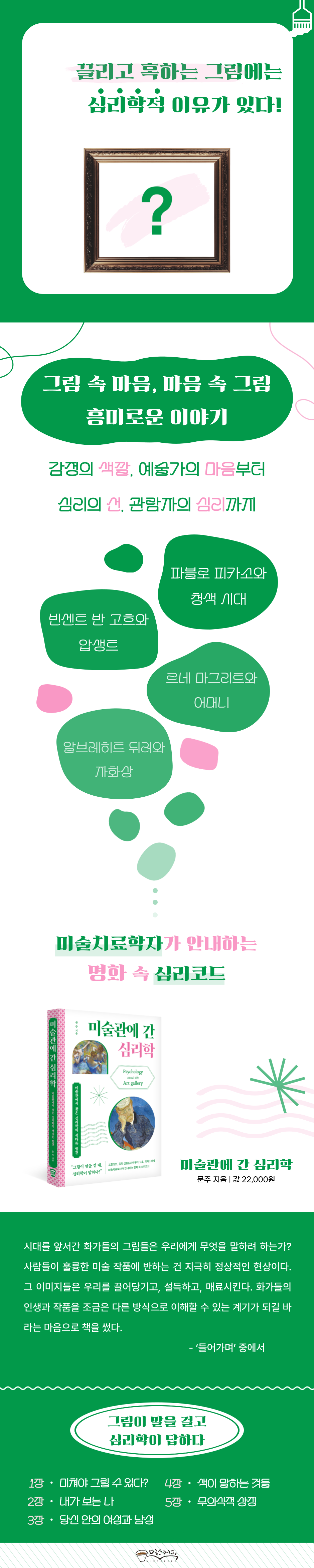
From Freud and Jung's depth psychology to Van Gogh and Picasso
Psychological Codes in Famous Paintings Guided by an Art Therapist
Throughout human history, art and psychology have always been mirrors reflecting each other and sources of inspiration.
Art sought to express inner feelings that cannot be expressed in words through color, line, and shape, while psychology sought to scientifically explore the human mind and behavior.
When we stand before the works of art in an art museum, we do not simply appreciate their beauty.
Some paintings evoke long-forgotten memories, while others convey an unknown sense of anxiety or comfort.
At that very moment, the art museum is transformed into a laboratory of psychology.
Van Gogh's passionate brushstrokes reveal traces of depression and madness, while Picasso's radical deconstruction of form reveals the division and reconstruction of the human mind.
Moreover, the gaze in the self-portrait poses the universal human question, 'Who am I?'
In this way, the art museum is a space where the secrets of the human spirit are condensed, and paintings are a mirror of the mind and a vivid text of psychology.
“The Psychology of Going to an Art Museum” starts from this very point.
By re-examining paintings through the lens of psychology and attempting to re-read the mind through the language of painting, we demonstrate how art can go beyond mere appreciation and become a window into understanding our emotions and thoughts.
Through this book, readers will not only gain a new perspective on works of art, but will also vividly experience the psychological mechanisms and emotional flow that operate in the deepest layers of the human mind.
The art museum is soon to become a living psychology classroom and a space for healing.
"Psychology at the Art Museum" breaks down the barriers between art and human understanding, and explores the fascinating and profound secret encounter between the mind in a painting and the painting in the mind.
Psychological Codes in Famous Paintings Guided by an Art Therapist
Throughout human history, art and psychology have always been mirrors reflecting each other and sources of inspiration.
Art sought to express inner feelings that cannot be expressed in words through color, line, and shape, while psychology sought to scientifically explore the human mind and behavior.
When we stand before the works of art in an art museum, we do not simply appreciate their beauty.
Some paintings evoke long-forgotten memories, while others convey an unknown sense of anxiety or comfort.
At that very moment, the art museum is transformed into a laboratory of psychology.
Van Gogh's passionate brushstrokes reveal traces of depression and madness, while Picasso's radical deconstruction of form reveals the division and reconstruction of the human mind.
Moreover, the gaze in the self-portrait poses the universal human question, 'Who am I?'
In this way, the art museum is a space where the secrets of the human spirit are condensed, and paintings are a mirror of the mind and a vivid text of psychology.
“The Psychology of Going to an Art Museum” starts from this very point.
By re-examining paintings through the lens of psychology and attempting to re-read the mind through the language of painting, we demonstrate how art can go beyond mere appreciation and become a window into understanding our emotions and thoughts.
Through this book, readers will not only gain a new perspective on works of art, but will also vividly experience the psychological mechanisms and emotional flow that operate in the deepest layers of the human mind.
The art museum is soon to become a living psychology classroom and a space for healing.
"Psychology at the Art Museum" breaks down the barriers between art and human understanding, and explores the fascinating and profound secret encounter between the mind in a painting and the painting in the mind.
- You can preview some of the book's contents.
Preview
index
Entering_
Everyone has an image in their subconscious.
Chapter 1: Do You Have to Be Crazy to Draw?: The Perilous Journey Between Art and Madness
Genius or Madness? Madness in Art History
The Seeds of Creativity: Masterpieces Created by Mental Illness
Wounded Self Takes Up the Brush
Painters who painted the world with gloomy brushstrokes
Chapter 2: The Real Story Hidden in Self-Portraits
Drawing a self-portrait means
The story behind a bold self-portrait
I engrave my life in a self-portrait
Realism that depicts things as they are
A self-portrait singing of death
Look at me in pain
Chapter 3 The Woman and Man Within You: Anima and Animus
Another self within you
Seduction or Art: Alluring Women
Artists Bewitched by Moonlight, the Symbolism of the Moon
Between Love and Hate, the Archetype of the Mother
Chapter 4: What Colors Say: Color Psychology
The Secret of Humanity's First Color
Now, the color we love the most
The green dress I traded my life for
Did Van Gogh really like the color yellow?
Why does my daughter like pink?
Chapter 5: Unconscious Symbols: Expressions of the Self
The inner self and the unconscious of repressed emotions
Dreams, fantasies, and the world created by the unconscious
The most surreal surrealist
The fate of the clown dancing the surreal
I became a bird, the image that remains as a clone
References
Everyone has an image in their subconscious.
Chapter 1: Do You Have to Be Crazy to Draw?: The Perilous Journey Between Art and Madness
Genius or Madness? Madness in Art History
The Seeds of Creativity: Masterpieces Created by Mental Illness
Wounded Self Takes Up the Brush
Painters who painted the world with gloomy brushstrokes
Chapter 2: The Real Story Hidden in Self-Portraits
Drawing a self-portrait means
The story behind a bold self-portrait
I engrave my life in a self-portrait
Realism that depicts things as they are
A self-portrait singing of death
Look at me in pain
Chapter 3 The Woman and Man Within You: Anima and Animus
Another self within you
Seduction or Art: Alluring Women
Artists Bewitched by Moonlight, the Symbolism of the Moon
Between Love and Hate, the Archetype of the Mother
Chapter 4: What Colors Say: Color Psychology
The Secret of Humanity's First Color
Now, the color we love the most
The green dress I traded my life for
Did Van Gogh really like the color yellow?
Why does my daughter like pink?
Chapter 5: Unconscious Symbols: Expressions of the Self
The inner self and the unconscious of repressed emotions
Dreams, fantasies, and the world created by the unconscious
The most surreal surrealist
The fate of the clown dancing the surreal
I became a bird, the image that remains as a clone
References
Detailed image
Into the book
Gauguin urged Van Gogh not to paint only what he saw, but to express his imagination, and Van Gogh had a strong philosophy that all paintings begin from nature.
There was an unbridgeable gap between the artistic perspectives of the two men.
In particular, the two chairs painted by Van Gogh are often analyzed from various perspectives.
These two highly symbolic paintings reveal Van Gogh's unconscious feelings towards his father.
Vincent's Chair with a Pipe was created in October 1885, shortly after his father's death.
--- p.47
Kusama began experiencing hallucinations around the age of ten.
One day, while walking in the garden, I saw purple flowers talking to each other with strange expressions, and as I was looking at a red floral tablecloth, I had a vision of it growing bigger and bigger, covering the ceiling, the windows, and Kusama's body, and eventually swallowing the entire universe.
The work, “Flower of Fantasy,” which recreates the terrifying hallucinations experienced in childhood, feels like a gateway that leads us into a world of fantasy.
--- p.68
“The Man Mad with Fear” and “The Man in Desperation” are self-portraits that record Courbet’s emotional reactions to the rejection and failure he experienced in his early years as a painter.
Rather than being faithful to the task of reproducing objective reality, he may have painted self-healing self-portraits faithful to expressing his subjective self and the mental state he experienced during difficult moments in his life.
--- p.102
Critics viewed Kahlo as a surrealist, but she considered herself a realist.
Because Calo painted the subject he knows best, not the surreal, namely himself and the sad reality.
The fact that as many as 55 of the 143 works Kahlo left behind are self-portraits shows that she was obsessed with expressing the complex and painful aspects of being a woman, using herself as her subject.
--- p.113
Among the various archetypes covered in analytical psychology, the 'anima/animus theory' is about the unconscious tendencies of men and women, and is believed to be closely related to the differences in consciousness between the two genders.
It starts from the very common-sense distinction that men and women are different.
However, as the consciousness is different, the influence of the unconscious is different.
--- p.123
When a man's mother has a negative influence on him, his anima often manifests itself as depression, irritability and mood swings, bitterness, anxiety, sensitivity, and extreme caution that prevents him from fully establishing himself in life.
This anima feeling can also cause fear of illness and incompetence.
When the anima is in an undifferentiated state, he appears rational but displays immature outbursts of primitive emotions.
In normal times, this sexual man's sudden outbursts of anger indicate that he is possessed by a negative anima.
--- p.146
Humanity really likes blue.
According to data from a survey conducted by a design firm in California, USA, based on responses from 6,300 people from 150 countries, blue was the most preferred color among Europeans, including Americans.
In most of the papers by Professor Labrecque of the University of Rhode Island, who studies color in the field of marketing, blue always ranked first in the subjects' color preference.
Also, in 1993, crayon manufacturer Crayola conducted a survey of American children to determine their favorite crayon color, and most children chose blue, with navy and sky blue also ranking in the top 10.
The same survey was repeated seven years later, and traditional blue once again took first place.
--- p.169
Humans perceive green as a peaceful and protective color.
Green is also a color that soothes humans on a primal, instinctive level, because if there is enough green space in an area, it means there is water, and if there is water, it means there is a possibility of food.
But green is also a powerful symbol of toxicity, jealousy, and beginners.
--- p.192
AI is too perfect and precise.
What is most important is that there is no 'self' in the pictures drawn by robots.
Of course, for the average viewer, it may not be easy to distinguish between paintings drawn by robots and paintings drawn by humans.
But what is certain is that the robot could not possibly have experienced the feeling of 'standing there' while drawing.
The result may be aesthetically pleasing, but it lacks the creator's struggles, intentions, and most importantly, self.
--- p.224
There was a duality in Dali's growth process.
In contrast to his strict father, who was a notary public, his mother nurtured Dali's artistic talent and creativity.
But sadly, his mother passed away when Dali was only sixteen, an event that had a profound impact on his life and art.
There was an unbridgeable gap between the artistic perspectives of the two men.
In particular, the two chairs painted by Van Gogh are often analyzed from various perspectives.
These two highly symbolic paintings reveal Van Gogh's unconscious feelings towards his father.
Vincent's Chair with a Pipe was created in October 1885, shortly after his father's death.
--- p.47
Kusama began experiencing hallucinations around the age of ten.
One day, while walking in the garden, I saw purple flowers talking to each other with strange expressions, and as I was looking at a red floral tablecloth, I had a vision of it growing bigger and bigger, covering the ceiling, the windows, and Kusama's body, and eventually swallowing the entire universe.
The work, “Flower of Fantasy,” which recreates the terrifying hallucinations experienced in childhood, feels like a gateway that leads us into a world of fantasy.
--- p.68
“The Man Mad with Fear” and “The Man in Desperation” are self-portraits that record Courbet’s emotional reactions to the rejection and failure he experienced in his early years as a painter.
Rather than being faithful to the task of reproducing objective reality, he may have painted self-healing self-portraits faithful to expressing his subjective self and the mental state he experienced during difficult moments in his life.
--- p.102
Critics viewed Kahlo as a surrealist, but she considered herself a realist.
Because Calo painted the subject he knows best, not the surreal, namely himself and the sad reality.
The fact that as many as 55 of the 143 works Kahlo left behind are self-portraits shows that she was obsessed with expressing the complex and painful aspects of being a woman, using herself as her subject.
--- p.113
Among the various archetypes covered in analytical psychology, the 'anima/animus theory' is about the unconscious tendencies of men and women, and is believed to be closely related to the differences in consciousness between the two genders.
It starts from the very common-sense distinction that men and women are different.
However, as the consciousness is different, the influence of the unconscious is different.
--- p.123
When a man's mother has a negative influence on him, his anima often manifests itself as depression, irritability and mood swings, bitterness, anxiety, sensitivity, and extreme caution that prevents him from fully establishing himself in life.
This anima feeling can also cause fear of illness and incompetence.
When the anima is in an undifferentiated state, he appears rational but displays immature outbursts of primitive emotions.
In normal times, this sexual man's sudden outbursts of anger indicate that he is possessed by a negative anima.
--- p.146
Humanity really likes blue.
According to data from a survey conducted by a design firm in California, USA, based on responses from 6,300 people from 150 countries, blue was the most preferred color among Europeans, including Americans.
In most of the papers by Professor Labrecque of the University of Rhode Island, who studies color in the field of marketing, blue always ranked first in the subjects' color preference.
Also, in 1993, crayon manufacturer Crayola conducted a survey of American children to determine their favorite crayon color, and most children chose blue, with navy and sky blue also ranking in the top 10.
The same survey was repeated seven years later, and traditional blue once again took first place.
--- p.169
Humans perceive green as a peaceful and protective color.
Green is also a color that soothes humans on a primal, instinctive level, because if there is enough green space in an area, it means there is water, and if there is water, it means there is a possibility of food.
But green is also a powerful symbol of toxicity, jealousy, and beginners.
--- p.192
AI is too perfect and precise.
What is most important is that there is no 'self' in the pictures drawn by robots.
Of course, for the average viewer, it may not be easy to distinguish between paintings drawn by robots and paintings drawn by humans.
But what is certain is that the robot could not possibly have experienced the feeling of 'standing there' while drawing.
The result may be aesthetically pleasing, but it lacks the creator's struggles, intentions, and most importantly, self.
--- p.224
There was a duality in Dali's growth process.
In contrast to his strict father, who was a notary public, his mother nurtured Dali's artistic talent and creativity.
But sadly, his mother passed away when Dali was only sixteen, an event that had a profound impact on his life and art.
--- p.243
Publisher's Review
The heart in the picture and the picture in the heart
Secret meeting
Vincent van Gogh once confessed, “I tried to express extreme sadness and loneliness with clarity of mind.”
For example, the swirl of “Starry Night” shows an inner world entangled with anxiety and hope, and the yellow color of “Sunflower” shows a desire to hold on to life.
We follow the loneliness and passion that permeates Van Gogh's brushstrokes and examine how art sublimated human suffering into beauty.
Pablo Picasso's 'Blue Period' was born in the shadow of deep depression and loss.
The screen, filled with blue light, overwhelmingly reveals the loneliness and sadness of human existence, while leaving behind an emotional resonance that goes beyond despair.
In this cold color palette, it is interesting to see how Picasso expressed his inner wounds and healed them through art.
The Color of Emotion, the Artist's
From the heart
The line of psychology, even the psychology of the viewer
This book consists of a total of five chapters.
In Chapter 1, “Do You Have to Be Crazy to Draw?: The Dangerous Journey Between Art and Madness,” you can encounter the stories of artists who kept the flame of creation burning in the midst of anxiety and pain, such as Vincent van Gogh, Edgar Degas, Henri de Toulouse-Lautrec, and Yayoi Kusama.
Chapter 2, “How I See Myself: Stories Hidden in Self-Portraits,” delves into the inner selves of masters who explored themselves through self-portraits, including Albrecht Dürer, Rembrandt Harmonsson van Rijn, Gustave Courbet, and Frida Kahlo.
Chapter 3, 'Woman and Man Within You: Anima and Animus', draws on the depth psychology of Sigmund Freud and Carl Gustav Jung to show the unconscious gendered face revealed in the works of Gustav Klimt, Guercino, Jackson Pollock, and René Magritte.
Chapter 4, "What Colors Say: Color Psychology," provides an interesting explanation of the cultural symbols and psychological meanings contained in colors such as red, blue, green, yellow, and pink.
Chapter 5, 'Unconscious Symbols: The Expression of the Self,' follows the world of surrealists such as Joan Miró, Yves Tanguy, Salvador Dali, and Max Ernst, and shows how the unconscious manifests itself in art.
Ultimately, it is only natural that people are fascinated by great works of art, and sometimes feel repulsed.
These images attract us, persuade us, and ultimately shake our hearts.
* This book, “Psychology in an Art Museum” (written by Moon Joo), has the same title as the out-of-print book by author Hyunhee Yoon, but contains separate content that is unrelated.
Secret meeting
Vincent van Gogh once confessed, “I tried to express extreme sadness and loneliness with clarity of mind.”
For example, the swirl of “Starry Night” shows an inner world entangled with anxiety and hope, and the yellow color of “Sunflower” shows a desire to hold on to life.
We follow the loneliness and passion that permeates Van Gogh's brushstrokes and examine how art sublimated human suffering into beauty.
Pablo Picasso's 'Blue Period' was born in the shadow of deep depression and loss.
The screen, filled with blue light, overwhelmingly reveals the loneliness and sadness of human existence, while leaving behind an emotional resonance that goes beyond despair.
In this cold color palette, it is interesting to see how Picasso expressed his inner wounds and healed them through art.
The Color of Emotion, the Artist's
From the heart
The line of psychology, even the psychology of the viewer
This book consists of a total of five chapters.
In Chapter 1, “Do You Have to Be Crazy to Draw?: The Dangerous Journey Between Art and Madness,” you can encounter the stories of artists who kept the flame of creation burning in the midst of anxiety and pain, such as Vincent van Gogh, Edgar Degas, Henri de Toulouse-Lautrec, and Yayoi Kusama.
Chapter 2, “How I See Myself: Stories Hidden in Self-Portraits,” delves into the inner selves of masters who explored themselves through self-portraits, including Albrecht Dürer, Rembrandt Harmonsson van Rijn, Gustave Courbet, and Frida Kahlo.
Chapter 3, 'Woman and Man Within You: Anima and Animus', draws on the depth psychology of Sigmund Freud and Carl Gustav Jung to show the unconscious gendered face revealed in the works of Gustav Klimt, Guercino, Jackson Pollock, and René Magritte.
Chapter 4, "What Colors Say: Color Psychology," provides an interesting explanation of the cultural symbols and psychological meanings contained in colors such as red, blue, green, yellow, and pink.
Chapter 5, 'Unconscious Symbols: The Expression of the Self,' follows the world of surrealists such as Joan Miró, Yves Tanguy, Salvador Dali, and Max Ernst, and shows how the unconscious manifests itself in art.
Ultimately, it is only natural that people are fascinated by great works of art, and sometimes feel repulsed.
These images attract us, persuade us, and ultimately shake our hearts.
* This book, “Psychology in an Art Museum” (written by Moon Joo), has the same title as the out-of-print book by author Hyunhee Yoon, but contains separate content that is unrelated.
GOODS SPECIFICS
- Date of issue: September 1, 2025
- Page count, weight, size: 264 pages | 434g | 148*210*16mm
- ISBN13: 9791170436690
- ISBN10: 1170436692
You may also like
카테고리
korean


korean

![GQ KOREA Mark (Monthly): December [2025]](http://librairie.coreenne.fr/cdn/shop/files/8ef265dbbfbf186523ed75ba7319009d.jpg?v=1765340328&width=3840)


