

The power of critical thinking
 |
Description
Book Introduction
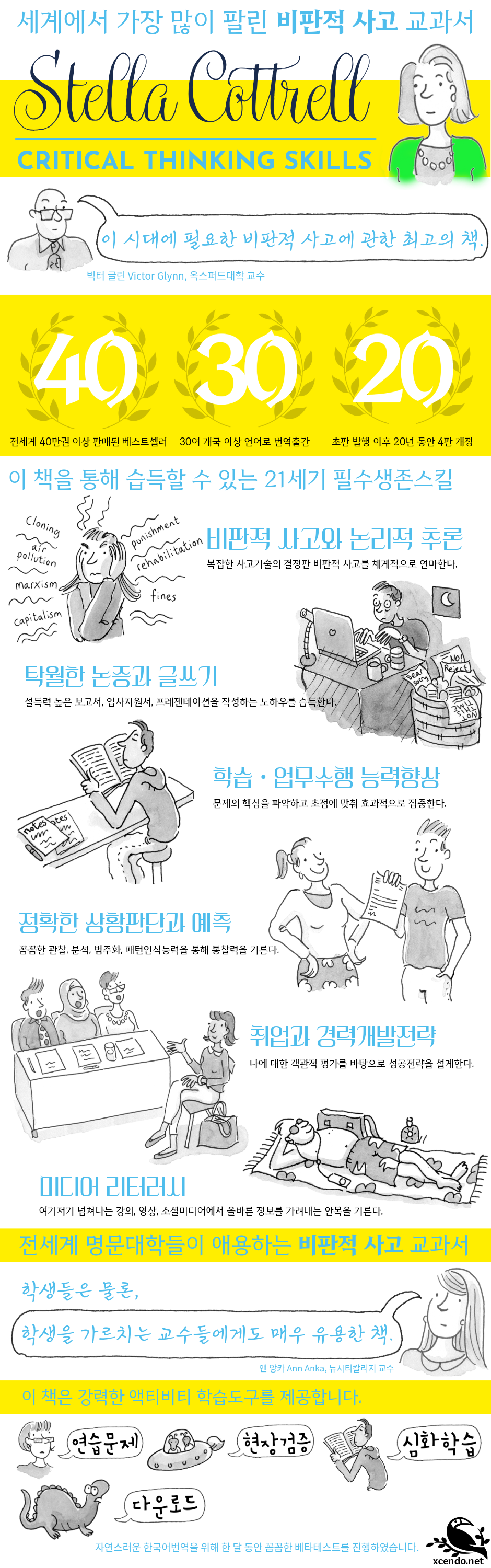
"The Power of Critical Thinking" presents specific methods to help you quickly acquire the core critical thinking skills of "rational thinking" and "the ability to doubt and reflect" and effectively utilize them in your daily life.
Following a step-by-step roadmap that trains critical thinking, it provides a variety of examples and practice problems, allowing readers to solve them themselves and test their understanding.
It explains how to understand arguments, analyze texts, and write effectively.
Furthermore, through critical reflection, it helps you apply critical thinking to your daily life, and trains your thinking muscles to prepare for employment, develop your career, and improve your job skills, helping you make better decisions and choices in all aspects of life, and live a more proactive life.
First published in 2005 and now in its fourth revision, this book has sold hundreds of thousands of copies over the past two decades and is still used as a critical thinking textbook in leading universities around the world.
Following a step-by-step roadmap that trains critical thinking, it provides a variety of examples and practice problems, allowing readers to solve them themselves and test their understanding.
It explains how to understand arguments, analyze texts, and write effectively.
Furthermore, through critical reflection, it helps you apply critical thinking to your daily life, and trains your thinking muscles to prepare for employment, develop your career, and improve your job skills, helping you make better decisions and choices in all aspects of life, and live a more proactive life.
First published in 2005 and now in its fourth revision, this book has sold hundreds of thousands of copies over the past two decades and is still used as a critical thinking textbook in leading universities around the world.
- You can preview some of the book's contents.
Preview
index
Who is this book for?
Why is critical thinking important?
Training your thinking muscles
How to use this book
Preview full content
Icons used in this book
1.
What is Critical Thinking?: Definition, History, and Value
The art of refining one's thoughts
The Core of Critical Thinking: Reasoning and Argumentation
The Origins and Development of Critical Thinking
What are the benefits of critical thinking?
What do universities require of students?
I've never heard of such a thing.
Basic qualities and attitudes for success
Barriers to Critical Thinking
Diagnostic test before critical thinking training
2.
Basic Thinking Skills Assessment: Warming Up for Critical Thinking Training
Thinking skills that form the foundation of critical thinking
How good is my thinking ability?
How long will my attention span be?
3.
Let me lay out my argument: the key elements of argument.
What would the argument look like?
Uncovering Arguments Buried in Text
Finding the conclusion
Key elements that make up an argument
4.
What's the Difference Between Arguments?: Arguments vs. Non-Arguments
Opposition for the sake of constructive criticism and opposition
Three Types of Non-Argumentative Writing
Summary and logical conclusion
Things that can be mistaken for arguments
Non-argumentative elements in an argumentative essay
5.
Building a Tower of Arguments: How to Powerfully Push a Strong Argument
What are you claiming?
Consistency of statements
logical consistency
Reasons for combination and individual reasons
Intermediate conclusion that summarizes the line of reasoning
Arrange the reasons in a logical order
6.
Reading Between the Lines: Hidden Assumptions and Implicit Arguments
Invisible claim
Omit argument elements
Reasoning and three-stage reasoning
Argument based on premise
implicit argument
Ideology and stereotypes
Surface meaning and implied meaning
7.
Finding Fallacies in Arguments: Illogical Persuasive Strategies That Distort Reasoning
Causality and Correlation
Necessary and sufficient conditions
Manipulating scenarios using metaphors
Error strategies that block rational thinking
8.
Is it a credible truth?: Finding the evidence, verifying it, and evaluating it.
Where can we find the basis?
What are some reliable sources?
How to evaluate whether the evidence is credible
Is it a fact or an opinion?
Approaching Social Media Critically
Is this real news or fake news?
9.
Critical Reading and Note-taking: Read, Watch, and Listen Accurately
How to Read a Book Critically
Categorizing Arguments: The Utility of Theory
The art of taking notes while reading a book
Techniques for taking notes while watching lectures or videos
10.
Critical and Analytical Writing: Effective Writing Strategies
Characteristics of Critical Analytical Writing
Putting the ideas in writing
Designing an Argument Structure
Writing an introduction, body, and conclusion
Limiting overly definitive statements
Signposts that guide the flow of argument
Cite a citation
11.
Argument Mapping: A Technique for Visualizing Argument Structure
Drawing an argument map
Mapping extended arguments
Checklist for Evaluating Arguments
Critically evaluate my writing
12.
Critical Reflection: Transform Your Everyday Life with Critical Thinking
What is critical reflection?
What are the benefits of critical reflection?
Obstacles to Critical Reflection
How do we practice critical reflection?
Step-by-step critical reflection model
Job Improvement Using Critical Reflection
Critical reflection and writing habits
13.
Employment and Career Development Success Strategies: Critical Thinking is a Key Competitive Edge for Future Talent
Life and Career Design Using Critical Reflection
Job Preparation Strategy
Common Mistakes Job Seekers Make
Critical thinking shines even brighter in the AI era
+ Attachments: Various reading materials and explanations of practice problems
Readings on 'Student Quality of Life'
Sample Essay Analysis Practice
Words that frequently appear in academic paper titles
Search engine for online literature research
Glossary and Index
Practice problem solutions and explanations
Sources and References
Acknowledgements
Translator's Note
Beta Tester's Note
Why is critical thinking important?
Training your thinking muscles
How to use this book
Preview full content
Icons used in this book
1.
What is Critical Thinking?: Definition, History, and Value
The art of refining one's thoughts
The Core of Critical Thinking: Reasoning and Argumentation
The Origins and Development of Critical Thinking
What are the benefits of critical thinking?
What do universities require of students?
I've never heard of such a thing.
Basic qualities and attitudes for success
Barriers to Critical Thinking
Diagnostic test before critical thinking training
2.
Basic Thinking Skills Assessment: Warming Up for Critical Thinking Training
Thinking skills that form the foundation of critical thinking
How good is my thinking ability?
How long will my attention span be?
3.
Let me lay out my argument: the key elements of argument.
What would the argument look like?
Uncovering Arguments Buried in Text
Finding the conclusion
Key elements that make up an argument
4.
What's the Difference Between Arguments?: Arguments vs. Non-Arguments
Opposition for the sake of constructive criticism and opposition
Three Types of Non-Argumentative Writing
Summary and logical conclusion
Things that can be mistaken for arguments
Non-argumentative elements in an argumentative essay
5.
Building a Tower of Arguments: How to Powerfully Push a Strong Argument
What are you claiming?
Consistency of statements
logical consistency
Reasons for combination and individual reasons
Intermediate conclusion that summarizes the line of reasoning
Arrange the reasons in a logical order
6.
Reading Between the Lines: Hidden Assumptions and Implicit Arguments
Invisible claim
Omit argument elements
Reasoning and three-stage reasoning
Argument based on premise
implicit argument
Ideology and stereotypes
Surface meaning and implied meaning
7.
Finding Fallacies in Arguments: Illogical Persuasive Strategies That Distort Reasoning
Causality and Correlation
Necessary and sufficient conditions
Manipulating scenarios using metaphors
Error strategies that block rational thinking
8.
Is it a credible truth?: Finding the evidence, verifying it, and evaluating it.
Where can we find the basis?
What are some reliable sources?
How to evaluate whether the evidence is credible
Is it a fact or an opinion?
Approaching Social Media Critically
Is this real news or fake news?
9.
Critical Reading and Note-taking: Read, Watch, and Listen Accurately
How to Read a Book Critically
Categorizing Arguments: The Utility of Theory
The art of taking notes while reading a book
Techniques for taking notes while watching lectures or videos
10.
Critical and Analytical Writing: Effective Writing Strategies
Characteristics of Critical Analytical Writing
Putting the ideas in writing
Designing an Argument Structure
Writing an introduction, body, and conclusion
Limiting overly definitive statements
Signposts that guide the flow of argument
Cite a citation
11.
Argument Mapping: A Technique for Visualizing Argument Structure
Drawing an argument map
Mapping extended arguments
Checklist for Evaluating Arguments
Critically evaluate my writing
12.
Critical Reflection: Transform Your Everyday Life with Critical Thinking
What is critical reflection?
What are the benefits of critical reflection?
Obstacles to Critical Reflection
How do we practice critical reflection?
Step-by-step critical reflection model
Job Improvement Using Critical Reflection
Critical reflection and writing habits
13.
Employment and Career Development Success Strategies: Critical Thinking is a Key Competitive Edge for Future Talent
Life and Career Design Using Critical Reflection
Job Preparation Strategy
Common Mistakes Job Seekers Make
Critical thinking shines even brighter in the AI era
+ Attachments: Various reading materials and explanations of practice problems
Readings on 'Student Quality of Life'
Sample Essay Analysis Practice
Words that frequently appear in academic paper titles
Search engine for online literature research
Glossary and Index
Practice problem solutions and explanations
Sources and References
Acknowledgements
Translator's Note
Beta Tester's Note
Detailed image
Into the book
Critical thinking can be said to be the culmination of a high-level thinking skill that is created by synthesizing various thinking skills.
Critical thinking is the skill of focusing closely, analyzing, dissecting, and evaluating, selecting and judging, and synthesizing these to arrive at a valid conclusion.
Of course, these thinking skills are not easy to build.
Only those who possess fundamental qualities such as curiosity, an open mind, systematic thinking, perseverance, and a fair, flexible, and honest attitude can embark on the path to acquiring these higher-level thinking skills.
--- p.8
Critical thinking is a very important competitive edge not only in college but also in the workplace you will pursue after graduation.
Without strong critical thinking skills, you won't be able to perform well academically or succeed in the professional world.
Furthermore, critical thinking plays a key role in creating a healthy civil society.
--- p.11
When giving a critical evaluation of someone's work, you must always maintain a constructive attitude and know how to add a bit of wit and humor.
The ability to convey a difficult message in a way that makes it easily receptive is a valuable skill and talent that cannot be ignored, as it is essential for maintaining sound critical thinking.
--- p.44
Even if I consistently win arguments, it doesn't prove that my arguments are right or that I have superior reasoning skills.
The other person may not have noticed the flaw in your argument, or for some personal reason--- p. for example, they may not want to fight or are too lazy to argue--- p. they may just ignore it and give in.
Inaccurate, imprecise, and illogical thinking can hinder the development of the mental abilities required for higher level studies and work.
--- p.53
Critical thinking can feel difficult and tedious.
Of course it is.
The same goes for professors.
But if it were something anyone could easily do, what value would it have? Developing critical thinking is like training the "muscles of thought."
If you want to live a long and healthy life, you have to constantly practice.
--- p.56
To determine whether the countless new stories that are pouring out are true or false, we must be able to ask critical questions.
Even if a story seems plausible, you must be able to verify whether it is true and understand the intention of the person telling the story.
Of course, even if there is absolutely no malicious intent to deceive or mislead, fake news is still fake news.
The ultimate goal of fake news is to paralyze the truth by confusing the real with the fake, making it impossible to distinguish between credible and unreliable interpretations.
--- p.298
As you work, you may encounter situations where it is difficult to follow procedures precisely or unexpected exceptional circumstances may arise.
Moreover, when such an emergency situation arises, the on-site staff must immediately and proactively make decisions.
However, if you work without properly understanding the relationship between theory and practice, you may make wrong decisions or fatal mistakes.
--- p.470
Employers all over the world want to hire talented college graduates.
This is because the core of university education is training ‘critical thinking skills.’
Critical thinking requires an open mind, the ability to reflect on oneself, to fairly evaluate problems from various perspectives, and to question existing approaches to business.
Critical thinking is the skill of focusing closely, analyzing, dissecting, and evaluating, selecting and judging, and synthesizing these to arrive at a valid conclusion.
Of course, these thinking skills are not easy to build.
Only those who possess fundamental qualities such as curiosity, an open mind, systematic thinking, perseverance, and a fair, flexible, and honest attitude can embark on the path to acquiring these higher-level thinking skills.
--- p.8
Critical thinking is a very important competitive edge not only in college but also in the workplace you will pursue after graduation.
Without strong critical thinking skills, you won't be able to perform well academically or succeed in the professional world.
Furthermore, critical thinking plays a key role in creating a healthy civil society.
--- p.11
When giving a critical evaluation of someone's work, you must always maintain a constructive attitude and know how to add a bit of wit and humor.
The ability to convey a difficult message in a way that makes it easily receptive is a valuable skill and talent that cannot be ignored, as it is essential for maintaining sound critical thinking.
--- p.44
Even if I consistently win arguments, it doesn't prove that my arguments are right or that I have superior reasoning skills.
The other person may not have noticed the flaw in your argument, or for some personal reason--- p. for example, they may not want to fight or are too lazy to argue--- p. they may just ignore it and give in.
Inaccurate, imprecise, and illogical thinking can hinder the development of the mental abilities required for higher level studies and work.
--- p.53
Critical thinking can feel difficult and tedious.
Of course it is.
The same goes for professors.
But if it were something anyone could easily do, what value would it have? Developing critical thinking is like training the "muscles of thought."
If you want to live a long and healthy life, you have to constantly practice.
--- p.56
To determine whether the countless new stories that are pouring out are true or false, we must be able to ask critical questions.
Even if a story seems plausible, you must be able to verify whether it is true and understand the intention of the person telling the story.
Of course, even if there is absolutely no malicious intent to deceive or mislead, fake news is still fake news.
The ultimate goal of fake news is to paralyze the truth by confusing the real with the fake, making it impossible to distinguish between credible and unreliable interpretations.
--- p.298
As you work, you may encounter situations where it is difficult to follow procedures precisely or unexpected exceptional circumstances may arise.
Moreover, when such an emergency situation arises, the on-site staff must immediately and proactively make decisions.
However, if you work without properly understanding the relationship between theory and practice, you may make wrong decisions or fatal mistakes.
--- p.470
Employers all over the world want to hire talented college graduates.
This is because the core of university education is training ‘critical thinking skills.’
Critical thinking requires an open mind, the ability to reflect on oneself, to fairly evaluate problems from various perspectives, and to question existing approaches to business.
--- p.503
Publisher's Review
The best book on critical thinking in our time.
The price of the book is not at all expensive.
Victor Glynn, Oxford University, Education Bookseller, 2011
An excellent book for systematically teaching critical thinking skills to students, regardless of their major.
- Una Crowley, Maynooth University, Ireland All Ireland Journal of Higher Education, 2015
The book's clear and systematic approach, coupled with the humor hidden throughout, makes it impossible not to be drawn into it.
Highly recommended!
- Deidre Kelleher, University College Dublin, Ireland
Clear, concise and practical.
The book you need right now!
- Liesl Schwabe, Yeshiva University College, New York
This is a very useful book not only for students but also for the faculty and staff who teach them.
In particular, the various activities included in this book serve as a guide to make lectures more exciting for beginner instructors who have just started teaching.
- Ann Anka, Havering College of Further and Higher Education, London
Fun and refreshing! My favorite book!
- Julie Engstrom, Brigham Young University-Idaho
The price of the book is not at all expensive.
Victor Glynn, Oxford University, Education Bookseller, 2011
An excellent book for systematically teaching critical thinking skills to students, regardless of their major.
- Una Crowley, Maynooth University, Ireland All Ireland Journal of Higher Education, 2015
The book's clear and systematic approach, coupled with the humor hidden throughout, makes it impossible not to be drawn into it.
Highly recommended!
- Deidre Kelleher, University College Dublin, Ireland
Clear, concise and practical.
The book you need right now!
- Liesl Schwabe, Yeshiva University College, New York
This is a very useful book not only for students but also for the faculty and staff who teach them.
In particular, the various activities included in this book serve as a guide to make lectures more exciting for beginner instructors who have just started teaching.
- Ann Anka, Havering College of Further and Higher Education, London
Fun and refreshing! My favorite book!
- Julie Engstrom, Brigham Young University-Idaho
GOODS SPECIFICS
- Date of issue: August 22, 2025
- Page count, weight, size: 664 pages | 926g | 152*220*32mm
- ISBN13: 9791188392582
You may also like
카테고리
korean


korean

![GQ KOREA Mark (Monthly): December [2025]](http://librairie.coreenne.fr/cdn/shop/files/8ef265dbbfbf186523ed75ba7319009d.jpg?v=1765340328&width=3840)


