

The war has started again
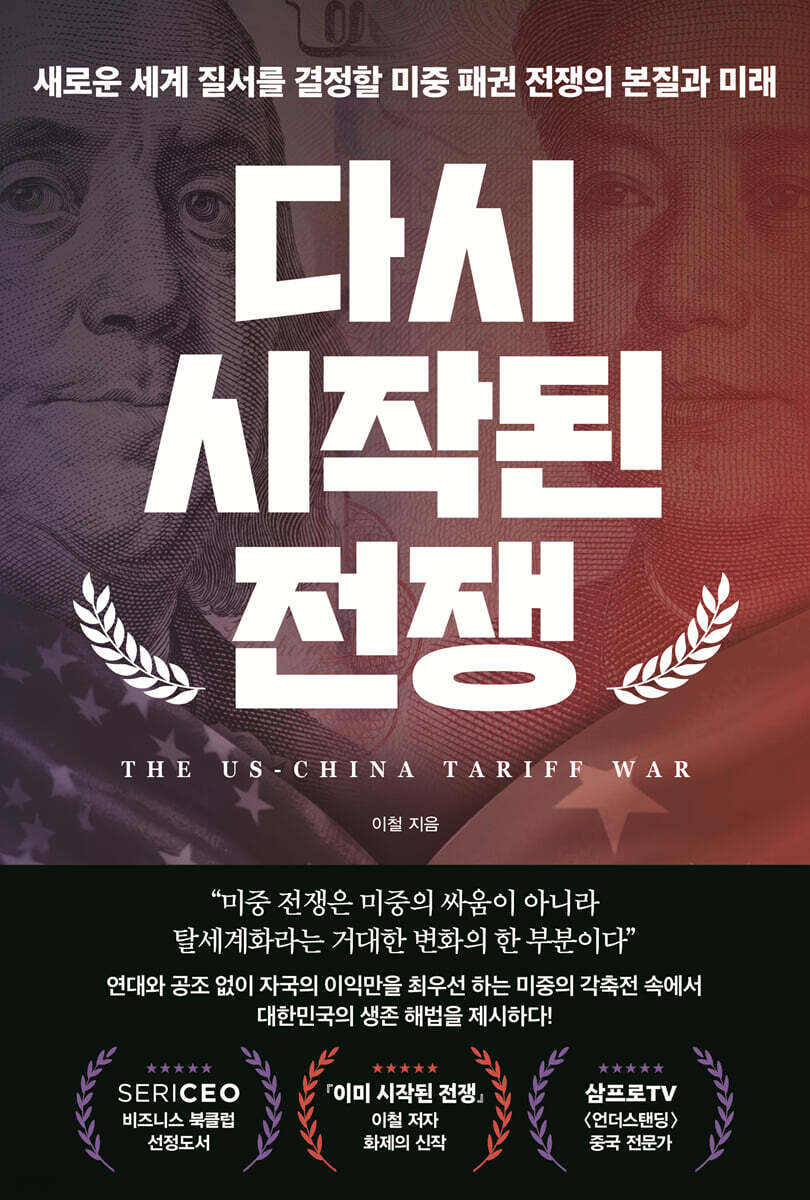 |
Description
Book Introduction
“Second 90-day extension! The US-China tariff war
“It can never end peacefully!”
Trump must win at all costs, Xi Jinping hides his true intentions.
If we choose one side, South Korea will face a crisis!
What choices should we make to get the results we want?
The tariff negotiations between the U.S. and China were held in three rounds, starting with the first agreement on May 12th, but failed to reach a clear conclusion even in the third round on July 29th, ending with a 90-day extension of the tariff war "truce."
This is the second extension of negotiations following the 90-day suspension of negotiations in the second agreement on June 10.
If the US-China tariff negotiations continue as they are, will they be able to achieve the beautiful ending both sides desire?
The United States and China, the G2 powers that have divided global hegemony, have long been at odds over trade friction, and with President Donald Trump inaugurated for a second term, the trade war from his first term continues.
Before taking office, Trump declared that he would impose a 60% tariff on China, and after taking office, he imposed high reciprocal tariffs and tariffs on products around the world.
The absurd tariffs of up to 254% on Chinese products embarrassed China, and the enormous tariffs imposed on the entire world shocked all countries.
Trump's tariffs went beyond common sense and did not distinguish between friend and foe.
What does Trump hope to gain from these high tariffs? What risks does the world face? Why did Trump risk such a trade war? What is his motive, and how will China respond? "The War Begins Again" analyzes how the US trade pressure triggered by tariffs is escalating from an economic war with China into a global power struggle. It also presents a response strategy for South Korea, which cannot afford to lean toward either the US or China, to wisely navigate this situation.
“It can never end peacefully!”
Trump must win at all costs, Xi Jinping hides his true intentions.
If we choose one side, South Korea will face a crisis!
What choices should we make to get the results we want?
The tariff negotiations between the U.S. and China were held in three rounds, starting with the first agreement on May 12th, but failed to reach a clear conclusion even in the third round on July 29th, ending with a 90-day extension of the tariff war "truce."
This is the second extension of negotiations following the 90-day suspension of negotiations in the second agreement on June 10.
If the US-China tariff negotiations continue as they are, will they be able to achieve the beautiful ending both sides desire?
The United States and China, the G2 powers that have divided global hegemony, have long been at odds over trade friction, and with President Donald Trump inaugurated for a second term, the trade war from his first term continues.
Before taking office, Trump declared that he would impose a 60% tariff on China, and after taking office, he imposed high reciprocal tariffs and tariffs on products around the world.
The absurd tariffs of up to 254% on Chinese products embarrassed China, and the enormous tariffs imposed on the entire world shocked all countries.
Trump's tariffs went beyond common sense and did not distinguish between friend and foe.
What does Trump hope to gain from these high tariffs? What risks does the world face? Why did Trump risk such a trade war? What is his motive, and how will China respond? "The War Begins Again" analyzes how the US trade pressure triggered by tariffs is escalating from an economic war with China into a global power struggle. It also presents a response strategy for South Korea, which cannot afford to lean toward either the US or China, to wisely navigate this situation.
- You can preview some of the book's contents.
Preview
index
The tariff war is ongoing.
Chapter 1: Who Chose Trump?
01 It's not Trump's return to power, it's the emergence of a hidden America.
02 MAGA, the Main Street Uprising
Chapter 2: What is the tariff war for?
Lesson 01: Trump Tariffs
02 Who and What Is Trump Fighting?
03 What are Trump's intentions?
Chapter 3: Trump Tariffs and the US-China Economy
01 Is a global recession coming?
02 Influence of the US and China
03 Are capital markets segregated?
Chapter 4: China Will Fight to the End
01 China's strategy toward the United States is to fight to the end while upholding its principles.
02 China wants to create a world without the United States if it decouples.
03 China can withstand decoupling with its internally circulating economy.
04 Winning the scientific and technological innovation race with new production capabilities and rare earth elements.
Chapter 5: The Future of the US-China Hegemony Competition and Korea's Response Strategy
01 Is Trump's Tariff Policy Successful?
02 Future Outlook for US-China Negotiations
03 Korea and the Third Camp
Conclusion: A third camp strategy is urgently needed to overcome the tariff war.
annotation
Chapter 1: Who Chose Trump?
01 It's not Trump's return to power, it's the emergence of a hidden America.
02 MAGA, the Main Street Uprising
Chapter 2: What is the tariff war for?
Lesson 01: Trump Tariffs
02 Who and What Is Trump Fighting?
03 What are Trump's intentions?
Chapter 3: Trump Tariffs and the US-China Economy
01 Is a global recession coming?
02 Influence of the US and China
03 Are capital markets segregated?
Chapter 4: China Will Fight to the End
01 China's strategy toward the United States is to fight to the end while upholding its principles.
02 China wants to create a world without the United States if it decouples.
03 China can withstand decoupling with its internally circulating economy.
04 Winning the scientific and technological innovation race with new production capabilities and rare earth elements.
Chapter 5: The Future of the US-China Hegemony Competition and Korea's Response Strategy
01 Is Trump's Tariff Policy Successful?
02 Future Outlook for US-China Negotiations
03 Korea and the Third Camp
Conclusion: A third camp strategy is urgently needed to overcome the tariff war.
annotation
Detailed image

Into the book
Trump began a series of actions that shocked the world.
In particular, it shocked all countries of the world by imposing enormous tariffs, especially on the entire world.
These tariffs went beyond common sense and made no distinction between friend and foe.
The global free trade system has been hit hard, and people are scrambling to find ways to cope with the coming chaos.
The reaction of American society was very different from that of a single monster like Trump, who could have triggered this change.
Many Americans have shown up, seemingly waiting for Trump's radical policies, to support them and enthusiastically implement them.
Therefore, we must understand that the current change is not due to one individual, Trump, but rather that a fundamental and profound change has occurred within the nation of the United States.
In other words, the current situation should be understood not as Trump's re-election, but as the emergence of a new America.
---From "Chapter 1: Who Chose Trump?"
Trump's tariff policy is merely an extension of America's economic policy.
This is also well explained by the fact that the first high tariffs announced by Trump were aimed at Canada and Mexico.
From a global political perspective, Canada is a blood ally and brother nation of the United States.
Mexico is also an ally of the United States and a country that has followed American leadership.
Depending on the US economic policy structure, Canada and Mexico may also accept a US-dependent economic system.
It is no wonder that such high tariffs on Canada and Mexico have sparked outrage in both countries.
But if we look at this measure from the perspective of the domestic U.S. economy, it becomes very simple.
From the Trump administration's perspective, the value of access to the U.S. market is greatest for these two countries.
Therefore, the highest tariff must be paid.
This means that when interpreting the policies of the second Trump administration, they should be viewed not from a geopolitical or global economic perspective, but as an extension of the U.S. domestic economy.
From Trump's perspective, this is a policy of 'deglobalization' and at the same time a 'MAGA' policy.
---From "Chapter 1: Who Chose Trump?"
China's response was significant.
China's State Council responded to Trump's 10% tariffs by imposing tariffs on some US imports. It's noteworthy that the State Council's announcement was made at 1:01 PM on February 4th.
When Trump signed the executive order imposing a 10% tariff on Chinese imports, the official effective time for the tariff increase was 1:01 PM on February 4th.
In other words, China intentionally imposed tariffs on the United States at the same time as the U.S. public tariffs took effect.
China's retaliation was limited to a 15% tariff on American coal and liquefied natural gas, rather than on all American goods.
And it added 10% tariffs on American crude oil, farm machinery, large-displacement vehicles and pickup trucks.
Cui Fan said that in the future, China will be able to dynamically adjust its corresponding countermeasures in accordance with the actions of the United States.
It was also significant that China imposed retaliatory tariffs on energy.
This is because energy, which was considered China's biggest strategic material weakness, was decided to be the target of retaliatory tariffs.
In other words, it was a message to the United States that China would be okay with cutting off its energy supply chain, and it was an indication that it was prepared for a naval blockade or even war.
---From "Chapter 2: What is the Tariff War for?"
Trump's tariffs had nothing to do with ideology or alliances.
The country with the highest tariff was Cambodia, not China, while countries like Brazil had a minimum tariff of 10%.
Hungary, Israel, and Italy, which have good cooperative relations with the United States, also received significant tariffs.
Even more surprising is the fact that the US has imposed enormous tariffs on its allies, including a 20% tariff on the EU and a 24% tariff on Japanese products.
Korea also faced a 25% tariff.
A whopping 26% tariff was imposed on India, which is of growing geopolitical importance.
China has already been subject to a 34% tariff since April 2, and with the addition of reciprocal tariffs, the average tariff rate on Chinese products has reached 67%.
---From "Chapter 2: What is the Tariff War for?"
Why did China change its stance to "no surrender"? At the time, Chinese diplomats had been establishing high-level communication channels with the Trump administration for months, trying to persuade them of a win-win trade relationship.
China experts were hopeful that Trump could strike a big deal with them on trade, TikTok, and maybe even Taiwan.
However, the US government's all-out attack following Trump's "Liberation Day" was a major blow to China, which was trying to avoid an escalation of the tariff war.
Trump said China wants to negotiate but isn't sure how to approach it.
Is that really true? It seems Trump simply said that China is bowing down and not coming in.
But there seems to have been no channel between the two countries.
China had multiple communication channels during the first Trump administration.
Among them, the communication between Cui Tiankai, then China's ambassador to the U.S., and Trump's son-in-law, Jared Kushner, was the most famous.
However, the current Chinese ambassador to the United States, Xie Feng, tried several times to meet Elon Musk before the election, but was unable to do so.
Chinese Foreign Minister Wang Yi attempted to meet with U.S. Secretary of State Marco Rubio during his February visit to New York, where he was presiding over a United Nations meeting, but the meeting did not materialize.
It was an insult to China.
---From "Chapter 3: Trump Tariffs and the US-China Economy"
Hong Kong's Asia Times said in a fiery tone that the United States would soon collapse in its foolish economic war with China.
He said that a surge in intermediate goods prices and disruption in the supply of essential raw materials such as rare earth elements would lead to the closure of a wide range of U.S. industries.
Store shelves would be empty, inflation would soar, and those who believed America's deficit-driven economy, with its fragile industrial base, had bargaining power would be humiliated.
He said that U.S. Treasury bonds would have a permanent "idiot premium," that American universities would fall off the rankings, and that America's global alliances would slowly and suddenly crumble.
This is a very extreme expression.
Ultimately, it points out that there is no money in the market and the supply chain is not functioning properly, and in short, it is seen that the United States cannot withstand decoupling.
---From "Chapter 3: Trump Tariffs and the US-China Economy"
In this way, the conflict between the US and China is taking on the appearance of a game of chicken.
It is difficult for the US and China to avoid a situation of increasing decoupling.
China may have time on its side, and Trump needs to pressure China even more.
American conservative elites say that decoupling with China is necessary, but in my view, it is China that is prepared to do so.
Moreover, it has been prepared for a long time.
A representative example of this is the internal circular economy.
In China, a consensus on the internal circular economy appears to have been formed as early as 2008-2009.
At the time, there were several internal suggestions to shift to an economy centered on internal circulation, but China failed to implement them. I suspect this was because the newly-elected Xi Jinping group was in the process of seizing power and vested interests.
Now, facing the US-China conflict, China has already reduced its external economic share from the 70% level at the time to 38%, and the share of China's exports to the US has also decreased from 21.6% in 2017 to 13.4% in 2024.
China has been preparing for a conflict with the United States for years.
China consistently says, “If you want to talk, the door is open.”
As seen in “If we are going to fight, we will fight to the end!” (?,大?敞?;打,奉陪到底!), China’s attitude is clear.
---From Chapter 4, “China Will Fight to the End”
China is promoting multilateral cooperation systems such as the EU, RCEP, CPTPP, and the China-Japan-South Korea FTA, while simultaneously strengthening cooperation with Russia, BRICS, SCO, North Korea, countries along the Belt and Road Initiative, and countries in the Global South.
The world is now transitioning from a single global market to a market system, at least with the United States out of it, or to a system of multiple regional blocs.
This means that the impact of cost leadership is diminishing, and therefore, a world in which focus strategies or differentiation advantages become more important is coming.
China has now begun to dream of a "world without the United States," or rather, a "global market without the United States."
As value investor Li Lu points out, markets naturally monopolize through size, and the global market is the largest market on earth.
China has made every effort to avoid being decoupled from this global market due to US sanctions.
However, Trump's current high tariffs could lead to 'America's own decoupling' depending on how the situation develops.
So, China now sees an opportunity in a global market without the United States, and David Lubin says there are signs that China is trying to make the most of this opportunity.
---From Chapter 4, “China Will Fight to the End”
Given Trump's political schedule, he is likely pursuing this tariff policy with the midterm elections in November 2026 as the ultimate target date.
If Trump's economic policies, particularly tariffs, lead to inflation and a recession that lasts more than a year, the Republican Party is likely to lose the midterm elections.
If that happens, it may be difficult to sustain such bold policies in the second half of Trump's term.
The US-China tariff conflict will last at least as long as Trump's term.
From China's perspective, which is competing with Trump, the optimistic view is that if it can maintain its current position until the midterm elections in November 2026, it will be able to weaken Trump's power and seize the initiative in negotiations with the United States thereafter.
China has been preparing for a circular economy and stockpiling strategic materials.
This attitude will give you strength.
---From "Chapter 5: The Future of the US-China Hegemony Competition and Korea's Response Strategy"
Cecilia Malmström and Yeo Han-gu emphasized the need for the EU and South Korea to join the CPTPP. The CPTPP economy is worth $16 trillion and accounts for approximately 15% of global trade. If the 12 CPTPP countries, the 27 EU countries, and South Korea joined forces, the group would account for over 30% of global GDP, potentially reaching a critical mass for change.
If Korea and the EU succeed in joining the CPTPP as they suggest, it will effectively become the largest single global market currently available.
Therefore, it can exert the best negotiating power against both the US and China.
(...) Our country possesses a considerable degree of competitiveness in industry, but an absolute portion of this industrial competitiveness depends on resources and supply chains from other countries.
For our survival, maintaining and developing cooperation with these foreign countries, on which we depend for resources, especially strategic materials, is absolutely essential.
And only when we have the ability to supply these countries with the strategic resources they need will exchanges with them become possible or advantageous.
In particular, it shocked all countries of the world by imposing enormous tariffs, especially on the entire world.
These tariffs went beyond common sense and made no distinction between friend and foe.
The global free trade system has been hit hard, and people are scrambling to find ways to cope with the coming chaos.
The reaction of American society was very different from that of a single monster like Trump, who could have triggered this change.
Many Americans have shown up, seemingly waiting for Trump's radical policies, to support them and enthusiastically implement them.
Therefore, we must understand that the current change is not due to one individual, Trump, but rather that a fundamental and profound change has occurred within the nation of the United States.
In other words, the current situation should be understood not as Trump's re-election, but as the emergence of a new America.
---From "Chapter 1: Who Chose Trump?"
Trump's tariff policy is merely an extension of America's economic policy.
This is also well explained by the fact that the first high tariffs announced by Trump were aimed at Canada and Mexico.
From a global political perspective, Canada is a blood ally and brother nation of the United States.
Mexico is also an ally of the United States and a country that has followed American leadership.
Depending on the US economic policy structure, Canada and Mexico may also accept a US-dependent economic system.
It is no wonder that such high tariffs on Canada and Mexico have sparked outrage in both countries.
But if we look at this measure from the perspective of the domestic U.S. economy, it becomes very simple.
From the Trump administration's perspective, the value of access to the U.S. market is greatest for these two countries.
Therefore, the highest tariff must be paid.
This means that when interpreting the policies of the second Trump administration, they should be viewed not from a geopolitical or global economic perspective, but as an extension of the U.S. domestic economy.
From Trump's perspective, this is a policy of 'deglobalization' and at the same time a 'MAGA' policy.
---From "Chapter 1: Who Chose Trump?"
China's response was significant.
China's State Council responded to Trump's 10% tariffs by imposing tariffs on some US imports. It's noteworthy that the State Council's announcement was made at 1:01 PM on February 4th.
When Trump signed the executive order imposing a 10% tariff on Chinese imports, the official effective time for the tariff increase was 1:01 PM on February 4th.
In other words, China intentionally imposed tariffs on the United States at the same time as the U.S. public tariffs took effect.
China's retaliation was limited to a 15% tariff on American coal and liquefied natural gas, rather than on all American goods.
And it added 10% tariffs on American crude oil, farm machinery, large-displacement vehicles and pickup trucks.
Cui Fan said that in the future, China will be able to dynamically adjust its corresponding countermeasures in accordance with the actions of the United States.
It was also significant that China imposed retaliatory tariffs on energy.
This is because energy, which was considered China's biggest strategic material weakness, was decided to be the target of retaliatory tariffs.
In other words, it was a message to the United States that China would be okay with cutting off its energy supply chain, and it was an indication that it was prepared for a naval blockade or even war.
---From "Chapter 2: What is the Tariff War for?"
Trump's tariffs had nothing to do with ideology or alliances.
The country with the highest tariff was Cambodia, not China, while countries like Brazil had a minimum tariff of 10%.
Hungary, Israel, and Italy, which have good cooperative relations with the United States, also received significant tariffs.
Even more surprising is the fact that the US has imposed enormous tariffs on its allies, including a 20% tariff on the EU and a 24% tariff on Japanese products.
Korea also faced a 25% tariff.
A whopping 26% tariff was imposed on India, which is of growing geopolitical importance.
China has already been subject to a 34% tariff since April 2, and with the addition of reciprocal tariffs, the average tariff rate on Chinese products has reached 67%.
---From "Chapter 2: What is the Tariff War for?"
Why did China change its stance to "no surrender"? At the time, Chinese diplomats had been establishing high-level communication channels with the Trump administration for months, trying to persuade them of a win-win trade relationship.
China experts were hopeful that Trump could strike a big deal with them on trade, TikTok, and maybe even Taiwan.
However, the US government's all-out attack following Trump's "Liberation Day" was a major blow to China, which was trying to avoid an escalation of the tariff war.
Trump said China wants to negotiate but isn't sure how to approach it.
Is that really true? It seems Trump simply said that China is bowing down and not coming in.
But there seems to have been no channel between the two countries.
China had multiple communication channels during the first Trump administration.
Among them, the communication between Cui Tiankai, then China's ambassador to the U.S., and Trump's son-in-law, Jared Kushner, was the most famous.
However, the current Chinese ambassador to the United States, Xie Feng, tried several times to meet Elon Musk before the election, but was unable to do so.
Chinese Foreign Minister Wang Yi attempted to meet with U.S. Secretary of State Marco Rubio during his February visit to New York, where he was presiding over a United Nations meeting, but the meeting did not materialize.
It was an insult to China.
---From "Chapter 3: Trump Tariffs and the US-China Economy"
Hong Kong's Asia Times said in a fiery tone that the United States would soon collapse in its foolish economic war with China.
He said that a surge in intermediate goods prices and disruption in the supply of essential raw materials such as rare earth elements would lead to the closure of a wide range of U.S. industries.
Store shelves would be empty, inflation would soar, and those who believed America's deficit-driven economy, with its fragile industrial base, had bargaining power would be humiliated.
He said that U.S. Treasury bonds would have a permanent "idiot premium," that American universities would fall off the rankings, and that America's global alliances would slowly and suddenly crumble.
This is a very extreme expression.
Ultimately, it points out that there is no money in the market and the supply chain is not functioning properly, and in short, it is seen that the United States cannot withstand decoupling.
---From "Chapter 3: Trump Tariffs and the US-China Economy"
In this way, the conflict between the US and China is taking on the appearance of a game of chicken.
It is difficult for the US and China to avoid a situation of increasing decoupling.
China may have time on its side, and Trump needs to pressure China even more.
American conservative elites say that decoupling with China is necessary, but in my view, it is China that is prepared to do so.
Moreover, it has been prepared for a long time.
A representative example of this is the internal circular economy.
In China, a consensus on the internal circular economy appears to have been formed as early as 2008-2009.
At the time, there were several internal suggestions to shift to an economy centered on internal circulation, but China failed to implement them. I suspect this was because the newly-elected Xi Jinping group was in the process of seizing power and vested interests.
Now, facing the US-China conflict, China has already reduced its external economic share from the 70% level at the time to 38%, and the share of China's exports to the US has also decreased from 21.6% in 2017 to 13.4% in 2024.
China has been preparing for a conflict with the United States for years.
China consistently says, “If you want to talk, the door is open.”
As seen in “If we are going to fight, we will fight to the end!” (?,大?敞?;打,奉陪到底!), China’s attitude is clear.
---From Chapter 4, “China Will Fight to the End”
China is promoting multilateral cooperation systems such as the EU, RCEP, CPTPP, and the China-Japan-South Korea FTA, while simultaneously strengthening cooperation with Russia, BRICS, SCO, North Korea, countries along the Belt and Road Initiative, and countries in the Global South.
The world is now transitioning from a single global market to a market system, at least with the United States out of it, or to a system of multiple regional blocs.
This means that the impact of cost leadership is diminishing, and therefore, a world in which focus strategies or differentiation advantages become more important is coming.
China has now begun to dream of a "world without the United States," or rather, a "global market without the United States."
As value investor Li Lu points out, markets naturally monopolize through size, and the global market is the largest market on earth.
China has made every effort to avoid being decoupled from this global market due to US sanctions.
However, Trump's current high tariffs could lead to 'America's own decoupling' depending on how the situation develops.
So, China now sees an opportunity in a global market without the United States, and David Lubin says there are signs that China is trying to make the most of this opportunity.
---From Chapter 4, “China Will Fight to the End”
Given Trump's political schedule, he is likely pursuing this tariff policy with the midterm elections in November 2026 as the ultimate target date.
If Trump's economic policies, particularly tariffs, lead to inflation and a recession that lasts more than a year, the Republican Party is likely to lose the midterm elections.
If that happens, it may be difficult to sustain such bold policies in the second half of Trump's term.
The US-China tariff conflict will last at least as long as Trump's term.
From China's perspective, which is competing with Trump, the optimistic view is that if it can maintain its current position until the midterm elections in November 2026, it will be able to weaken Trump's power and seize the initiative in negotiations with the United States thereafter.
China has been preparing for a circular economy and stockpiling strategic materials.
This attitude will give you strength.
---From "Chapter 5: The Future of the US-China Hegemony Competition and Korea's Response Strategy"
Cecilia Malmström and Yeo Han-gu emphasized the need for the EU and South Korea to join the CPTPP. The CPTPP economy is worth $16 trillion and accounts for approximately 15% of global trade. If the 12 CPTPP countries, the 27 EU countries, and South Korea joined forces, the group would account for over 30% of global GDP, potentially reaching a critical mass for change.
If Korea and the EU succeed in joining the CPTPP as they suggest, it will effectively become the largest single global market currently available.
Therefore, it can exert the best negotiating power against both the US and China.
(...) Our country possesses a considerable degree of competitiveness in industry, but an absolute portion of this industrial competitiveness depends on resources and supply chains from other countries.
For our survival, maintaining and developing cooperation with these foreign countries, on which we depend for resources, especially strategic materials, is absolutely essential.
And only when we have the ability to supply these countries with the strategic resources they need will exchanges with them become possible or advantageous.
---From "Chapter 5: The Future of the US-China Hegemony Competition and Korea's Response Strategy"
Publisher's Review
The tariff war is still ongoing.
Now that the ‘world by rules’ is turning into a ‘world by power’,
America's claims of "soft power" and "lighthouse nation" have lost credibility.
Since taking office, the Trump administration's second term has shaken the world almost daily by announcing new or revised tariff measures more than 50 times over the course of roughly 100 days, from January 20 to May 12.
On April 2, he announced a massive plan for "reciprocal tariffs" against the world, and just a week later, on April 9, Trump announced a 90-day suspension of reciprocal tariffs on countries that did not retaliate against the United States.
If all goes as planned, a 90-day grace period would expire on July 9, 2025, and countries would have until then to either reach an agreement with the United States or accept the tariffs Trump unilaterally imposed.
However, as July 9th approached, Trump unilaterally notified each country of the tariffs he had decided on, declaring the tariffs would take effect on August 1st.
In this process, Trump not only completely ignored existing economic rules, but also failed to consult with any other country before taking any action.
The US and China held face-to-face negotiations in Geneva, Switzerland on May 12th and agreed to negotiate within the 90-day tariff grace period. However, before the deadline expired, they held high-level trade negotiations in Stockholm, Sweden on July 28th and 29th and tentatively agreed to extend the tariff grace period for another three months.
Meanwhile, the United States has been negotiating tariffs with the EU, the UK, Vietnam, Indonesia, the Philippines, Japan, and South Korea, and has reached an agreement on lower rates than before.
Trump has long championed "strategic unpredictability" and has demonstrated behavior that defies conventional wisdom and convention, and his tariff policy is no exception.
As a result, countries that have concluded tariff negotiations, as well as countries around the world that have yet to conclude negotiations, including China, which extended its suspension of tariff negotiations, are struggling to wisely navigate the storm of the tariff war, facing the sword of "tariffs" wielded by Trump.
This tariff war will continue throughout Trump's term.
“The US-China war is not a fight between the US and China.
“It is part of a huge shift called deglobalization.”
“Are Trump’s tariffs intended to reshape the global trade order?
Or is it to reindustrialize America?
Or is it a new source of revenue for government finances?”
Trump has said on numerous occasions that all three are true.
On April 2, 2025, Trump announced plans for "reciprocal tariffs" to be imposed on countries that trade with the United States.
They have thrown the world into chaos by imposing absurdly high tariffs on allies and friendly countries (Canada 25%, Mexico 25%, South Korea 25%, Japan 24%, EU 20%) and exempting so-called rogue countries like Russia, Iran, and North Korea from tariffs.
In addition, a tariff bomb was dropped on Southeast Asian countries (Cambodia 49%, Vietnam 46%, Thailand 36%, Indonesia 32%) with the aim of blocking China's indirect exports.
What is Trump's true intention, as he shocked the world with his tariff imposition, which is difficult to understand? Chinese economist Xiang Songzuo points out that the United States, which has led the global economy since World War II, currently faces three challenges.
First is jobs, second is the gap between the rich and the poor, and third is the government's fiscal deficit.
The Trump administration is attempting to restructure the global economic order to address these structural problems, using tariffs as a trade war card to make the United States a manufacturing powerhouse again and reduce its fiscal deficit.
He said that while Trump's reciprocal tariffs on 158 countries appear to be targeting countries around the world, they are focused on China, and that the tariffs on Southeast Asian countries are also aimed at blocking Chinese exports.
Trump has made it clear that the goal of his tariff policy is to encourage companies to relocate manufacturing to the United States, but it is unlikely to go as planned.
Urban C. Renner, a long-time Asia correspondent for the Wall Street Journal,
Lehner) pointed out that there is no reason to bring low-wage competitive manufacturing to the United States, that people will not move their factories to the United States if they think tariffs can be canceled by the next administration, and that the wage gap between the United States and developing countries is so large that even if factories were to move to the United States, they would be highly automated and the employment effect would be minimal.
In "The Wars That Started Again," the author sees Trump's desire as "eliminating the twin deficits" through "deglobalization" to avoid industrial competition with foreign countries.
From Trump's perspective, the United States is now a victim of "globalism," with countries like China stealing its wealth, and is in a crisis due to the "twin deficits" of "trade deficit" and "fiscal deficit."
The source of America's wealth is the American market, or in other words, the consumption of the American people.
And this consumption of American citizens is controlled by domestic globalists who build factories overseas and bring in goods, harming honest American merchants and workers in our domestic communities.
So, if we raise tariffs to achieve deglobalization without trade imbalance, increase fiscal revenue, and implement a small government internally to achieve government fiscal balance, everything will be fine.
For our country, diplomatic security based on the alliance with the United States is of utmost importance.
Meanwhile, China is a country that has such a huge influence on our country's industry, economy, and people's lives that this reality cannot be overlooked.
The author, who has been working in China for over 30 years and has closely observed the rapidly changing landscape of the country, is a China expert with a reputation for delivering the most accurate and up-to-date information on China through meticulous local reporting.
In this book, he examines how the US trade pressure triggered by tariffs is evolving from an economic war with China into a global hegemony struggle, and suggests a response strategy for Korea.
By analyzing information from sources who provided crucial internal information from the U.S., Chinese, and Taiwanese governments, as well as statements from credible international organizations, economic groups, and economic experts, we delve into the impact of the U.S.-China tariff war on the global economy.
“If we get caught up in the US-China divide, it’s over.
“Only by choosing a third path can Korea find a way forward.”
How should we respond to the unpredictable US-China hegemony competition?
As the US-China economic war escalates into a global power struggle, what is South Korea's survival strategy? South Korea is a fictitious trading nation, dependent on foreign resources and markets.
The US-China economic war triggered by tariffs will deal the greatest blow to South Korea, which has been unprepared for the impact, both in terms of its industrial structure and ideological structure.
South Korea cannot afford to choose between the United States and China, and must therefore devise a strategy to align itself with the third camp.
The third camp consists of countries that trade and cooperate with both the United States and China without any problems.
Representative examples include India, Saudi Arabia, Brazil, South Africa, and Singapore, most of which are geographically distant from the US and China, ideologically neutral, have abundant resources, and their industrial capabilities have not yet reached the level of advanced countries.
In this book, we will explore how standing in the third camp can be a survival strategy for us.
In "The War Begins Again," the author proposes creating a third camp with other countries to overcome the era of US-China hegemony competition.
He emphasizes the urgent need for better strategies and opinions that take into account the dynamics of relations with countries around the world, rather than being caught up in the existing schematics of bilateral relations, such as those between Korea and the United States or Korea and China.
Now that the ‘world by rules’ is turning into a ‘world by power’,
America's claims of "soft power" and "lighthouse nation" have lost credibility.
Since taking office, the Trump administration's second term has shaken the world almost daily by announcing new or revised tariff measures more than 50 times over the course of roughly 100 days, from January 20 to May 12.
On April 2, he announced a massive plan for "reciprocal tariffs" against the world, and just a week later, on April 9, Trump announced a 90-day suspension of reciprocal tariffs on countries that did not retaliate against the United States.
If all goes as planned, a 90-day grace period would expire on July 9, 2025, and countries would have until then to either reach an agreement with the United States or accept the tariffs Trump unilaterally imposed.
However, as July 9th approached, Trump unilaterally notified each country of the tariffs he had decided on, declaring the tariffs would take effect on August 1st.
In this process, Trump not only completely ignored existing economic rules, but also failed to consult with any other country before taking any action.
The US and China held face-to-face negotiations in Geneva, Switzerland on May 12th and agreed to negotiate within the 90-day tariff grace period. However, before the deadline expired, they held high-level trade negotiations in Stockholm, Sweden on July 28th and 29th and tentatively agreed to extend the tariff grace period for another three months.
Meanwhile, the United States has been negotiating tariffs with the EU, the UK, Vietnam, Indonesia, the Philippines, Japan, and South Korea, and has reached an agreement on lower rates than before.
Trump has long championed "strategic unpredictability" and has demonstrated behavior that defies conventional wisdom and convention, and his tariff policy is no exception.
As a result, countries that have concluded tariff negotiations, as well as countries around the world that have yet to conclude negotiations, including China, which extended its suspension of tariff negotiations, are struggling to wisely navigate the storm of the tariff war, facing the sword of "tariffs" wielded by Trump.
This tariff war will continue throughout Trump's term.
“The US-China war is not a fight between the US and China.
“It is part of a huge shift called deglobalization.”
“Are Trump’s tariffs intended to reshape the global trade order?
Or is it to reindustrialize America?
Or is it a new source of revenue for government finances?”
Trump has said on numerous occasions that all three are true.
On April 2, 2025, Trump announced plans for "reciprocal tariffs" to be imposed on countries that trade with the United States.
They have thrown the world into chaos by imposing absurdly high tariffs on allies and friendly countries (Canada 25%, Mexico 25%, South Korea 25%, Japan 24%, EU 20%) and exempting so-called rogue countries like Russia, Iran, and North Korea from tariffs.
In addition, a tariff bomb was dropped on Southeast Asian countries (Cambodia 49%, Vietnam 46%, Thailand 36%, Indonesia 32%) with the aim of blocking China's indirect exports.
What is Trump's true intention, as he shocked the world with his tariff imposition, which is difficult to understand? Chinese economist Xiang Songzuo points out that the United States, which has led the global economy since World War II, currently faces three challenges.
First is jobs, second is the gap between the rich and the poor, and third is the government's fiscal deficit.
The Trump administration is attempting to restructure the global economic order to address these structural problems, using tariffs as a trade war card to make the United States a manufacturing powerhouse again and reduce its fiscal deficit.
He said that while Trump's reciprocal tariffs on 158 countries appear to be targeting countries around the world, they are focused on China, and that the tariffs on Southeast Asian countries are also aimed at blocking Chinese exports.
Trump has made it clear that the goal of his tariff policy is to encourage companies to relocate manufacturing to the United States, but it is unlikely to go as planned.
Urban C. Renner, a long-time Asia correspondent for the Wall Street Journal,
Lehner) pointed out that there is no reason to bring low-wage competitive manufacturing to the United States, that people will not move their factories to the United States if they think tariffs can be canceled by the next administration, and that the wage gap between the United States and developing countries is so large that even if factories were to move to the United States, they would be highly automated and the employment effect would be minimal.
In "The Wars That Started Again," the author sees Trump's desire as "eliminating the twin deficits" through "deglobalization" to avoid industrial competition with foreign countries.
From Trump's perspective, the United States is now a victim of "globalism," with countries like China stealing its wealth, and is in a crisis due to the "twin deficits" of "trade deficit" and "fiscal deficit."
The source of America's wealth is the American market, or in other words, the consumption of the American people.
And this consumption of American citizens is controlled by domestic globalists who build factories overseas and bring in goods, harming honest American merchants and workers in our domestic communities.
So, if we raise tariffs to achieve deglobalization without trade imbalance, increase fiscal revenue, and implement a small government internally to achieve government fiscal balance, everything will be fine.
For our country, diplomatic security based on the alliance with the United States is of utmost importance.
Meanwhile, China is a country that has such a huge influence on our country's industry, economy, and people's lives that this reality cannot be overlooked.
The author, who has been working in China for over 30 years and has closely observed the rapidly changing landscape of the country, is a China expert with a reputation for delivering the most accurate and up-to-date information on China through meticulous local reporting.
In this book, he examines how the US trade pressure triggered by tariffs is evolving from an economic war with China into a global hegemony struggle, and suggests a response strategy for Korea.
By analyzing information from sources who provided crucial internal information from the U.S., Chinese, and Taiwanese governments, as well as statements from credible international organizations, economic groups, and economic experts, we delve into the impact of the U.S.-China tariff war on the global economy.
“If we get caught up in the US-China divide, it’s over.
“Only by choosing a third path can Korea find a way forward.”
How should we respond to the unpredictable US-China hegemony competition?
As the US-China economic war escalates into a global power struggle, what is South Korea's survival strategy? South Korea is a fictitious trading nation, dependent on foreign resources and markets.
The US-China economic war triggered by tariffs will deal the greatest blow to South Korea, which has been unprepared for the impact, both in terms of its industrial structure and ideological structure.
South Korea cannot afford to choose between the United States and China, and must therefore devise a strategy to align itself with the third camp.
The third camp consists of countries that trade and cooperate with both the United States and China without any problems.
Representative examples include India, Saudi Arabia, Brazil, South Africa, and Singapore, most of which are geographically distant from the US and China, ideologically neutral, have abundant resources, and their industrial capabilities have not yet reached the level of advanced countries.
In this book, we will explore how standing in the third camp can be a survival strategy for us.
In "The War Begins Again," the author proposes creating a third camp with other countries to overcome the era of US-China hegemony competition.
He emphasizes the urgent need for better strategies and opinions that take into account the dynamics of relations with countries around the world, rather than being caught up in the existing schematics of bilateral relations, such as those between Korea and the United States or Korea and China.
GOODS SPECIFICS
- Date of issue: August 25, 2025
- Page count, weight, size: 320 pages | 562g | 152*225*20mm
- ISBN13: 9791169851527
- ISBN10: 1169851525
You may also like
카테고리
korean


korean

![GQ KOREA Mark (Monthly): December [2025]](http://librairie.coreenne.fr/cdn/shop/files/8ef265dbbfbf186523ed75ba7319009d.jpg?v=1765340328&width=3840)


