

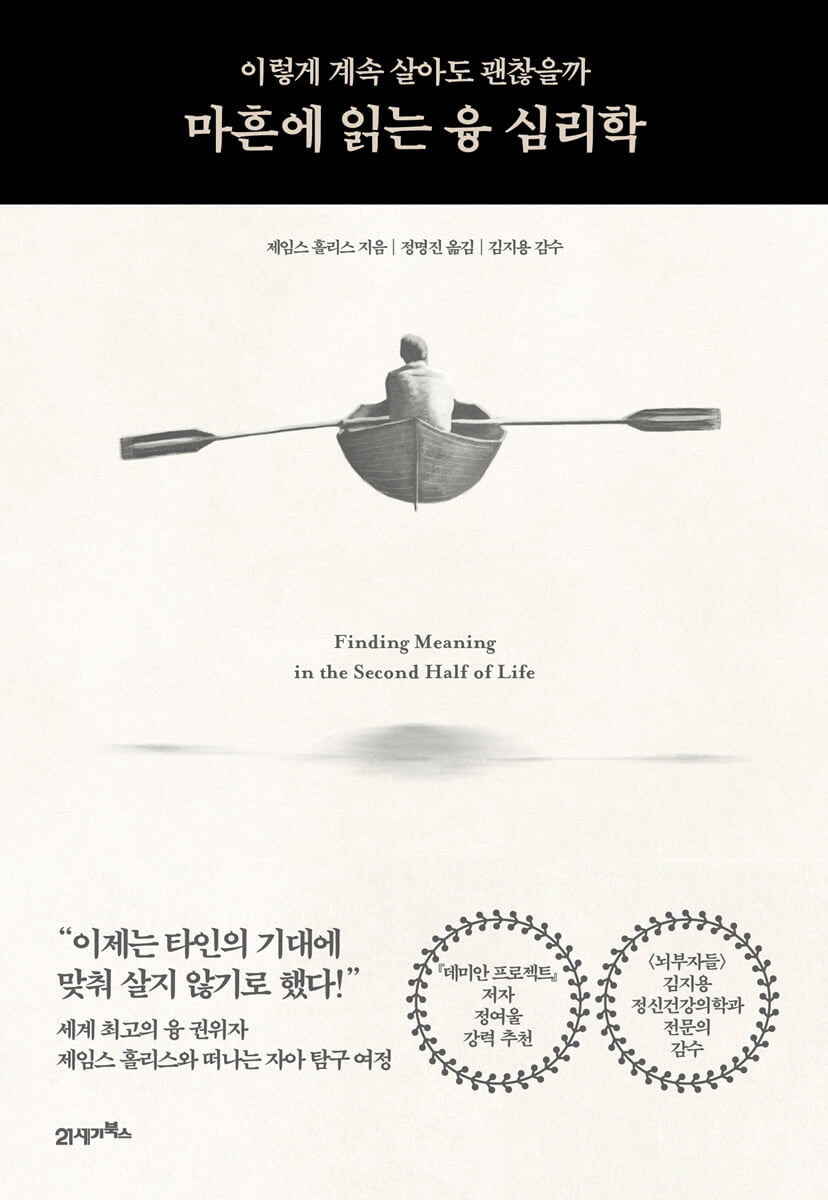
Jungian Psychology for those in their forties
 |
Description
Book Introduction
★ Overwhelming praise from readers, with an average rating of 4.4/5 on Amazon.com (1,272 stars) and an average rating of 4.2/5 on Goodreads (2,590 stars) ★
★ A psychological compass to help you turn your midlife crisis into a life opportunity ★
★ Broad insights covering various fields such as psychology, literature, history, religion, and mythology ★
Lost sense of direction, strained relationships, empty hearts…
Who have I been living for all this time?
The Psychology of Self-Discovery: Transforming Anxiety and Emptiness into Meaning and Fullness
People believe that if they go to a good school, get a high-paying job, get married, have children, buy a nice car, buy a house, and build a solid career, they will be happy.
I believe that the anxiety in my heart will subside and a peaceful and stable day will come.
That's why everyone is working hard towards that goal.
But then, halfway through life, you're suddenly struck by an inexplicable sense of unease, a feeling of "something's wrong," a deep-seated doubt that makes you wonder, "Is this really the life I wanted?" or a sharp realization that makes you want to slap your forehead and say, "Is this really all there is? Is this my life?"
Carl Gustav Jung said, “When you turn forty, there is an earthquake in your heart.”
The midlife crisis, where you feel confused about where to go, your relationships with your partner or family seem to be on the rocks, and you're not sure if what you've been doing is really what you want, is expressed as an 'earthquake in your heart.'
There is a book that provides deep insight to modern people who seem to live stable lives on the outside, but are deeply anxious and empty on the inside.
This is 『Jungian Psychology for Those in Their Forties』 by James Hollis, the world's leading Jungian authority and psychoanalyst.
James Hollis interprets this crisis that comes around forty as an invitation to find your true self, and offers a profound and persuasive way to find a meaningful and fulfilling life.
If you're doubting the choices you've made so far and feeling like you've reached a dead end, I urge you to stop ignoring this inner signal telling you to become your true self.
By following James Hollis's guidance, you will be able to free yourself from the expectations of others, sociocultural pressures, and even traumas and complexes you were unaware of, and finally discover your true self.
Life after forty is divided into two.
Either live as you have always lived, falling into a depressed sleep, or discover your true self and choose to grow once again, even if you are anxious and afraid.
Only when you respond to this great invitation from deep within you can you embark on the path of healing and encounter your greater true self.
★ A psychological compass to help you turn your midlife crisis into a life opportunity ★
★ Broad insights covering various fields such as psychology, literature, history, religion, and mythology ★
Lost sense of direction, strained relationships, empty hearts…
Who have I been living for all this time?
The Psychology of Self-Discovery: Transforming Anxiety and Emptiness into Meaning and Fullness
People believe that if they go to a good school, get a high-paying job, get married, have children, buy a nice car, buy a house, and build a solid career, they will be happy.
I believe that the anxiety in my heart will subside and a peaceful and stable day will come.
That's why everyone is working hard towards that goal.
But then, halfway through life, you're suddenly struck by an inexplicable sense of unease, a feeling of "something's wrong," a deep-seated doubt that makes you wonder, "Is this really the life I wanted?" or a sharp realization that makes you want to slap your forehead and say, "Is this really all there is? Is this my life?"
Carl Gustav Jung said, “When you turn forty, there is an earthquake in your heart.”
The midlife crisis, where you feel confused about where to go, your relationships with your partner or family seem to be on the rocks, and you're not sure if what you've been doing is really what you want, is expressed as an 'earthquake in your heart.'
There is a book that provides deep insight to modern people who seem to live stable lives on the outside, but are deeply anxious and empty on the inside.
This is 『Jungian Psychology for Those in Their Forties』 by James Hollis, the world's leading Jungian authority and psychoanalyst.
James Hollis interprets this crisis that comes around forty as an invitation to find your true self, and offers a profound and persuasive way to find a meaningful and fulfilling life.
If you're doubting the choices you've made so far and feeling like you've reached a dead end, I urge you to stop ignoring this inner signal telling you to become your true self.
By following James Hollis's guidance, you will be able to free yourself from the expectations of others, sociocultural pressures, and even traumas and complexes you were unaware of, and finally discover your true self.
Life after forty is divided into two.
Either live as you have always lived, falling into a depressed sleep, or discover your true self and choose to grow once again, even if you are anxious and afraid.
Only when you respond to this great invitation from deep within you can you embark on the path of healing and encounter your greater true self.
- You can preview some of the book's contents.
Preview
index
Recommendation | James Hollis, a warm mentor for those who dream of brilliant individualization.
Reviewer's Note | A book for those who are still hesitant to change.
Introduction | Finding Your Way in the Dark Forest
Chapter 1: Awakening Around Forty
Who wrote the script of my life? | The beginning of a quest I've never embarked on before | Why turmoil comes in middle age | If I don't feel like my life is okay
Chapter 2: How Did We Become Such People?
Welcome the tragic sense of life | Early life messages shape self-perception | 3 ways to cope with overwhelming experiences | 3 ways to respond to the wounds of lack
Chapter 3: Time to Meet Your True Self
Depression holds therapeutic potential | Inner turmoil turns intimate relationships into battlefields | The best way to find a change in direction in your life | Failed fighters help you grow | The illusion of obedience being rewarded is shattered | The clash between your instinctive self and your provisional personality
Chapter 4: What Blocks Change?
The History of Complexes: How Fear Rules Us | Awaken from Spiritual Lethargy
Chapter 5: Romance, Love, and the Dynamics of Intimate Relationships
Projection and Transference: The Psychodynamics of Relationships | Why Do I Want Him to Do My Jobs? | How to Maintain a Long-Term, Mature Relationship
Chapter 6: The Meaning of Family as Seen Halfway Through Life
Families that support growth, families that restrict growth | The recurring and repetitive history of families | Parents who can't be perfect, but are good enough | Make time for your children, your parents, and yourself | True love takes courage.
Chapter 7 Between Occupation and Calling
Being Productive and Nurturing | You can choose your job, but you can't choose your calling | Only when you do your job, however clumsily, do you feel safe.
Chapter 8: A Time When Everyone Was Sick, But No One Was
The Pathological Ideology That Rules Us | Living Myths
Chapter 9: Recovering Mature Spirituality in a Material Age
Reclaiming Personal Authority | The Soul Calls Us | How to Reclaim Spirituality | Dream Images: A Wonderful Gift from the Soul
Chapter 10: Escape from the Swamp of the Mind
Guilt | Grief and Loss | Betrayal | Doubt and Loneliness | Depression | Addiction | Anxiety | How to Avoid the Swamp of the Soul
Chapter 11: How to Heal Your Soul
References
source
Reviewer's Note | A book for those who are still hesitant to change.
Introduction | Finding Your Way in the Dark Forest
Chapter 1: Awakening Around Forty
Who wrote the script of my life? | The beginning of a quest I've never embarked on before | Why turmoil comes in middle age | If I don't feel like my life is okay
Chapter 2: How Did We Become Such People?
Welcome the tragic sense of life | Early life messages shape self-perception | 3 ways to cope with overwhelming experiences | 3 ways to respond to the wounds of lack
Chapter 3: Time to Meet Your True Self
Depression holds therapeutic potential | Inner turmoil turns intimate relationships into battlefields | The best way to find a change in direction in your life | Failed fighters help you grow | The illusion of obedience being rewarded is shattered | The clash between your instinctive self and your provisional personality
Chapter 4: What Blocks Change?
The History of Complexes: How Fear Rules Us | Awaken from Spiritual Lethargy
Chapter 5: Romance, Love, and the Dynamics of Intimate Relationships
Projection and Transference: The Psychodynamics of Relationships | Why Do I Want Him to Do My Jobs? | How to Maintain a Long-Term, Mature Relationship
Chapter 6: The Meaning of Family as Seen Halfway Through Life
Families that support growth, families that restrict growth | The recurring and repetitive history of families | Parents who can't be perfect, but are good enough | Make time for your children, your parents, and yourself | True love takes courage.
Chapter 7 Between Occupation and Calling
Being Productive and Nurturing | You can choose your job, but you can't choose your calling | Only when you do your job, however clumsily, do you feel safe.
Chapter 8: A Time When Everyone Was Sick, But No One Was
The Pathological Ideology That Rules Us | Living Myths
Chapter 9: Recovering Mature Spirituality in a Material Age
Reclaiming Personal Authority | The Soul Calls Us | How to Reclaim Spirituality | Dream Images: A Wonderful Gift from the Soul
Chapter 10: Escape from the Swamp of the Mind
Guilt | Grief and Loss | Betrayal | Doubt and Loneliness | Depression | Addiction | Anxiety | How to Avoid the Swamp of the Soul
Chapter 11: How to Heal Your Soul
References
source
Detailed image

Into the book
The poet Dante Alighieri found himself lost in a dark forest midway through his life and began his famous journey down to the underworld.
Likewise, we live with the best of intentions, but we still often find ourselves lost in the dark forest.
No matter how well-intentioned, how well-informed, how thoroughly planned, how fervently prayed, or how well guided by others, confusion, disorientation, helplessness, depression, disappointment in oneself and others, and the failure of plans and strategies that had seemed to work so far are inevitable.
--- From the "Introductory Note"
Paradoxically, this calling requires us to begin to take ourselves more seriously than we have before.
This kind of self-reflection cannot take place without extreme honesty.
Most people reach this point after living with a narrow view of themselves.
As Jung once humorously said, we walk in shoes that are too small for us.
By holding onto old defensive strategies and unconsciously repeating choices tied to our past history, we become enemies that hinder our own growth, the expansion of our souls, by having an overly narrow view of our life's journey.
--- From "Chapter 1: Awakening Around Forty"
Therefore, the tragic sense of life is not pathological but rather heroic.
Because it is a call to live consciously, to seek change, and to move forward with humility in the face of nature and our own divided minds.
Those who ignore this call will suffer the wrath of the gods and the division of the soul that we call neurosis.
The tragic sense of life is a constant invitation to move toward consciousness, and accepting it paradoxically allows us to regain our place in the larger picture.
The traditional warning to walk humbly and fear the gods still holds true for all of us.
--- From "Chapter 2: How Did We Become Such People?"
There are many modern versions of this contract we assume we have with the universe.
For some, this assumption begins with compliant interactions with parents and later extends to social institutions.
Social institutions publicly state rules that promise rewards for those who behave according to the rules.
(So, we expect that if we give it our all, the company won't let us go even if it restructures.) To others, this contract assumes that acting in good faith will always be rewarded in good faith.
For others, it comes in the form of the expectation that proper exercise, proper spirituality, proper diet, and proper diagnosis will protect them from cancer.
Yet, sooner or later, life brings each of us not only disappointment, but something worse: a deep disillusionment with the "contract" we had implicitly assumed and served to the best of our ability.
--- From "Chapter 3: Time to Meet Your True Self"
It's so easy to be daunted by the enormity of life, seduced by apathy, distracted by popular culture, and swept up in collective fantasies that have little to do with the soul's agenda.
Yet, we must ultimately face ourselves.
Whether you numb yourself, pretend to be busy to avoid what you really need to do, or agonize over trivial matters, the ways to rationalize your choices are endless.
Life always presents us with new moments of choice in new situations.
Only when we face this question more consciously, which has already come to us, do we begin to cross the middle path and truly grow.
--- From Chapter 4, “What Blocks Change”
Fear of loneliness and fear of growth are the major obstacles of our time.
Escaping loneliness can lead people to hang out at the mall, stay in bad relationships, abuse drugs, and, worst of all, avoid connecting with themselves.
How can you possibly build good relationships with others if you can't maintain a good relationship with yourself? Escaping from yourself means constantly feeling uncomfortable around others.
What we fear to see in ourselves, we will fear to see in others.
What you avoid dealing with within yourself, you will avoid dealing with in others.
Also, the barriers within yourself will appear as barriers in your relationships with others.
--- From “Chapter 5 Romance and Love, the Dynamics of Intimate Relationships”
If parents could unconditionally trust their children by saying things like: Our lives and the world would change so much.
“You are very precious to us.
You will always have our love and support.
You were born into this world to cultivate your own life.
Never harm others, but never stop trying to be as good as you can be.
Even when you fall and fail, you will still be loved and welcomed.
But you were born into this world to leave us.
Don't worry about things that make us happy, just forge your own destiny and move forward steadfastly." How much our history will change!
--- From "Chapter 6: The Meaning of Family as Seen Halfway Through Life"
You can choose your job, but you can't choose your calling.
Our calling chooses us.
Choosing that which has chosen us is a kind of liberation, and as a byproduct of this liberation, you will feel that you have found the right job and that harmony will arise within you.
Even if it creates a world of conflict, goes unrecognized, and costs you a great deal personally.
--- From “Chapter 7 Between Occupation and Calling”
The greatest gift of depth psychology is that it gives us back the possibility of engaging in a deep conversation with this mystery.
Being a psychological being doesn't mean you need therapy, but it does mean asking more fundamentally than ever before what's going on beneath the surface.
We are all too easily seduced by surfaces.
But the energy that moves the universe, that moves the great myths, that moves our ancestors, is still moving within you.
--- "Chapter 8: The Age When Everyone Was Sick, But No One Was Sick, Page 264"
Even though we don't order dreams, we receive visits from these other worlds on average six times a night.
Of course, this other world is also our world.
Such a massive expenditure of energy is never random, nor is it without purpose.
Nature does not waste energy.
Paying attention to the point where the inner and outer worlds meet is a central task of depth psychology, the mystical traditions of world religions, and the daily task of all of us.
From this juncture, creative energy arises, revelations emerge, and each of us enters a greater and more developed spiritual world.
--- From “Chapter 9: Recovering Mature Spirituality in a Material Age”
The only antidote to this guilt that paralyzes people is determination.
It is, so to speak, a decision to take the risk of becoming who we are meant to be by choosing to expand ourselves rather than to be bound by the past.
The guilt that renders the person helpless in this way is always connected to his past.
Therefore, we cannot move forward into the future without overcoming the past.
There is no future without moving forward with more honest actions in the face of guilt.
--- From "Chapter 10: The Swamp of the Mind"
So here you are in this mysterious now.
Your history fades away like the sound of a hunter's horn blowing in the wind, and your future rushes toward you like the next season.
This is the moment, the only moment that exists.
Within that moment, creation takes place and consciousness creates change.
The highest achievement of consciousness will not be to selfishly repeat one's own glory or to pursue an agenda of regressive reinforcement in the face of this vast and threatening universe that is our human home.
Rather, it would be the ability to acknowledge and serve that we are called to witness and serve something much greater.
There is space within your vessel to receive a second, greater life that transcends time.
Likewise, we live with the best of intentions, but we still often find ourselves lost in the dark forest.
No matter how well-intentioned, how well-informed, how thoroughly planned, how fervently prayed, or how well guided by others, confusion, disorientation, helplessness, depression, disappointment in oneself and others, and the failure of plans and strategies that had seemed to work so far are inevitable.
--- From the "Introductory Note"
Paradoxically, this calling requires us to begin to take ourselves more seriously than we have before.
This kind of self-reflection cannot take place without extreme honesty.
Most people reach this point after living with a narrow view of themselves.
As Jung once humorously said, we walk in shoes that are too small for us.
By holding onto old defensive strategies and unconsciously repeating choices tied to our past history, we become enemies that hinder our own growth, the expansion of our souls, by having an overly narrow view of our life's journey.
--- From "Chapter 1: Awakening Around Forty"
Therefore, the tragic sense of life is not pathological but rather heroic.
Because it is a call to live consciously, to seek change, and to move forward with humility in the face of nature and our own divided minds.
Those who ignore this call will suffer the wrath of the gods and the division of the soul that we call neurosis.
The tragic sense of life is a constant invitation to move toward consciousness, and accepting it paradoxically allows us to regain our place in the larger picture.
The traditional warning to walk humbly and fear the gods still holds true for all of us.
--- From "Chapter 2: How Did We Become Such People?"
There are many modern versions of this contract we assume we have with the universe.
For some, this assumption begins with compliant interactions with parents and later extends to social institutions.
Social institutions publicly state rules that promise rewards for those who behave according to the rules.
(So, we expect that if we give it our all, the company won't let us go even if it restructures.) To others, this contract assumes that acting in good faith will always be rewarded in good faith.
For others, it comes in the form of the expectation that proper exercise, proper spirituality, proper diet, and proper diagnosis will protect them from cancer.
Yet, sooner or later, life brings each of us not only disappointment, but something worse: a deep disillusionment with the "contract" we had implicitly assumed and served to the best of our ability.
--- From "Chapter 3: Time to Meet Your True Self"
It's so easy to be daunted by the enormity of life, seduced by apathy, distracted by popular culture, and swept up in collective fantasies that have little to do with the soul's agenda.
Yet, we must ultimately face ourselves.
Whether you numb yourself, pretend to be busy to avoid what you really need to do, or agonize over trivial matters, the ways to rationalize your choices are endless.
Life always presents us with new moments of choice in new situations.
Only when we face this question more consciously, which has already come to us, do we begin to cross the middle path and truly grow.
--- From Chapter 4, “What Blocks Change”
Fear of loneliness and fear of growth are the major obstacles of our time.
Escaping loneliness can lead people to hang out at the mall, stay in bad relationships, abuse drugs, and, worst of all, avoid connecting with themselves.
How can you possibly build good relationships with others if you can't maintain a good relationship with yourself? Escaping from yourself means constantly feeling uncomfortable around others.
What we fear to see in ourselves, we will fear to see in others.
What you avoid dealing with within yourself, you will avoid dealing with in others.
Also, the barriers within yourself will appear as barriers in your relationships with others.
--- From “Chapter 5 Romance and Love, the Dynamics of Intimate Relationships”
If parents could unconditionally trust their children by saying things like: Our lives and the world would change so much.
“You are very precious to us.
You will always have our love and support.
You were born into this world to cultivate your own life.
Never harm others, but never stop trying to be as good as you can be.
Even when you fall and fail, you will still be loved and welcomed.
But you were born into this world to leave us.
Don't worry about things that make us happy, just forge your own destiny and move forward steadfastly." How much our history will change!
--- From "Chapter 6: The Meaning of Family as Seen Halfway Through Life"
You can choose your job, but you can't choose your calling.
Our calling chooses us.
Choosing that which has chosen us is a kind of liberation, and as a byproduct of this liberation, you will feel that you have found the right job and that harmony will arise within you.
Even if it creates a world of conflict, goes unrecognized, and costs you a great deal personally.
--- From “Chapter 7 Between Occupation and Calling”
The greatest gift of depth psychology is that it gives us back the possibility of engaging in a deep conversation with this mystery.
Being a psychological being doesn't mean you need therapy, but it does mean asking more fundamentally than ever before what's going on beneath the surface.
We are all too easily seduced by surfaces.
But the energy that moves the universe, that moves the great myths, that moves our ancestors, is still moving within you.
--- "Chapter 8: The Age When Everyone Was Sick, But No One Was Sick, Page 264"
Even though we don't order dreams, we receive visits from these other worlds on average six times a night.
Of course, this other world is also our world.
Such a massive expenditure of energy is never random, nor is it without purpose.
Nature does not waste energy.
Paying attention to the point where the inner and outer worlds meet is a central task of depth psychology, the mystical traditions of world religions, and the daily task of all of us.
From this juncture, creative energy arises, revelations emerge, and each of us enters a greater and more developed spiritual world.
--- From “Chapter 9: Recovering Mature Spirituality in a Material Age”
The only antidote to this guilt that paralyzes people is determination.
It is, so to speak, a decision to take the risk of becoming who we are meant to be by choosing to expand ourselves rather than to be bound by the past.
The guilt that renders the person helpless in this way is always connected to his past.
Therefore, we cannot move forward into the future without overcoming the past.
There is no future without moving forward with more honest actions in the face of guilt.
--- From "Chapter 10: The Swamp of the Mind"
So here you are in this mysterious now.
Your history fades away like the sound of a hunter's horn blowing in the wind, and your future rushes toward you like the next season.
This is the moment, the only moment that exists.
Within that moment, creation takes place and consciousness creates change.
The highest achievement of consciousness will not be to selfishly repeat one's own glory or to pursue an agenda of regressive reinforcement in the face of this vast and threatening universe that is our human home.
Rather, it would be the ability to acknowledge and serve that we are called to witness and serve something much greater.
There is space within your vessel to receive a second, greater life that transcends time.
--- From “Chapter 11 How to Heal the Soul”
Publisher's Review
“I am not what happened to me, but what I choose to become.”
The freedom to be myself, something I finally found about halfway through life.
No one wakes up every morning and says, 'I'm going to live today like I did yesterday.'
But surprisingly, about 95% of our daily lives are similarly repetitive.
Most people live today as they did yesterday, moving on autopilot without any awareness.
In the first half of life, it is difficult to feel any particular sense of problem.
This is because we pursue external achievements such as independence, success, and recognition, and we prioritize the satisfaction of our ego (our social self), so we have no time to look back on our inner selves or to question ourselves.
But beneath the ego lies the 'Self' as a larger whole that includes the unconscious, and this self begins to raise deep questions, such as 'Was this really the life I wanted?', around the age of forty, when the second half of life begins.
These questions, which sometimes come with confusion, depression and helplessness, and disappointment in oneself and others, shake the second half of life like an earthquake.
But there is no need to be afraid.
This is not a disaster, but an invitation from a greater self.
This invitation is the first step toward wholeness, embracing both consciousness and unconsciousness, light and shadow.
Jung said, "I am not what happened to me, but what I choose to become."
What has happened to me so far, the accumulated old history, blocks the path to meeting myself.
If the overwhelming experience of our powerlessness in the face of our circumstances, the wound of deprivation that the world does not meet our needs, or the values imposed by our family or social culture are 'what happened to me,' then it is time to make different choices to achieve true growth and meet our whole selves.
Even though I am the only character who consistently appears in every scene of the long drama called life, countless people live their lives blaming others for the fact that they are wandering around like this.
But as Jung said, we can and should grow into who we choose to be, without being trapped by what happened to us.
In the second half of life, you must write your own life script through courageous choices.
Even though it may be scary, I must let go of the persona (temporary personality, mask) that has brought me here and walk towards my true self.
Accepting yourself as you are instead of trying to be more perfect is the beginning of true freedom.
If you're confused about whose life you're living right now, if something feels missing in your life, it's time to turn off autopilot and start your own journey.
Through this journey, you will discover the inner energy toward self-realization, the true meaning of life, and the fulfillment of connecting with a greater whole.
“Why do you try to walk in those little shoes you’re so used to?”
To live the greater life that the soul demands
Breaking away from the way you've lived and taking a new path to discover your true self can feel like a risky adventure.
But let's close our eyes for a moment and picture the last moments of our lives.
How would you feel if you were lying in bed, reflecting on your life, and realized that fear had prevented you from truly showing your true self and living life to the fullest? Could there be a greater regret? The helplessness ingrained in us from childhood, the fear that the world is big and we are small, and the desire to settle for familiar discomfort hold us back, but the soul leads us to a greater life.
Within us, the twin forces of progress and regression converse every day.
The ego tells us to stay safe and wear old, small shoes, but the soul gently urges us to go out into the wider world.
Whose words should I follow, what choice should I make?
James Hollis offers a clear criterion for asking one question at this crossroads:
“Will this choice expand me or diminish me?” The answer to this question is clear.
No one would want to regress to a small self.
The desire to meet one's true self and freely expand is an innate desire that lies deep within everyone.
True growth begins the moment you decide to let go of your fears, listen to your inner self, and step into slightly bigger shoes.
Even though the first steps may be unsteady, new possibilities lie within that shaking.
As you continue this journey, you will encounter richer experiences, broader perspectives, and deeper meaning.
This is the most beautiful adventure given to us, the secret to a life full of meaning.
“Why do you dream of a different life when you are still living the way you have been living?”
The wisdom of Jungian psychology that makes the meaning of self, relationships, and work clearer
If we repeat the same actions and expect different results, isn't that self-deception? Yet, we live each day in dissatisfaction, seemingly tied to an invisible wheel, oblivious to the fact that past patterns dictate our present choices.
The book delicately captures these unconscious patterns, and by detailing the major areas that make up life as a whole—self-understanding, relationships, family, work—it offers wisdom for breaking free from this cycle.
From the repeated disappointments in relationships, to the unconscious legacy of family that passes through generations, to the true calling that lies beyond the daily grind.
Hollis shows us how we limit ourselves in all these areas and how we can overcome those limitations.
Anxiety is a sign of progress, depression is a sign of regression.
When you are willing to face change without being swayed by anxiety, the second half of life becomes an opportunity to rediscover your true self.
On your journey toward true growth, "Jungian Psychology for Forty" will serve as your guide and compass.
The freedom to be myself, something I finally found about halfway through life.
No one wakes up every morning and says, 'I'm going to live today like I did yesterday.'
But surprisingly, about 95% of our daily lives are similarly repetitive.
Most people live today as they did yesterday, moving on autopilot without any awareness.
In the first half of life, it is difficult to feel any particular sense of problem.
This is because we pursue external achievements such as independence, success, and recognition, and we prioritize the satisfaction of our ego (our social self), so we have no time to look back on our inner selves or to question ourselves.
But beneath the ego lies the 'Self' as a larger whole that includes the unconscious, and this self begins to raise deep questions, such as 'Was this really the life I wanted?', around the age of forty, when the second half of life begins.
These questions, which sometimes come with confusion, depression and helplessness, and disappointment in oneself and others, shake the second half of life like an earthquake.
But there is no need to be afraid.
This is not a disaster, but an invitation from a greater self.
This invitation is the first step toward wholeness, embracing both consciousness and unconsciousness, light and shadow.
Jung said, "I am not what happened to me, but what I choose to become."
What has happened to me so far, the accumulated old history, blocks the path to meeting myself.
If the overwhelming experience of our powerlessness in the face of our circumstances, the wound of deprivation that the world does not meet our needs, or the values imposed by our family or social culture are 'what happened to me,' then it is time to make different choices to achieve true growth and meet our whole selves.
Even though I am the only character who consistently appears in every scene of the long drama called life, countless people live their lives blaming others for the fact that they are wandering around like this.
But as Jung said, we can and should grow into who we choose to be, without being trapped by what happened to us.
In the second half of life, you must write your own life script through courageous choices.
Even though it may be scary, I must let go of the persona (temporary personality, mask) that has brought me here and walk towards my true self.
Accepting yourself as you are instead of trying to be more perfect is the beginning of true freedom.
If you're confused about whose life you're living right now, if something feels missing in your life, it's time to turn off autopilot and start your own journey.
Through this journey, you will discover the inner energy toward self-realization, the true meaning of life, and the fulfillment of connecting with a greater whole.
“Why do you try to walk in those little shoes you’re so used to?”
To live the greater life that the soul demands
Breaking away from the way you've lived and taking a new path to discover your true self can feel like a risky adventure.
But let's close our eyes for a moment and picture the last moments of our lives.
How would you feel if you were lying in bed, reflecting on your life, and realized that fear had prevented you from truly showing your true self and living life to the fullest? Could there be a greater regret? The helplessness ingrained in us from childhood, the fear that the world is big and we are small, and the desire to settle for familiar discomfort hold us back, but the soul leads us to a greater life.
Within us, the twin forces of progress and regression converse every day.
The ego tells us to stay safe and wear old, small shoes, but the soul gently urges us to go out into the wider world.
Whose words should I follow, what choice should I make?
James Hollis offers a clear criterion for asking one question at this crossroads:
“Will this choice expand me or diminish me?” The answer to this question is clear.
No one would want to regress to a small self.
The desire to meet one's true self and freely expand is an innate desire that lies deep within everyone.
True growth begins the moment you decide to let go of your fears, listen to your inner self, and step into slightly bigger shoes.
Even though the first steps may be unsteady, new possibilities lie within that shaking.
As you continue this journey, you will encounter richer experiences, broader perspectives, and deeper meaning.
This is the most beautiful adventure given to us, the secret to a life full of meaning.
“Why do you dream of a different life when you are still living the way you have been living?”
The wisdom of Jungian psychology that makes the meaning of self, relationships, and work clearer
If we repeat the same actions and expect different results, isn't that self-deception? Yet, we live each day in dissatisfaction, seemingly tied to an invisible wheel, oblivious to the fact that past patterns dictate our present choices.
The book delicately captures these unconscious patterns, and by detailing the major areas that make up life as a whole—self-understanding, relationships, family, work—it offers wisdom for breaking free from this cycle.
From the repeated disappointments in relationships, to the unconscious legacy of family that passes through generations, to the true calling that lies beyond the daily grind.
Hollis shows us how we limit ourselves in all these areas and how we can overcome those limitations.
Anxiety is a sign of progress, depression is a sign of regression.
When you are willing to face change without being swayed by anxiety, the second half of life becomes an opportunity to rediscover your true self.
On your journey toward true growth, "Jungian Psychology for Forty" will serve as your guide and compass.
GOODS SPECIFICS
- Date of issue: February 19, 2025
- Page count, weight, size: 380 pages | 512g | 145*210*25mm
- ISBN13: 9791173570223
- ISBN10: 1173570225
You may also like
카테고리
korean


korean

![GQ KOREA Mark (Monthly): December [2025]](http://librairie.coreenne.fr/cdn/shop/files/8ef265dbbfbf186523ed75ba7319009d.jpg?v=1765340328&width=3840)


