

People who can't stand uncertainty
 |
Description
Book Introduction
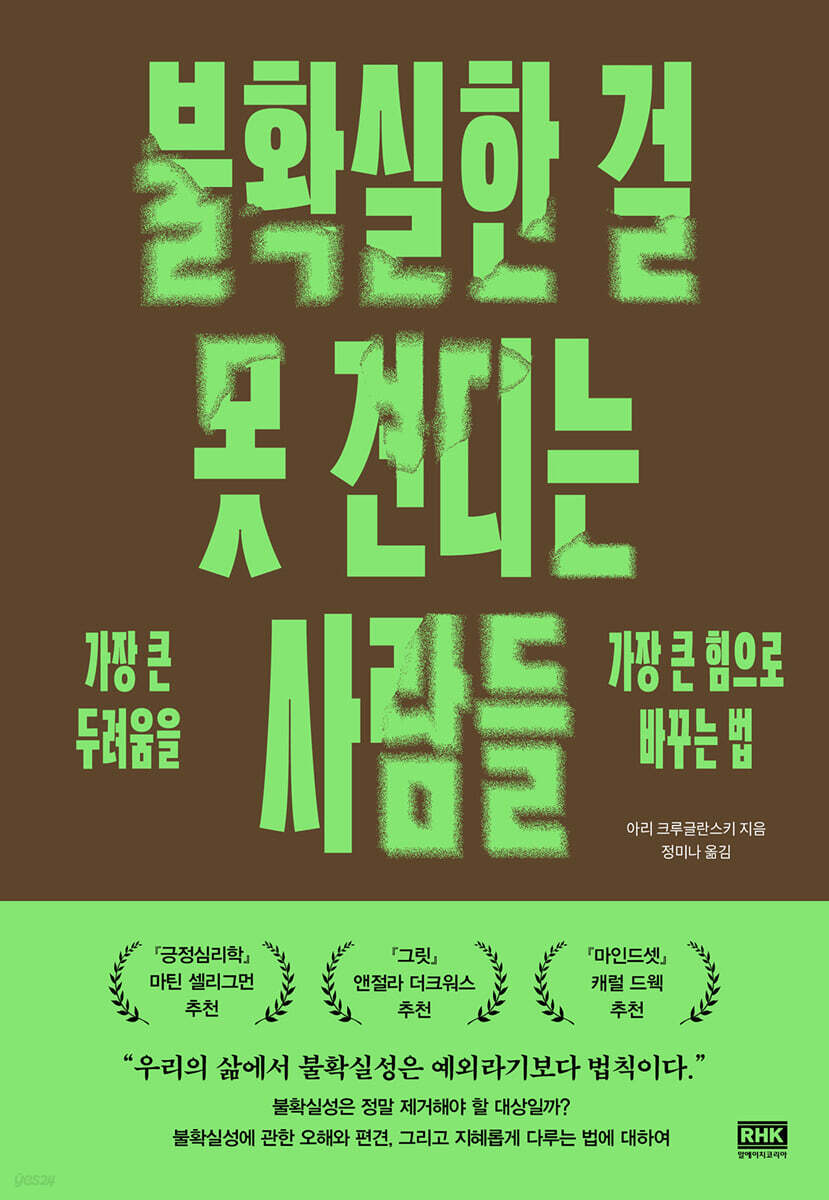
★ Highly recommended by Martin Seligman, Angela Duckworth, and Carol Dweck ★ ★ A compilation of decades of research on 'uncertainty' ★ Why we fall for populism and conspiracy theories… How does 'uncertainty' affect our lives? And how should we deal with this uncertainty? It is no exaggeration to say that our lives are shrouded in uncertainty. "Unpredictable international situations," "unclear stock market outlook," "pandemic that has thrown the world into chaos"... We live in an era where the very foundations of society, economy, and politics are shaken, making it difficult to be certain of anything. So how do we respond to the uncertainty that lurks everywhere? Ari Kruglansky, a renowned American social psychologist, explains this with the concept of "need for closure." The need for closure is the desire to hasten the end of an unpredictable situation, that is, uncertainty. People with a high need for closure often feel great fear in uncertain situations, value order and rules, and tend to jump to conclusions, while those with a low need for closure are often said to be good at accepting various perspectives but are indecisive. Anything in excess becomes a problem. The author sees the spread of neo-Nazism, white supremacy, and extremist activities among young people in Europe as the result of an excessive desire for closure. In fact, there are studies that show that a high need for closure is a major cause of many historical events. So how can we live without being swayed by the fear of uncertainty? Ari Kruglanski teaches us how to relate to uncertainty in "The Uncertain." He has been researching and pursuing for 40 years to delve into the essence of the relationship between humans and uncertainty. This book, a culmination of that research, is divided into three parts. Part 1 examines human responses to uncertainty and the causes of these differences. Part 2 explores how human responses to uncertainty impact society, politics, and life in general. Finally, Part 3 provides guidance on attitude and mindset to help us deal wisely with this uncertainty. Through this book, we will go beyond understanding our own desire for closure and gain a broader understanding of human behavior and social phenomena. This will allow us to transform fear into opportunity in a world rife with uncertainty. |
- You can preview some of the book's contents.
Preview
index
Recommendation
Introduction: Understanding Life's Uncertainties and Dealing with Them Wisely
Part 1.
How do we react to uncertainty?
1. Assessing My Need for Termination
2 Why We Need a Need for Closure
3 Factors that determine the tendency to desire termination
4 The Power of Secure Attachment
5 Culture of Certainty and Culture of Uncertainty
6. The variable called situation
Part 2: Our Reaction to Uncertainty Changes the World
7. The Trap of Black-and-White Logic
8 People who lack empathy
9 Why People Fall into Extremism
Part 3.
A Smart Way to Embrace Uncertainty
10 A positive gaze that sees a ray of hope
11 How to Live as an Optimist
12 We grow every day
13 Things You See When You Take a Step Back
14 Hope Sprouts When We Accept Differences
Concluding Remarks: How Should We Relate to Uncertainty?
Huzhou
References
Introduction: Understanding Life's Uncertainties and Dealing with Them Wisely
Part 1.
How do we react to uncertainty?
1. Assessing My Need for Termination
2 Why We Need a Need for Closure
3 Factors that determine the tendency to desire termination
4 The Power of Secure Attachment
5 Culture of Certainty and Culture of Uncertainty
6. The variable called situation
Part 2: Our Reaction to Uncertainty Changes the World
7. The Trap of Black-and-White Logic
8 People who lack empathy
9 Why People Fall into Extremism
Part 3.
A Smart Way to Embrace Uncertainty
10 A positive gaze that sees a ray of hope
11 How to Live as an Optimist
12 We grow every day
13 Things You See When You Take a Step Back
14 Hope Sprouts When We Accept Differences
Concluding Remarks: How Should We Relate to Uncertainty?
Huzhou
References
Detailed image

Into the book
Although everyone reacts differently, everyone has the same ability to solve problems.
Anyone can harness the magical gift of uncertainty and conquer their worst fears.
--- p.11
Benjamin Franklin famously said, "In this world, nothing is certain except death and taxes." But are death and taxes any different? Aren't they equally uncertain? In short, human life is full of uncertainty.
Moreover, any certainty we feel can be shattered by one unexpected event.
--- p.15
What causes us to feel anxious are the 'negative thoughts' that come to mind in uncertain situations.
It is very important and useful to realize this point.
First, we can determine whether a person can deal constructively with uncertainty, and conversely, whether a person is completely overwhelmed by uncertainty.
You can also guess the reason.
Going a step further, you might even get hints on how to master the art of dealing with uncertainty, face it calmly, and discover the hidden potential within it, thereby finding a ray of hope.
--- p.19
If you have a high need for closure, you probably prefer order and predictability in your life.
He has a firm personality, communicates his thoughts clearly, and is not afraid to make too many countermeasures or conditions.
Also, once you've made up your mind, you're less likely to abandon your initial idea when you encounter opposing arguments, information, or viewpoints.
Rather, you will feel offended and irritated if someone disagrees with your opinion or presents a different point of view.
--- p.29
It is not entirely disadvantageous or entirely advantageous to have a high or low need for closure.
(…) Although there are times when a hasty ending comes at a high price, people with a high need for closure tend to be devoted to those around them, their families, their beliefs, and their country.
These people can be role models of mutual commitment and sacrifice, which can be seen as pro-social strengths.
Conversely, people with low need for closure are more likely to come across as indecisive and ambivalent, but they are also open to uncharted territory and new ideas.
--- p.37
We all try to avoid uncertainty or get closer to it.
Because our lives are so full of daily judgments and decisions, the need for closure influences almost everything we do.
Therefore, knowing your own tendencies can be very helpful in situations where you might be blinded by a desire for certainty and closure, thereby failing to recognize important considerations or ignoring the other person's valid arguments or objective information.
--- p.39
Without certainty, we end up in an ambiguous state of neither here nor there.
You may be stuck in 'analysis paralysis' and unable to think or act on anything.
Potentially, the information gathering phase before making a decision is never-ending.
Because there is no objective signal anywhere that tells us that we have gathered enough evidence to be confident that it is the right decision.
If we don't make up our minds, all sorts of things will happen to us unexpectedly.
The world doesn't wait until we're fully prepared.
If we don't make decisions, circumstances will make decisions for us.
--- p.52
When we try to avoid uncertainty, we end up craving the feeling that we are 'seeing clearly'.
To do this, they gloss over exceptions and cover up evidence that doesn't match their claims.
People often use rhetoric that draws clear lines such as 'us versus them,' 'good versus evil,' and 'right versus wrong' in various ideologies (e.g., nationalism or racism), and they often display dichotomous thinking.
The reason people get caught up in black-and-white thinking is because this way of thinking brings peace of mind.
--- p.156
In the Western and superhero genres, having a definitive happy ending is very significant in itself.
Not only does it provide a satisfying cognitive closure, but it also fulfills the deep-seated desire of those who long for positive closure.
When the heroes we root for win, it always feels like the world is running smoothly.
We need confirmation that we are on the right side.
--- p.161
Why does a heightened need for closure lead to a decline in empathy? The answer is quite simple.
This is because, driven by the desire for closure, we cling to our own thoughts and our ability to see ourselves from another person's perspective diminishes.
As the need for closure increases, we begin to take our reactions for granted, as if they were everyone else's reactions.
--- p.177
For some, uncertainty reminds them of potential danger and evokes pent-up fear.
For others, uncertainty evokes the thrill of adventure and discovery.
It also comes with the meaning of new possibilities that promise satisfaction, glory, and presence.
Anyone can harness the magical gift of uncertainty and conquer their worst fears.
--- p.11
Benjamin Franklin famously said, "In this world, nothing is certain except death and taxes." But are death and taxes any different? Aren't they equally uncertain? In short, human life is full of uncertainty.
Moreover, any certainty we feel can be shattered by one unexpected event.
--- p.15
What causes us to feel anxious are the 'negative thoughts' that come to mind in uncertain situations.
It is very important and useful to realize this point.
First, we can determine whether a person can deal constructively with uncertainty, and conversely, whether a person is completely overwhelmed by uncertainty.
You can also guess the reason.
Going a step further, you might even get hints on how to master the art of dealing with uncertainty, face it calmly, and discover the hidden potential within it, thereby finding a ray of hope.
--- p.19
If you have a high need for closure, you probably prefer order and predictability in your life.
He has a firm personality, communicates his thoughts clearly, and is not afraid to make too many countermeasures or conditions.
Also, once you've made up your mind, you're less likely to abandon your initial idea when you encounter opposing arguments, information, or viewpoints.
Rather, you will feel offended and irritated if someone disagrees with your opinion or presents a different point of view.
--- p.29
It is not entirely disadvantageous or entirely advantageous to have a high or low need for closure.
(…) Although there are times when a hasty ending comes at a high price, people with a high need for closure tend to be devoted to those around them, their families, their beliefs, and their country.
These people can be role models of mutual commitment and sacrifice, which can be seen as pro-social strengths.
Conversely, people with low need for closure are more likely to come across as indecisive and ambivalent, but they are also open to uncharted territory and new ideas.
--- p.37
We all try to avoid uncertainty or get closer to it.
Because our lives are so full of daily judgments and decisions, the need for closure influences almost everything we do.
Therefore, knowing your own tendencies can be very helpful in situations where you might be blinded by a desire for certainty and closure, thereby failing to recognize important considerations or ignoring the other person's valid arguments or objective information.
--- p.39
Without certainty, we end up in an ambiguous state of neither here nor there.
You may be stuck in 'analysis paralysis' and unable to think or act on anything.
Potentially, the information gathering phase before making a decision is never-ending.
Because there is no objective signal anywhere that tells us that we have gathered enough evidence to be confident that it is the right decision.
If we don't make up our minds, all sorts of things will happen to us unexpectedly.
The world doesn't wait until we're fully prepared.
If we don't make decisions, circumstances will make decisions for us.
--- p.52
When we try to avoid uncertainty, we end up craving the feeling that we are 'seeing clearly'.
To do this, they gloss over exceptions and cover up evidence that doesn't match their claims.
People often use rhetoric that draws clear lines such as 'us versus them,' 'good versus evil,' and 'right versus wrong' in various ideologies (e.g., nationalism or racism), and they often display dichotomous thinking.
The reason people get caught up in black-and-white thinking is because this way of thinking brings peace of mind.
--- p.156
In the Western and superhero genres, having a definitive happy ending is very significant in itself.
Not only does it provide a satisfying cognitive closure, but it also fulfills the deep-seated desire of those who long for positive closure.
When the heroes we root for win, it always feels like the world is running smoothly.
We need confirmation that we are on the right side.
--- p.161
Why does a heightened need for closure lead to a decline in empathy? The answer is quite simple.
This is because, driven by the desire for closure, we cling to our own thoughts and our ability to see ourselves from another person's perspective diminishes.
As the need for closure increases, we begin to take our reactions for granted, as if they were everyone else's reactions.
--- p.177
For some, uncertainty reminds them of potential danger and evokes pent-up fear.
For others, uncertainty evokes the thrill of adventure and discovery.
It also comes with the meaning of new possibilities that promise satisfaction, glory, and presence.
--- p.217~218
Publisher's Review
People who can't stand uncertainty
People who don't want to be consumed by anxiety and fear
If you look around, there are people who cannot stand uncertainty.
A person who is so curious about the ending of a novel that they flip through the pages and only feel better after reading the last chapter first.
I'm not attracted to restaurants I've never been to, so I always go to the same places.
A person who has perfectly planned out even the details, even though there is still a long way to go until the trip.
There will be one or two around.
Or you yourself.
So why do they exhibit such high levels of avoidance and a desire for closure? It's due to the anxiety and stress they feel in unknown situations.
Fear is especially amplified when negative outcomes are anticipated.
An American writer said this:
“The deepest and most terrible fear is the fear of the unknown.”
If this fear grows and the desire for closure becomes extremely high, it will have a huge impact on society.
People with a strong need for closure find it difficult to accept or empathize with the opinions of others, who are in unfamiliar territory, and this leads to a growing lack of empathy, and prejudice and preconceptions become widespread throughout society.
This is why populist policies that divide people into enemies and allies and advocate only for and support specific groups are gaining support, why conspiracy theories that only accept sensational claims as truth are rampant, and why young people who want to feel a sense of complete belonging are falling for extremism like neo-Nazism.
The author argues that understanding our own need for closure is crucial both for our individual lives and for the survival of a healthy society.
This book includes a scale that allows you to test your own desire for closure, allowing you to first understand and discover your own tendencies.
We explore the various factors that may have influenced this outcome, including genetic factors, attachment styles, and cultural differences, and consider the impact our desire for closure may have on society.
In such an unpredictable world
How to Live with Uncertainty
Unfortunately, uncertainty permeates our lives.
Author Ari Kruglanski says in the book:
“Uncertainty is almost a law in our lives.
We live with uncertainty, not even knowing what will happen in the next moment.” Haven’t we already realized this through the COVID-19 pandemic?
After the unexpected catastrophe, we are living in a new normal era that is completely different from the past.
On the other hand, uncertainty is a subjective experience, so different people react differently to it.
While some people are gripped by fear of uncertainty, others use it as an opportunity.
Rahm Emanuel, former Chief of Staff to President Barack Obama, once said:
“We must not waste a serious crisis.
In other words, this crisis is an opportunity to do things we couldn't do before."
Viktor Frankl and Travis Roy, who are introduced in this book, are people who turned crises into opportunities.
Viktor Frankl survived the Auschwitz concentration camp, a place filled with despair.
In places where the chances of survival were slim, some gave up on life, while others, like Viktor Frankl, recognized that they had the power to decide their actions and focused on living each day.
Travis Roy, a former ice hockey player, also went from being a promising athlete to becoming a quadriplegic in an instant due to an unexpected car accident.
However, he did not break down there, but went through rigorous rehabilitation training, started studying again, and began to spread positive influence as a motivational speaker.
Moreover, if you look at the words of famous actors, artists, and those who have left a strong mark in a certain field, most of them say that they find possibility in uncertainty.
On our journey through life, we will face endless uncertainties, both big and small.
In this book, the author encourages us to flexibly accept and embrace this uncertainty rather than running away from it.
Therefore, in Part 3 of this book, we introduce some psychological mechanisms that can help us wisely deal with the fears we feel.
Accepting this in my life will allow me to respond more flexibly to this era of social, economic, and political upheaval, and lead a solid life unshaken by waves of fear.
People who don't want to be consumed by anxiety and fear
If you look around, there are people who cannot stand uncertainty.
A person who is so curious about the ending of a novel that they flip through the pages and only feel better after reading the last chapter first.
I'm not attracted to restaurants I've never been to, so I always go to the same places.
A person who has perfectly planned out even the details, even though there is still a long way to go until the trip.
There will be one or two around.
Or you yourself.
So why do they exhibit such high levels of avoidance and a desire for closure? It's due to the anxiety and stress they feel in unknown situations.
Fear is especially amplified when negative outcomes are anticipated.
An American writer said this:
“The deepest and most terrible fear is the fear of the unknown.”
If this fear grows and the desire for closure becomes extremely high, it will have a huge impact on society.
People with a strong need for closure find it difficult to accept or empathize with the opinions of others, who are in unfamiliar territory, and this leads to a growing lack of empathy, and prejudice and preconceptions become widespread throughout society.
This is why populist policies that divide people into enemies and allies and advocate only for and support specific groups are gaining support, why conspiracy theories that only accept sensational claims as truth are rampant, and why young people who want to feel a sense of complete belonging are falling for extremism like neo-Nazism.
The author argues that understanding our own need for closure is crucial both for our individual lives and for the survival of a healthy society.
This book includes a scale that allows you to test your own desire for closure, allowing you to first understand and discover your own tendencies.
We explore the various factors that may have influenced this outcome, including genetic factors, attachment styles, and cultural differences, and consider the impact our desire for closure may have on society.
In such an unpredictable world
How to Live with Uncertainty
Unfortunately, uncertainty permeates our lives.
Author Ari Kruglanski says in the book:
“Uncertainty is almost a law in our lives.
We live with uncertainty, not even knowing what will happen in the next moment.” Haven’t we already realized this through the COVID-19 pandemic?
After the unexpected catastrophe, we are living in a new normal era that is completely different from the past.
On the other hand, uncertainty is a subjective experience, so different people react differently to it.
While some people are gripped by fear of uncertainty, others use it as an opportunity.
Rahm Emanuel, former Chief of Staff to President Barack Obama, once said:
“We must not waste a serious crisis.
In other words, this crisis is an opportunity to do things we couldn't do before."
Viktor Frankl and Travis Roy, who are introduced in this book, are people who turned crises into opportunities.
Viktor Frankl survived the Auschwitz concentration camp, a place filled with despair.
In places where the chances of survival were slim, some gave up on life, while others, like Viktor Frankl, recognized that they had the power to decide their actions and focused on living each day.
Travis Roy, a former ice hockey player, also went from being a promising athlete to becoming a quadriplegic in an instant due to an unexpected car accident.
However, he did not break down there, but went through rigorous rehabilitation training, started studying again, and began to spread positive influence as a motivational speaker.
Moreover, if you look at the words of famous actors, artists, and those who have left a strong mark in a certain field, most of them say that they find possibility in uncertainty.
On our journey through life, we will face endless uncertainties, both big and small.
In this book, the author encourages us to flexibly accept and embrace this uncertainty rather than running away from it.
Therefore, in Part 3 of this book, we introduce some psychological mechanisms that can help us wisely deal with the fears we feel.
Accepting this in my life will allow me to respond more flexibly to this era of social, economic, and political upheaval, and lead a solid life unshaken by waves of fear.
GOODS SPECIFICS
- Date of issue: August 28, 2024
- Page count, weight, size: 380 pages | 564g | 152*220*25mm
- ISBN13: 9788925574615
- ISBN10: 8925574616
You may also like
카테고리
korean


korean

![GQ KOREA Mark (Monthly): December [2025]](http://librairie.coreenne.fr/cdn/shop/files/8ef265dbbfbf186523ed75ba7319009d.jpg?v=1765340328&width=3840)


