

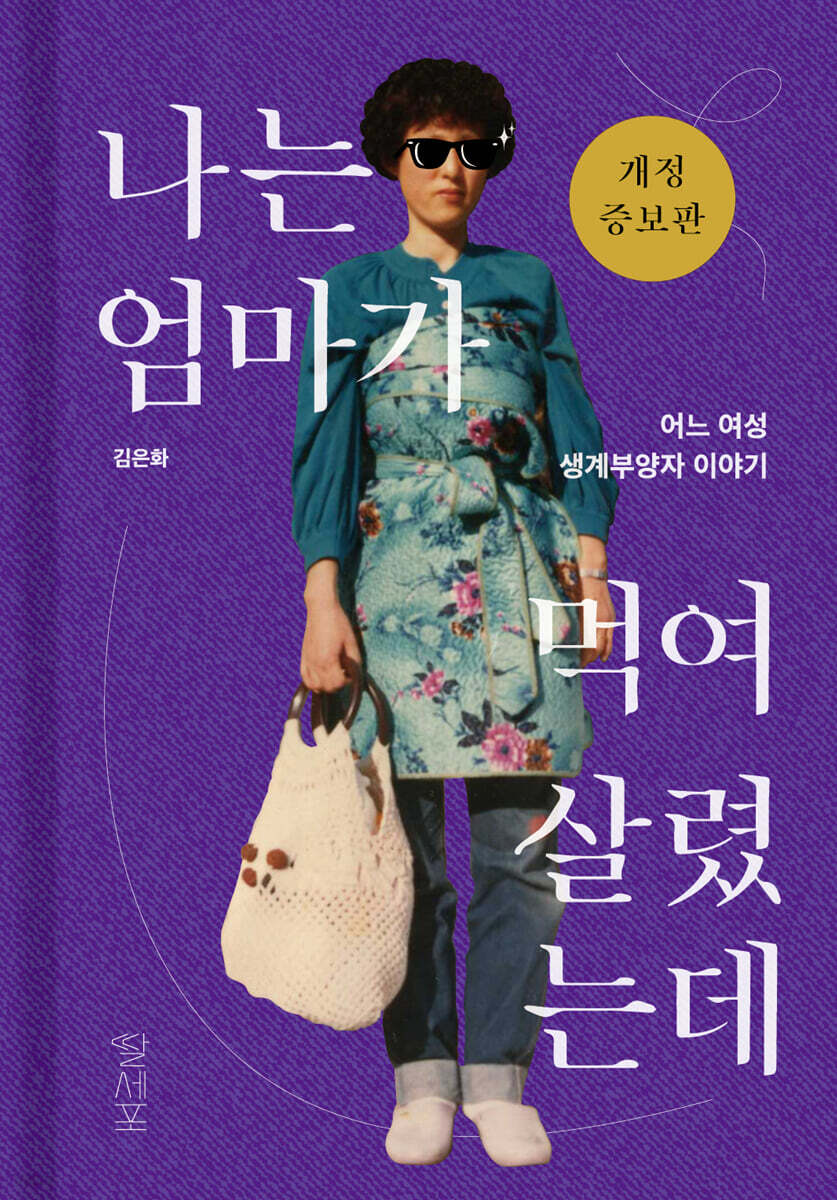
My mother fed me
 |
Description
Book Introduction
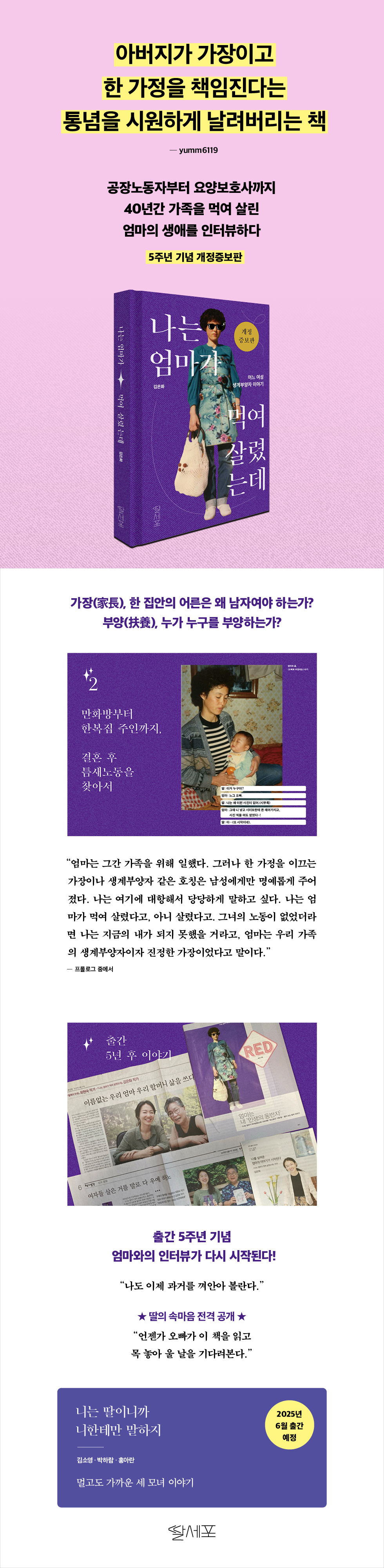
My father is the head of the household
The common belief that one person is responsible for a family
A book that blows you away!
Park Young-sun, a 62-year-old mother, said.
“I haven’t accomplished anything in life,” thought Kim Eun-hwa, 31.
What on earth was the work of my mother, who woke up at 6 a.m. to prepare ten meals a day, from lunch boxes for her children to meals for her in-laws, worked for more than eight hours straight at the warehouse in front of her house, and was busy with laundry and grocery shopping on the weekends?
This is the background to my decision to interview and record my mother's life.
This book contains the process of reinterpreting the present by looking into the mother's past together.
The daughter has always viewed her mother as someone who must protect her from long hours of work and a violent father.
As I listened to the story carefully, I realized that Park Young-seon was a strong person in her own right.
From her days as a factory worker in the Masan Free Export Zone in 1972 until her retirement as a nursing assistant in 2013, Park Young-seon had a deep-rooted sense of pride as someone who had supported her family with her own hands for 40 years.
Here, I have been in charge of housework, childcare, and parent-in-law care.
But no one recognized its value.
“So I decided to get to know my mom first.
The beginning is to give it a proper title.
My mother worked for the family all this time.
However, titles such as head of a household or breadwinner were given with honor only to men.
I want to stand up against this and speak out boldly.
“I say that my mother fed me, no, saved me, that without her labor I would not be who I am today, that my mother was the breadwinner and true head of our family.” (p. 16)
The common belief that one person is responsible for a family
A book that blows you away!
Park Young-sun, a 62-year-old mother, said.
“I haven’t accomplished anything in life,” thought Kim Eun-hwa, 31.
What on earth was the work of my mother, who woke up at 6 a.m. to prepare ten meals a day, from lunch boxes for her children to meals for her in-laws, worked for more than eight hours straight at the warehouse in front of her house, and was busy with laundry and grocery shopping on the weekends?
This is the background to my decision to interview and record my mother's life.
This book contains the process of reinterpreting the present by looking into the mother's past together.
The daughter has always viewed her mother as someone who must protect her from long hours of work and a violent father.
As I listened to the story carefully, I realized that Park Young-seon was a strong person in her own right.
From her days as a factory worker in the Masan Free Export Zone in 1972 until her retirement as a nursing assistant in 2013, Park Young-seon had a deep-rooted sense of pride as someone who had supported her family with her own hands for 40 years.
Here, I have been in charge of housework, childcare, and parent-in-law care.
But no one recognized its value.
“So I decided to get to know my mom first.
The beginning is to give it a proper title.
My mother worked for the family all this time.
However, titles such as head of a household or breadwinner were given with honor only to men.
I want to stand up against this and speak out boldly.
“I say that my mother fed me, no, saved me, that without her labor I would not be who I am today, that my mother was the breadwinner and true head of our family.” (p. 16)
- You can preview some of the book's contents.
Preview
index
Prologue - A Daughter's Story of Watching Her Mother's Endless Labor
Chapter 1: Masan Free Export Zone Workers by Day, Broadcasting and Communications High School Students by Night
When my mother was younger than me
The eldest daughter's fate
The second daughter's childhood
Fifteen, the beginning of housework
A worker's life began in the Masan Free Export Zone.
Challenge the delegate 'Oyabun'
We demonstrated against Japanese companies, so we said, "We are patriots."
The days when we were dating over the press machine
The Bangtong High School class where I would nod off at 10 p.m.
I wanted to go to college and become a teacher, but
- Interview Review - A Mother's Lifelong Focus: Work and Learning
Chapter 2: From a comic book store owner to a hanbok shop owner, finding a niche job after marriage
“I got married with a heart of service.”
A comic book store that earns as much as a civil servant's salary
The reason I cried so sadly after giving birth to my first child
Money disappeared just before buying a house
The new bride's rice planting life in the gatehouse
A genius at investing
A Biographical Understanding of a Tyrannical Husband
Go to Broadcasting and Communication University
1988, from Masan to Seoul
Even if your child is hit, you should put yourself in their shoes
A house that my husband secretly signed a contract for
Open a hanbok shop
The Graveyard of Self-Employed Women: Housework and Care Work
- Interview Review - It would be enough to just throw away the family register and such.
Chapter 3: The Last Irregular Worker of the "King of Recycling"
Women's Association's Waste Separation King
Going to the auction with my husband
“I said I would never do a part-time job again.”
Pride as a worker at a publishing logistics company
My mother and I's labor, compiled into a book
- Interview Review - There's always calm before the storm
Chapter 4 Divorce
Stocks and Horse Racing: The Beginning of a Ruin
A visit from a loan shark
Because the house is uncomfortable
Divorce with the intention of death
Son's Counterattack
Daughter's resentment
“Divorce, no matter how many times you think about it, it’s always right.”
- Interview Review - Mom's Frontline, My Frontline
Chapter 5: Irregular Workers as They Come
To the island with a desire to hide
Living with a caregiver in a nursing home
That Winter's Choice
At the pier shop
Without even knowing that my heart is in pain
- Interview Review - The Scars of Individual Battles
Chapter 6: Ten Years as a Nursing Assistant and Beyond
Finally to Seoul
The dilemma of the "smart fool" who always gives in
Daughter's Spear vs. Mother's Shield
“There is no one who has worked as a caregiver without getting sick.”
Now that I'm older, I understand that feeling.
Hold on until your children get jobs
About my ex-husband
“I told you I’m a person who is soft on the outside but strong on the inside.”
- Interview Review - Boomerang
Epilogue - The Women Who Survive Are Strong
Story 5 years after publication
“Did you make a lot of money selling mine?”
That damn national pension
If there is a next life
Chronology
Chapter 1: Masan Free Export Zone Workers by Day, Broadcasting and Communications High School Students by Night
When my mother was younger than me
The eldest daughter's fate
The second daughter's childhood
Fifteen, the beginning of housework
A worker's life began in the Masan Free Export Zone.
Challenge the delegate 'Oyabun'
We demonstrated against Japanese companies, so we said, "We are patriots."
The days when we were dating over the press machine
The Bangtong High School class where I would nod off at 10 p.m.
I wanted to go to college and become a teacher, but
- Interview Review - A Mother's Lifelong Focus: Work and Learning
Chapter 2: From a comic book store owner to a hanbok shop owner, finding a niche job after marriage
“I got married with a heart of service.”
A comic book store that earns as much as a civil servant's salary
The reason I cried so sadly after giving birth to my first child
Money disappeared just before buying a house
The new bride's rice planting life in the gatehouse
A genius at investing
A Biographical Understanding of a Tyrannical Husband
Go to Broadcasting and Communication University
1988, from Masan to Seoul
Even if your child is hit, you should put yourself in their shoes
A house that my husband secretly signed a contract for
Open a hanbok shop
The Graveyard of Self-Employed Women: Housework and Care Work
- Interview Review - It would be enough to just throw away the family register and such.
Chapter 3: The Last Irregular Worker of the "King of Recycling"
Women's Association's Waste Separation King
Going to the auction with my husband
“I said I would never do a part-time job again.”
Pride as a worker at a publishing logistics company
My mother and I's labor, compiled into a book
- Interview Review - There's always calm before the storm
Chapter 4 Divorce
Stocks and Horse Racing: The Beginning of a Ruin
A visit from a loan shark
Because the house is uncomfortable
Divorce with the intention of death
Son's Counterattack
Daughter's resentment
“Divorce, no matter how many times you think about it, it’s always right.”
- Interview Review - Mom's Frontline, My Frontline
Chapter 5: Irregular Workers as They Come
To the island with a desire to hide
Living with a caregiver in a nursing home
That Winter's Choice
At the pier shop
Without even knowing that my heart is in pain
- Interview Review - The Scars of Individual Battles
Chapter 6: Ten Years as a Nursing Assistant and Beyond
Finally to Seoul
The dilemma of the "smart fool" who always gives in
Daughter's Spear vs. Mother's Shield
“There is no one who has worked as a caregiver without getting sick.”
Now that I'm older, I understand that feeling.
Hold on until your children get jobs
About my ex-husband
“I told you I’m a person who is soft on the outside but strong on the inside.”
- Interview Review - Boomerang
Epilogue - The Women Who Survive Are Strong
Story 5 years after publication
“Did you make a lot of money selling mine?”
That damn national pension
If there is a next life
Chronology
Detailed image
Into the book
My mother seemed like she was born to work.
I woke up at 4 a.m., studied for two hours, and at 6 a.m., I put rice in the pressure cooker.
It was a time when I prepared ten meals a day, from my grandfather's table to my brother's lunchbox.
My mother worked at a publishing company five minutes away from home.
I squatted down all day, unpacking, sorting, and carrying the returned books.
Because the job put a lot of strain on my back and knees, I often suffered from muscle pain every morning.
--- p.12
When I was eighteen, my parents divorced.
(...) I started to fight against the world that tried to insult my mother at every opportunity while defending myself.
It was both the venomous face of those with vested interests and the screams of those in power who ignored the law and beat people up as they pleased.
Underneath it all was the face of a violent father.
I wanted to become strong.
I wanted to free my mother from these rude people, long hours of work, and money worries.
--- p.13
Even after my divorce, when I was working irregular jobs for low wages, my mother always knew how to give her all and find meaning in the work she was given.
She had pride in herself as a hard worker who had earned her own living for 40 years.
I used to think of my mother as a weak person, but it turns out she was a flexible and strong person.
(...) I've been telling my mom to be proud of her life, but maybe it was I who was ignoring her all this time.
--- p.15
So I decided to get to know my mom first.
The beginning is to give it a proper title.
My mother worked for the family all this time.
However, titles like head of a household or breadwinner were only honorably bestowed upon men. I want to speak out against this and speak out boldly.
I said that my mother fed me, no, saved me.
I would not be who I am today without her work, she was the breadwinner and true head of our family.
--- p.16
When we were working at F1 in the Masan Free Export Zone, we protested and made a fuss because it was a Japanese company, so we could get paid more.
(…) If you made money in Korea, why don’t you spend some of it in Korea, improve employee treatment, or pay them more? Why does the Japanese take all that money?
We are patriots because we blocked it.
--- pp.35-36
I graduated from Masan Communication High School as the top student. Oh boy, top student! (…) When I graduated, it was the last year of the two-year program at Jinju National University of Education.
The second place kid went there.
I had the skills, but I never thought about going to college.
If I had gone to college then, my life would have been completely different. (…) My older brothers would have all been sent to the military at once, so I would have had to earn a living.
--- pp.47-49
I thought it would be difficult to do business, so I thought it wouldn't work out.
My dad quits his job and I don't want to live. I have to cook breakfast and go out. I have to do business. I have to do chores, laundry, and all that... Business is just making me suffer to the point where I'm dying.
--- p.103
I thought, "This won't work. Even though I may not be a good mother to raise my children, I should be their support."
I was prepared to die.
If I had to die, I would die. If I had to live, I would live. This is how I have lived without any plan.
--- p.161
I've thought about getting divorced twelve times and I've been right all twelve times.
People might criticize me for living like this.
--- p.165
Patriarchal society constantly pushes women to the margins.
(…) But women do not remain in the position of victims.
Even if it is pushed, it bounces back, and even if it conforms, it bounces back.
(…) On the path of life, each and every one of them is an active player and a protagonist of history.
I don't believe in the saying, 'Women are weak, but mothers are strong.'
Any woman who survives is strong.
Because we start from a place where we are pushed out from birth.
--- p.249
A mother loves her son terribly.
Even though I show my daughter the rotten and rotten vegetable drawer in the refrigerator, I only show my son the neatly organized living room.
He asks me for all kinds of little favors, but he has difficulty even making a phone call to his son.
What does a daughter mean to a mother?
--- p.293
I look forward to the day when my brother reads this book and cries out loud.
I woke up at 4 a.m., studied for two hours, and at 6 a.m., I put rice in the pressure cooker.
It was a time when I prepared ten meals a day, from my grandfather's table to my brother's lunchbox.
My mother worked at a publishing company five minutes away from home.
I squatted down all day, unpacking, sorting, and carrying the returned books.
Because the job put a lot of strain on my back and knees, I often suffered from muscle pain every morning.
--- p.12
When I was eighteen, my parents divorced.
(...) I started to fight against the world that tried to insult my mother at every opportunity while defending myself.
It was both the venomous face of those with vested interests and the screams of those in power who ignored the law and beat people up as they pleased.
Underneath it all was the face of a violent father.
I wanted to become strong.
I wanted to free my mother from these rude people, long hours of work, and money worries.
--- p.13
Even after my divorce, when I was working irregular jobs for low wages, my mother always knew how to give her all and find meaning in the work she was given.
She had pride in herself as a hard worker who had earned her own living for 40 years.
I used to think of my mother as a weak person, but it turns out she was a flexible and strong person.
(...) I've been telling my mom to be proud of her life, but maybe it was I who was ignoring her all this time.
--- p.15
So I decided to get to know my mom first.
The beginning is to give it a proper title.
My mother worked for the family all this time.
However, titles like head of a household or breadwinner were only honorably bestowed upon men. I want to speak out against this and speak out boldly.
I said that my mother fed me, no, saved me.
I would not be who I am today without her work, she was the breadwinner and true head of our family.
--- p.16
When we were working at F1 in the Masan Free Export Zone, we protested and made a fuss because it was a Japanese company, so we could get paid more.
(…) If you made money in Korea, why don’t you spend some of it in Korea, improve employee treatment, or pay them more? Why does the Japanese take all that money?
We are patriots because we blocked it.
--- pp.35-36
I graduated from Masan Communication High School as the top student. Oh boy, top student! (…) When I graduated, it was the last year of the two-year program at Jinju National University of Education.
The second place kid went there.
I had the skills, but I never thought about going to college.
If I had gone to college then, my life would have been completely different. (…) My older brothers would have all been sent to the military at once, so I would have had to earn a living.
--- pp.47-49
I thought it would be difficult to do business, so I thought it wouldn't work out.
My dad quits his job and I don't want to live. I have to cook breakfast and go out. I have to do business. I have to do chores, laundry, and all that... Business is just making me suffer to the point where I'm dying.
--- p.103
I thought, "This won't work. Even though I may not be a good mother to raise my children, I should be their support."
I was prepared to die.
If I had to die, I would die. If I had to live, I would live. This is how I have lived without any plan.
--- p.161
I've thought about getting divorced twelve times and I've been right all twelve times.
People might criticize me for living like this.
--- p.165
Patriarchal society constantly pushes women to the margins.
(…) But women do not remain in the position of victims.
Even if it is pushed, it bounces back, and even if it conforms, it bounces back.
(…) On the path of life, each and every one of them is an active player and a protagonist of history.
I don't believe in the saying, 'Women are weak, but mothers are strong.'
Any woman who survives is strong.
Because we start from a place where we are pushed out from birth.
--- p.249
A mother loves her son terribly.
Even though I show my daughter the rotten and rotten vegetable drawer in the refrigerator, I only show my son the neatly organized living room.
He asks me for all kinds of little favors, but he has difficulty even making a phone call to his son.
What does a daughter mean to a mother?
--- p.293
I look forward to the day when my brother reads this book and cries out loud.
--- p.295
Publisher's Review
Mother and daughter face each other
Times of tears, laughter, and reconciliation
Another axis of this book is about 'relationships'.
Yeong-seon makes a firm statement about her ex-husband, whom she did her best to live with, but with whom she could not be together in the end.
“Divorce, no matter how many times you think about it, it’s always right,” the daughter counters.
“If we had divorced earlier, our children might have had a better life.” The back-and-forth conversation between mother and daughter is filled with scenes of sadness and laughter, resentment and reconciliation.
Through this, we can glimpse the process of understanding each other's inner selves and becoming emotionally independent.
“I now realize that from the beginning, I neither needed nor could I be my mother’s savior.
If I had one wish, it would be that there would be daughters like me somewhere who would let go of their guilt toward their mothers.
Even if we share blood, we cannot replace each other.
“Because Mom has her life, and I have my life.” (p. 17)
A portrait of an individual revealed through a three-dimensional gaze
This book, which compiles only the key scenes from six interviews spanning a total of fourteen hours from March 2017, is largely divided into three parts.
First is the perspective of mother Park Young-sun.
In the text, which retains the Gyeongsang dialect, the past is recounted from a first-person perspective.
The second is the daughter's perspective.
At the end of each chapter, you can find the daughter's inner thoughts in the form of a review.
Third is the nature of the times.
The article cited social events that affected Park Young-sun's life to emphasize the context of the times.
Through this, we can see the portrait of 'Park Young-sun the human' through intersecting perspectives on how an individual encounters the times and how that experience is interpreted after a generation has passed.
Times of tears, laughter, and reconciliation
Another axis of this book is about 'relationships'.
Yeong-seon makes a firm statement about her ex-husband, whom she did her best to live with, but with whom she could not be together in the end.
“Divorce, no matter how many times you think about it, it’s always right,” the daughter counters.
“If we had divorced earlier, our children might have had a better life.” The back-and-forth conversation between mother and daughter is filled with scenes of sadness and laughter, resentment and reconciliation.
Through this, we can glimpse the process of understanding each other's inner selves and becoming emotionally independent.
“I now realize that from the beginning, I neither needed nor could I be my mother’s savior.
If I had one wish, it would be that there would be daughters like me somewhere who would let go of their guilt toward their mothers.
Even if we share blood, we cannot replace each other.
“Because Mom has her life, and I have my life.” (p. 17)
A portrait of an individual revealed through a three-dimensional gaze
This book, which compiles only the key scenes from six interviews spanning a total of fourteen hours from March 2017, is largely divided into three parts.
First is the perspective of mother Park Young-sun.
In the text, which retains the Gyeongsang dialect, the past is recounted from a first-person perspective.
The second is the daughter's perspective.
At the end of each chapter, you can find the daughter's inner thoughts in the form of a review.
Third is the nature of the times.
The article cited social events that affected Park Young-sun's life to emphasize the context of the times.
Through this, we can see the portrait of 'Park Young-sun the human' through intersecting perspectives on how an individual encounters the times and how that experience is interpreted after a generation has passed.
GOODS SPECIFICS
- Date of issue: April 16, 2025
- Page count, weight, size: 304 pages | 128*188*30mm
- ISBN13: 9791196675608
- ISBN10: 1196675600
You may also like
카테고리
korean


korean

![GQ KOREA Mark (Monthly): December [2025]](http://librairie.coreenne.fr/cdn/shop/files/8ef265dbbfbf186523ed75ba7319009d.jpg?v=1765340328&width=3840)


