

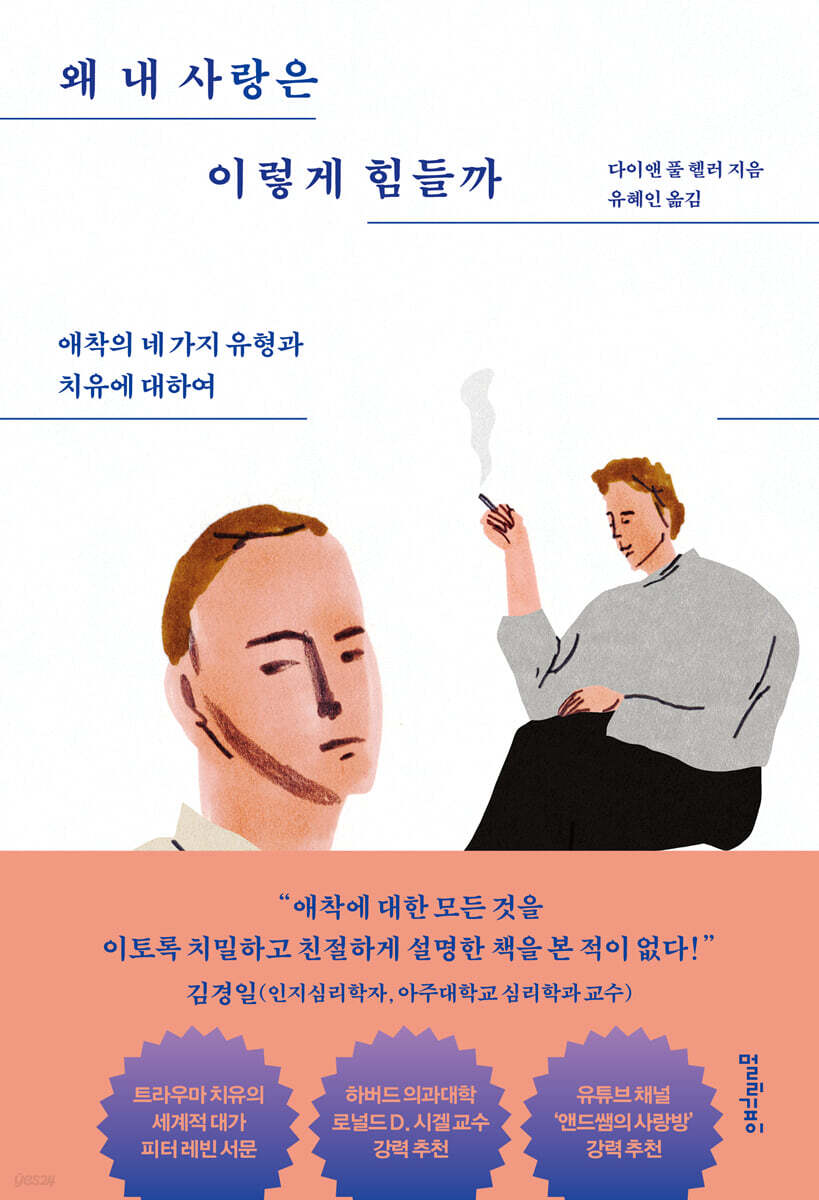
Why is my love so difficult?
 |
Description
Book Introduction
Cognitive psychologist Kyung-il Kim, Harvard Medical School's Ronald Siegel, and the YouTube channel 'And Sam's Love Room' are highly recommended! The only book in Korea that introduces four attachment types, including disorganized attachment! Dr. Diane Poole Heller, a world-renowned authority on adult attachment theory and trauma treatment, presents her first Korean book! As a disciple of Peter Levin, founder of the Somatic Experiential Trauma Institute (SETI), she condenses her 20-plus years of worldwide lectures into a single volume. This book has been praised as a perfect guide to the 'chaotic attachment theory', which is unfamiliar in Korea. Above all, it is a heartwarming book that argues that the imperfect attachment style we did not receive from our parents can be overcome through healthy relationships with others and effort. |
- You can preview some of the book's contents.
Preview
index
Praise for this book
Recommended Preface
Introduction
Chapter 1 Secure Attachment: The Way We Were Born
Factors that contribute to secure attachment
Let me picture myself receiving protection and affection.
How to Unleash the Secure Attachment Latent Within Us
Self-assessment of secure attachment
Chapter 2: Avoidant Attachment: People Who Push Away as Much as They Long
Factors Contributing to Avoidant Attachment
People who feel the 'joy of separation'
When it rains in the dry desert
Self-Assessment of Avoidant Attachment
Chapter 3: Ambivalent Attachment: People Who Move Between Attachment and Obsession
Factors that foster ambivalent attachment
People with highly developed sense of others
Let's recognize the love the other person is sending us.
Self-assessment of ambivalent attachment
Chapter 4: Chaotic Attachment: Those Who Choose Instability for Survival
Range of resilience by attachment style
Factors that create chaotic attachment
People who press the brake and accelerator at the same time
A deep sense of security can only be restored by restoring a damaged sense of boundaries.
Self-Assessment of Chaotic Attachment
Chapter 5: Attachment Styles and Romance: Why We Can Still Love Each Other
Various factors that determine attachment style
Characteristics of Couples Who Have Secure Attachments
Guidelines for those seeking a partner
Towards a more stable relationship
Changing Your Attachment Style
Sometimes you have to make the decision to end a relationship.
We are born to enjoy secure attachments.
Acknowledgements
annotation
References
Recommended Preface
Introduction
Chapter 1 Secure Attachment: The Way We Were Born
Factors that contribute to secure attachment
Let me picture myself receiving protection and affection.
How to Unleash the Secure Attachment Latent Within Us
Self-assessment of secure attachment
Chapter 2: Avoidant Attachment: People Who Push Away as Much as They Long
Factors Contributing to Avoidant Attachment
People who feel the 'joy of separation'
When it rains in the dry desert
Self-Assessment of Avoidant Attachment
Chapter 3: Ambivalent Attachment: People Who Move Between Attachment and Obsession
Factors that foster ambivalent attachment
People with highly developed sense of others
Let's recognize the love the other person is sending us.
Self-assessment of ambivalent attachment
Chapter 4: Chaotic Attachment: Those Who Choose Instability for Survival
Range of resilience by attachment style
Factors that create chaotic attachment
People who press the brake and accelerator at the same time
A deep sense of security can only be restored by restoring a damaged sense of boundaries.
Self-Assessment of Chaotic Attachment
Chapter 5: Attachment Styles and Romance: Why We Can Still Love Each Other
Various factors that determine attachment style
Characteristics of Couples Who Have Secure Attachments
Guidelines for those seeking a partner
Towards a more stable relationship
Changing Your Attachment Style
Sometimes you have to make the decision to end a relationship.
We are born to enjoy secure attachments.
Acknowledgements
annotation
References
Detailed image

Into the book
Humans are fundamentally designed to heal.
It's okay if your childhood wasn't ideal.
Because we are beings born with a secure attachment.
Now we just need to figure out what's hindering secure attachment and learn how to make secure attachment a more dominant trait.
Let's unearth the secure attachment buried somewhere.
Then you will be victorious over any relationship trauma or attachment disorder that may come your way someday.
Even if you lose, you can get back up and recover faster.
---From "Introductory Remarks"
It's important to remember that people may avoid eye contact when they are going through a difficult experience (e.g., feeling embarrassed).
Attempting to maintain eye contact or asking someone to look you in the eye is not always beneficial.
Adolescents often interpret this as an invasion of territory or an attack.
When parents demand, “Look into your child’s eyes when you talk,” they only distance themselves from their children.
Sometimes it's better to walk side by side and talk, or to do activities together that are largely silent, like fishing, gardening, or sewing.
---「Chapter 1.
From “Stable Attachment”
Some avoidants don't miss important people when they leave.
When that person disappears from our sight for reasons such as work, business trips, divorce, or even death, we initially feel a sense of relief.
The pressure to connect is temporarily relieved, and symptoms of “separation elation” appear.
Avoidant people often only fully recognize how disconnected they are after they have healed their wounds.
The avoidant attachment system is inactive.
It seems that some of our functions stopped working because we didn't get enough comfortable and beneficial relationships as children, especially during the first few years of life.
But if you look beneath the surface, avoidant types still crave connection.
We live with the unspoken fear of being rejected.
So, avoidant people may feel like they've revealed too much when they open up in a relationship.
---「Chapter 2.
From "Avoidant Attachment"
Ambivalent people often demand a lot of time and energy from their loved ones.
This is because they feel that their needs are mainly met through others.
Because the ambivalent type did not learn to properly regulate their nervous system as children, they always seek satisfaction and security from others.
Naturally, this can be problematic for your partner, and the tendency to become increasingly demanding can only add strain to any relationship.
Of course, there is nothing wrong with relying on a relationship and asking for support and love.
I have no intention of telling you not to do that.
The point is that we must learn to strike the optimal balance between co-regulation and self-regulation.
---「Chapter 3.
From “Ambivalence”
Chaotic attachment can be complex and frustrating.
Let's take as few steps as possible and start with people and situations that are comfortable to deal with.
Gather around you people who will be your true allies and do your best to strengthen your relationships with them.
To learn to better self-regulate and regain our innate right to secure attachment, we must rely on a secure support system.
We can learn these skills.
You can learn self-regulation and co-regulation.
You can acquire a feeling of safety.
You can cross the bridge back to a secure attachment.
It's okay if your childhood wasn't ideal.
Because we are beings born with a secure attachment.
Now we just need to figure out what's hindering secure attachment and learn how to make secure attachment a more dominant trait.
Let's unearth the secure attachment buried somewhere.
Then you will be victorious over any relationship trauma or attachment disorder that may come your way someday.
Even if you lose, you can get back up and recover faster.
---From "Introductory Remarks"
It's important to remember that people may avoid eye contact when they are going through a difficult experience (e.g., feeling embarrassed).
Attempting to maintain eye contact or asking someone to look you in the eye is not always beneficial.
Adolescents often interpret this as an invasion of territory or an attack.
When parents demand, “Look into your child’s eyes when you talk,” they only distance themselves from their children.
Sometimes it's better to walk side by side and talk, or to do activities together that are largely silent, like fishing, gardening, or sewing.
---「Chapter 1.
From “Stable Attachment”
Some avoidants don't miss important people when they leave.
When that person disappears from our sight for reasons such as work, business trips, divorce, or even death, we initially feel a sense of relief.
The pressure to connect is temporarily relieved, and symptoms of “separation elation” appear.
Avoidant people often only fully recognize how disconnected they are after they have healed their wounds.
The avoidant attachment system is inactive.
It seems that some of our functions stopped working because we didn't get enough comfortable and beneficial relationships as children, especially during the first few years of life.
But if you look beneath the surface, avoidant types still crave connection.
We live with the unspoken fear of being rejected.
So, avoidant people may feel like they've revealed too much when they open up in a relationship.
---「Chapter 2.
From "Avoidant Attachment"
Ambivalent people often demand a lot of time and energy from their loved ones.
This is because they feel that their needs are mainly met through others.
Because the ambivalent type did not learn to properly regulate their nervous system as children, they always seek satisfaction and security from others.
Naturally, this can be problematic for your partner, and the tendency to become increasingly demanding can only add strain to any relationship.
Of course, there is nothing wrong with relying on a relationship and asking for support and love.
I have no intention of telling you not to do that.
The point is that we must learn to strike the optimal balance between co-regulation and self-regulation.
---「Chapter 3.
From “Ambivalence”
Chaotic attachment can be complex and frustrating.
Let's take as few steps as possible and start with people and situations that are comfortable to deal with.
Gather around you people who will be your true allies and do your best to strengthen your relationships with them.
To learn to better self-regulate and regain our innate right to secure attachment, we must rely on a secure support system.
We can learn these skills.
You can learn self-regulation and co-regulation.
You can acquire a feeling of safety.
You can cross the bridge back to a secure attachment.
---「Chapter 4.
From “Chaotic Attachment”
From “Chaotic Attachment”
Publisher's Review
Your innate attachment style doesn't matter!
How to move beyond lonely, desolate attachment trauma and heal the wounds of relationships.
Guided by Dr. Diane Poole Heller, a world pioneer in attachment trauma treatment
The only complete guide to the four attachment types in Korea.
example.
Frieda, a client who came to Dr. Diane Poole Heller's counseling office, was deeply hurt by her relationship with her mother.
Her mother always made Frida clean.
At the same time, he constantly criticized me for not cleaning in the right order or using the tools properly.
When a cowering Frida asked questions like, “Should I vacuum first or dust first?”, he didn’t give a direct answer, but only said, “If you’ve lived in this house all this time, you should know how to do that.”
As an adult, Frida felt she couldn't keep her home or office organized. She often gave up, thinking, "Why even try if I'm not going to do it right anyway?" and felt she was destined to fail.
It was the same in love.
"Why Is My Love So Hard?" (published by Mulli-Gip-Pi in 2024) is the first Korean publication by Dr. Diane Poole Heller, a world-renowned authority on trauma treatment.
Dr. Diane Poole Heller, who has traveled the world coaching psychotherapists for over 20 years, uses Somatic Experiencing (SE) Therapy to help adults with attachment trauma overcome serious relationship challenges with simple, insightful alternatives.
In the case of Frida, who is introduced in this book, she was suffering from chaotic attachment trauma due to a family environment that was always turbulent, her parents' emotional states that were erratic, and her parents' contradictory and confusing instructions. Dr. Diane Poole Heller then conducted 'Finding a Competent Caregiver' therapy on Frida.
The method was simple.
Treatment methods.
① Take a comfortable position and focus on your body sensations.
② Think of someone who truly protected and watched over you.
③ When you want to escape to a safe place, think about how you would feel if that person was with you. Observe where and how you feel supported or have that sensation.
Therapeutic effect.
Debra, who had sought out Dr. Diane Poole Heller, was reminded of the doctor who had examined her as a child.
The doctor, who had become serious while examining Debra, turned to his mother and spoke firmly.
“Stop hitting this child.” The mother, who thought she would attack the doctor, said, “Oh, yes.
“I’ll stop,” she replied, and a brief conversation between the doctor and her mother led to Debra’s release from the domestic violence.
Through this treatment, Debra remembered the doctor who had protected her as a child and realized how deeply he had influenced her life.
The book introduces four types of attachment: secure, avoidant, ambivalent, and disorganized, allowing readers to assess which attachment type they have.
It also introduces various practices that can help you tap into your potential for secure attachment and overcome the trauma caused by insecure attachment.
Simple yet profound exercises like "Finding a Competent Caregiver" have helped many readers recover their potential for secure attachment.
“I’ve never seen such a detailed and friendly book on attachment styles!”
The Four Attachment Types and a Guide to Trauma Healing
As recommended by Professor Kim Kyung-il and And Sam, the book covers the four attachment types and assessment methods in more detail than any other book published in Korea, spanning 2 to 4 chapters.
① Secure Attachment
They usually grew up with abundant love and support from responsive and consistent caregivers.
Each person is an independent entity, forming healthy and beneficial relationships, feeling equally comfortable and flexible in their thinking when alone as when with others.
Even if you have different opinions from others, you don't care and resolve conflicts without much emotional drain.
When we receive love, we accept it internally and forgive others easily.
② Avoidant Attachment
There is a tendency to reject intimate relationships or minimize their importance.
This type often occurs when a caregiver neglects the child for a long time, pushes away an approaching child, or is absent from the child's presence for a long time (or is only present when teaching something).
Because these are people who have hit the brakes and disconnected from their attachment system, the process of reconnecting with others in a safe and healthy way is essential.
③ Ambivalent Attachment
They feel extremely anxious when their needs are being met and when they feel secure in giving and receiving love.
Parents of the ambivalent type show a characteristic of withdrawing their interest without warning even when they are in love.
The attachment system goes into overdrive because the person is extremely sensitive to signs that the other person is ignoring or abandoning them.
They are so convinced that they will be abandoned that they feel sad, disappointed, and angry even when nothing has actually happened.
For this type of ambivalent person, consistency and confidence are important.
④ Disorganized Attachment
When we're stressed, sick, or scared, our loving parents should comfort and protect us, but what if they're the source of our fears? This chaotic type is characterized by a constant state of threat response, oscillating between avoidant and ambivalent behaviors without a clear pattern.
Chaotic parents may be fearful of their own children and may have seen their parents as threats during childhood.
Since they are the type that struggles with emotional regulation and causes the most problems, they need to fundamentally learn how to regulate their nervous system and regain a sense of safety in their relationships.
Somatic Therapy (SE) is something you can only find in professional courses costing millions of won!
An amazing experience of discovering what hinders secure attachment and restoring it!
The book suggests a variety of trauma healing practices for each type.
Separately organized practical programs called "Let's Try It Together" provide healing time tailored to each of the four attachment types.
There are various exercises that can be done right away in the space you are sitting without much difficulty, such as 'thinking of a person who makes you feel safe and comfortable', 'thinking of a feeling of deep understanding and connection', 'thinking of the wounds and help you received from your parents at the same time', and 'finding the reversed role of mother'. These are simple but bring fundamental satisfaction and healing effects.
The author, an expert on not only attachment trauma but also surviving major accident trauma, guides trauma victims through a warm and compassionate gaze, guiding them that their innate attachment style doesn't matter, and that our attachment trauma can be improved.
My dear, don't love that!
The indicators you should never encounter are revealed!
The book devotes five entire chapters to explaining the dating patterns of secure, avoidant, ambivalent, and chaotic types, as well as the types of relationships that must be avoided.
The stable type, as the book describes it, are like winning the lottery.
Insecure partners heal their attachment wounds by being with the secure type.
On the other hand, unstable partners are also attracted to each other for various contradictory reasons.
While relationships between unstable partners aren't always doomed to failure, at least when warning signs appear, it's crucial to run away without hesitation! The book provides the following indicators:
① Warning signs of avoidance
· Enter the cave periodically.
There is no way to respond consistently to texts or phone calls.
· Frequently displays a negative, critical, or contemptuous attitude.
They often find fault with others, especially their partners.
② Warning signs of ambivalent behavior
· I get jealous easily.
They are always looking for evidence that their partner will abandon them and suspect infidelity even when it is not true.
· You have trouble trusting your partner even after a long time has passed since you met them.
You can eavesdrop on conversations or secretly read texts and emails to find evidence that someone else is more interested in you.
③ Warning signs of confusion
· You are suddenly stimulated and react violently.
It can be difficult to understand what is making you angry.
· At some point during a relationship, you may begin to experience inexplicable fears.
This phenomenon is especially evident when the feeling of intimacy and security with one's partner increases.
How to move beyond lonely, desolate attachment trauma and heal the wounds of relationships.
Guided by Dr. Diane Poole Heller, a world pioneer in attachment trauma treatment
The only complete guide to the four attachment types in Korea.
example.
Frieda, a client who came to Dr. Diane Poole Heller's counseling office, was deeply hurt by her relationship with her mother.
Her mother always made Frida clean.
At the same time, he constantly criticized me for not cleaning in the right order or using the tools properly.
When a cowering Frida asked questions like, “Should I vacuum first or dust first?”, he didn’t give a direct answer, but only said, “If you’ve lived in this house all this time, you should know how to do that.”
As an adult, Frida felt she couldn't keep her home or office organized. She often gave up, thinking, "Why even try if I'm not going to do it right anyway?" and felt she was destined to fail.
It was the same in love.
"Why Is My Love So Hard?" (published by Mulli-Gip-Pi in 2024) is the first Korean publication by Dr. Diane Poole Heller, a world-renowned authority on trauma treatment.
Dr. Diane Poole Heller, who has traveled the world coaching psychotherapists for over 20 years, uses Somatic Experiencing (SE) Therapy to help adults with attachment trauma overcome serious relationship challenges with simple, insightful alternatives.
In the case of Frida, who is introduced in this book, she was suffering from chaotic attachment trauma due to a family environment that was always turbulent, her parents' emotional states that were erratic, and her parents' contradictory and confusing instructions. Dr. Diane Poole Heller then conducted 'Finding a Competent Caregiver' therapy on Frida.
The method was simple.
Treatment methods.
① Take a comfortable position and focus on your body sensations.
② Think of someone who truly protected and watched over you.
③ When you want to escape to a safe place, think about how you would feel if that person was with you. Observe where and how you feel supported or have that sensation.
Therapeutic effect.
Debra, who had sought out Dr. Diane Poole Heller, was reminded of the doctor who had examined her as a child.
The doctor, who had become serious while examining Debra, turned to his mother and spoke firmly.
“Stop hitting this child.” The mother, who thought she would attack the doctor, said, “Oh, yes.
“I’ll stop,” she replied, and a brief conversation between the doctor and her mother led to Debra’s release from the domestic violence.
Through this treatment, Debra remembered the doctor who had protected her as a child and realized how deeply he had influenced her life.
The book introduces four types of attachment: secure, avoidant, ambivalent, and disorganized, allowing readers to assess which attachment type they have.
It also introduces various practices that can help you tap into your potential for secure attachment and overcome the trauma caused by insecure attachment.
Simple yet profound exercises like "Finding a Competent Caregiver" have helped many readers recover their potential for secure attachment.
“I’ve never seen such a detailed and friendly book on attachment styles!”
The Four Attachment Types and a Guide to Trauma Healing
As recommended by Professor Kim Kyung-il and And Sam, the book covers the four attachment types and assessment methods in more detail than any other book published in Korea, spanning 2 to 4 chapters.
① Secure Attachment
They usually grew up with abundant love and support from responsive and consistent caregivers.
Each person is an independent entity, forming healthy and beneficial relationships, feeling equally comfortable and flexible in their thinking when alone as when with others.
Even if you have different opinions from others, you don't care and resolve conflicts without much emotional drain.
When we receive love, we accept it internally and forgive others easily.
② Avoidant Attachment
There is a tendency to reject intimate relationships or minimize their importance.
This type often occurs when a caregiver neglects the child for a long time, pushes away an approaching child, or is absent from the child's presence for a long time (or is only present when teaching something).
Because these are people who have hit the brakes and disconnected from their attachment system, the process of reconnecting with others in a safe and healthy way is essential.
③ Ambivalent Attachment
They feel extremely anxious when their needs are being met and when they feel secure in giving and receiving love.
Parents of the ambivalent type show a characteristic of withdrawing their interest without warning even when they are in love.
The attachment system goes into overdrive because the person is extremely sensitive to signs that the other person is ignoring or abandoning them.
They are so convinced that they will be abandoned that they feel sad, disappointed, and angry even when nothing has actually happened.
For this type of ambivalent person, consistency and confidence are important.
④ Disorganized Attachment
When we're stressed, sick, or scared, our loving parents should comfort and protect us, but what if they're the source of our fears? This chaotic type is characterized by a constant state of threat response, oscillating between avoidant and ambivalent behaviors without a clear pattern.
Chaotic parents may be fearful of their own children and may have seen their parents as threats during childhood.
Since they are the type that struggles with emotional regulation and causes the most problems, they need to fundamentally learn how to regulate their nervous system and regain a sense of safety in their relationships.
Somatic Therapy (SE) is something you can only find in professional courses costing millions of won!
An amazing experience of discovering what hinders secure attachment and restoring it!
The book suggests a variety of trauma healing practices for each type.
Separately organized practical programs called "Let's Try It Together" provide healing time tailored to each of the four attachment types.
There are various exercises that can be done right away in the space you are sitting without much difficulty, such as 'thinking of a person who makes you feel safe and comfortable', 'thinking of a feeling of deep understanding and connection', 'thinking of the wounds and help you received from your parents at the same time', and 'finding the reversed role of mother'. These are simple but bring fundamental satisfaction and healing effects.
The author, an expert on not only attachment trauma but also surviving major accident trauma, guides trauma victims through a warm and compassionate gaze, guiding them that their innate attachment style doesn't matter, and that our attachment trauma can be improved.
My dear, don't love that!
The indicators you should never encounter are revealed!
The book devotes five entire chapters to explaining the dating patterns of secure, avoidant, ambivalent, and chaotic types, as well as the types of relationships that must be avoided.
The stable type, as the book describes it, are like winning the lottery.
Insecure partners heal their attachment wounds by being with the secure type.
On the other hand, unstable partners are also attracted to each other for various contradictory reasons.
While relationships between unstable partners aren't always doomed to failure, at least when warning signs appear, it's crucial to run away without hesitation! The book provides the following indicators:
① Warning signs of avoidance
· Enter the cave periodically.
There is no way to respond consistently to texts or phone calls.
· Frequently displays a negative, critical, or contemptuous attitude.
They often find fault with others, especially their partners.
② Warning signs of ambivalent behavior
· I get jealous easily.
They are always looking for evidence that their partner will abandon them and suspect infidelity even when it is not true.
· You have trouble trusting your partner even after a long time has passed since you met them.
You can eavesdrop on conversations or secretly read texts and emails to find evidence that someone else is more interested in you.
③ Warning signs of confusion
· You are suddenly stimulated and react violently.
It can be difficult to understand what is making you angry.
· At some point during a relationship, you may begin to experience inexplicable fears.
This phenomenon is especially evident when the feeling of intimacy and security with one's partner increases.
GOODS SPECIFICS
- Date of issue: February 14, 2024
- Page count, weight, size: 328 pages | 418g | 140*205*20mm
- ISBN13: 9791191439410
- ISBN10: 1191439410
You may also like
카테고리
korean


korean

![GQ KOREA Mark (Monthly): December [2025]](http://librairie.coreenne.fr/cdn/shop/files/8ef265dbbfbf186523ed75ba7319009d.jpg?v=1765340328&width=3840)


