

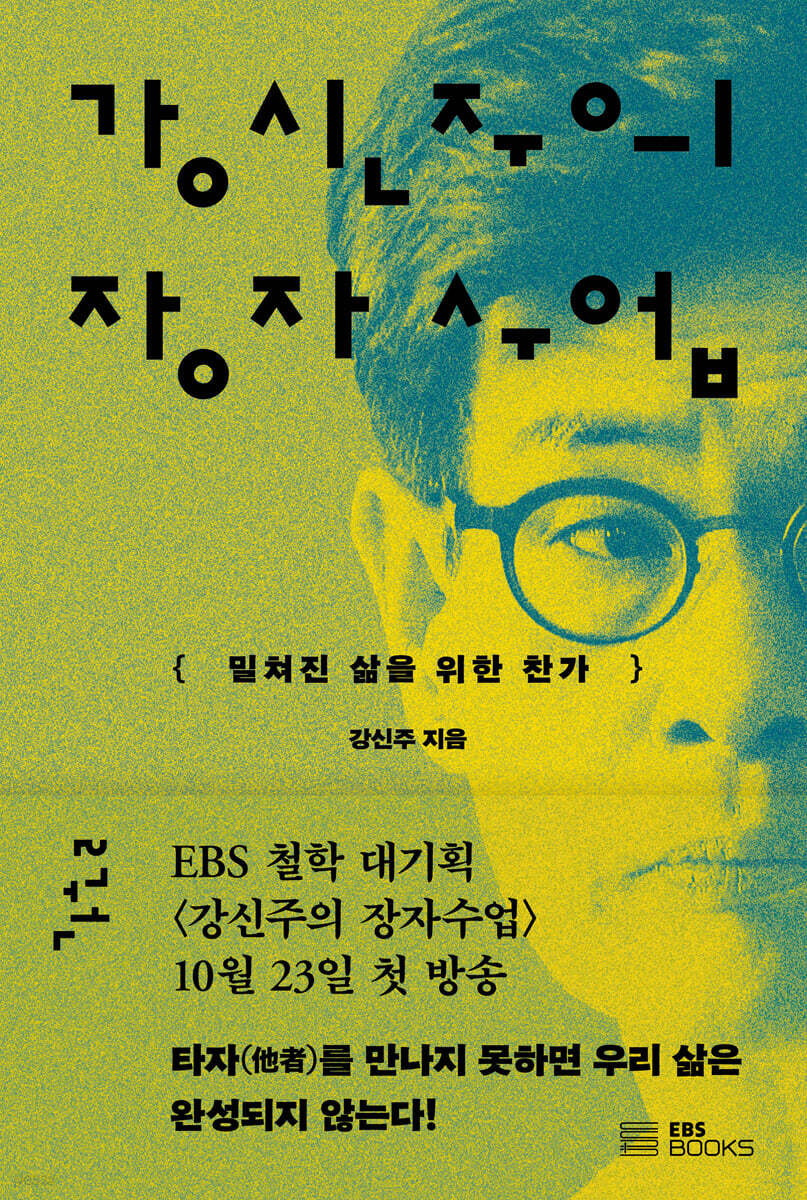
Kang Shin-ju's Lesson 2
 |
Description
Book Introduction
Simultaneous publication and broadcast of EBS's philosophy project "Kang Shin-ju's Jangja Lessons" The last book by Kang Shin-ju, the most beloved philosopher of our time The most powerful interpretation of Zhuangzi in 2,500 years “When you have a serious question about life, meet Zhuangzi!” In an age of overuse and competition, the 2,500-year-old teachings of Zhuangzi are offered to a Korean society weary of competition. Philosopher Kang Shin-ju received his doctorate in 『Zhuangzi』 in his youth, and after contemplating Zhuangzi's thoughts for over 20 years, he published several books on Zhuangzi. The reason he once again chose 『Zhuangzi』 as a philosophical book that is absolutely necessary for our times is because 『Zhuangzi』 is the most powerful text that can help all of us living in an age of excess use regain positivity and self-esteem in life. Philosopher Kang Shin-ju defines Zhuangzi from three main perspectives. Zhuangzi is the 'philosopher of uselessness'. 2,500 years ago, China's Warring States Period (403 BC - 221 BC) was a time when everyone proved their usefulness and existence under the slogan of enriching the country and strengthening the military. In an era when the logic of talent was prevalent, Zhuangzi was the only one to advocate the 'philosophy of uselessness'. Zhuangzi is a ‘philosopher of others.’ Zhuangzi was the first in the East to discover the 'other' and to ponder the relationship with the other. Finally, Jangja is a 'contextualist'. We were wary of ‘allism’ and ‘absolutism’ and realized that the world is not one but is made up of diverse and complex contexts. 『Kang Shin-ju's Jangja Lessons』 (2 volumes) focuses on these three perspectives and travels across the 2,500-year Warring States period and 21st-century Korean society, awakening us to the seriousness of how a world obsessed with cost-effectiveness and utility is eating away at us. Furthermore, based on the core philosophy of Zhuangzi, it strongly pumps and pulses the power to regain our self-esteem and sovereignty over our lives. This book will be published and broadcast simultaneously with the EBS broadcast program “Kang Shin-ju’s Jangja Class” (scheduled to air on October 23, 2023). This is the first major EBS philosophy project in 10 years, following “Lao-tzu and the 21st Century” (1999, Kim Yong-ok) and “Modern Philosopher, Lao-tzu” (2013, Choi Jin-seok). |
- You can preview some of the book's contents.
Preview
index
[Volume 2]
Blow out the third lamp
25 Ehi pasiko! No, just pasiko! - A Story of Wisdom
26 A Nightmare That's Hard to Wake Up From - Yeohee's Story
27 The Day Zhang Zhu Was Reborn as Zhang Zi - The Story of Zhao Ling
28 From a World of Vanity to a Community of Joy - The Story of the Piglet
29 The Epic of Life and Death - The Story of the Sea
30 The Health of Oblivion - The Story of Airborne
31 Roads and Horses, Their Possibilities and Limitations - Road Stories
32 Beside the Wheel - The Story of Tangrang
33 Things You Can't See Without Comparison - Wish Story
34 Why the Great Bong Flies to the Southern Sea - The Story of Mr. Sinam
35 Salto Mortale! - The Wings Story
36 Dialectics of Two Legs - The Tale of the Laggard Sheep
Part 4: Where the Wind Blows
37 Looking at the Road from the Threshold - The Story of Dochu
In Search of the 38th Arrow - A Bug's Tale
39 Death, Dismantling That Obsessive Idea - The Story of Meng Sunzhai
40 The Moment Art is Barely Born - Jae-kyung's Story
41. Against the Temptation of the Fence! - The Pheasant Story
42 A Sad World and the Solitude of Zhuangzi - A Story of Three People
43 The Heart of a Warrior Who Protects Freedom - The Fox's Story
44 The Secret Duality of a Loving Heart - The Monkey Story
45 The Irresistible Charm of a Free Man - The Story of Ae-tae-ta
46 Where Two Worlds Meet - Swimming Stories
47 The Great Death with a Narrow Coffin - A Story of the End
48 Who Will Wake the Dream of the Elder? - The Butterfly Dream Story
Epilogue_ For the freedom and strength to leave
Blow out the third lamp
25 Ehi pasiko! No, just pasiko! - A Story of Wisdom
26 A Nightmare That's Hard to Wake Up From - Yeohee's Story
27 The Day Zhang Zhu Was Reborn as Zhang Zi - The Story of Zhao Ling
28 From a World of Vanity to a Community of Joy - The Story of the Piglet
29 The Epic of Life and Death - The Story of the Sea
30 The Health of Oblivion - The Story of Airborne
31 Roads and Horses, Their Possibilities and Limitations - Road Stories
32 Beside the Wheel - The Story of Tangrang
33 Things You Can't See Without Comparison - Wish Story
34 Why the Great Bong Flies to the Southern Sea - The Story of Mr. Sinam
35 Salto Mortale! - The Wings Story
36 Dialectics of Two Legs - The Tale of the Laggard Sheep
Part 4: Where the Wind Blows
37 Looking at the Road from the Threshold - The Story of Dochu
In Search of the 38th Arrow - A Bug's Tale
39 Death, Dismantling That Obsessive Idea - The Story of Meng Sunzhai
40 The Moment Art is Barely Born - Jae-kyung's Story
41. Against the Temptation of the Fence! - The Pheasant Story
42 A Sad World and the Solitude of Zhuangzi - A Story of Three People
43 The Heart of a Warrior Who Protects Freedom - The Fox's Story
44 The Secret Duality of a Loving Heart - The Monkey Story
45 The Irresistible Charm of a Free Man - The Story of Ae-tae-ta
46 Where Two Worlds Meet - Swimming Stories
47 The Great Death with a Narrow Coffin - A Story of the End
48 Who Will Wake the Dream of the Elder? - The Butterfly Dream Story
Epilogue_ For the freedom and strength to leave
Detailed image
.jpg)
Into the book
Could the thoughts I harbor about myself, others, objects, events, relationships, and society be my own dreams? Zhuangzi's dream motif prompts this kind of reflection.
However, we should not think that Zhangzi is simply advocating solipsism.
Because Zhuangzi talks about awakening, that is, awakening.
The reason why Zhang Zi reflects and doubts whether this is a dream is to wake up from the dream.
Methodological solipsism! This is the core of the dream motif for Zhuangzi.
--- p.28, from "A Nightmare That's Really Hard to Wake Up From - Yeohee's Story"
It is important to note that an oppressive society steeped in superficiality and vanity relies on the sense of sight.
(…) If there is a small clue to escaping from an oppressive society, it lies in overcoming the logic of vanity, and we must dismantle the monopoly of vision.
It is enough to remember that the seer controls the seen, and that one can only possess what one sees.
--- p.59, from “From a World of Vanity to a Community of Joy - The Story of the Piglet”
To Zhuangzi, concepts such as ‘emptiness’, ‘mourning’, or ‘forgetting’ are very important.
All three concepts target the mind.
It's a story about emptying your mind, losing your mind, and forgetting your mind.
(…) If someone doesn’t understand the sincerity of the eldest son, he will at best speak with a serious expression.
“Try sitting cross-legged near a waterfall or at the edge of a cliff.
“Once you have completed your practice and have emptied your mind, you will be able to understand the mind of a Taoist.” This is nonsense that is completely worthless and shows that you do not know what you are talking about.
--- p.87~88, from “The Health of Oblivion - The Story of Airborne Forces”
The way of the house mouse, or the Tao, is born when it is tamed by humans without being detected by humans.
It is safe to say that house mice are born when rats become accustomed to human dwellings.
But a house mouse must never forget for a moment that he is a mouse.
The point is that they should not be so completely domesticated that they cannot survive without human homes.
As human surveillance increases or the presence of hazards such as rat poison or traps increases throughout the home, rats are forced to leave and settle elsewhere.
--- p.105, from “Roads and Horses, Their Possibilities and Limitations - Stories of Roads”
Graham distinguishes between the concepts of wish (爲是) and insi (因是).
Here, '위(爲)' is a verb meaning 'to regard, consider, or think of as ~', and '인(因)' is also a verb meaning 'to follow ~'.
And 'shi' (是) is a noun meaning 'this', and in the case of the two concepts, it is used as the object of 'above' and 'in' respectively.
So, 'wishi' means 'I think this is it', and 'insi' means 'I follow this'.
(…) In ‘wish’ which means ‘I think this is it’, ‘this’ is ‘this’ that is compared to something else.
On the other hand, in the word 'insi' which means 'according to this', the 'this' is 'this' that has no object of comparison.
--- p.135~139, from “Things You Can See Without Comparison - Wish Stories”
Salto Mortale! It means a leap of life and death.
(…) If there are footprints that reach the edge of the cliff, but no footprints that return from the edge, we know that someone has fallen into the abyss or flown over the abyss.
Then you guess.
Someone said they took a life-threatening leap, someone said they stepped off the edge of the cliff they were standing on in fear.
--- p.167, from "Saltp Mortale! - The Story of Wings"
When the door closes, the inside and outside appear distinct.
But when the door opens, the distinction between inside and outside dissolves.
(…) The path to understanding others opens from the inside out.
The opposite situation is also possible.
Since the door is made, it is quite possible to bring the outside batter in.
It is a path of hospitality where the outside opens inward.
However, we should not focus solely on understanding or welcoming others, that is, opening doors.
Perhaps it is equally important to decisively cut off from others who seek to destroy me, that is, to close the door.
--- p.201~202, from “Looking at the Road from the Threshold - The Story of Dochu”
This is how the sad vanity of the ruling class is born.
It is sad because, unlike the ostentatious vanity of those who want to show off that they are part of the ruling class, it is the vanity of the ruled class who want to be chosen by the ruling class.
The twisted jealousy of the ruling classes towards each other aggravates this sadness.
Although I express my regret for my neighbors' failures and misfortunes, I feel a strange sense of joy and relief inside.
On the contrary, I congratulate my neighbors on their success and good fortune, but behind it all, I feel depressed and inferior.
Because we feel like all of our neighbors are potential competitors.
--- p.207, from "In Search of the Tenth Arrow - The Story of a Bug"
The intensity with which we experience death is quite different in these two cases: when a stranger's daughter dies and when our own beloved daughter dies.
(…) In your daughter’s empty room, in the living room, at the kitchen table, in the bathroom, in the shoes your daughter used to wear, in the clothes your daughter used to wear, in the teddy bear your daughter used to play with, and even in your spouse, you will be gripped by the experience of “your daughter is not here,” a black hole-like sense of absence.
(…) This is the death of the second person.
Here, the second person goes beyond the grammatical meaning of referring to the person I call 'you' or 'your', that is, someone in front of me.
Because it is the second person in the humanistic sense.
The person I love, the person who brings me joy, and the person whose absence brings me sadness is in the second person.
On the other hand, the daughter of a stranger is third person to me.
--- p.219, from “Deconstructing the Persistent Idea of Death - The Story of Mengsonjae”
Fox! By its very existence, it stands outside the patriarchal order of heaven, composed of the heavenly, the great, and the small, justified by heaven.
A woman who lives a dignified life, independent of the world! (…) From the fox, the "woman who walks alone," we must recall the dignity of a warrior on horseback.
Foxes are different from women in traditional patriarchal societies who cannot escape the oppressive society and endure all kinds of stress.
(…) It is clear that she is greater than most men struggling in an oppressive society.
--- p.284~285, from “The Heart of a Warrior Who Protects Freedom - The Fox Story”
An empty mind is not a dead mind or a mind that has fallen into silence.
Because it is an incredibly sensitive mind, a dynamic mind, a tireless mind that makes new suggestions until the other person says “yes.”
(…) In this way, the monkey story is freed from the curse of the four-character idiom, “Josammosa.”
I am neither a cunning swindler nor a businessman who uses his eloquence to take advantage of others.
Because he was a lover and a communicator who knew that love and communication is doing to others what they think is right, not what you think is right.
--- p.304~305, from “The Secret Duality of a Loving Heart - The Monkey Story”
But a dream without a partner is just a daydream.
(…) I am both scared and excited about who and what face will wake me up.
Anyway, I won't live my life following the advice of Zhuangzi, saying I'm a philosopher, a teacher, a man, an author, a lecturer, or a middle-aged person.
Because only those whose identity is unclear are granted the freedom to become anything and the power to communicate with others.
I think it's time to completely wake up from the dream of becoming a long-time leader.
However, we should not think that Zhangzi is simply advocating solipsism.
Because Zhuangzi talks about awakening, that is, awakening.
The reason why Zhang Zi reflects and doubts whether this is a dream is to wake up from the dream.
Methodological solipsism! This is the core of the dream motif for Zhuangzi.
--- p.28, from "A Nightmare That's Really Hard to Wake Up From - Yeohee's Story"
It is important to note that an oppressive society steeped in superficiality and vanity relies on the sense of sight.
(…) If there is a small clue to escaping from an oppressive society, it lies in overcoming the logic of vanity, and we must dismantle the monopoly of vision.
It is enough to remember that the seer controls the seen, and that one can only possess what one sees.
--- p.59, from “From a World of Vanity to a Community of Joy - The Story of the Piglet”
To Zhuangzi, concepts such as ‘emptiness’, ‘mourning’, or ‘forgetting’ are very important.
All three concepts target the mind.
It's a story about emptying your mind, losing your mind, and forgetting your mind.
(…) If someone doesn’t understand the sincerity of the eldest son, he will at best speak with a serious expression.
“Try sitting cross-legged near a waterfall or at the edge of a cliff.
“Once you have completed your practice and have emptied your mind, you will be able to understand the mind of a Taoist.” This is nonsense that is completely worthless and shows that you do not know what you are talking about.
--- p.87~88, from “The Health of Oblivion - The Story of Airborne Forces”
The way of the house mouse, or the Tao, is born when it is tamed by humans without being detected by humans.
It is safe to say that house mice are born when rats become accustomed to human dwellings.
But a house mouse must never forget for a moment that he is a mouse.
The point is that they should not be so completely domesticated that they cannot survive without human homes.
As human surveillance increases or the presence of hazards such as rat poison or traps increases throughout the home, rats are forced to leave and settle elsewhere.
--- p.105, from “Roads and Horses, Their Possibilities and Limitations - Stories of Roads”
Graham distinguishes between the concepts of wish (爲是) and insi (因是).
Here, '위(爲)' is a verb meaning 'to regard, consider, or think of as ~', and '인(因)' is also a verb meaning 'to follow ~'.
And 'shi' (是) is a noun meaning 'this', and in the case of the two concepts, it is used as the object of 'above' and 'in' respectively.
So, 'wishi' means 'I think this is it', and 'insi' means 'I follow this'.
(…) In ‘wish’ which means ‘I think this is it’, ‘this’ is ‘this’ that is compared to something else.
On the other hand, in the word 'insi' which means 'according to this', the 'this' is 'this' that has no object of comparison.
--- p.135~139, from “Things You Can See Without Comparison - Wish Stories”
Salto Mortale! It means a leap of life and death.
(…) If there are footprints that reach the edge of the cliff, but no footprints that return from the edge, we know that someone has fallen into the abyss or flown over the abyss.
Then you guess.
Someone said they took a life-threatening leap, someone said they stepped off the edge of the cliff they were standing on in fear.
--- p.167, from "Saltp Mortale! - The Story of Wings"
When the door closes, the inside and outside appear distinct.
But when the door opens, the distinction between inside and outside dissolves.
(…) The path to understanding others opens from the inside out.
The opposite situation is also possible.
Since the door is made, it is quite possible to bring the outside batter in.
It is a path of hospitality where the outside opens inward.
However, we should not focus solely on understanding or welcoming others, that is, opening doors.
Perhaps it is equally important to decisively cut off from others who seek to destroy me, that is, to close the door.
--- p.201~202, from “Looking at the Road from the Threshold - The Story of Dochu”
This is how the sad vanity of the ruling class is born.
It is sad because, unlike the ostentatious vanity of those who want to show off that they are part of the ruling class, it is the vanity of the ruled class who want to be chosen by the ruling class.
The twisted jealousy of the ruling classes towards each other aggravates this sadness.
Although I express my regret for my neighbors' failures and misfortunes, I feel a strange sense of joy and relief inside.
On the contrary, I congratulate my neighbors on their success and good fortune, but behind it all, I feel depressed and inferior.
Because we feel like all of our neighbors are potential competitors.
--- p.207, from "In Search of the Tenth Arrow - The Story of a Bug"
The intensity with which we experience death is quite different in these two cases: when a stranger's daughter dies and when our own beloved daughter dies.
(…) In your daughter’s empty room, in the living room, at the kitchen table, in the bathroom, in the shoes your daughter used to wear, in the clothes your daughter used to wear, in the teddy bear your daughter used to play with, and even in your spouse, you will be gripped by the experience of “your daughter is not here,” a black hole-like sense of absence.
(…) This is the death of the second person.
Here, the second person goes beyond the grammatical meaning of referring to the person I call 'you' or 'your', that is, someone in front of me.
Because it is the second person in the humanistic sense.
The person I love, the person who brings me joy, and the person whose absence brings me sadness is in the second person.
On the other hand, the daughter of a stranger is third person to me.
--- p.219, from “Deconstructing the Persistent Idea of Death - The Story of Mengsonjae”
Fox! By its very existence, it stands outside the patriarchal order of heaven, composed of the heavenly, the great, and the small, justified by heaven.
A woman who lives a dignified life, independent of the world! (…) From the fox, the "woman who walks alone," we must recall the dignity of a warrior on horseback.
Foxes are different from women in traditional patriarchal societies who cannot escape the oppressive society and endure all kinds of stress.
(…) It is clear that she is greater than most men struggling in an oppressive society.
--- p.284~285, from “The Heart of a Warrior Who Protects Freedom - The Fox Story”
An empty mind is not a dead mind or a mind that has fallen into silence.
Because it is an incredibly sensitive mind, a dynamic mind, a tireless mind that makes new suggestions until the other person says “yes.”
(…) In this way, the monkey story is freed from the curse of the four-character idiom, “Josammosa.”
I am neither a cunning swindler nor a businessman who uses his eloquence to take advantage of others.
Because he was a lover and a communicator who knew that love and communication is doing to others what they think is right, not what you think is right.
--- p.304~305, from “The Secret Duality of a Loving Heart - The Monkey Story”
But a dream without a partner is just a daydream.
(…) I am both scared and excited about who and what face will wake me up.
Anyway, I won't live my life following the advice of Zhuangzi, saying I'm a philosopher, a teacher, a man, an author, a lecturer, or a middle-aged person.
Because only those whose identity is unclear are granted the freedom to become anything and the power to communicate with others.
I think it's time to completely wake up from the dream of becoming a long-time leader.
--- p.360~362, from “Who Will Wake the Dream of the Elder? - The Butterfly Dream Story”
Publisher's Review
Will I take the path that is useful to others, or will I take the path that is useful to myself?
The Warring States Period, in which Zhang Zi lived, was a time of fierce competition.
To win the competition, monarchs were obsessed with recruiting talented people, promising honor, power, and wealth to those who would become their talents.
In such a situation, the disciples of the Hundred Schools of Thought argued that if one followed their own teachings, one could survive the fierce competition for survival.
This book says that the word 'road' or 'Tao' appeared right here.
If we look at the logic of talent from 2,500 years ago, it is similar to our lives as we enter the competitive logic of the 21st century.
The author says that the 'logic of competition and talent' is a powerful ideology that is still valid in both the era of Zhangzi and the present.
No, the author points out that during the Warring States period, the logic was limited to the ruling class, but today it has expanded to apply to everyone.
Zhuangzi was a philosopher who questioned the logic of usefulness and talent in the Warring States period and tried to overcome it.
He argued that usefulness can actually destroy our lives, while uselessness can enrich our lives.
Above all, the author says that useful reason is nothing more than reason demanded by the state or capital.
The reason why we can earn more money and rise to a higher position is because it is for the country and capital, and it cannot be truly for me or for humanity.
The author poses the question to us through the thoughts of Zhuangzi from 2,500 years ago: "Should I take the path that is useful to others?" or "Should I take the path that is useful to myself?"
This book selects 48 stories from the original text of Zhuangzi that are essential for our times and, through powerful interpretations, brings Zhuangzi face-to-face with our lives in the 21st century.
This book helps those who go out every day to prove their worth, driven by the compulsion that they will lose their value if they cannot prove their worth to the company, the country, capital, and even their family, regain their positivity and self-esteem.
Our lives are incomplete without meeting others.
Zhuangzi was a philosopher who pondered over others and relationships with others.
The author defines such a person in one word as a ‘philosopher of others.’
Through the concept of 'others', Zhuangzi also directly criticizes Confucius, the idol of the time.
Regarding Confucius' famous saying, "Do not do to others what you do not want done to yourself (己所不欲 勿施於人)", Zhuangzi asks, "But can what I want be the same as what others want?"
We know very well that there are very few relationships in which the other person wants what we want and the other person does not want what we do not want.
Rather, there are countless cases where the other person does not want what I want, and I do not want what the other person wants.
So, Zhuangzi says that if you love someone, true love is giving them what they want.
And the author says that if we take Zhuangzi's advice, our lives can be completely changed.
All the relationships surrounding me, such as mother, father, husband, wife, daughter, son, senior, junior, etc., can move toward love rather than destruction.
What does it mean to encounter another? Does it mean we meet physically? This book borrows from Spinoza's Ethics to explain that encountering another evokes two emotions: joy and sorrow.
If you don't feel joy or sorrow when you meet someone, then you can't really say that you've 'met' them.
We meet countless people on the subway, at work, and in restaurants, but we don't meet them.
But what if, when we return home and see our husbands, wives, and children, we feel no emotion? Then perhaps we're not truly connecting.
When I empty myself, I can encounter others.
So how can we encounter others? The author uses Zhuangzi's famous line, "I have lost myself," to discuss the possibility of encountering others.
To empty oneself, to lose oneself, means to eliminate the possessiveness and self-consciousness within oneself.
For example, when the thoughts and self-consciousness that fill my mind, such as 'I am smart', 'I am a man (woman)', 'I have a lot of money', 'I am sexy', etc. disappear, the possibility arises that others can take their place.
The author explains the vague concept of Osang-ah using the metaphor of the sound of the wind.
The sounds we hear, such as ‘the sound of the wind,’ ‘the sound of flowing water,’ and ‘the sound of breathing,’ arise from the encounter with something.
A sound is made when a ‘certain hole’ and a ‘certain wind’ meet.
So, who came from this sound of encounter? Was it the wind? Or the hole? The answer is both.
If the hole is blocked, the wind cannot blow and if the hole is empty, the wind cannot blow and the sound cannot be heard.
It is only when these two meet that a sound is made.
The author says:
All birth and change, including ours, are the result of this encounter.
But if I were like a bamboo shoot, full of possessiveness and self-consciousness, what kind of wind, what kind of other could possibly pass me by? That's why I'm Osang-ah.
Sometimes we become an empty hole, and sometimes we become the wind. We must put the other person in that hole or enter the other person's hole in order to meet and communicate.
Context is not just one
The author lists two key words for viewing the book: ‘other’ and ‘context.’
The world that Jang-ja sees is not singular but plural, and rather than an all-ism that says, "This is the only principle," he thinks, "The world is full of diverse and complex contexts."
On the contrary, all attention was paid to the day.
Because all attention only destroys our singularity and closes the hole of the other that was opened to us.
In the book, the author describes the unification of context as 'context singularism' and the diversity of context as 'context pluralism'.
Just as the Warring States period 2,500 years ago, when wealth, military power, and personal success were absolute principles, and personal achievement and personal fame have become absolute beliefs in the 21st century capitalist era, our lives are also far from the contextual pluralism that Zhuangzi spoke of.
The author has felt the seriousness of this issue vividly while living as a philosopher.
If we believe that the world where the logic of usefulness prevails is the only world, then the moment we consider ourselves useless in that world, we cannot help but despair.
Therefore, the contextual pluralism of Jangja can give us hope.
If you feel useless in your current context, it is wise to tell yourself to create another context in which you can be useful.
The author says:
It's not that usefulness is important, nor is it that dance is important.
It is more important to affirm our lives and find a context for a better direction.
The Warring States Period, in which Zhang Zi lived, was a time of fierce competition.
To win the competition, monarchs were obsessed with recruiting talented people, promising honor, power, and wealth to those who would become their talents.
In such a situation, the disciples of the Hundred Schools of Thought argued that if one followed their own teachings, one could survive the fierce competition for survival.
This book says that the word 'road' or 'Tao' appeared right here.
If we look at the logic of talent from 2,500 years ago, it is similar to our lives as we enter the competitive logic of the 21st century.
The author says that the 'logic of competition and talent' is a powerful ideology that is still valid in both the era of Zhangzi and the present.
No, the author points out that during the Warring States period, the logic was limited to the ruling class, but today it has expanded to apply to everyone.
Zhuangzi was a philosopher who questioned the logic of usefulness and talent in the Warring States period and tried to overcome it.
He argued that usefulness can actually destroy our lives, while uselessness can enrich our lives.
Above all, the author says that useful reason is nothing more than reason demanded by the state or capital.
The reason why we can earn more money and rise to a higher position is because it is for the country and capital, and it cannot be truly for me or for humanity.
The author poses the question to us through the thoughts of Zhuangzi from 2,500 years ago: "Should I take the path that is useful to others?" or "Should I take the path that is useful to myself?"
This book selects 48 stories from the original text of Zhuangzi that are essential for our times and, through powerful interpretations, brings Zhuangzi face-to-face with our lives in the 21st century.
This book helps those who go out every day to prove their worth, driven by the compulsion that they will lose their value if they cannot prove their worth to the company, the country, capital, and even their family, regain their positivity and self-esteem.
Our lives are incomplete without meeting others.
Zhuangzi was a philosopher who pondered over others and relationships with others.
The author defines such a person in one word as a ‘philosopher of others.’
Through the concept of 'others', Zhuangzi also directly criticizes Confucius, the idol of the time.
Regarding Confucius' famous saying, "Do not do to others what you do not want done to yourself (己所不欲 勿施於人)", Zhuangzi asks, "But can what I want be the same as what others want?"
We know very well that there are very few relationships in which the other person wants what we want and the other person does not want what we do not want.
Rather, there are countless cases where the other person does not want what I want, and I do not want what the other person wants.
So, Zhuangzi says that if you love someone, true love is giving them what they want.
And the author says that if we take Zhuangzi's advice, our lives can be completely changed.
All the relationships surrounding me, such as mother, father, husband, wife, daughter, son, senior, junior, etc., can move toward love rather than destruction.
What does it mean to encounter another? Does it mean we meet physically? This book borrows from Spinoza's Ethics to explain that encountering another evokes two emotions: joy and sorrow.
If you don't feel joy or sorrow when you meet someone, then you can't really say that you've 'met' them.
We meet countless people on the subway, at work, and in restaurants, but we don't meet them.
But what if, when we return home and see our husbands, wives, and children, we feel no emotion? Then perhaps we're not truly connecting.
When I empty myself, I can encounter others.
So how can we encounter others? The author uses Zhuangzi's famous line, "I have lost myself," to discuss the possibility of encountering others.
To empty oneself, to lose oneself, means to eliminate the possessiveness and self-consciousness within oneself.
For example, when the thoughts and self-consciousness that fill my mind, such as 'I am smart', 'I am a man (woman)', 'I have a lot of money', 'I am sexy', etc. disappear, the possibility arises that others can take their place.
The author explains the vague concept of Osang-ah using the metaphor of the sound of the wind.
The sounds we hear, such as ‘the sound of the wind,’ ‘the sound of flowing water,’ and ‘the sound of breathing,’ arise from the encounter with something.
A sound is made when a ‘certain hole’ and a ‘certain wind’ meet.
So, who came from this sound of encounter? Was it the wind? Or the hole? The answer is both.
If the hole is blocked, the wind cannot blow and if the hole is empty, the wind cannot blow and the sound cannot be heard.
It is only when these two meet that a sound is made.
The author says:
All birth and change, including ours, are the result of this encounter.
But if I were like a bamboo shoot, full of possessiveness and self-consciousness, what kind of wind, what kind of other could possibly pass me by? That's why I'm Osang-ah.
Sometimes we become an empty hole, and sometimes we become the wind. We must put the other person in that hole or enter the other person's hole in order to meet and communicate.
Context is not just one
The author lists two key words for viewing the book: ‘other’ and ‘context.’
The world that Jang-ja sees is not singular but plural, and rather than an all-ism that says, "This is the only principle," he thinks, "The world is full of diverse and complex contexts."
On the contrary, all attention was paid to the day.
Because all attention only destroys our singularity and closes the hole of the other that was opened to us.
In the book, the author describes the unification of context as 'context singularism' and the diversity of context as 'context pluralism'.
Just as the Warring States period 2,500 years ago, when wealth, military power, and personal success were absolute principles, and personal achievement and personal fame have become absolute beliefs in the 21st century capitalist era, our lives are also far from the contextual pluralism that Zhuangzi spoke of.
The author has felt the seriousness of this issue vividly while living as a philosopher.
If we believe that the world where the logic of usefulness prevails is the only world, then the moment we consider ourselves useless in that world, we cannot help but despair.
Therefore, the contextual pluralism of Jangja can give us hope.
If you feel useless in your current context, it is wise to tell yourself to create another context in which you can be useful.
The author says:
It's not that usefulness is important, nor is it that dance is important.
It is more important to affirm our lives and find a context for a better direction.
GOODS SPECIFICS
- Date of issue: October 20, 2023
- Page count, weight, size: 376 pages | 608g | 146*217*22mm
- ISBN13: 9788954799461
- ISBN10: 8954799469
You may also like
카테고리
korean


korean

![GQ KOREA Mark (Monthly): December [2025]](http://librairie.coreenne.fr/cdn/shop/files/8ef265dbbfbf186523ed75ba7319009d.jpg?v=1765340328&width=3840)


