

Gift theory
 |
Description
Book Introduction
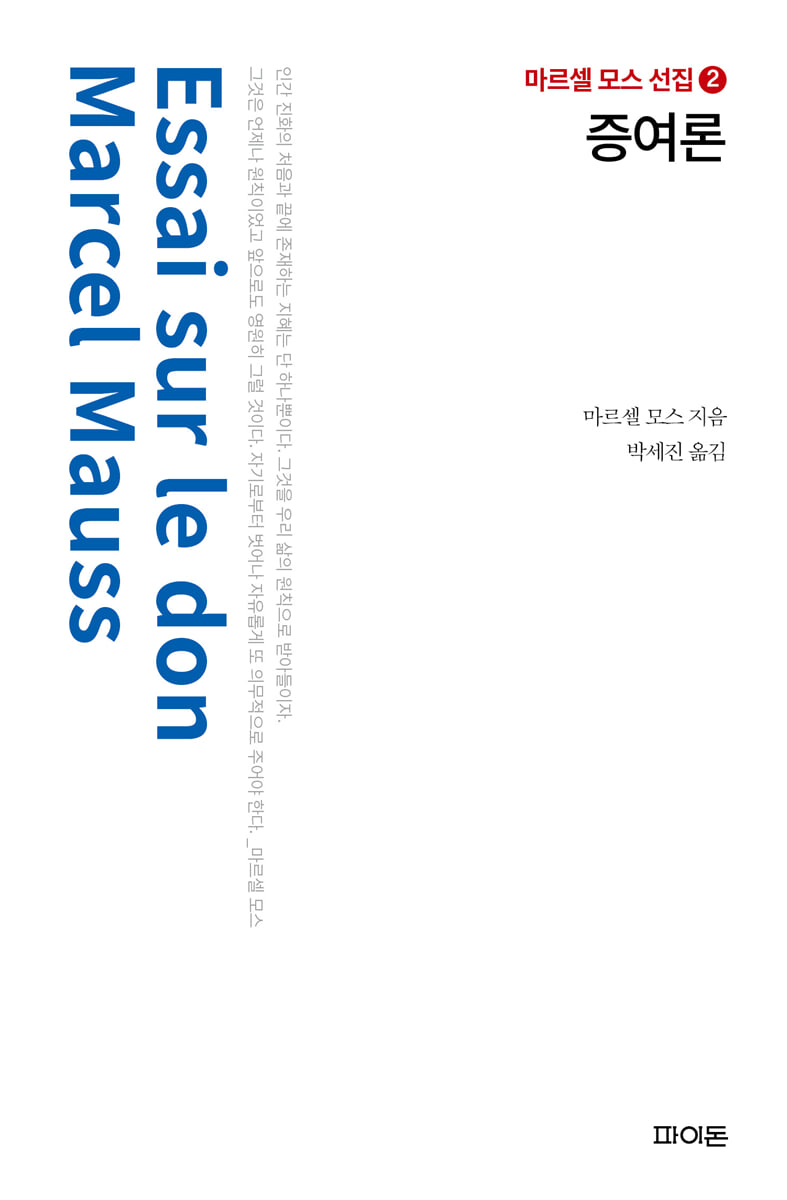
Marcel Mauss's "On the Gift" celebrates its centennial with a new translation.
This is a new translation published on the 100th anniversary of the publication of French sociologist and anthropologist Marcel Mauss's masterpiece, The Gift.
The influence of 『The Gift』, which is considered one of the classics of anthropology, including Bataille, Levi-Strauss, Bourdieu, Derrida, and Foucault, is still inexhaustible, and it opens up new possibilities for exploration.
The Gift, which is considered the most famous but also the most difficult of all social anthropological texts, became widely known in academic circles in 1950 when it was republished with a 'Preface' written by Levi-Strauss on Mauss's entire work.
In his Preface, Levi-Strauss commented, “Where does the power of surprise in The Gift come from? It is a truly exquisite juxtaposition of descriptions based on sensory impressions and the erudition compressed into the footnotes that weigh down the text.” He added that he could not help but feel “a feeling seized by the incomprehensible yet absolute certainty that the mind is witnessing a decisive moment in the progress of science.”
This is a new translation published on the 100th anniversary of the publication of French sociologist and anthropologist Marcel Mauss's masterpiece, The Gift.
The influence of 『The Gift』, which is considered one of the classics of anthropology, including Bataille, Levi-Strauss, Bourdieu, Derrida, and Foucault, is still inexhaustible, and it opens up new possibilities for exploration.
The Gift, which is considered the most famous but also the most difficult of all social anthropological texts, became widely known in academic circles in 1950 when it was republished with a 'Preface' written by Levi-Strauss on Mauss's entire work.
In his Preface, Levi-Strauss commented, “Where does the power of surprise in The Gift come from? It is a truly exquisite juxtaposition of descriptions based on sensory impressions and the erudition compressed into the footnotes that weigh down the text.” He added that he could not help but feel “a feeling seized by the incomprehensible yet absolute certainty that the mind is witnessing a decisive moment in the progress of science.”
- You can preview some of the book's contents.
Preview
index
Introduction: On gifts, especially the obligation to reciprocate gifts.
eulogy
Research plan
Applied method
Benefits: Gifts and Potlatches
Chapter 1: Gifts Exchanged and Obligations to Repay (Polynesia)
1.
Total benefits: matrilineal and masculine goods (Samoan Islands)
2.
The spirit of a given thing (Maori)
3.
Other topics: Obligations to give and obligations to receive
4.
Note: Gifts to humans and gifts to gods
Chapter 2: The Spread of the System: Generosity, Honor, and Currency
1.
The Rule of Generosity (Andaman Islands)
2.
The principles, reasons, and intensity of gift exchange (Melanesia)
Other Melanesian societies
3.
Northwest America
Honor and Credit
The Three Obligations: Give, Receive, and Repay
The power of things
“Prestige Currency”
First conclusion
Chapter 3: The Principle of Exchange and Gift in Ancient Law and Economy
1.
Laws concerning persons and laws concerning things (a very old Roman law)
exegesis
Other Indo-European laws
2.
Classical Hindu Law: Theory of Gift
3.
Germanic law (collateral and donation)
Celtic law
Chinese law
Chapter 4 Conclusion
1.
moral conclusion
2.
Economic sociological and political economic conclusions
3.
General sociological and moral conclusions
supplement
1.
The ancient form of contract among the Thracians
2.
Gift, poison
annotation
A talk commemorating the publication of "The Gift"
Translator's Note
Marcel Mauss Chronology
Search
eulogy
Research plan
Applied method
Benefits: Gifts and Potlatches
Chapter 1: Gifts Exchanged and Obligations to Repay (Polynesia)
1.
Total benefits: matrilineal and masculine goods (Samoan Islands)
2.
The spirit of a given thing (Maori)
3.
Other topics: Obligations to give and obligations to receive
4.
Note: Gifts to humans and gifts to gods
Chapter 2: The Spread of the System: Generosity, Honor, and Currency
1.
The Rule of Generosity (Andaman Islands)
2.
The principles, reasons, and intensity of gift exchange (Melanesia)
Other Melanesian societies
3.
Northwest America
Honor and Credit
The Three Obligations: Give, Receive, and Repay
The power of things
“Prestige Currency”
First conclusion
Chapter 3: The Principle of Exchange and Gift in Ancient Law and Economy
1.
Laws concerning persons and laws concerning things (a very old Roman law)
exegesis
Other Indo-European laws
2.
Classical Hindu Law: Theory of Gift
3.
Germanic law (collateral and donation)
Celtic law
Chinese law
Chapter 4 Conclusion
1.
moral conclusion
2.
Economic sociological and political economic conclusions
3.
General sociological and moral conclusions
supplement
1.
The ancient form of contract among the Thracians
2.
Gift, poison
annotation
A talk commemorating the publication of "The Gift"
Translator's Note
Marcel Mauss Chronology
Search
Into the book
In societies that existed before our own, dating back as far as the protohistoire, all the elements that constitute true social life are interwoven.
Through this phenomenon, which we wish to call a 'total' social phenomenon, all kinds of institutions are expressed simultaneously and at once.
These include religious, legal, and moral institutions, which are also political and family institutions.
Economic institutions are also involved, which presuppose certain forms of production and consumption, or more precisely, certain forms of provision and distribution.
The aesthetic phenomena resulting from these facts and the morphological phenomena revealed by these institutions must of course be considered together.
--- p.20
What are the legal and vested interests that obligate reciprocation for gifts received in a backward or primitive society? What power does a given object possess that compels the recipient to reciprocate? This is precisely the question we will delve into, among many others.
--- p.22
The reason why a gift received or exchanged imposes an obligation is because the thing received is not inerte.
Even if the thing is given away by the donor, it still remains a part of him.
Just as the original owner influences the thief through the stolen object, the donor influences the beneficiary through the object given.
Because the taonga has vitality because of the forest, mountain, and land from which it originated.
Taonga is truly 'indigenous'.
Howe follows everyone who holds a taonga in his hand.
Howe follows not only the original recipient and sometimes a third party, but also everyone who simply receives the taonga.
Ultimately, Howe wants to return to the place of his birth, to the forest and the sanctuary of his clan, to his original owners.
--- p.39~40
Since receiving something from someone is accepting a part of their spiritual essence, their soul, it is logically self-evident in this system of ideas that what is actually given back is also a fragment of that person's nature and substance.
--- p.41
In the end, there is a mix.
People mix their souls with things, and their souls with things.
People mix various lives, and in this way, personalities and things go beyond their own realms and mix with each other.
This is contract and exchange.
--- p.56
In Melanesia and Polynesia, gifts circulate with the assurance that they will be repaid.
What guarantees this is the efficacy (vertu) of the given thing, the gift itself being a 'guarantee' of repayment.
--- p.84
Things have a special power that makes people give them away and, above all, repay them.
--- p.89
The reason people give and return things is because they give and return 'respect' to each other - we still call it 'courtesy'.
Furthermore, giving something is also giving oneself, and people give of themselves because they 'owe' themselves and their possessions to others.
--- p.101
Each person must be sensitive not only to himself but also to others and to social reality—is there a different reality when it comes to moral issues?
Each person must act with consideration for himself, his subgroup, and society as a whole.
These morals are eternal.
It exists in the most evolved societies, in the societies of the near future, and in the least developed societies imaginable.
Now we are touching the rock.
We are no longer talking simply about law, but about human beings and human groups.
Because it is they, it is society, that is, the emotions of human beings with soul, flesh, and bones, that are moving everywhere and at all times.
--- p.147
Nations, classes, families, and individuals can only become wealthy and happy when they learn to gather together, like Arthurian knights, around a common wealth.
There is no need to look far to find what is good and what is happiness.
It exists in a solid peace, in a well-coordinated rhythm of work together and work alone, in the accumulation and redistribution of wealth guided by mutual respect and generous generosity established through education.
Through this phenomenon, which we wish to call a 'total' social phenomenon, all kinds of institutions are expressed simultaneously and at once.
These include religious, legal, and moral institutions, which are also political and family institutions.
Economic institutions are also involved, which presuppose certain forms of production and consumption, or more precisely, certain forms of provision and distribution.
The aesthetic phenomena resulting from these facts and the morphological phenomena revealed by these institutions must of course be considered together.
--- p.20
What are the legal and vested interests that obligate reciprocation for gifts received in a backward or primitive society? What power does a given object possess that compels the recipient to reciprocate? This is precisely the question we will delve into, among many others.
--- p.22
The reason why a gift received or exchanged imposes an obligation is because the thing received is not inerte.
Even if the thing is given away by the donor, it still remains a part of him.
Just as the original owner influences the thief through the stolen object, the donor influences the beneficiary through the object given.
Because the taonga has vitality because of the forest, mountain, and land from which it originated.
Taonga is truly 'indigenous'.
Howe follows everyone who holds a taonga in his hand.
Howe follows not only the original recipient and sometimes a third party, but also everyone who simply receives the taonga.
Ultimately, Howe wants to return to the place of his birth, to the forest and the sanctuary of his clan, to his original owners.
--- p.39~40
Since receiving something from someone is accepting a part of their spiritual essence, their soul, it is logically self-evident in this system of ideas that what is actually given back is also a fragment of that person's nature and substance.
--- p.41
In the end, there is a mix.
People mix their souls with things, and their souls with things.
People mix various lives, and in this way, personalities and things go beyond their own realms and mix with each other.
This is contract and exchange.
--- p.56
In Melanesia and Polynesia, gifts circulate with the assurance that they will be repaid.
What guarantees this is the efficacy (vertu) of the given thing, the gift itself being a 'guarantee' of repayment.
--- p.84
Things have a special power that makes people give them away and, above all, repay them.
--- p.89
The reason people give and return things is because they give and return 'respect' to each other - we still call it 'courtesy'.
Furthermore, giving something is also giving oneself, and people give of themselves because they 'owe' themselves and their possessions to others.
--- p.101
Each person must be sensitive not only to himself but also to others and to social reality—is there a different reality when it comes to moral issues?
Each person must act with consideration for himself, his subgroup, and society as a whole.
These morals are eternal.
It exists in the most evolved societies, in the societies of the near future, and in the least developed societies imaginable.
Now we are touching the rock.
We are no longer talking simply about law, but about human beings and human groups.
Because it is they, it is society, that is, the emotions of human beings with soul, flesh, and bones, that are moving everywhere and at all times.
--- p.147
Nations, classes, families, and individuals can only become wealthy and happy when they learn to gather together, like Arthurian knights, around a common wealth.
There is no need to look far to find what is good and what is happiness.
It exists in a solid peace, in a well-coordinated rhythm of work together and work alone, in the accumulation and redistribution of wealth guided by mutual respect and generous generosity established through education.
--- p.170
Publisher's Review
Two papers on Morse's theory of gift giving and a "conversation" with researchers that will enhance understanding of the theory.
This new translation of 『The Gift』, which has been translated for the first time in over 20 years, includes two short but important essays for understanding the gift theory (「The Primordial Form of the Thracian Contract」, 「Gift, Poison」) and a 60-page 「Conversation」 with researchers to help readers understand.
Above all, the "conversation" between three researchers who have explored the topic of gifting for a long time unfolds and discusses controversial points and tasks of gifting theory, such as translations of key terms such as gift/gift, reciprocity/hosu, and holistic benefit, as well as the problem of "how," the third party, and the obligation to repay. By doing so, it allows us to gauge what perspectives and arguments this "complex yet simple" book, "The Gift," has opened up, and what comprehensive academic and practical discussions it has triggered both inside and outside of anthropology, and provides a glimpse into the horizons of related discussions that will continue in the future.
The translator, publishing a new translation after 20 years in Korea, simply stated that he “translated it with the hope that it would be a text that is not too difficult to read as it is written in Korean,” but he also put a lot of effort into translating the original text and adding meticulous and detailed translator’s notes that provide context to aid readability and understanding.
Meanwhile, Professor Park Jeong-ho, who oversaw the publication of the anthology, said in a “dialogue” that “The Theory of Gifts,” which was first translated and published in Korea in 2002, was a great blessing to our academic world.
“It seems that it is now time to look back on the trajectory of the discussion surrounding ‘The Gift’ that has continued for the past 20 years,” he said, expressing his expectation that the message of ‘The Gift’ will be amplified even more greatly along with other major works by Mauss that will be included in the ‘Anthology.’
Therefore, readers of this book, which transcends time and space from the Edda of Scandinavia and the Veda of ancient India to the Pacific coast, the 'Kula' studied by Malinowski in the Trobriand Islands of Melanesia, and the 'potlatch' of the Kwakiutl Indians of Alaska studied by Boas, and while anthropological discussions dominate the first half, it also jumps to sociological and political discussions such as welfare, solidarity, and international alliances in the second half, will be able to experience the "decisive moment" that Levi-Strauss would have felt.
What is "The Gift" about?
"The Gift" is a theoretical study of the gift system observed in what Mauss called "primitive society," and it synthesizes ethnographic research and materials from the 19th and early 20th centuries.
Mauss develops his argument primarily based on societies in or along the Pacific, such as those in Polynesia, Melanesia, and Northwest America, and among them, wealthy societies that have accumulated considerable surpluses.
Mauss calls the institutions of gift observed in these societies the 'total benefit system'.
The system is 'total' in that not only objects but also ceremonial services, military support, women, children, dances, festivals, and all sorts of things pass between groups as a whole.
Rather than placing abstract social facts at the center of sociology, it advocates the study of 'total social facts' by placing a concrete set of complex facts at the center.
By doing so, it “sets society and its institutions (potlatches, competing clans, visiting tribes, etc.) in motion” (p. 162), and “by examining the whole as a whole… it captures the fleeting moment when society, or human beings, become emotionally aware of their place in relation to themselves and to others” (p. 164).
To summarize the structure and content of the book, the comparative ethnographic discussion of the Maori how, the Trobriand Islands kula, and the Northwest American potlatch forms the core of The Gift (Introduction to Chapter 2), to which are added discussions of ancient Roman contract law, ancient Indian gift theory, and the secondary status of collateral in ancient Germanic society (Chapter 3). In the final conclusion, Mauss states, “It is possible to extend the considerations made so far and apply them to our society.
“A significant part of our morality and life still remains in an atmosphere of mixed gifts, duties, and freedoms” (p. 139), reminding us that the morality and economy of the society that preceded us are still functioning.
The gift theory that raises social security as a countermeasure for workers' donations,
Applicable to the reality of wage labor today
When reading The Gift while considering the background in which Mauss conceived and wrote it in the political environment devastated by the Bolshevik Revolution in Russia and the aftermath of World War I, the book is not merely an anthropological treatise, but also a work that breaks new ground in the context of sociology and political science.
By delving into the ethnography of gift customs, Mauss urgently sought clues to rebuild French and European society, which was in crisis both internally and externally.
For example, Mauss regards wage labor as a gift that demands compensation beyond wages, elevating it to the level of social benefits.
Rejecting the contemporary model of charity or benevolence, he proposed understanding social security as a counter-payment for workers' contributions.
“The worker sacrificed his life and labor for the community on the one hand and for his employer on the other.
While workers themselves must cooperate with the social security system, those who benefit from workers' services cannot be said to have fully repaid their debt to workers simply by paying wages.
“The state, which represents the community, also has a duty to provide workers with a certain level of living security in case of unemployment, illness, old age, and death, together with employers and based on the workers’ own contributions.” (pp. 142-143) As the boundaries of labor collapse, capitalist labor does not disappear. Rather, while in reality, it is wage labor and performing work similar to hired labor, the form of wage labor is becoming ambiguous due to de-boundaryization, and wage workers and hired workers are excluded from the rights they can exercise. This reality provides a reason to look into gift theory again.
In a 'conversation' commemorating the publication of 'The Gift Theory'
Lee Kyung-mook: I believe that donations still function as an important catalyst in small groups like subcultures, civic movements, and unions.
Of course, this is not a donation that encompasses the entire society, but I think that a special form of donation continues within a limited scope.
The claim that today's younger generation dislikes community is also important in context.
I think it's not that they truly reject communal values, but rather that they dislike the way the older generation uses the word community.
… In this respect, I believe that The Gift can still play an important role in thinking about social relations and communal values. (pp. 318-319)
Park Jeong-ho - If there is an eternal bedrock of society for Moss, it is not a give-and-take contract, but a cycle of three obligations: giving, receiving, and reciprocation.
The place where this rock is placed is not the 'market', which is considered a golden rule in economics, but the bottom of the long-deposited stratum.
The core theme of 『The Gift Theory』 is to excavate this rock archaeologically.
In that it touches the very foundation on which society is built, "The Gift" is also a book that questions the fundamental motivations of human activity.
"The Gift" decisively rejects the assumption of "homo economicus," which holds that self-interest motivates action, and instead reveals that human actions are driven by a combination of opposing motives (pp. 289-290).
Park Se-jin - Human social life, past and present, is filled with giving and receiving things in various ways.
『The Gift』 is not just a story about gifting, but a story about the ‘social life of the gifting human being.’
『The Gift』 reveals human life as a life lived through all sorts of non-human beings, and furthermore, as the persistent reference to Hana Mana shows, as being lived through the intervention of 'superhuman' beings.
The form of transferring things, including donation, is also the form of relationships between humans, non-humans, and superhumans.
To put it more grandly, it is the way in which the inhabitants of the world interact, and in the process, a particular form of the world itself is produced.
Ultimately, with "The Gift," we may already be facing the pinnacle of anthropological research on human social life. (pp. 331-332)
This new translation of 『The Gift』, which has been translated for the first time in over 20 years, includes two short but important essays for understanding the gift theory (「The Primordial Form of the Thracian Contract」, 「Gift, Poison」) and a 60-page 「Conversation」 with researchers to help readers understand.
Above all, the "conversation" between three researchers who have explored the topic of gifting for a long time unfolds and discusses controversial points and tasks of gifting theory, such as translations of key terms such as gift/gift, reciprocity/hosu, and holistic benefit, as well as the problem of "how," the third party, and the obligation to repay. By doing so, it allows us to gauge what perspectives and arguments this "complex yet simple" book, "The Gift," has opened up, and what comprehensive academic and practical discussions it has triggered both inside and outside of anthropology, and provides a glimpse into the horizons of related discussions that will continue in the future.
The translator, publishing a new translation after 20 years in Korea, simply stated that he “translated it with the hope that it would be a text that is not too difficult to read as it is written in Korean,” but he also put a lot of effort into translating the original text and adding meticulous and detailed translator’s notes that provide context to aid readability and understanding.
Meanwhile, Professor Park Jeong-ho, who oversaw the publication of the anthology, said in a “dialogue” that “The Theory of Gifts,” which was first translated and published in Korea in 2002, was a great blessing to our academic world.
“It seems that it is now time to look back on the trajectory of the discussion surrounding ‘The Gift’ that has continued for the past 20 years,” he said, expressing his expectation that the message of ‘The Gift’ will be amplified even more greatly along with other major works by Mauss that will be included in the ‘Anthology.’
Therefore, readers of this book, which transcends time and space from the Edda of Scandinavia and the Veda of ancient India to the Pacific coast, the 'Kula' studied by Malinowski in the Trobriand Islands of Melanesia, and the 'potlatch' of the Kwakiutl Indians of Alaska studied by Boas, and while anthropological discussions dominate the first half, it also jumps to sociological and political discussions such as welfare, solidarity, and international alliances in the second half, will be able to experience the "decisive moment" that Levi-Strauss would have felt.
What is "The Gift" about?
"The Gift" is a theoretical study of the gift system observed in what Mauss called "primitive society," and it synthesizes ethnographic research and materials from the 19th and early 20th centuries.
Mauss develops his argument primarily based on societies in or along the Pacific, such as those in Polynesia, Melanesia, and Northwest America, and among them, wealthy societies that have accumulated considerable surpluses.
Mauss calls the institutions of gift observed in these societies the 'total benefit system'.
The system is 'total' in that not only objects but also ceremonial services, military support, women, children, dances, festivals, and all sorts of things pass between groups as a whole.
Rather than placing abstract social facts at the center of sociology, it advocates the study of 'total social facts' by placing a concrete set of complex facts at the center.
By doing so, it “sets society and its institutions (potlatches, competing clans, visiting tribes, etc.) in motion” (p. 162), and “by examining the whole as a whole… it captures the fleeting moment when society, or human beings, become emotionally aware of their place in relation to themselves and to others” (p. 164).
To summarize the structure and content of the book, the comparative ethnographic discussion of the Maori how, the Trobriand Islands kula, and the Northwest American potlatch forms the core of The Gift (Introduction to Chapter 2), to which are added discussions of ancient Roman contract law, ancient Indian gift theory, and the secondary status of collateral in ancient Germanic society (Chapter 3). In the final conclusion, Mauss states, “It is possible to extend the considerations made so far and apply them to our society.
“A significant part of our morality and life still remains in an atmosphere of mixed gifts, duties, and freedoms” (p. 139), reminding us that the morality and economy of the society that preceded us are still functioning.
The gift theory that raises social security as a countermeasure for workers' donations,
Applicable to the reality of wage labor today
When reading The Gift while considering the background in which Mauss conceived and wrote it in the political environment devastated by the Bolshevik Revolution in Russia and the aftermath of World War I, the book is not merely an anthropological treatise, but also a work that breaks new ground in the context of sociology and political science.
By delving into the ethnography of gift customs, Mauss urgently sought clues to rebuild French and European society, which was in crisis both internally and externally.
For example, Mauss regards wage labor as a gift that demands compensation beyond wages, elevating it to the level of social benefits.
Rejecting the contemporary model of charity or benevolence, he proposed understanding social security as a counter-payment for workers' contributions.
“The worker sacrificed his life and labor for the community on the one hand and for his employer on the other.
While workers themselves must cooperate with the social security system, those who benefit from workers' services cannot be said to have fully repaid their debt to workers simply by paying wages.
“The state, which represents the community, also has a duty to provide workers with a certain level of living security in case of unemployment, illness, old age, and death, together with employers and based on the workers’ own contributions.” (pp. 142-143) As the boundaries of labor collapse, capitalist labor does not disappear. Rather, while in reality, it is wage labor and performing work similar to hired labor, the form of wage labor is becoming ambiguous due to de-boundaryization, and wage workers and hired workers are excluded from the rights they can exercise. This reality provides a reason to look into gift theory again.
In a 'conversation' commemorating the publication of 'The Gift Theory'
Lee Kyung-mook: I believe that donations still function as an important catalyst in small groups like subcultures, civic movements, and unions.
Of course, this is not a donation that encompasses the entire society, but I think that a special form of donation continues within a limited scope.
The claim that today's younger generation dislikes community is also important in context.
I think it's not that they truly reject communal values, but rather that they dislike the way the older generation uses the word community.
… In this respect, I believe that The Gift can still play an important role in thinking about social relations and communal values. (pp. 318-319)
Park Jeong-ho - If there is an eternal bedrock of society for Moss, it is not a give-and-take contract, but a cycle of three obligations: giving, receiving, and reciprocation.
The place where this rock is placed is not the 'market', which is considered a golden rule in economics, but the bottom of the long-deposited stratum.
The core theme of 『The Gift Theory』 is to excavate this rock archaeologically.
In that it touches the very foundation on which society is built, "The Gift" is also a book that questions the fundamental motivations of human activity.
"The Gift" decisively rejects the assumption of "homo economicus," which holds that self-interest motivates action, and instead reveals that human actions are driven by a combination of opposing motives (pp. 289-290).
Park Se-jin - Human social life, past and present, is filled with giving and receiving things in various ways.
『The Gift』 is not just a story about gifting, but a story about the ‘social life of the gifting human being.’
『The Gift』 reveals human life as a life lived through all sorts of non-human beings, and furthermore, as the persistent reference to Hana Mana shows, as being lived through the intervention of 'superhuman' beings.
The form of transferring things, including donation, is also the form of relationships between humans, non-humans, and superhumans.
To put it more grandly, it is the way in which the inhabitants of the world interact, and in the process, a particular form of the world itself is produced.
Ultimately, with "The Gift," we may already be facing the pinnacle of anthropological research on human social life. (pp. 331-332)
GOODS SPECIFICS
- Date of issue: March 14, 2025
- Format: Hardcover book binding method guide
- Page count, weight, size: 352 pages | 128*195*30mm
- ISBN13: 9791198561985
- ISBN10: 119856198X
You may also like
카테고리
korean


korean

![GQ KOREA Mark (Monthly): December [2025]](http://librairie.coreenne.fr/cdn/shop/files/8ef265dbbfbf186523ed75ba7319009d.jpg?v=1765340328&width=3840)


