

Modern Poetry
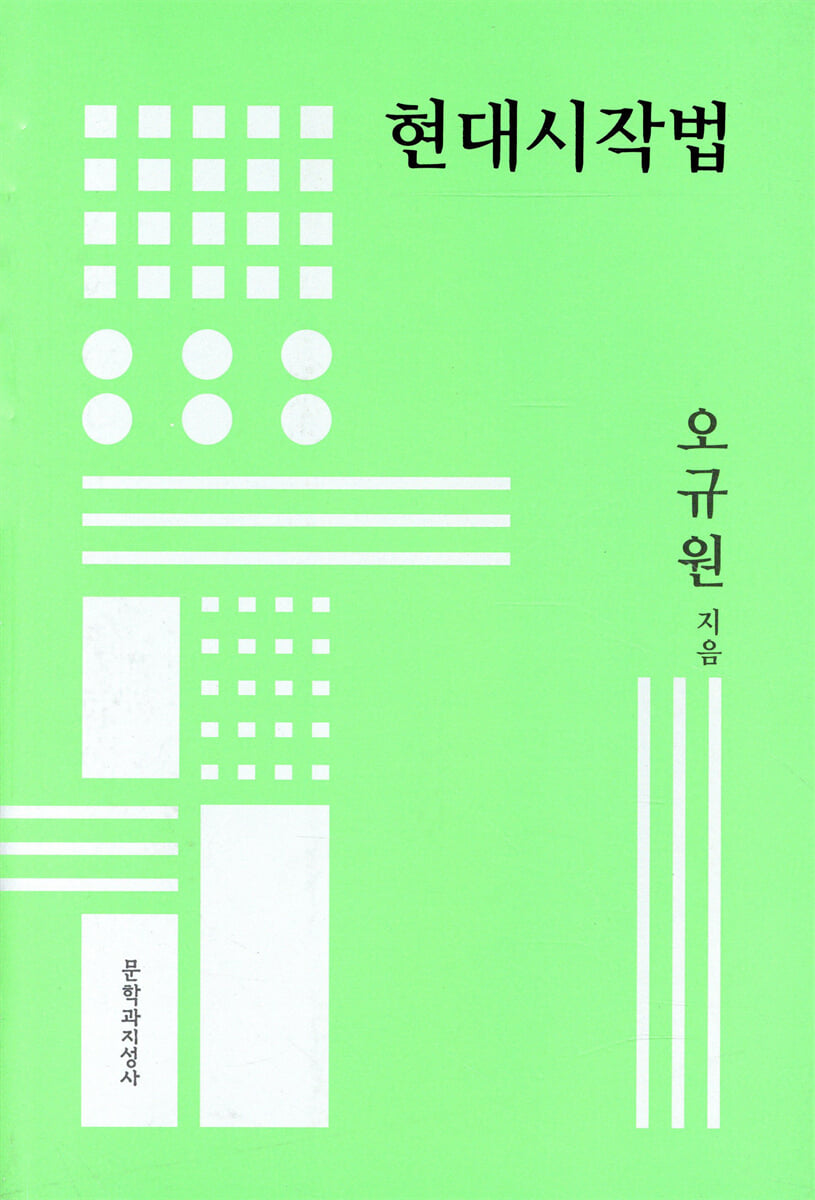 |
Description
Book Introduction
Oh Kyu-won's "Modern Poetry" is a book in which the author, a poet who has taught poetry creation at a university for a long time, theoretically explains the delicate problems that poets directly encounter in the creative process through abundant examples based on his own experience in the field.
『Modern Poetry』 is an excellent textbook on poetry writing in itself.
The reason why this is inevitable is because it breaks through the limitations of conceptual poetics through case studies of actual practice and practical analysis of poetic expression.
As is well known, Oh Kyu-won is one of the poets with the most acute self-consciousness about poetic methodology in Korean contemporary poetry.
In various places in 『Modern Poetry』, which can also be read as his theory of poetry, readers can catch a glimpse of the poet's later transition and deepening into the aesthetic stance of 'deconstruction of ideas', 'reading of phenomena', and 'raw image'.
In commemoration of the poet's 10th anniversary in 2017, the newly published 『Modern Poetry Method』 (first edition 1990, second edition 1993) retains the original content, but has reorganized the text's editing format to ensure that modern readers have no difficulty reading and understanding it.
『Modern Poetry』 is an excellent textbook on poetry writing in itself.
The reason why this is inevitable is because it breaks through the limitations of conceptual poetics through case studies of actual practice and practical analysis of poetic expression.
As is well known, Oh Kyu-won is one of the poets with the most acute self-consciousness about poetic methodology in Korean contemporary poetry.
In various places in 『Modern Poetry』, which can also be read as his theory of poetry, readers can catch a glimpse of the poet's later transition and deepening into the aesthetic stance of 'deconstruction of ideas', 'reading of phenomena', and 'raw image'.
In commemoration of the poet's 10th anniversary in 2017, the newly published 『Modern Poetry Method』 (first edition 1990, second edition 1993) retains the original content, but has reorganized the text's editing format to ensure that modern readers have no difficulty reading and understanding it.
index
9 in the preface of the revised edition
10 Additional Notes for Beginners
13 at the beginning of the book
1.
Understanding poetic expression
1.
Poetic Expression and Stereotypes 23
2.
Clichés and Conventional Perceptions 26
3.
Foreign Language and Superficial Perception 30
4.
Emotional Exposure and Emotional Suppression 33
5.
Logical Language and Conventional Language 35
6.
Abstract and Universal Languages 38
7.
Philosophical Content and Philosophical Language 40
8.
Form and Rhythm 42
2.
Objects and cognitive processes
1.
Psychological Distance from the Poetic Object 47
2.
Context and Perspective 52
3.
Types of Perspective and Aesthetic Perception 55
4.
Integrative Perspective 66
3.
poetic description
1.
Characteristics of Description 73
2.
Descriptive and implicit descriptions 75
3.
Subjective and Objective Descriptions 77
4.
The Matching of Descriptions 86
5.
Language and Moderation in Description 90
6.
Description within a description 94
7.
Description and decorative rhetoric 98
4.
Structure and point of view of the description
1.
Western Structure and Point of View 105
2.
Imagery Structure and Point of View 119
3.
Narrative Structure and Point of View 132
4.
Point of view value 138
5.
poetic statement
1.
Poetic Statement and Description 143
2.
Characteristics of Statements 148
3.
Types of Statements 149
4.
156 Soliloquies and Monologues
5.
Superficial Claims and Invitatory Statements 159
6.
Egocentric Thinking and Interpretive Statements 165
7.
Matching Statements and Descriptions 170
6.
Structure and Point of View of Poetic Statement
1.
Monologue 176
Retrospective Viewpoint 176 | Originary Viewpoint 186
2.
Invitational Statement 194
Conventional Point of View 195 | Unconventional Point of View 196
3.
Interpretive Statement 202
Contemplative Point of View 203 | Satirical Point of View 209
7.
Poetry and Speaker
1.
Poetic Speakers and General Types 231
2.
The 'I' in Poetry and the 'I' in Reality 235
3.
The 'Me' in Everyday Life and the 'Me' in Concrete Experiences 246
4.
The Speaker and Tone of the Mask 252
5.
Opaque Masks and Poetic Speakers 259
6.
Hidden Speakers and Their Roles in Poetry 269
7.
Hidden Speakers and Sensory Perception 272
8.
Speaker and Perception Changes 282
8.
Metaphors and Applications
1.
Metaphors and Poetic Expressions 291
2.
Types of Parables 294
3.
Metaphor of Meaning 296
Metaphor 296 | Metaphor 302 | Symbolism 314 | Allusion 323 | Allusion and Quotative Illusion 326
Sycophantology and Metonymy 337 | Allegory and Fable 342 | Allegory 349 | Illusion 354
4.
Parable of the Horse 359
Inversion 360 | Hyperbole 365 | Contrast and Ottomanism 370 | Repetition and Enumeration 376
Irony and Paradox 387 | The Art of Conversation and the Art of Donho 396 | The Art of Paraphrasing 403 | The Art of Rhetorical Interrogatives 408
Euphemism 411
9.
The structure of poetry and lines and stanzas
1.
Lines and stanzas of the poem 417
2.
Poetry Form and Lines and Stanzas 419
3.
Rhythm and Lines 425
The Regularity of Foreign and Korean Poetry 42 | The Rhythm of Free Verse 430
4.
Image and Line 441
The Concept of Image 441 | Emphasis and Lines and Stanzas in Imagery 445
Types of Images and Lines and Stanzas 448 | Pictorial Composition and Lines and Stanzas 450
5.
Meaning and Lines 457
Meaning and Modality 457 | Meaning and the Function of Syntax 463 | Typical Forms of Meaning and Lines and Syntax 465
The Two-Way Intersection and the Line and Year 471 | Emphasis and Deconstruction of Meaning 475
Transformation of Everyday Expression Forms 480
10.
Intentional meaning and reality
1.
Works and Meaning 489
Three Meanings in the Work 489 | Overall Obscurity and Intention 490
Partial Obscurity and Intention 496 | Intention and Other Worlds 500
The Possibility of Interpretation and the Excessiveness of Expression 502
2.
Intention and Initiation Process 502
The Distance Between Intention and the Work 502 | The Process and Practice of Revision 506
Index 512
10 Additional Notes for Beginners
13 at the beginning of the book
1.
Understanding poetic expression
1.
Poetic Expression and Stereotypes 23
2.
Clichés and Conventional Perceptions 26
3.
Foreign Language and Superficial Perception 30
4.
Emotional Exposure and Emotional Suppression 33
5.
Logical Language and Conventional Language 35
6.
Abstract and Universal Languages 38
7.
Philosophical Content and Philosophical Language 40
8.
Form and Rhythm 42
2.
Objects and cognitive processes
1.
Psychological Distance from the Poetic Object 47
2.
Context and Perspective 52
3.
Types of Perspective and Aesthetic Perception 55
4.
Integrative Perspective 66
3.
poetic description
1.
Characteristics of Description 73
2.
Descriptive and implicit descriptions 75
3.
Subjective and Objective Descriptions 77
4.
The Matching of Descriptions 86
5.
Language and Moderation in Description 90
6.
Description within a description 94
7.
Description and decorative rhetoric 98
4.
Structure and point of view of the description
1.
Western Structure and Point of View 105
2.
Imagery Structure and Point of View 119
3.
Narrative Structure and Point of View 132
4.
Point of view value 138
5.
poetic statement
1.
Poetic Statement and Description 143
2.
Characteristics of Statements 148
3.
Types of Statements 149
4.
156 Soliloquies and Monologues
5.
Superficial Claims and Invitatory Statements 159
6.
Egocentric Thinking and Interpretive Statements 165
7.
Matching Statements and Descriptions 170
6.
Structure and Point of View of Poetic Statement
1.
Monologue 176
Retrospective Viewpoint 176 | Originary Viewpoint 186
2.
Invitational Statement 194
Conventional Point of View 195 | Unconventional Point of View 196
3.
Interpretive Statement 202
Contemplative Point of View 203 | Satirical Point of View 209
7.
Poetry and Speaker
1.
Poetic Speakers and General Types 231
2.
The 'I' in Poetry and the 'I' in Reality 235
3.
The 'Me' in Everyday Life and the 'Me' in Concrete Experiences 246
4.
The Speaker and Tone of the Mask 252
5.
Opaque Masks and Poetic Speakers 259
6.
Hidden Speakers and Their Roles in Poetry 269
7.
Hidden Speakers and Sensory Perception 272
8.
Speaker and Perception Changes 282
8.
Metaphors and Applications
1.
Metaphors and Poetic Expressions 291
2.
Types of Parables 294
3.
Metaphor of Meaning 296
Metaphor 296 | Metaphor 302 | Symbolism 314 | Allusion 323 | Allusion and Quotative Illusion 326
Sycophantology and Metonymy 337 | Allegory and Fable 342 | Allegory 349 | Illusion 354
4.
Parable of the Horse 359
Inversion 360 | Hyperbole 365 | Contrast and Ottomanism 370 | Repetition and Enumeration 376
Irony and Paradox 387 | The Art of Conversation and the Art of Donho 396 | The Art of Paraphrasing 403 | The Art of Rhetorical Interrogatives 408
Euphemism 411
9.
The structure of poetry and lines and stanzas
1.
Lines and stanzas of the poem 417
2.
Poetry Form and Lines and Stanzas 419
3.
Rhythm and Lines 425
The Regularity of Foreign and Korean Poetry 42 | The Rhythm of Free Verse 430
4.
Image and Line 441
The Concept of Image 441 | Emphasis and Lines and Stanzas in Imagery 445
Types of Images and Lines and Stanzas 448 | Pictorial Composition and Lines and Stanzas 450
5.
Meaning and Lines 457
Meaning and Modality 457 | Meaning and the Function of Syntax 463 | Typical Forms of Meaning and Lines and Syntax 465
The Two-Way Intersection and the Line and Year 471 | Emphasis and Deconstruction of Meaning 475
Transformation of Everyday Expression Forms 480
10.
Intentional meaning and reality
1.
Works and Meaning 489
Three Meanings in the Work 489 | Overall Obscurity and Intention 490
Partial Obscurity and Intention 496 | Intention and Other Worlds 500
The Possibility of Interpretation and the Excessiveness of Expression 502
2.
Intention and Initiation Process 502
The Distance Between Intention and the Work 502 | The Process and Practice of Revision 506
Index 512
Into the book
[Introduction to the revised edition]
Since its first publication in September 1990, this book has received a response far exceeding my expectations.
I believe that the lives of our people who love poetry play a large part in this response.
And, in addition to that, unlike other introductory books, I think it is because it systematizes poetic thinking and poetic expression into an understandable structure and tries to reach an understanding of poetry and poetic creation through case studies.
Thanks to your generosity, we are now publishing a revised edition.
However, no modifications were made to the system or main contents of this book.
The revised parts include minor additions and deletions in “Understanding Poetic Expression,” “Objects and Cognitive Process,” and “Poetry and Speaker,” as well as revisions to several terms and expressions throughout the book.
And we added “Additional Notes for Beginners” that was not in the first edition.
Originally, this book was researched and published as a textbook for students majoring in poetry in creative writing departments at universities, so the preface to this book (the “Preface” in the first edition) was also intended as a guide for those teaching it.
However, knowing that many people who love poetry read it, I have added a brief guide for them on this occasion.
I hope this helps.
Again, I would like to thank everyone who helped me write this book and everyone who read it.
1993.
January, Author
[Additional note for beginners]
As stated in the preface of the first edition, this book is a theoretical book to assist in the creation of poetry.
Since this is a theoretical book, it would be helpful to keep the following points in mind:
First, anyone can write poetry.
This statement is not an exaggeration or a lie in the least.
Yet, if you tell most people that, they won't believe you.
Poetry is often considered something special that can only be written by people with poetic talent or by a certain type of person (poet).
From a conventional perspective, if we write down our thoughts (usually called ideas and feelings) in the form of verse (parables) rather than prose (lines), then it is all poetry.
And there is no one who cannot write in this form.
So, anyone can write poetry.
The problem is that there are good poems and bad poems.
So, to say that you don't know how to write poetry, or to be more precise, to say that you don't know how to write good poetry.
If you're going to write poetry, everyone wants to write good poetry, well-written poetry.
But writing such poetry from the beginning is not something that can be done easily.
Think about it, do you think you can draw a good picture without going through a period of regular practice?
This is precisely the problem, the desire to write good poetry, well-written poetry, from the very beginning.
This desire, this greed, clouds our thinking and causes us to misuse our talents.
So, rather than enjoying the creation itself, we become more interested in the results, imitating others, listing the knowledge we have acquired, and often embellishing things in vain.
So, we must not forget that good poetry comes from writing without pretense or imitation, without being greedy for results.
Second, poetry is a different literary form from novels, plays, etc.
Poetry, novels, plays, criticism, etc. are all literary discourses (literary expressions, to put it simply).
However, just as novels have novelistic characteristics and plays have dramatic characteristics, poetry also has poetic characteristics.
Because of these characteristics, genres are divided even though they are all literary discourses.
So, for those who want to create poetry, it is important to write poetically, not in a novelistic or dramatic way, and to know what poetic writing requires.
So, we need to know what poetic thinking and poetic expression are.
This book describes the process of learning exactly this, and this is precisely where its greatest virtue lies.
Third, it is true that knowing the technical terms related to poetry does not mean that you can write good poetry.
Knowing a term is not the same as knowing the concept, because knowing the term is not the same as being able to use it effectively.
Let me explain with an example. There's a term called 'direct metaphor.'
Everyone knows that the concept of this term is “a metaphor that expresses two things or ideas by combining them with connective words such as like, like, as if, as if, the same, or as much as.”
Even if it is not as specific as above, everyone knows the general concept of this metaphor.
However, there is no guarantee that using that metaphor in your poetry will make it better.
(1) Rather, despair is
Nari is as warm as snow
(2) A new willow branch with fluffy eyes sticking out
The raindrops grew as thick as the sturdy tree trunks.
Both verses in the example use metaphors.
However, (1) is a good metaphor, and (2) is a wrong or poor metaphor.
The reason is this:
There are times when people feel tragic emotions such as sadness, pain, and despair in reverse depending on the situation.
It's a paradoxical emotion, like when you laugh when something is so absurd.
So, the metaphor of (1) is an appropriate expression of that kind of psychology through the eyes (which feel cold yet warm).
However, “fluffy eyes” in (2) is a wrong metaphor because the eyes are not fluffy, but fluff itself.
And the “strong tree trunk” is a clumsy metaphor that is so exaggerated as to be comparable to the thickness of a raindrop, which is a source of resistance for us.
If it had been a branch instead of a tree trunk, it wouldn't have felt so exaggerated.
Likewise, if you only know a term conceptually, it is not of much help in creating poetry.
This book is written in the form of a case study, transforming this conceptual understanding into practical understanding.
There is a fair amount of technical terminology in this book, but you don't need to worry too much about going over each term.
Important terms are fully explained and repeated through case studies, so you can understand them on your own.
No, to put it extremely, even if you don't understand, it won't be a big problem.
Because what's important is understanding the work you're looking at.
Fourth, for beginners, it is recommended to read this book in the following order:
That is, rather than reading the preface (at the beginning of the book) of the first edition, it may be more effective to read the following: a general review of poetic utterances and objects (① Understanding poetic expression ② Objects and cognitive processes) → a review of the characteristics and structure of poetic utterances (③ Poetic descriptions ~ ⑥ Structure and point of view of statements) → a review of intention, reality, and process (⑩ Intentional meaning and reality), and then a review of the main elements in poetic utterances (⑦ Poetry and speaker ~ ⑨ Structure and lines/stanzas of poetry).
In this order, metaphorically speaking, I would like you to read it once like a novel, and then review only the parts you want to discuss for yourself.
1993.
January, Author
[Introduction]
Beneath each and every word I
Attend my birth.
Alain Bosquet
① This book is a theoretical book to help with the creation of poetry, that is, the method of beginning.
To help you understand the overall content, I will briefly summarize my 'intentional system' for this book as follows:
A Comprehensive Review of Poetic Utterance and Object Recognition
1) Understanding poetic expression
2) Object and cognitive process
Examination of the characteristics and structure of poetic speech
3) Poetic description
4) Structure and point of view of the description
5) Poetic statement
6) Structure and timing of the statement
A review of the main elements in poetic speech
7) Poetry and speaker
8) Metaphors and Applications
9) Review of the structure of the poem and the intention, reality, and process of the lines and verses.
10) Intentional meaning and reality
And this book is a combination of a 'case study' and a 'study on the characteristics of poetic speech'.
For this reason, unlike other similar theoretical books, this book is based on an inductive rather than a deductive approach.
② The need for case studies, especially on works from the apprenticeship period that have many problems as poetry, has been raised to me for a long time, because I have been teaching poetry writing classes at universities and outside of universities for about 10 years.
The above experience made me realize that the works of the apprentice period have the potential to be categorized in their own way.
Of course, this was due to the tempting assumption that if it could be typified, it would be quite effective in reducing the confusion of non-poetic expressions or thoughts by showing such expressions or thoughts in a typological way.
The first result of such temptation or desire is “understanding poetic expression” and “object and process of recognition.”
The former is a review of various types of undesirable conventional expressions that arise from a lack of understanding of poetry, and the latter is a review of several types that emerge from the process or viewpoint of recognizing the object.
So, the two texts above are meant to expose the most basic and general issues in poetic creation regarding poetic expression and approach to the subject.
More specific case studies that cannot be resolved through typology alone are developed as comparative studies within the characteristics of poetic utterances.
③ In this book, I accept the characteristics of poetic discourse with two rhetorical terms: ‘description’ and ‘statement.’
This is because I believe that the essence of poetic utterance lies in the form of description, which is a form of discourse that visualizes by mobilizing emotional equivalents, that is, conceptualization through observation and explanation through contemplation, and in the form of statement that confessionally and declaratively makes the feeling or realization itself audible regardless of the presence or absence of equivalents.
Therefore, the study of the characteristics, types, structures, and points of view of description and statement occupies the main part of this book, along with other major sections such as “Metaphor” and “Structure and Lines of Poetry.”
Such research provides a framework and a pathway for examining the poetic and non-poetic utterances of individual works, whether good or bad, and the organic or inorganic relationships between those utterances.
Let's look at a simple example taken from the text.
A) When the Government-General of Korea existed
On the threshold of the 10-cheap, one-bedroom restaurant in Cheonggyecheon
A beggar girl meets her beggar parents
He was leading and standing there
The master shouted,
He was calm
The little girl said it was her parents' birthday.
Did you see two 10-jeon pieces? Kim Jong-sam, "Palm Chapter 2"
When observing a work like the above independently, its linguistic characteristics are not readily apparent.
But look at this work together:
B) 그는 아버지의 다리를 잡고 개새끼 건방진 자식 하며
He staggered and tore his father's shirt, and his father threw a punch.
I swung my sword and struck his face, but I just watched.
He glared again and said, "You son of a bitch, you coward."
He broke his father's arm and his father barely managed to cut off his balls.
I pushed him out the door. I just watched him with his shoes on.
I crawled back up onto the floor, picked up the bottle, and put my father down.
When I was about to take a picture, my mother, older sister, and younger sister screamed,
I walked forward, smelling his sweat and alcohol.
I'm going to kill him, I screamed while looking straight at him.
I'm going to kill you, you bastard who doesn't even know the law. You howled like a dog.
The stars are not visible and people's faces are visible through the gap in the open door.
I screamed again, shining like a lilac flower.
Is this neighborhood a neighborhood without laws? There are no laws. There are laws, but
My arms trembled slightly, not wanting to commit a sin. At the nearby market.
The wind brought the smell of blood. Leave the door open. It will come back.
My father said, erasing the sound of water tapping until
Lee Seong-bok, "Record of a Fight"
Both pieces take the descriptive form of speech and also have a narrative structure.
But the important thing is the form of the description.
That is, A) is a general description, and B) is a detailed description.
Therefore, the two works above,
We can extract the fact that just one difference like this shows a completely different world.
So, to put it the other way around, it dramatically shows how thoughts determine the form of expression.
Only after knowing this can we begin to discern, in the following works, what can and cannot be taught, to borrow Frye's term, in the laboratory of literature.
a-1) It rained steadily all day.
Mondays when there's no TV
My lover didn't even come
Only a few merchants came
I yelled at him and he got upset.
I looked at yesterday's newspaper again
I was staring blankly out the window
Have you ever boiled and eaten Jangsu Ramen? "Ramen"
a-2) My father became a scholar.
Over the grave of the son I raised alone
One crane always
I'm going around and around
Grandma
With knuckles like corn stalks
String a frog
The damp grass leaves sway
Going to find my son? "Untitled"
A) What can we say from these two pieces that have the same characteristics of poetic utterance?
If we copy the text as it is here, “The two works above are general descriptions.
The reason why "Untitled" is so much more moving than "Ramen" is not because of the rhetorical difference that the general description itself is better.
It is the difference in depth in which one views things or the world.
From an investigative perspective, "Ramen" is also not that bad.
However, "Ramen" transfers a free day of everyday life into a poetic space.
So, that poetic space is just that, that which represents freedom.
"Untitled" visualizes a specific situation in which one can see the grandmother's love through a general description.
A mother who believes that a crane hovering over her son's grave is her son and carries a frog she caught and impaled across the wet grass is the very essence of love, its visualization.
The extent to which one has the ability to perceive or discern such facts, or rather, the extent to which one has acquired them, is closely related to the success of one's general description.
This is because it soon tells us insight into things.”
In other words, we can say that the problem lies not in the form of the general description that appears in form, but in the way one looks at the world, or, to put it in Bachelard's terms, in the way one lives in the world.
④ In this way, after a general review of the utterances that form the genre characteristics, it is possible to naturally examine the metaphors, poetic speakers, and the structure and execution of the poem involved in the poetic utterances below.
metaphor
Execution and rhythm
Speaker
A
A literal description without metaphor
General practice of meaning-focused
Hidden Speaker
B
metaphor, quotation (swearing)
Breakthrough using the two-way bridge
Revealed speaker
a-1
A literal description without metaphor
General practice of meaning-focused
Hidden Speaker
a-2
Metaphor (leaves of grass), quotative description
General practice of meaning-focused
Hidden Speaker
Of course, the table above provides a direction for comparison, analysis, and review.
And, ultimately, because every case defies typification or systematization, each case must be explored individually within any system.
⑤ Even so, I do not think that this book remains merely a study or case study of poetic expression.
I believe that this point will be somewhat explained by studies on metaphor, the structure of poetry, and the lines and stanzas.
This is because, like the study of the characteristics of speech, this type of research was pursued with the dual purpose of understanding poetry through examples and understanding the creation of poetry through examples.
The reason why "Intentional Meaning and Reality" is placed separately at the end of this book is to help us look back and organize the various pitfalls of subjective psychology that can arise until a work is completed by understanding the relationship between the intentional, actual, and interpretive meanings of the work.
Although the content of the book does not follow the intention, it nevertheless tried to follow the intention.
I would like to express my gratitude to Lee Jeong-eun, Lee Jong-hwan, and Jo Eun, who helped me tirelessly with data collection and manuscript organization for a long time until the publication of this book, and to Professor Kim Hye-sun, who taught a poetry course at the same university and offered me various advice. In the words of Alain Bosquet,
August 1990, in a laboratory at the foot of Namsan Mountain, the author
Since its first publication in September 1990, this book has received a response far exceeding my expectations.
I believe that the lives of our people who love poetry play a large part in this response.
And, in addition to that, unlike other introductory books, I think it is because it systematizes poetic thinking and poetic expression into an understandable structure and tries to reach an understanding of poetry and poetic creation through case studies.
Thanks to your generosity, we are now publishing a revised edition.
However, no modifications were made to the system or main contents of this book.
The revised parts include minor additions and deletions in “Understanding Poetic Expression,” “Objects and Cognitive Process,” and “Poetry and Speaker,” as well as revisions to several terms and expressions throughout the book.
And we added “Additional Notes for Beginners” that was not in the first edition.
Originally, this book was researched and published as a textbook for students majoring in poetry in creative writing departments at universities, so the preface to this book (the “Preface” in the first edition) was also intended as a guide for those teaching it.
However, knowing that many people who love poetry read it, I have added a brief guide for them on this occasion.
I hope this helps.
Again, I would like to thank everyone who helped me write this book and everyone who read it.
1993.
January, Author
[Additional note for beginners]
As stated in the preface of the first edition, this book is a theoretical book to assist in the creation of poetry.
Since this is a theoretical book, it would be helpful to keep the following points in mind:
First, anyone can write poetry.
This statement is not an exaggeration or a lie in the least.
Yet, if you tell most people that, they won't believe you.
Poetry is often considered something special that can only be written by people with poetic talent or by a certain type of person (poet).
From a conventional perspective, if we write down our thoughts (usually called ideas and feelings) in the form of verse (parables) rather than prose (lines), then it is all poetry.
And there is no one who cannot write in this form.
So, anyone can write poetry.
The problem is that there are good poems and bad poems.
So, to say that you don't know how to write poetry, or to be more precise, to say that you don't know how to write good poetry.
If you're going to write poetry, everyone wants to write good poetry, well-written poetry.
But writing such poetry from the beginning is not something that can be done easily.
Think about it, do you think you can draw a good picture without going through a period of regular practice?
This is precisely the problem, the desire to write good poetry, well-written poetry, from the very beginning.
This desire, this greed, clouds our thinking and causes us to misuse our talents.
So, rather than enjoying the creation itself, we become more interested in the results, imitating others, listing the knowledge we have acquired, and often embellishing things in vain.
So, we must not forget that good poetry comes from writing without pretense or imitation, without being greedy for results.
Second, poetry is a different literary form from novels, plays, etc.
Poetry, novels, plays, criticism, etc. are all literary discourses (literary expressions, to put it simply).
However, just as novels have novelistic characteristics and plays have dramatic characteristics, poetry also has poetic characteristics.
Because of these characteristics, genres are divided even though they are all literary discourses.
So, for those who want to create poetry, it is important to write poetically, not in a novelistic or dramatic way, and to know what poetic writing requires.
So, we need to know what poetic thinking and poetic expression are.
This book describes the process of learning exactly this, and this is precisely where its greatest virtue lies.
Third, it is true that knowing the technical terms related to poetry does not mean that you can write good poetry.
Knowing a term is not the same as knowing the concept, because knowing the term is not the same as being able to use it effectively.
Let me explain with an example. There's a term called 'direct metaphor.'
Everyone knows that the concept of this term is “a metaphor that expresses two things or ideas by combining them with connective words such as like, like, as if, as if, the same, or as much as.”
Even if it is not as specific as above, everyone knows the general concept of this metaphor.
However, there is no guarantee that using that metaphor in your poetry will make it better.
(1) Rather, despair is
Nari is as warm as snow
(2) A new willow branch with fluffy eyes sticking out
The raindrops grew as thick as the sturdy tree trunks.
Both verses in the example use metaphors.
However, (1) is a good metaphor, and (2) is a wrong or poor metaphor.
The reason is this:
There are times when people feel tragic emotions such as sadness, pain, and despair in reverse depending on the situation.
It's a paradoxical emotion, like when you laugh when something is so absurd.
So, the metaphor of (1) is an appropriate expression of that kind of psychology through the eyes (which feel cold yet warm).
However, “fluffy eyes” in (2) is a wrong metaphor because the eyes are not fluffy, but fluff itself.
And the “strong tree trunk” is a clumsy metaphor that is so exaggerated as to be comparable to the thickness of a raindrop, which is a source of resistance for us.
If it had been a branch instead of a tree trunk, it wouldn't have felt so exaggerated.
Likewise, if you only know a term conceptually, it is not of much help in creating poetry.
This book is written in the form of a case study, transforming this conceptual understanding into practical understanding.
There is a fair amount of technical terminology in this book, but you don't need to worry too much about going over each term.
Important terms are fully explained and repeated through case studies, so you can understand them on your own.
No, to put it extremely, even if you don't understand, it won't be a big problem.
Because what's important is understanding the work you're looking at.
Fourth, for beginners, it is recommended to read this book in the following order:
That is, rather than reading the preface (at the beginning of the book) of the first edition, it may be more effective to read the following: a general review of poetic utterances and objects (① Understanding poetic expression ② Objects and cognitive processes) → a review of the characteristics and structure of poetic utterances (③ Poetic descriptions ~ ⑥ Structure and point of view of statements) → a review of intention, reality, and process (⑩ Intentional meaning and reality), and then a review of the main elements in poetic utterances (⑦ Poetry and speaker ~ ⑨ Structure and lines/stanzas of poetry).
In this order, metaphorically speaking, I would like you to read it once like a novel, and then review only the parts you want to discuss for yourself.
1993.
January, Author
[Introduction]
Beneath each and every word I
Attend my birth.
Alain Bosquet
① This book is a theoretical book to help with the creation of poetry, that is, the method of beginning.
To help you understand the overall content, I will briefly summarize my 'intentional system' for this book as follows:
A Comprehensive Review of Poetic Utterance and Object Recognition
1) Understanding poetic expression
2) Object and cognitive process
Examination of the characteristics and structure of poetic speech
3) Poetic description
4) Structure and point of view of the description
5) Poetic statement
6) Structure and timing of the statement
A review of the main elements in poetic speech
7) Poetry and speaker
8) Metaphors and Applications
9) Review of the structure of the poem and the intention, reality, and process of the lines and verses.
10) Intentional meaning and reality
And this book is a combination of a 'case study' and a 'study on the characteristics of poetic speech'.
For this reason, unlike other similar theoretical books, this book is based on an inductive rather than a deductive approach.
② The need for case studies, especially on works from the apprenticeship period that have many problems as poetry, has been raised to me for a long time, because I have been teaching poetry writing classes at universities and outside of universities for about 10 years.
The above experience made me realize that the works of the apprentice period have the potential to be categorized in their own way.
Of course, this was due to the tempting assumption that if it could be typified, it would be quite effective in reducing the confusion of non-poetic expressions or thoughts by showing such expressions or thoughts in a typological way.
The first result of such temptation or desire is “understanding poetic expression” and “object and process of recognition.”
The former is a review of various types of undesirable conventional expressions that arise from a lack of understanding of poetry, and the latter is a review of several types that emerge from the process or viewpoint of recognizing the object.
So, the two texts above are meant to expose the most basic and general issues in poetic creation regarding poetic expression and approach to the subject.
More specific case studies that cannot be resolved through typology alone are developed as comparative studies within the characteristics of poetic utterances.
③ In this book, I accept the characteristics of poetic discourse with two rhetorical terms: ‘description’ and ‘statement.’
This is because I believe that the essence of poetic utterance lies in the form of description, which is a form of discourse that visualizes by mobilizing emotional equivalents, that is, conceptualization through observation and explanation through contemplation, and in the form of statement that confessionally and declaratively makes the feeling or realization itself audible regardless of the presence or absence of equivalents.
Therefore, the study of the characteristics, types, structures, and points of view of description and statement occupies the main part of this book, along with other major sections such as “Metaphor” and “Structure and Lines of Poetry.”
Such research provides a framework and a pathway for examining the poetic and non-poetic utterances of individual works, whether good or bad, and the organic or inorganic relationships between those utterances.
Let's look at a simple example taken from the text.
A) When the Government-General of Korea existed
On the threshold of the 10-cheap, one-bedroom restaurant in Cheonggyecheon
A beggar girl meets her beggar parents
He was leading and standing there
The master shouted,
He was calm
The little girl said it was her parents' birthday.
Did you see two 10-jeon pieces? Kim Jong-sam, "Palm Chapter 2"
When observing a work like the above independently, its linguistic characteristics are not readily apparent.
But look at this work together:
B) 그는 아버지의 다리를 잡고 개새끼 건방진 자식 하며
He staggered and tore his father's shirt, and his father threw a punch.
I swung my sword and struck his face, but I just watched.
He glared again and said, "You son of a bitch, you coward."
He broke his father's arm and his father barely managed to cut off his balls.
I pushed him out the door. I just watched him with his shoes on.
I crawled back up onto the floor, picked up the bottle, and put my father down.
When I was about to take a picture, my mother, older sister, and younger sister screamed,
I walked forward, smelling his sweat and alcohol.
I'm going to kill him, I screamed while looking straight at him.
I'm going to kill you, you bastard who doesn't even know the law. You howled like a dog.
The stars are not visible and people's faces are visible through the gap in the open door.
I screamed again, shining like a lilac flower.
Is this neighborhood a neighborhood without laws? There are no laws. There are laws, but
My arms trembled slightly, not wanting to commit a sin. At the nearby market.
The wind brought the smell of blood. Leave the door open. It will come back.
My father said, erasing the sound of water tapping until
Lee Seong-bok, "Record of a Fight"
Both pieces take the descriptive form of speech and also have a narrative structure.
But the important thing is the form of the description.
That is, A) is a general description, and B) is a detailed description.
Therefore, the two works above,
We can extract the fact that just one difference like this shows a completely different world.
So, to put it the other way around, it dramatically shows how thoughts determine the form of expression.
Only after knowing this can we begin to discern, in the following works, what can and cannot be taught, to borrow Frye's term, in the laboratory of literature.
a-1) It rained steadily all day.
Mondays when there's no TV
My lover didn't even come
Only a few merchants came
I yelled at him and he got upset.
I looked at yesterday's newspaper again
I was staring blankly out the window
Have you ever boiled and eaten Jangsu Ramen? "Ramen"
a-2) My father became a scholar.
Over the grave of the son I raised alone
One crane always
I'm going around and around
Grandma
With knuckles like corn stalks
String a frog
The damp grass leaves sway
Going to find my son? "Untitled"
A) What can we say from these two pieces that have the same characteristics of poetic utterance?
If we copy the text as it is here, “The two works above are general descriptions.
The reason why "Untitled" is so much more moving than "Ramen" is not because of the rhetorical difference that the general description itself is better.
It is the difference in depth in which one views things or the world.
From an investigative perspective, "Ramen" is also not that bad.
However, "Ramen" transfers a free day of everyday life into a poetic space.
So, that poetic space is just that, that which represents freedom.
"Untitled" visualizes a specific situation in which one can see the grandmother's love through a general description.
A mother who believes that a crane hovering over her son's grave is her son and carries a frog she caught and impaled across the wet grass is the very essence of love, its visualization.
The extent to which one has the ability to perceive or discern such facts, or rather, the extent to which one has acquired them, is closely related to the success of one's general description.
This is because it soon tells us insight into things.”
In other words, we can say that the problem lies not in the form of the general description that appears in form, but in the way one looks at the world, or, to put it in Bachelard's terms, in the way one lives in the world.
④ In this way, after a general review of the utterances that form the genre characteristics, it is possible to naturally examine the metaphors, poetic speakers, and the structure and execution of the poem involved in the poetic utterances below.
metaphor
Execution and rhythm
Speaker
A
A literal description without metaphor
General practice of meaning-focused
Hidden Speaker
B
metaphor, quotation (swearing)
Breakthrough using the two-way bridge
Revealed speaker
a-1
A literal description without metaphor
General practice of meaning-focused
Hidden Speaker
a-2
Metaphor (leaves of grass), quotative description
General practice of meaning-focused
Hidden Speaker
Of course, the table above provides a direction for comparison, analysis, and review.
And, ultimately, because every case defies typification or systematization, each case must be explored individually within any system.
⑤ Even so, I do not think that this book remains merely a study or case study of poetic expression.
I believe that this point will be somewhat explained by studies on metaphor, the structure of poetry, and the lines and stanzas.
This is because, like the study of the characteristics of speech, this type of research was pursued with the dual purpose of understanding poetry through examples and understanding the creation of poetry through examples.
The reason why "Intentional Meaning and Reality" is placed separately at the end of this book is to help us look back and organize the various pitfalls of subjective psychology that can arise until a work is completed by understanding the relationship between the intentional, actual, and interpretive meanings of the work.
Although the content of the book does not follow the intention, it nevertheless tried to follow the intention.
I would like to express my gratitude to Lee Jeong-eun, Lee Jong-hwan, and Jo Eun, who helped me tirelessly with data collection and manuscript organization for a long time until the publication of this book, and to Professor Kim Hye-sun, who taught a poetry course at the same university and offered me various advice. In the words of Alain Bosquet,
August 1990, in a laboratory at the foot of Namsan Mountain, the author
--- From the text
Publisher's Review
“Oh Kyu-won_ The rhetoric of poetry, that is, the characteristics and structure of poetic utterances, is a systematized theory. This theory is not something that was borrowed and applied and reproduced from other theories at home and abroad, but is an original one.
The fact that the rhetoric of poetry, in other words, is centered around the two axes of description and statement, is a result of the rhetorical approach, and this rhetorical approach is also deeply related to the recognition of the poetic object.
That is, the reason why poetry, novels, and plays are divided is because they have different methods of perceiving their subjects, and the difference in methods of perceiving them entails rhetorical differences.
For example, the reason why novels use the narrative as a central rhetoric is because of the genre's characteristic of having to structure the story through a single continuum of time.
But poetry relies on the rhetoric of description because it must structure feelings.
Creative education in the field should also focus on these characteristics.
However, although examples of practice can be analyzed, systematization is not easy.
This is because of the unexpected nature of the creation, so the case analysis is nothing more than a classification, like a legal casebook.
I tried to put that classification under the structure of poetic utterance and to some extent to serialize it.
[… … ]
In our educational setting, the target audience is high school graduates, and therefore they are very young.
That is, the senses are developed, but the ability to contemplate is less prepared.
In other words, sensory perception has more to do with the sensitivity of an individual's emotional senses than with the accumulation of individual experiential facts.
Therefore, statements that require direct expression of enlightenment are a more difficult task for young people with less accumulated experiential knowledge.
This point should also be taken into consideration.
In the field of education, people with such declarative ability are far fewer in number than those with descriptive ability.
These problems in the educational field may not be entirely unrelated to such a specific literary trend.
And the creative education system and methods of my 『Modern Poetry Method』 will also be related.
I am neither optimistic nor pessimistic about this fact.
This is partly because the role of education and the role of the writer are separate, but also because we can see from my generation and the younger generation that 『Modern Poetry』 is having a certain impact on the strengthening of reality, a weakness of Korean poetry.”
―From Oh Kyu-won/Lee Gwang-ho's interview, "The Trajectory of Linguistic Exploration" (Reading Oh Kyu-won Deeply, Moonji Publishing, 2002)
The fact that the rhetoric of poetry, in other words, is centered around the two axes of description and statement, is a result of the rhetorical approach, and this rhetorical approach is also deeply related to the recognition of the poetic object.
That is, the reason why poetry, novels, and plays are divided is because they have different methods of perceiving their subjects, and the difference in methods of perceiving them entails rhetorical differences.
For example, the reason why novels use the narrative as a central rhetoric is because of the genre's characteristic of having to structure the story through a single continuum of time.
But poetry relies on the rhetoric of description because it must structure feelings.
Creative education in the field should also focus on these characteristics.
However, although examples of practice can be analyzed, systematization is not easy.
This is because of the unexpected nature of the creation, so the case analysis is nothing more than a classification, like a legal casebook.
I tried to put that classification under the structure of poetic utterance and to some extent to serialize it.
[… … ]
In our educational setting, the target audience is high school graduates, and therefore they are very young.
That is, the senses are developed, but the ability to contemplate is less prepared.
In other words, sensory perception has more to do with the sensitivity of an individual's emotional senses than with the accumulation of individual experiential facts.
Therefore, statements that require direct expression of enlightenment are a more difficult task for young people with less accumulated experiential knowledge.
This point should also be taken into consideration.
In the field of education, people with such declarative ability are far fewer in number than those with descriptive ability.
These problems in the educational field may not be entirely unrelated to such a specific literary trend.
And the creative education system and methods of my 『Modern Poetry Method』 will also be related.
I am neither optimistic nor pessimistic about this fact.
This is partly because the role of education and the role of the writer are separate, but also because we can see from my generation and the younger generation that 『Modern Poetry』 is having a certain impact on the strengthening of reality, a weakness of Korean poetry.”
―From Oh Kyu-won/Lee Gwang-ho's interview, "The Trajectory of Linguistic Exploration" (Reading Oh Kyu-won Deeply, Moonji Publishing, 2002)
GOODS SPECIFICS
- Date of issue: May 30, 2017
- Page count, weight, size: 524 pages | 746g | 152*225*35mm
- ISBN13: 9788932030036
- ISBN10: 8932030030
You may also like
카테고리
korean


korean

![GQ KOREA Mark (Monthly): December [2025]](http://librairie.coreenne.fr/cdn/shop/files/8ef265dbbfbf186523ed75ba7319009d.jpg?v=1765340328&width=3840)


