

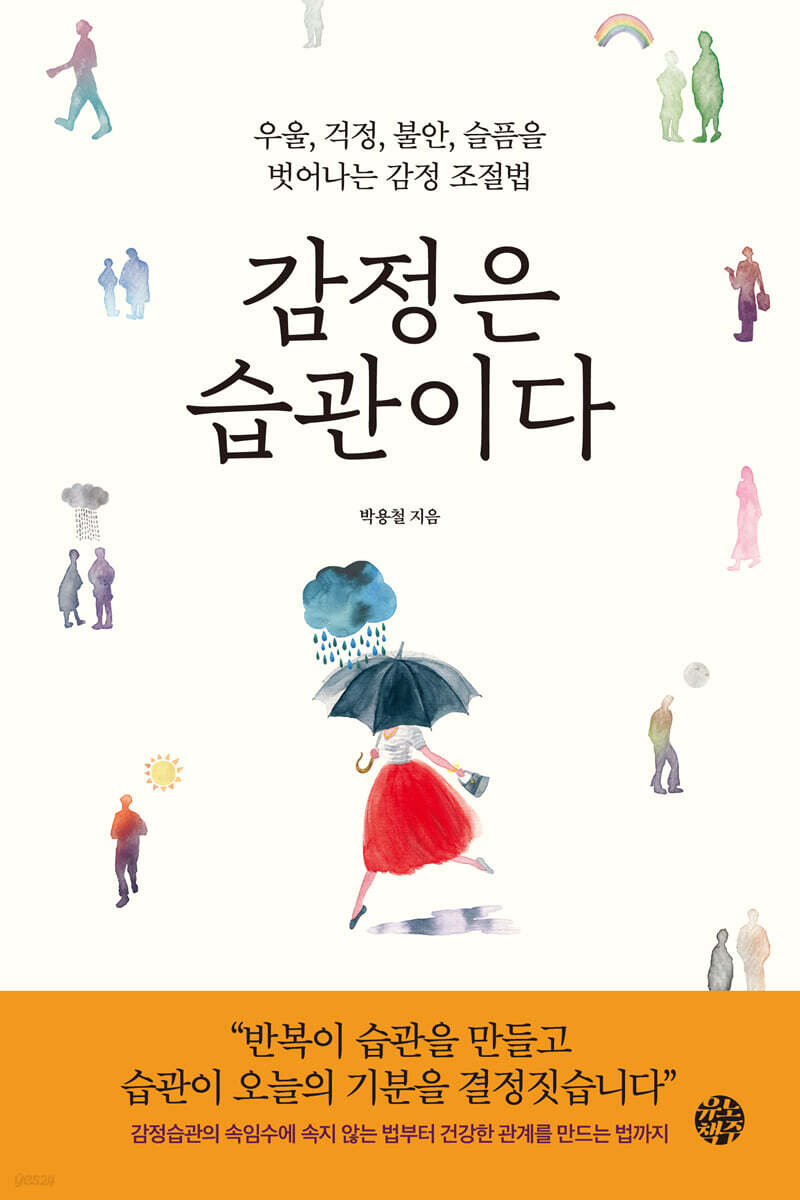
Emotions are habits
 |
Description
Book Introduction
“Repetition creates habits,
“Your habits determine your mood today.”
A new book, "Emotions Are Habits," is out now to help you break free from negative emotional habits!
From avoiding the deception of emotional habits to building healthy relationships.
John Dryden, the English poet and playwright, once said:
“First we make our habits, then our habits make us.” This saying holds true for habits like smoking, drinking, and eating salty foods.
At first, without much awareness, they start smoking cigarettes, drinking alcohol, and eating salty foods repeatedly.
Once becomes twice, twice becomes three, and now it has become a complete habit.
Once it becomes a habit, it is not easy to go back to the way it was.
But did you know that emotions, too, can become habits? People accustomed to living alone feel strange and uncomfortable when they're surrounded by others.
Middle-aged men, who are accustomed to speaking in an angry tone rather than in a sarcastic tone throughout their lives, tend to get angry rather than express their regret when something sad happens.
These are 'habitual emotions' that we feel because our brain desperately tries to maintain familiarity.
As a doctor, the author has experienced many times while treating many people that not only behaviors but also 'emotions become habits.'
So, through this book, we have very kindly explained how to overcome negative emotions, control them, and further develop positive and happy emotional habits.
"Emotions are Habits," which reinterpreted the reasons why negative emotions persist, as "habits," and explained them in an easy-to-understand way, resonating with many people, offering comfort and hope, has been republished in a new form.
Why do some emotions last long and others fade quickly? The book begins by exploring the nature of emotional habits and how the brain has been deceiving us all along.
We examine how emotional habits function in certain situations and make it difficult to regulate our emotions, and explain that recurring bad interpersonal relationships are also a form of emotional habits.
The second half suggests five specific ways to correct emotional habits.
We also provide seven ways to solidify positive emotional habits.
In this book, you will learn how emotions like depression, worry, anxiety, and sadness can take hold of us, and how to break these habits and better manage them.
“Your habits determine your mood today.”
A new book, "Emotions Are Habits," is out now to help you break free from negative emotional habits!
From avoiding the deception of emotional habits to building healthy relationships.
John Dryden, the English poet and playwright, once said:
“First we make our habits, then our habits make us.” This saying holds true for habits like smoking, drinking, and eating salty foods.
At first, without much awareness, they start smoking cigarettes, drinking alcohol, and eating salty foods repeatedly.
Once becomes twice, twice becomes three, and now it has become a complete habit.
Once it becomes a habit, it is not easy to go back to the way it was.
But did you know that emotions, too, can become habits? People accustomed to living alone feel strange and uncomfortable when they're surrounded by others.
Middle-aged men, who are accustomed to speaking in an angry tone rather than in a sarcastic tone throughout their lives, tend to get angry rather than express their regret when something sad happens.
These are 'habitual emotions' that we feel because our brain desperately tries to maintain familiarity.
As a doctor, the author has experienced many times while treating many people that not only behaviors but also 'emotions become habits.'
So, through this book, we have very kindly explained how to overcome negative emotions, control them, and further develop positive and happy emotional habits.
"Emotions are Habits," which reinterpreted the reasons why negative emotions persist, as "habits," and explained them in an easy-to-understand way, resonating with many people, offering comfort and hope, has been republished in a new form.
Why do some emotions last long and others fade quickly? The book begins by exploring the nature of emotional habits and how the brain has been deceiving us all along.
We examine how emotional habits function in certain situations and make it difficult to regulate our emotions, and explain that recurring bad interpersonal relationships are also a form of emotional habits.
The second half suggests five specific ways to correct emotional habits.
We also provide seven ways to solidify positive emotional habits.
In this book, you will learn how emotions like depression, worry, anxiety, and sadness can take hold of us, and how to break these habits and better manage them.
- You can preview some of the book's contents.
Preview
index
Prologue: People Wandering Between Unfamiliar Happiness and Familiar Unhappiness
Chapter 1 “Why do some emotions last a long time and others fade away quickly?”
· The Power of Emotional Habits ·
My brain is mine, but it's not always on my side.
The more recognition you receive, the more anxious you become, and withdrawal symptoms of emotion
The hyena of the mind that seeks out anxiety
An important trick your brain uses
“I don’t know, so I’ll just stick with what I’m familiar with!”
Why the Brain Is Clinging to Emotional Habits
Why do they prefer unhappiness to happiness?
Chapter 2: “Emotional Habits Are the Yo-Yo Effect of Emotions”
· How emotional habits work ·
Why does the brain remember physical and emotional wounds?
Emotions that cleverly change faces
A roller coaster between depression and pleasure
The illusion of stress relief
Feeding the Destructive Emotional Habits
There are two flavors of pleasure
Chapter 3: “Turn Off Bad Emotional Habits”
· Emotional habits and interpersonal relationships ·
Interpersonal relationships are also habits.
Three Types of Distorted Intimacy
Who should I do my best for?
My relationship with myself determines my relationships with others.
Letting go of someone who has become a habit
The process of separation cannot be omitted.
Chapter 4: "Take a Step Away from Negative Emotional Habits"
· How to correct emotional habits ·
Imagining New Emotions | Imagination Exposure Method
Finding the Connection Between Stimuli and Emotions | Modifying Your Thinking Habits
Changing Emotionally Triggering Situations | Avoidance Therapy
Minimizing Negative Stimuli | Stimulus Control
Making a Pleasant Mood Habit | Emotion Switch
Chapter 5: "Managing Your Emotions Well Becomes a Weapon in Your Life"
· Strengthening positive emotional habits ·
Get used to small emotions
Even fleeting feelings can be turned to your side.
Worry about your worries during your worry time.
Change your small daily habits.
Try changing your words and facial expressions.
Remember the small but meaningful things
Establish a happy vision
Epilogue Fortunately, everyone can be happy.
Chapter 1 “Why do some emotions last a long time and others fade away quickly?”
· The Power of Emotional Habits ·
My brain is mine, but it's not always on my side.
The more recognition you receive, the more anxious you become, and withdrawal symptoms of emotion
The hyena of the mind that seeks out anxiety
An important trick your brain uses
“I don’t know, so I’ll just stick with what I’m familiar with!”
Why the Brain Is Clinging to Emotional Habits
Why do they prefer unhappiness to happiness?
Chapter 2: “Emotional Habits Are the Yo-Yo Effect of Emotions”
· How emotional habits work ·
Why does the brain remember physical and emotional wounds?
Emotions that cleverly change faces
A roller coaster between depression and pleasure
The illusion of stress relief
Feeding the Destructive Emotional Habits
There are two flavors of pleasure
Chapter 3: “Turn Off Bad Emotional Habits”
· Emotional habits and interpersonal relationships ·
Interpersonal relationships are also habits.
Three Types of Distorted Intimacy
Who should I do my best for?
My relationship with myself determines my relationships with others.
Letting go of someone who has become a habit
The process of separation cannot be omitted.
Chapter 4: "Take a Step Away from Negative Emotional Habits"
· How to correct emotional habits ·
Imagining New Emotions | Imagination Exposure Method
Finding the Connection Between Stimuli and Emotions | Modifying Your Thinking Habits
Changing Emotionally Triggering Situations | Avoidance Therapy
Minimizing Negative Stimuli | Stimulus Control
Making a Pleasant Mood Habit | Emotion Switch
Chapter 5: "Managing Your Emotions Well Becomes a Weapon in Your Life"
· Strengthening positive emotional habits ·
Get used to small emotions
Even fleeting feelings can be turned to your side.
Worry about your worries during your worry time.
Change your small daily habits.
Try changing your words and facial expressions.
Remember the small but meaningful things
Establish a happy vision
Epilogue Fortunately, everyone can be happy.
Detailed image
.jpg)
Into the book
People who have become accustomed to anxiety look back on their day and remember only their worries.
And then they rationalize their anxiety by saying that there is nothing they can do about these things.
On the other hand, people who are ingrained in gratitude remember things to be thankful for first.
Also, depending on their emotional habits, some people may interpret the same thing positively, while others may interpret it negatively and become anxious.
Some people get angry first.
To understand and control emotions more deeply, we must not overlook the fact that 'emotions are also habits.'
---From "The brain is mine, but it's not always on my side"
One of the challenges in getting people with anorexia to start eating again is that they often experience discomfort and severe abdominal pain after eating.
Also, I don't really know what it feels like to be hungry and I think my stomach hurts too.
As the fast continued, the feeling of hunger was continuously ignored and the feeling of fullness was not felt for a long time, so the brain reverted to its infantile state.
It's because I can't tell the subtle differences between feelings.
The brain of an anorexic is confused: "What's hungry and what's full? It's confusing."
It seems like he's saying, "Just let it be that my stomach hurts!"
The same goes for emotions.
As we grow and learn language, our brains learn and differentiate between the subtle differences in each emotion.
However, if you fall into the trap of emotional habits where you start to use one emotion primarily and ignore others, you will increasingly lose the ability to distinguish between subtle differences in stimuli and may misinterpret situations where you should feel a different emotion as just a familiar one.
---From "I don't know, so let's just stick to what we're familiar with!"
His first stress reliever was alcohol.
Hanging out with friends and drinking after work was a great pleasure.
As a result, my alcohol tolerance gradually increased and I developed excessive drinking behavior.
The second is to immerse yourself in sports activities.
He played badminton on weekends as a hobby.
I worked out so hard that I was sweating profusely and out of breath.
He also said that while playing, he makes bets with his fellow players and that he gets really absorbed in the bets to relieve stress.
So, he said that when he wins a game, the thrill seems to relieve his stress.
Of course, I was so angry that I couldn't stand it.
(Omitted) I think the readers have probably noticed by now.
For him, the state of tension and excitement called 'hwa' is maintained with only a changed face in the name of 'stress relief'.
Yes, that's right.
He's not relieving stress.
His sympathetic nervous system, which has become accustomed to being overexcited due to stress, tries to maintain that tension and prevents him from resting even when he should be resting.
---From "The Illusion of Stress Relief"
Close your eyes and imagine this.
Think back to your childhood experiences when you were hurt in interpersonal relationships.
Find a memory of being hurt by people who were especially important to you, whether it was your family when you were young, or a lover or someone you trusted when you were older.
Also, think back to your relationship with your parents when you were young and the emotions you felt at the time.
Also, vividly recall the feelings you felt among your siblings or school friends.
Compare your current interpersonal relationship patterns to see if the relationship habits from that time are repeating themselves.
What do you think? Do you have recurring habits? Do you have recurring wounds? Or do you find yourself constantly holding back from opening up for fear of being hurt? If so, you need to renew your interpersonal habits.
---From "'To whom should I give my best?'"
Do you know how circuses train elephants? First, they tie up a young elephant tightly with a chain.
He tries to run away with all his might, but he still doesn't have the strength to break the chains.
As time passes and the elephant grows bigger, it gains the strength to break the chain, but it does not even try to escape.
This is because the elephant has become accustomed to the thought, 'I cannot break this chain.'
Every time you get hit with the whip from the breeder, you feel the same old fear and frustration you felt as a child.
With the habitual thought, 'I can't escape from here.'
Don't we too? We have many habits of wrong thoughts and emotions in our minds that don't fit the current situation.
Now is the time to examine the past thoughts that have become habits without me even realizing it.
I need to make sure that this is appropriate for the current situation and for me as a person.
Let's also update the thoughts that are stuck in our heads.
You need to discard what you don't need and fill in new data to make it more suitable for the current situation.
In times like these, I use an emotional journal.
Whenever an emotion that bothers you arises, capture the thought that passes through your mind at that moment and write it down in a notebook.
Because these thoughts come and go very quickly, you should write them down as soon as the emotion arises.
And then they rationalize their anxiety by saying that there is nothing they can do about these things.
On the other hand, people who are ingrained in gratitude remember things to be thankful for first.
Also, depending on their emotional habits, some people may interpret the same thing positively, while others may interpret it negatively and become anxious.
Some people get angry first.
To understand and control emotions more deeply, we must not overlook the fact that 'emotions are also habits.'
---From "The brain is mine, but it's not always on my side"
One of the challenges in getting people with anorexia to start eating again is that they often experience discomfort and severe abdominal pain after eating.
Also, I don't really know what it feels like to be hungry and I think my stomach hurts too.
As the fast continued, the feeling of hunger was continuously ignored and the feeling of fullness was not felt for a long time, so the brain reverted to its infantile state.
It's because I can't tell the subtle differences between feelings.
The brain of an anorexic is confused: "What's hungry and what's full? It's confusing."
It seems like he's saying, "Just let it be that my stomach hurts!"
The same goes for emotions.
As we grow and learn language, our brains learn and differentiate between the subtle differences in each emotion.
However, if you fall into the trap of emotional habits where you start to use one emotion primarily and ignore others, you will increasingly lose the ability to distinguish between subtle differences in stimuli and may misinterpret situations where you should feel a different emotion as just a familiar one.
---From "I don't know, so let's just stick to what we're familiar with!"
His first stress reliever was alcohol.
Hanging out with friends and drinking after work was a great pleasure.
As a result, my alcohol tolerance gradually increased and I developed excessive drinking behavior.
The second is to immerse yourself in sports activities.
He played badminton on weekends as a hobby.
I worked out so hard that I was sweating profusely and out of breath.
He also said that while playing, he makes bets with his fellow players and that he gets really absorbed in the bets to relieve stress.
So, he said that when he wins a game, the thrill seems to relieve his stress.
Of course, I was so angry that I couldn't stand it.
(Omitted) I think the readers have probably noticed by now.
For him, the state of tension and excitement called 'hwa' is maintained with only a changed face in the name of 'stress relief'.
Yes, that's right.
He's not relieving stress.
His sympathetic nervous system, which has become accustomed to being overexcited due to stress, tries to maintain that tension and prevents him from resting even when he should be resting.
---From "The Illusion of Stress Relief"
Close your eyes and imagine this.
Think back to your childhood experiences when you were hurt in interpersonal relationships.
Find a memory of being hurt by people who were especially important to you, whether it was your family when you were young, or a lover or someone you trusted when you were older.
Also, think back to your relationship with your parents when you were young and the emotions you felt at the time.
Also, vividly recall the feelings you felt among your siblings or school friends.
Compare your current interpersonal relationship patterns to see if the relationship habits from that time are repeating themselves.
What do you think? Do you have recurring habits? Do you have recurring wounds? Or do you find yourself constantly holding back from opening up for fear of being hurt? If so, you need to renew your interpersonal habits.
---From "'To whom should I give my best?'"
Do you know how circuses train elephants? First, they tie up a young elephant tightly with a chain.
He tries to run away with all his might, but he still doesn't have the strength to break the chains.
As time passes and the elephant grows bigger, it gains the strength to break the chain, but it does not even try to escape.
This is because the elephant has become accustomed to the thought, 'I cannot break this chain.'
Every time you get hit with the whip from the breeder, you feel the same old fear and frustration you felt as a child.
With the habitual thought, 'I can't escape from here.'
Don't we too? We have many habits of wrong thoughts and emotions in our minds that don't fit the current situation.
Now is the time to examine the past thoughts that have become habits without me even realizing it.
I need to make sure that this is appropriate for the current situation and for me as a person.
Let's also update the thoughts that are stuck in our heads.
You need to discard what you don't need and fill in new data to make it more suitable for the current situation.
In times like these, I use an emotional journal.
Whenever an emotion that bothers you arises, capture the thought that passes through your mind at that moment and write it down in a notebook.
Because these thoughts come and go very quickly, you should write them down as soon as the emotion arises.
---From "Finding the Link Between Stimulus and Emotion"
Publisher's Review
“Just as you can correct bad habits,
“Even painful emotions can be changed”
Habits have a truly scary side.
Even if that habit is self-destructive, we cannot easily shake it off.
Some of the most easily encountered destructive habits include smoking and drinking.
If such extreme cases feel far from you, what about habits like eating salty foods? Even if you know it's wrong, and even know it's driving you to death, habits are difficult to break.
As a psychiatrist, the author has met countless patients.
Patients who came to see the author were caught up in familiar emotions rather than positive ones, and did not feel at ease even when difficult situations improved and worries disappeared.
Rather, it seemed as if he wanted anxiety and depression.
When there was nothing to worry about, I would deliberately create things to worry about, get anxious about things that never happened, and belittle myself and feel sad about trivial things.
Sometimes I would find myself repeatedly seeking out the same type of person who had hurt me.
Through this, the author realizes that not only actions but also emotions become habits, and he calls this 'emotional habit'.
In a word, emotional habits mean that the brain tries to maintain previously familiar emotions.
Habits have so much power that they can be painful.
But the fact that emotions become habits can be both painful and hopeful.
Just as you can develop new habits like quitting smoking, drinking, and eating less, you can also develop new habits like changing negative emotions into positive ones.
I want to keep what is familiar rather than what is good.
The Law of Emotions
"How are you feeling today? Are you feeling down? Why?" When we're asked these questions, we first examine what happened that day.
Then, you decide, 'Oh, right! That's why I feel this way.'
But is that really true? Can my current mood be explained solely by the current situation or the events that happened today?
How the brain works: The brain doesn't unconsciously choose what's beneficial to me, but rather desperately tries to maintain the familiar state it has always maintained.
(From page 22 of the text)
Because of this brain principle, the emotions I felt today do not match the events that actually happened today.
Our brains scan our surroundings to see where we might feel familiar emotions again.
Among the countless things that happened today, find something that resonates with you and give it meaning and amplify it.
So what should people do if they have developed a habit of feeling depressed, worried, anxious, or sad?
First, we need to understand the nature of emotional habits and examine how our brains have been deceiving us, to understand why some emotions last a long time and others disappear quickly.
When the brain becomes accustomed to repeated emotions, it tries very hard to go toward the emotions it has felt frequently rather than judging whether they are good or bad.
We will examine why people who feel anxious as if something will happen even when nothing is happening or get angry even when there is no reason to get angry repeatedly feel these negative emotions from the perspective of emotional habits.
Second, we learn how emotional habits work.
From the perspective of emotional habits, we examine how, when experiencing trauma, we feel physical pain that doesn't exist in the present, how feelings of love and longing turn into anger, and whether behaviors intended to relieve stress actually relieve it.
Third, we explore how the myriad emotions play out in interpersonal relationships and why we are repeatedly hurt in our relationships.
We examine the distorted ways of dealing with intimacy, dividing them into three types: intimacy binge eating, intimacy giving up, and intimacy anorexia, and explain how to overcome these bad interpersonal habits.
Fourth, we will examine emotional habits that exist in each situation and learn how to correct emotional habits that have become bad habits.
It suggests imaginal exposure methods to imagine new emotions, thought habit modification methods to find the link between stimuli and emotions, avoidance therapy to change situations that trigger emotions, stimulus control methods to minimize negative stimuli, and methods to create emotional switches to make pleasant feelings a habit.
Finally, we will explore how to break free from negative emotional habits and solidify positive ones, and further, how to effectively manage your emotions and turn them into a weapon in your life.
It suggests seven ways to become accustomed to small happiness and simple pleasures.
When you drive in the UK after living in Korea, you may be confused by the fact that the driver's seat is on the right, even though it is something you are very used to.
This is entirely because it is 'unfamiliar' to us.
To get used to this, you have to think about it from start to finish and keep trying, even if it takes time.
The same goes for emotions.
At first, you have to think carefully and pay attention to everything from one to ten.
There will be many times when you feel like giving up because it is so slow and frustrating, but at those times, you must have the confidence that you can do it.
These hard-won positive emotional habits will eventually free us from negative emotions and help us better manage them.
Are you currently struggling between unfamiliar happiness and familiar unhappiness? Now is the time to break free from destructive emotional habits and open the door to new ones.
“Even painful emotions can be changed”
Habits have a truly scary side.
Even if that habit is self-destructive, we cannot easily shake it off.
Some of the most easily encountered destructive habits include smoking and drinking.
If such extreme cases feel far from you, what about habits like eating salty foods? Even if you know it's wrong, and even know it's driving you to death, habits are difficult to break.
As a psychiatrist, the author has met countless patients.
Patients who came to see the author were caught up in familiar emotions rather than positive ones, and did not feel at ease even when difficult situations improved and worries disappeared.
Rather, it seemed as if he wanted anxiety and depression.
When there was nothing to worry about, I would deliberately create things to worry about, get anxious about things that never happened, and belittle myself and feel sad about trivial things.
Sometimes I would find myself repeatedly seeking out the same type of person who had hurt me.
Through this, the author realizes that not only actions but also emotions become habits, and he calls this 'emotional habit'.
In a word, emotional habits mean that the brain tries to maintain previously familiar emotions.
Habits have so much power that they can be painful.
But the fact that emotions become habits can be both painful and hopeful.
Just as you can develop new habits like quitting smoking, drinking, and eating less, you can also develop new habits like changing negative emotions into positive ones.
I want to keep what is familiar rather than what is good.
The Law of Emotions
"How are you feeling today? Are you feeling down? Why?" When we're asked these questions, we first examine what happened that day.
Then, you decide, 'Oh, right! That's why I feel this way.'
But is that really true? Can my current mood be explained solely by the current situation or the events that happened today?
How the brain works: The brain doesn't unconsciously choose what's beneficial to me, but rather desperately tries to maintain the familiar state it has always maintained.
(From page 22 of the text)
Because of this brain principle, the emotions I felt today do not match the events that actually happened today.
Our brains scan our surroundings to see where we might feel familiar emotions again.
Among the countless things that happened today, find something that resonates with you and give it meaning and amplify it.
So what should people do if they have developed a habit of feeling depressed, worried, anxious, or sad?
First, we need to understand the nature of emotional habits and examine how our brains have been deceiving us, to understand why some emotions last a long time and others disappear quickly.
When the brain becomes accustomed to repeated emotions, it tries very hard to go toward the emotions it has felt frequently rather than judging whether they are good or bad.
We will examine why people who feel anxious as if something will happen even when nothing is happening or get angry even when there is no reason to get angry repeatedly feel these negative emotions from the perspective of emotional habits.
Second, we learn how emotional habits work.
From the perspective of emotional habits, we examine how, when experiencing trauma, we feel physical pain that doesn't exist in the present, how feelings of love and longing turn into anger, and whether behaviors intended to relieve stress actually relieve it.
Third, we explore how the myriad emotions play out in interpersonal relationships and why we are repeatedly hurt in our relationships.
We examine the distorted ways of dealing with intimacy, dividing them into three types: intimacy binge eating, intimacy giving up, and intimacy anorexia, and explain how to overcome these bad interpersonal habits.
Fourth, we will examine emotional habits that exist in each situation and learn how to correct emotional habits that have become bad habits.
It suggests imaginal exposure methods to imagine new emotions, thought habit modification methods to find the link between stimuli and emotions, avoidance therapy to change situations that trigger emotions, stimulus control methods to minimize negative stimuli, and methods to create emotional switches to make pleasant feelings a habit.
Finally, we will explore how to break free from negative emotional habits and solidify positive ones, and further, how to effectively manage your emotions and turn them into a weapon in your life.
It suggests seven ways to become accustomed to small happiness and simple pleasures.
When you drive in the UK after living in Korea, you may be confused by the fact that the driver's seat is on the right, even though it is something you are very used to.
This is entirely because it is 'unfamiliar' to us.
To get used to this, you have to think about it from start to finish and keep trying, even if it takes time.
The same goes for emotions.
At first, you have to think carefully and pay attention to everything from one to ten.
There will be many times when you feel like giving up because it is so slow and frustrating, but at those times, you must have the confidence that you can do it.
These hard-won positive emotional habits will eventually free us from negative emotions and help us better manage them.
Are you currently struggling between unfamiliar happiness and familiar unhappiness? Now is the time to break free from destructive emotional habits and open the door to new ones.
GOODS SPECIFICS
- Date of issue: January 25, 2023
- Page count, weight, size: 272 pages | 418g | 140*210*16mm
- ISBN13: 9791192300467
- ISBN10: 1192300467
You may also like
카테고리
korean


korean

![GQ KOREA Mark (Monthly): December [2025]](http://librairie.coreenne.fr/cdn/shop/files/8ef265dbbfbf186523ed75ba7319009d.jpg?v=1765340328&width=3840)


