

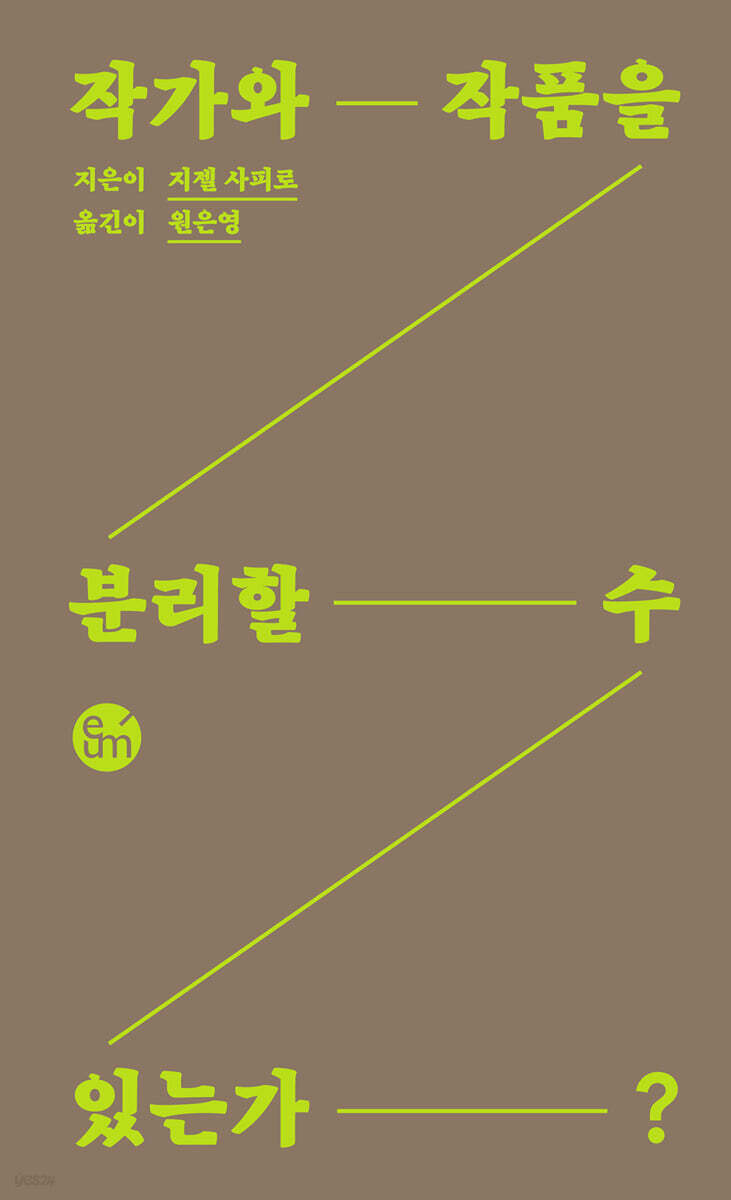
Can the author and the work be separated?
 |
Description
Book Introduction
The issue surrounding the morality of the work and its author is the most heated debate at this point.
When an incident occurs, the debate becomes heated, sometimes devolving into baseless accusations and illogical arguments rather than healthy discussions.
This is because, until now, there has been an absence of a theoretical and analytical framework to deal with this.
"Can Authors and Works Be Separated?" is a book that covers various discussions surrounding the morality of authors and their works, and introduces basic theories and analytical methods that can be utilized.
This book will serve as a guide for those who are confused.
When an incident occurs, the debate becomes heated, sometimes devolving into baseless accusations and illogical arguments rather than healthy discussions.
This is because, until now, there has been an absence of a theoretical and analytical framework to deal with this.
"Can Authors and Works Be Separated?" is a book that covers various discussions surrounding the morality of authors and their works, and introduces basic theories and analytical methods that can be utilized.
This book will serve as a guide for those who are confused.
- You can preview some of the book's contents.
Preview
index
Translator's Note
Preface to the Korean edition
introduction
Part 1: Authors and Works
Chapter 1: Metonymic Relationships
The instability of the boundary of a 'work'
Organizing consistency
Chapter 2 Similar Relationships
Author, speaker, character
Writing about yourself
The Author and His Fictional Alter: Houellebecq and Bénier-Bürkel
Chapter 3: Intentionality/Intentionality or Internal Causality
Lawsuits over intent? The "right to make mistakes" of anti-German collaborators.
Backfire? Orel's Song and Brett Bailey's "Exhibition B"
Writers Embroiled in Part 2 Scandals
Chapter 4 Abuse of Power
Meaning of the award: Polanski case
The Depraved Child Sexuality - The Glory and Misery of the Author
Chapter 5: Participating in Reality That Endangers Reputation
Hermeneutics of Oppression: Blanchot and Grass vs. De Man and Jauss
Heidegger's “Metaphysical Anti-Semitism”
In memory of Moras?
Endgame: From Literature to Ideology
Chapter 6: Is Peter Handke an Advocate of Evil?
Ambiguity about the writing of doubt
The price of real-world engagement
conclusion
Acknowledgements
Author's Note
Appendix: The Impure Foundations of Autonomy
Preface to the Korean edition
introduction
Part 1: Authors and Works
Chapter 1: Metonymic Relationships
The instability of the boundary of a 'work'
Organizing consistency
Chapter 2 Similar Relationships
Author, speaker, character
Writing about yourself
The Author and His Fictional Alter: Houellebecq and Bénier-Bürkel
Chapter 3: Intentionality/Intentionality or Internal Causality
Lawsuits over intent? The "right to make mistakes" of anti-German collaborators.
Backfire? Orel's Song and Brett Bailey's "Exhibition B"
Writers Embroiled in Part 2 Scandals
Chapter 4 Abuse of Power
Meaning of the award: Polanski case
The Depraved Child Sexuality - The Glory and Misery of the Author
Chapter 5: Participating in Reality That Endangers Reputation
Hermeneutics of Oppression: Blanchot and Grass vs. De Man and Jauss
Heidegger's “Metaphysical Anti-Semitism”
In memory of Moras?
Endgame: From Literature to Ideology
Chapter 6: Is Peter Handke an Advocate of Evil?
Ambiguity about the writing of doubt
The price of real-world engagement
conclusion
Acknowledgements
Author's Note
Appendix: The Impure Foundations of Autonomy
Detailed image
Into the book
However, this does not mean that all claims have equal value, and some claims may obscure others.
This essay seeks to step back from the evolving debate, take a socio-historical perspective on it, and offer a critical tool.
While not denying the principle of "art for art's sake," the book takes seriously the movements and motivations of younger generations to boycott and reject certain artists, and reminds us that "art for art's sake" does not mean a license to abuse others, in the face of the contemporary sacralization of the creator.
--- p.20
The distinction between the morality of a work and the morality of its author has only recently been raised by feminist organizations, but the question is old and has been sharply raised by public figures and artists who have publicly made racist or anti-Semitic remarks, incited hatred, or expressed support for the Nazis. These attitudes are also condemned by law.
--- p.27~28
The controversies surrounding Roman Polanski, Peter Handke, and other cases have raised two questions.
Should a writer be censored based on his or her conduct? Can an award for a work be given without considering the individual's actions or attitudes? These questions also arise about public figures like Heidegger, Gauguin, or Nolde, whose past engagement with reality or actions was unknown or underappreciated.
Should we reevaluate the ceasefire?
--- p.91
When male and female creators are accused of rape and sexual assault, these accusations are generally seen as an attack on creative freedom.
Of course, creative freedom must be protected from ideological coercion or economic pressure.
But freedom of creation has never been defined as the freedom to harm others.
The fact that the charismatic figure of the divine monster or genius could be used as a tool, even to cover up specific violations, highlights the need for our society to question the power that the position of author or creator creates.
Likewise, if a writer uses his or her symbolic power to spread hate speech, that writer should be held accountable.
This essay seeks to step back from the evolving debate, take a socio-historical perspective on it, and offer a critical tool.
While not denying the principle of "art for art's sake," the book takes seriously the movements and motivations of younger generations to boycott and reject certain artists, and reminds us that "art for art's sake" does not mean a license to abuse others, in the face of the contemporary sacralization of the creator.
--- p.20
The distinction between the morality of a work and the morality of its author has only recently been raised by feminist organizations, but the question is old and has been sharply raised by public figures and artists who have publicly made racist or anti-Semitic remarks, incited hatred, or expressed support for the Nazis. These attitudes are also condemned by law.
--- p.27~28
The controversies surrounding Roman Polanski, Peter Handke, and other cases have raised two questions.
Should a writer be censored based on his or her conduct? Can an award for a work be given without considering the individual's actions or attitudes? These questions also arise about public figures like Heidegger, Gauguin, or Nolde, whose past engagement with reality or actions was unknown or underappreciated.
Should we reevaluate the ceasefire?
--- p.91
When male and female creators are accused of rape and sexual assault, these accusations are generally seen as an attack on creative freedom.
Of course, creative freedom must be protected from ideological coercion or economic pressure.
But freedom of creation has never been defined as the freedom to harm others.
The fact that the charismatic figure of the divine monster or genius could be used as a tool, even to cover up specific violations, highlights the need for our society to question the power that the position of author or creator creates.
Likewise, if a writer uses his or her symbolic power to spread hate speech, that writer should be held accountable.
--- p.207
Publisher's Review
Between love and deletion,
Always a hot and old issue
When a work we've loved so dearly is discovered to have violated someone's rights, or when it's revealed that the author has committed a crime or morally wrongful act, what should we do with that love? We can't simply cut that heart off overnight, nor can we sustain that love. We're left clutching that heart, unable to move forward.
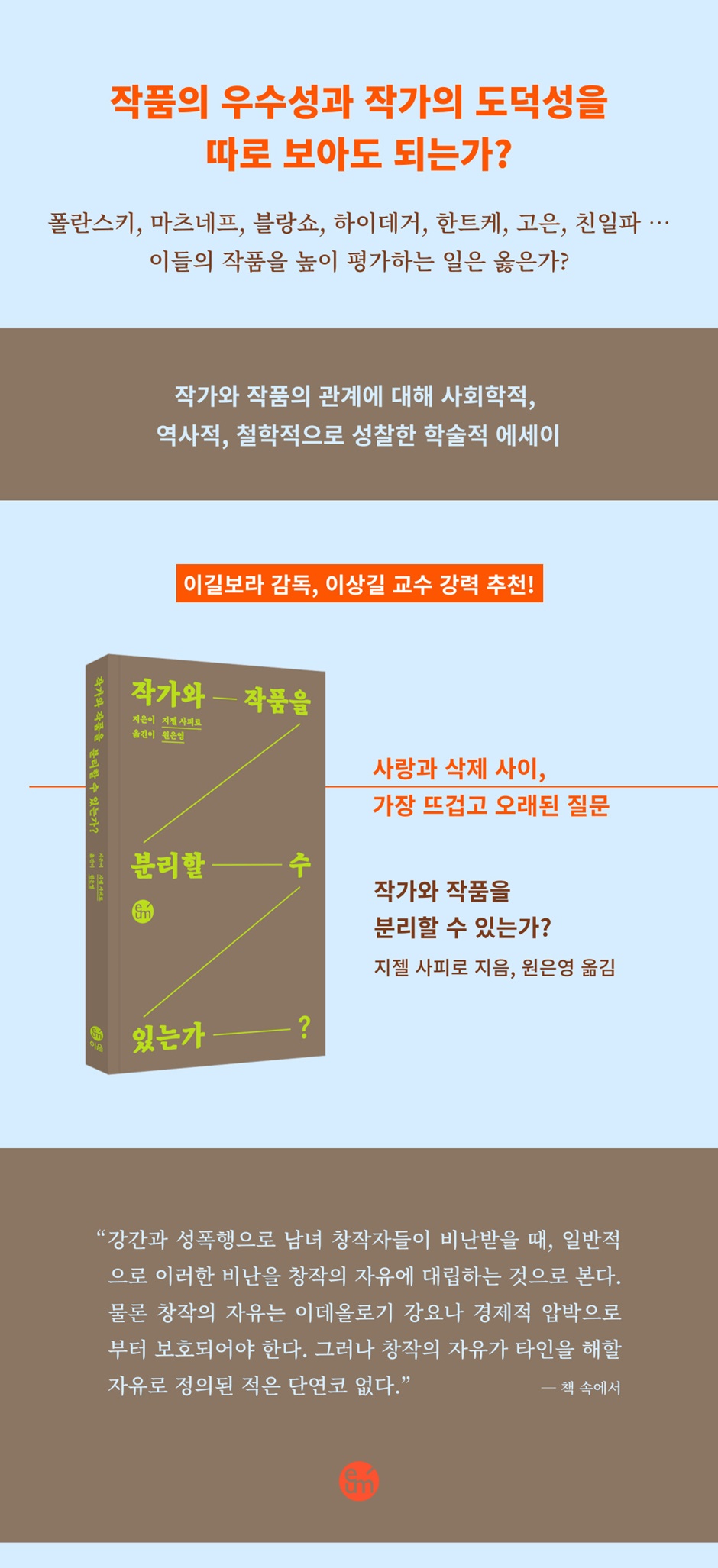
The issue surrounding the morality of the work and its author is the most heated debate at this point.
A recent incident in which a novelist reproduced the victim's story in his work without her permission sparked a heated debate over creative freedom, the scope of tolerance, and the ethics of reproduction. The controversy surrounding the #MeToo movement, which began in earnest in 2016, and the subsequent return of the perpetrator to creative activities, continues to this day.
While some call for boycotts, boycotts, and even the deletion of the work and the permanent suspension of the artist's creative activities, others believe that the excellence of a work should be judged solely by the work itself.
Although it has once again surfaced, the debate surrounding the ethics of authors and their works has been an ongoing issue with many conflicting views for a long time.
The feeling of discomfort we feel when we find out too late that the author of a work included in a textbook was pro-Japanese is not at all unfamiliar to us.
With the emergence of social media, which serves as both a private space and a public forum where anyone can freely express their opinions, more people have been able to voice their opinions.
Whenever an incident occurs, heated debates about it erupt on social media, sometimes devolving into groundless accusations and illogical arguments rather than healthy discussions.
This is because, until now, there has been an absence of a theoretical and analytical framework to address these issues.
"Can Authors and Works Be Separated?" is a book that covers various discussions surrounding the morality of authors and their works, and introduces basic theories and useful analytical methods that can be utilized.
This book will serve as a guide for those who are confused.
In 'What is a writer?'
Peter Handke's Nobel Prize win
Can the author and the work be separated? To answer this question, this book begins by examining the relationship between "author" and "work."
Are the author as creator of a work and the author as a human being the same person? Does the work's ethics reflect the author's? Are the two inseparable? Part 1 of the book seeks to answer these questions by analyzing and defining the relationship between the author and the work in three ways.
If Part 1 of the book is a theory section that establishes a theoretical foundation, Part 2 is a practical section that applies it to real-life examples.
Based on the analytical framework established in Part 1, Part 2 examines the cases of Roman Polanski, Heidegger, and Peter Handke, divided by their characteristics.
Chapter 4 deals with writers who have committed crimes such as rape, child sexual abuse, and murder, while Chapter 5 deals with writers who have expressed problematic ideologies such as racism, anti-Semitism, and support for fascism and Nazism.
The controversy sparked by the Nobel Prize in Literature awarded to Peter Handke, who expressed a pro-Serbian stance during the wars in the former Yugoslavia, is discussed separately in Chapter 6.
By analyzing specific cases, we examine several questions surrounding the relationship between an author's morality and his or her work, which arise when the author commits a reprehensible act or crime.
By following the author's analysis, each reader will find it easy to apply and expand upon it to other cases.
For those who want to become better cultural consumers and mediators
This book argues that simply deleting problematic works and making them seem as if they never existed is dangerous.
Because it can erase even the traces of violence.
We need a “questioning attitude” and “good questions” rather than quick and clear decisions or answers.
This will lead to a proper discussion and a better direction for the cultural world.
As viewers and consumers of art, the works we choose reflect our personal ethics.
For those struggling to become better appreciators and consumers of culture, "Can You Separate the Author and the Work?" will be a very useful book.
As you follow the author's case studies, along with the underlying theoretical framework, you'll soon develop your own ethical principles and develop useful analytical tools.
This book particularly emphasizes the role of cultural mediators, who decide which works will be highly praised, awarded, and elevated to the ranks of classics, and which will be introduced to the public and which will not.
I highly recommend this book to them.
Always a hot and old issue
When a work we've loved so dearly is discovered to have violated someone's rights, or when it's revealed that the author has committed a crime or morally wrongful act, what should we do with that love? We can't simply cut that heart off overnight, nor can we sustain that love. We're left clutching that heart, unable to move forward.
The issue surrounding the morality of the work and its author is the most heated debate at this point.
A recent incident in which a novelist reproduced the victim's story in his work without her permission sparked a heated debate over creative freedom, the scope of tolerance, and the ethics of reproduction. The controversy surrounding the #MeToo movement, which began in earnest in 2016, and the subsequent return of the perpetrator to creative activities, continues to this day.
While some call for boycotts, boycotts, and even the deletion of the work and the permanent suspension of the artist's creative activities, others believe that the excellence of a work should be judged solely by the work itself.
Although it has once again surfaced, the debate surrounding the ethics of authors and their works has been an ongoing issue with many conflicting views for a long time.
The feeling of discomfort we feel when we find out too late that the author of a work included in a textbook was pro-Japanese is not at all unfamiliar to us.
With the emergence of social media, which serves as both a private space and a public forum where anyone can freely express their opinions, more people have been able to voice their opinions.
Whenever an incident occurs, heated debates about it erupt on social media, sometimes devolving into groundless accusations and illogical arguments rather than healthy discussions.
This is because, until now, there has been an absence of a theoretical and analytical framework to address these issues.
"Can Authors and Works Be Separated?" is a book that covers various discussions surrounding the morality of authors and their works, and introduces basic theories and useful analytical methods that can be utilized.
This book will serve as a guide for those who are confused.
In 'What is a writer?'
Peter Handke's Nobel Prize win
Can the author and the work be separated? To answer this question, this book begins by examining the relationship between "author" and "work."
Are the author as creator of a work and the author as a human being the same person? Does the work's ethics reflect the author's? Are the two inseparable? Part 1 of the book seeks to answer these questions by analyzing and defining the relationship between the author and the work in three ways.
If Part 1 of the book is a theory section that establishes a theoretical foundation, Part 2 is a practical section that applies it to real-life examples.
Based on the analytical framework established in Part 1, Part 2 examines the cases of Roman Polanski, Heidegger, and Peter Handke, divided by their characteristics.
Chapter 4 deals with writers who have committed crimes such as rape, child sexual abuse, and murder, while Chapter 5 deals with writers who have expressed problematic ideologies such as racism, anti-Semitism, and support for fascism and Nazism.
The controversy sparked by the Nobel Prize in Literature awarded to Peter Handke, who expressed a pro-Serbian stance during the wars in the former Yugoslavia, is discussed separately in Chapter 6.
By analyzing specific cases, we examine several questions surrounding the relationship between an author's morality and his or her work, which arise when the author commits a reprehensible act or crime.
By following the author's analysis, each reader will find it easy to apply and expand upon it to other cases.
For those who want to become better cultural consumers and mediators
This book argues that simply deleting problematic works and making them seem as if they never existed is dangerous.
Because it can erase even the traces of violence.
We need a “questioning attitude” and “good questions” rather than quick and clear decisions or answers.
This will lead to a proper discussion and a better direction for the cultural world.
As viewers and consumers of art, the works we choose reflect our personal ethics.
For those struggling to become better appreciators and consumers of culture, "Can You Separate the Author and the Work?" will be a very useful book.
As you follow the author's case studies, along with the underlying theoretical framework, you'll soon develop your own ethical principles and develop useful analytical tools.
This book particularly emphasizes the role of cultural mediators, who decide which works will be highly praised, awarded, and elevated to the ranks of classics, and which will be introduced to the public and which will not.
I highly recommend this book to them.
GOODS SPECIFICS
- Date of issue: January 20, 2025
- Page count, weight, size: 228 pages | 322g | 128*210*15mm
- ISBN13: 9791194172093
- ISBN10: 1194172091
You may also like
카테고리
korean


korean

![GQ KOREA Mark (Monthly): December [2025]](http://librairie.coreenne.fr/cdn/shop/files/8ef265dbbfbf186523ed75ba7319009d.jpg?v=1765340328&width=3840)


