

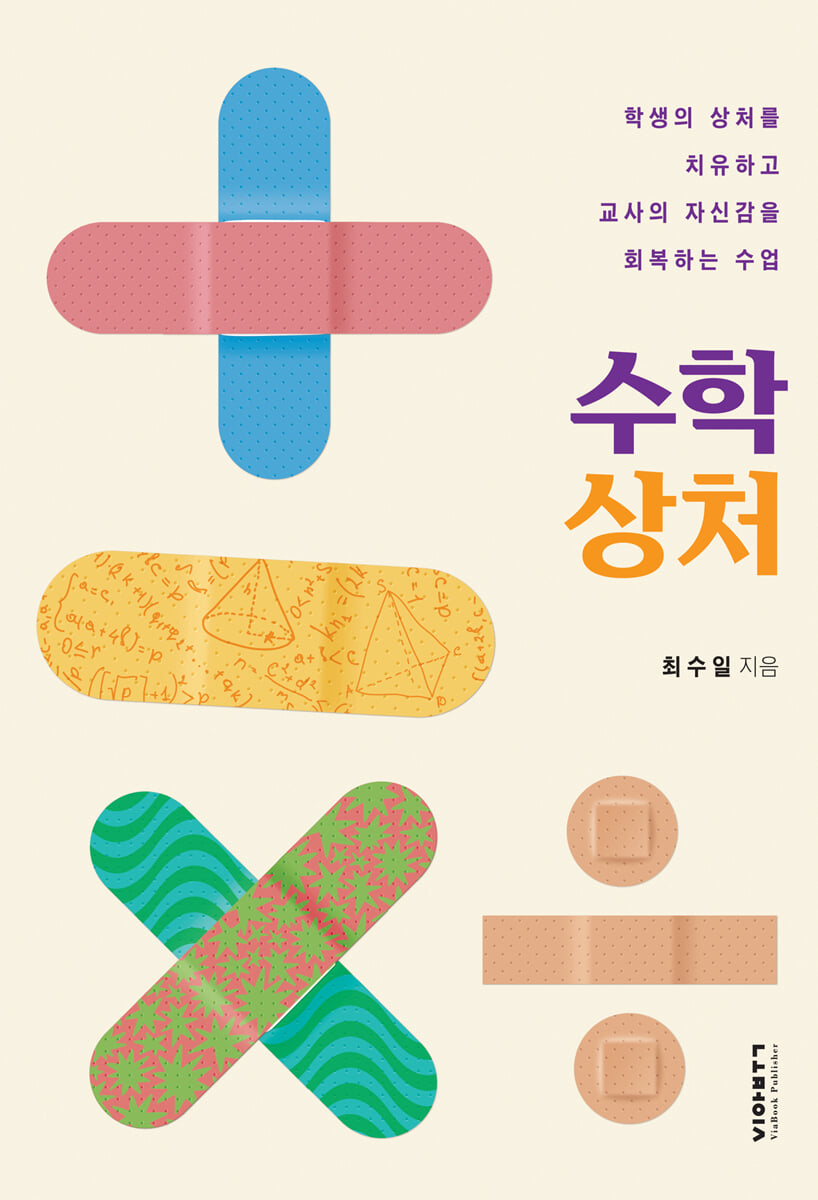
Math scars
 |
Description
Book Introduction
“Am I helping or hurting my students right now?”
Restoring a teacher's shattered self-esteem
Happy Math Class Guide
According to PISA 2022, South Korea's math scores ranked 1st or 2nd among OECD member countries and 3rd to 7th among 81 countries overall.
On the other hand, the difference in math achievement levels between students within schools was 98.1%, far exceeding the OECD member country average of 68.3%.
This clearly shows the reality of our country, where the average math score is high but the academic achievement gap is severe.
Meanwhile, 'math self-efficacy' ranked 47th, and 'effort and persistence in math' ranked 58th, which also shows the reality of 'math dropouts' in Korea.
Teachers feel this reality more closely than anyone else.
The reasons for participating in a job training program conducted by the National Association of Mathematics Teachers were as follows.
First, I lack confidence in class.
Second, it is difficult to have classes where students actively participate and communicate with each other.
Third, there is the concern of having to teach in a classroom where there is a difference in level.
Fourth, I lack confidence in my professionalism as a math teacher.
Fifth, I am taking a class ‘alone’.
In this way, teachers in the field are facing realistic obstacles that are difficult to overcome through effort.
Even though the problem that needs to be solved is obvious, I am struggling alone and gradually losing confidence.
Having worked in the teaching profession and in educational organizations for over 40 years, the author has witnessed the damage that the current mathematics education method has inflicted on students and teachers. He diagnoses the current situation as follows.
“The misconception that students who solve many difficult math problems from a young age will demonstrate solid skills is shattered when they reach middle and high school.
Although 80% of all students jump into early math, only a very small number of them truly enjoy and excel at math.
Many students are suffering from a sense of defeatism due to math.
“In this situation, math teachers are also losing their self-esteem and confidence.”
-From the "Preface"
Students aren't the only ones who get hurt by math.
Teachers who deal directly with students are also losing confidence and being hurt by mathematics.
Based on this awareness of the problem, a book titled "Mathematics Wounds" was published to heal the wounds of mathematics teachers and suggest a direction for the future.
We identify the root causes of the occurrence of 'dropouts' and provide specific teaching guidelines to create a classroom where both students and teachers are happy.
I hope this will help you regain your lost confidence in teaching and gain clear answers to the questions of 'how and what to teach.'
Restoring a teacher's shattered self-esteem
Happy Math Class Guide
According to PISA 2022, South Korea's math scores ranked 1st or 2nd among OECD member countries and 3rd to 7th among 81 countries overall.
On the other hand, the difference in math achievement levels between students within schools was 98.1%, far exceeding the OECD member country average of 68.3%.
This clearly shows the reality of our country, where the average math score is high but the academic achievement gap is severe.
Meanwhile, 'math self-efficacy' ranked 47th, and 'effort and persistence in math' ranked 58th, which also shows the reality of 'math dropouts' in Korea.
Teachers feel this reality more closely than anyone else.
The reasons for participating in a job training program conducted by the National Association of Mathematics Teachers were as follows.
First, I lack confidence in class.
Second, it is difficult to have classes where students actively participate and communicate with each other.
Third, there is the concern of having to teach in a classroom where there is a difference in level.
Fourth, I lack confidence in my professionalism as a math teacher.
Fifth, I am taking a class ‘alone’.
In this way, teachers in the field are facing realistic obstacles that are difficult to overcome through effort.
Even though the problem that needs to be solved is obvious, I am struggling alone and gradually losing confidence.
Having worked in the teaching profession and in educational organizations for over 40 years, the author has witnessed the damage that the current mathematics education method has inflicted on students and teachers. He diagnoses the current situation as follows.
“The misconception that students who solve many difficult math problems from a young age will demonstrate solid skills is shattered when they reach middle and high school.
Although 80% of all students jump into early math, only a very small number of them truly enjoy and excel at math.
Many students are suffering from a sense of defeatism due to math.
“In this situation, math teachers are also losing their self-esteem and confidence.”
-From the "Preface"
Students aren't the only ones who get hurt by math.
Teachers who deal directly with students are also losing confidence and being hurt by mathematics.
Based on this awareness of the problem, a book titled "Mathematics Wounds" was published to heal the wounds of mathematics teachers and suggest a direction for the future.
We identify the root causes of the occurrence of 'dropouts' and provide specific teaching guidelines to create a classroom where both students and teachers are happy.
I hope this will help you regain your lost confidence in teaching and gain clear answers to the questions of 'how and what to teach.'
- You can preview some of the book's contents.
Preview
index
Preface - Mathematics: What and How to Teach It?
Part 1: How to Teach Mathematics - The Mathematics of Learning
Chapter 1: The Dilemma of Mathematics Education in Korea
Teachers who are anxious about math
The subject students hate the most, math
Students who only become quiet during math class
Teaching with silence, not words
Two Ways to Make Classes Run Smoothly
Chapter 2: Teaching Methods for the Future
3-step activity class beyond the textbook
The dilemma of group formation
The 'Ignorant Teacher' Experiment
Teaching with 5 practices
A class that also invites students who have previously attended
In a reality where there is a difference in level
So that all students can start off on the same footing
Chapter 3: How to Deal with Misconceptions
Students also respond to the teacher's response.
Triple device to prevent mistakes
Middle and high school problems also require some guesswork.
The Bermuda Triangle Theory of Error Correction
Middle-ranking students erase their own solutions by looking at the incorrect answers of the upper-ranking students.
Practical Ideas - Connecting Elementary, Middle, and High School Math Concepts with Consistency
The core idea of each angle, right angle
Formula for finding the sum of the interior angles of a polygon
The secret behind the formula for calculating the area of a triangle
Uniqueness, where mathematics is made
The core idea of the area formula, 1cm
Confusing arithmetic operations with fractions
Consistency is also important in the four basic operations of fractions.
The core idea of probability, fractions
The path from an isosceles triangle to an equilateral triangle
Consistency in elementary, middle, and high school calculations
An elementary school student's question about proportions
Discovering the circularity of rational numbers
Elementary teachers can better teach middle school children.
Proportional distribution in elementary schools and internal division in high schools
Differences in quadratic equation root formulas in middle school and high school
The concept of multiplication that eliminates the formulas of permutations
Part 2: Mathematics: What to Teach - Preparing for Communication
Chapter 1: Lack of Consistency Between the Curriculum and Textbooks
Changes in the 2022 Revised Curriculum
The gap between the curriculum and textbooks
Chapter 2: One-way lecture textbooks
A textbook that doesn't allow for guesswork
Textbooks that only demand imitation
Examples that take away opportunities for independent thinking
proof with a fixed answer
The use of text requires educational considerations.
Chapter 3: A Textbook Centered on Learner Learning
Opening the mind of a formal textbook
The definition is after sufficient observation and discussion.
Explaining mathematical concepts using various representations
Chapter 4: A Textbook for Developing Students' Initiatives
A class without review that makes you give up on math
'5 minutes' to get everyone on the starting line
Connection with previous concepts
A review process that integrates meaning
Chapter 5: A Textbook on Overcoming Separation and Achieving Integration Between Areas
Problems with segmented, domain-specific curricula
An integrated curriculum that connects disparate concepts
Changes in the first-year middle school textbook and the integration of the relationship area
Integration of rational and irrational equations and rational and irrational functions
Quadratic equations, quadratic inequalities, and integration of quadratic functions
Integration of equations and functions
Reconstructing textbooks to suit learners
Expansion of definitions appropriate for upper grades
Chapter 6: A Textbook with Good Assignments
What makes a good assignment?
Step-by-step questions that harm students' autonomy
Use materials that match students' interests
Creating assignments that take students' experiences into account
Avoid activities that lead students ahead of their time.
Creating tasks that require higher-order reasoning
Eliciting student findings through incorrect questions
Part 3: Why We Teach Mathematics - The Teacher's Identity
Chapter 1 Our Math Classroom Now
Why aren't classes getting easier?
Concerns about AI digital textbooks and engineering tools
You can't get through without proof
Chapter 2: Classes on Belief and Philosophy
The identity of a math teacher
We need unshakable faith
Fostering a Healthy Social Culture in Class
Mistakes are an idea bank
Why Secondary School Teachers Must Read Elementary School Textbooks
A class that helps students overcome the limitations of their teachers.
Why do we teach math?
Appendix - To move beyond a 'village without worrying about studying math' to a 'school without worrying about studying math'
References
Part 1: How to Teach Mathematics - The Mathematics of Learning
Chapter 1: The Dilemma of Mathematics Education in Korea
Teachers who are anxious about math
The subject students hate the most, math
Students who only become quiet during math class
Teaching with silence, not words
Two Ways to Make Classes Run Smoothly
Chapter 2: Teaching Methods for the Future
3-step activity class beyond the textbook
The dilemma of group formation
The 'Ignorant Teacher' Experiment
Teaching with 5 practices
A class that also invites students who have previously attended
In a reality where there is a difference in level
So that all students can start off on the same footing
Chapter 3: How to Deal with Misconceptions
Students also respond to the teacher's response.
Triple device to prevent mistakes
Middle and high school problems also require some guesswork.
The Bermuda Triangle Theory of Error Correction
Middle-ranking students erase their own solutions by looking at the incorrect answers of the upper-ranking students.
Practical Ideas - Connecting Elementary, Middle, and High School Math Concepts with Consistency
The core idea of each angle, right angle
Formula for finding the sum of the interior angles of a polygon
The secret behind the formula for calculating the area of a triangle
Uniqueness, where mathematics is made
The core idea of the area formula, 1cm
Confusing arithmetic operations with fractions
Consistency is also important in the four basic operations of fractions.
The core idea of probability, fractions
The path from an isosceles triangle to an equilateral triangle
Consistency in elementary, middle, and high school calculations
An elementary school student's question about proportions
Discovering the circularity of rational numbers
Elementary teachers can better teach middle school children.
Proportional distribution in elementary schools and internal division in high schools
Differences in quadratic equation root formulas in middle school and high school
The concept of multiplication that eliminates the formulas of permutations
Part 2: Mathematics: What to Teach - Preparing for Communication
Chapter 1: Lack of Consistency Between the Curriculum and Textbooks
Changes in the 2022 Revised Curriculum
The gap between the curriculum and textbooks
Chapter 2: One-way lecture textbooks
A textbook that doesn't allow for guesswork
Textbooks that only demand imitation
Examples that take away opportunities for independent thinking
proof with a fixed answer
The use of text requires educational considerations.
Chapter 3: A Textbook Centered on Learner Learning
Opening the mind of a formal textbook
The definition is after sufficient observation and discussion.
Explaining mathematical concepts using various representations
Chapter 4: A Textbook for Developing Students' Initiatives
A class without review that makes you give up on math
'5 minutes' to get everyone on the starting line
Connection with previous concepts
A review process that integrates meaning
Chapter 5: A Textbook on Overcoming Separation and Achieving Integration Between Areas
Problems with segmented, domain-specific curricula
An integrated curriculum that connects disparate concepts
Changes in the first-year middle school textbook and the integration of the relationship area
Integration of rational and irrational equations and rational and irrational functions
Quadratic equations, quadratic inequalities, and integration of quadratic functions
Integration of equations and functions
Reconstructing textbooks to suit learners
Expansion of definitions appropriate for upper grades
Chapter 6: A Textbook with Good Assignments
What makes a good assignment?
Step-by-step questions that harm students' autonomy
Use materials that match students' interests
Creating assignments that take students' experiences into account
Avoid activities that lead students ahead of their time.
Creating tasks that require higher-order reasoning
Eliciting student findings through incorrect questions
Part 3: Why We Teach Mathematics - The Teacher's Identity
Chapter 1 Our Math Classroom Now
Why aren't classes getting easier?
Concerns about AI digital textbooks and engineering tools
You can't get through without proof
Chapter 2: Classes on Belief and Philosophy
The identity of a math teacher
We need unshakable faith
Fostering a Healthy Social Culture in Class
Mistakes are an idea bank
Why Secondary School Teachers Must Read Elementary School Textbooks
A class that helps students overcome the limitations of their teachers.
Why do we teach math?
Appendix - To move beyond a 'village without worrying about studying math' to a 'school without worrying about studying math'
References
Detailed image

Publisher's Review
From practical examples to mindset
From class execution to class preparation to class philosophy
3-Step 'Treatment' Roadmap
"Math Wounds" is a book that comforts teachers who have been hurt and is like a teaching manual with practical advice for 'healing'.
No matter how good your teaching philosophy is, it's useless if you don't know how to apply it to your classes.
The author presents concrete teaching methods proven through experiments, along with abundant field examples.
And we talk about what preparations are needed to conduct a good class, what to teach the children, and finally, what kind of mindset to have when teaching the children.
Part 1, “How to Teach Mathematics: A Class for Learning,” examines the dilemma of mathematics education in Korea and discusses teaching methods for the future.
You can also get a taste of practical ideas that can connect elementary, middle, and high school math concepts with consistency.
Part 2, “What to Teach in Mathematics: Preparing for Communication,” presents the ideal textbook for overcoming the problems of mathematics textbooks and fostering students’ proactive thinking.
And through examples of overcoming separation and achieving integration across domains, it explains how good assignments can heal students' wounds.
Part 3, “Why Teach Mathematics_Teacher’s Identity,” covers the identity of a mathematics teacher that can support all of this.
By reflecting on the inner workings of teachers, such as the question of why they teach mathematics and their unwavering beliefs, we can see a new perspective on forming a healthy classroom culture and viewing mistakes as a bank of ideas.
In the appendix, "To Go Beyond a 'Village Without Worries About Math Studying' to a 'School Without Worries About Math Studying'," the author introduces the 'Village Without Worries About Math Studying' that he has been creating since 2023.
'A village without the worry of studying math' is a village where village teachers, who are citizens, help the children study math.
At this time, the village teacher does not teach the children, but only helps them with self-directed learning.
This 'village without worrying about studying math' provides a glimpse into the idea of expanding into a 'school without worrying about studying math.'
Not a 'teacher who teaches'
The Path to Becoming a 'Co-Teacher'
I think teacher-centered classes are beneficial for achieving learning goals.
(O, X)
I don't think there will be any major problems if you teach according to the textbook.
(O, X)
It is inevitable that students who have done prior learning will not show interest in class.
(O, X)
Before solving an unfamiliar type of problem, I always provide an example solution.
(O, X)
If you nod your head to even one of these sentences, you are a 'hurt' teacher.
At the beginning of each chapter, there is a questionnaire prepared for teachers to self-diagnose, as shown above.
The purpose of the questions is not to reprimand you for what you have done wrong so far, but to suggest a direction for you as a practitioner who faces classes and students.
As you progress through the class, you are bound to encounter realistic obstacles.
For example, students who have done prior learning may not be interested in class, or it may be difficult to provide a class that satisfies everyone due to differences in ability among students.
As time passes and accumulates, you naturally end up giving up on the ideals you once held.
Gradually, teacher-centered classes become the norm, and it becomes natural for students who have done prior learning to show no interest in class.
The focus of the class becomes on the top students, and there is no room to care for the middle and lower level students.
In this way, the teacher gets hurt little by little.
"Math Wounds" is a book that helps you become a "teacher who accompanies others" rather than a "teacher who teaches."
It confronts various difficulties that teachers face in reality, such as 'How to attract students who have learned in advance to class', 'How to teach smoothly in a classroom with different levels', 'Why it is not good for teachers to react to students' right or wrong answers', and 'How to create good assignments', and presents the causes of specific problems and solutions with class examples.
From the perspective of a field teacher who must conduct classes day after day, the author's suggestion to change the teaching paradigm may sound heavy at first.
We can't change all our teaching methods right now, and there are so many variables.
However, 『Math Wounds』 is a book that helps you take the 'first step' toward change.
This book offers warm encouragement and a helping hand to lonely teachers who struggle every day to improve their classes.
“It is truly unfortunate that teachers in the field are increasingly being driven out.
Nevertheless, our country has achieved this level of progress thanks to the teachers who quietly love children and strive to foster mathematical thinking.
I hope that an atmosphere will soon be created where schools, society, and families can work together to consider the future of our children's education. I also support the teachers who are working hard to teach math today.”
-From the "Preface"
From class execution to class preparation to class philosophy
3-Step 'Treatment' Roadmap
"Math Wounds" is a book that comforts teachers who have been hurt and is like a teaching manual with practical advice for 'healing'.
No matter how good your teaching philosophy is, it's useless if you don't know how to apply it to your classes.
The author presents concrete teaching methods proven through experiments, along with abundant field examples.
And we talk about what preparations are needed to conduct a good class, what to teach the children, and finally, what kind of mindset to have when teaching the children.
Part 1, “How to Teach Mathematics: A Class for Learning,” examines the dilemma of mathematics education in Korea and discusses teaching methods for the future.
You can also get a taste of practical ideas that can connect elementary, middle, and high school math concepts with consistency.
Part 2, “What to Teach in Mathematics: Preparing for Communication,” presents the ideal textbook for overcoming the problems of mathematics textbooks and fostering students’ proactive thinking.
And through examples of overcoming separation and achieving integration across domains, it explains how good assignments can heal students' wounds.
Part 3, “Why Teach Mathematics_Teacher’s Identity,” covers the identity of a mathematics teacher that can support all of this.
By reflecting on the inner workings of teachers, such as the question of why they teach mathematics and their unwavering beliefs, we can see a new perspective on forming a healthy classroom culture and viewing mistakes as a bank of ideas.
In the appendix, "To Go Beyond a 'Village Without Worries About Math Studying' to a 'School Without Worries About Math Studying'," the author introduces the 'Village Without Worries About Math Studying' that he has been creating since 2023.
'A village without the worry of studying math' is a village where village teachers, who are citizens, help the children study math.
At this time, the village teacher does not teach the children, but only helps them with self-directed learning.
This 'village without worrying about studying math' provides a glimpse into the idea of expanding into a 'school without worrying about studying math.'
Not a 'teacher who teaches'
The Path to Becoming a 'Co-Teacher'
I think teacher-centered classes are beneficial for achieving learning goals.
(O, X)
I don't think there will be any major problems if you teach according to the textbook.
(O, X)
It is inevitable that students who have done prior learning will not show interest in class.
(O, X)
Before solving an unfamiliar type of problem, I always provide an example solution.
(O, X)
If you nod your head to even one of these sentences, you are a 'hurt' teacher.
At the beginning of each chapter, there is a questionnaire prepared for teachers to self-diagnose, as shown above.
The purpose of the questions is not to reprimand you for what you have done wrong so far, but to suggest a direction for you as a practitioner who faces classes and students.
As you progress through the class, you are bound to encounter realistic obstacles.
For example, students who have done prior learning may not be interested in class, or it may be difficult to provide a class that satisfies everyone due to differences in ability among students.
As time passes and accumulates, you naturally end up giving up on the ideals you once held.
Gradually, teacher-centered classes become the norm, and it becomes natural for students who have done prior learning to show no interest in class.
The focus of the class becomes on the top students, and there is no room to care for the middle and lower level students.
In this way, the teacher gets hurt little by little.
"Math Wounds" is a book that helps you become a "teacher who accompanies others" rather than a "teacher who teaches."
It confronts various difficulties that teachers face in reality, such as 'How to attract students who have learned in advance to class', 'How to teach smoothly in a classroom with different levels', 'Why it is not good for teachers to react to students' right or wrong answers', and 'How to create good assignments', and presents the causes of specific problems and solutions with class examples.
From the perspective of a field teacher who must conduct classes day after day, the author's suggestion to change the teaching paradigm may sound heavy at first.
We can't change all our teaching methods right now, and there are so many variables.
However, 『Math Wounds』 is a book that helps you take the 'first step' toward change.
This book offers warm encouragement and a helping hand to lonely teachers who struggle every day to improve their classes.
“It is truly unfortunate that teachers in the field are increasingly being driven out.
Nevertheless, our country has achieved this level of progress thanks to the teachers who quietly love children and strive to foster mathematical thinking.
I hope that an atmosphere will soon be created where schools, society, and families can work together to consider the future of our children's education. I also support the teachers who are working hard to teach math today.”
-From the "Preface"
GOODS SPECIFICS
- Date of issue: December 13, 2024
- Page count, weight, size: 256 pages | 350g | 143*210*18mm
- ISBN13: 9791194348122
- ISBN10: 1194348122
You may also like
카테고리
korean


korean

![GQ KOREA Mark (Monthly): December [2025]](http://librairie.coreenne.fr/cdn/shop/files/8ef265dbbfbf186523ed75ba7319009d.jpg?v=1765340328&width=3840)


