

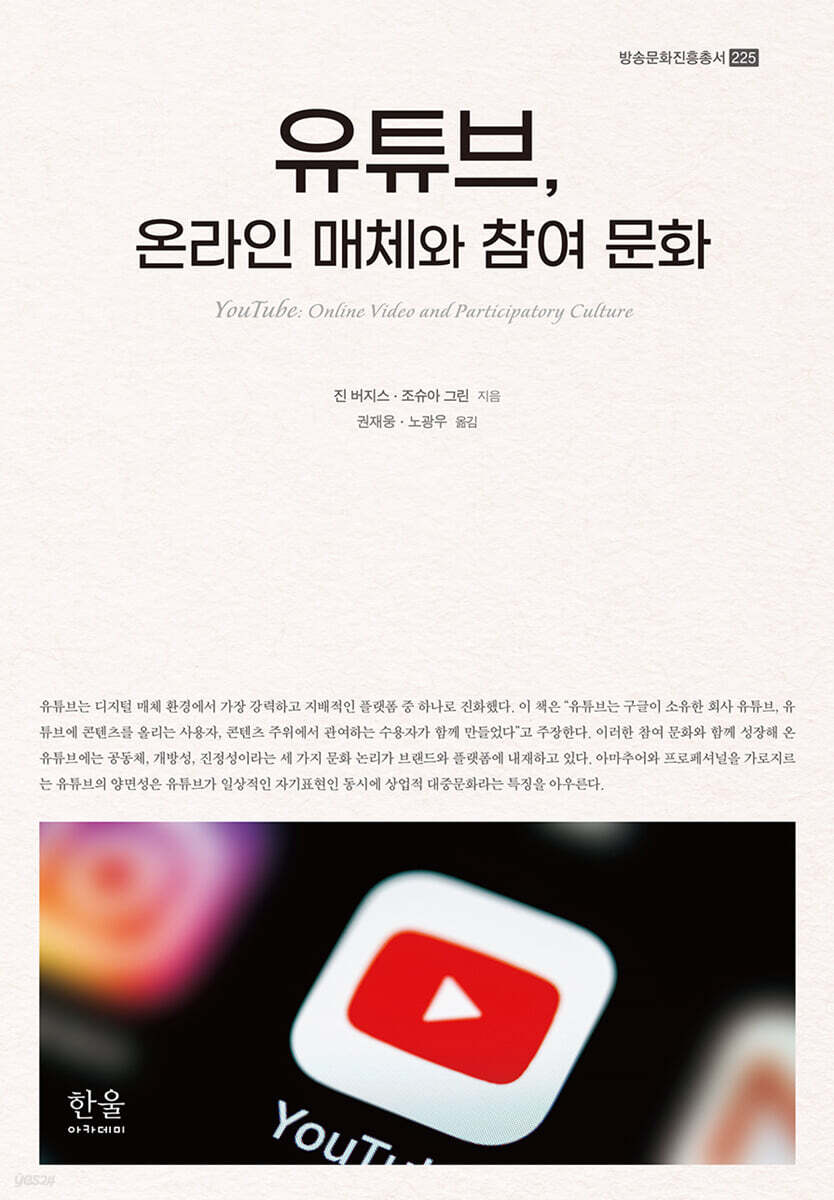
YouTube, Online Media, and Participatory Culture
 |
Description
Book Introduction
Anyone can participate
The most powerful online medium today
Research paper on YouTube
YouTube has become such a powerful and dominant medium that it has become a part of people's daily lives around the world.
When YouTube launched as an innovative startup in 2005, its business model was unclear and its future development was uncertain.
The advent of YouTube brought about a drastic and significant change in the way content was delivered, which had previously been centered on TV and newspapers.
YouTube is used by so many people everywhere and at all times that it has become difficult to distinguish it from traditional mainstream media.
But it's clear that the technology and platform YouTube provided were accessible to everyone from the beginning, and that's still the case today.
Since 2005, YouTube has grown into both a platform and a company, and its business model has been built around deriving value from content creators, subscribers, and advertisers as participants and coordinating their interests.
And now it finds itself competing with other social media or streaming platforms.
This book will serve as a guide for exploring the past, present, and future directions and significance of digital media and platforms across the fields of media, communication, and cultural studies.
The most powerful online medium today
Research paper on YouTube
YouTube has become such a powerful and dominant medium that it has become a part of people's daily lives around the world.
When YouTube launched as an innovative startup in 2005, its business model was unclear and its future development was uncertain.
The advent of YouTube brought about a drastic and significant change in the way content was delivered, which had previously been centered on TV and newspapers.
YouTube is used by so many people everywhere and at all times that it has become difficult to distinguish it from traditional mainstream media.
But it's clear that the technology and platform YouTube provided were accessible to everyone from the beginning, and that's still the case today.
Since 2005, YouTube has grown into both a platform and a company, and its business model has been built around deriving value from content creators, subscribers, and advertisers as participants and coordinating their interests.
And now it finds itself competing with other social media or streaming platforms.
This book will serve as a guide for exploring the past, present, and future directions and significance of digital media and platforms across the fields of media, communication, and cultural studies.
index
Preface to the 2nd edition
Acknowledgements
Translator's Preface
Chapter 1 - How YouTube Became Important
Origins | Platform Business | YouTube Research | Politics of Participatory Culture
Chapter 2 - YouTube and the Media
Framing YouTube | Social Concerns and Media Panic | YouTube and the Culture of Celebrity | The Changing Meaning of Everyday Videos | The Copyright War | YouTube as a Mainstream Media
Chapter 3 - Popular Culture on YouTube
Explaining Popularity | How the YouTube Platform Creates Popularity | The Two YouTubes: Original Content and User-Generated Content | Video Clips and Quotes: Leveraging Existing Media Content | From Vaudeville to Vlogs: User-Generated Content | Understanding Uploaders: Beyond the Professional and Amateur Distinction | From Videos and Views to Channels and Subscribers
Chapter 4 - YouTube Community
Platform as a Supporter | YouTuber as an Innovator | Learning with Others | Controversies Within the YouTube Community
Chapter 5 - Cultural Politics on YouTube
Diversity and Cultural Citizenship | Globalization and Localization | YouTube as a Cultural Repository
Chapter 6 - YouTube's Conflicting Future
Who's Sorry Now? | Productive Tension, Ongoing Challenges
annotation
References
Search
Acknowledgements
Translator's Preface
Chapter 1 - How YouTube Became Important
Origins | Platform Business | YouTube Research | Politics of Participatory Culture
Chapter 2 - YouTube and the Media
Framing YouTube | Social Concerns and Media Panic | YouTube and the Culture of Celebrity | The Changing Meaning of Everyday Videos | The Copyright War | YouTube as a Mainstream Media
Chapter 3 - Popular Culture on YouTube
Explaining Popularity | How the YouTube Platform Creates Popularity | The Two YouTubes: Original Content and User-Generated Content | Video Clips and Quotes: Leveraging Existing Media Content | From Vaudeville to Vlogs: User-Generated Content | Understanding Uploaders: Beyond the Professional and Amateur Distinction | From Videos and Views to Channels and Subscribers
Chapter 4 - YouTube Community
Platform as a Supporter | YouTuber as an Innovator | Learning with Others | Controversies Within the YouTube Community
Chapter 5 - Cultural Politics on YouTube
Diversity and Cultural Citizenship | Globalization and Localization | YouTube as a Cultural Repository
Chapter 6 - YouTube's Conflicting Future
Who's Sorry Now? | Productive Tension, Ongoing Challenges
annotation
References
Search
Into the book
YouTube's approach has always been two-faced.
One was the pursuit of professional production, which presented the challenges of copyright protection, professional artistry, and commercializing access and attention.
The other is a purely scale-based and ubiquitous concern, providing a platform for everyday expression, everyday creativity, and community building.
This duality of YouTube has never really been separate, but rather has become increasingly intertwined.
In fact, the dynamic tension and synergy of this duality has allowed YouTube to grow, diversify, and transform as a platform.
And this duality always has a commercial aspect.
--- From "Chapter 1: How YouTube Became Famous"
In its early days, YouTube demonstrated the potential for commercializing amateur content, and in some cases, turning those content creators into celebrities.
But as the examples mentioned above show, the residual logic of the traditional media industry remained influential, and the mark of success for these new forms was paradoxically not their online popularity, but their ability to pass through the gatekeeping structures of the purchasing entity (such as record contracts, film festivals, television pilots, and advertising deals) once they had achieved popularity.
By 2017, the star power and brand power of YouTubers had grown dramatically and exponentially, and the media ecosystem surrounding them had changed significantly, but the story of how they achieved that "fame" remained the same.
YouTubers become newsworthy when they do something that gains them notoriety or attention, or when their web series or vlog is picked up by a streaming service like Netflix to develop into a more formal program.
Of course, this kind of reporting of development as an official program is one way for mainstream media to strengthen their own cultural power and maintain a connection with the market.
--- From "Chapter 2 YouTube and Media"
The YouTube platform not only reinforces the importance of popularity, but also shapes it through its design, interface, and the rhetoric it uses to appeal to users.
By 2007, when we finished collecting data, YouTube website users could easily view a transparent "database" of well-organized, visually clear lists of content popular among other YouTube users, from which they could select and view.
This site has been progressively redesigned to keep pace with evolving web design conventions and the shift to mobile apps, connecting you directly to the content you want to see and promotional content.
By logging in, you can deliver content tailored to your personal tastes and manage your playlists.
In 2017, navigating this website has been reduced to a constant scrolling, and once users start viewing on most devices, the platform constantly encourages them to browse through "relevant videos" curated and presented by its algorithms.
--- From "Chapter 3: Popular Culture on YouTube"
While YouTube has always been said to be a community, it was initially designed and engineered to encourage individual participation rather than collaborative creation.
Opportunities for co-creation have either been intentionally created by the YouTube community itself, or have been specifically encouraged to do so by YouTube itself.
Back in 2008, YouTube didn't offer a standardized way for users to capture and reuse other users' videos or create their own content for that purpose.
Nonetheless, collaboratively produced and remixed vlogs are a notable characteristic of the most popular content in our study.
In some cases, it was clear that a lot of planning went into the production of these videos and that they served their intended purpose.
In other cases, it seemed to function as a way to celebrate and showcase YouTube as a community of practice.
--- From "Chapter 4 YouTube Community"
YouTube is a commercial enterprise, and always has been.
But YouTube has always been a platform designed to enable cultural engagement by the general public.
Despite all the complexities of a specialized media ecosystem, YouTube's inclusiveness and openness—that anyone can participate—is also the foundation of its unique commercial value.
This is what we mean when we say about YouTube, “Participatory culture is at the heart of this business.”
In the digital environment, peripheral, subcultural, and community-based modes of cultural production are, by design, absorbed into the commercial logic of mainstream media corporations, a clear example of the broader tendency for market and non-market modes of cultural production to become uneasily integrated.
As I've said, YouTube's value arises partly from the communication between its users and audiences, along with their collective creativity, and its culture is characterized by both commercial motivations and outcomes, as well as community motivations and outcomes.
Therefore, it is true that YouTube has provided a platform for a wider range of participants to participate in digital media culture than before, and the YouTube brand operates based on the social and cultural diversity that YouTube supports.
From a media and cultural studies perspective, access to and engagement with popular culture is a crucial means of political participation and citizenship, particularly for women, sexual minorities, religious minorities, and racial minorities.
Here, citizenship is not only a matter of the codified rights and obligations that individuals have in their relationship with the state, but also the way in which individuals engage in practices and collective actions that are shaped by common interests, identities, or issues of concern.
--- From "Chapter 5: Cultural Politics on YouTube"
Attempts to purify YouTube culture for advertisers have created numerous problems by conflating socio-cultural and political issues with commercial ones, and have exposed the limits of the tension between "community" and "corporate logic."
This problem was also notorious on Facebook and Twitter.
Even now, YouTube's two dimensions—as a corporate media business and as an open platform for everyday culture—remain in dynamic tension, and as long as this tension persists, YouTube will continue to be a site for cultural innovation and diversity.
One was the pursuit of professional production, which presented the challenges of copyright protection, professional artistry, and commercializing access and attention.
The other is a purely scale-based and ubiquitous concern, providing a platform for everyday expression, everyday creativity, and community building.
This duality of YouTube has never really been separate, but rather has become increasingly intertwined.
In fact, the dynamic tension and synergy of this duality has allowed YouTube to grow, diversify, and transform as a platform.
And this duality always has a commercial aspect.
--- From "Chapter 1: How YouTube Became Famous"
In its early days, YouTube demonstrated the potential for commercializing amateur content, and in some cases, turning those content creators into celebrities.
But as the examples mentioned above show, the residual logic of the traditional media industry remained influential, and the mark of success for these new forms was paradoxically not their online popularity, but their ability to pass through the gatekeeping structures of the purchasing entity (such as record contracts, film festivals, television pilots, and advertising deals) once they had achieved popularity.
By 2017, the star power and brand power of YouTubers had grown dramatically and exponentially, and the media ecosystem surrounding them had changed significantly, but the story of how they achieved that "fame" remained the same.
YouTubers become newsworthy when they do something that gains them notoriety or attention, or when their web series or vlog is picked up by a streaming service like Netflix to develop into a more formal program.
Of course, this kind of reporting of development as an official program is one way for mainstream media to strengthen their own cultural power and maintain a connection with the market.
--- From "Chapter 2 YouTube and Media"
The YouTube platform not only reinforces the importance of popularity, but also shapes it through its design, interface, and the rhetoric it uses to appeal to users.
By 2007, when we finished collecting data, YouTube website users could easily view a transparent "database" of well-organized, visually clear lists of content popular among other YouTube users, from which they could select and view.
This site has been progressively redesigned to keep pace with evolving web design conventions and the shift to mobile apps, connecting you directly to the content you want to see and promotional content.
By logging in, you can deliver content tailored to your personal tastes and manage your playlists.
In 2017, navigating this website has been reduced to a constant scrolling, and once users start viewing on most devices, the platform constantly encourages them to browse through "relevant videos" curated and presented by its algorithms.
--- From "Chapter 3: Popular Culture on YouTube"
While YouTube has always been said to be a community, it was initially designed and engineered to encourage individual participation rather than collaborative creation.
Opportunities for co-creation have either been intentionally created by the YouTube community itself, or have been specifically encouraged to do so by YouTube itself.
Back in 2008, YouTube didn't offer a standardized way for users to capture and reuse other users' videos or create their own content for that purpose.
Nonetheless, collaboratively produced and remixed vlogs are a notable characteristic of the most popular content in our study.
In some cases, it was clear that a lot of planning went into the production of these videos and that they served their intended purpose.
In other cases, it seemed to function as a way to celebrate and showcase YouTube as a community of practice.
--- From "Chapter 4 YouTube Community"
YouTube is a commercial enterprise, and always has been.
But YouTube has always been a platform designed to enable cultural engagement by the general public.
Despite all the complexities of a specialized media ecosystem, YouTube's inclusiveness and openness—that anyone can participate—is also the foundation of its unique commercial value.
This is what we mean when we say about YouTube, “Participatory culture is at the heart of this business.”
In the digital environment, peripheral, subcultural, and community-based modes of cultural production are, by design, absorbed into the commercial logic of mainstream media corporations, a clear example of the broader tendency for market and non-market modes of cultural production to become uneasily integrated.
As I've said, YouTube's value arises partly from the communication between its users and audiences, along with their collective creativity, and its culture is characterized by both commercial motivations and outcomes, as well as community motivations and outcomes.
Therefore, it is true that YouTube has provided a platform for a wider range of participants to participate in digital media culture than before, and the YouTube brand operates based on the social and cultural diversity that YouTube supports.
From a media and cultural studies perspective, access to and engagement with popular culture is a crucial means of political participation and citizenship, particularly for women, sexual minorities, religious minorities, and racial minorities.
Here, citizenship is not only a matter of the codified rights and obligations that individuals have in their relationship with the state, but also the way in which individuals engage in practices and collective actions that are shaped by common interests, identities, or issues of concern.
--- From "Chapter 5: Cultural Politics on YouTube"
Attempts to purify YouTube culture for advertisers have created numerous problems by conflating socio-cultural and political issues with commercial ones, and have exposed the limits of the tension between "community" and "corporate logic."
This problem was also notorious on Facebook and Twitter.
Even now, YouTube's two dimensions—as a corporate media business and as an open platform for everyday culture—remain in dynamic tension, and as long as this tension persists, YouTube will continue to be a site for cultural innovation and diversity.
--- From "Chapter 6: YouTube's Conflicting Future"
Publisher's Review
Analyzing Online Media, YouTube
It would be no exaggeration to say that 17 years have passed since YouTube launched its service in 2005, making it difficult to deliver news and advertising without online media and digital platforms like YouTube.
YouTube has now become a massively influential medium consumed globally, but it has gone through a series of trials and errors to achieve this, creating its own unique structure and culture.
This book is a translation of the second edition (2018) of the first edition (2009), which observed and analyzed YouTube from its early days.
The first edition, published in 2009, provided a detailed study of YouTube as a digital medium, and the second edition maintains that perspective while including updated case studies and changes since then.
This book comprehensively studies YouTube from a diachronic perspective, utilizing both quantitative and qualitative methods.
Participation and creativity: the two pillars that made YouTube what it is today.
One of the book's key arguments is that YouTube has evolved alongside a culture of participation.
The characteristics that define the platform called YouTube, such as authenticity, creativity, and everyday life, can also be said to be YouTube's unique user culture.
The genre that symbolizes this is the daily vlog.
Daily vlogs have become a representative genre on YouTube because anyone can easily create them without any special skills.
The authors demonstrate through several examples that YouTube created a platform in which anyone could participate, that users (creators) created content and uploaded it to YouTube, and that the audience (subscribers) who watched the content and left comments formed YouTube's unique user culture.
How YouTube Became a Dominant Medium
The authors argue that YouTube became such an influential and dominant platform globally because it allowed users to simultaneously view self-expressive and creative content created by ordinary users and popular, mainstream content from mainstream media outlets.
Just as YouTube was initially a commercial enterprise while also being a platform designed to enable participation by ordinary people, its inclusive yet commercial nature is also a characteristic that has made YouTube accessible to so many people.
We also examine how YouTube, now used by so many people that the distinction between YouTube and mainstream media has become meaningless, has reshaped its relationship with traditional media (TV, newspapers), and we also address the controversial copyright disputes and channel monetization issues that have arisen both on and off YouTube.
A brief summary of each chapter is as follows:
Chapter 1 presents the business role YouTube plays in the development of digital technology and the Internet, as well as the methods and directions for researching this role.
Chapter 2 covers how YouTube is defined within the media landscape and how it has grown into a media industry.
Chapter 3 examines the forms of culture that emerge through YouTube from the perspective of popular culture.
Chapter 4 discusses the interactions between users, audiences, and those involved in YouTube, and the discourse that takes place within the communities they constitute.
Chapter 5 discusses the cultural value of YouTube as a platform.
Chapter 6 presents the direction in which YouTube will move forward as a community and a business.
It would be no exaggeration to say that 17 years have passed since YouTube launched its service in 2005, making it difficult to deliver news and advertising without online media and digital platforms like YouTube.
YouTube has now become a massively influential medium consumed globally, but it has gone through a series of trials and errors to achieve this, creating its own unique structure and culture.
This book is a translation of the second edition (2018) of the first edition (2009), which observed and analyzed YouTube from its early days.
The first edition, published in 2009, provided a detailed study of YouTube as a digital medium, and the second edition maintains that perspective while including updated case studies and changes since then.
This book comprehensively studies YouTube from a diachronic perspective, utilizing both quantitative and qualitative methods.
Participation and creativity: the two pillars that made YouTube what it is today.
One of the book's key arguments is that YouTube has evolved alongside a culture of participation.
The characteristics that define the platform called YouTube, such as authenticity, creativity, and everyday life, can also be said to be YouTube's unique user culture.
The genre that symbolizes this is the daily vlog.
Daily vlogs have become a representative genre on YouTube because anyone can easily create them without any special skills.
The authors demonstrate through several examples that YouTube created a platform in which anyone could participate, that users (creators) created content and uploaded it to YouTube, and that the audience (subscribers) who watched the content and left comments formed YouTube's unique user culture.
How YouTube Became a Dominant Medium
The authors argue that YouTube became such an influential and dominant platform globally because it allowed users to simultaneously view self-expressive and creative content created by ordinary users and popular, mainstream content from mainstream media outlets.
Just as YouTube was initially a commercial enterprise while also being a platform designed to enable participation by ordinary people, its inclusive yet commercial nature is also a characteristic that has made YouTube accessible to so many people.
We also examine how YouTube, now used by so many people that the distinction between YouTube and mainstream media has become meaningless, has reshaped its relationship with traditional media (TV, newspapers), and we also address the controversial copyright disputes and channel monetization issues that have arisen both on and off YouTube.
A brief summary of each chapter is as follows:
Chapter 1 presents the business role YouTube plays in the development of digital technology and the Internet, as well as the methods and directions for researching this role.
Chapter 2 covers how YouTube is defined within the media landscape and how it has grown into a media industry.
Chapter 3 examines the forms of culture that emerge through YouTube from the perspective of popular culture.
Chapter 4 discusses the interactions between users, audiences, and those involved in YouTube, and the discourse that takes place within the communities they constitute.
Chapter 5 discusses the cultural value of YouTube as a platform.
Chapter 6 presents the direction in which YouTube will move forward as a community and a business.
GOODS SPECIFICS
- Date of issue: April 25, 2024
- Format: Paperback book binding method guide
- Page count, weight, size: 248 pages | 153*224*12mm
- ISBN13: 9788946082533
You may also like
카테고리
korean


korean

![GQ KOREA Mark (Monthly): December [2025]](http://librairie.coreenne.fr/cdn/shop/files/8ef265dbbfbf186523ed75ba7319009d.jpg?v=1765340328&width=3840)


