

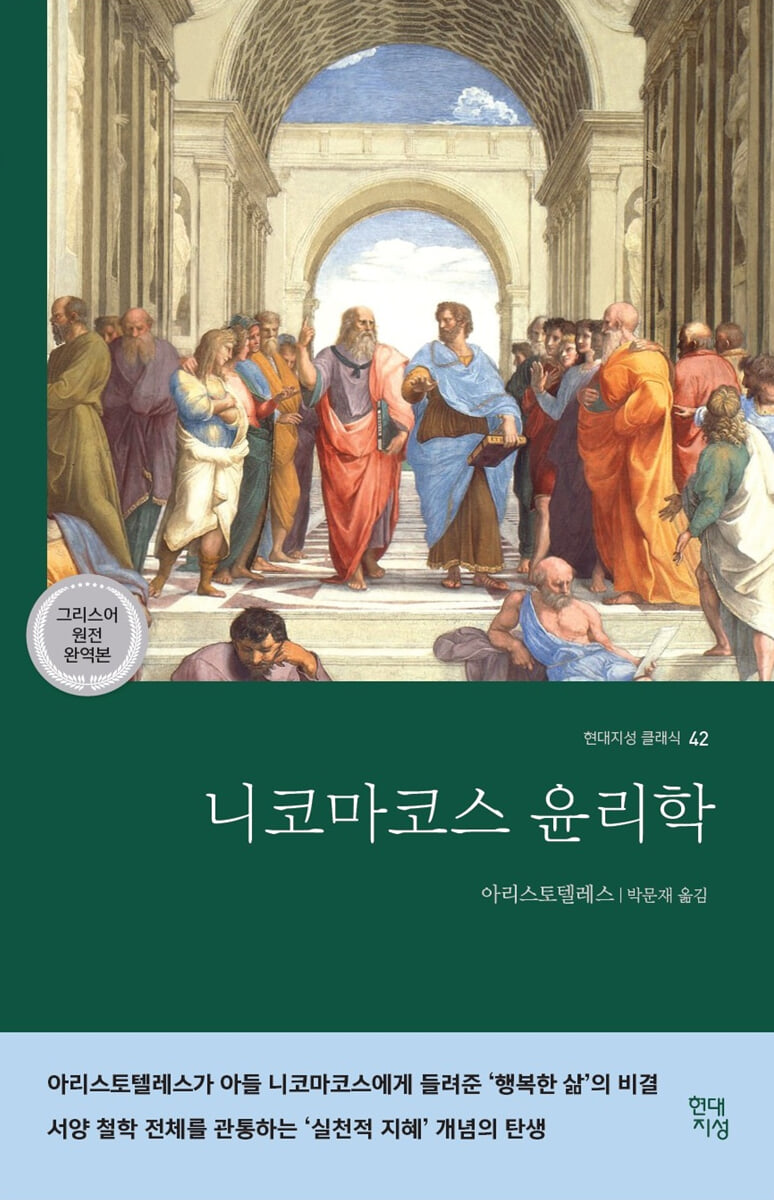
Nicomachean Ethics (Complete Translation of the Greek Original)
 |
Description
Book Introduction
Aristotle, the intellect of mankind
The Secret to a Happy Life, Told to His Son, Nicomachus
This book is a compilation of writings written by Aristotle to help him understand and lecture on where human happiness comes from, how it is possible, and how it is maintained and developed.
It is said that Aristotle's disciple Eudemus first wrote down his teacher's lectures, and then Aristotle's son Nicomachus compiled the manuscript and published this book.
In other words, this book is a very rare 'hot content' in which the greatest philosopher of mankind shared his thoughts on the personal and intimate subject of 'happiness' with his disciples and sons.
This is why, even after 2,400 years, people still consider the Nicomachean Ethics to be Aristotle's representative work.
Aristotle viewed happiness (ε?δαιμον?α, eudaimonia) as “an activity of the soul in which the proper functions of a human being are excellently exercised according to virtue (arete).”
It refers to a state in which people want to choose something “in itself” regardless of the outcome or reward, and are self-sufficient without any lack.
The image of a 'happy person' that the Greeks so desired was one in which various emotions, desires, and actions were well-managed by reason and intellect, and a state in which life's meaning was continuously fulfilled.
The sense of accomplishment, growth, enlightenment, and satisfaction that comes from maximizing one's abilities combine to create happiness in life.
And in this process, he believed that the reason (Logos) and intellect (Nous) given to humans must be used.
The Nicomachean Ethics emphasized knowledge that leads to action through “practical wisdom” (phronesis), knowledge that leads to real life, and thus gave birth to the medieval ideology of Thomas Aquinas, British utilitarianism, and Western empiricism, which, in turn, formed an important framework for Western philosophy as it led to pragmatism and scientism.
The translator, who smoothly translated Aristotle's Rhetoric and Poetics from the original Greek texts with meticulous annotations and footnotes, also helps readers gain a deeper understanding with this book through 380 meticulous footnotes, concise annotations that cover the entire text without unnecessary details, and comprehensive explanations of 15 key Greek terms.
Readers will be able to feel an intellectual thrill as they observe the various cases, variations, and combinations that occur as reason and intellect work together to ultimately create 'eudaimonia.'
The Secret to a Happy Life, Told to His Son, Nicomachus
This book is a compilation of writings written by Aristotle to help him understand and lecture on where human happiness comes from, how it is possible, and how it is maintained and developed.
It is said that Aristotle's disciple Eudemus first wrote down his teacher's lectures, and then Aristotle's son Nicomachus compiled the manuscript and published this book.
In other words, this book is a very rare 'hot content' in which the greatest philosopher of mankind shared his thoughts on the personal and intimate subject of 'happiness' with his disciples and sons.
This is why, even after 2,400 years, people still consider the Nicomachean Ethics to be Aristotle's representative work.
Aristotle viewed happiness (ε?δαιμον?α, eudaimonia) as “an activity of the soul in which the proper functions of a human being are excellently exercised according to virtue (arete).”
It refers to a state in which people want to choose something “in itself” regardless of the outcome or reward, and are self-sufficient without any lack.
The image of a 'happy person' that the Greeks so desired was one in which various emotions, desires, and actions were well-managed by reason and intellect, and a state in which life's meaning was continuously fulfilled.
The sense of accomplishment, growth, enlightenment, and satisfaction that comes from maximizing one's abilities combine to create happiness in life.
And in this process, he believed that the reason (Logos) and intellect (Nous) given to humans must be used.
The Nicomachean Ethics emphasized knowledge that leads to action through “practical wisdom” (phronesis), knowledge that leads to real life, and thus gave birth to the medieval ideology of Thomas Aquinas, British utilitarianism, and Western empiricism, which, in turn, formed an important framework for Western philosophy as it led to pragmatism and scientism.
The translator, who smoothly translated Aristotle's Rhetoric and Poetics from the original Greek texts with meticulous annotations and footnotes, also helps readers gain a deeper understanding with this book through 380 meticulous footnotes, concise annotations that cover the entire text without unnecessary details, and comprehensive explanations of 15 key Greek terms.
Readers will be able to feel an intellectual thrill as they observe the various cases, variations, and combinations that occur as reason and intellect work together to ultimately create 'eudaimonia.'
- You can preview some of the book's contents.
Preview
index
Volume 1: What is “good” for humans?
Chapter 1: Humans pursue “goodness” in all their actions.
Chapter 2: Political Science is the Study of What is Best for Humanity
Chapter 3: Political Science is Not a Precision Science
Chapter 4: Problems Concerning Happiness, the Best
Chapter 5: Three Types of Life: The Hedonistic Life, the Political Life, and the Contemplative Life
Chapter 6: Criticism of the view that there is an archetype of goodness
Chapter 7: After examining the unique functions of human beings, we arrive at a definition of happiness, the ultimate and self-sufficient good.
Chapter 8: Our Definition of Happiness Matches What the Public Thinks of Happiness
Chapter 9: How to Achieve Happiness
Chapter 10: Shouldn't anyone say they are happy while they are alive?
Chapter 11: Do the fortunes and misfortunes of the living also affect the dead?
Chapter 12: Virtue is praiseworthy, but happiness is more than that.
Chapter 13: Virtue is divided into intellectual virtue and moral virtue.
Book 2: What Are Moral Virtues?
Chapter 1: Moral Virtue is Acquired Through Habit
Chapter 2: Avoiding Excess or Deficiency
Chapter 3: Enjoying the Practice of Virtue is a Sign of Acquiring Moral Character
Chapter 4 Conditions for Acquiring Virtue
Chapter 5: Virtue is not a feeling or ability, but a character.
Chapter 6 Virtue differs from vice in that it is a character that chooses moderation.
Chapter 7: The Principle of Moderation Applied to Individual Virtues
Chapter 8: Excess and deficiency are in conflict with each other, and also with moderation.
Chapter 9: Practical Guidelines for the Doctrine of the Mean
Book 3: Virtues and Vices
Chapter 1: The Objects of Praise and Criticism are Voluntary Acts
Chapter 2 Rational Choice
Chapter 3: The Nature and Object of Deliberation
Chapter 4: The Object of the Wind is Good Things or Things That Look Good
Chapter 5: Virtues and Vices Are Our Responsibility
Chapter 6 Courage
Chapter 7 Courage, Cowardice, and Recklessness
Chapter 8: Five Characteristics Called Courageous But Not Courageous
Chapter 9: Courage and Pain
Chapter 10: Temperance is Related to Physical Pleasure
Chapter 11: Temperance and Intemperance
Chapter 12: Intemperance and Spontaneity
Book 4: Other Virtues
Chapter 1 Generosity: The Virtue Associated with Small Wealth
Chapter 2: The Great Treasure: The Virtues Associated with Great Wealth
Chapter 3: Ambition: Virtues Associated with Great Honor
Chapter 4: Virtues Associated with Small Honors
Chapter 5: Gentleness: A Virtue Related to Anger
Chapter 6: Virtues Related to Social Relations
Chapter 7 Truthfulness: A Virtue Related to Words and Actions
Chapter 8: A Virtue of Playfulness
Chapter 9 Shame
Book 5 Definitions
Chapter 1 Justice and Injustice
Chapter 2: Definition of Virtue as a Whole and Definition of Virtue as a Part
Chapter 3 Distributive Justice
Chapter 4 Correcting Justice
Chapter 5 Definition of Exchange
Chapter 6 Political Justice
Chapter 7 Natural Justice and Legal Justice
Chapter 8: Volunteering and Involunteering
Chapter 9: The Problem of Voluntarily Suffering Injustice
Chapter 10: Fairness in Correcting Legal Justice
Chapter 11: Is it possible to do injustice to oneself?
Book 6: Intellectual Virtues
Chapter 1 Right Reason
Chapter 2 Virtue is a combination of intelligence and desire.
Chapter 3 Academic Awareness
Chapter 4 Technology
Chapter 5 Practical Wisdom
Chapter 6: Intuitive Intelligence
Chapter 7: Philosophical Wisdom
Chapter 8: Practical Wisdom and Politics
Chapter 9: Consideration
Chapter 10 Comprehension
Chapter 11 Insight
Chapter 12 Practical Wisdom and Cleverness
Chapter 13: The Relationship Between Practical Wisdom and Virtue
Book 7: The Nature of Pleasure: With and Without Self-Control
Chapter 1: Common Myths About Moderation, Self-Control, and Patience
Chapter 2: Myths and Challenges Associated with Lack of Self-Control
Chapter 3: Incontinence and Ignorance
Chapter 4: What it means to have no self-control
Chapter 5: Beastly Nature
Chapter 6: Various Types of Incontinence
Chapter 7: Incontinence, Excessive Temperance, and Impatience
Chapter 8: Incontinence and Excessiveness
Chapter 9: Self-Control
Chapter 10: Lack of Self-Control and Character
Chapter 11: Common Ideas About Pleasure and Goodness
Chapter 12: A Review of Common Sense About Pleasure
Chapter 13: Joy and Happiness
Chapter 14: Physical Pleasure and Human Nature
Volume 8: Love (1)
Chapter 1: Common Myths and Difficulties About Love
Chapter 2: Object of Love
Chapter 3: Three Kinds of Love
Chapter 4: Perfect Love
Chapter 5: Love from Character
Chapter 6: Characteristics of Different Types of Love
Chapter 7: Love Between Unequals
Chapter 8: Loving and Being Loved
Chapter 9 Love and Justice
Chapter 10: Love and Political Systems
Chapter 11: Political System, Justice, and Love
Chapter 12 Love Between Kin
Chapter 13: Love among Equals
Chapter 14: Love Between Unequals
Volume 9: Love (2)
Chapter 1: Principles Related to Giving and Receiving
Chapter 2: The Priority Between Different Kinds of Love
Chapter 3: The End of Love
Chapter 4 Love and Self-Love
Chapter 5 Love and Kindness
Chapter 6 Harmony
Chapter 7: Giving and Receiving Help
Chapter 8 Two Kinds of Narcissism
Chapter 9: Happiness and Love
Chapter 10: How Many Friends Should You Have?
Chapter 11: When Do You Need Friends?
Chapter 12: Love is Living Life Together
Book 10: Joy and Happiness
Chapter 1: Conflicting Views on Pleasure
Chapter 2: The View that Pleasure is Good
Chapter 3: The View That Pleasure Is Not Beneficial
Chapter 4: The Joy of Activity
Chapter 5: Types of Pleasure
Chapter 6 Happiness
Chapter 7: The Happiness of Contemplative Activity
Chapter 8: Moral Activity is the Second Best Happiness
Chapter 9: Ethics, Legislation, and Political Systems
Release | Park Moon-jae
Important Terms and Concepts
Aristotle's Chronology
Chapter 1: Humans pursue “goodness” in all their actions.
Chapter 2: Political Science is the Study of What is Best for Humanity
Chapter 3: Political Science is Not a Precision Science
Chapter 4: Problems Concerning Happiness, the Best
Chapter 5: Three Types of Life: The Hedonistic Life, the Political Life, and the Contemplative Life
Chapter 6: Criticism of the view that there is an archetype of goodness
Chapter 7: After examining the unique functions of human beings, we arrive at a definition of happiness, the ultimate and self-sufficient good.
Chapter 8: Our Definition of Happiness Matches What the Public Thinks of Happiness
Chapter 9: How to Achieve Happiness
Chapter 10: Shouldn't anyone say they are happy while they are alive?
Chapter 11: Do the fortunes and misfortunes of the living also affect the dead?
Chapter 12: Virtue is praiseworthy, but happiness is more than that.
Chapter 13: Virtue is divided into intellectual virtue and moral virtue.
Book 2: What Are Moral Virtues?
Chapter 1: Moral Virtue is Acquired Through Habit
Chapter 2: Avoiding Excess or Deficiency
Chapter 3: Enjoying the Practice of Virtue is a Sign of Acquiring Moral Character
Chapter 4 Conditions for Acquiring Virtue
Chapter 5: Virtue is not a feeling or ability, but a character.
Chapter 6 Virtue differs from vice in that it is a character that chooses moderation.
Chapter 7: The Principle of Moderation Applied to Individual Virtues
Chapter 8: Excess and deficiency are in conflict with each other, and also with moderation.
Chapter 9: Practical Guidelines for the Doctrine of the Mean
Book 3: Virtues and Vices
Chapter 1: The Objects of Praise and Criticism are Voluntary Acts
Chapter 2 Rational Choice
Chapter 3: The Nature and Object of Deliberation
Chapter 4: The Object of the Wind is Good Things or Things That Look Good
Chapter 5: Virtues and Vices Are Our Responsibility
Chapter 6 Courage
Chapter 7 Courage, Cowardice, and Recklessness
Chapter 8: Five Characteristics Called Courageous But Not Courageous
Chapter 9: Courage and Pain
Chapter 10: Temperance is Related to Physical Pleasure
Chapter 11: Temperance and Intemperance
Chapter 12: Intemperance and Spontaneity
Book 4: Other Virtues
Chapter 1 Generosity: The Virtue Associated with Small Wealth
Chapter 2: The Great Treasure: The Virtues Associated with Great Wealth
Chapter 3: Ambition: Virtues Associated with Great Honor
Chapter 4: Virtues Associated with Small Honors
Chapter 5: Gentleness: A Virtue Related to Anger
Chapter 6: Virtues Related to Social Relations
Chapter 7 Truthfulness: A Virtue Related to Words and Actions
Chapter 8: A Virtue of Playfulness
Chapter 9 Shame
Book 5 Definitions
Chapter 1 Justice and Injustice
Chapter 2: Definition of Virtue as a Whole and Definition of Virtue as a Part
Chapter 3 Distributive Justice
Chapter 4 Correcting Justice
Chapter 5 Definition of Exchange
Chapter 6 Political Justice
Chapter 7 Natural Justice and Legal Justice
Chapter 8: Volunteering and Involunteering
Chapter 9: The Problem of Voluntarily Suffering Injustice
Chapter 10: Fairness in Correcting Legal Justice
Chapter 11: Is it possible to do injustice to oneself?
Book 6: Intellectual Virtues
Chapter 1 Right Reason
Chapter 2 Virtue is a combination of intelligence and desire.
Chapter 3 Academic Awareness
Chapter 4 Technology
Chapter 5 Practical Wisdom
Chapter 6: Intuitive Intelligence
Chapter 7: Philosophical Wisdom
Chapter 8: Practical Wisdom and Politics
Chapter 9: Consideration
Chapter 10 Comprehension
Chapter 11 Insight
Chapter 12 Practical Wisdom and Cleverness
Chapter 13: The Relationship Between Practical Wisdom and Virtue
Book 7: The Nature of Pleasure: With and Without Self-Control
Chapter 1: Common Myths About Moderation, Self-Control, and Patience
Chapter 2: Myths and Challenges Associated with Lack of Self-Control
Chapter 3: Incontinence and Ignorance
Chapter 4: What it means to have no self-control
Chapter 5: Beastly Nature
Chapter 6: Various Types of Incontinence
Chapter 7: Incontinence, Excessive Temperance, and Impatience
Chapter 8: Incontinence and Excessiveness
Chapter 9: Self-Control
Chapter 10: Lack of Self-Control and Character
Chapter 11: Common Ideas About Pleasure and Goodness
Chapter 12: A Review of Common Sense About Pleasure
Chapter 13: Joy and Happiness
Chapter 14: Physical Pleasure and Human Nature
Volume 8: Love (1)
Chapter 1: Common Myths and Difficulties About Love
Chapter 2: Object of Love
Chapter 3: Three Kinds of Love
Chapter 4: Perfect Love
Chapter 5: Love from Character
Chapter 6: Characteristics of Different Types of Love
Chapter 7: Love Between Unequals
Chapter 8: Loving and Being Loved
Chapter 9 Love and Justice
Chapter 10: Love and Political Systems
Chapter 11: Political System, Justice, and Love
Chapter 12 Love Between Kin
Chapter 13: Love among Equals
Chapter 14: Love Between Unequals
Volume 9: Love (2)
Chapter 1: Principles Related to Giving and Receiving
Chapter 2: The Priority Between Different Kinds of Love
Chapter 3: The End of Love
Chapter 4 Love and Self-Love
Chapter 5 Love and Kindness
Chapter 6 Harmony
Chapter 7: Giving and Receiving Help
Chapter 8 Two Kinds of Narcissism
Chapter 9: Happiness and Love
Chapter 10: How Many Friends Should You Have?
Chapter 11: When Do You Need Friends?
Chapter 12: Love is Living Life Together
Book 10: Joy and Happiness
Chapter 1: Conflicting Views on Pleasure
Chapter 2: The View that Pleasure is Good
Chapter 3: The View That Pleasure Is Not Beneficial
Chapter 4: The Joy of Activity
Chapter 5: Types of Pleasure
Chapter 6 Happiness
Chapter 7: The Happiness of Contemplative Activity
Chapter 8: Moral Activity is the Second Best Happiness
Chapter 9: Ethics, Legislation, and Political Systems
Release | Park Moon-jae
Important Terms and Concepts
Aristotle's Chronology
Detailed image

Into the book
What does it mean to be good in itself? Is it something that is pursued for its own sake, independent of other things, like thinking, seeing, or any pleasure or honor? Even if people pursue these things for the sake of other things, they could easily be considered good in themselves.
Or is it that only the archetype of goodness is good in itself, and nothing else exists? But if so, then the archetype becomes empty.
On the other hand, if what we have said above is good in itself, then the definition of good must be the same everywhere.
This is just as the definition of white is the same in white snow and white lead.
But the explanations for why honor, wisdom, and pleasure are good are different and distinct.
Therefore, there is no common good corresponding to a single archetype.
…
We say that something that is worth pursuing for its own sake is more ultimate than something that is pursued for the sake of something else.
It is said that what is desired for its own sake, without desiring it for anything else, is more final than what is desired for anything else.
Therefore, we call absolutely final that which we desire for itself, without desiring it for anything else.
Happiness, above all else, is that absolutely final thing.
Because happiness is never chosen for something else, but always chosen for itself.
On the other hand, we choose honor, pleasure, intelligence, and all kinds of virtues not only for their own sake (for we would still choose them even if we did not gain anything else by them), but also for the sake of happiness, that is, because we think we will be happy through them.
But no one chooses happiness for that, or for anything else in general.
---From "Volume 1: What is "Good" to Humans"
Joy has been with us since we were little.
Because it is so deeply rooted in our lives, it is difficult to eliminate the feeling of joy.
Moreover, although the degree of this varies from person to person, we use pleasure and pain as the standards for our actions.
Therefore, this must be addressed in the overall discussion.
Because whether we feel pleasure or pain correctly or incorrectly has a significant impact on our actions.
As Heraclitus said, it is harder to fight pleasure than to fight anger.
But whether it's skill or virtue, it's always associated with something more difficult.
Because the harder you do something, the better it becomes.
For that reason, virtue and politics deal deeply with pleasure and pain.
Because those who use pleasure and pain properly become good people, and those who use them incorrectly become bad people.
---From "What is Moral Virtue?" in Volume 2
We know that justice is that quality that makes people do what is just, act justly, and desire what is just.
Likewise, the character that causes people to do injustice, to act injustice, and to desire injustice is called injustice.
So let's take this as the basis for our discussion.
Character is different from knowledge or ability.
Ability and knowledge may appear as opposites of the same thing, but character does not seem to be related to what is opposite to oneself.
For example, a healthy person does not do anything that is contrary to health, but only does what makes him healthy.
When a person walks like a healthy person, people say that he is walking healthily.
---From "Volume 5, Justice"
The end of any action is its starting point, but to a person who is destroyed by pleasure or pain, that starting point is not clearly visible, nor is it clearly visible that he must choose and do everything for this end and in accordance with this end.
Vice destroys the starting point.
Therefore, practical wisdom must be a true practical disposition that involves reason in relation to what is good for human beings.
Technology can be used for good or bad, but practical wisdom cannot.
That is, in technology one can choose to do something wrong deliberately to achieve some evil end, but practical wisdom is not something to be chosen in the same way as other virtues.
Therefore, practical wisdom is not a skill but a kind of virtue.
The rational soul is made up of two parts, and practical wisdom is a virtue that belongs to the part that forms opinions, which is different from the part that relates to academic knowledge.
Because both opinion and practical wisdom are involved in change.
But practical wisdom is not merely a disposition involving reason.
The proof is that character can be forgotten, but practical wisdom cannot.
---From "Book 6: Intellectual Virtues"
The reason why something enjoyable cannot always be enjoyable is that we are mortal beings, and therefore our nature is not just one thing, but also two things, and when one of the two is active, it is against the nature of the other.
And when these two are in balance, all activities within our nature become neither painful nor pleasurable.
If our nature were united, the same activities would always be most enjoyable.
Therefore, God always enjoys one single pleasure.
Because not only exercising is an activity, but not exercising is also an activity, and there is more enjoyment in not exercising than in exercising.
A poet once said, “All change is sweet,” but the sweetness of change is due to a kind of evil.
Just as a fickle person is a bad person, a nature that needs change is also a bad nature.
Because such nature is neither single nor excellent.
---From "Volume 7: The Nature of Pleasure: With and Without Self-Control"
Conflicts arise whenever one person gets something different from what they initially wanted.
If you don't get what you want, it's like you didn't get anything.
For example, someone promised a kithara player that the better he played, the more he would be paid.
But the next day, when the kithara player demanded the promised payment, the man replied that it was enough, for he had repaid pleasure with pleasure.
If what both parties wanted was pleasure, that would have been enough.
But since one side wanted pleasure and the other side wanted financial gain, the matter in which the two people were entangled was not properly resolved, as one side got what it wanted and the other side did not.
Because each one gave what he had in order to get what he needed.
But who determines value, the giver or the receiver? It seems the giver leaves the task of determining value to the receiver.
People say that Protagoras did the same.
Whenever he taught something, he asked the learner to estimate what he could do with it and put a price on it, and then he received the suggested price as tuition.
On the other hand, some people prefer the saying “conservatives decide first” in such matters.
---From "Volume 9 Love (2)"
But it cannot lead the masses to noble and good things.
The masses obey when they feel fear, not shame, and they do not do bad things because they are afraid of being punished, not because they feel shame.
The masses live according to their emotions, pursuing the pleasures they desire and what brings them such pleasure, and avoiding the pain that is the opposite of it.
Moreover, the masses have never experienced anything noble and truly enjoyable, so they have no idea what it is.
But how can we change such people with words alone? Changing something deeply ingrained in their character for so long is not easy, if not impossible.
If something that makes a person great is inherent in him, we should be content to turn it into virtue.
Or is it that only the archetype of goodness is good in itself, and nothing else exists? But if so, then the archetype becomes empty.
On the other hand, if what we have said above is good in itself, then the definition of good must be the same everywhere.
This is just as the definition of white is the same in white snow and white lead.
But the explanations for why honor, wisdom, and pleasure are good are different and distinct.
Therefore, there is no common good corresponding to a single archetype.
…
We say that something that is worth pursuing for its own sake is more ultimate than something that is pursued for the sake of something else.
It is said that what is desired for its own sake, without desiring it for anything else, is more final than what is desired for anything else.
Therefore, we call absolutely final that which we desire for itself, without desiring it for anything else.
Happiness, above all else, is that absolutely final thing.
Because happiness is never chosen for something else, but always chosen for itself.
On the other hand, we choose honor, pleasure, intelligence, and all kinds of virtues not only for their own sake (for we would still choose them even if we did not gain anything else by them), but also for the sake of happiness, that is, because we think we will be happy through them.
But no one chooses happiness for that, or for anything else in general.
---From "Volume 1: What is "Good" to Humans"
Joy has been with us since we were little.
Because it is so deeply rooted in our lives, it is difficult to eliminate the feeling of joy.
Moreover, although the degree of this varies from person to person, we use pleasure and pain as the standards for our actions.
Therefore, this must be addressed in the overall discussion.
Because whether we feel pleasure or pain correctly or incorrectly has a significant impact on our actions.
As Heraclitus said, it is harder to fight pleasure than to fight anger.
But whether it's skill or virtue, it's always associated with something more difficult.
Because the harder you do something, the better it becomes.
For that reason, virtue and politics deal deeply with pleasure and pain.
Because those who use pleasure and pain properly become good people, and those who use them incorrectly become bad people.
---From "What is Moral Virtue?" in Volume 2
We know that justice is that quality that makes people do what is just, act justly, and desire what is just.
Likewise, the character that causes people to do injustice, to act injustice, and to desire injustice is called injustice.
So let's take this as the basis for our discussion.
Character is different from knowledge or ability.
Ability and knowledge may appear as opposites of the same thing, but character does not seem to be related to what is opposite to oneself.
For example, a healthy person does not do anything that is contrary to health, but only does what makes him healthy.
When a person walks like a healthy person, people say that he is walking healthily.
---From "Volume 5, Justice"
The end of any action is its starting point, but to a person who is destroyed by pleasure or pain, that starting point is not clearly visible, nor is it clearly visible that he must choose and do everything for this end and in accordance with this end.
Vice destroys the starting point.
Therefore, practical wisdom must be a true practical disposition that involves reason in relation to what is good for human beings.
Technology can be used for good or bad, but practical wisdom cannot.
That is, in technology one can choose to do something wrong deliberately to achieve some evil end, but practical wisdom is not something to be chosen in the same way as other virtues.
Therefore, practical wisdom is not a skill but a kind of virtue.
The rational soul is made up of two parts, and practical wisdom is a virtue that belongs to the part that forms opinions, which is different from the part that relates to academic knowledge.
Because both opinion and practical wisdom are involved in change.
But practical wisdom is not merely a disposition involving reason.
The proof is that character can be forgotten, but practical wisdom cannot.
---From "Book 6: Intellectual Virtues"
The reason why something enjoyable cannot always be enjoyable is that we are mortal beings, and therefore our nature is not just one thing, but also two things, and when one of the two is active, it is against the nature of the other.
And when these two are in balance, all activities within our nature become neither painful nor pleasurable.
If our nature were united, the same activities would always be most enjoyable.
Therefore, God always enjoys one single pleasure.
Because not only exercising is an activity, but not exercising is also an activity, and there is more enjoyment in not exercising than in exercising.
A poet once said, “All change is sweet,” but the sweetness of change is due to a kind of evil.
Just as a fickle person is a bad person, a nature that needs change is also a bad nature.
Because such nature is neither single nor excellent.
---From "Volume 7: The Nature of Pleasure: With and Without Self-Control"
Conflicts arise whenever one person gets something different from what they initially wanted.
If you don't get what you want, it's like you didn't get anything.
For example, someone promised a kithara player that the better he played, the more he would be paid.
But the next day, when the kithara player demanded the promised payment, the man replied that it was enough, for he had repaid pleasure with pleasure.
If what both parties wanted was pleasure, that would have been enough.
But since one side wanted pleasure and the other side wanted financial gain, the matter in which the two people were entangled was not properly resolved, as one side got what it wanted and the other side did not.
Because each one gave what he had in order to get what he needed.
But who determines value, the giver or the receiver? It seems the giver leaves the task of determining value to the receiver.
People say that Protagoras did the same.
Whenever he taught something, he asked the learner to estimate what he could do with it and put a price on it, and then he received the suggested price as tuition.
On the other hand, some people prefer the saying “conservatives decide first” in such matters.
---From "Volume 9 Love (2)"
But it cannot lead the masses to noble and good things.
The masses obey when they feel fear, not shame, and they do not do bad things because they are afraid of being punished, not because they feel shame.
The masses live according to their emotions, pursuing the pleasures they desire and what brings them such pleasure, and avoiding the pain that is the opposite of it.
Moreover, the masses have never experienced anything noble and truly enjoyable, so they have no idea what it is.
But how can we change such people with words alone? Changing something deeply ingrained in their character for so long is not easy, if not impossible.
If something that makes a person great is inherent in him, we should be content to turn it into virtue.
---From "Volume 10: Joy and Happiness"
Publisher's Review
The fundamental human desire,
About “What makes me happy”
Empirical Insights from Humanity's Greatest Philosopher
This book is a compilation of writings written by Aristotle to help him understand and lecture on where human happiness comes from, how it is possible, and how it is maintained and developed.
It is said that Aristotle's disciple Eudemus first wrote down his teacher's lectures, and then Aristotle's son Nicomachus compiled the manuscript and published this book.
In other words, this book is a very rare 'hot content' in which the greatest philosopher of mankind shared his thoughts on the personal and intimate subject of 'happiness' with his disciples and sons.
This is why, even after 2,400 years, people still consider the Nicomachean Ethics to be Aristotle's representative work.
Aristotle emphasizes in the first chapter of this book that he wrote the Nicomachean Ethics to understand what is best for human beings.
People call the best thing for humans 'happiness', so let's examine what that happiness really is.
When we see that all living things, including humans and animals, pursue pleasure, we can say that happiness, which is the best, cannot but be the most enjoyable, and we delve into what 'pleasure' is.
Why did Aristotle use this method? There are two reasons.
First, this is because the Greeks approached ethics from the perspective of “good, pleasant, and happy” rather than using the concepts of good and evil or duty and obligation, and using the concept of “good or bad.”
In that era, Aristotle also closely observed almost all human behavior in order to find the conditions for happiness that fit human nature, and he had to examine not only appearances but also virtue, moderation, intelligence, behavior, and reason.
Second, the author believed that all true knowledge cannot be separated from what people actually experience in reality, and that it necessarily exists in real life, and he sought to prove that this is indeed the case.
Aristotle does not simply accept people's common notions about happiness and pleasure, but shows the process of uncovering them one by one using reason (logos) and intellect (nous).
The beauty of this book lies not in simply knowing the conclusion, but in confirming the honest reasoning process and insight he demonstrated.
Aristotle wrote several works on ethics, the most famous of which is the Nicomachean Ethics.
He says that virtue is related to the proper function of a particular thing.
For example, an eye is good only when it can see properly.
Because the unique function of the eye is to see.
Likewise, he believed that humans also had a unique function, which was the activity of the soul ('psyche') according to reason ('logos').
He taught that the rational activity of the soul is directed toward “happiness” (eudaimonia), which is the goal of all intentional human actions.
For lifelong happiness
Laying the most important intellectual foundation
Aristotle viewed happiness (ε?δαιμον?α, eudaimonia) as “an activity of the soul in which the proper functions of a human being are excellently exercised according to virtue (arete).”
It refers to a state in which people want to choose something “in itself” regardless of the outcome or reward, and are self-sufficient without any lack.
And humans should do the work given to them by their own nature ('ergon'), and for that work, they should use their reason ('logos') and intellect ('nos') which are given only to humans and not to animals.
Therefore, human happiness cannot but lie in the activity of reason and intellect ('energeia').
Even if we think that we can find temporary happiness in eating and drinking or simply living a sensual life, it is not inherently good for human nature, since animals also experience such things.
The image of a 'happy person' that the Greeks so desired was one in which various emotions, desires, and actions were well-managed by reason and intellect, and a state in which life's meaning was continuously fulfilled.
Since happiness is an activity of reason and intellect, the first activity involves governing the various emotions and desires arising from sense perception with reason, and the second activity involves governing the “action” itself with reason.
When this control is properly exercised, a certain character ('ethos') or state ('hexis') appears in us, which is called "virtue" ('arete').
The sense of accomplishment, growth, enlightenment, and satisfaction that comes from maximizing one's abilities combine to create happiness in life.
And in this process, he believed that the reason (Logos) and intellect (Nous) given to humans must be used.
Through the Nicomachean Ethics, readers can witness the process of serious reflection of a philosopher who, on an important topic of life (in this case, 'happiness'), uses all of his reason and intellect to reach a high-level conclusion, and they can also catch a glimpse of the "contemplative life" that is revealed and emanates from the process.
Rather than simply concluding with a short answer about "happiness according to Aristotle," if you read this book carefully, imagining the smile of the wise man who is persuading and lecturing us with its contents, you will be able to lay the foundation for a thought experiment for lifelong happiness.
380 meticulous footnotes and comprehensive commentary,
A comprehensive explanation of 15 important terms
Aristotle's masterpiece!
The hurdles to overcome for such high-level work are high and varied.
A time gap of about 2,300 years, the logical system of the Greeks and the argumentation method that is considered somewhat boring and useless, similar philosophical concepts and words, the author's difficult writing style that makes it difficult to understand the meaning even if the original text is faithfully translated... Just as an elementary school student who only liked comic books would have difficulty understanding a novel by a Nobel Prize-winning author, this book will not provide immediate enjoyment to readers who are accustomed to reading and understanding immediately.
But for readers seeking a path to lasting and deepening happiness throughout life, this book is a treasure.
This is because Aristotle systematically teaches the path to 'eudaimonia' (happiness), a concept that combines 'resilience' and 'positive psychology', through this book, which is a compilation of lectures given to his son Nicomachus.
Translator Park Moon-jae, who has translated the original Greek texts such as Aristotle's Rhetoric and Poetics, and Aurelius's Meditations, with meticulous commentary and footnotes, has also helped readers gain a deeper understanding in this book with 380 meticulous footnotes, comprehensive commentary that covers the entire text without unnecessary details, and comprehensive explanations of 15 important Greek terms.
In particular, the translator made efforts to present a more appropriate translation by comparing it with past translations.
Looking at reader reviews of the various translations of the Nicomachean Ethics published in the past, the main complaint was, “It seems to have some meaning, but there is nothing left after reading it all.”
This is because the original text itself is difficult to understand and readers are not familiar with philosophical concepts and argumentation methods.
Hyundai Jisung Classics has been painstakingly edited by veteran editors through more than five rounds of proofreading and editing to ensure that the book can be read in one sitting.
The meaning is clearly conveyed through the Korean translation itself, without having to compare it with other versions or refer to the original text or English version.
By following these guidelines, readers will be able to gradually peel away the cultural and temporal layers that have accumulated over the text and discover for themselves the path to happiness that is just right for them in their daily lives.
Now, through this book, let us experience the joy of philosophizing, the “contemplative activity” that Aristotle spoke of as the greatest happiness.
About “What makes me happy”
Empirical Insights from Humanity's Greatest Philosopher
This book is a compilation of writings written by Aristotle to help him understand and lecture on where human happiness comes from, how it is possible, and how it is maintained and developed.
It is said that Aristotle's disciple Eudemus first wrote down his teacher's lectures, and then Aristotle's son Nicomachus compiled the manuscript and published this book.
In other words, this book is a very rare 'hot content' in which the greatest philosopher of mankind shared his thoughts on the personal and intimate subject of 'happiness' with his disciples and sons.
This is why, even after 2,400 years, people still consider the Nicomachean Ethics to be Aristotle's representative work.
Aristotle emphasizes in the first chapter of this book that he wrote the Nicomachean Ethics to understand what is best for human beings.
People call the best thing for humans 'happiness', so let's examine what that happiness really is.
When we see that all living things, including humans and animals, pursue pleasure, we can say that happiness, which is the best, cannot but be the most enjoyable, and we delve into what 'pleasure' is.
Why did Aristotle use this method? There are two reasons.
First, this is because the Greeks approached ethics from the perspective of “good, pleasant, and happy” rather than using the concepts of good and evil or duty and obligation, and using the concept of “good or bad.”
In that era, Aristotle also closely observed almost all human behavior in order to find the conditions for happiness that fit human nature, and he had to examine not only appearances but also virtue, moderation, intelligence, behavior, and reason.
Second, the author believed that all true knowledge cannot be separated from what people actually experience in reality, and that it necessarily exists in real life, and he sought to prove that this is indeed the case.
Aristotle does not simply accept people's common notions about happiness and pleasure, but shows the process of uncovering them one by one using reason (logos) and intellect (nous).
The beauty of this book lies not in simply knowing the conclusion, but in confirming the honest reasoning process and insight he demonstrated.
Aristotle wrote several works on ethics, the most famous of which is the Nicomachean Ethics.
He says that virtue is related to the proper function of a particular thing.
For example, an eye is good only when it can see properly.
Because the unique function of the eye is to see.
Likewise, he believed that humans also had a unique function, which was the activity of the soul ('psyche') according to reason ('logos').
He taught that the rational activity of the soul is directed toward “happiness” (eudaimonia), which is the goal of all intentional human actions.
For lifelong happiness
Laying the most important intellectual foundation
Aristotle viewed happiness (ε?δαιμον?α, eudaimonia) as “an activity of the soul in which the proper functions of a human being are excellently exercised according to virtue (arete).”
It refers to a state in which people want to choose something “in itself” regardless of the outcome or reward, and are self-sufficient without any lack.
And humans should do the work given to them by their own nature ('ergon'), and for that work, they should use their reason ('logos') and intellect ('nos') which are given only to humans and not to animals.
Therefore, human happiness cannot but lie in the activity of reason and intellect ('energeia').
Even if we think that we can find temporary happiness in eating and drinking or simply living a sensual life, it is not inherently good for human nature, since animals also experience such things.
The image of a 'happy person' that the Greeks so desired was one in which various emotions, desires, and actions were well-managed by reason and intellect, and a state in which life's meaning was continuously fulfilled.
Since happiness is an activity of reason and intellect, the first activity involves governing the various emotions and desires arising from sense perception with reason, and the second activity involves governing the “action” itself with reason.
When this control is properly exercised, a certain character ('ethos') or state ('hexis') appears in us, which is called "virtue" ('arete').
The sense of accomplishment, growth, enlightenment, and satisfaction that comes from maximizing one's abilities combine to create happiness in life.
And in this process, he believed that the reason (Logos) and intellect (Nous) given to humans must be used.
Through the Nicomachean Ethics, readers can witness the process of serious reflection of a philosopher who, on an important topic of life (in this case, 'happiness'), uses all of his reason and intellect to reach a high-level conclusion, and they can also catch a glimpse of the "contemplative life" that is revealed and emanates from the process.
Rather than simply concluding with a short answer about "happiness according to Aristotle," if you read this book carefully, imagining the smile of the wise man who is persuading and lecturing us with its contents, you will be able to lay the foundation for a thought experiment for lifelong happiness.
380 meticulous footnotes and comprehensive commentary,
A comprehensive explanation of 15 important terms
Aristotle's masterpiece!
The hurdles to overcome for such high-level work are high and varied.
A time gap of about 2,300 years, the logical system of the Greeks and the argumentation method that is considered somewhat boring and useless, similar philosophical concepts and words, the author's difficult writing style that makes it difficult to understand the meaning even if the original text is faithfully translated... Just as an elementary school student who only liked comic books would have difficulty understanding a novel by a Nobel Prize-winning author, this book will not provide immediate enjoyment to readers who are accustomed to reading and understanding immediately.
But for readers seeking a path to lasting and deepening happiness throughout life, this book is a treasure.
This is because Aristotle systematically teaches the path to 'eudaimonia' (happiness), a concept that combines 'resilience' and 'positive psychology', through this book, which is a compilation of lectures given to his son Nicomachus.
Translator Park Moon-jae, who has translated the original Greek texts such as Aristotle's Rhetoric and Poetics, and Aurelius's Meditations, with meticulous commentary and footnotes, has also helped readers gain a deeper understanding in this book with 380 meticulous footnotes, comprehensive commentary that covers the entire text without unnecessary details, and comprehensive explanations of 15 important Greek terms.
In particular, the translator made efforts to present a more appropriate translation by comparing it with past translations.
Looking at reader reviews of the various translations of the Nicomachean Ethics published in the past, the main complaint was, “It seems to have some meaning, but there is nothing left after reading it all.”
This is because the original text itself is difficult to understand and readers are not familiar with philosophical concepts and argumentation methods.
Hyundai Jisung Classics has been painstakingly edited by veteran editors through more than five rounds of proofreading and editing to ensure that the book can be read in one sitting.
The meaning is clearly conveyed through the Korean translation itself, without having to compare it with other versions or refer to the original text or English version.
By following these guidelines, readers will be able to gradually peel away the cultural and temporal layers that have accumulated over the text and discover for themselves the path to happiness that is just right for them in their daily lives.
Now, through this book, let us experience the joy of philosophizing, the “contemplative activity” that Aristotle spoke of as the greatest happiness.
GOODS SPECIFICS
- Publication date: February 14, 2022
- Page count, weight, size: 456 pages | 580g | 150*225*30mm
- ISBN13: 9791139701777
- ISBN10: 1139701770
You may also like
카테고리
korean


korean

![GQ KOREA Mark (Monthly): December [2025]](http://librairie.coreenne.fr/cdn/shop/files/8ef265dbbfbf186523ed75ba7319009d.jpg?v=1765340328&width=3840)


