

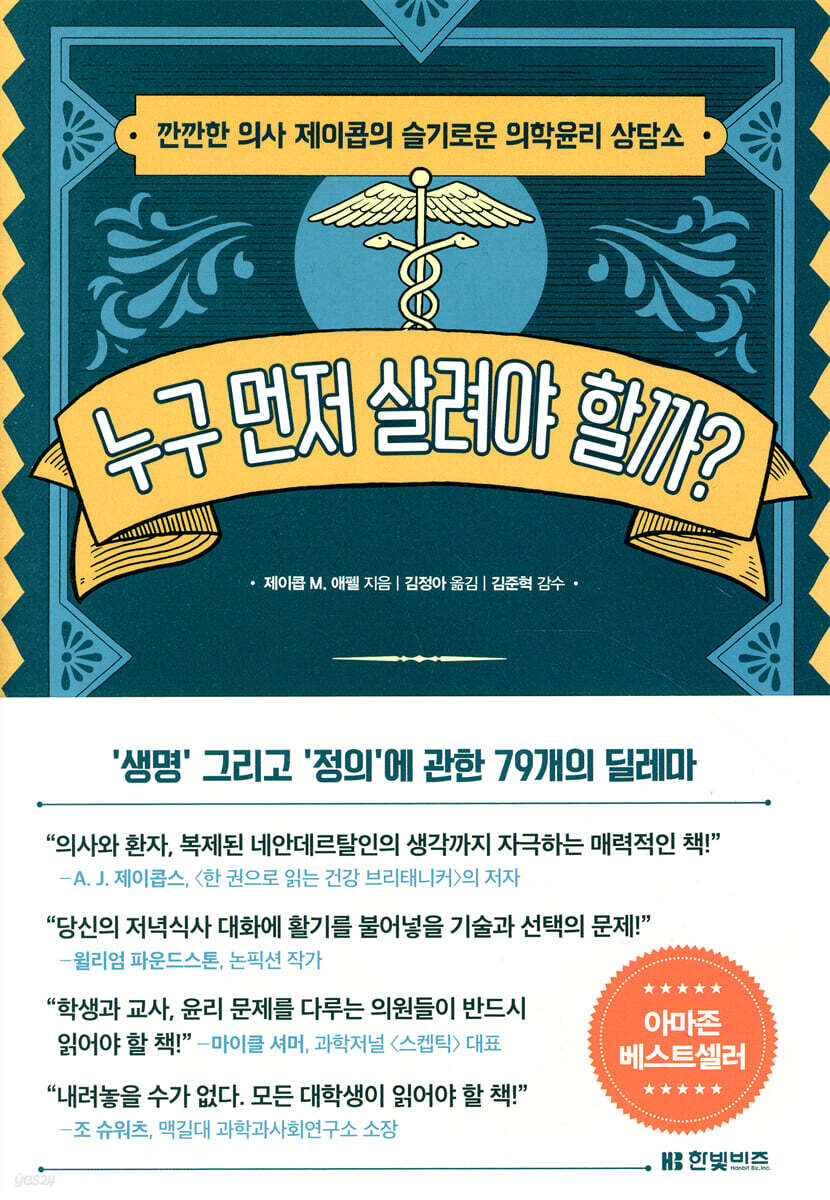
Who should be saved first?
 |
Description
Book Introduction
A psychiatrist who has been teaching ethics for 20 years,
He selected 79 ethical dilemmas of our time! Since the world was gripped by the coronavirus, people's sensitivity to medical and ethical issues has greatly increased. Technological advancements are creating new dilemmas in the medical field. No one is immune from these issues anymore, including vaccination, treatment priorities, and the rights of doctors and patients. What are the concerns that could arise in my life today, and how should I respond? "Who Should Live First?" is a book that introduces 79 dilemmas related to "life" and "justice." From familiar questions like "Should we forcibly quarantine those carrying the virus?" to questions of human dignity like "Should we remove ventilators from patients who appear hopeless?", it addresses issues relevant to our time. The author is a bioethicist and psychiatrist who has been teaching ethics for 20 years. We have consistently collected questions for doctors, patients, and guardians to consider when faced with various medical ethics issues, and refined them to the level of the general reader. Guidance is also included on how it was actually solved and what to consider. These are compelling stories for both healthcare professionals and the general public! There's no topic more useful for discussion at home or in school. Events that will stimulate your intellectual pleasure unfold vividly, like a season of a medical drama! |
- You can preview some of the book's contents.
Preview
index
Entering
Part 1 | Issues Doctors in the Field Are Concerned About
01 Am I not my father's daughter?
02 What is the survival rate of the patients you treat?
03 Should I disclose the crime the patient confessed to during the consultation?
04 Do I have to leave it in my medical records?
05 Is there a secret to the President's health?
06 Can I send out a patient with a serious condition?
07 Are sexual fantasies also subject to reporting?
08 A psychiatrist slept with a patient?
09 What if a murderer becomes a doctor?
10 Can doctors participate in torture?
11 What if health issues affect stock prices?
12 Should past unethical experiments be tolerated for the public good?
Part 2 | Issues Between the Private and the Public
13 They'll give me money if I don't have children?
14 You're forcing me into a rehab center?
15 Should virus carriers be quarantined?
16 Is DNA testing an invasion of privacy?
17 Is mandatory genetic testing unethical?
18 Can hunger strike prisoners be force-fed?
19 Do I really need to get my child vaccinated?
20 Evidence on the criminal's legs?
21 Can experimental research be conducted on subjects in developing countries?
22 Will clinical trials benefit participants?
23 Does adding lithium to drinking water lower the suicide rate?
24 Why didn't you tell me about the risk of developing the disease?
25 Half rat, half human?
26 Should we not provide medical treatment to a notorious dictator?
Part 3 | Challenges Facing Modern Medicine
27 What if job applicants were required to take a genetic test?
28 I want to see a white doctor.
29 Could you please not tell my mother that I have cancer?
30 The best treatment is prayer, right?
31 Should we turn a blind eye to health insurance fraud?
32 How much should we spend on treating one patient?
33 Who should we save and who should we give up?
34 Is it illegal to sell cheap counterfeit drugs?
35 You don't accept black sperm?
36 Is it okay for men and women to share a hospital room?
37 Can I fire an unhealthy employee?
38 Will I get Alzheimer's disease?
39 Should we not support the treatment costs of patients with low survival rates?
Is there any medicine that helps me do well for 40 days?
41 Can I ignore an advance directive for psychotherapy?
42 Should people engaging in risky activities be provided with insurance?
43 Should we tolerate the sexual activity of nursing home patients?
Part 4 | Issues Related to Surgery
44 Can you cut off my left foot?
45 Should we suppress a child's growth?
46 Can I circumcise my child?
47 Should we grant the desperate request of an organ donor with a high risk of death?
48 I'm giving my bone marrow to my brother?
49 Should we give the organ to the star first?
What if you could buy an organ for 50 dollars?
51 Would a death row inmate be eligible for a heart transplant?
52 How about transplanting a chimpanzee heart?
53 Can't you just move your head?
54 You want me to remove your testicles?
55 Can you put horns on my head?
56 I don't want to be stuck with him for the rest of my life.
Part 5 | Issues Related to Pregnancy and Childbirth
Did you give birth to me to save your brother?
58 I want to have a baby.
59 Who owns the embryo?
60 Invasion of Privacy or Child Protection?
61 God said not to breastfeed the child?
62 Getting pregnant with stolen sperm?
63 You say you won't have a cesarean section even if it means dying?
64 Who owns the fetus?
65 Should forced sterilization be permitted?
66 They'll give you money if you give birth to a girl?
67 I had my tubes tied and I'm pregnant?
68 Can humans be cloned?
69 What if Neanderthals came back to life?
70 You won't perform artificial insemination on homosexuals?
Part 6 | Issues Surrounding Death
71 How should we judge death?
72 Can I give morphine to a child who is in pain?
73 You want me to be euthanized to get a tax break?
74 Has your brother ever had AIDS?
75 Should physician-assisted suicide be tolerated in disaster situations?
76 You want your dead fiancé's sperm?
77 Should we remove a patient from a ventilator if he or she appears hopeless?
78 The bodies were switched?
79 How do we balance the dignity of life and the quality of life?
Sources & Further Reading
Part 1 | Issues Doctors in the Field Are Concerned About
01 Am I not my father's daughter?
02 What is the survival rate of the patients you treat?
03 Should I disclose the crime the patient confessed to during the consultation?
04 Do I have to leave it in my medical records?
05 Is there a secret to the President's health?
06 Can I send out a patient with a serious condition?
07 Are sexual fantasies also subject to reporting?
08 A psychiatrist slept with a patient?
09 What if a murderer becomes a doctor?
10 Can doctors participate in torture?
11 What if health issues affect stock prices?
12 Should past unethical experiments be tolerated for the public good?
Part 2 | Issues Between the Private and the Public
13 They'll give me money if I don't have children?
14 You're forcing me into a rehab center?
15 Should virus carriers be quarantined?
16 Is DNA testing an invasion of privacy?
17 Is mandatory genetic testing unethical?
18 Can hunger strike prisoners be force-fed?
19 Do I really need to get my child vaccinated?
20 Evidence on the criminal's legs?
21 Can experimental research be conducted on subjects in developing countries?
22 Will clinical trials benefit participants?
23 Does adding lithium to drinking water lower the suicide rate?
24 Why didn't you tell me about the risk of developing the disease?
25 Half rat, half human?
26 Should we not provide medical treatment to a notorious dictator?
Part 3 | Challenges Facing Modern Medicine
27 What if job applicants were required to take a genetic test?
28 I want to see a white doctor.
29 Could you please not tell my mother that I have cancer?
30 The best treatment is prayer, right?
31 Should we turn a blind eye to health insurance fraud?
32 How much should we spend on treating one patient?
33 Who should we save and who should we give up?
34 Is it illegal to sell cheap counterfeit drugs?
35 You don't accept black sperm?
36 Is it okay for men and women to share a hospital room?
37 Can I fire an unhealthy employee?
38 Will I get Alzheimer's disease?
39 Should we not support the treatment costs of patients with low survival rates?
Is there any medicine that helps me do well for 40 days?
41 Can I ignore an advance directive for psychotherapy?
42 Should people engaging in risky activities be provided with insurance?
43 Should we tolerate the sexual activity of nursing home patients?
Part 4 | Issues Related to Surgery
44 Can you cut off my left foot?
45 Should we suppress a child's growth?
46 Can I circumcise my child?
47 Should we grant the desperate request of an organ donor with a high risk of death?
48 I'm giving my bone marrow to my brother?
49 Should we give the organ to the star first?
What if you could buy an organ for 50 dollars?
51 Would a death row inmate be eligible for a heart transplant?
52 How about transplanting a chimpanzee heart?
53 Can't you just move your head?
54 You want me to remove your testicles?
55 Can you put horns on my head?
56 I don't want to be stuck with him for the rest of my life.
Part 5 | Issues Related to Pregnancy and Childbirth
Did you give birth to me to save your brother?
58 I want to have a baby.
59 Who owns the embryo?
60 Invasion of Privacy or Child Protection?
61 God said not to breastfeed the child?
62 Getting pregnant with stolen sperm?
63 You say you won't have a cesarean section even if it means dying?
64 Who owns the fetus?
65 Should forced sterilization be permitted?
66 They'll give you money if you give birth to a girl?
67 I had my tubes tied and I'm pregnant?
68 Can humans be cloned?
69 What if Neanderthals came back to life?
70 You won't perform artificial insemination on homosexuals?
Part 6 | Issues Surrounding Death
71 How should we judge death?
72 Can I give morphine to a child who is in pain?
73 You want me to be euthanized to get a tax break?
74 Has your brother ever had AIDS?
75 Should physician-assisted suicide be tolerated in disaster situations?
76 You want your dead fiancé's sperm?
77 Should we remove a patient from a ventilator if he or she appears hopeless?
78 The bodies were switched?
79 How do we balance the dignity of life and the quality of life?
Sources & Further Reading
Detailed image

Into the book
Whether you're planning a career in medicine or simply interested in the ethical controversies often glossed over on popular television shows, the challenges presented in this book will undoubtedly be helpful.
Reading a book can help you examine your own values, or it can help you focus on the dizzying controversies unfolding in the "real world," or it can even lead to a pleasant debate with family or friends over a meal.
--- From "Entering"
If you don't know your true family history, you may have a child with a disease that could have been prevented.
And because she will unknowingly give her doctor an inaccurate family history, the doctor will likely underestimate the risks Linda faces, from early colon cancer to suicide.
You can imagine this too.
What if Linda isn't Fred's biological child but is a suitable kidney donor? In this situation, revealing that she's not his biological child could lead to Linda changing her mind and potentially jeopardizing Fred's health.
--- From "Aren't I Daddy's Daughter?"
Many who criticized Hellekant's admission asked this question:
Would a patient truly trust a doctor who was a murderer? Furthermore, wouldn't the medical school's decision to admit Hellekant over another applicant have harmed the public? If Hellekant were allowed to practice medicine, wouldn't it undermine trust in all doctors? According to New York Times contributor Laurence Altman, then-president of Karolinska University Harriet Wallberg-Henriksson referred the case to the school's ethics committee for guidance.
The president asked:
“Should educators and school administrators disclose to patients the past of a student with a criminal record?”
--- From "What if a murderer becomes a doctor?"
Diseases for which the United States permits mandatory quarantine include viral hemorrhagic fevers such as Ebola, cholera, diphtheria, tuberculosis, plague, smallpox, yellow fever, influenza, and severe acute respiratory syndrome.
Some of these are easily treatable, but others have a short incubation period.
Almost all ethicists are not particularly concerned about the short-term quarantine of highly infectious individuals.
Most people who know how to discern reason would voluntarily accept such isolation in order to protect the public interest.
The truly troubling problem are asymptomatic carriers like Sandra, a child care worker, who have no treatment, or the rare cases who refuse necessary treatment and must be quarantined for long periods.
--- From "Should virus carriers be forcibly quarantined?"
When parents make decisions that are too outrageous, the courts can intervene according to the law.
However, all states recognize the right of parents to forgo vaccinations for medical reasons.
Many states also allow exceptions for objections based on religion or philosophy.
However, just because parents have the right not to vaccinate their children, that doesn't mean pediatricians have a legal or ethical obligation to continue to treat them.
--- From "Do I really need to get my child vaccinated?"
In routine medical practice, ventilators are usually used on a 'first come, first served' basis.
However, experts unanimously agree that this method should not be applied in the future when a flu pandemic occurs.
Rather, we should establish appropriate criteria for ventilator application and exclusion in such catastrophic situations.
The ethical debate at this point is not whether or not to classify patients by severity (severity classification seems to be a given), but rather who specifically should be excluded.
--- From "Who should we save and who should we give up?"
Advocates of donations with religious goals argue that such donors not only save the lives of certain groups of people, but also provide a breathing space for others on the waiting list to receive organs.
Because if Renewal provides a kidney to one Jewish patient, it means that one less person is on the waiting list for a non-Jewish kidney.
If there had been no renewal, these donors would not have donated any organs.
--- From "Should we give the organ to the star first?"
There have been at least ten cases in U.S. courts dealing with this issue.
In the first such case, Davis v. Davis in 1992, the Tennessee Supreme Court ruled that the embryos in question were neither persons nor property, but belonged to a “provisional category of beings entitled to special respect because they have the potential to become persons.”
The majority of these trials sided with those opposed to implanting and carrying the embryos in question to term.
Still, some trials have ruled in favor of women who became infertile due to chemotherapy.
For these women, implanting stored embryos is the only way to become biological parents.
Reading a book can help you examine your own values, or it can help you focus on the dizzying controversies unfolding in the "real world," or it can even lead to a pleasant debate with family or friends over a meal.
--- From "Entering"
If you don't know your true family history, you may have a child with a disease that could have been prevented.
And because she will unknowingly give her doctor an inaccurate family history, the doctor will likely underestimate the risks Linda faces, from early colon cancer to suicide.
You can imagine this too.
What if Linda isn't Fred's biological child but is a suitable kidney donor? In this situation, revealing that she's not his biological child could lead to Linda changing her mind and potentially jeopardizing Fred's health.
--- From "Aren't I Daddy's Daughter?"
Many who criticized Hellekant's admission asked this question:
Would a patient truly trust a doctor who was a murderer? Furthermore, wouldn't the medical school's decision to admit Hellekant over another applicant have harmed the public? If Hellekant were allowed to practice medicine, wouldn't it undermine trust in all doctors? According to New York Times contributor Laurence Altman, then-president of Karolinska University Harriet Wallberg-Henriksson referred the case to the school's ethics committee for guidance.
The president asked:
“Should educators and school administrators disclose to patients the past of a student with a criminal record?”
--- From "What if a murderer becomes a doctor?"
Diseases for which the United States permits mandatory quarantine include viral hemorrhagic fevers such as Ebola, cholera, diphtheria, tuberculosis, plague, smallpox, yellow fever, influenza, and severe acute respiratory syndrome.
Some of these are easily treatable, but others have a short incubation period.
Almost all ethicists are not particularly concerned about the short-term quarantine of highly infectious individuals.
Most people who know how to discern reason would voluntarily accept such isolation in order to protect the public interest.
The truly troubling problem are asymptomatic carriers like Sandra, a child care worker, who have no treatment, or the rare cases who refuse necessary treatment and must be quarantined for long periods.
--- From "Should virus carriers be forcibly quarantined?"
When parents make decisions that are too outrageous, the courts can intervene according to the law.
However, all states recognize the right of parents to forgo vaccinations for medical reasons.
Many states also allow exceptions for objections based on religion or philosophy.
However, just because parents have the right not to vaccinate their children, that doesn't mean pediatricians have a legal or ethical obligation to continue to treat them.
--- From "Do I really need to get my child vaccinated?"
In routine medical practice, ventilators are usually used on a 'first come, first served' basis.
However, experts unanimously agree that this method should not be applied in the future when a flu pandemic occurs.
Rather, we should establish appropriate criteria for ventilator application and exclusion in such catastrophic situations.
The ethical debate at this point is not whether or not to classify patients by severity (severity classification seems to be a given), but rather who specifically should be excluded.
--- From "Who should we save and who should we give up?"
Advocates of donations with religious goals argue that such donors not only save the lives of certain groups of people, but also provide a breathing space for others on the waiting list to receive organs.
Because if Renewal provides a kidney to one Jewish patient, it means that one less person is on the waiting list for a non-Jewish kidney.
If there had been no renewal, these donors would not have donated any organs.
--- From "Should we give the organ to the star first?"
There have been at least ten cases in U.S. courts dealing with this issue.
In the first such case, Davis v. Davis in 1992, the Tennessee Supreme Court ruled that the embryos in question were neither persons nor property, but belonged to a “provisional category of beings entitled to special respect because they have the potential to become persons.”
The majority of these trials sided with those opposed to implanting and carrying the embryos in question to term.
Still, some trials have ruled in favor of women who became infertile due to chemotherapy.
For these women, implanting stored embryos is the only way to become biological parents.
--- From "Who owns the embryo?"
Publisher's Review
In the age of Corona,
Ethical issues we face in our increasingly sensitive daily lives
Have we ever been so close to the words "hygiene" and "quarantine"? In a world where so much has changed due to the coronavirus.
Until recently, there was a lot of noise about religious freedom and quarantine, but now it's a series of vaccine news.
"What is the most just way to distribute it?" "Is there no right to refuse the vaccine?" "Is it ethical to experiment with infecting healthy people to develop a vaccine?"
As the ethical issues poured in, we realized:
The fact that many of the dilemmas of modern medicine are intertwined with me, my family, and all of us.
A reality where technological advancement and human rights are intertwined, creating new dilemmas every day.
What should we consider in the process of choosing? These are the questions worth examining in advance as we worry about the post-COVID-19 era. This is the beginning of a vivid and challenging series of concerns.
Another thought on meaningful questions,
There's no better topic for discussion than this.
Author Jacob M.
Appel is a bioethicist and psychiatrist.
He has been teaching ethics for nearly 20 years at Columbia University, New York University, and other institutions.
It was a habit to uncover new ethical challenges for the sake of active discussion among practitioners.
“Should someone with a felony conviction be given a medical license?” “Should a death row inmate be eligible for a heart transplant?”
There may be some challenges you'll actually face among these, so it's not a bad idea to think about what the issues might be in advance.
Whatever conclusion you ultimately reach, I hope you'll consider these questions from a variety of perspectives and appreciate that well-intentioned, intelligent people can reach different conclusions.
_From 〈Entering〉
Among them, the author selected difficult problems that would be interesting and meaningful to both medical professionals and the general public who enjoy medical dramas.
The author says these are the perfect topics for self-reflection on your own values and engaging in engaging discussions.
“The purpose of this book is to convey the intellectual pleasure of engaging with complex ethical questions!”
Face the challenges of technology and ethics,
A must-read for medical professionals and politicians
The 79 challenging problems introduced in the book are divided into the following categories: 'Problems that doctors in the field are concerned about,' 'Problems between the private and the public,' 'Problems facing modern medicine,' 'Problems related to surgery,' 'Problems related to pregnancy and childbirth,' and 'Problems surrounding death.'
Each puzzle is followed by a thought-provoking explanation.
We present how prominent bioethicists, clinicians, and policymakers have addressed similar challenges.
Ultimately, these questions converge on the issues of 'technology and ethics' and 'life and justice'.
As a bioethicist and law graduate, the author has tried to maintain as balanced a perspective as possible.
It offers important implications for politicians dealing with ethical issues, and is a must-read for aspiring doctors and nurses before interviews.
Ethical issues we face in our increasingly sensitive daily lives
Have we ever been so close to the words "hygiene" and "quarantine"? In a world where so much has changed due to the coronavirus.
Until recently, there was a lot of noise about religious freedom and quarantine, but now it's a series of vaccine news.
"What is the most just way to distribute it?" "Is there no right to refuse the vaccine?" "Is it ethical to experiment with infecting healthy people to develop a vaccine?"
As the ethical issues poured in, we realized:
The fact that many of the dilemmas of modern medicine are intertwined with me, my family, and all of us.
A reality where technological advancement and human rights are intertwined, creating new dilemmas every day.
What should we consider in the process of choosing? These are the questions worth examining in advance as we worry about the post-COVID-19 era. This is the beginning of a vivid and challenging series of concerns.
Another thought on meaningful questions,
There's no better topic for discussion than this.
Author Jacob M.
Appel is a bioethicist and psychiatrist.
He has been teaching ethics for nearly 20 years at Columbia University, New York University, and other institutions.
It was a habit to uncover new ethical challenges for the sake of active discussion among practitioners.
“Should someone with a felony conviction be given a medical license?” “Should a death row inmate be eligible for a heart transplant?”
There may be some challenges you'll actually face among these, so it's not a bad idea to think about what the issues might be in advance.
Whatever conclusion you ultimately reach, I hope you'll consider these questions from a variety of perspectives and appreciate that well-intentioned, intelligent people can reach different conclusions.
_From 〈Entering〉
Among them, the author selected difficult problems that would be interesting and meaningful to both medical professionals and the general public who enjoy medical dramas.
The author says these are the perfect topics for self-reflection on your own values and engaging in engaging discussions.
“The purpose of this book is to convey the intellectual pleasure of engaging with complex ethical questions!”
Face the challenges of technology and ethics,
A must-read for medical professionals and politicians
The 79 challenging problems introduced in the book are divided into the following categories: 'Problems that doctors in the field are concerned about,' 'Problems between the private and the public,' 'Problems facing modern medicine,' 'Problems related to surgery,' 'Problems related to pregnancy and childbirth,' and 'Problems surrounding death.'
Each puzzle is followed by a thought-provoking explanation.
We present how prominent bioethicists, clinicians, and policymakers have addressed similar challenges.
Ultimately, these questions converge on the issues of 'technology and ethics' and 'life and justice'.
As a bioethicist and law graduate, the author has tried to maintain as balanced a perspective as possible.
It offers important implications for politicians dealing with ethical issues, and is a must-read for aspiring doctors and nurses before interviews.
GOODS SPECIFICS
- Publication date: February 28, 2021
- Page count, weight, size: 396 pages | 578g | 148*215*30mm
- ISBN13: 9791157844869
- ISBN10: 1157844863
You may also like
카테고리
korean


korean

![GQ KOREA Mark (Monthly): December [2025]](http://librairie.coreenne.fr/cdn/shop/files/8ef265dbbfbf186523ed75ba7319009d.jpg?v=1765340328&width=3840)


