

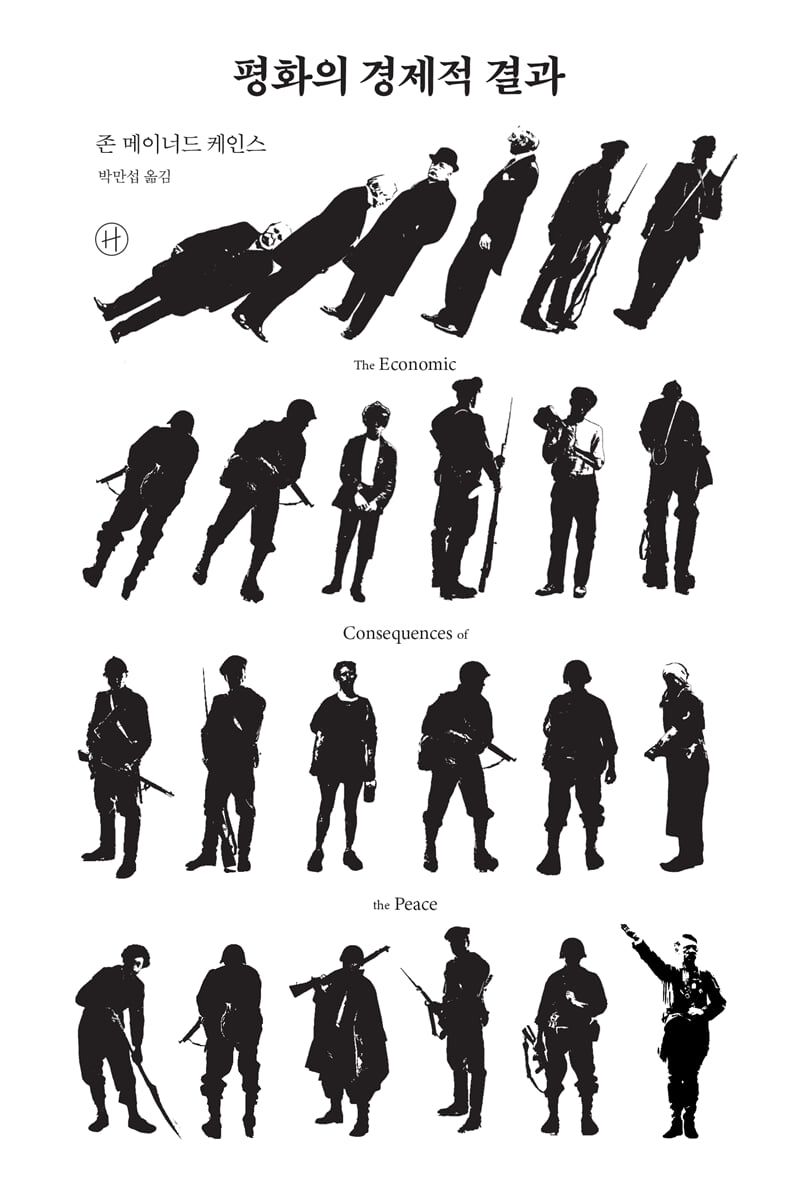
Economic Consequences of Peace
 |
Description
Book Introduction
When war ends, politics begins.
and predicted the catastrophe of punitive post-war treatment,
An immortal classic that paints a picture of the post-war world we live in today.
★★A dense translation by Professor Emeritus Park Man-seop of Korea University, who delves into 'Keynesian Economics'★★
★★A masterpiece that demonstrated both insight and courage, recognized by Keynes' rival Joseph Schumpeter★★
『The Economic Consequences of the Peace』 is a book written by British economist John Maynard Keynes (1883-1946) to widely inform the public about the problems with the Treaty of Versailles, the outcome of the armistice negotiations for the end of World War I.
Keynes believed that while the damage caused by the Great War needed to be repaired as much as possible, the peoples of countries that had been cut off from each other needed to be reconnected.
However, Keynes's vision was frustrated by politicians who prioritized immediate political interests and failed to implement his vision.
The victorious powers, including Britain and France, demanded punitive reparations that the defeated Germany could not afford. It was clear as day that this would humiliate the German people and render the economic system beyond repair.
Keynes, who foresaw that if things continued this way, a larger war would break out, diagnosed in this book that for the entire world to prosper again, everyone must put aside their hostility and continue to interact.
Keynes's warning came true with the rise of Hitler and the Nazi Party in Germany and the outbreak of World War II.
As the gates of globalization narrow and retaliation of all kinds become more rampant, "The Economic Consequences of Peace" is a modern classic that must be read if we are to avoid repeating humanity's past mistakes.
and predicted the catastrophe of punitive post-war treatment,
An immortal classic that paints a picture of the post-war world we live in today.
★★A dense translation by Professor Emeritus Park Man-seop of Korea University, who delves into 'Keynesian Economics'★★
★★A masterpiece that demonstrated both insight and courage, recognized by Keynes' rival Joseph Schumpeter★★
『The Economic Consequences of the Peace』 is a book written by British economist John Maynard Keynes (1883-1946) to widely inform the public about the problems with the Treaty of Versailles, the outcome of the armistice negotiations for the end of World War I.
Keynes believed that while the damage caused by the Great War needed to be repaired as much as possible, the peoples of countries that had been cut off from each other needed to be reconnected.
However, Keynes's vision was frustrated by politicians who prioritized immediate political interests and failed to implement his vision.
The victorious powers, including Britain and France, demanded punitive reparations that the defeated Germany could not afford. It was clear as day that this would humiliate the German people and render the economic system beyond repair.
Keynes, who foresaw that if things continued this way, a larger war would break out, diagnosed in this book that for the entire world to prosper again, everyone must put aside their hostility and continue to interact.
Keynes's warning came true with the rise of Hitler and the Nazi Party in Germany and the outbreak of World War II.
As the gates of globalization narrow and retaliation of all kinds become more rampant, "The Economic Consequences of Peace" is a modern classic that must be read if we are to avoid repeating humanity's past mistakes.
- You can preview some of the book's contents.
Preview
index
Translator's Note
introduction
Chapter 1 Introduction
Chapter 2 Europe before the war
Chapter 3: Paris Peace Conference
Chapter 4 Peace Treaty
Chapter 5 Compensation
Chapter 6 Europe after the Treaty
Chapter 7 Prescription
supplement
Translator's Note
John Maynard Keynes Chronology
Search
introduction
Chapter 1 Introduction
Chapter 2 Europe before the war
Chapter 3: Paris Peace Conference
Chapter 4 Peace Treaty
Chapter 5 Compensation
Chapter 6 Europe after the Treaty
Chapter 7 Prescription
supplement
Translator's Note
John Maynard Keynes Chronology
Search
Detailed image

Into the book
“Just as the shots fired in Sarajevo on June 28, 1914, were the trigger for a world war, there seems to be no absolute guarantee that the Sino-Taiwan relationship, and the situation on the Korean Peninsula where we live, will not act as a catalyst for a tragic explosion during these unstable times.
At this point, The Economic Consequences of Peace could function as a “prescient warning,” as the editors of the centennial commemorative collection put it.
This is why we need to pay attention to this book again, and why we are publishing the translation now.”
--- From the Translator's Note
“Paris was a nightmare.
And everyone there was horribly sick.
A feeling of impending doom rose over the frivolous landscape.
A sense of futility and insignificance came over people in the face of such a huge event.
The importance and unreality of the decisions being made intertwined.
Recklessness, blindness, arrogance, and the confused cries from outside.
All the elements of ancient tragedy were there.
Indeed, to one sitting in the magnificently theatrically decorated hall of the French government, the extraordinary faces of President Wilson and Prime Minister Clemenceau, with their uniform features and unchanging expressions, might have given rise to the suspicion whether they were real human faces or tragicomedic masks from some strange play or puppet show.”
--- 「Chapter 1.
From the Introduction
“The war shook this system to such an extent that it put all life in Europe at risk.
A very large area of the European continent was sick and dying.
The people of this region were outnumbered relative to their available means of subsistence, their economic organization was destroyed, their transportation system was broken, and their food supply was severely compromised.
The mission of the Paris Peace Conference was to honor promises and satisfy justice.
But equally important was their mission to rebuild people's lives and heal their wounds.
These duties were to be observed with prudence, but at the same time with the generosity which the wisdom of the ancients accorded to the victors in war.”
--- 「Chapter 2.
From "Pre-War Europe"
“Thus, in the end, Clemenceau succeeded in making a proposal that would have seemed outrageous and impossible only a few months before: that Germany should not be listened to.
If President Wilson had not been so conscientious, if he had not kept his work hidden from himself, he might have recovered his lost ground and achieved considerable success even at the last moment.
But the president was stuck in a rut.
… … In the final scene of the peace conference, the president became synonymous with stubbornness and refusal to compromise.”
--- Chapter 3.
From the Paris Peace Conference
“The true form of this dilemma would be to place German industry on the one hand, and French and Italian industry on the other.
It can be admitted that the transfer of coal would destroy German industry.
But it may be equally persuasive to argue that if coal is not transferred, the industries of France and Italy will be at risk.
In such cases, especially when most of the damage inflicted was ultimately due to the wicked actions of the now-vanquished nation, wouldn't it be natural to side with the victorious powers, who held various rights under the treaty? However, if such sentiments and authority were allowed to stray from the right path of wisdom, the impact they would have on the social and economic life of Central Europe would be too powerful to be sustained within the limits originally intended.
--- 「Chapter 4.
From the "Peace Treaty"
“The policy which reduces Germany to slavery for a single generation, which degrades the lives of millions of human beings, and which deprives entire citizens of happiness in one country, is a hateful and detestable policy.
… … Some people preach it in the name of justice.
In the great events of human history, when the intertwined destinies of nations are unraveled, justice is not so simple.
If it were so simple, the state would not be given the power, in the name of religion or natural morality, to punish the children of enemy nations for the wrongs committed by their parents or rulers.”
--- Chapter 5.
From "Compensation"
“Economic poverty progresses through easy stages, and as long as people endure it patiently, the outside world pays little attention to those in poverty.
Life goes on somehow, even though physical efficiency and resistance to disease gradually decline.
But finally, human patience reaches its limit, and cries of despair and madness awaken and shake those who suffer from helplessness.
This feeling of helplessness is what appears before a crisis occurs.
Now people are rising up, and the shackles of convention are being broken.
Thoughts have the highest power.
People listen to the instructions that come from the air, whether it be hope, fantasy, revenge, or anything else.”
--- 「Chapter 6.
From "Europe after the Treaty"
“In the fall of 1919, when I am writing this book, we are at the end of our luck.
The backlash against the intense exertion of power, fear, and suffering that has occurred over the past five years is at its peak.
The power to feel and care beyond the immediate concerns of our own material comfort has temporarily disappeared from sight.
No matter how great the events outside our own immediate experience, no matter how terrible the predictions, they cannot move us.
… … We are already past the end of patience.
You need to rest your body and mind.
“Never in the lifetime of those who are now living has the universal elements of the human soul shone so faintly as now.”
--- Chapter 7.
From "Prescription"
“It is widely known that Joseph Schumpeter, who was a rival of Keynes, was critical of Keynes’ economic theory.
However, even Schumpeter gave a respectful and acknowledgment evaluation to 『The Economic Consequences of Peace』.
Even if Keynes had not written his masterpiece, The General Theory of Employment, Interest and Money, in 1936, he “would still be remembered as the author of The Economic Consequences of the Peace, as the author who achieved world-wide fame when others of equal insight but less courage, or of equal courage but less insight, remained silent.”
At this point, The Economic Consequences of Peace could function as a “prescient warning,” as the editors of the centennial commemorative collection put it.
This is why we need to pay attention to this book again, and why we are publishing the translation now.”
--- From the Translator's Note
“Paris was a nightmare.
And everyone there was horribly sick.
A feeling of impending doom rose over the frivolous landscape.
A sense of futility and insignificance came over people in the face of such a huge event.
The importance and unreality of the decisions being made intertwined.
Recklessness, blindness, arrogance, and the confused cries from outside.
All the elements of ancient tragedy were there.
Indeed, to one sitting in the magnificently theatrically decorated hall of the French government, the extraordinary faces of President Wilson and Prime Minister Clemenceau, with their uniform features and unchanging expressions, might have given rise to the suspicion whether they were real human faces or tragicomedic masks from some strange play or puppet show.”
--- 「Chapter 1.
From the Introduction
“The war shook this system to such an extent that it put all life in Europe at risk.
A very large area of the European continent was sick and dying.
The people of this region were outnumbered relative to their available means of subsistence, their economic organization was destroyed, their transportation system was broken, and their food supply was severely compromised.
The mission of the Paris Peace Conference was to honor promises and satisfy justice.
But equally important was their mission to rebuild people's lives and heal their wounds.
These duties were to be observed with prudence, but at the same time with the generosity which the wisdom of the ancients accorded to the victors in war.”
--- 「Chapter 2.
From "Pre-War Europe"
“Thus, in the end, Clemenceau succeeded in making a proposal that would have seemed outrageous and impossible only a few months before: that Germany should not be listened to.
If President Wilson had not been so conscientious, if he had not kept his work hidden from himself, he might have recovered his lost ground and achieved considerable success even at the last moment.
But the president was stuck in a rut.
… … In the final scene of the peace conference, the president became synonymous with stubbornness and refusal to compromise.”
--- Chapter 3.
From the Paris Peace Conference
“The true form of this dilemma would be to place German industry on the one hand, and French and Italian industry on the other.
It can be admitted that the transfer of coal would destroy German industry.
But it may be equally persuasive to argue that if coal is not transferred, the industries of France and Italy will be at risk.
In such cases, especially when most of the damage inflicted was ultimately due to the wicked actions of the now-vanquished nation, wouldn't it be natural to side with the victorious powers, who held various rights under the treaty? However, if such sentiments and authority were allowed to stray from the right path of wisdom, the impact they would have on the social and economic life of Central Europe would be too powerful to be sustained within the limits originally intended.
--- 「Chapter 4.
From the "Peace Treaty"
“The policy which reduces Germany to slavery for a single generation, which degrades the lives of millions of human beings, and which deprives entire citizens of happiness in one country, is a hateful and detestable policy.
… … Some people preach it in the name of justice.
In the great events of human history, when the intertwined destinies of nations are unraveled, justice is not so simple.
If it were so simple, the state would not be given the power, in the name of religion or natural morality, to punish the children of enemy nations for the wrongs committed by their parents or rulers.”
--- Chapter 5.
From "Compensation"
“Economic poverty progresses through easy stages, and as long as people endure it patiently, the outside world pays little attention to those in poverty.
Life goes on somehow, even though physical efficiency and resistance to disease gradually decline.
But finally, human patience reaches its limit, and cries of despair and madness awaken and shake those who suffer from helplessness.
This feeling of helplessness is what appears before a crisis occurs.
Now people are rising up, and the shackles of convention are being broken.
Thoughts have the highest power.
People listen to the instructions that come from the air, whether it be hope, fantasy, revenge, or anything else.”
--- 「Chapter 6.
From "Europe after the Treaty"
“In the fall of 1919, when I am writing this book, we are at the end of our luck.
The backlash against the intense exertion of power, fear, and suffering that has occurred over the past five years is at its peak.
The power to feel and care beyond the immediate concerns of our own material comfort has temporarily disappeared from sight.
No matter how great the events outside our own immediate experience, no matter how terrible the predictions, they cannot move us.
… … We are already past the end of patience.
You need to rest your body and mind.
“Never in the lifetime of those who are now living has the universal elements of the human soul shone so faintly as now.”
--- Chapter 7.
From "Prescription"
“It is widely known that Joseph Schumpeter, who was a rival of Keynes, was critical of Keynes’ economic theory.
However, even Schumpeter gave a respectful and acknowledgment evaluation to 『The Economic Consequences of Peace』.
Even if Keynes had not written his masterpiece, The General Theory of Employment, Interest and Money, in 1936, he “would still be remembered as the author of The Economic Consequences of the Peace, as the author who achieved world-wide fame when others of equal insight but less courage, or of equal courage but less insight, remained silent.”
--- From the "Translator's Note"
Publisher's Review
1.
John Maynard Keynes and His Times
─ An economist who laid the foundation for modern macroeconomics and a strategist who established the international economic system.
─ Seeking ways for the world to recover from the devastation of World War I
John Maynard Keynes, author of The Economic Consequences of the Peace, is famous for laying the foundation for modern macroeconomics.
Born into a middle-class family in Cambridge, he was a typical member of the British elite, having studied at Eton College and King's College, Cambridge.
Keynes, who preferred to serve the nation rather than live as a schoolteacher, was appointed as an advisor to the British Treasury in 1914 when World War I broke out, and in 1915 he became a full-time Treasury official.
Keynes became a member of the British Treasury delegation to the Paris Peace Conference in January 1919, but resigned from the delegation in June of that year and published several works, including The Economic Consequences of the Peace.
Leaving aside 『The Economic Consequences of the Peace』, the most important book in Keynes's life is 『The General Theory of Employment, Interest and Money』, published in 1936.
The effective demand theory presented in this book serves as an economic theory for reconstruction and the basis for fiscal policy for social stability, and continues to have a significant influence to this day.
Keynes, who served as the head of the British delegation at the Bretton Woods Conference in June 1944, when World War II was nearing its end, played a role in establishing the International Bank for Reconstruction and Development (now the World Bank) and the International Monetary Fund (IMF), and in creating the international economic system known today as the Bretton Woods system.
Keynes, who had a significant influence on the creation of the modern system, especially in the immediate aftermath of World War II, was also responsible for negotiating with the delegations of the other victorious nations and presenting his opinions to the Prime Minister as the British Treasury representative and acting Chancellor of the Exchequer at the Paris Peace Conference in 1919.
World War I, which lasted from July 1914 to November 1918, had an unprecedented impact on Europe, so much so that it was called “the war to end all wars” or “the Great War.”
In this war, in which Britain, France, and the Russian Empire formed the Allies and the German Empire, the Austro-Hungarian Empire, and the Ottoman Empire formed the Central Powers, tens of millions of people were killed and injured, and survivors of various war crimes, trench warfare, and poison gas warfare suffered from post-traumatic stress disorder (PTSD).
Meanwhile, revolutions occurred in Russia in 1917, the emperor was deposed, and the Bolsheviks, supported by the working class, took power.
Revolutionary Russia, which had declared peace with Germany, entered into a civil war in 1918, and in November of that year, a revolution broke out in Germany, the emperor went into exile, and eventually Germany also proposed peace to the Allied Powers.
The Paris Peace Conference took place in the midst of the Russian Civil War and shortly after the German government brutally suppressed the workers' uprising of January 1919.
In Keynes' view, in this situation, the peace conference should focus on restoring the economies of all the devastated countries.
But reality did not unfold as Keynes expected.
2.
A Complete Analysis of the "Economic Consequences of Peace" That Will Set the World on Fire Again
The vivid truth about the Paris Peace Conference, where politicians' interests took precedence over world stability.
─ "Squeeze Germany until you hear the sound of crushed lemon seeds" Warns of the dangers of the Treaty of Versailles
Exhausted by the peace conference, Keynes wrote to the British Prime Minister on June 5, 1919, “I want to get out of this nightmare place.
There is nothing more I can do here.
… … The battle was a failure (page 337),” he said, leaving behind a note and leaving the delegation.
And in December of that year, he published “The Economic Consequences of Peace,” which reported on the reality of the peace conference and sharply analyzed the problems of the Treaty of Versailles.
The scene Keynes witnessed at the peace conference drove him to despair.
The main figures at the peace conference were French Prime Minister Georges Clemenceau, British Prime Minister David Lloyd George, American President Woodrow Wilson, and Italian Prime Minister Vittorio Orlando.
These leaders, known as the "Big Four," publicly declared that as representatives of the victorious nations, they would hold the defeated nations accountable and ensure justice.
But in reality, each of them had different intentions.
Prime Minister Clemenceau took a strong stance to thoroughly weaken Germany so that it could never again threaten France.
Prime Minister Lloyd George was more focused on winning votes than on economic measures, threatening to bring the Kaiser (German Emperor) to trial ahead of the general election.
President Wilson, who had decided to enter the war at the very end and had later promised fair treatment to Germany through his Eighteen Points, was swept away by the arguments of Clemenceau and Lloyd George.
Prime Minister Orlando also prioritized his country's interests.
Keynes, who was also a participant in the meeting, sharply criticized the four people and the peace conference.
Politicians who should have sought stability in Europe and the world through peace conferences have instead pandered to those driven by revenge, fanned their hatred, and reversed their decisions whenever necessary.
President Wilson, who was highly anticipated to rebuild Europe from the ashes, was in reality a “Presbyterian minister (p. 73)” who was “not only insensitive to his surroundings in the sense that he was outside himself, but also indifferent to everything around him (p. 72)” and thus could not compete with Prime Minister Lloyd George, who “displayed an almost psychic, meticulous sensitivity to everyone in his vicinity (p. 72).”
Meanwhile, Prime Minister Clemenceau, who was “sitting quietly alone in a corner, wearing his usual gray gloves, on a silk chair like a king (p. 61),” dominated the peace conference as an old man of the past who viewed all problems “from the perspective of France and Germany (p. 67)” and “had no expectation or hope that humanity was standing on the threshold of a new era (p. 67).”
There was little room for the German delegation to push through its position here.
The Treaty of Versailles, as it was ultimately drafted, effectively destroyed Germany's economic system.
The treaty focused on weakening Germany's foreign trade, manufacturing, transport, and customs systems, ceding Germany's main coal mining areas to France and extending most-favored-nation treatment only to the Allies.
Here, the compensation was determined in a way that would put a heavy burden on the shoulders of the German people.
Germany was forced to pay 8 billion pounds in reparations over 30 years, as the Allied powers took into account the alimony and pensions owed to their own citizens when calculating the damages suffered during the war.
As one British agitator put it, such a post-war treatment would “squeeze Germany until you could hear the lemon seeds crunching” (p. 179).
In Keynes's eyes, the outcome of the peace conference and the treaty, the "economic consequences of peace," were enough to set Europe ablaze again.
“Thus, in the end, Clemenceau succeeded in making a proposal that would have seemed outrageous and impossible only a few months before: that Germany should not be listened to.
If President Wilson had not been so conscientious, if he had not kept his work hidden from himself, he might have recovered his lost ground and achieved considerable success even at the last moment.
But the president was stuck in a rut.
… … In the final scene of the peace conference, the president became synonymous with stubbornness and refusal to compromise.”
- 〈Chapter 3.
Paris Peace Conference, p. 86
“The policy which reduces Germany to slavery for a single generation, which degrades the lives of millions of human beings, and which deprives entire citizens of happiness in one country, is a hateful and detestable policy.
… … Some people preach it in the name of justice.
In the great events of human history, when the intertwined destinies of nations are unraveled, justice is not so simple.
If it were so simple, the state would not be given the power, in the name of religion or natural morality, to punish the children of enemy nations for the wrongs committed by their parents or rulers.”
- 〈Chapter 5.
Compensation, p. 253
3.
A modern classic you must read if you want true peace.
─ An excellent translation by Professor Park Man-seop, who has studied Keynesian economics in depth.
─ The way to heal a world torn apart by war lies in connection and exchange!
The course of history thereafter is well known.
At the time, Germany, known as the Weimar Republic, began economic exchanges with the Soviet Union in order to survive, and the areas that had been under German control and had been transferred to other countries were in an unstable state due to the diverse ethnic composition and conflicting interests of each country.
Although the Allied Powers partially reduced the reparations, the economic burden of reparations weighed heavily on the German people, and as the Great Depression of 1929 intensified, fascism emerged.
In 1933, Hitler and the Nazi Party, which championed anti-Semitism and nationalism, came to power and Germany embarked on the path of war and genocide.
In August 1939, Germany launched a full-scale invasion of Poland, triggering World War II, and the catastrophe Keynes feared in this book eventually became reality.
Park Man-seop, Professor Emeritus of Economics at Korea University, who translated this book, began his scholarly journey in the late 1970s as an economics student seeking to learn about true "Keynesian economics," fundamentally different from Keynesianism and monetarism, which were fiercely fighting for the throne of macroeconomics.
The translator, who received bachelor's, master's, and doctoral degrees in economics from Korea University, Cambridge University, and Manchester University, has a deep understanding of Keynesian economics and has read many of Keynes's works and books about his life, greatly increasing the density of the translation.
The translation, which strives to preserve Keynes's vivid writing style as much as possible, the translator's notes, which clearly show the times and present detailed statistics, and the in-depth commentary written by a scholar who seriously studies Keynesian economics, greatly contribute to a multifaceted reading of this book.
105 years after the publication of "The Economic Consequences of Peace," the reason for republishing this book stems from the awareness that we must never again repeat such a massive and catastrophic war.
This book was heavily criticized at the time of its publication, and even decades later, it remains a controversial work, with many still raising questions about the gap between Keynes's arguments and reality.
In the eyes of those filled with vengeance, this book appeared as a spear aimed at our own forces while taking the side of the enemy.
Those on the other side saw it as a shield that defended them as victims as well as simple perpetrators.
However, what Keynes emphasizes is not which side is just.
Keynes's argument is that when a world that is connected is torn apart by war, we must clearly recognize that the way to heal it lies in connection and exchange.
In a world where everything seems eternal until it vanishes, readers will find in this book unforgettable lessons for true peace.
“It is widely known that Joseph Schumpeter, who was a rival of Keynes, was critical of Keynes’ economic theory.
However, even Schumpeter gave a respectful and acknowledgment evaluation to 『The Economic Consequences of Peace』.
Even if Keynes had not written his masterpiece, The General Theory of Employment, Interest and Money, in 1936, he “would still be remembered as the author of The Economic Consequences of the Peace, as the author who achieved world-wide fame when others of equal insight but less courage, or of equal courage but less insight, remained silent.”
- Translator's Note, p. 355
“Just as the shots fired in Sarajevo on June 28, 1914, were the trigger for a world war, there seems to be no absolute guarantee that the Sino-Taiwan relationship, and the situation on the Korean Peninsula where we live, will not act as a catalyst for a tragic explosion during these unstable times.
At this point, The Economic Consequences of Peace could function as a “prescient warning,” as the editors of the centennial commemorative collection put it.
This is why we need to pay attention to this book again, and why we are publishing the translation now.”
- Translator's Note, p. 12
John Maynard Keynes and His Times
─ An economist who laid the foundation for modern macroeconomics and a strategist who established the international economic system.
─ Seeking ways for the world to recover from the devastation of World War I
John Maynard Keynes, author of The Economic Consequences of the Peace, is famous for laying the foundation for modern macroeconomics.
Born into a middle-class family in Cambridge, he was a typical member of the British elite, having studied at Eton College and King's College, Cambridge.
Keynes, who preferred to serve the nation rather than live as a schoolteacher, was appointed as an advisor to the British Treasury in 1914 when World War I broke out, and in 1915 he became a full-time Treasury official.
Keynes became a member of the British Treasury delegation to the Paris Peace Conference in January 1919, but resigned from the delegation in June of that year and published several works, including The Economic Consequences of the Peace.
Leaving aside 『The Economic Consequences of the Peace』, the most important book in Keynes's life is 『The General Theory of Employment, Interest and Money』, published in 1936.
The effective demand theory presented in this book serves as an economic theory for reconstruction and the basis for fiscal policy for social stability, and continues to have a significant influence to this day.
Keynes, who served as the head of the British delegation at the Bretton Woods Conference in June 1944, when World War II was nearing its end, played a role in establishing the International Bank for Reconstruction and Development (now the World Bank) and the International Monetary Fund (IMF), and in creating the international economic system known today as the Bretton Woods system.
Keynes, who had a significant influence on the creation of the modern system, especially in the immediate aftermath of World War II, was also responsible for negotiating with the delegations of the other victorious nations and presenting his opinions to the Prime Minister as the British Treasury representative and acting Chancellor of the Exchequer at the Paris Peace Conference in 1919.
World War I, which lasted from July 1914 to November 1918, had an unprecedented impact on Europe, so much so that it was called “the war to end all wars” or “the Great War.”
In this war, in which Britain, France, and the Russian Empire formed the Allies and the German Empire, the Austro-Hungarian Empire, and the Ottoman Empire formed the Central Powers, tens of millions of people were killed and injured, and survivors of various war crimes, trench warfare, and poison gas warfare suffered from post-traumatic stress disorder (PTSD).
Meanwhile, revolutions occurred in Russia in 1917, the emperor was deposed, and the Bolsheviks, supported by the working class, took power.
Revolutionary Russia, which had declared peace with Germany, entered into a civil war in 1918, and in November of that year, a revolution broke out in Germany, the emperor went into exile, and eventually Germany also proposed peace to the Allied Powers.
The Paris Peace Conference took place in the midst of the Russian Civil War and shortly after the German government brutally suppressed the workers' uprising of January 1919.
In Keynes' view, in this situation, the peace conference should focus on restoring the economies of all the devastated countries.
But reality did not unfold as Keynes expected.
2.
A Complete Analysis of the "Economic Consequences of Peace" That Will Set the World on Fire Again
The vivid truth about the Paris Peace Conference, where politicians' interests took precedence over world stability.
─ "Squeeze Germany until you hear the sound of crushed lemon seeds" Warns of the dangers of the Treaty of Versailles
Exhausted by the peace conference, Keynes wrote to the British Prime Minister on June 5, 1919, “I want to get out of this nightmare place.
There is nothing more I can do here.
… … The battle was a failure (page 337),” he said, leaving behind a note and leaving the delegation.
And in December of that year, he published “The Economic Consequences of Peace,” which reported on the reality of the peace conference and sharply analyzed the problems of the Treaty of Versailles.
The scene Keynes witnessed at the peace conference drove him to despair.
The main figures at the peace conference were French Prime Minister Georges Clemenceau, British Prime Minister David Lloyd George, American President Woodrow Wilson, and Italian Prime Minister Vittorio Orlando.
These leaders, known as the "Big Four," publicly declared that as representatives of the victorious nations, they would hold the defeated nations accountable and ensure justice.
But in reality, each of them had different intentions.
Prime Minister Clemenceau took a strong stance to thoroughly weaken Germany so that it could never again threaten France.
Prime Minister Lloyd George was more focused on winning votes than on economic measures, threatening to bring the Kaiser (German Emperor) to trial ahead of the general election.
President Wilson, who had decided to enter the war at the very end and had later promised fair treatment to Germany through his Eighteen Points, was swept away by the arguments of Clemenceau and Lloyd George.
Prime Minister Orlando also prioritized his country's interests.
Keynes, who was also a participant in the meeting, sharply criticized the four people and the peace conference.
Politicians who should have sought stability in Europe and the world through peace conferences have instead pandered to those driven by revenge, fanned their hatred, and reversed their decisions whenever necessary.
President Wilson, who was highly anticipated to rebuild Europe from the ashes, was in reality a “Presbyterian minister (p. 73)” who was “not only insensitive to his surroundings in the sense that he was outside himself, but also indifferent to everything around him (p. 72)” and thus could not compete with Prime Minister Lloyd George, who “displayed an almost psychic, meticulous sensitivity to everyone in his vicinity (p. 72).”
Meanwhile, Prime Minister Clemenceau, who was “sitting quietly alone in a corner, wearing his usual gray gloves, on a silk chair like a king (p. 61),” dominated the peace conference as an old man of the past who viewed all problems “from the perspective of France and Germany (p. 67)” and “had no expectation or hope that humanity was standing on the threshold of a new era (p. 67).”
There was little room for the German delegation to push through its position here.
The Treaty of Versailles, as it was ultimately drafted, effectively destroyed Germany's economic system.
The treaty focused on weakening Germany's foreign trade, manufacturing, transport, and customs systems, ceding Germany's main coal mining areas to France and extending most-favored-nation treatment only to the Allies.
Here, the compensation was determined in a way that would put a heavy burden on the shoulders of the German people.
Germany was forced to pay 8 billion pounds in reparations over 30 years, as the Allied powers took into account the alimony and pensions owed to their own citizens when calculating the damages suffered during the war.
As one British agitator put it, such a post-war treatment would “squeeze Germany until you could hear the lemon seeds crunching” (p. 179).
In Keynes's eyes, the outcome of the peace conference and the treaty, the "economic consequences of peace," were enough to set Europe ablaze again.
“Thus, in the end, Clemenceau succeeded in making a proposal that would have seemed outrageous and impossible only a few months before: that Germany should not be listened to.
If President Wilson had not been so conscientious, if he had not kept his work hidden from himself, he might have recovered his lost ground and achieved considerable success even at the last moment.
But the president was stuck in a rut.
… … In the final scene of the peace conference, the president became synonymous with stubbornness and refusal to compromise.”
- 〈Chapter 3.
Paris Peace Conference, p. 86
“The policy which reduces Germany to slavery for a single generation, which degrades the lives of millions of human beings, and which deprives entire citizens of happiness in one country, is a hateful and detestable policy.
… … Some people preach it in the name of justice.
In the great events of human history, when the intertwined destinies of nations are unraveled, justice is not so simple.
If it were so simple, the state would not be given the power, in the name of religion or natural morality, to punish the children of enemy nations for the wrongs committed by their parents or rulers.”
- 〈Chapter 5.
Compensation, p. 253
3.
A modern classic you must read if you want true peace.
─ An excellent translation by Professor Park Man-seop, who has studied Keynesian economics in depth.
─ The way to heal a world torn apart by war lies in connection and exchange!
The course of history thereafter is well known.
At the time, Germany, known as the Weimar Republic, began economic exchanges with the Soviet Union in order to survive, and the areas that had been under German control and had been transferred to other countries were in an unstable state due to the diverse ethnic composition and conflicting interests of each country.
Although the Allied Powers partially reduced the reparations, the economic burden of reparations weighed heavily on the German people, and as the Great Depression of 1929 intensified, fascism emerged.
In 1933, Hitler and the Nazi Party, which championed anti-Semitism and nationalism, came to power and Germany embarked on the path of war and genocide.
In August 1939, Germany launched a full-scale invasion of Poland, triggering World War II, and the catastrophe Keynes feared in this book eventually became reality.
Park Man-seop, Professor Emeritus of Economics at Korea University, who translated this book, began his scholarly journey in the late 1970s as an economics student seeking to learn about true "Keynesian economics," fundamentally different from Keynesianism and monetarism, which were fiercely fighting for the throne of macroeconomics.
The translator, who received bachelor's, master's, and doctoral degrees in economics from Korea University, Cambridge University, and Manchester University, has a deep understanding of Keynesian economics and has read many of Keynes's works and books about his life, greatly increasing the density of the translation.
The translation, which strives to preserve Keynes's vivid writing style as much as possible, the translator's notes, which clearly show the times and present detailed statistics, and the in-depth commentary written by a scholar who seriously studies Keynesian economics, greatly contribute to a multifaceted reading of this book.
105 years after the publication of "The Economic Consequences of Peace," the reason for republishing this book stems from the awareness that we must never again repeat such a massive and catastrophic war.
This book was heavily criticized at the time of its publication, and even decades later, it remains a controversial work, with many still raising questions about the gap between Keynes's arguments and reality.
In the eyes of those filled with vengeance, this book appeared as a spear aimed at our own forces while taking the side of the enemy.
Those on the other side saw it as a shield that defended them as victims as well as simple perpetrators.
However, what Keynes emphasizes is not which side is just.
Keynes's argument is that when a world that is connected is torn apart by war, we must clearly recognize that the way to heal it lies in connection and exchange.
In a world where everything seems eternal until it vanishes, readers will find in this book unforgettable lessons for true peace.
“It is widely known that Joseph Schumpeter, who was a rival of Keynes, was critical of Keynes’ economic theory.
However, even Schumpeter gave a respectful and acknowledgment evaluation to 『The Economic Consequences of Peace』.
Even if Keynes had not written his masterpiece, The General Theory of Employment, Interest and Money, in 1936, he “would still be remembered as the author of The Economic Consequences of the Peace, as the author who achieved world-wide fame when others of equal insight but less courage, or of equal courage but less insight, remained silent.”
- Translator's Note, p. 355
“Just as the shots fired in Sarajevo on June 28, 1914, were the trigger for a world war, there seems to be no absolute guarantee that the Sino-Taiwan relationship, and the situation on the Korean Peninsula where we live, will not act as a catalyst for a tragic explosion during these unstable times.
At this point, The Economic Consequences of Peace could function as a “prescient warning,” as the editors of the centennial commemorative collection put it.
This is why we need to pay attention to this book again, and why we are publishing the translation now.”
- Translator's Note, p. 12
GOODS SPECIFICS
- Date of issue: November 25, 2024
- Page count, weight, size: 368 pages | 462g | 140*210*20mm
- ISBN13: 9791170872757
- ISBN10: 1170872751
You may also like
카테고리
korean


korean

![GQ KOREA Mark (Monthly): December [2025]](http://librairie.coreenne.fr/cdn/shop/files/8ef265dbbfbf186523ed75ba7319009d.jpg?v=1765340328&width=3840)


