

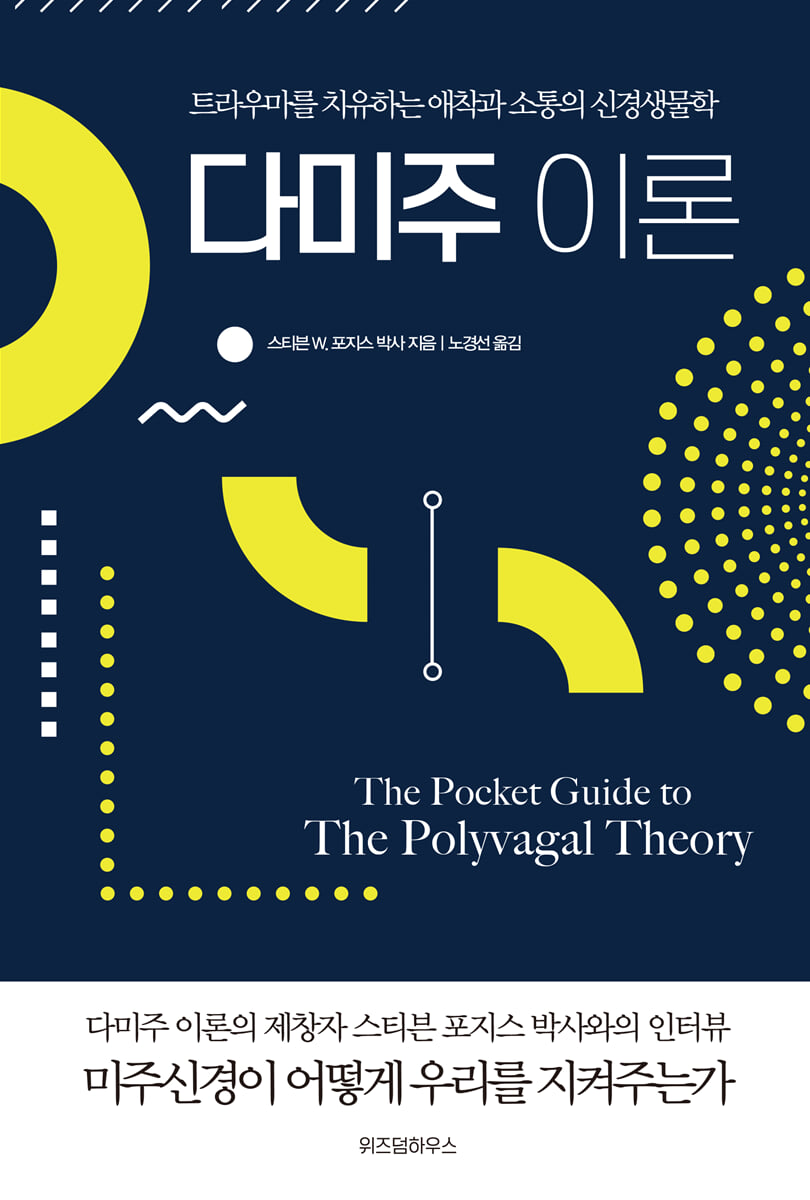
Polygamy theory
 |
Description
Book Introduction
An interview with Dr. Stephen Porges, the founder of the polyamorous theory.
How the Vagus Nerve Protects Us
Stephen W.
Dr. Porges discovered the crucial role the vagus nerve plays in the process of the autonomic nervous system protecting us, and published the polyvagal theory in 1994.
This book is written in an interview format so that even laypeople, including clinicians who are not scientists, can easily access the complex theory of damiju. Dr. Noh Kyung-sun, a leading pediatric psychiatrist in Korea, personally took on the task of translating it.
It not only helps you gain a general understanding of the polyvagal theory, but also provides specific suggestions on how to apply the polyvagal theory in clinical practice.
How the Vagus Nerve Protects Us
Stephen W.
Dr. Porges discovered the crucial role the vagus nerve plays in the process of the autonomic nervous system protecting us, and published the polyvagal theory in 1994.
This book is written in an interview format so that even laypeople, including clinicians who are not scientists, can easily access the complex theory of damiju. Dr. Noh Kyung-sun, a leading pediatric psychiatrist in Korea, personally took on the task of translating it.
It not only helps you gain a general understanding of the polyvagal theory, but also provides specific suggestions on how to apply the polyvagal theory in clinical practice.
- You can preview some of the book's contents.
Preview
index
Preface: Why We Should Pursue Safety
Terminology for Understanding the Theory of the Multiverse
1.
Neurophysiology of safety
Thoughts and feelings that reflect the brain and body
Feeling, a valid scientific topic
The Role of Heart Rate Variability in Psychophysiological Research
Neural mechanisms mediating heart rate variability
How to measure vagal control of the heart
Integration of physiological state measurement and stimulus-response models
Finding the mediating variable
Safety and physiological status
The Role of Safety and Safety Signals for Survival
Social Participation and Safety
Pursuit of biological challenges
2.
Damiju Theory and Trauma Treatment
Trauma and the Nervous System
The Origins of the Polyvagal Theory: The "Vagus Paradox"
Reexamining the autonomic nervous system
nerves, unconscious exploration
What causes post-traumatic stress disorder
The Role and Attachment of Social Participation
What Autism and Trauma Have in Common
Treatment of autism spectrum disorder
Listening Project Protocol and Treatment
How Music Gives Us a Sense of Safety
3.
Self-regulation and social participation
The Relationship Between Heart Rate Variability and Self-Regulation
Organizational Principles of the Polygamous Theory
How to use others for security
Systems that influence how we react to the world
The paradox of the vagus nerve
Vagus nerve, the conduit of motor and sensory pathways
The Relationship Between Trauma and Social Engagement
How Music Signals Vagal Regulation
Social Engagement Signals, Self-Regulation vs.
“Ignorance”
Use of neuromodulation
Attachment theory and adaptive functioning
How to Make Hospitals Psychologically Safer
4.
How Trauma Affects the Brain, Body, and Behavior
The origins of the polygamous theory
The 'vegetable vagus nerve' and the 'smart vagus nerve'
The vagus nerve, a collection of nerve pathways
Vagus nerve and cardiopulmonary function
sixth sense and interoception
How Vagal Tone Relates to Emotions
vagus nerve brake
How the nervous system works, feeling threatened or safe
Nerves, responding to threats and safety
How Mammals and Reptiles Respond to Novel Events
Play as neurotraining
Vagus nerve and Harry
Single-trial learning
5.
Clues to Safety and Health, and the Theory of Damiju
Vagus nerve and polyvagal theory
How the Mind-Body Connection Affects Medical Conditions
Trauma and the loss of trust
How do nerves work?
Connectivity as Uncertainty and Biological Challenges
Damiju Theory, Trauma, and Attachment
How Singing and Listening Calm Us
Training to activate social participation systems
The Future of Trauma Treatment
6.
Future Trauma Treatment through the Theory of Damiju
7.
Psychotherapy from a physical perspective
Acknowledgements
References
Terminology for Understanding the Theory of the Multiverse
1.
Neurophysiology of safety
Thoughts and feelings that reflect the brain and body
Feeling, a valid scientific topic
The Role of Heart Rate Variability in Psychophysiological Research
Neural mechanisms mediating heart rate variability
How to measure vagal control of the heart
Integration of physiological state measurement and stimulus-response models
Finding the mediating variable
Safety and physiological status
The Role of Safety and Safety Signals for Survival
Social Participation and Safety
Pursuit of biological challenges
2.
Damiju Theory and Trauma Treatment
Trauma and the Nervous System
The Origins of the Polyvagal Theory: The "Vagus Paradox"
Reexamining the autonomic nervous system
nerves, unconscious exploration
What causes post-traumatic stress disorder
The Role and Attachment of Social Participation
What Autism and Trauma Have in Common
Treatment of autism spectrum disorder
Listening Project Protocol and Treatment
How Music Gives Us a Sense of Safety
3.
Self-regulation and social participation
The Relationship Between Heart Rate Variability and Self-Regulation
Organizational Principles of the Polygamous Theory
How to use others for security
Systems that influence how we react to the world
The paradox of the vagus nerve
Vagus nerve, the conduit of motor and sensory pathways
The Relationship Between Trauma and Social Engagement
How Music Signals Vagal Regulation
Social Engagement Signals, Self-Regulation vs.
“Ignorance”
Use of neuromodulation
Attachment theory and adaptive functioning
How to Make Hospitals Psychologically Safer
4.
How Trauma Affects the Brain, Body, and Behavior
The origins of the polygamous theory
The 'vegetable vagus nerve' and the 'smart vagus nerve'
The vagus nerve, a collection of nerve pathways
Vagus nerve and cardiopulmonary function
sixth sense and interoception
How Vagal Tone Relates to Emotions
vagus nerve brake
How the nervous system works, feeling threatened or safe
Nerves, responding to threats and safety
How Mammals and Reptiles Respond to Novel Events
Play as neurotraining
Vagus nerve and Harry
Single-trial learning
5.
Clues to Safety and Health, and the Theory of Damiju
Vagus nerve and polyvagal theory
How the Mind-Body Connection Affects Medical Conditions
Trauma and the loss of trust
How do nerves work?
Connectivity as Uncertainty and Biological Challenges
Damiju Theory, Trauma, and Attachment
How Singing and Listening Calm Us
Training to activate social participation systems
The Future of Trauma Treatment
6.
Future Trauma Treatment through the Theory of Damiju
7.
Psychotherapy from a physical perspective
Acknowledgements
References
Into the book
Safety is necessary for humans to optimize their potential in various areas.
A safe environment is a prerequisite for the brain structure for human creativity and production as well as social behavior.
But what are institutions like educational institutions, governments, and medical treatment centers doing to foster safe environments? What priorities do our culture and society prioritize to respect individual needs for safety? We need to understand the characteristics of those things that undermine our sense of security and recognize the potential costs of living in an unsafe world.
As we understand how vulnerable we are to risks and life-threatening situations, we must begin to recognize the importance of social behavior and systems of social engagement that soften our defenses, foster strong social bonds, and support health, growth, and recovery.
--- p.57~58
In the context of the polyvagal theory, the states and responses of the autonomic nervous system could no longer be explained as the opposing outcomes of the two paired elements of parasympathetic and sympathetic.
To explain the autonomic nervous system, we need to understand its three hierarchically organized functional subsystems as functions of evolutionary biology.
In humans and mammals, this subsystem includes ① the unmyelinated vagal pathway, which provides the primary vagal control of organs below the diaphragm; ② the myelinated vagal pathway, which provides the primary vagal control of organs above the diaphragm; and ③ the sympathetic nervous system.
--- p.73
When I say play, I don't mean 'playing' alone with video games, computers, or toys.
Here, play refers to play that requires social interaction.
Play requires the ability to activate the sympathetic nervous system, and the ability to cool down that excitement through face-to-face social interaction and social engagement systems.
In this model, play is an efficient neural training that uses social interaction to ‘mutually regulate’ physiological and behavioral states.
--- p.93
I'm not talking about treatment.
We're talking about reducing some of the symptoms so that people with the condition can live a better life.
If we understand that physiological states are functional platforms that enable different types of behavior, we will recognize that when a client is in a physiological state of fight/flight, he or she is unable to engage in social behavior.
If a client is in a physiological state of shutdown, they are functionally unable to interact socially.
An important goal of treatment is to develop the client's ability to access physiological states that enable social participation.
To develop this ability, clients must be made aware that this physiological state can only be achieved in a safe environment because of the nervous system's ability to detect danger.
--- p.97~98
If you want people to feel safe, you shouldn't blame them for doing something wrong or being bad.
We need to teach them how their bodies react and how adaptive those reactions are.
And we need to explain how flexible these adaptive features can be and how they can change in different contexts.
In this way, we can use our wonderfully creative and integrated brains to develop narratives that understand atypical behaviors not as evil deeds, but rather as heroic adaptive functions.
--- p.142
The problem is that once you're in a state of survival, where your body reflexively freezes, it becomes difficult to escape and enter a safe state that allows you to participate in society.
It is important to understand that the bodily responses that functionally alter physiological states are involuntary.
And when we are in a state of shutdown, where we reflexively block, our range of voluntary actions is greatly reduced.
The changed body only helps in self-protection and does not help in social participation behavior.
I encourage therapists to tell their clients about the wonderful things their bodies have done to help them survive.
Clients need to understand that survival is the most important thing.
They survived a horrific experience and need to be treated as heroes.
--- p.173~174
The idea of a neurobiological and adaptive response to a threatening event has profound implications for our conceptualization of trauma.
The nervous system constantly assesses external threats outside the realm of functional conscious awareness and reflexively switches physiological states to appropriate behaviors: social engagement, fight/flight, or shutdown.
In a sense, it is an attempt to shift towards a physiological state that promotes the most adaptive behavior, based on what the nervous system interprets as most adaptive.
I named this process 'nerve training'.
A safe environment is a prerequisite for the brain structure for human creativity and production as well as social behavior.
But what are institutions like educational institutions, governments, and medical treatment centers doing to foster safe environments? What priorities do our culture and society prioritize to respect individual needs for safety? We need to understand the characteristics of those things that undermine our sense of security and recognize the potential costs of living in an unsafe world.
As we understand how vulnerable we are to risks and life-threatening situations, we must begin to recognize the importance of social behavior and systems of social engagement that soften our defenses, foster strong social bonds, and support health, growth, and recovery.
--- p.57~58
In the context of the polyvagal theory, the states and responses of the autonomic nervous system could no longer be explained as the opposing outcomes of the two paired elements of parasympathetic and sympathetic.
To explain the autonomic nervous system, we need to understand its three hierarchically organized functional subsystems as functions of evolutionary biology.
In humans and mammals, this subsystem includes ① the unmyelinated vagal pathway, which provides the primary vagal control of organs below the diaphragm; ② the myelinated vagal pathway, which provides the primary vagal control of organs above the diaphragm; and ③ the sympathetic nervous system.
--- p.73
When I say play, I don't mean 'playing' alone with video games, computers, or toys.
Here, play refers to play that requires social interaction.
Play requires the ability to activate the sympathetic nervous system, and the ability to cool down that excitement through face-to-face social interaction and social engagement systems.
In this model, play is an efficient neural training that uses social interaction to ‘mutually regulate’ physiological and behavioral states.
--- p.93
I'm not talking about treatment.
We're talking about reducing some of the symptoms so that people with the condition can live a better life.
If we understand that physiological states are functional platforms that enable different types of behavior, we will recognize that when a client is in a physiological state of fight/flight, he or she is unable to engage in social behavior.
If a client is in a physiological state of shutdown, they are functionally unable to interact socially.
An important goal of treatment is to develop the client's ability to access physiological states that enable social participation.
To develop this ability, clients must be made aware that this physiological state can only be achieved in a safe environment because of the nervous system's ability to detect danger.
--- p.97~98
If you want people to feel safe, you shouldn't blame them for doing something wrong or being bad.
We need to teach them how their bodies react and how adaptive those reactions are.
And we need to explain how flexible these adaptive features can be and how they can change in different contexts.
In this way, we can use our wonderfully creative and integrated brains to develop narratives that understand atypical behaviors not as evil deeds, but rather as heroic adaptive functions.
--- p.142
The problem is that once you're in a state of survival, where your body reflexively freezes, it becomes difficult to escape and enter a safe state that allows you to participate in society.
It is important to understand that the bodily responses that functionally alter physiological states are involuntary.
And when we are in a state of shutdown, where we reflexively block, our range of voluntary actions is greatly reduced.
The changed body only helps in self-protection and does not help in social participation behavior.
I encourage therapists to tell their clients about the wonderful things their bodies have done to help them survive.
Clients need to understand that survival is the most important thing.
They survived a horrific experience and need to be treated as heroes.
--- p.173~174
The idea of a neurobiological and adaptive response to a threatening event has profound implications for our conceptualization of trauma.
The nervous system constantly assesses external threats outside the realm of functional conscious awareness and reflexively switches physiological states to appropriate behaviors: social engagement, fight/flight, or shutdown.
In a sense, it is an attempt to shift towards a physiological state that promotes the most adaptive behavior, based on what the nervous system interprets as most adaptive.
I named this process 'nerve training'.
--- p.204
Publisher's Review
An Interview with Dr. Stephen Porges, Proponent of the Polygamous Theory
How the Vagus Nerve Protects Us
When someone who was robbed in the middle of the night shows traumatic reactions from time to time in their daily lives, we look at them with wonder at how they are unable to recover psychologically even though they are safe.
They also scold the victim of sexual assault for not resisting and staying still.
When a child with autism covers his or her ears, parents or teachers often get angry, thinking that the child is not listening to them.
Stephen W., who brought about a groundbreaking change in mental health treatment.
Dr. Porges's "Damiju Theory" (Wisdom House) scientifically explains the fundamental reasons for reactions and behaviors that may seem contradictory at first glance and are difficult to understand for both clients suffering from trauma, autism, borderline personality disorder, anxiety, and depression, as well as those around them.
Even though those reflexive reactions and actions may be difficult for the client now, they are actually the result of the client's autonomic nervous system making the best choice to keep the client safe.
Dr. Porges discovered the crucial role the vagus nerve plays in the process of the autonomic nervous system protecting us, and announced the polyvagal theory in 1994.
『Damiju Theory』 is a book written in an interview format so that even laypeople, including clinicians who are not scientists, can easily access the difficult theory of damiju. Dr. Noh Kyung-sun, a leading child psychiatrist in Korea, personally took on the task of translating it.
It not only helps you gain a general understanding of the polyvagal theory, but also provides specific suggestions on how to apply the polyvagal theory in clinical practice.
By understanding this, the therapist can not only increase the effectiveness of the treatment for the client, but also the client can accept it without blaming himself and change on his own, and the guardian can also realize that the client's actions were never intentional.
In any case, there is no bad reaction.
There are only adaptive responses!
The autonomic nervous system is involved in human physiological states through the evolutionarily oldest unmyelinated vagus nerve, the sympathetic nerve, and the newest myelinated vagus nerve, and allows us to react and act most adaptively in 'safe' situations, 'dangerous' situations, and 'life-threatening' situations.
At this time, the autonomic nervous system's top priority is human safety and survival.
The vagus nerve regulates subdiaphragmatic organs (such as the stomach), promoting health, growth, and recovery in safe environments but supporting immobilization defenses such as shutdown, fainting, and dissociation in unsafe environments.
In safe environments, the sympathetic nervous system works with the social engagement system to enable safe movement, but in unsafe environments, it supports the challenge/flight mobilization defense and causes anxiety.
The vagus nerve, which evolved only in mammals, controls supra-diaphragmatic organs (such as the heart) and muscles of the face and head, downregulating the sympathetic nervous system's challenge/flight defenses in safe environments and supporting social engagement systems that enable social interaction with conspecifics.
When the autonomic nervous system activates the sympathetic nervous system as a defense mechanism in an environment where there is 'danger' or 'life threat', our body becomes activated and we take action to fight or run away from it.
However, if this does not ensure safety, the autonomic nervous system activates the immobilization defense of the vagus nerve to shut down or dissociate it, thereby eliminating the opportunity for further life-threatening attacks and minimizing the pain we feel, thus ensuring our survival.
However, the immobilization survival strategy of the vagus nerve, which was adaptive in dangerous situations, comes at a price.
Even after becoming safe, it becomes difficult to escape from the immobilized defense state, which leads to maladaptive behavior, which is what appears as symptoms of trauma and other mental disorders.
Providing a sense of safety is the beginning of mental health treatment.
Why We Should Pursue Safety
This process happens unconsciously through 'neuroception' without us being aware of it.
'Neurocognition' refers to the nervous system's reflexive evaluation and detection of characteristics that are considered 'dangerous' and 'life-threatening' from clues and signals from the environment and others without conscious awareness, and this varies from person to person.
In other words, a characteristic that is perceived as non-threatening to one person may be perceived as dangerous to another.
When 'danger' and 'life-threatening' are detected through the nervous system, the autonomic nervous system automatically changes our physiological state to optimize survival by using the sympathetic nerve (activation challenge/flight) and the vagus nerve (immobilization shutdown).
However, in this physiological defensive state, the vagus nerve, which supports health, growth, recovery, and interaction through voluntary social engagement behaviors through the heart-face connection that promotes positive facial expressions, rhythmic vocalization, listening, and eye contact, is not activated.
The vagus nerve only functions in a safe environment, and in this case, 'safety' does not simply mean the removal of danger or threat, but also the feeling of safety through 'nerve awareness'.
This sense of security depends on the characteristics of the environment or relationships with others that the neurologist evaluates as safe.
Humans can fulfill their biological need to connect with others and form stable attachments only through secure relationships in a safe environment, and through this interaction with others, they can mutually regulate their physiological state so that it does not shift to a defensive state, allowing them to live socially.
Our physiological state is a kind of 'neural platform' that calms down when safety is sensed and activates or immobilizes for defense when danger is sensed.
By removing features in the client's environment that the neurologist perceives as dangerous or life-threatening, and thereby stabilizing his physiological state, his defensive reactions and behaviors can be improved and social participation behaviors can be encouraged.
“Physiological states are functional platforms that enable different types of behavior, and a key goal of therapy is to develop clients’ ability to access physiological states that enable social participation,” says Dr. Porges.
And to achieve this physiological state governed by the vagus nerve, a safe environment is essential.
Safety is a prerequisite not only for social interaction but also for humans to create and produce by optimizing their potential in various fields.
How the Vagus Nerve Protects Us
When someone who was robbed in the middle of the night shows traumatic reactions from time to time in their daily lives, we look at them with wonder at how they are unable to recover psychologically even though they are safe.
They also scold the victim of sexual assault for not resisting and staying still.
When a child with autism covers his or her ears, parents or teachers often get angry, thinking that the child is not listening to them.
Stephen W., who brought about a groundbreaking change in mental health treatment.
Dr. Porges's "Damiju Theory" (Wisdom House) scientifically explains the fundamental reasons for reactions and behaviors that may seem contradictory at first glance and are difficult to understand for both clients suffering from trauma, autism, borderline personality disorder, anxiety, and depression, as well as those around them.
Even though those reflexive reactions and actions may be difficult for the client now, they are actually the result of the client's autonomic nervous system making the best choice to keep the client safe.
Dr. Porges discovered the crucial role the vagus nerve plays in the process of the autonomic nervous system protecting us, and announced the polyvagal theory in 1994.
『Damiju Theory』 is a book written in an interview format so that even laypeople, including clinicians who are not scientists, can easily access the difficult theory of damiju. Dr. Noh Kyung-sun, a leading child psychiatrist in Korea, personally took on the task of translating it.
It not only helps you gain a general understanding of the polyvagal theory, but also provides specific suggestions on how to apply the polyvagal theory in clinical practice.
By understanding this, the therapist can not only increase the effectiveness of the treatment for the client, but also the client can accept it without blaming himself and change on his own, and the guardian can also realize that the client's actions were never intentional.
In any case, there is no bad reaction.
There are only adaptive responses!
The autonomic nervous system is involved in human physiological states through the evolutionarily oldest unmyelinated vagus nerve, the sympathetic nerve, and the newest myelinated vagus nerve, and allows us to react and act most adaptively in 'safe' situations, 'dangerous' situations, and 'life-threatening' situations.
At this time, the autonomic nervous system's top priority is human safety and survival.
The vagus nerve regulates subdiaphragmatic organs (such as the stomach), promoting health, growth, and recovery in safe environments but supporting immobilization defenses such as shutdown, fainting, and dissociation in unsafe environments.
In safe environments, the sympathetic nervous system works with the social engagement system to enable safe movement, but in unsafe environments, it supports the challenge/flight mobilization defense and causes anxiety.
The vagus nerve, which evolved only in mammals, controls supra-diaphragmatic organs (such as the heart) and muscles of the face and head, downregulating the sympathetic nervous system's challenge/flight defenses in safe environments and supporting social engagement systems that enable social interaction with conspecifics.
When the autonomic nervous system activates the sympathetic nervous system as a defense mechanism in an environment where there is 'danger' or 'life threat', our body becomes activated and we take action to fight or run away from it.
However, if this does not ensure safety, the autonomic nervous system activates the immobilization defense of the vagus nerve to shut down or dissociate it, thereby eliminating the opportunity for further life-threatening attacks and minimizing the pain we feel, thus ensuring our survival.
However, the immobilization survival strategy of the vagus nerve, which was adaptive in dangerous situations, comes at a price.
Even after becoming safe, it becomes difficult to escape from the immobilized defense state, which leads to maladaptive behavior, which is what appears as symptoms of trauma and other mental disorders.
Providing a sense of safety is the beginning of mental health treatment.
Why We Should Pursue Safety
This process happens unconsciously through 'neuroception' without us being aware of it.
'Neurocognition' refers to the nervous system's reflexive evaluation and detection of characteristics that are considered 'dangerous' and 'life-threatening' from clues and signals from the environment and others without conscious awareness, and this varies from person to person.
In other words, a characteristic that is perceived as non-threatening to one person may be perceived as dangerous to another.
When 'danger' and 'life-threatening' are detected through the nervous system, the autonomic nervous system automatically changes our physiological state to optimize survival by using the sympathetic nerve (activation challenge/flight) and the vagus nerve (immobilization shutdown).
However, in this physiological defensive state, the vagus nerve, which supports health, growth, recovery, and interaction through voluntary social engagement behaviors through the heart-face connection that promotes positive facial expressions, rhythmic vocalization, listening, and eye contact, is not activated.
The vagus nerve only functions in a safe environment, and in this case, 'safety' does not simply mean the removal of danger or threat, but also the feeling of safety through 'nerve awareness'.
This sense of security depends on the characteristics of the environment or relationships with others that the neurologist evaluates as safe.
Humans can fulfill their biological need to connect with others and form stable attachments only through secure relationships in a safe environment, and through this interaction with others, they can mutually regulate their physiological state so that it does not shift to a defensive state, allowing them to live socially.
Our physiological state is a kind of 'neural platform' that calms down when safety is sensed and activates or immobilizes for defense when danger is sensed.
By removing features in the client's environment that the neurologist perceives as dangerous or life-threatening, and thereby stabilizing his physiological state, his defensive reactions and behaviors can be improved and social participation behaviors can be encouraged.
“Physiological states are functional platforms that enable different types of behavior, and a key goal of therapy is to develop clients’ ability to access physiological states that enable social participation,” says Dr. Porges.
And to achieve this physiological state governed by the vagus nerve, a safe environment is essential.
Safety is a prerequisite not only for social interaction but also for humans to create and produce by optimizing their potential in various fields.
GOODS SPECIFICS
- Date of issue: May 25, 2020
- Page count, weight, size: 292 pages | 514g | 152*225*17mm
- ISBN13: 9791190786584
- ISBN10: 1190786583
You may also like
카테고리
korean


korean

![GQ KOREA Mark (Monthly): December [2025]](http://librairie.coreenne.fr/cdn/shop/files/8ef265dbbfbf186523ed75ba7319009d.jpg?v=1765340328&width=3840)


