

Amazon Dystopia
 |
Description
Book Introduction
When Amazon Became the World
Withering under the shadow of giant platform companies
A sad elegy for our work, our industry, and our community.
“Can you live without Amazon?” This question from American consumers can be rephrased in any number of ways.
Could you live without Coupang? Could you live without Ali? Of course you could.
If we believe that this cannot be done, then we must accept that these corporations will completely control our work, our economy, our politics, and even the conditions of our lives.
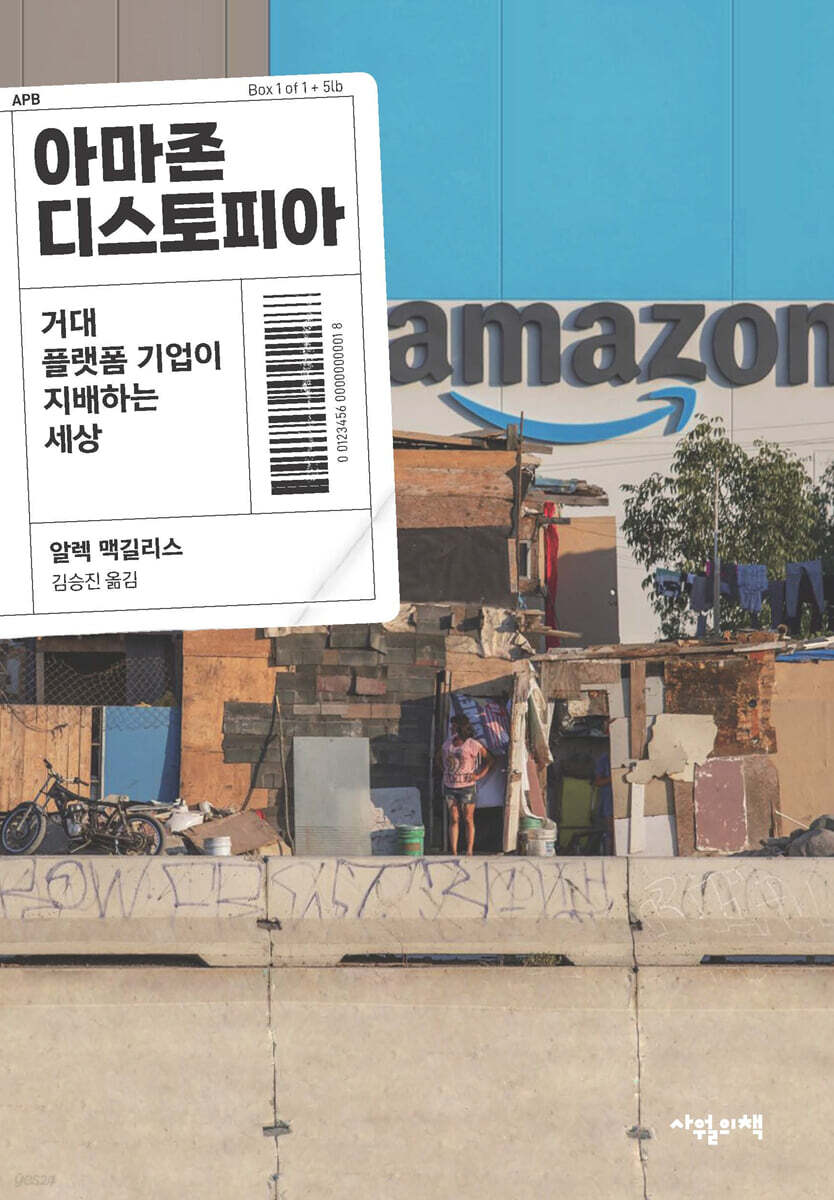
This book is the definitive investigative report that delves into the very realities of how Amazon, the giant corporation known as the "Everything Store" and the "Everywhere Store," is deepening economic inequality in the United States, widening regional disparities, driving workers to death, evading taxes, and even corrupting politics and democracy.
This book has also received praise from the American press for its in-depth reporting and empathetic approach to the underprivileged.
The stories of workers, small businesses, and local communities suffering under a single giant retail platform make us read this book as Amazon's version of "Nomadland" or "Hillbilly Elegy."
Amazon is a company that plays an overwhelmingly large role in the neoliberal restructuring that divides every region and every person in a country into winners and losers.
This book makes us reflect on our reality, using the United States, which is increasingly shrouded in shadow, as a cautionary tale.
We can't help but think of domestic companies trying to follow Amazon's lead.
Withering under the shadow of giant platform companies
A sad elegy for our work, our industry, and our community.
“Can you live without Amazon?” This question from American consumers can be rephrased in any number of ways.
Could you live without Coupang? Could you live without Ali? Of course you could.
If we believe that this cannot be done, then we must accept that these corporations will completely control our work, our economy, our politics, and even the conditions of our lives.
This book is the definitive investigative report that delves into the very realities of how Amazon, the giant corporation known as the "Everything Store" and the "Everywhere Store," is deepening economic inequality in the United States, widening regional disparities, driving workers to death, evading taxes, and even corrupting politics and democracy.
This book has also received praise from the American press for its in-depth reporting and empathetic approach to the underprivileged.
The stories of workers, small businesses, and local communities suffering under a single giant retail platform make us read this book as Amazon's version of "Nomadland" or "Hillbilly Elegy."
Amazon is a company that plays an overwhelmingly large role in the neoliberal restructuring that divides every region and every person in a country into winners and losers.
This book makes us reflect on our reality, using the United States, which is increasingly shrouded in shadow, as a cautionary tale.
We can't help but think of domestic companies trying to follow Amazon's lead.
- You can preview some of the book's contents.
Preview
index
Entry / In the Basement
1.
The Hyper-Prosperous City: The Decline of Community Life / Seattle
2.
Cardboard - Downward Mobility in the Midwest / Dayton, Ohio
3.
Security Industry - The Tremendous Wealth of America's Capital / Washington, DC
Break Time - Drop Zone 9 / Carlisle, Pennsylvania
4.
Dignified Labor: The Decline of Traditional Labor / Baltimore
5.
Customer Service - The Battle of Local Businesses / El Paso, Texas
6.
Power and Power - Under the Cloud / Northern Virginia, Columbus, Ohio, and Washington, D.C.
Break - Back to PHL6 / Carlisle, Pennsylvania
7.
Housing Crisis: Donations and Tax Avoidance / Seattle, Washington, DC
8.
Isolated Cities: The Crisis of Small Town America / Nelsonville, Ohio; York, Pennsylvania; Columbus, Ohio
9.
Concentration and Concentration - Two Cities 60 Kilometers Apart / Baltimore and Washington, DC
The Rest of the Story / Mayday
Reviews
Acknowledgements
main
Search
1.
The Hyper-Prosperous City: The Decline of Community Life / Seattle
2.
Cardboard - Downward Mobility in the Midwest / Dayton, Ohio
3.
Security Industry - The Tremendous Wealth of America's Capital / Washington, DC
Break Time - Drop Zone 9 / Carlisle, Pennsylvania
4.
Dignified Labor: The Decline of Traditional Labor / Baltimore
5.
Customer Service - The Battle of Local Businesses / El Paso, Texas
6.
Power and Power - Under the Cloud / Northern Virginia, Columbus, Ohio, and Washington, D.C.
Break - Back to PHL6 / Carlisle, Pennsylvania
7.
Housing Crisis: Donations and Tax Avoidance / Seattle, Washington, DC
8.
Isolated Cities: The Crisis of Small Town America / Nelsonville, Ohio; York, Pennsylvania; Columbus, Ohio
9.
Concentration and Concentration - Two Cities 60 Kilometers Apart / Baltimore and Washington, DC
The Rest of the Story / Mayday
Reviews
Acknowledgements
main
Search
Into the book
Although much has been written about regional inequality and economic concentration, the two have often been discussed separately rather than in relation to each other.
But these two are connected.
And the more I thought about this connection, the more I became convinced that centered the story around Amazon was the most natural way to reveal it.
This book is less a look into the Amazon itself than it is a look into the United States, cast in the long and ever-deepening shadow of the Amazon.
--- p.22
It is unclear what the promise of the word 'fulfillment' means to the workers working within it.
The GM plant on Browning Highway paid workers an average of $27 an hour and offered many fringe benefits.
But now, a decade later, an Amazon fulfillment center in the same location pays $12 to $13 an hour and offers far fewer fringe benefits.
That doesn't mean local and state governments haven't offered enormous incentives to attract these logistics centers.
The total amount of special favors received by the company is 43 million dollars.
--- p.187
Even as Amazon's demand for workers surged, the average wage for warehouse workers nationwide was falling because wages were so low.
Some economists have described this as a "buying monopoly" situation.
The commodity purchased by the monopolist here is labor power.
As Amazon grows larger and dominates more local labor markets, there will be less competition among employers in the labor market, and therefore less need to raise wages.
--- p.191
Andrew Carnegie stated in his book that “the duty of the rich is to use their wealth in such a way as he judges will produce the most beneficial results for the community.”
Carnegie was so convinced that he had a superior judgment than others about how to spend such "surplus income" that he could not understand why it should be distributed to workers in "tiny portions."
(…) It was a thought that completely ignored the fact that if the poor had been able to receive better wages, there would not have been a need for the massive donations of the rich in the first place.
--- p.293~294
The problem is that emergency services and fire departments, which are tax-funded agencies, are providing free services to address accidents caused by Amazon's safety lapses.
According to the deal with the state, Amazon would receive a 15-year property tax exemption, which would be used to fund local government functions, from schools to police and fire departments.
Amazon warehouses jam hundreds of cars and trucks every day, and they also cause frequent emergency calls, but Amazon doesn't pay for snow removal trucks or ambulances.
The residents are filling the gap left by Amazon's exemption.
--- p.373~374
This apartment costs $500,000 for a 20-pyeong unit, and up to $1 million for a larger unit.
“Can you imagine, half a million dollars? A studio apartment the size of a dorm room for half a million dollars,” Max Pollock said.
(…) If economic concentration had not been so severe, there might have been people who were thinking of creating businesses that could revitalize neighborhoods with greatly diminished populations and buildings that were not receiving much attention.
But instead, a great paradox unfolded.
In one city, decay and neglect reign supreme, while in another, just an hour away, congestion and exclusion reign supreme.
While three-story townhouses were being demolished in one city, in another city, you had to pay a million dollars to buy a three-story house.
--- p.453
Amazon's earnings report for the year, which showed it had made huge profits during the pandemic, came on the same day as the Commerce Department reported that the U.S. economy had its largest quarterly decline on record.
U.S. GDP in the second quarter fell 10 percent compared to the previous quarter.
Amazon was thriving more than ever at a time when the U.S. economy was in its deepest recession.
The fate of the Amazon and the fate of the nation were completely separate.
The fundamental imbalance in economic fortunes has been a major cause of the political upheaval of our time.
But these two are connected.
And the more I thought about this connection, the more I became convinced that centered the story around Amazon was the most natural way to reveal it.
This book is less a look into the Amazon itself than it is a look into the United States, cast in the long and ever-deepening shadow of the Amazon.
--- p.22
It is unclear what the promise of the word 'fulfillment' means to the workers working within it.
The GM plant on Browning Highway paid workers an average of $27 an hour and offered many fringe benefits.
But now, a decade later, an Amazon fulfillment center in the same location pays $12 to $13 an hour and offers far fewer fringe benefits.
That doesn't mean local and state governments haven't offered enormous incentives to attract these logistics centers.
The total amount of special favors received by the company is 43 million dollars.
--- p.187
Even as Amazon's demand for workers surged, the average wage for warehouse workers nationwide was falling because wages were so low.
Some economists have described this as a "buying monopoly" situation.
The commodity purchased by the monopolist here is labor power.
As Amazon grows larger and dominates more local labor markets, there will be less competition among employers in the labor market, and therefore less need to raise wages.
--- p.191
Andrew Carnegie stated in his book that “the duty of the rich is to use their wealth in such a way as he judges will produce the most beneficial results for the community.”
Carnegie was so convinced that he had a superior judgment than others about how to spend such "surplus income" that he could not understand why it should be distributed to workers in "tiny portions."
(…) It was a thought that completely ignored the fact that if the poor had been able to receive better wages, there would not have been a need for the massive donations of the rich in the first place.
--- p.293~294
The problem is that emergency services and fire departments, which are tax-funded agencies, are providing free services to address accidents caused by Amazon's safety lapses.
According to the deal with the state, Amazon would receive a 15-year property tax exemption, which would be used to fund local government functions, from schools to police and fire departments.
Amazon warehouses jam hundreds of cars and trucks every day, and they also cause frequent emergency calls, but Amazon doesn't pay for snow removal trucks or ambulances.
The residents are filling the gap left by Amazon's exemption.
--- p.373~374
This apartment costs $500,000 for a 20-pyeong unit, and up to $1 million for a larger unit.
“Can you imagine, half a million dollars? A studio apartment the size of a dorm room for half a million dollars,” Max Pollock said.
(…) If economic concentration had not been so severe, there might have been people who were thinking of creating businesses that could revitalize neighborhoods with greatly diminished populations and buildings that were not receiving much attention.
But instead, a great paradox unfolded.
In one city, decay and neglect reign supreme, while in another, just an hour away, congestion and exclusion reign supreme.
While three-story townhouses were being demolished in one city, in another city, you had to pay a million dollars to buy a three-story house.
--- p.453
Amazon's earnings report for the year, which showed it had made huge profits during the pandemic, came on the same day as the Commerce Department reported that the U.S. economy had its largest quarterly decline on record.
U.S. GDP in the second quarter fell 10 percent compared to the previous quarter.
Amazon was thriving more than ever at a time when the U.S. economy was in its deepest recession.
The fate of the Amazon and the fate of the nation were completely separate.
The fundamental imbalance in economic fortunes has been a major cause of the political upheaval of our time.
--- p.461
Publisher's Review
When Amazon Became the World
Withering under the shadow of giant platform companies
A sad elegy for our work, our industry, and our community.
“Can you live without Amazon?” This question from American consumers can be rephrased in any number of ways.
Could you live without Coupang? Could you live without Ali? Of course you could.
If we believe that this cannot be done, then we must accept that these corporations will completely control our work, our economy, our politics, and even the conditions of our lives.
This book is the definitive investigative report that delves into the very realities of how Amazon, the giant corporation known as the "Everything Store" and the "Everywhere Store," is deepening economic inequality in the United States, widening regional disparities, driving workers to death, evading taxes, and even corrupting politics and democracy.
This book has also received praise from the American press for its in-depth reporting and empathetic approach to the underprivileged.
The stories of workers, small businesses, and local communities suffering under a single giant retail platform make us read this book as Amazon's version of "Nomadland" or "Hillbilly Elegy."
Amazon is a company that plays an overwhelmingly large role in the neoliberal restructuring that divides every region and every person in a country into winners and losers.
This book makes us reflect on our reality, using the United States, which is increasingly shrouded in shadow, as a cautionary tale.
We can't help but think of domestic companies trying to follow Amazon's lead.
Our lives are being "batch-processed" / Amazon, the corporation that has become a "nation"
Amazon is a company that has become almost a country.
Amazon, which started as an online bookstore and grew into a massive e-commerce platform, is now a monopoly with dozens of data centers and a dominant presence in the cloud and streaming markets.
The term "United States of Amazon" is not an empty phrase.
Amazon is omnipresent, and through its size and monopoly power, it has become a 'nation' that influences not only the economy but also political power.
The country of Amazon, by Amazon, for Amazon has been completed.
The original title of this book, ‘Fulfillment,’ is a term referring to Amazon’s delivery logistics system, meaning ‘completion’ or ‘batch processing.’
Author Alec McGillis guides readers into a dystopia where our very lives are being "batch-processed" through "fulfillment," meaning meeting and completing customer needs.
Go there and you'll see the collapsed local economy, workers who have lost their jobs and are barely scraping by as logistics and delivery workers, small and medium-sized businesses that have abandoned their decades-old family businesses, and cities with thriving IT companies and declining regional cities.
The author explains why he chose the Amazon as a subject of exploration:
“Amazon is a uniquely positioned company to serve as a lens through which to examine the profound disparities and divisions within a country.
Because it exists literally everywhere and in so many different forms.
(…) Amazon divided the United States into different types of regions, each with different ranks, incomes, and goals.
They transformed not only America's geographic landscape but also its landscape of opportunity.
“What has changed is the choices people have before them, what they can dream of in life.” (p. 23)
Work, Housing, Politics, Community… / The Various Harms Amazon Inflicts
In this book, the author raises serious issues that are not limited to economic inequality through the framework of 'Amazon'.
What's more concerning is that these problems are being glossed over by the company's image as a consumer-friendly company, making them invisible to the average consumer, and thus, only worsening.
The author addresses these issues as follows:
(1) The contrast between the enormous wealth of Amazon's founders and executives and the paltry wages of a far greater number of workers illustrates the extreme wealth inequality brought about by neoliberal economics and unchecked monopolies.
(2) The gap between prosperous cities and underdeveloped regions is widening as Amazon divides national territory according to industrial needs.
Hyper-prosperous cities are also experiencing serious class and racial divisions due to gentrification and rising housing costs, while underdeveloped areas are further devastated by Amazon logistics centers and data centers replacing declining industries.
(3) The work performed by many Amazon employees has been reduced to simple, isolated, low-wage labor that no longer provides the value of skilled and rewarding labor of the past, and these workers, who have become disposable commodities, are unable to assert any rights.
(4) Furthermore, Amazon exerts enormous influence over elected officials in both the central and local governments through campaign contributions, revolving door appointments, and lobbying, and is now a major force in political power itself, undermining democracy itself by scouting out officials with conflicts of interest in charge of taxes and public procurement.
(5) We can see how local communities are being dismantled and civic ties are being broken down through the Amazon.
As Amazon erodes local tax bases, local governments are depleting their capacity to support social infrastructure and public services, weakening local autonomy and civic solidarity.
(6) Finally, Amazon is transforming our everyday lives at the most fundamental level by completely changing the way we consume—the way we support and fulfill ourselves.
Monopolies Inevitably Lead to Immoralities / The Concrete Consequences of Amazon's Monopoly
This book focuses on several aspects of the harm caused by Amazon.
What's even more admirable is that these issues are brought to light through vivid stories of workers, local residents, and self-employed people whose personal lives have been ruined by Amazon.
From their stories, we can deeply understand how the characters in "Nomadland" and "Hillbilly Elegy" came to be.
This is why this book is not just a dry social science book, but rather gains widespread sympathy.
The life of a fallen worker:
The author's primary focus in this book is how the lives of countless American workers have changed since the industrial restructuring brought about by companies like Amazon.
There are stories about workers endlessly making cardboard boxes for Amazon (Chapter 2), a logistics center worker who died while driving a forklift without brakes (pages 139 and below), and a former steel worker hired at a logistics center built on the site of a bankrupt steel plant (pages 197 and below).
These workers, who have flowed into the Amazon with the collapse of traditional industries, work for pitiful low wages and take on risks.
The author mercilessly denounces the reality that Amazon has transformed the dignity of labor into low-quality labor desperate for survival, and is passing the resulting risk costs onto the public.
In these stories, we contrast the deaths of workers from overwork after working all night and making early morning deliveries at Coupang's logistics centers with the deaths of firefighters in fires.
Geographic inequality and the disintegration of communities:
The author says Amazon is even redrawing the "map of America."
Amazon uses a strategy of locating its headquarters in Seattle, Washington, D.C., to avoid sales taxes in populous states and increase political accessibility.
Meanwhile, in the remaining underdeveloped regions, local governments are further impoverishing the region by obtaining huge tax benefits in the name of attracting logistics centers and increasing employment.
Furthermore, the geographic restructuring caused by Amazon is said to be producing negative side effects such as rising housing costs, traffic congestion, and class/racial segregation even in the ultra-prosperous cities where its headquarters are located.
The decline of local businesses:
Amazon's low-price offensive and the public sector's monopoly on purchasing are driving even well-established local businesses into bankruptcy and closure.
Representative examples include the struggles of local businesses in El Paso, Texas (pages 220 and below) and the case of Bongtong, a department store that was trusted for its excellent customer/employee policies (pages 358 and 381 and below).
Amazon also goes so far as to discourage independent retailers from selling their products on its site by offering counterfeit copies of popular products and charging a commission of up to 16 percent.
Revolving Door Greetings and Lobby:
The author points out that the moral hazard of public service and political lobbying are also significant factors behind Amazon's meteoric rise.
The case of Ann Leung (pp. 216 and below, pp. 227), who was the "chief procurement officer" of the U.S. federal government and then moved to Amazon's public procurement division, is not only immoral but also ugly.
The same goes for Jay Carney (page 125 and below), who started out as a journalist, served as the White House press secretary, and then became Amazon's communications director.
Tax benefits and low-quality jobs:
Amazon and Jeff Bezos' tax avoidance tactics of choosing cities with small populations to avoid high sales taxes since their founding continued.
By promoting the attraction of logistics centers and data centers, they are not only providing tax breaks but also shifting even the cost of the power grid to the public, while also holding open competition for the city where the second headquarters will be located to maximize tax benefits for local governments.
The authors point out that Amazon has eliminated twice as many independent retail jobs as it has created.
Amazon didn't hire a single worker in Illinois or Missouri, where it generated $3 billion in annual sales (p. 229), and in Baltimore, it paid $12 an hour to workers who earned $27 an hour at their previous jobs, reaping a whopping $43 million in tax breaks (p. 187).
Amazon Web Services and Data Centers:
Amazon's expansion extends beyond online commerce to cloud computing and data server markets.
Amazon Web Services (AWS) and its data centers are entering rural villages where communities once lived, sucking up power and disrupting the local landscape and social relationships with heavily fortified buildings (page 249 and below). The author points out that Washington's information and security industry, which has grown rapidly since the 9/11 terrorist attacks, is one of the pillars supporting AWS.
Corporate social responsibility avoidance:
The author describes the ideology of Amazon and its founder, Jeff Bezos, in one word: "die-hard libertarianism."
Amazon's perspective is a classic neoliberal one, the idea that the sole purpose of a corporation is to further its own interests and those of its shareholders, even at the exclusion of everyone else.
The impact of Amazon's activities on society and the region is of no concern to them.
Nick Hanauer, an early investor in Amazon, has now become one of the company's most blunt critics.
He says this:
"Fixing social problems? Are you kidding me? Jeff Bezos is a diehard libertarian.
To them, the only thing that matters in the world is how well Amazon is doing, and nothing else matters.
It's not a consideration what negative impact Amazon has on this country.
They don't worry about that kind of thing.
“Jeff’s perspective is a typical neoliberal perspective.” (p. 272)
How Can We Stop Amazon? / A New Political Movement
At the end of the book, the author places a glimmer of hope in the efforts of politicians and citizens to stop Amazon's rampage.
During the COVID-19 pandemic, manufacturing and retail industries have been further devastated, while wealth and power have been concentrated in giant IT companies like Amazon, a phenomenon that is no different in the US or South Korea.
Concerned about this worsening situation, the US political establishment is holding antitrust hearings and appointing a progressive scholar to the position of Federal Trade Commission Chairman (page 477 and below). The ongoing efforts to form a union at Amazon are also a positive sign (the unionization effort was successful after the publication of this book).
But it is also true that Jeff Bezos is handing over the legally responsible CEO position and throwing fanciful parties like the 'Blue Origin' space exploration project.
This reminds us of the case of Coupang's actual owner stepping down from his position as a registered executive, evading responsibility, but still controlling the company.
It is truly symbolic that Coupang took the lead in adopting Amazon's fulfillment system and established its logistics division as an independent company called 'Coupang Fulfillment Co., Ltd.'
The author concludes by saying, “The United States has little economic capacity left to sustain the harm caused by the Amazon.”
The book concludes with the suggestion that “finding a way to address this gap [created by Amazon] is a matter that President Joe Biden and his administration must address first” (p. 462).
Ultimately, the only way to stop corporate greed under a neoliberal economy will be through political resolve and democratic control.
Withering under the shadow of giant platform companies
A sad elegy for our work, our industry, and our community.
“Can you live without Amazon?” This question from American consumers can be rephrased in any number of ways.
Could you live without Coupang? Could you live without Ali? Of course you could.
If we believe that this cannot be done, then we must accept that these corporations will completely control our work, our economy, our politics, and even the conditions of our lives.
This book is the definitive investigative report that delves into the very realities of how Amazon, the giant corporation known as the "Everything Store" and the "Everywhere Store," is deepening economic inequality in the United States, widening regional disparities, driving workers to death, evading taxes, and even corrupting politics and democracy.
This book has also received praise from the American press for its in-depth reporting and empathetic approach to the underprivileged.
The stories of workers, small businesses, and local communities suffering under a single giant retail platform make us read this book as Amazon's version of "Nomadland" or "Hillbilly Elegy."
Amazon is a company that plays an overwhelmingly large role in the neoliberal restructuring that divides every region and every person in a country into winners and losers.
This book makes us reflect on our reality, using the United States, which is increasingly shrouded in shadow, as a cautionary tale.
We can't help but think of domestic companies trying to follow Amazon's lead.
Our lives are being "batch-processed" / Amazon, the corporation that has become a "nation"
Amazon is a company that has become almost a country.
Amazon, which started as an online bookstore and grew into a massive e-commerce platform, is now a monopoly with dozens of data centers and a dominant presence in the cloud and streaming markets.
The term "United States of Amazon" is not an empty phrase.
Amazon is omnipresent, and through its size and monopoly power, it has become a 'nation' that influences not only the economy but also political power.
The country of Amazon, by Amazon, for Amazon has been completed.
The original title of this book, ‘Fulfillment,’ is a term referring to Amazon’s delivery logistics system, meaning ‘completion’ or ‘batch processing.’
Author Alec McGillis guides readers into a dystopia where our very lives are being "batch-processed" through "fulfillment," meaning meeting and completing customer needs.
Go there and you'll see the collapsed local economy, workers who have lost their jobs and are barely scraping by as logistics and delivery workers, small and medium-sized businesses that have abandoned their decades-old family businesses, and cities with thriving IT companies and declining regional cities.
The author explains why he chose the Amazon as a subject of exploration:
“Amazon is a uniquely positioned company to serve as a lens through which to examine the profound disparities and divisions within a country.
Because it exists literally everywhere and in so many different forms.
(…) Amazon divided the United States into different types of regions, each with different ranks, incomes, and goals.
They transformed not only America's geographic landscape but also its landscape of opportunity.
“What has changed is the choices people have before them, what they can dream of in life.” (p. 23)
Work, Housing, Politics, Community… / The Various Harms Amazon Inflicts
In this book, the author raises serious issues that are not limited to economic inequality through the framework of 'Amazon'.
What's more concerning is that these problems are being glossed over by the company's image as a consumer-friendly company, making them invisible to the average consumer, and thus, only worsening.
The author addresses these issues as follows:
(1) The contrast between the enormous wealth of Amazon's founders and executives and the paltry wages of a far greater number of workers illustrates the extreme wealth inequality brought about by neoliberal economics and unchecked monopolies.
(2) The gap between prosperous cities and underdeveloped regions is widening as Amazon divides national territory according to industrial needs.
Hyper-prosperous cities are also experiencing serious class and racial divisions due to gentrification and rising housing costs, while underdeveloped areas are further devastated by Amazon logistics centers and data centers replacing declining industries.
(3) The work performed by many Amazon employees has been reduced to simple, isolated, low-wage labor that no longer provides the value of skilled and rewarding labor of the past, and these workers, who have become disposable commodities, are unable to assert any rights.
(4) Furthermore, Amazon exerts enormous influence over elected officials in both the central and local governments through campaign contributions, revolving door appointments, and lobbying, and is now a major force in political power itself, undermining democracy itself by scouting out officials with conflicts of interest in charge of taxes and public procurement.
(5) We can see how local communities are being dismantled and civic ties are being broken down through the Amazon.
As Amazon erodes local tax bases, local governments are depleting their capacity to support social infrastructure and public services, weakening local autonomy and civic solidarity.
(6) Finally, Amazon is transforming our everyday lives at the most fundamental level by completely changing the way we consume—the way we support and fulfill ourselves.
Monopolies Inevitably Lead to Immoralities / The Concrete Consequences of Amazon's Monopoly
This book focuses on several aspects of the harm caused by Amazon.
What's even more admirable is that these issues are brought to light through vivid stories of workers, local residents, and self-employed people whose personal lives have been ruined by Amazon.
From their stories, we can deeply understand how the characters in "Nomadland" and "Hillbilly Elegy" came to be.
This is why this book is not just a dry social science book, but rather gains widespread sympathy.
The life of a fallen worker:
The author's primary focus in this book is how the lives of countless American workers have changed since the industrial restructuring brought about by companies like Amazon.
There are stories about workers endlessly making cardboard boxes for Amazon (Chapter 2), a logistics center worker who died while driving a forklift without brakes (pages 139 and below), and a former steel worker hired at a logistics center built on the site of a bankrupt steel plant (pages 197 and below).
These workers, who have flowed into the Amazon with the collapse of traditional industries, work for pitiful low wages and take on risks.
The author mercilessly denounces the reality that Amazon has transformed the dignity of labor into low-quality labor desperate for survival, and is passing the resulting risk costs onto the public.
In these stories, we contrast the deaths of workers from overwork after working all night and making early morning deliveries at Coupang's logistics centers with the deaths of firefighters in fires.
Geographic inequality and the disintegration of communities:
The author says Amazon is even redrawing the "map of America."
Amazon uses a strategy of locating its headquarters in Seattle, Washington, D.C., to avoid sales taxes in populous states and increase political accessibility.
Meanwhile, in the remaining underdeveloped regions, local governments are further impoverishing the region by obtaining huge tax benefits in the name of attracting logistics centers and increasing employment.
Furthermore, the geographic restructuring caused by Amazon is said to be producing negative side effects such as rising housing costs, traffic congestion, and class/racial segregation even in the ultra-prosperous cities where its headquarters are located.
The decline of local businesses:
Amazon's low-price offensive and the public sector's monopoly on purchasing are driving even well-established local businesses into bankruptcy and closure.
Representative examples include the struggles of local businesses in El Paso, Texas (pages 220 and below) and the case of Bongtong, a department store that was trusted for its excellent customer/employee policies (pages 358 and 381 and below).
Amazon also goes so far as to discourage independent retailers from selling their products on its site by offering counterfeit copies of popular products and charging a commission of up to 16 percent.
Revolving Door Greetings and Lobby:
The author points out that the moral hazard of public service and political lobbying are also significant factors behind Amazon's meteoric rise.
The case of Ann Leung (pp. 216 and below, pp. 227), who was the "chief procurement officer" of the U.S. federal government and then moved to Amazon's public procurement division, is not only immoral but also ugly.
The same goes for Jay Carney (page 125 and below), who started out as a journalist, served as the White House press secretary, and then became Amazon's communications director.
Tax benefits and low-quality jobs:
Amazon and Jeff Bezos' tax avoidance tactics of choosing cities with small populations to avoid high sales taxes since their founding continued.
By promoting the attraction of logistics centers and data centers, they are not only providing tax breaks but also shifting even the cost of the power grid to the public, while also holding open competition for the city where the second headquarters will be located to maximize tax benefits for local governments.
The authors point out that Amazon has eliminated twice as many independent retail jobs as it has created.
Amazon didn't hire a single worker in Illinois or Missouri, where it generated $3 billion in annual sales (p. 229), and in Baltimore, it paid $12 an hour to workers who earned $27 an hour at their previous jobs, reaping a whopping $43 million in tax breaks (p. 187).
Amazon Web Services and Data Centers:
Amazon's expansion extends beyond online commerce to cloud computing and data server markets.
Amazon Web Services (AWS) and its data centers are entering rural villages where communities once lived, sucking up power and disrupting the local landscape and social relationships with heavily fortified buildings (page 249 and below). The author points out that Washington's information and security industry, which has grown rapidly since the 9/11 terrorist attacks, is one of the pillars supporting AWS.
Corporate social responsibility avoidance:
The author describes the ideology of Amazon and its founder, Jeff Bezos, in one word: "die-hard libertarianism."
Amazon's perspective is a classic neoliberal one, the idea that the sole purpose of a corporation is to further its own interests and those of its shareholders, even at the exclusion of everyone else.
The impact of Amazon's activities on society and the region is of no concern to them.
Nick Hanauer, an early investor in Amazon, has now become one of the company's most blunt critics.
He says this:
"Fixing social problems? Are you kidding me? Jeff Bezos is a diehard libertarian.
To them, the only thing that matters in the world is how well Amazon is doing, and nothing else matters.
It's not a consideration what negative impact Amazon has on this country.
They don't worry about that kind of thing.
“Jeff’s perspective is a typical neoliberal perspective.” (p. 272)
How Can We Stop Amazon? / A New Political Movement
At the end of the book, the author places a glimmer of hope in the efforts of politicians and citizens to stop Amazon's rampage.
During the COVID-19 pandemic, manufacturing and retail industries have been further devastated, while wealth and power have been concentrated in giant IT companies like Amazon, a phenomenon that is no different in the US or South Korea.
Concerned about this worsening situation, the US political establishment is holding antitrust hearings and appointing a progressive scholar to the position of Federal Trade Commission Chairman (page 477 and below). The ongoing efforts to form a union at Amazon are also a positive sign (the unionization effort was successful after the publication of this book).
But it is also true that Jeff Bezos is handing over the legally responsible CEO position and throwing fanciful parties like the 'Blue Origin' space exploration project.
This reminds us of the case of Coupang's actual owner stepping down from his position as a registered executive, evading responsibility, but still controlling the company.
It is truly symbolic that Coupang took the lead in adopting Amazon's fulfillment system and established its logistics division as an independent company called 'Coupang Fulfillment Co., Ltd.'
The author concludes by saying, “The United States has little economic capacity left to sustain the harm caused by the Amazon.”
The book concludes with the suggestion that “finding a way to address this gap [created by Amazon] is a matter that President Joe Biden and his administration must address first” (p. 462).
Ultimately, the only way to stop corporate greed under a neoliberal economy will be through political resolve and democratic control.
GOODS SPECIFICS
- Date of issue: June 1, 2024
- Format: Paperback book binding method guide
- Page count, weight, size: 520 pages | 668g | 146*210*25mm
- ISBN13: 9791192092294
- ISBN10: 1192092295
You may also like
카테고리
korean


korean

![GQ KOREA Mark (Monthly): December [2025]](http://librairie.coreenne.fr/cdn/shop/files/8ef265dbbfbf186523ed75ba7319009d.jpg?v=1765340328&width=3840)


