

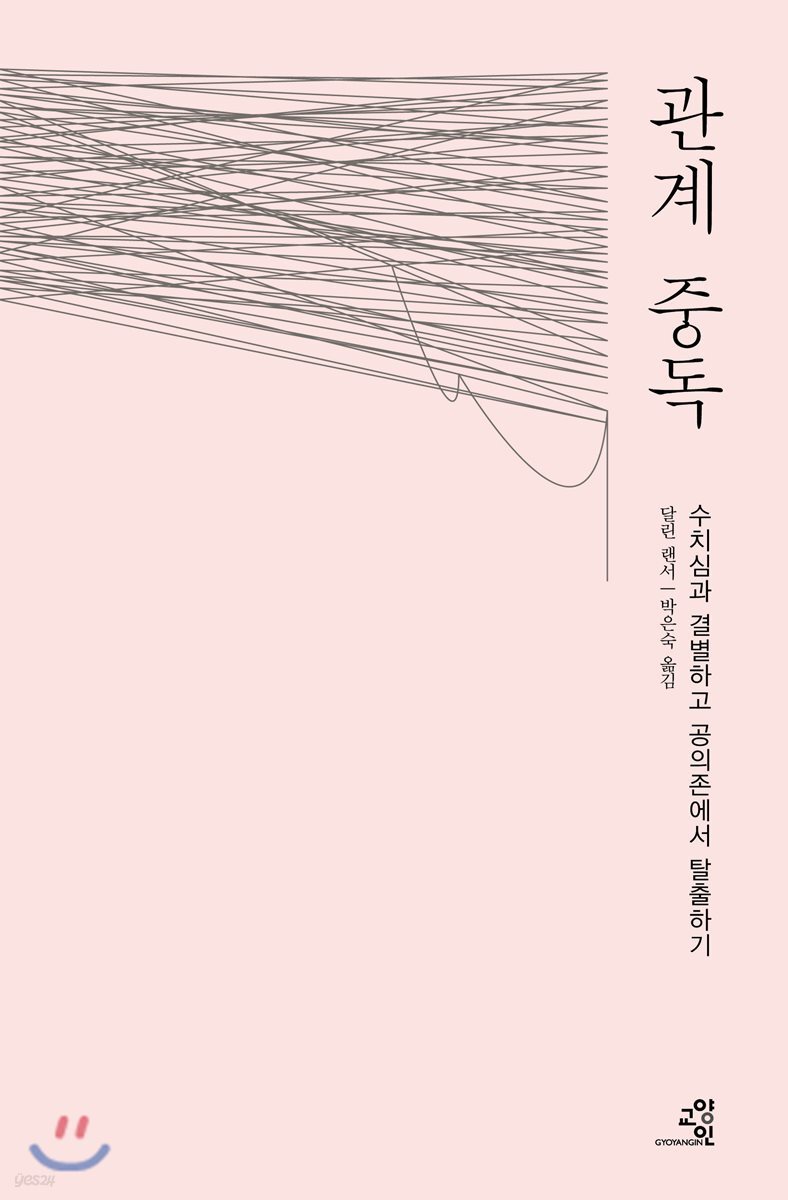
relationship addiction
 |
Description
Book Introduction
When I looked into my love-addicted heart, I saw that 'shame' was living there.
The Psychology of Self-Healing: Breaking Free from Codependency and Reclaiming Healthy Relationships
There are people who find the meaning of life in ‘you’ rather than ‘me’.
They feel guilty when they refuse a friend's request.
Even if your partner cheats or is violent, you can't leave.
They find self-esteem in the success of their spouse or children.
Every time you're in a relationship, it's hard to try to fit everything into your partner's shoes.
The words I fear the most are “Let’s stop seeing each other.”
Because all of your energy is focused on others, you can't properly manage your own life or take care of yourself.
For these people, who are called relationship addicts, there is no such thing as a 'me standing alone'.
There is only 'me with you'.
Inside a relationship addict, there is a bad feeling of shame, a feeling of being unlovable and ashamed that they want to disappear.
Shame is the 'destroyer of love'.
Because it destroys all the behaviors and communication required for a healthy relationship.
Shame and relationship addiction feed off each other and ruin our lives.
The author shares his own story of being a serious relationship addict.
Also, based on the cases of clients I met while providing psychological counseling, I provide guidance on how to overcome shame and relationship addiction.
The Psychology of Self-Healing: Breaking Free from Codependency and Reclaiming Healthy Relationships
There are people who find the meaning of life in ‘you’ rather than ‘me’.
They feel guilty when they refuse a friend's request.
Even if your partner cheats or is violent, you can't leave.
They find self-esteem in the success of their spouse or children.
Every time you're in a relationship, it's hard to try to fit everything into your partner's shoes.
The words I fear the most are “Let’s stop seeing each other.”
Because all of your energy is focused on others, you can't properly manage your own life or take care of yourself.
For these people, who are called relationship addicts, there is no such thing as a 'me standing alone'.
There is only 'me with you'.
Inside a relationship addict, there is a bad feeling of shame, a feeling of being unlovable and ashamed that they want to disappear.
Shame is the 'destroyer of love'.
Because it destroys all the behaviors and communication required for a healthy relationship.
Shame and relationship addiction feed off each other and ruin our lives.
The author shares his own story of being a serious relationship addict.
Also, based on the cases of clients I met while providing psychological counseling, I provide guidance on how to overcome shame and relationship addiction.
- You can preview some of the book's contents.
Preview
index
Preface _ I was a codependent trapped in shame.
Chapter 1 When the feeling of uselessness suddenly comes over me
_ The Root of Shame
Everyone lives with shame
Emotions closely related to shame
Four Categories of Shame
Narcissism of self-loathing
Breaking the Chain of Shame
Training
Chapter 2: How Shame Blocks Inner Growth
_ The Birth of Shame
The 'real me' and the 'false me'
Depressed parents with depressed children
Parents of children who overcome shame well
Feelings crushed by shame
The inner critic that paralyzes life
Training
Chapter 3: Defensive Behaviors to Hide Shame
_ Shame Coping Strategies
Shame Defense Mechanisms: From Projection to Addiction
Types of Relationship Addiction: Dominant, Bystander, and Submissive
Training
Chapter 4: Where Does This Insatiable Hunger Come From?
_ The empty inner self of the codependent
The source of shame, emptiness
existential emptiness
psychological emptiness
Why Codependents Become Addicted
Accepting Emptiness
Training
Chapter 5: Anxiety and Addiction Caused by Low Self-Esteem
_ Symptoms of codependency
Low self-esteem and relationship addiction
Core emotions of codependents: anxiety, guilt, and depression
People who deny their emotions and suppress their desires
Why are perfectionists afraid of making mistakes?
"Better an unhappy relationship than being alone."
Covert manipulation, passive control
Training
Chapter 6: Addictive Love Driven by Jealousy, Fear, and Anger
_ Relationship addiction
How People with Low Self-Esteem Love
A relationship that respects autonomy
No one is perfect
Even love needs boundaries
Communication Strategies for Intimate Relationships
Getting out of an abusive relationship
How People with High Self-Esteem Love
Training
Chapter 7: Why do we feel sexual pleasure is shameful?
_ Sexuality and Shame
sexual trauma
Is your last name shameful?
Shame determines sexual identity.
Sexual Abuse and Guilt
What is sexual self-esteem?
Sex addiction and self-loathing
Boosting sexual self-esteem
Training
Chapter 8: To Free Me from Shame
Step 1: Who is the 'real me'?
Step 2: Expressing Shame
Step 3: Finding the Roots of Shame
Step 4: Talk to Your Inner Critic
Step 5: Facing Shame
Step 6: Courage to Be Vulnerable
Step 7: How to increase self-esteem?
Step 8: The Miracle of Self-Acceptance
Appendix - Self-Empathy Test
annotation
Chapter 1 When the feeling of uselessness suddenly comes over me
_ The Root of Shame
Everyone lives with shame
Emotions closely related to shame
Four Categories of Shame
Narcissism of self-loathing
Breaking the Chain of Shame
Training
Chapter 2: How Shame Blocks Inner Growth
_ The Birth of Shame
The 'real me' and the 'false me'
Depressed parents with depressed children
Parents of children who overcome shame well
Feelings crushed by shame
The inner critic that paralyzes life
Training
Chapter 3: Defensive Behaviors to Hide Shame
_ Shame Coping Strategies
Shame Defense Mechanisms: From Projection to Addiction
Types of Relationship Addiction: Dominant, Bystander, and Submissive
Training
Chapter 4: Where Does This Insatiable Hunger Come From?
_ The empty inner self of the codependent
The source of shame, emptiness
existential emptiness
psychological emptiness
Why Codependents Become Addicted
Accepting Emptiness
Training
Chapter 5: Anxiety and Addiction Caused by Low Self-Esteem
_ Symptoms of codependency
Low self-esteem and relationship addiction
Core emotions of codependents: anxiety, guilt, and depression
People who deny their emotions and suppress their desires
Why are perfectionists afraid of making mistakes?
"Better an unhappy relationship than being alone."
Covert manipulation, passive control
Training
Chapter 6: Addictive Love Driven by Jealousy, Fear, and Anger
_ Relationship addiction
How People with Low Self-Esteem Love
A relationship that respects autonomy
No one is perfect
Even love needs boundaries
Communication Strategies for Intimate Relationships
Getting out of an abusive relationship
How People with High Self-Esteem Love
Training
Chapter 7: Why do we feel sexual pleasure is shameful?
_ Sexuality and Shame
sexual trauma
Is your last name shameful?
Shame determines sexual identity.
Sexual Abuse and Guilt
What is sexual self-esteem?
Sex addiction and self-loathing
Boosting sexual self-esteem
Training
Chapter 8: To Free Me from Shame
Step 1: Who is the 'real me'?
Step 2: Expressing Shame
Step 3: Finding the Roots of Shame
Step 4: Talk to Your Inner Critic
Step 5: Facing Shame
Step 6: Courage to Be Vulnerable
Step 7: How to increase self-esteem?
Step 8: The Miracle of Self-Acceptance
Appendix - Self-Empathy Test
annotation
Publisher's Review
Why on earth am I feeling ashamed of myself for no reason?
Where does this feeling of being unworthy of love come from?
Is there no way out of this familiar feeling of worthlessness?
Shame is an emotion familiar to everyone.
But how many of us have ever considered the impact shame has on our lives? Shame isn't just a one-time, embarrassing event; it can become a lifelong entanglement.
For example, people who consider loneliness shameful are less likely to express feelings of loneliness.
People who are ashamed of their body may avoid gatherings where they are required to wear revealing clothing.
Parents who feel ashamed of not having received a good education may try to compensate for their shame through their children.
By closely observing our own actions and thoughts in this way, we can easily realize how deeply shame restricts our thoughts and actions in many aspects of our lives.
Modern people are more focused on external things than ever before and suffer from comparing themselves to others.
This can easily lead to shame, which can have a huge impact on how I decide my future path.
Shame is the root of codependency.
Codependency is an immature relationship in which one person sacrifices their own needs and feelings to accommodate the needs of the other person and expects something in return.
Codependents can be seen as addicted to relationships, much like alcoholics.
After reading this book, you will realize that shame and codependency affect almost every area of your life.
You will also understand how shame leads to codependency, and you will gain great tools to recognize and improve both shame and codependency.
Why am I obsessed with relationships?
Relationship addicts deny their feelings, suppress their desires, and live according to the demands of others.
To maintain the relationship, I say “I’m sorry” whenever I get the chance.
We stay in unhappy relationships because we feel that being alone is even more terrifying.
When relationship addicts become close to someone they idealize, they unconsciously think, "If someone this wonderful accepts me, I must not be such a bad person," and they see it as a means to make the other person feel perfect.
The core of relationship addiction is 'shame'.
Shame is at the heart of codependency and addiction.
Shame destroys relationships as much as we want to love and be loved.
Shame hides deep inside us and prevents us from forming healthy relationships.
Internalized shame is a common symptom in codependents and addicts.
It is an unhealed wound that exposes everything inside, and it secretly invades the soul and spreads like a virus.
And, without realizing it, it plants negative ideas about yourself that take away your confidence, talents, and happiness.
At this point, not only are the symptoms of shame worse, but external events or other people are no longer needed to trigger the associated feelings and thoughts.
… … Because once shame is internalized, it follows us around like a shadow.
Now, we can trigger shame in ourselves through self-criticism, self-imposed standards or goals, or comparing ourselves to others.
- Pages 37 and 38
The Codependent's Covert Manipulation: "Passive Control"
Codependents try to control others' behavior and emotions to avoid shame.
The greater the shame a person has, the more intense their desire for control becomes.
Another reason codependents control others is because they are dependent on others.
Their focus is outward, and they see others as the cause of their problems, the solution to their problems, or both.
For example, some parents pressure their children to achieve higher goals to compensate for their own feelings of inferiority and shame.
Codependent caregiving involves giving something in exchange for love.
“I will help you.
“Then you will love me and accept me” is the motivation.
The caregiver may be responsible for more than half of the relationship.
They are irresponsible to themselves, yet they try to take responsibility for their partner's happiness, emotions, needs, expectations, and even their actions and problems.
You may put in a lot of effort to be useful to others.
Examples include volunteering, doing more than your assigned share at work, and giving in to unreasonable demands.
… … but their giving behavior is tinged with control and expectations.
They expect gratitude, affection, and recognition, and they expect that the person they are receiving advice will listen to them and change.
Otherwise, the other person will feel ungrateful and will become angry.
- Pages 170 and 171
Everyone lives with shame
How does shame differ from other emotions? Similar emotions to shame include shyness, embarrassment, humiliation, and guilt.
“Although they differ in meaning, experience, and intensity, shyness, embarrassment, humiliation, and guilt all share the commonality of shame, a feeling of inferiority.”
Shame is the pain we feel when we are insulted or rejected, or when flaws we wish to hide are exposed.
But the shame doesn't stop there.
Even after the situation in which we felt humiliated and inadequate is over, shame can linger and torment us for days or even years.
Shame freezes us and prevents us from taking action, even when there is no objective reason to fear or when we have done nothing wrong.
Shame convinces us that we are bad or seriously flawed and that no matter what we do, we cannot change.
When shame rules our hearts
An unexpected bout of shame, such as when you fall in front of a large group of people or spill a drink while eating out, or a physiological phenomenon where your face becomes hot and sweat pours down is called 'acute shame.'
Acute shame is not much different from other emotions in that it comes and goes suddenly.
But once the shame builds up to a certain level, the story changes.
This is because we are dominated by a deep-seated belief in our incompetence that seems to last forever and is impossible to reverse.
Internalized shame is a common symptom in codependents and addicts.
It is an unhealed wound that exposes everything inside, and it secretly invades the soul and spreads like a virus.
And, without realizing it, it plants negative ideas about yourself that take away your confidence, talents, and happiness.
At this point, not only are the symptoms of shame worse, but external events or other people are no longer needed to trigger the associated feelings and thoughts.
You don't have to remember or be conscious of the first shameful incident or belief.
Because once internalized, shame follows us around like a shadow.
Now, we can trigger shame in ourselves through self-criticism, self-imposed standards or goals, or comparing ourselves to others.
- Pages 37 and 38
Shame Coping Mechanisms: Addiction and Projection
Coping mechanisms used to avoid the unpleasant feelings that shame causes include denial, repression, aggression, 'addiction', and 'projection'.
Addiction numbs painful emotions.
We use addiction to control shame, whether it's a person, a substance (alcohol, drugs, food, etc.), or an activity (shopping, sex, gambling, etc.).
Shame can also be managed by indulging in power, stimulation, and pleasure.
Compulsively indulging in love is also a defense against the feeling that one is unlovable.
People addicted to love and romance can temporarily escape their shame by fantasizing about an ideal relationship.
- Page 101
When we project our inner critic onto others, we become hypersensitive and may even perceive compliments as criticism.
“You look really good.” is interpreted as “So you looked bad before?”
“Have you lost weight?” becomes “Does that mean you looked fat before?”
“You got an A!” sounds like a question, like “You got an A?”
Codependents, in particular, are sensitive to boundaries set by others because they don't know how to draw them.
“I have to go now” is interpreted as “I’m boring you” or “You hate me.”
- Pages 147 and 148
Fake personalities created by shame
Shame plays a crucial role in the developmental process of childhood, when identity is formed.
If our parents or those in parental roles during childhood do not instill confidence in us or encourage us to express our feelings and needs openly, but rather ignore them, our true selves become besieged by shame.
As shame becomes internalized, we create false identities to try to rid ourselves of it: the ideal self, the codependent self, the inner critic, and the self-deprecating self.
This manipulated identity not only prevents us from properly protecting and loving ourselves, but also distances us further from our true selves.
The 'me' who believes that he or she should become
Most codependents have little experience in childhood of having their needs and feelings accepted.
The 'ideal self' reflects what kind of person a child 'should' be in order to survive in the family.
A child who grows up in a home where sad emotions are not tolerated will constantly try to show only happiness, and in this case, the false identity of the ideal self replaces the actual self, the 'real me'.
The effort to perfect one's ideal self can be obsessive.
For example, they try to hide their real self and express only their idealized self.
Unfortunately, this obsession with the ideal self is a devastating thing that can alter our entire lives and developmental trajectories.
And by trying to fit into these false ideals, we experience a more intense sense of alienation.
- Page 55
Codependency, the disease of "losing myself"
The 'codependent self' is much more serious than creating an ideal self.
Codependents are disconnected from their true selves and are unable to function effectively as their true selves.
Like the actual self and the ideal self, the codependent self usually has its roots in childhood.
This is especially true if one or both parents were codependent.
Codependent parents, who have unclear interpersonal boundaries, often view their children as extensions of themselves and not as independent, separate individuals.
Even 'loving' parents can do this.
They don't know how to empathize.
Instead of empathizing, they use their children to boost their self-esteem, realize their ideals, and satisfy their needs.
- Pages 56 and 57
The inner critic that paralyzes life
The voice of our parents, shaming and belittling us, becomes our inner critic and lingers within us for a long time.
The codependent lives with this critic.
The voice of our inner critic causes us to experience intense shame, constantly clashes with our true selves, and constantly brings up traumatic events from our childhood.
From childhood, our inner critic expects things of us that are difficult to achieve.
Forcing us to suppress our true feelings and characteristics that conflict with our inner ideals.
We obediently follow our inner critic.
In other words, we try to be 'just as' our inner critic thinks we are, and we try to 'become' the person who feels, thinks, does, and needs 'just as' our inner critic believes we are.
As a result, codependents inevitably become consumed by shame when their behavior falls short of expectations or when limitations prevent them from reaching their ideals.
- Pages 77 and 78
Three Types of Relationship Addiction
The author broadly categorizes relationship addiction into three types.
These are the dominant type, the bystander type, and the submissive type.
When we think of relationship addicts, we usually think of people who are overly obsessed with relationships or who approach others in a submissive manner, but people who try to distance themselves from others or have a strong desire to control others can also be considered relationship addicts.
Dominant - Aggressive Narcissist
Unlike codependents who identify with a shameful and self-deprecating self, dominant types are often narcissists.
They believe that their ideal self is 'themselves'.
Their sense of privilege may reduce their unconscious feelings of deprivation and inferiority, but they resurface when they are not treated with privilege.
The dominant type may appear to have high self-esteem and not need others.
But that's not the case.
The reason they try to charm others is to gain their respect.
The reason we boast about ourselves, our plans, and our accomplishments is to escape the feeling of shame or failure.
- Pages 105 and 106
Bystander - Avoidant Liberal
This personality type exhibits a resigned or detached attitude.
They act as if they are not the masters of their own lives, as if they are just bystanders.
The bystander type personality is formed on the basis of psychological withdrawal.
To avoid one's own desires and needs, or to avoid hurt and disappointment.
Their shame leads them to feel unworthy of interacting with others, and the solution is to distance themselves from people.
Because I want to intentionally reduce the radius of my life and somehow achieve peace of mind.
… … This type, who does not like to make any effort, is not interested in competition, arguments, goal achievement, or getting involved in things that involve other people.
- Pages 106 and 107
Submissive - Self-Deprecating Codependent
Denial of personal needs and fear of conflict and abandonment make it extremely difficult for submissive types to set boundaries.
This gives others an excuse to easily abuse and exploit them.
They find it difficult to say 'no' to those who abuse them and need them.
Moreover, in trying to please them, we tend to sacrifice ourselves.
And to do so, they not only deny, minimize, and rationalize the abuse and hurt feelings they have received, but they also try to find their own flaws and become more understanding.
This attitude prevents them from what they fear most: rejection.
Rejection destroys the hope of finding lasting love and validates their belief that they are unlovable.
- Pages 111 and 112
How to Break Free from Shame and Relationship Addiction
Don't guess what the other person is thinking.
There are times when we assume we know what our partner is thinking or what emotional state he or she is in.
When we analyze our partner's emotional state, define how they feel, tell others about their emotional state, or express, "You're the problem," we are disregarding our partner's mental and emotional boundaries.
This attitude implies that one member of the couple is superior and knows everything.
This situation can make you feel like you're invading and attacking your partner, making them feel ashamed and superior.
Therefore, it is much more respectful to open your heart and ask your partner how they feel.
- Pages 212 and 213
Respect boundaries
Maintaining a healthy relationship requires partners to set healthy boundaries that prevent anger and abuse from developing between each other.
But because we have a hard time drawing boundaries between ourselves and others, other people's boundaries feel like they bring shame to us.
For example, when our partner spends time with friends or engaging in personal hobbies, we may view this as selfish behavior.
If my wife wants to be alone, I take it as evidence that she is not worth spending time with.
A healthy relationship requires both time spent with your partner and time spent alone.
… … Relationships can improve when you learn to set boundaries and accept your partner's boundaries.
- Pages 213 and 214
Resist the urge to care and control.
Any action taken to fix your partner will only lead to conflict and anger between you two.
Perhaps we may even be further encouraging the very behavior we are trying to eradicate.
This principle can be understood through examples of winners and losers.
The winner, who is the helper, feels self-reliant and superior, while the loser feels incompetent and inferior.
And this upsets the balance of these relationships.
… …Typical couple patterns can appear intermittently or continuously.
Especially when abuse is involved, it can create distance or create imbalance in the relationship between the two people.
You may be stuck in your role for years, and life for both of you could become miserable.
To change, winners must resist the urge to advise and control.
Also, losers need to lower their expectations and refocus on their true selves.
- Pages 214-216
Where does this feeling of being unworthy of love come from?
Is there no way out of this familiar feeling of worthlessness?
Shame is an emotion familiar to everyone.
But how many of us have ever considered the impact shame has on our lives? Shame isn't just a one-time, embarrassing event; it can become a lifelong entanglement.
For example, people who consider loneliness shameful are less likely to express feelings of loneliness.
People who are ashamed of their body may avoid gatherings where they are required to wear revealing clothing.
Parents who feel ashamed of not having received a good education may try to compensate for their shame through their children.
By closely observing our own actions and thoughts in this way, we can easily realize how deeply shame restricts our thoughts and actions in many aspects of our lives.
Modern people are more focused on external things than ever before and suffer from comparing themselves to others.
This can easily lead to shame, which can have a huge impact on how I decide my future path.
Shame is the root of codependency.
Codependency is an immature relationship in which one person sacrifices their own needs and feelings to accommodate the needs of the other person and expects something in return.
Codependents can be seen as addicted to relationships, much like alcoholics.
After reading this book, you will realize that shame and codependency affect almost every area of your life.
You will also understand how shame leads to codependency, and you will gain great tools to recognize and improve both shame and codependency.
Why am I obsessed with relationships?
Relationship addicts deny their feelings, suppress their desires, and live according to the demands of others.
To maintain the relationship, I say “I’m sorry” whenever I get the chance.
We stay in unhappy relationships because we feel that being alone is even more terrifying.
When relationship addicts become close to someone they idealize, they unconsciously think, "If someone this wonderful accepts me, I must not be such a bad person," and they see it as a means to make the other person feel perfect.
The core of relationship addiction is 'shame'.
Shame is at the heart of codependency and addiction.
Shame destroys relationships as much as we want to love and be loved.
Shame hides deep inside us and prevents us from forming healthy relationships.
Internalized shame is a common symptom in codependents and addicts.
It is an unhealed wound that exposes everything inside, and it secretly invades the soul and spreads like a virus.
And, without realizing it, it plants negative ideas about yourself that take away your confidence, talents, and happiness.
At this point, not only are the symptoms of shame worse, but external events or other people are no longer needed to trigger the associated feelings and thoughts.
… … Because once shame is internalized, it follows us around like a shadow.
Now, we can trigger shame in ourselves through self-criticism, self-imposed standards or goals, or comparing ourselves to others.
- Pages 37 and 38
The Codependent's Covert Manipulation: "Passive Control"
Codependents try to control others' behavior and emotions to avoid shame.
The greater the shame a person has, the more intense their desire for control becomes.
Another reason codependents control others is because they are dependent on others.
Their focus is outward, and they see others as the cause of their problems, the solution to their problems, or both.
For example, some parents pressure their children to achieve higher goals to compensate for their own feelings of inferiority and shame.
Codependent caregiving involves giving something in exchange for love.
“I will help you.
“Then you will love me and accept me” is the motivation.
The caregiver may be responsible for more than half of the relationship.
They are irresponsible to themselves, yet they try to take responsibility for their partner's happiness, emotions, needs, expectations, and even their actions and problems.
You may put in a lot of effort to be useful to others.
Examples include volunteering, doing more than your assigned share at work, and giving in to unreasonable demands.
… … but their giving behavior is tinged with control and expectations.
They expect gratitude, affection, and recognition, and they expect that the person they are receiving advice will listen to them and change.
Otherwise, the other person will feel ungrateful and will become angry.
- Pages 170 and 171
Everyone lives with shame
How does shame differ from other emotions? Similar emotions to shame include shyness, embarrassment, humiliation, and guilt.
“Although they differ in meaning, experience, and intensity, shyness, embarrassment, humiliation, and guilt all share the commonality of shame, a feeling of inferiority.”
Shame is the pain we feel when we are insulted or rejected, or when flaws we wish to hide are exposed.
But the shame doesn't stop there.
Even after the situation in which we felt humiliated and inadequate is over, shame can linger and torment us for days or even years.
Shame freezes us and prevents us from taking action, even when there is no objective reason to fear or when we have done nothing wrong.
Shame convinces us that we are bad or seriously flawed and that no matter what we do, we cannot change.
When shame rules our hearts
An unexpected bout of shame, such as when you fall in front of a large group of people or spill a drink while eating out, or a physiological phenomenon where your face becomes hot and sweat pours down is called 'acute shame.'
Acute shame is not much different from other emotions in that it comes and goes suddenly.
But once the shame builds up to a certain level, the story changes.
This is because we are dominated by a deep-seated belief in our incompetence that seems to last forever and is impossible to reverse.
Internalized shame is a common symptom in codependents and addicts.
It is an unhealed wound that exposes everything inside, and it secretly invades the soul and spreads like a virus.
And, without realizing it, it plants negative ideas about yourself that take away your confidence, talents, and happiness.
At this point, not only are the symptoms of shame worse, but external events or other people are no longer needed to trigger the associated feelings and thoughts.
You don't have to remember or be conscious of the first shameful incident or belief.
Because once internalized, shame follows us around like a shadow.
Now, we can trigger shame in ourselves through self-criticism, self-imposed standards or goals, or comparing ourselves to others.
- Pages 37 and 38
Shame Coping Mechanisms: Addiction and Projection
Coping mechanisms used to avoid the unpleasant feelings that shame causes include denial, repression, aggression, 'addiction', and 'projection'.
Addiction numbs painful emotions.
We use addiction to control shame, whether it's a person, a substance (alcohol, drugs, food, etc.), or an activity (shopping, sex, gambling, etc.).
Shame can also be managed by indulging in power, stimulation, and pleasure.
Compulsively indulging in love is also a defense against the feeling that one is unlovable.
People addicted to love and romance can temporarily escape their shame by fantasizing about an ideal relationship.
- Page 101
When we project our inner critic onto others, we become hypersensitive and may even perceive compliments as criticism.
“You look really good.” is interpreted as “So you looked bad before?”
“Have you lost weight?” becomes “Does that mean you looked fat before?”
“You got an A!” sounds like a question, like “You got an A?”
Codependents, in particular, are sensitive to boundaries set by others because they don't know how to draw them.
“I have to go now” is interpreted as “I’m boring you” or “You hate me.”
- Pages 147 and 148
Fake personalities created by shame
Shame plays a crucial role in the developmental process of childhood, when identity is formed.
If our parents or those in parental roles during childhood do not instill confidence in us or encourage us to express our feelings and needs openly, but rather ignore them, our true selves become besieged by shame.
As shame becomes internalized, we create false identities to try to rid ourselves of it: the ideal self, the codependent self, the inner critic, and the self-deprecating self.
This manipulated identity not only prevents us from properly protecting and loving ourselves, but also distances us further from our true selves.
The 'me' who believes that he or she should become
Most codependents have little experience in childhood of having their needs and feelings accepted.
The 'ideal self' reflects what kind of person a child 'should' be in order to survive in the family.
A child who grows up in a home where sad emotions are not tolerated will constantly try to show only happiness, and in this case, the false identity of the ideal self replaces the actual self, the 'real me'.
The effort to perfect one's ideal self can be obsessive.
For example, they try to hide their real self and express only their idealized self.
Unfortunately, this obsession with the ideal self is a devastating thing that can alter our entire lives and developmental trajectories.
And by trying to fit into these false ideals, we experience a more intense sense of alienation.
- Page 55
Codependency, the disease of "losing myself"
The 'codependent self' is much more serious than creating an ideal self.
Codependents are disconnected from their true selves and are unable to function effectively as their true selves.
Like the actual self and the ideal self, the codependent self usually has its roots in childhood.
This is especially true if one or both parents were codependent.
Codependent parents, who have unclear interpersonal boundaries, often view their children as extensions of themselves and not as independent, separate individuals.
Even 'loving' parents can do this.
They don't know how to empathize.
Instead of empathizing, they use their children to boost their self-esteem, realize their ideals, and satisfy their needs.
- Pages 56 and 57
The inner critic that paralyzes life
The voice of our parents, shaming and belittling us, becomes our inner critic and lingers within us for a long time.
The codependent lives with this critic.
The voice of our inner critic causes us to experience intense shame, constantly clashes with our true selves, and constantly brings up traumatic events from our childhood.
From childhood, our inner critic expects things of us that are difficult to achieve.
Forcing us to suppress our true feelings and characteristics that conflict with our inner ideals.
We obediently follow our inner critic.
In other words, we try to be 'just as' our inner critic thinks we are, and we try to 'become' the person who feels, thinks, does, and needs 'just as' our inner critic believes we are.
As a result, codependents inevitably become consumed by shame when their behavior falls short of expectations or when limitations prevent them from reaching their ideals.
- Pages 77 and 78
Three Types of Relationship Addiction
The author broadly categorizes relationship addiction into three types.
These are the dominant type, the bystander type, and the submissive type.
When we think of relationship addicts, we usually think of people who are overly obsessed with relationships or who approach others in a submissive manner, but people who try to distance themselves from others or have a strong desire to control others can also be considered relationship addicts.
Dominant - Aggressive Narcissist
Unlike codependents who identify with a shameful and self-deprecating self, dominant types are often narcissists.
They believe that their ideal self is 'themselves'.
Their sense of privilege may reduce their unconscious feelings of deprivation and inferiority, but they resurface when they are not treated with privilege.
The dominant type may appear to have high self-esteem and not need others.
But that's not the case.
The reason they try to charm others is to gain their respect.
The reason we boast about ourselves, our plans, and our accomplishments is to escape the feeling of shame or failure.
- Pages 105 and 106
Bystander - Avoidant Liberal
This personality type exhibits a resigned or detached attitude.
They act as if they are not the masters of their own lives, as if they are just bystanders.
The bystander type personality is formed on the basis of psychological withdrawal.
To avoid one's own desires and needs, or to avoid hurt and disappointment.
Their shame leads them to feel unworthy of interacting with others, and the solution is to distance themselves from people.
Because I want to intentionally reduce the radius of my life and somehow achieve peace of mind.
… … This type, who does not like to make any effort, is not interested in competition, arguments, goal achievement, or getting involved in things that involve other people.
- Pages 106 and 107
Submissive - Self-Deprecating Codependent
Denial of personal needs and fear of conflict and abandonment make it extremely difficult for submissive types to set boundaries.
This gives others an excuse to easily abuse and exploit them.
They find it difficult to say 'no' to those who abuse them and need them.
Moreover, in trying to please them, we tend to sacrifice ourselves.
And to do so, they not only deny, minimize, and rationalize the abuse and hurt feelings they have received, but they also try to find their own flaws and become more understanding.
This attitude prevents them from what they fear most: rejection.
Rejection destroys the hope of finding lasting love and validates their belief that they are unlovable.
- Pages 111 and 112
How to Break Free from Shame and Relationship Addiction
Don't guess what the other person is thinking.
There are times when we assume we know what our partner is thinking or what emotional state he or she is in.
When we analyze our partner's emotional state, define how they feel, tell others about their emotional state, or express, "You're the problem," we are disregarding our partner's mental and emotional boundaries.
This attitude implies that one member of the couple is superior and knows everything.
This situation can make you feel like you're invading and attacking your partner, making them feel ashamed and superior.
Therefore, it is much more respectful to open your heart and ask your partner how they feel.
- Pages 212 and 213
Respect boundaries
Maintaining a healthy relationship requires partners to set healthy boundaries that prevent anger and abuse from developing between each other.
But because we have a hard time drawing boundaries between ourselves and others, other people's boundaries feel like they bring shame to us.
For example, when our partner spends time with friends or engaging in personal hobbies, we may view this as selfish behavior.
If my wife wants to be alone, I take it as evidence that she is not worth spending time with.
A healthy relationship requires both time spent with your partner and time spent alone.
… … Relationships can improve when you learn to set boundaries and accept your partner's boundaries.
- Pages 213 and 214
Resist the urge to care and control.
Any action taken to fix your partner will only lead to conflict and anger between you two.
Perhaps we may even be further encouraging the very behavior we are trying to eradicate.
This principle can be understood through examples of winners and losers.
The winner, who is the helper, feels self-reliant and superior, while the loser feels incompetent and inferior.
And this upsets the balance of these relationships.
… …Typical couple patterns can appear intermittently or continuously.
Especially when abuse is involved, it can create distance or create imbalance in the relationship between the two people.
You may be stuck in your role for years, and life for both of you could become miserable.
To change, winners must resist the urge to advise and control.
Also, losers need to lower their expectations and refocus on their true selves.
- Pages 214-216
GOODS SPECIFICS
- Publication date: November 19, 2018
- Page count, weight, size: 320 pages | 460g | 140*213*30mm
- ISBN13: 9791187064299
- ISBN10: 1187064297
You may also like
카테고리
korean


korean

![GQ KOREA Mark (Monthly): December [2025]](http://librairie.coreenne.fr/cdn/shop/files/8ef265dbbfbf186523ed75ba7319009d.jpg?v=1765340328&width=3840)


