

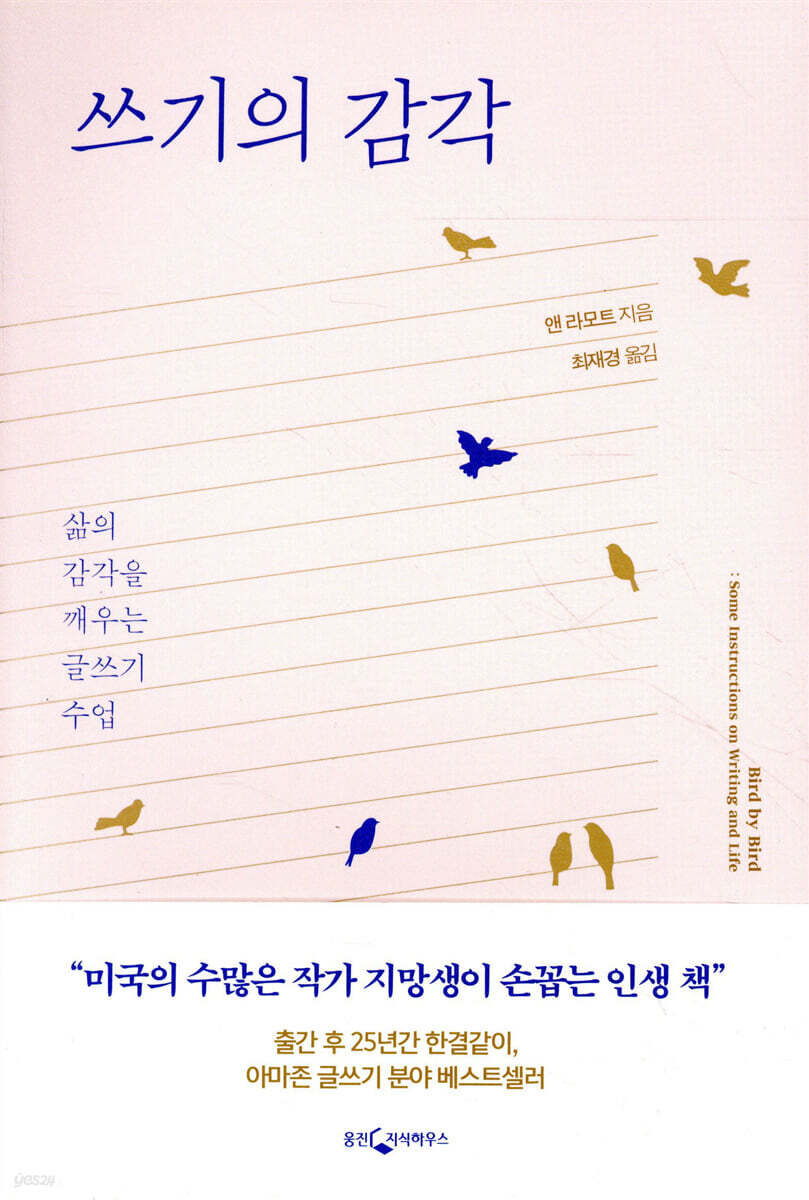
The feeling of writing
 |
Description
Book Introduction
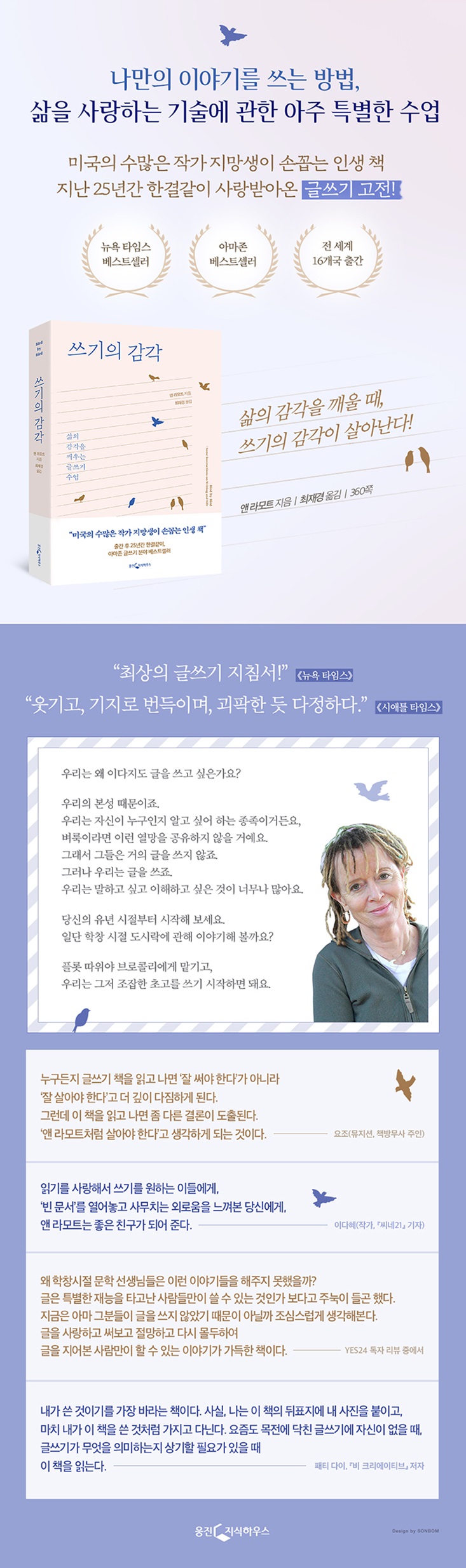
A life-changing book for aspiring American writers
[New York Times], Amazon Books Bestseller
“After reading this book, I added a writing category to my blog.”
“It’s not that I want to write well, but I think I want to live like this.”
"The Sense of Writing" is considered a must-read for many aspiring writers in the United States, a book that provides comfort and encouragement.
This book, which has become the representative work of Anne Lamott, a widely loved author known as a “popular writer,” is “a kind of help on writing and life” based on stories and autobiographical accounts told to students while teaching writing classes for a long time.
The author unfolds the reality of living as a writer in a sharp yet humorous way, along with all the know-how he has gained through experience in writing.
This classic work is widely used as a textbook in creative writing workshops and school classes in the United States, and has remained an Amazon bestseller for 25 years since its publication in 1994. It has been translated and published in 16 countries around the world.
After reading this book, I want to revisit and read the books I liked, go out for a walk, meet people and chat, and above all, I can't help but write something.
Perhaps the reason this book has been so beloved for so long is because the author so passionately confesses his love (or love-hate) for books, writing, and life, leaving readers desperately hoping they can do the same.
If you were expecting writing techniques or tips that you could use right away, this is not the book for you.
But it is full of messages worth keeping in your pocket for the rest of your life and taking out from time to time about 'why we want to write so badly' and 'why we have to write anyway'.
[New York Times], Amazon Books Bestseller
“After reading this book, I added a writing category to my blog.”
“It’s not that I want to write well, but I think I want to live like this.”
"The Sense of Writing" is considered a must-read for many aspiring writers in the United States, a book that provides comfort and encouragement.
This book, which has become the representative work of Anne Lamott, a widely loved author known as a “popular writer,” is “a kind of help on writing and life” based on stories and autobiographical accounts told to students while teaching writing classes for a long time.
The author unfolds the reality of living as a writer in a sharp yet humorous way, along with all the know-how he has gained through experience in writing.
This classic work is widely used as a textbook in creative writing workshops and school classes in the United States, and has remained an Amazon bestseller for 25 years since its publication in 1994. It has been translated and published in 16 countries around the world.
After reading this book, I want to revisit and read the books I liked, go out for a walk, meet people and chat, and above all, I can't help but write something.
Perhaps the reason this book has been so beloved for so long is because the author so passionately confesses his love (or love-hate) for books, writing, and life, leaving readers desperately hoping they can do the same.
If you were expecting writing techniques or tips that you could use right away, this is not the book for you.
But it is full of messages worth keeping in your pocket for the rest of your life and taking out from time to time about 'why we want to write so badly' and 'why we have to write anyway'.
- You can preview some of the book's contents.
Preview
index
Starting the class
Lesson 1: How to Write and Refining Your Own Story
Getting started
A short piece
Writing a rough draft
Perfectionism is the enemy of humanity
Talk about lunch boxes
The Polaroid developing process
Characters
The identity of the plot
Dialogue
stage design
Beware of false starts
Plot major surgery
When it has to end
Lesson 2 · What Happens Inside a Writer
Look with admiration
What you believe is right
How to Talk to Broccoli
The radio station in my head
The War on Jealousy
Lesson 3 · Things to help you keep writing
My Index Card Life
Make phone calls here and there
creative gathering
Someone to read your rough draft
The utility of letters
Writer's Block and Acceptance
Lesson 4 · Why We Write Yet
Writing as a gift
Finding your own voice
How to Become a Giver and a Giver
What comes after publication
Lesson 5 · A story I want to tell in the last class
Acknowledgements
Translator's Note
Lesson 1: How to Write and Refining Your Own Story
Getting started
A short piece
Writing a rough draft
Perfectionism is the enemy of humanity
Talk about lunch boxes
The Polaroid developing process
Characters
The identity of the plot
Dialogue
stage design
Beware of false starts
Plot major surgery
When it has to end
Lesson 2 · What Happens Inside a Writer
Look with admiration
What you believe is right
How to Talk to Broccoli
The radio station in my head
The War on Jealousy
Lesson 3 · Things to help you keep writing
My Index Card Life
Make phone calls here and there
creative gathering
Someone to read your rough draft
The utility of letters
Writer's Block and Acceptance
Lesson 4 · Why We Write Yet
Writing as a gift
Finding your own voice
How to Become a Giver and a Giver
What comes after publication
Lesson 5 · A story I want to tell in the last class
Acknowledgements
Translator's Note
Detailed image
Into the book
People often ask me:
“Writing isn’t something you can teach, is it?”
When I hear that, I respond like this.
“Who the hell are you, that you have permission from God to say such things?”
If people come to one of my classes and want to learn how to write or write better, I can tell them everything that has helped me and how writing has impacted my life in everyday life.
It can tell you little truths that aren't found in general creative writing books.
For example, I've never seen any other book mention that "December is traditionally a bad month for writing."
December is, in my opinion, the month of 'a lot of Mondays'.
Monday is not a good day for writing.
(Page 32, from 'Starting Class')
My writer friends (there are more than a truckload of them) have never reached the point of quiet contentment.
Looking at their faces, most of them have a look of surprise, a sign of emotional distress, similar to the expression on a lab dog that has been tested with a deodorant spray.
Students tend to ignore these words.
They also don't want to hear that it wasn't until I published my fourth book that I finally escaped the starving artist life.
They refuse to believe that most of them will never publish a book, and that even fewer will be able to make a living by writing.
(Page 36, from 'Starting Class')
“I have absolutely no idea where to start.”
A student pleads tearfully.
“Start from your childhood.”
I answer like that.
First, boldly jump into that time and write down all your memories as truthfully as possible.
Flannery O'Connor said that anyone who survived childhood has plenty of material to write about in life.
Perhaps your childhood was unfortunate and painful, but if you express it well, it can be a great source of material.
But don't try to write too well just yet.
Just start writing.
(Page 42, from 'Getting Started')
E.
L. Doctoro said:
“Writing a novel is like driving at night.
You can only see as far as your headlights can illuminate, but that's how you get to your destination."
You don't need to know where you're going.
There is no need to see every sight you pass by on your way to or from your destination.
You should only be able to see the view that is 60 to 90 centimeters wide in front of you.
This has to be the best advice I've ever heard about writing or life.
(Page 62, from 'A Short Essay')
What you wrote all day may turn out to be a mess when you read it.
But what if it's like that?
The novelist Kurt Vonnegut said:
“When I write, I feel like I have no arms or legs, just a crayon in my mouth.”
So keep pushing forward as you have been doing, and make big mistakes and trial and error.
Use up all the paper.
Perfectionism is a poor and cruel form of idealism.
On the other hand, chaos and disorder are the true friends of artists.
This is what adults carelessly forgot to tell us when we were children.
That is, we need to fail in order to realize who we are and why we were born.
Going one step further, failure is essential to realizing what we should write about.
(Page 80, from 'Perfectionism is the Enemy of Humanity')
Don't pretend to know your characters better than they do.
Because in fact you don't know them very well.
Give them a chance and just wait.
Now it was time for tea and everyone came and sat down at the table.
Listen carefully to what they say.
How simple and easy it is.
(Page 110, from 'Characters')
Conversely, characters shouldn't be pawns in the plot you dream of.
Any plot you arbitrarily assign to your characters is nothing more than a semblance of a plot.
I emphasize that you shouldn't worry about the plot.
You just have to worry about the character.
Let those characters speak as they speak, let them reveal themselves naturally, let them live their lives.
And then, I ask myself this question.
'What happens now?' The development of relationships creates the plot.
(Page 111-2, from 'The Identity of the Plot')
I honestly think that to become a writer, you have to learn how to have awe.
If not, why are you writing? Why are you struggling here? Let's think of awe as a sense of wonder at the world, a sense of being present within it, an openness to the world.
(…) a moment when suddenly everything seems to connect, or at least make some sense.
I think this is our goal as writers.
It's about helping people regain this sense of awe, see things in a new way, be amazed by the newness, and ultimately break free from the narrow and limited world that has confined them.
(Page 170-1, from 'Looking with Admiration')
A psychiatrist tells his patient:
“Listen to what your broccoli has to say, and it will tell you how to eat it.”
(…) To write well, you need your own broccoli.
Without it, you would wake up in the morning and think only as your reason guides you.
Then, I'll get really upset all day because my writing isn't going well, and I'll mess everything up.
You could give up on writing in the first place, get up, and go somewhere else, but that would be worse.
Because we usually know that just sitting in a place for a long time can produce a little bit of something in some form.
(Pages 186-7, from 'How to Talk to Broccoli')
My friend Terry said.
When you have to make a decision, whether in writing or anything else, and you just can't figure out what to choose, just do this or that.
The worst that can happen in this situation is that I made a terrible mistake.
So instead of going right, let the plot go left in this part, or let your character decide to go back to her disgusting, eccentric husband.
This decision may or may not be right.
If you don't like it, you can go back to the previous step and try again.
We tend to think that what we do, say, decide, and write is of cosmic significance.
Not at all.
(Page 190-1, from 'How to Talk to Broccoli')
What if you agreed to read each other's work and give each other advice, and the other person gave you a completely negative and destructive review of your work?
(…) People like this should be cut off immediately.
Even if that person is your husband.
No one should ever talk to you like that.
(Page 261, from "Someone Who Will Read Your Rough Draft")
In some way, all the elements we need to tell a story that suits our emotions in a way we like already exist within us.
Everything you need is in your head and memory, in all the sensations your senses provide, contained in what you have already seen, thought, and absorbed.
(Page 277, from "Writer's Block and Acceptance")
We write to reveal what is not revealed.
If there is a door in the castle that is off-limits, you must desperately open it and enter.
Otherwise, you'll just be moving the furniture around in the room you already live in.
Most people tend to keep one closed door closed.
But the writer's duty is to look behind that door, to confront that dark and unspeakable thing, and then to put into words that which cannot be put into words.
And not just simple words, but a mix of rhythm and blues as much as possible.
(Page 300, from 'Finding Your Own Voice')
You have to give, and give again, or else there's no reason to be writing.
You must also bring out the truth that lies deep within you, and you must continue to give, and the act of giving must become its own reward.
Publishing your work isn't important at all, but learning to be a giver is.
When you're giving everything you have to your characters and readers, you'll often feel like your work is like a three-year-old and you're the single mother raising that child.
The kid will go from being cool, to being weird, to being horrible, to being crazy (like a psychopath), to being mind-blowingly charming, all in a nutshell.
(Page 306, from "How to Become a Giver and a Giver Again")
Becoming a writer can also profoundly transform your life as a reader.
People read books with a much deeper aesthetic sense and concentration.
Because I know how difficult writing is, and especially how difficult it is to make it look easy.
You begin to read the text through the eyes of the writer.
Then you start to focus in a new way.
We will read while studying how each writer portrays his or her perspective in a new, bold, and original way.
Explore how the author has created a fascinating character or era for you, yet doesn't feel like you're being taught a ton of information.
And when you realize how artistic the piece is, you'll probably actually put the book down for a moment and savor that moment.
Just to enjoy that feeling for a long time.
(Page 346, from 'Stories I Want to Tell in the Last Class')
“Writing isn’t something you can teach, is it?”
When I hear that, I respond like this.
“Who the hell are you, that you have permission from God to say such things?”
If people come to one of my classes and want to learn how to write or write better, I can tell them everything that has helped me and how writing has impacted my life in everyday life.
It can tell you little truths that aren't found in general creative writing books.
For example, I've never seen any other book mention that "December is traditionally a bad month for writing."
December is, in my opinion, the month of 'a lot of Mondays'.
Monday is not a good day for writing.
(Page 32, from 'Starting Class')
My writer friends (there are more than a truckload of them) have never reached the point of quiet contentment.
Looking at their faces, most of them have a look of surprise, a sign of emotional distress, similar to the expression on a lab dog that has been tested with a deodorant spray.
Students tend to ignore these words.
They also don't want to hear that it wasn't until I published my fourth book that I finally escaped the starving artist life.
They refuse to believe that most of them will never publish a book, and that even fewer will be able to make a living by writing.
(Page 36, from 'Starting Class')
“I have absolutely no idea where to start.”
A student pleads tearfully.
“Start from your childhood.”
I answer like that.
First, boldly jump into that time and write down all your memories as truthfully as possible.
Flannery O'Connor said that anyone who survived childhood has plenty of material to write about in life.
Perhaps your childhood was unfortunate and painful, but if you express it well, it can be a great source of material.
But don't try to write too well just yet.
Just start writing.
(Page 42, from 'Getting Started')
E.
L. Doctoro said:
“Writing a novel is like driving at night.
You can only see as far as your headlights can illuminate, but that's how you get to your destination."
You don't need to know where you're going.
There is no need to see every sight you pass by on your way to or from your destination.
You should only be able to see the view that is 60 to 90 centimeters wide in front of you.
This has to be the best advice I've ever heard about writing or life.
(Page 62, from 'A Short Essay')
What you wrote all day may turn out to be a mess when you read it.
But what if it's like that?
The novelist Kurt Vonnegut said:
“When I write, I feel like I have no arms or legs, just a crayon in my mouth.”
So keep pushing forward as you have been doing, and make big mistakes and trial and error.
Use up all the paper.
Perfectionism is a poor and cruel form of idealism.
On the other hand, chaos and disorder are the true friends of artists.
This is what adults carelessly forgot to tell us when we were children.
That is, we need to fail in order to realize who we are and why we were born.
Going one step further, failure is essential to realizing what we should write about.
(Page 80, from 'Perfectionism is the Enemy of Humanity')
Don't pretend to know your characters better than they do.
Because in fact you don't know them very well.
Give them a chance and just wait.
Now it was time for tea and everyone came and sat down at the table.
Listen carefully to what they say.
How simple and easy it is.
(Page 110, from 'Characters')
Conversely, characters shouldn't be pawns in the plot you dream of.
Any plot you arbitrarily assign to your characters is nothing more than a semblance of a plot.
I emphasize that you shouldn't worry about the plot.
You just have to worry about the character.
Let those characters speak as they speak, let them reveal themselves naturally, let them live their lives.
And then, I ask myself this question.
'What happens now?' The development of relationships creates the plot.
(Page 111-2, from 'The Identity of the Plot')
I honestly think that to become a writer, you have to learn how to have awe.
If not, why are you writing? Why are you struggling here? Let's think of awe as a sense of wonder at the world, a sense of being present within it, an openness to the world.
(…) a moment when suddenly everything seems to connect, or at least make some sense.
I think this is our goal as writers.
It's about helping people regain this sense of awe, see things in a new way, be amazed by the newness, and ultimately break free from the narrow and limited world that has confined them.
(Page 170-1, from 'Looking with Admiration')
A psychiatrist tells his patient:
“Listen to what your broccoli has to say, and it will tell you how to eat it.”
(…) To write well, you need your own broccoli.
Without it, you would wake up in the morning and think only as your reason guides you.
Then, I'll get really upset all day because my writing isn't going well, and I'll mess everything up.
You could give up on writing in the first place, get up, and go somewhere else, but that would be worse.
Because we usually know that just sitting in a place for a long time can produce a little bit of something in some form.
(Pages 186-7, from 'How to Talk to Broccoli')
My friend Terry said.
When you have to make a decision, whether in writing or anything else, and you just can't figure out what to choose, just do this or that.
The worst that can happen in this situation is that I made a terrible mistake.
So instead of going right, let the plot go left in this part, or let your character decide to go back to her disgusting, eccentric husband.
This decision may or may not be right.
If you don't like it, you can go back to the previous step and try again.
We tend to think that what we do, say, decide, and write is of cosmic significance.
Not at all.
(Page 190-1, from 'How to Talk to Broccoli')
What if you agreed to read each other's work and give each other advice, and the other person gave you a completely negative and destructive review of your work?
(…) People like this should be cut off immediately.
Even if that person is your husband.
No one should ever talk to you like that.
(Page 261, from "Someone Who Will Read Your Rough Draft")
In some way, all the elements we need to tell a story that suits our emotions in a way we like already exist within us.
Everything you need is in your head and memory, in all the sensations your senses provide, contained in what you have already seen, thought, and absorbed.
(Page 277, from "Writer's Block and Acceptance")
We write to reveal what is not revealed.
If there is a door in the castle that is off-limits, you must desperately open it and enter.
Otherwise, you'll just be moving the furniture around in the room you already live in.
Most people tend to keep one closed door closed.
But the writer's duty is to look behind that door, to confront that dark and unspeakable thing, and then to put into words that which cannot be put into words.
And not just simple words, but a mix of rhythm and blues as much as possible.
(Page 300, from 'Finding Your Own Voice')
You have to give, and give again, or else there's no reason to be writing.
You must also bring out the truth that lies deep within you, and you must continue to give, and the act of giving must become its own reward.
Publishing your work isn't important at all, but learning to be a giver is.
When you're giving everything you have to your characters and readers, you'll often feel like your work is like a three-year-old and you're the single mother raising that child.
The kid will go from being cool, to being weird, to being horrible, to being crazy (like a psychopath), to being mind-blowingly charming, all in a nutshell.
(Page 306, from "How to Become a Giver and a Giver Again")
Becoming a writer can also profoundly transform your life as a reader.
People read books with a much deeper aesthetic sense and concentration.
Because I know how difficult writing is, and especially how difficult it is to make it look easy.
You begin to read the text through the eyes of the writer.
Then you start to focus in a new way.
We will read while studying how each writer portrays his or her perspective in a new, bold, and original way.
Explore how the author has created a fascinating character or era for you, yet doesn't feel like you're being taught a ton of information.
And when you realize how artistic the piece is, you'll probably actually put the book down for a moment and savor that moment.
Just to enjoy that feeling for a long time.
(Page 346, from 'Stories I Want to Tell in the Last Class')
--- From the text
Publisher's Review
★ “The Ultimate Writing Guide!” _The New York Times
★ “It’s hilarious, witty, and quirky yet sweet.” _The Seattle Times
★ Books that musician Yojo and writer Da-hye Lee read first and recommend
There is a book that has been at the top of the bestseller list in the writing category on Amazon, the largest bookstore in the United States, for a very long time.
A classic in the field of writing that many aspiring writers in the United States consider a life-changing book, and that most writers have read.
This book offers great comfort and courage to ordinary people who wish to write, even if they do not pursue a career in writing.
It is the ‘Sense of Writing’.
This book is a “kind of help on writing and life” based on stories told in a long-running writing class by Anne Lamott, a Guggenheim Award winner and widely loved author known as a “popular writer” in the United States.
By sharing all the know-how he has gained through his own experience regarding writing, as well as the painful reality of living as a writer and the incomparable value of a life of writing, he naturally guides the reader's eyes and senses into the world of writing.
Hailed by The New York Times as “the ultimate writing guide!”, this book began as a classroom exercise and is now widely used as a textbook in schools across the country, as well as in creative writing workshops and gatherings.
Since its publication in 1994, it has been translated and published in 16 countries around the world, and was introduced in Korea in 2007 under the title “Writing Class.” Ahead of its 25th anniversary, it has been refurbished and presented by Woongjin Knowledge House.
“After reading it, I can’t help but write something down right away.”
A book that provides comfort and courage to anyone, whether starting or continuing.
Choi Jae-kyung, the translator and author of this book, happened to go to study abroad in the United States while translating this book, and experienced the popularity of Anne Lamott, who was virtually unknown in Korea, there.
“After coming to the United States, I often heard praise for her from English teachers and aspiring writers I met nearby.
“Anne Lamott seems to have given much hope and comfort not only to aspiring writers, but also to those who love books and always dream but are too busy with reality to even think about writing.” (Translator’s Note)
What story does this book tell that has made it so beloved and enduring, inspiring so many to begin or continue writing?
Lamott says that anyone can write and that there is an abundance of material to write about, but he doesn't deny that the process of living a life of writing is rife with frustration, failure, jealousy, and mental problems.
Writing must be about telling the truth of the world, and to do that, you must first confront your own truth.
But the first step, she says, is to look at yourself "as affectionately as possible" rather than "coldly."
“If writing is about seeing people as they really are, then to do that you have to look at yourself in the most affectionate way possible.
Only then will we be able to look at others properly.
(…) Think of your mind as a disobedient puppy that you are potty training.
You can't kick your puppy into the neighbor's yard like a ball every time he poops on the floor.
It will just continue to act like it is putting the puppy on the newspaper.
So I continue to gently return my mind to its original place, looking at it with a kind of awe and writing it down.
“Until I learn to cultivate these eyes, I will continue to feel like I am doing something wrong.” (p. 168)
This book boldly advises me to cut ties with anyone who only criticizes my writing under the pretext of giving advice, even if that person is my spouse.
There has never been a writing book in the world that said, “No one should ever talk to you like that.”
“I hope you don’t hesitate about such things.
I don't think you have time to waste on not writing because you're afraid you won't write very well, and I don't think you have time to waste on someone who doesn't treat you with kindness and respect.
Who would want to waste their precious time in life around someone who just puts them down?
You can never write with confidence if you are timid.
“Confidence is the very source of writing, and even when your mind is empty, it pours out images, ideas, and scents like a waterfall, filling you up.” (p. 263)
Even when I reread the tiny bit of writing I've barely managed to produce in the past few days and realize with a certain inevitability that it's "worse than shit," even when I shake my head in frustration and loneliness at the blank page, Anne Lamott insists that I don't leave my desk just yet.
If you sit down at your desk for a certain amount of time every day, you'll end up writing something, and the author will share in detail the know-how of himself and his "truckload" of writer friends that can be useful during this time.
Looking through a 2.5-centimeter picture frame, writing a rough draft, paying attention to the Polaroid development process, leaving the plot to broccoli, organizing your life story in a letter format—all of these fresh and practical tips only encourage you to "keep writing."
Because as we use it, we can't help but get better.
“What you wrote all day might turn out to be a mess when you read it.
But what if it's like that?
The novelist Kurt Vonnegut said:
'When I write, I feel like a person with no arms or legs, just a crayon in my mouth.'
So keep pushing forward as you have been doing, and make big mistakes and trial and error.
Use up all the paper.
Perfectionism is a poor and cruel form of idealism.
This is what adults carelessly forgot to tell us when we were children.
That is, we need to fail in order to realize who we are and why we were born.
Going one step further, failure is essential to realizing what we should write about.” (p. 80)
How to write your own,
A very special class on the art of loving life
If you were expecting writing techniques or tips you could use right away, I'm sorry, but this isn't that book.
However, this book is for everyone who loves books and reading and wants to write to find their own voice, and it provides the fundamentals of good writing as well as the skills to love life.
Readers will learn the principles needed to turn their own stories into words, and through the author's courageous confessions about his life and inner self, they will realize that "writing is writing life."
This book says, “You have to give, and give, and give again, or else there is no reason to write.
When we assert, “Getting your work published isn’t important at all, but learning to be a giver is,” we are suddenly confronted with the truth of life in a writing class we attended for practical purposes.
According to the author, we all have a story that only we can tell.
No one can write it for you.
Just as you can't live someone else's life for them.
Ultimately, what we can do for others is to share our stories (or lives).
“There was a wife who was in despair because her husband would often find her passed out on the lawn in front of the house, drunk and passed out in the middle of the night.
She always dragged her husband into the house before dawn, so the neighbors never saw him.
Then one day, an old black woman finally came to her and said:
'Honey, just leave your husband where God left him.'
And as I write, I'm slowly, slowly learning how to deliberately leave the characters I love alone.
“In real life, it takes much longer.” (p. 98)
This book is the author's theory of writing, but ultimately it is also the author's theory of life.
So, as you read the book, you will be surprised to find yourself thinking deeply about 'how to live' rather than just 'how to write'.
It will probably be a pleasant surprise.
Because you might want to write down those thoughts and feelings right away.
It is full of messages that you should keep in your pocket for the rest of your life and take out from time to time about 'the reason why you want to write so much' and 'the reason why you have to write anyway'.
They look at me quietly and ask:
“Then why on earth do we have to write?”
My answer is this.
It's because of the soul.
You could also say it's because of the mind.
Writing and reading relieve our loneliness.
It deepens and broadens our sensitivity to life.
In a word, it is food for our soul.
When writers shake our heads with sharp prose and pinpoint truth, and even make us laugh at ourselves and life, we regain our optimism.
We try to dance to the dissonance of life's absurdity, or at least clap our hands along.
Instead of being crushed over and over again.
It's like singing on a ship when a terrible typhoon is blowing in at sea.
You can't calm the angry storm, but a song can change the hearts and souls of those on board.
(Page 351)
By the time you finish this book, you'll want to reread the good books you've read, go for a walk and peer into anthills, meet people and chat, and most of all, you'll want to write something.
Perhaps the reason this book is loved as a "life book" rather than just a "must-read" is because the author so passionately conveys his love (or love-hate) for books, writing, and life, making readers desperately hope they can do the same.
This book leads us to a life of writing by awakening our sense of life.
I can never go back to the life I never lived.
And Anne Lamott will be there to give you strength, laugh and cry with you for a long time on that long journey.
* The original title of this book is 'Bird by Bird'.
It means '(birds) one by one', and in relation to this, the author introduces an anecdote from his childhood that the students are so touched by every time he tells it.
Whether it's writing or life, if you do everything one step at a time, you'll eventually reach somewhere.
“Thirty years ago, my brother, who was ten years old at the time, was struggling to write a report about birds.
The assignment was given three months ago, but my brother, who hadn't written a single line until the day before the deadline, was sitting at the kitchen table on the verge of tears.
Surrounded by all sorts of new encyclopedias, I was overwhelmed by the enormity of the task before me and couldn't move.
Then my father sat down next to me, put his arm on my brother's shoulder, and said this.
'One by one.
“You just have to deal with each bird one by one.” (p. 62)
★ “It’s hilarious, witty, and quirky yet sweet.” _The Seattle Times
★ Books that musician Yojo and writer Da-hye Lee read first and recommend
There is a book that has been at the top of the bestseller list in the writing category on Amazon, the largest bookstore in the United States, for a very long time.
A classic in the field of writing that many aspiring writers in the United States consider a life-changing book, and that most writers have read.
This book offers great comfort and courage to ordinary people who wish to write, even if they do not pursue a career in writing.
It is the ‘Sense of Writing’.
This book is a “kind of help on writing and life” based on stories told in a long-running writing class by Anne Lamott, a Guggenheim Award winner and widely loved author known as a “popular writer” in the United States.
By sharing all the know-how he has gained through his own experience regarding writing, as well as the painful reality of living as a writer and the incomparable value of a life of writing, he naturally guides the reader's eyes and senses into the world of writing.
Hailed by The New York Times as “the ultimate writing guide!”, this book began as a classroom exercise and is now widely used as a textbook in schools across the country, as well as in creative writing workshops and gatherings.
Since its publication in 1994, it has been translated and published in 16 countries around the world, and was introduced in Korea in 2007 under the title “Writing Class.” Ahead of its 25th anniversary, it has been refurbished and presented by Woongjin Knowledge House.
“After reading it, I can’t help but write something down right away.”
A book that provides comfort and courage to anyone, whether starting or continuing.
Choi Jae-kyung, the translator and author of this book, happened to go to study abroad in the United States while translating this book, and experienced the popularity of Anne Lamott, who was virtually unknown in Korea, there.
“After coming to the United States, I often heard praise for her from English teachers and aspiring writers I met nearby.
“Anne Lamott seems to have given much hope and comfort not only to aspiring writers, but also to those who love books and always dream but are too busy with reality to even think about writing.” (Translator’s Note)
What story does this book tell that has made it so beloved and enduring, inspiring so many to begin or continue writing?
Lamott says that anyone can write and that there is an abundance of material to write about, but he doesn't deny that the process of living a life of writing is rife with frustration, failure, jealousy, and mental problems.
Writing must be about telling the truth of the world, and to do that, you must first confront your own truth.
But the first step, she says, is to look at yourself "as affectionately as possible" rather than "coldly."
“If writing is about seeing people as they really are, then to do that you have to look at yourself in the most affectionate way possible.
Only then will we be able to look at others properly.
(…) Think of your mind as a disobedient puppy that you are potty training.
You can't kick your puppy into the neighbor's yard like a ball every time he poops on the floor.
It will just continue to act like it is putting the puppy on the newspaper.
So I continue to gently return my mind to its original place, looking at it with a kind of awe and writing it down.
“Until I learn to cultivate these eyes, I will continue to feel like I am doing something wrong.” (p. 168)
This book boldly advises me to cut ties with anyone who only criticizes my writing under the pretext of giving advice, even if that person is my spouse.
There has never been a writing book in the world that said, “No one should ever talk to you like that.”
“I hope you don’t hesitate about such things.
I don't think you have time to waste on not writing because you're afraid you won't write very well, and I don't think you have time to waste on someone who doesn't treat you with kindness and respect.
Who would want to waste their precious time in life around someone who just puts them down?
You can never write with confidence if you are timid.
“Confidence is the very source of writing, and even when your mind is empty, it pours out images, ideas, and scents like a waterfall, filling you up.” (p. 263)
Even when I reread the tiny bit of writing I've barely managed to produce in the past few days and realize with a certain inevitability that it's "worse than shit," even when I shake my head in frustration and loneliness at the blank page, Anne Lamott insists that I don't leave my desk just yet.
If you sit down at your desk for a certain amount of time every day, you'll end up writing something, and the author will share in detail the know-how of himself and his "truckload" of writer friends that can be useful during this time.
Looking through a 2.5-centimeter picture frame, writing a rough draft, paying attention to the Polaroid development process, leaving the plot to broccoli, organizing your life story in a letter format—all of these fresh and practical tips only encourage you to "keep writing."
Because as we use it, we can't help but get better.
“What you wrote all day might turn out to be a mess when you read it.
But what if it's like that?
The novelist Kurt Vonnegut said:
'When I write, I feel like a person with no arms or legs, just a crayon in my mouth.'
So keep pushing forward as you have been doing, and make big mistakes and trial and error.
Use up all the paper.
Perfectionism is a poor and cruel form of idealism.
This is what adults carelessly forgot to tell us when we were children.
That is, we need to fail in order to realize who we are and why we were born.
Going one step further, failure is essential to realizing what we should write about.” (p. 80)
How to write your own,
A very special class on the art of loving life
If you were expecting writing techniques or tips you could use right away, I'm sorry, but this isn't that book.
However, this book is for everyone who loves books and reading and wants to write to find their own voice, and it provides the fundamentals of good writing as well as the skills to love life.
Readers will learn the principles needed to turn their own stories into words, and through the author's courageous confessions about his life and inner self, they will realize that "writing is writing life."
This book says, “You have to give, and give, and give again, or else there is no reason to write.
When we assert, “Getting your work published isn’t important at all, but learning to be a giver is,” we are suddenly confronted with the truth of life in a writing class we attended for practical purposes.
According to the author, we all have a story that only we can tell.
No one can write it for you.
Just as you can't live someone else's life for them.
Ultimately, what we can do for others is to share our stories (or lives).
“There was a wife who was in despair because her husband would often find her passed out on the lawn in front of the house, drunk and passed out in the middle of the night.
She always dragged her husband into the house before dawn, so the neighbors never saw him.
Then one day, an old black woman finally came to her and said:
'Honey, just leave your husband where God left him.'
And as I write, I'm slowly, slowly learning how to deliberately leave the characters I love alone.
“In real life, it takes much longer.” (p. 98)
This book is the author's theory of writing, but ultimately it is also the author's theory of life.
So, as you read the book, you will be surprised to find yourself thinking deeply about 'how to live' rather than just 'how to write'.
It will probably be a pleasant surprise.
Because you might want to write down those thoughts and feelings right away.
It is full of messages that you should keep in your pocket for the rest of your life and take out from time to time about 'the reason why you want to write so much' and 'the reason why you have to write anyway'.
They look at me quietly and ask:
“Then why on earth do we have to write?”
My answer is this.
It's because of the soul.
You could also say it's because of the mind.
Writing and reading relieve our loneliness.
It deepens and broadens our sensitivity to life.
In a word, it is food for our soul.
When writers shake our heads with sharp prose and pinpoint truth, and even make us laugh at ourselves and life, we regain our optimism.
We try to dance to the dissonance of life's absurdity, or at least clap our hands along.
Instead of being crushed over and over again.
It's like singing on a ship when a terrible typhoon is blowing in at sea.
You can't calm the angry storm, but a song can change the hearts and souls of those on board.
(Page 351)
By the time you finish this book, you'll want to reread the good books you've read, go for a walk and peer into anthills, meet people and chat, and most of all, you'll want to write something.
Perhaps the reason this book is loved as a "life book" rather than just a "must-read" is because the author so passionately conveys his love (or love-hate) for books, writing, and life, making readers desperately hope they can do the same.
This book leads us to a life of writing by awakening our sense of life.
I can never go back to the life I never lived.
And Anne Lamott will be there to give you strength, laugh and cry with you for a long time on that long journey.
* The original title of this book is 'Bird by Bird'.
It means '(birds) one by one', and in relation to this, the author introduces an anecdote from his childhood that the students are so touched by every time he tells it.
Whether it's writing or life, if you do everything one step at a time, you'll eventually reach somewhere.
“Thirty years ago, my brother, who was ten years old at the time, was struggling to write a report about birds.
The assignment was given three months ago, but my brother, who hadn't written a single line until the day before the deadline, was sitting at the kitchen table on the verge of tears.
Surrounded by all sorts of new encyclopedias, I was overwhelmed by the enormity of the task before me and couldn't move.
Then my father sat down next to me, put his arm on my brother's shoulder, and said this.
'One by one.
“You just have to deal with each bird one by one.” (p. 62)
GOODS SPECIFICS
- Date of publication: September 17, 2018
- Page count, weight, size: 360 pages | 510g | 135*200*30mm
- ISBN13: 9788901226545
- ISBN10: 8901226545
You may also like
카테고리
korean


korean

![GQ KOREA Mark (Monthly): December [2025]](http://librairie.coreenne.fr/cdn/shop/files/8ef265dbbfbf186523ed75ba7319009d.jpg?v=1765340328&width=3840)


