

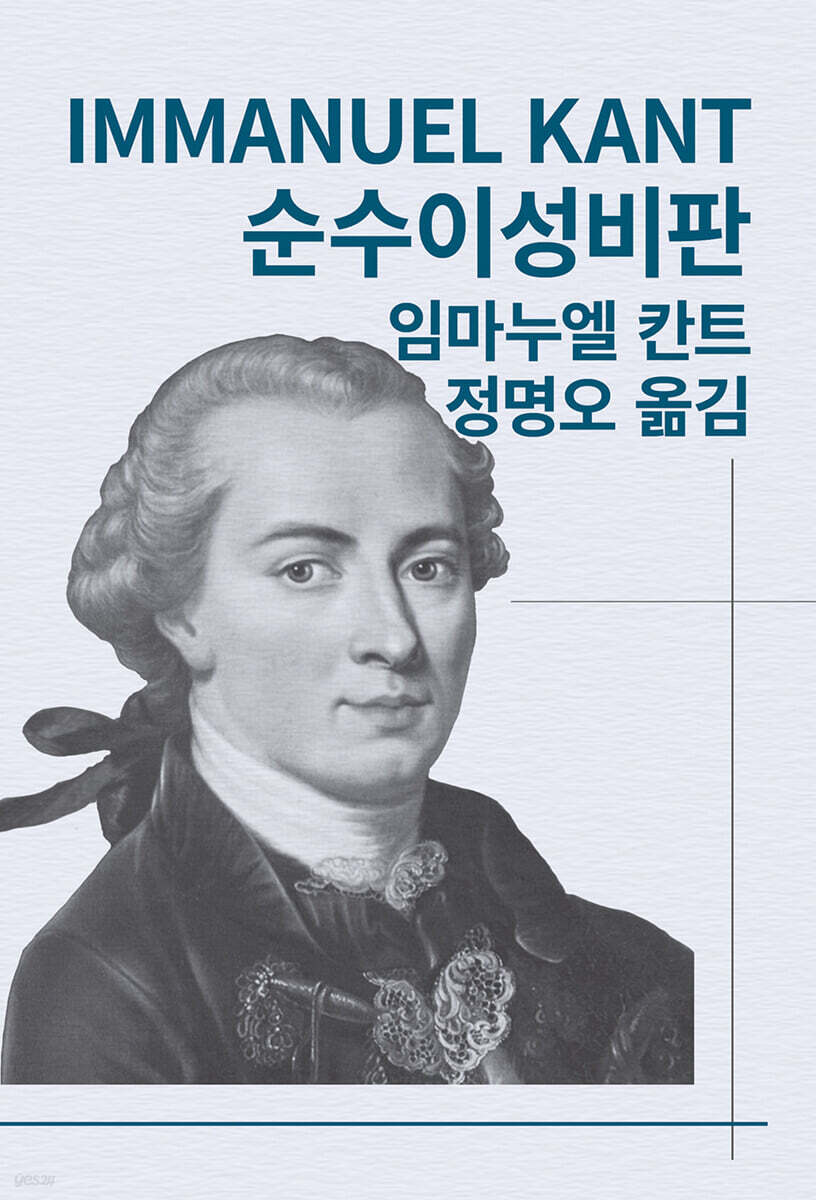
Critique of Pure Reason
 |
Description
Book Introduction
The essence of Kant's philosophy! The dynamism of thought!
A human revolution that overturns old ideas!
Humans are at the center of nature, a Copernican revolution!
The essence of Kant's great philosophy that deals with the values of world civilization!
There is a strong tendency to be interested in 'transcendental analysis' today,
The reader should consider that Kant's own thought dynamism is rather breathing in 'transcendental dialectic'.
Read this immortal masterpiece.
The greatest work of moral philosophy!
The Critique of Pure Reason is the first work of Kant's critical philosophy and was published in 1781.
In this book, Kant questions the authority and limits of human reason and the possibility of establishing metaphysics as an academic discipline.
It also overturned the traditional dogmatic metaphysics and completed a human-centered world.
『Critique of Pure Reason』, along with his 『Critique of Practical Reason』, is considered a masterpiece of the highest authority in moral philosophy.
Kant raises the following three questions as problems of true philosophy, particularly through the Critique of Pure Reason.
First, 'What can I know?', second, 'What should I do?', and third, 'What should I hope for?'
The answer to these three questions (tasks) is this book, Kant's Critique of Pure Reason.
A human revolution that overturns old ideas!
Humans are at the center of nature, a Copernican revolution!
The essence of Kant's great philosophy that deals with the values of world civilization!
There is a strong tendency to be interested in 'transcendental analysis' today,
The reader should consider that Kant's own thought dynamism is rather breathing in 'transcendental dialectic'.
Read this immortal masterpiece.
The greatest work of moral philosophy!
The Critique of Pure Reason is the first work of Kant's critical philosophy and was published in 1781.
In this book, Kant questions the authority and limits of human reason and the possibility of establishing metaphysics as an academic discipline.
It also overturned the traditional dogmatic metaphysics and completed a human-centered world.
『Critique of Pure Reason』, along with his 『Critique of Practical Reason』, is considered a masterpiece of the highest authority in moral philosophy.
Kant raises the following three questions as problems of true philosophy, particularly through the Critique of Pure Reason.
First, 'What can I know?', second, 'What should I do?', and third, 'What should I hope for?'
The answer to these three questions (tasks) is this book, Kant's Critique of Pure Reason.
- You can preview some of the book's contents.
Preview
index
Bacon's "Great Innovation" Heading
His Excellency Baron von Zetlitz, Royal Secretary of State
Preface to the First Edition (1781)
Preface to the Second Edition (1787)
Introduction … 42
1.
On the distinction between pure cognition and empirical cognition/2.
We have some kind of a priori knowledge, and even if it is common sense, there is bound to be such knowledge/3.
Philosophy requires a discipline that determines the possibility, principles, and scope of all a priori knowledge/4.
On the distinction between analytical judgment and empirical judgment/5.
All theoretical sciences of reason contain a priori synthetic judgments as principles/6.
General Tasks of Pure Reason/7.
The conception and distinction of a special discipline called the Critique of Pure Reason
Transcendental Principle Theory
Part 1: Transcendental Aesthetics … 63
§1 Introduction/Section 1 On Space (§2 Metaphysical Clarification of the Concept of Space/§3 Transcendental Clarification of the Concept of Space/Conclusions from the Previously Said Concepts)/Section 2 On Time (§4 Metaphysical Clarification of the Concept of Time/§5 Transcendental Clarification of the Concept of Time/§6 Conclusions from These Concepts/§7 Explanation/§8 General Notes on Transcendental Aesthetics/Conclusion of Transcendental Aesthetics)
Part II: Transcendental Logic … 88
Introduction/Concept of Transcendental Logic (1.
On logic in general/2.
On Transcendental Logic/3.
On the division of general logic into analytics and dialectics/4.
(On the division of transcendental logic into analytic and dialectical)
Section 1: Transcendental Analytics … 97
Part 1: Analysis of Concepts… 98
Chapter 1: On the Clue to Discovering All Pure Intellectual Concepts… 98
Chapter 2: On the Deduction of the Concept of Pure Intelligence… 112
§13 On the general principles of transcendental deduction/§14 The category passes over to transcendental deduction/[1st edition] Section 2 Transcendental deduction of the concept of pure understanding/On the a priori grounds that make experience possible/A temporary note/1.
On the synthesis of senses in intuition/2.
On the synthesis of reproduction in composition/3.
On the synthesis of re-recognition in ideas/4.
First, the possibility of categories as a priori cognition is explained/Section 3. On the relation of the understanding to objects in general and the possibility of cognition a priori/Summarily showing that the deduction of the concepts of pure understanding is justified and the only possible one/[2nd edition] Section 2. Transcendental deduction of the concepts of pure understanding/§15. On the possibility of combination in general/§16. On the original synthetic unity of apperception/§17. The principle of the synthetic unity of apperception is the principle of the highest use of all understanding/§18. What is the objective unity of self-consciousness?/§19. The essence of the logical form of every judgment consists in giving the objective unity of apperception to the concepts in the judgment/§20. All sensible intuition follows categories.
The various intuitions can be summarized in one consciousness only under the condition of categories/§21 Commentary/§22 Categories can only be applied to objects of experience and are not used in the cognition of other things/§23/§24 Application of categories to objects of sense in general/§25/§26 Transcendental deduction of the possible use of experience for the concepts of pure understanding in general/§27 Conclusion of the transcendental deduction of the concepts of understanding/Summary of this deduction
Part 2: Analysis of Principles … 162
Preface: On Transcendental Judgment in General… 163
Chapter 1: On the Schema of the Concept of Pure Intelligence… 165
Chapter 2: The System of All Principles of Pure Intelligence… 171
Section 1: On the Supreme Principle of All Analytical Judgments/Section 2: On the Supreme Principle of All Synthetic Judgments/Section 3: Systematic Expression of All Synthetic Principles of Pure Understanding
Chapter 3: On the Reasons for Distinguishing All Objects in General into Phenomenal and Virtual Objects… 235
Note on the ambiguity of the concept of appendix/reflection
Part II: Transcendental Dialectics … 271
Header (1.
About transcendent virtuality/2.
On pure reason as a transcendent virtual abode―A.
B. About reason in general.
C. On the logical use of reason.
(On the pure use of reason)
Part 1: On the Concept of Pure Reason… 280
Section 1: On Ideology in General / Section 2: On Transcendental Ideology / Section 3: On the System of Transcendental Ideology
Part II: On the Dialectical Reasoning of Pure Reason… 297
Chapter 1: On the Fallacies of Pure Reason… 298
The first fallacy of reasoning surrounding substantiality/Criticism of the first fallacy of reasoning in pure psychology/The second fallacy of reasoning surrounding simplicity/Criticism of the second fallacy of reasoning in transcendental psychology/The third fallacy of reasoning surrounding personality/Criticism of the third fallacy of reasoning in transcendental psychology/The fourth fallacy of reasoning surrounding identity (external relationship)/Criticism of the fourth fallacy of reasoning in transcendental psychology/A comprehensive examination of pure psychology based on the above fallacies of reasoning/[2nd edition] Refuting Mendelssohn's proof of the fixedness of the soul/Conclusion on the resolution of psychological fallacies of reasoning/General notes on the transition from rational psychology to cosmology
Chapter 2: The Contradiction of Pure Reason… 352
Section 1. The System of Cosmological Ideas/Section 2. The Theory of Contradiction of Pure Reason (The First Controversy of the Transcendental Idea/Commentary on the First Antinomy/The Second Controversy of the Transcendental Idea/Commentary on the Second Antinomy/The Third Controversy of the Transcendental Idea/Commentary on the Third Antinomy/The Fourth Controversy of the Transcendental Idea/Commentary on the Fourth Antinomy)/Section 3. On the Interest of Reason in the Antinomies of Pure Reason/Section 4. On the Transcendental Tasks of Pure Reason That Must Be Solved/Section 5. A Skeptical Presentation of the Cosmological Problem by the Four Transcendental Ideas/Section 6. Transcendental Idealism as the Key to Solving Cosmological Dialectics/Section 7. A Critical Resolution of the Cosmological Controversy with One's Own Pure Reason/Section 8. The Governing Principle of Pure Reason on the Cosmological Idea/Section 9. On the Empirical Use of the Governing Principle of Reason on the Cosmological Idea (I.
Resolution of the cosmological idea of totality that synthesizes phenomena into the world as a whole/Ⅱ.
Resolution of the cosmological idea of the totality of the given divisions in intuition/Ⅲ.
Resolution of the cosmological idea of the totality of world events inference from their causes/Ⅳ.
The resolution of the cosmological idea of the totality of the dependence of phenomenal reality
Chapter 3: The Ideal of Pure Reason… 445
Section 1. On ideals in general / Section 2. On transcendental ideals (archetypes) / Section 3. On the grounds on which speculative reason infers the actual existence of the highest being / Three methods of proving the existence of God based on speculative reason / Section 4. On the impossibility of ontological proof for the existence of God / Section 5. On the impossibility of cosmological proof for the existence of God / Discovery and explanation of dialectical hypotheses in all transcendental arguments for the existence of necessary beings / Section 6. On the impossibility of natural theological proof / Section 7. Criticism of all theologies based on the speculative principle of reason / Appendix to transcendental dialectic / On the controlling use of the idea of pure reason / On the ultimate goal of natural dialectic of human reason
Transcendental Methodology
Transcendental Methodology … 531
Chapter 1: The Training of Pure Reason… 533
Section 1: The training of pure reason in dogmatic use/Section 2: The training of pure reason in argumentative use/On the impossibility of skeptically satisfying pure reason that has caused self-division/Section 3: The training of pure reason in hypothesis/Section 4: The training of pure reason in proof
Chapter 2: The Standard of Pure Reason… 585
Section 1: On the ultimate end of the pure use of our reason / Section 2: On the ideal of the highest good as the basis for determining the ultimate end of pure reason / Section 3: On opinion, knowledge, and belief
Chapter 3: The Architecture of Pure Reason… 608
Chapter 4: The History of Pure Reason… 620
Kant's life and thought
A Life Dedicated to the Study of Philosophy…625
What is a human being?… 682
Kant's Chronology … 769
His Excellency Baron von Zetlitz, Royal Secretary of State
Preface to the First Edition (1781)
Preface to the Second Edition (1787)
Introduction … 42
1.
On the distinction between pure cognition and empirical cognition/2.
We have some kind of a priori knowledge, and even if it is common sense, there is bound to be such knowledge/3.
Philosophy requires a discipline that determines the possibility, principles, and scope of all a priori knowledge/4.
On the distinction between analytical judgment and empirical judgment/5.
All theoretical sciences of reason contain a priori synthetic judgments as principles/6.
General Tasks of Pure Reason/7.
The conception and distinction of a special discipline called the Critique of Pure Reason
Transcendental Principle Theory
Part 1: Transcendental Aesthetics … 63
§1 Introduction/Section 1 On Space (§2 Metaphysical Clarification of the Concept of Space/§3 Transcendental Clarification of the Concept of Space/Conclusions from the Previously Said Concepts)/Section 2 On Time (§4 Metaphysical Clarification of the Concept of Time/§5 Transcendental Clarification of the Concept of Time/§6 Conclusions from These Concepts/§7 Explanation/§8 General Notes on Transcendental Aesthetics/Conclusion of Transcendental Aesthetics)
Part II: Transcendental Logic … 88
Introduction/Concept of Transcendental Logic (1.
On logic in general/2.
On Transcendental Logic/3.
On the division of general logic into analytics and dialectics/4.
(On the division of transcendental logic into analytic and dialectical)
Section 1: Transcendental Analytics … 97
Part 1: Analysis of Concepts… 98
Chapter 1: On the Clue to Discovering All Pure Intellectual Concepts… 98
Chapter 2: On the Deduction of the Concept of Pure Intelligence… 112
§13 On the general principles of transcendental deduction/§14 The category passes over to transcendental deduction/[1st edition] Section 2 Transcendental deduction of the concept of pure understanding/On the a priori grounds that make experience possible/A temporary note/1.
On the synthesis of senses in intuition/2.
On the synthesis of reproduction in composition/3.
On the synthesis of re-recognition in ideas/4.
First, the possibility of categories as a priori cognition is explained/Section 3. On the relation of the understanding to objects in general and the possibility of cognition a priori/Summarily showing that the deduction of the concepts of pure understanding is justified and the only possible one/[2nd edition] Section 2. Transcendental deduction of the concepts of pure understanding/§15. On the possibility of combination in general/§16. On the original synthetic unity of apperception/§17. The principle of the synthetic unity of apperception is the principle of the highest use of all understanding/§18. What is the objective unity of self-consciousness?/§19. The essence of the logical form of every judgment consists in giving the objective unity of apperception to the concepts in the judgment/§20. All sensible intuition follows categories.
The various intuitions can be summarized in one consciousness only under the condition of categories/§21 Commentary/§22 Categories can only be applied to objects of experience and are not used in the cognition of other things/§23/§24 Application of categories to objects of sense in general/§25/§26 Transcendental deduction of the possible use of experience for the concepts of pure understanding in general/§27 Conclusion of the transcendental deduction of the concepts of understanding/Summary of this deduction
Part 2: Analysis of Principles … 162
Preface: On Transcendental Judgment in General… 163
Chapter 1: On the Schema of the Concept of Pure Intelligence… 165
Chapter 2: The System of All Principles of Pure Intelligence… 171
Section 1: On the Supreme Principle of All Analytical Judgments/Section 2: On the Supreme Principle of All Synthetic Judgments/Section 3: Systematic Expression of All Synthetic Principles of Pure Understanding
Chapter 3: On the Reasons for Distinguishing All Objects in General into Phenomenal and Virtual Objects… 235
Note on the ambiguity of the concept of appendix/reflection
Part II: Transcendental Dialectics … 271
Header (1.
About transcendent virtuality/2.
On pure reason as a transcendent virtual abode―A.
B. About reason in general.
C. On the logical use of reason.
(On the pure use of reason)
Part 1: On the Concept of Pure Reason… 280
Section 1: On Ideology in General / Section 2: On Transcendental Ideology / Section 3: On the System of Transcendental Ideology
Part II: On the Dialectical Reasoning of Pure Reason… 297
Chapter 1: On the Fallacies of Pure Reason… 298
The first fallacy of reasoning surrounding substantiality/Criticism of the first fallacy of reasoning in pure psychology/The second fallacy of reasoning surrounding simplicity/Criticism of the second fallacy of reasoning in transcendental psychology/The third fallacy of reasoning surrounding personality/Criticism of the third fallacy of reasoning in transcendental psychology/The fourth fallacy of reasoning surrounding identity (external relationship)/Criticism of the fourth fallacy of reasoning in transcendental psychology/A comprehensive examination of pure psychology based on the above fallacies of reasoning/[2nd edition] Refuting Mendelssohn's proof of the fixedness of the soul/Conclusion on the resolution of psychological fallacies of reasoning/General notes on the transition from rational psychology to cosmology
Chapter 2: The Contradiction of Pure Reason… 352
Section 1. The System of Cosmological Ideas/Section 2. The Theory of Contradiction of Pure Reason (The First Controversy of the Transcendental Idea/Commentary on the First Antinomy/The Second Controversy of the Transcendental Idea/Commentary on the Second Antinomy/The Third Controversy of the Transcendental Idea/Commentary on the Third Antinomy/The Fourth Controversy of the Transcendental Idea/Commentary on the Fourth Antinomy)/Section 3. On the Interest of Reason in the Antinomies of Pure Reason/Section 4. On the Transcendental Tasks of Pure Reason That Must Be Solved/Section 5. A Skeptical Presentation of the Cosmological Problem by the Four Transcendental Ideas/Section 6. Transcendental Idealism as the Key to Solving Cosmological Dialectics/Section 7. A Critical Resolution of the Cosmological Controversy with One's Own Pure Reason/Section 8. The Governing Principle of Pure Reason on the Cosmological Idea/Section 9. On the Empirical Use of the Governing Principle of Reason on the Cosmological Idea (I.
Resolution of the cosmological idea of totality that synthesizes phenomena into the world as a whole/Ⅱ.
Resolution of the cosmological idea of the totality of the given divisions in intuition/Ⅲ.
Resolution of the cosmological idea of the totality of world events inference from their causes/Ⅳ.
The resolution of the cosmological idea of the totality of the dependence of phenomenal reality
Chapter 3: The Ideal of Pure Reason… 445
Section 1. On ideals in general / Section 2. On transcendental ideals (archetypes) / Section 3. On the grounds on which speculative reason infers the actual existence of the highest being / Three methods of proving the existence of God based on speculative reason / Section 4. On the impossibility of ontological proof for the existence of God / Section 5. On the impossibility of cosmological proof for the existence of God / Discovery and explanation of dialectical hypotheses in all transcendental arguments for the existence of necessary beings / Section 6. On the impossibility of natural theological proof / Section 7. Criticism of all theologies based on the speculative principle of reason / Appendix to transcendental dialectic / On the controlling use of the idea of pure reason / On the ultimate goal of natural dialectic of human reason
Transcendental Methodology
Transcendental Methodology … 531
Chapter 1: The Training of Pure Reason… 533
Section 1: The training of pure reason in dogmatic use/Section 2: The training of pure reason in argumentative use/On the impossibility of skeptically satisfying pure reason that has caused self-division/Section 3: The training of pure reason in hypothesis/Section 4: The training of pure reason in proof
Chapter 2: The Standard of Pure Reason… 585
Section 1: On the ultimate end of the pure use of our reason / Section 2: On the ideal of the highest good as the basis for determining the ultimate end of pure reason / Section 3: On opinion, knowledge, and belief
Chapter 3: The Architecture of Pure Reason… 608
Chapter 4: The History of Pure Reason… 620
Kant's life and thought
A Life Dedicated to the Study of Philosophy…625
What is a human being?… 682
Kant's Chronology … 769
Publisher's Review
The core of Kant's philosophy is the pursuit of the true value of human existence!
In his Critique of Pure Reason, Kant argues that the true meaning of philosophy, that is, 'to philosophize', means the search for truth, and that in order to search for truth, one must abandon all dogmatic prejudices and skeptical despair and follow a critical way of thinking.
After reading Rousseau's "Emile," Kant realized that all humans deserve respect and that those who do not respect their personality are inferior and shameful beings.
Kant's philosophy is both critical philosophy and human philosophy.
He depicted the human figure in the vast universe.
There, humans are nothing more than insignificant animal creatures given a fleeting life.
But even among these, Kant saw human dignity in the voice of morality beckoning from within.
Because we repeat failures and mistakes, we come to see the true and proper form of humanity.
Criticizing and innovating the current situation and creating a truly humane society is the true value of human existence that Kant proclaimed as the "moral law within us."
The image of human beings, free from the laws of the external world of sense and free to define themselves by moral laws, will shine with unchanging nobility throughout the long course of history.
Humans are at the center of nature! A Copernican revolution!
Kant believed that something does not exist independently of humans, in nature outside of humans, but rather, that humans constitute the empirical object that corresponds to it.
Universal and necessary truths, that is, scientific a priori synthetic judgments, are not established by our correctly replicating external objects, but, on the contrary, are judgments about what we ourselves have spontaneously created through a priori forms.
Since such a composition is voluntary and depends on one's own abilities, it can be said to be subjective.
But if, however shabby, as long as there is an experience or an object, that formal synthesis must always be in operation, then it is also objective.
These natural objects and experiences become possible through human spontaneity, and the various laws that arise from them can be grasped, and a priori synthetic judgments are made.
Copernicus overturned the geocentric theory and advocated the heliocentric theory.
Kant overturned the existing doctrine that external objects exist independently, and argued that humans themselves create such objects by operating a priori forms.
This way of thinking is, as Kant himself said, comparable to a 'Copernican revolution' in the correct understanding of things.
Philosophy toward humanity! Philosophy for humanity!
When people think of Kant, they usually think of a detached man whose daily life was as regular as clockwork.
And it will bring to mind a philosopher who remained single throughout his life, pursuing profound critical philosophy, a difficult subject to approach.
But we must not ignore another aspect of Kant.
Kant's philosophy is a philosophy directed towards humanity.
If you don't know people, you can't teach them.
Kant recommends, above all, interacting with people and traveling a lot, and reading travelogues, world history, biographies, plays, and novels as a way to acquire and expand knowledge about humans and the world.
Kant was constantly conducting experiments to understand so-called human beings through this method.
Kant had a keen insight into human psychology, both inside and out.
Kant lived by his own theories and teachings.
Soon, he wanted to live with the people of the world according to philosophical and moral theories, strictly suppressing himself by reason.
It is based on human principles.
Kant was extremely conscientious, diligent, pious, and strict in his conduct.
But at the same time, he was very cheerful, humorous, and witty, and he was kind and generous to everyone.
This aspect of Kant's personality is deeply embedded in his philosophy.
This philosophy of Kant develops further from the Critique of Pure Reason to the Critique of Practical Reason.
His Critique of Practical Reason is famous as a masterpiece on human ethics and behavior.
In this book, Kant proves that the fundamental system required by human reason cannot be completed through theory alone and must be preceded by practice.
In his Critique of Pure Reason, Kant argues that the true meaning of philosophy, that is, 'to philosophize', means the search for truth, and that in order to search for truth, one must abandon all dogmatic prejudices and skeptical despair and follow a critical way of thinking.
After reading Rousseau's "Emile," Kant realized that all humans deserve respect and that those who do not respect their personality are inferior and shameful beings.
Kant's philosophy is both critical philosophy and human philosophy.
He depicted the human figure in the vast universe.
There, humans are nothing more than insignificant animal creatures given a fleeting life.
But even among these, Kant saw human dignity in the voice of morality beckoning from within.
Because we repeat failures and mistakes, we come to see the true and proper form of humanity.
Criticizing and innovating the current situation and creating a truly humane society is the true value of human existence that Kant proclaimed as the "moral law within us."
The image of human beings, free from the laws of the external world of sense and free to define themselves by moral laws, will shine with unchanging nobility throughout the long course of history.
Humans are at the center of nature! A Copernican revolution!
Kant believed that something does not exist independently of humans, in nature outside of humans, but rather, that humans constitute the empirical object that corresponds to it.
Universal and necessary truths, that is, scientific a priori synthetic judgments, are not established by our correctly replicating external objects, but, on the contrary, are judgments about what we ourselves have spontaneously created through a priori forms.
Since such a composition is voluntary and depends on one's own abilities, it can be said to be subjective.
But if, however shabby, as long as there is an experience or an object, that formal synthesis must always be in operation, then it is also objective.
These natural objects and experiences become possible through human spontaneity, and the various laws that arise from them can be grasped, and a priori synthetic judgments are made.
Copernicus overturned the geocentric theory and advocated the heliocentric theory.
Kant overturned the existing doctrine that external objects exist independently, and argued that humans themselves create such objects by operating a priori forms.
This way of thinking is, as Kant himself said, comparable to a 'Copernican revolution' in the correct understanding of things.
Philosophy toward humanity! Philosophy for humanity!
When people think of Kant, they usually think of a detached man whose daily life was as regular as clockwork.
And it will bring to mind a philosopher who remained single throughout his life, pursuing profound critical philosophy, a difficult subject to approach.
But we must not ignore another aspect of Kant.
Kant's philosophy is a philosophy directed towards humanity.
If you don't know people, you can't teach them.
Kant recommends, above all, interacting with people and traveling a lot, and reading travelogues, world history, biographies, plays, and novels as a way to acquire and expand knowledge about humans and the world.
Kant was constantly conducting experiments to understand so-called human beings through this method.
Kant had a keen insight into human psychology, both inside and out.
Kant lived by his own theories and teachings.
Soon, he wanted to live with the people of the world according to philosophical and moral theories, strictly suppressing himself by reason.
It is based on human principles.
Kant was extremely conscientious, diligent, pious, and strict in his conduct.
But at the same time, he was very cheerful, humorous, and witty, and he was kind and generous to everyone.
This aspect of Kant's personality is deeply embedded in his philosophy.
This philosophy of Kant develops further from the Critique of Pure Reason to the Critique of Practical Reason.
His Critique of Practical Reason is famous as a masterpiece on human ethics and behavior.
In this book, Kant proves that the fundamental system required by human reason cannot be completed through theory alone and must be preceded by practice.
GOODS SPECIFICS
- Date of issue: June 9, 2016
- Page count, weight, size: 776 pages | 153*224*40mm
- ISBN13: 9788949714325
- ISBN10: 8949714329
You may also like
카테고리
korean


korean

![GQ KOREA Mark (Monthly): December [2025]](http://librairie.coreenne.fr/cdn/shop/files/8ef265dbbfbf186523ed75ba7319009d.jpg?v=1765340328&width=3840)


