

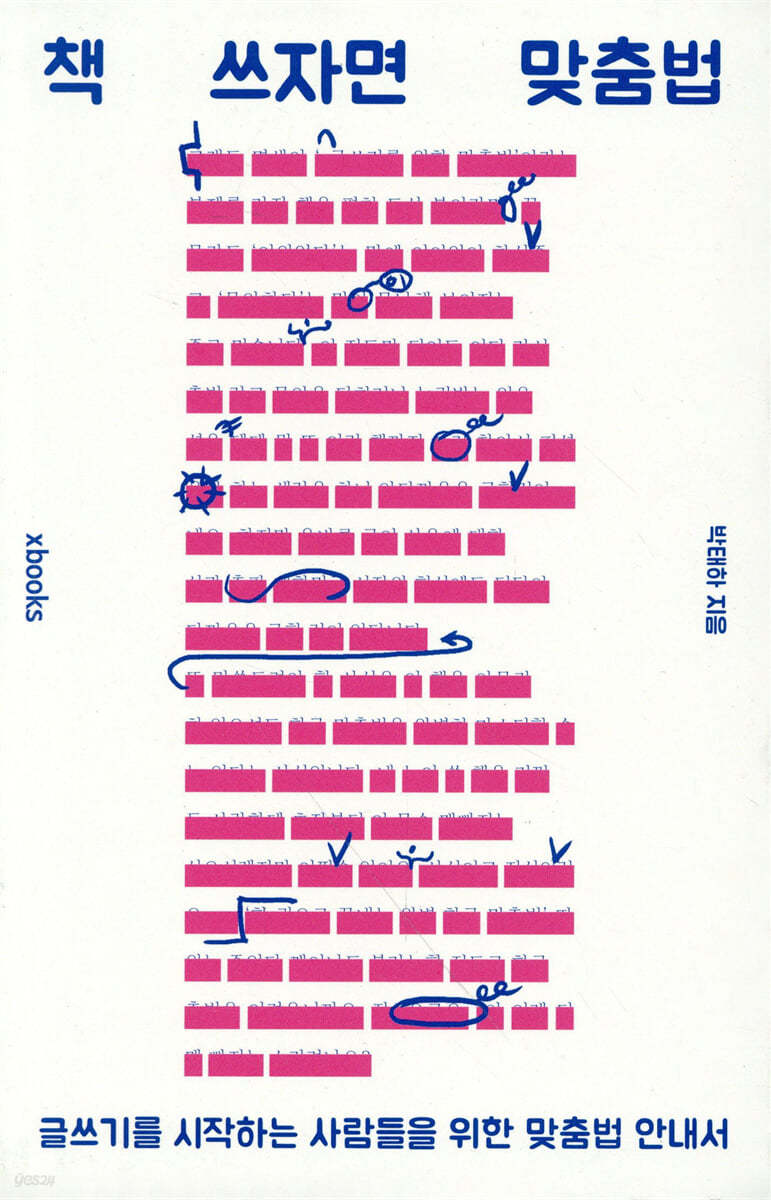
Spelling if you're going to write a book
 |
Description
Book Introduction
A spelling guide for almost anyone interested in or involved with writing, whether for professional or other reasons.
"Spelling for Writing" is a book for anyone involved in writing, including aspiring writers, power bloggers and other internet content producers, students who need to write reports or resumes, social media/PR staff at companies or organizations, and even novice reporters and editors.
From theory to practical application, the author's expertise from over 10 years of experience as an editor has been incorporated into this book, making it easy for anyone to read and write.
"Spelling for Writing" is a book for anyone involved in writing, including aspiring writers, power bloggers and other internet content producers, students who need to write reports or resumes, social media/PR staff at companies or organizations, and even novice reporters and editors.
From theory to practical application, the author's expertise from over 10 years of experience as an editor has been incorporated into this book, making it easy for anyone to read and write.
index
Part 1: Spacing
All words are removed, except for particles! | Even if you pretend not to be particles, everything will come out if you put particles | You who seems like a word but isn't a word (1) - Ending | You who seems like a word but isn't a word (2) - Affix | Just boldly space them, dependent nouns | Is it a particle, ending, affix, or dependent noun? - Reveal your true identity! | Just rely on the dictionary for spacing of compound words | But you shouldn't blindly rely on the dictionary for spacing | The final hurdle of spacing, auxiliary verbs
Part 2 Spelling
Verbs and adjectives whose basic forms are often misunderstood | Verbs and adjectives that must be used with distinction | Verbs and adjectives that must be used with caution | Endings and particles that must be used with caution | Adjectives and adverbs that must be used with caution | Nouns that must be used with caution | Plural standard words that are useful to know
Part 3: Foreign Language Notation and Punctuation
Basic Principles of Foreign Language Transcription | Useful Tips for Foreign Language Transcription | Proper Noun Transcription: Know These! | Key Language-Specific Checklists | Punctuation: Considered Insignificant, It's Actually Quite Important
supplement
Types of auxiliary verbs | Compound words that must be written as one word | Commonly misspelled foreign words | Foreign names to watch out for | Foreign place names to watch out for
Classification of content by difficulty and importance
Search
All words are removed, except for particles! | Even if you pretend not to be particles, everything will come out if you put particles | You who seems like a word but isn't a word (1) - Ending | You who seems like a word but isn't a word (2) - Affix | Just boldly space them, dependent nouns | Is it a particle, ending, affix, or dependent noun? - Reveal your true identity! | Just rely on the dictionary for spacing of compound words | But you shouldn't blindly rely on the dictionary for spacing | The final hurdle of spacing, auxiliary verbs
Part 2 Spelling
Verbs and adjectives whose basic forms are often misunderstood | Verbs and adjectives that must be used with distinction | Verbs and adjectives that must be used with caution | Endings and particles that must be used with caution | Adjectives and adverbs that must be used with caution | Nouns that must be used with caution | Plural standard words that are useful to know
Part 3: Foreign Language Notation and Punctuation
Basic Principles of Foreign Language Transcription | Useful Tips for Foreign Language Transcription | Proper Noun Transcription: Know These! | Key Language-Specific Checklists | Punctuation: Considered Insignificant, It's Actually Quite Important
supplement
Types of auxiliary verbs | Compound words that must be written as one word | Commonly misspelled foreign words | Foreign names to watch out for | Foreign place names to watch out for
Classification of content by difficulty and importance
Search
Publisher's Review
Spelling know-how from a professional editor,
The bare minimum of spelling for 'you' who just started writing a book
Reading sentences with poor spelling is quite a pain.
Right now, even in this sentence alone, we can see for ourselves how much the credibility of a piece of writing can be reduced by just spelling and spacing.
As the title suggests, "Spelling for Writing a Book" is a book that informs not only those who want to write a book, but also all citizens who write almost every day, such as on social media, reports, love letters, business letters, and text messages, that "spelling" is more necessary than one might think.
Even without necessarily referencing articles like “90% of female college students lose interest in partners who make spelling mistakes” (Yonhap News, October 7, 2013), as confirmed in the first sentence, the content can be hindered by the format.
Spelling know-how from a professional editor: that's why you need "Spelling for Book Writing."
“I know what you did wrong to your lover last night.”
Some people refuse to use spaces because they find it annoying, and others proudly insist on using Korean with incorrect spellings because they think it looks prettier. However, the survey results showing that people are less attracted to those who make Korean spelling mistakes mercilessly scratch the hearts of those who are stubborn.
Although it is not necessarily the case, the author of this book does not miss out on not only spelling as a pre-writing step but also our basic spelling in daily life, saying, “Even those of you who have sent a purely kind text to your boyfriend or girlfriend saying, ‘Don’t be sick and have a baby soon ㅠㅠ’ and received a sharp reply saying, ‘What are you talking about! Have a baby yourself’ can read and understand it.”
While his writing was admirable for its excellent logic and structure, when we found something ridiculous like “nonsense” in his writing, our trust in the author also suddenly dropped slightly. We couldn’t help it, so this book contains such seemingly trivial but easy-to-make mistakes, and therefore even more unavoidable spelling rules.
No matter how much you think about it, you can't figure out why, but if your girlfriend's texts have become colder in just one night, I recommend checking (and spelling-checking) the texts she sent you last night.
The reason spelling is more important than you might think can be found in many areas outside of dating, and the author of this book explains it this way, drawing on his experience as an editor.
From my experience as an editor, I can tell you that writing with accurate spelling impresses the author, makes them feel grateful (because it reduces their workload), and even makes them think, "This author's spelling and spacing are the result of careful consideration, so I should be even more careful."
Of course, I'm not saying that we should treat writing that isn't sloppy, but it's common sense, and an open secret in the industry, that we should be a little more careful about using a 'red pen' on writing that adheres to good spelling.
Even when encountering a typo, in most cases, we're likely to just think, "Oh, that's a typo," and fix it without much thought. But if it's written by an author who meticulously follows spelling rules, we find ourselves thinking, "Is this really a typo? Is there a word I don't know? Is there a hidden intention behind this?"
(Page 8)
It is the writer's responsibility and ability to clean and present his writing properly so that the reader does not read it carelessly.
It may seem a bit far-fetched to use proverbs like “If you’re going to do it, do it with a red skirt” and “A single word can be worth a thousand nyang”, but as the author says, it is a matter of “human nature” that a piece of writing with correct spelling has more class than one with incorrect spelling.
I suggest you rethink your grammar.
When you listen to the stories of people who gave up on English early, they all say that they don't know what the ○○ format means and they don't know what the parts of speech are.
I hear the complaints of eternal beginners in English who don't even know what's going on from the beginning, let alone memorize or apply it.
Grammar is supposed to be a guide or manual that helps us enter the world of writing (and language), but strangely enough, people don't hold the guide's hand.
But as with all things, once you know the principles, you can freely apply and utilize them.
Once you know the identity of parts of speech, their functions, and a few principles, you will be able to infer and apply them (“All words are separated, except for particles!” “Particles are written together, no matter how many there are.” “Dependent nouns are separate words, so they are written separately.”…).
For example, for those who feel that it is a bit long to write the sentence “even if only at school” and are wondering whether to write it with spaces in appropriate places, showing them the principle that “postpositions are written with any number of spaces” and reassuring them that it is okay not to write them with spaces is a great deal of freedom in their use of language.
Korean speakers, who are comfortable with spelling mistakes, often perceive grammar as a constraint or a burden. However, rather than restricting us, the norms and rules of language liberate us and serve as a foundation for our language use.
As the author points out, rather than insisting on a harsh perception and language usage by saying, "It doesn't matter how you use it!" even if it's a misspelling, if you know what the correct word is and use language based on the reasons why that word cannot or should not be used, that perception will soon have a point in common with the meticulousness of writing and the delicacy of thought.
This is a moment when we realize anew that the impact of using correct language is broader than we thought.
The orthography rules are the result of a compromise that seeks to reflect actual language use while ensuring that it is organized within norms.
Originally, rules had to be conservative in order to be universal, and it was not easy to create rules that could be applied consistently and uniformly to the vast vocabulary used by tens of millions of people, so I think it would be good to be a little more lenient.
(Pages 12-13)
Last June, the Korean language regulations were changed to allow the adverb 'too much' to be used in positive descriptions.
There were also many opinions that it was too late to impose regulations on too much, and I remember that after this announcement, cheers erupted here and there saying, “It’s so great that we can use too much.”
Language is alive.
Disappear, evolve, transform, and be created.
Grammar also changes accordingly.
Before we say that grammar is too monotonous or too frustrating, we need to think again about language itself and what certain rules and restrictions can do.
Disregarding spelling rules as meaningless is no different from claiming that all words in the world should be recognized as standard, and if that is the case, then it is impossible to ask, "How can I write 'Seoul City Sports Association' as 'Seoul City Yukhoe'?"
Rules and restrictions enable our minimal communication and form the cornerstone of precise thinking.
Yes, that's right.
This is the book that will set you free.
Let us leave the question of whether ‘freedom’ is a bit too grandiose a word to be applied to spelling until after we have deeply considered ‘language.’
Amazing finds and humor that will make you slap your knees
One thing we all implicitly share when it comes to spelling is that there are definitely some spellings that are embarrassing to get wrong.
to take a risk/kneel down to touch/touch Godamjunron/Gojun discourse
Surrounded/surrounded? I'm thinking of payment/settlement/settlement
In case you originally knew it but wrote it wrong, or if you wrote it wrong because you didn't know, there may be some embarrassing situations, so we have prepared an appendix and a search engine specifically for this.
The author recommends using this appendix as a final checklist, index, or additional table of contents when completing the manuscript.
The appendix of this book, which runs to a whopping 57 pages, could be considered another main text. The "Index, Classified by Difficulty and Importance" section offers a glimpse into the author's practical know-how, gained from over ten years of experience as an editor.
Beyond this unprecedented lookup in a spelling book, what makes this book unique is its narrative and storytelling, something you wouldn't expect from a grammar manual.
If you're wondering why you're laughing while reading a spelling book, you've read the right book.
This book was planned and written with the somewhat secret intention of helping you learn spelling while you smile, and with the official intention of serving as a guide for those beginning to write. Even if you don't know it, this one book will satisfy most of your curiosity about the Korean language.
This book is intended for almost anyone interested in or involved with writing, whether for professional or other reasons. It is intended for everyone, from beginners to seasoned writers, and is hoped to be of practical help even to those with negative memories of Korean language from middle and high school. The author offers the following advice:
This book is primarily intended for those who are interested in writing, or who 'should be' interested for professional or other reasons.
This category could include aspiring writers, internet content producers such as power bloggers, students who frequently need to write reports, social media or public relations staff at companies or organizations, and even novice reporters or editors.
Here, you might be thinking, "Hey, this is going to be difficult for a beginner like me," and if you were to close this book here, there would be nothing more disappointing than that. So, let me hastily add that this book doesn't cover any more difficult material than other spelling books! I'm saying this because I took great care to structure it so that it would be practical and easy to use for your writing.
Many people are curious about spacing, but I thought there was no spelling book that covered it in detail, so I devoted a considerable amount of space to it. I also organized the appendix so that after reading the book, you can keep it by your side and use it like a dictionary.
So don't worry too much about the difficulty.
Of course, spelling itself is not something that can be terribly easy, so I can't guarantee that it will be easy to read, but I think you can read it with an easy mind.
(Page 10)
The bare minimum of spelling for 'you' who just started writing a book
Reading sentences with poor spelling is quite a pain.
Right now, even in this sentence alone, we can see for ourselves how much the credibility of a piece of writing can be reduced by just spelling and spacing.
As the title suggests, "Spelling for Writing a Book" is a book that informs not only those who want to write a book, but also all citizens who write almost every day, such as on social media, reports, love letters, business letters, and text messages, that "spelling" is more necessary than one might think.
Even without necessarily referencing articles like “90% of female college students lose interest in partners who make spelling mistakes” (Yonhap News, October 7, 2013), as confirmed in the first sentence, the content can be hindered by the format.
Spelling know-how from a professional editor: that's why you need "Spelling for Book Writing."
“I know what you did wrong to your lover last night.”
Some people refuse to use spaces because they find it annoying, and others proudly insist on using Korean with incorrect spellings because they think it looks prettier. However, the survey results showing that people are less attracted to those who make Korean spelling mistakes mercilessly scratch the hearts of those who are stubborn.
Although it is not necessarily the case, the author of this book does not miss out on not only spelling as a pre-writing step but also our basic spelling in daily life, saying, “Even those of you who have sent a purely kind text to your boyfriend or girlfriend saying, ‘Don’t be sick and have a baby soon ㅠㅠ’ and received a sharp reply saying, ‘What are you talking about! Have a baby yourself’ can read and understand it.”
While his writing was admirable for its excellent logic and structure, when we found something ridiculous like “nonsense” in his writing, our trust in the author also suddenly dropped slightly. We couldn’t help it, so this book contains such seemingly trivial but easy-to-make mistakes, and therefore even more unavoidable spelling rules.
No matter how much you think about it, you can't figure out why, but if your girlfriend's texts have become colder in just one night, I recommend checking (and spelling-checking) the texts she sent you last night.
The reason spelling is more important than you might think can be found in many areas outside of dating, and the author of this book explains it this way, drawing on his experience as an editor.
From my experience as an editor, I can tell you that writing with accurate spelling impresses the author, makes them feel grateful (because it reduces their workload), and even makes them think, "This author's spelling and spacing are the result of careful consideration, so I should be even more careful."
Of course, I'm not saying that we should treat writing that isn't sloppy, but it's common sense, and an open secret in the industry, that we should be a little more careful about using a 'red pen' on writing that adheres to good spelling.
Even when encountering a typo, in most cases, we're likely to just think, "Oh, that's a typo," and fix it without much thought. But if it's written by an author who meticulously follows spelling rules, we find ourselves thinking, "Is this really a typo? Is there a word I don't know? Is there a hidden intention behind this?"
(Page 8)
It is the writer's responsibility and ability to clean and present his writing properly so that the reader does not read it carelessly.
It may seem a bit far-fetched to use proverbs like “If you’re going to do it, do it with a red skirt” and “A single word can be worth a thousand nyang”, but as the author says, it is a matter of “human nature” that a piece of writing with correct spelling has more class than one with incorrect spelling.
I suggest you rethink your grammar.
When you listen to the stories of people who gave up on English early, they all say that they don't know what the ○○ format means and they don't know what the parts of speech are.
I hear the complaints of eternal beginners in English who don't even know what's going on from the beginning, let alone memorize or apply it.
Grammar is supposed to be a guide or manual that helps us enter the world of writing (and language), but strangely enough, people don't hold the guide's hand.
But as with all things, once you know the principles, you can freely apply and utilize them.
Once you know the identity of parts of speech, their functions, and a few principles, you will be able to infer and apply them (“All words are separated, except for particles!” “Particles are written together, no matter how many there are.” “Dependent nouns are separate words, so they are written separately.”…).
For example, for those who feel that it is a bit long to write the sentence “even if only at school” and are wondering whether to write it with spaces in appropriate places, showing them the principle that “postpositions are written with any number of spaces” and reassuring them that it is okay not to write them with spaces is a great deal of freedom in their use of language.
Korean speakers, who are comfortable with spelling mistakes, often perceive grammar as a constraint or a burden. However, rather than restricting us, the norms and rules of language liberate us and serve as a foundation for our language use.
As the author points out, rather than insisting on a harsh perception and language usage by saying, "It doesn't matter how you use it!" even if it's a misspelling, if you know what the correct word is and use language based on the reasons why that word cannot or should not be used, that perception will soon have a point in common with the meticulousness of writing and the delicacy of thought.
This is a moment when we realize anew that the impact of using correct language is broader than we thought.
The orthography rules are the result of a compromise that seeks to reflect actual language use while ensuring that it is organized within norms.
Originally, rules had to be conservative in order to be universal, and it was not easy to create rules that could be applied consistently and uniformly to the vast vocabulary used by tens of millions of people, so I think it would be good to be a little more lenient.
(Pages 12-13)
Last June, the Korean language regulations were changed to allow the adverb 'too much' to be used in positive descriptions.
There were also many opinions that it was too late to impose regulations on too much, and I remember that after this announcement, cheers erupted here and there saying, “It’s so great that we can use too much.”
Language is alive.
Disappear, evolve, transform, and be created.
Grammar also changes accordingly.
Before we say that grammar is too monotonous or too frustrating, we need to think again about language itself and what certain rules and restrictions can do.
Disregarding spelling rules as meaningless is no different from claiming that all words in the world should be recognized as standard, and if that is the case, then it is impossible to ask, "How can I write 'Seoul City Sports Association' as 'Seoul City Yukhoe'?"
Rules and restrictions enable our minimal communication and form the cornerstone of precise thinking.
Yes, that's right.
This is the book that will set you free.
Let us leave the question of whether ‘freedom’ is a bit too grandiose a word to be applied to spelling until after we have deeply considered ‘language.’
Amazing finds and humor that will make you slap your knees
One thing we all implicitly share when it comes to spelling is that there are definitely some spellings that are embarrassing to get wrong.
to take a risk/kneel down to touch/touch Godamjunron/Gojun discourse
Surrounded/surrounded? I'm thinking of payment/settlement/settlement
In case you originally knew it but wrote it wrong, or if you wrote it wrong because you didn't know, there may be some embarrassing situations, so we have prepared an appendix and a search engine specifically for this.
The author recommends using this appendix as a final checklist, index, or additional table of contents when completing the manuscript.
The appendix of this book, which runs to a whopping 57 pages, could be considered another main text. The "Index, Classified by Difficulty and Importance" section offers a glimpse into the author's practical know-how, gained from over ten years of experience as an editor.
Beyond this unprecedented lookup in a spelling book, what makes this book unique is its narrative and storytelling, something you wouldn't expect from a grammar manual.
If you're wondering why you're laughing while reading a spelling book, you've read the right book.
This book was planned and written with the somewhat secret intention of helping you learn spelling while you smile, and with the official intention of serving as a guide for those beginning to write. Even if you don't know it, this one book will satisfy most of your curiosity about the Korean language.
This book is intended for almost anyone interested in or involved with writing, whether for professional or other reasons. It is intended for everyone, from beginners to seasoned writers, and is hoped to be of practical help even to those with negative memories of Korean language from middle and high school. The author offers the following advice:
This book is primarily intended for those who are interested in writing, or who 'should be' interested for professional or other reasons.
This category could include aspiring writers, internet content producers such as power bloggers, students who frequently need to write reports, social media or public relations staff at companies or organizations, and even novice reporters or editors.
Here, you might be thinking, "Hey, this is going to be difficult for a beginner like me," and if you were to close this book here, there would be nothing more disappointing than that. So, let me hastily add that this book doesn't cover any more difficult material than other spelling books! I'm saying this because I took great care to structure it so that it would be practical and easy to use for your writing.
Many people are curious about spacing, but I thought there was no spelling book that covered it in detail, so I devoted a considerable amount of space to it. I also organized the appendix so that after reading the book, you can keep it by your side and use it like a dictionary.
So don't worry too much about the difficulty.
Of course, spelling itself is not something that can be terribly easy, so I can't guarantee that it will be easy to read, but I think you can read it with an easy mind.
(Page 10)
GOODS SPECIFICS
- Date of issue: August 30, 2015
- Page count, weight, size: 432 pages | 424g | 122*189*30mm
- ISBN13: 9791195346387
- ISBN10: 1195346387
You may also like
카테고리
korean


korean

![GQ KOREA Mark (Monthly): December [2025]](http://librairie.coreenne.fr/cdn/shop/files/8ef265dbbfbf186523ed75ba7319009d.jpg?v=1765340328&width=3840)


