

Umberto Eco's Guide to Writing Good Papers
 |
Description
Book Introduction
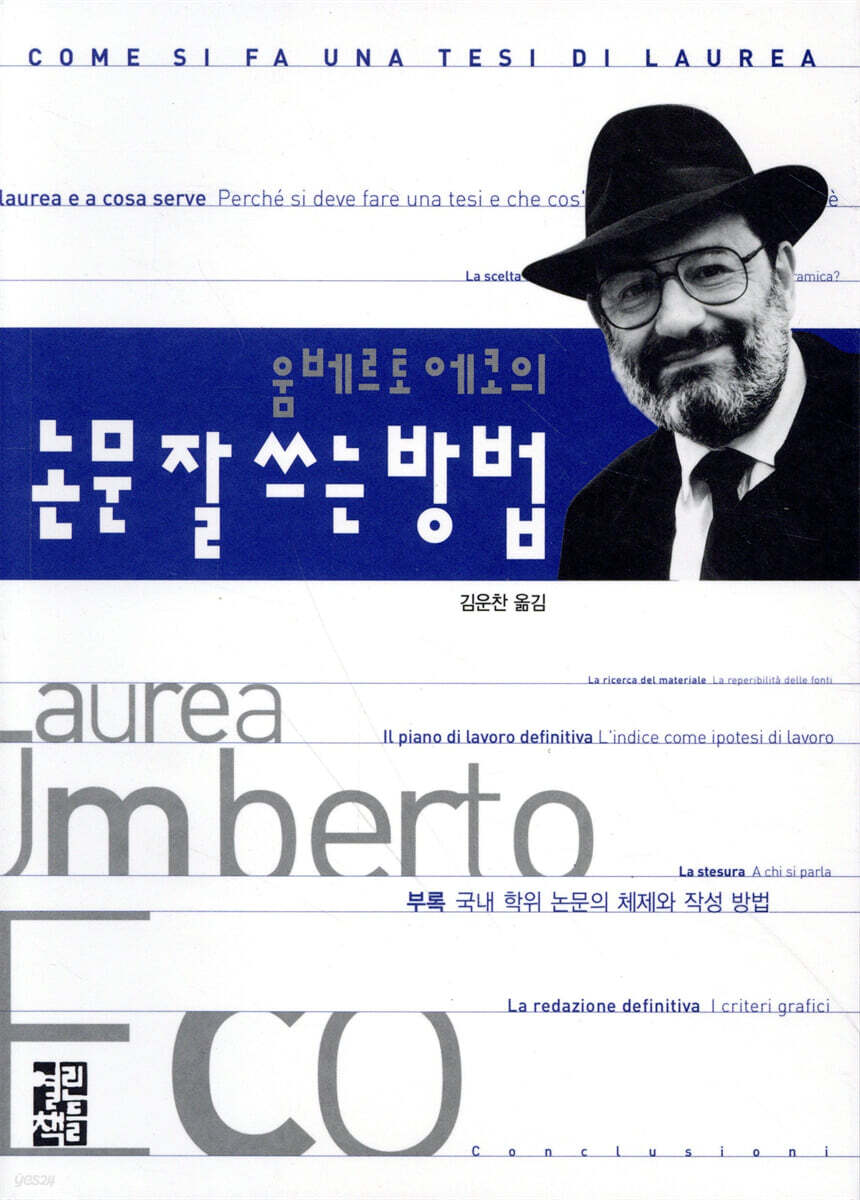
COME SI FA UNA TESI DI LAUREA
A thesis writing guide for Italian university students written by Umberto Eco, who is well-known among domestic readers for several high-quality novels such as "The Name of the Rose" and "Foucault's Pendulum" as well as works on semiotics.
Starting with the meaning and importance of a graduation thesis as the first step toward entering the academic path, it explains writing skills and the development of organized thoughts, and when viewed comprehensively, it contains useful content not only for college students but also for professionals in various academic fields.
Starting with the meaning and importance of a graduation thesis as the first step toward entering the academic path, it explains writing skills and the development of organized thoughts, and when viewed comprehensively, it contains useful content not only for college students but also for professionals in various academic fields.
index
1.
What is a thesis and why is it needed?
Why should I write a thesis and what is a thesis?
Who might be interested in this book?
How Does a Thesis Help After Graduation?
Four clear rules
2.
Choosing a theme
Is it a single-topic paper or a panoramic paper?
Is it a historical paper or a theoretical paper?
Is it an old theme or a modern theme?
How long does it take to write a paper?
Is it essential to know a foreign language?
Is it a thesis or a political thesis?
How to avoid being taken advantage of by your advisor
3.
Data research
Availability of sources
Bibliography
4.
Work Planning and Card Organization
Order as a hypothesis of the work
Cards and notes
5.
Writing a manuscript
Who are you talking to?
How to say
quote
Footnotes at the bottom of the page
Cautions, pitfalls, and practices
6.
Final manuscript writing
Calligraphic standards
Final References
supplement
time
7.
conclusion
What is a thesis and why is it needed?
Why should I write a thesis and what is a thesis?
Who might be interested in this book?
How Does a Thesis Help After Graduation?
Four clear rules
2.
Choosing a theme
Is it a single-topic paper or a panoramic paper?
Is it a historical paper or a theoretical paper?
Is it an old theme or a modern theme?
How long does it take to write a paper?
Is it essential to know a foreign language?
Is it a thesis or a political thesis?
How to avoid being taken advantage of by your advisor
3.
Data research
Availability of sources
Bibliography
4.
Work Planning and Card Organization
Order as a hypothesis of the work
Cards and notes
5.
Writing a manuscript
Who are you talking to?
How to say
quote
Footnotes at the bottom of the page
Cautions, pitfalls, and practices
6.
Final manuscript writing
Calligraphic standards
Final References
supplement
time
7.
conclusion
Into the book
The table of contents can be placed at the beginning or end of the paper.
Most Italian and French books place the table of contents at the end.
Books in English and most German are placed first. Recently, some Italian editors have also adopted this second criterion.
In my opinion, it is more convenient to put it at the beginning.
So, while you can find the table of contents right away by opening the first few pages, it requires a lot more physical effort to refer to it at the end.
But if you have to be first, make sure you're first.
Some Anglo-American books place the table of contents after the preface, often after the preface, preface to the first edition, or preface to the second edition.
That's barbaric.
That's really stupid, and it would be better to put it in the middle of the book.
Most Italian and French books place the table of contents at the end.
Books in English and most German are placed first. Recently, some Italian editors have also adopted this second criterion.
In my opinion, it is more convenient to put it at the beginning.
So, while you can find the table of contents right away by opening the first few pages, it requires a lot more physical effort to refer to it at the end.
But if you have to be first, make sure you're first.
Some Anglo-American books place the table of contents after the preface, often after the preface, preface to the first edition, or preface to the second edition.
That's barbaric.
That's really stupid, and it would be better to put it in the middle of the book.
--- p.299
This is also because, if you work hard, there is no such thing as a truly stupid theme.
If you work hard, you can draw useful conclusions even from seemingly peripheral and distant themes.
Marx did not write a treatise on political economy, but on two Greek philosophers, Epicurus and Democritus.
And it wasn't an accidental operation.
Perhaps it was precisely because he learned to think from those two Greek philosophers that Marx was able to think about historical and economic problems with the theoretical capacity we know so well.
Considering the many students who start out with ambitious dissertations on Marx and end up working in the human resources departments of huge capitalist corporations, it is worth reconsidering the usefulness of the dissertation topic and the concept of mission.
This is also because, if you work hard, there is no such thing as a truly stupid theme.
If you work hard, you can draw useful conclusions even from seemingly peripheral and distant themes.
Marx did not write a treatise on political economy, but on two Greek philosophers, Epicurus and Democritus.
And it wasn't an accidental operation.
Perhaps it was precisely because he learned to think from those two Greek philosophers that Marx was able to think about historical and economic problems with the theoretical capacity we know so well.
Considering the many students who start out with ambitious dissertations on Marx and end up working in the human resources departments of huge capitalist corporations, it is worth reconsidering the usefulness of the dissertation topic and the concept of mission.
If you work hard, you can draw useful conclusions even from seemingly peripheral and distant themes.
Marx did not write a treatise on political economy, but on two Greek philosophers, Epicurus and Democritus.
And it wasn't an accidental operation.
Perhaps it was precisely because he learned to think from those two Greek philosophers that Marx was able to think about historical and economic problems with the theoretical capacity we know so well.
Considering the many students who start out with ambitious dissertations on Marx and end up working in the human resources departments of huge capitalist corporations, it is worth reconsidering the usefulness of the dissertation topic and the concept of mission.
This is also because, if you work hard, there is no such thing as a truly stupid theme.
If you work hard, you can draw useful conclusions even from seemingly peripheral and distant themes.
Marx did not write a treatise on political economy, but on two Greek philosophers, Epicurus and Democritus.
And it wasn't an accidental operation.
Perhaps it was precisely because he learned to think from those two Greek philosophers that Marx was able to think about historical and economic problems with the theoretical capacity we know so well.
Considering the many students who start out with ambitious dissertations on Marx and end up working in the human resources departments of huge capitalist corporations, it is worth reconsidering the usefulness of the dissertation topic and the concept of mission.
---p.
31
31
In such cases, there are four rules for choosing a theme.
1) The theme should be relevant to the applicant's interests (i.e., related to the types of tests the applicant has taken, the type of reading he or she does, and his or her political, cultural, and religious environment).
2) The sources to be used as references must be available, that is, they must be materials that the applicant can obtain.
3) The sources to be used as references should be easily handled, that is, materials appropriate to the applicant's general knowledge.
4) The methodological category of the study should correspond to the applicant's area of experience.
If so, these four rules are very ordinary and can be summarized as a simple law.
In such cases, there are four rules for choosing a theme.
1) The theme should be relevant to the applicant's interests (i.e., related to the types of tests the applicant has taken, the type of reading he or she does, and his or her political, cultural, and religious environment).
2) The sources to be used as references must be available, that is, they must be materials that the applicant can obtain.
3) The sources to be used as references should be easily handled, that is, materials appropriate to the applicant's general knowledge.
4) The methodological category of the study should correspond to the applicant's area of experience.
If so, these four rules are very ordinary and can be summarized as a simple law.
1) The theme should be relevant to the applicant's interests (i.e., related to the types of tests the applicant has taken, the type of reading he or she does, and his or her political, cultural, and religious environment).
2) The sources to be used as references must be available, that is, they must be materials that the applicant can obtain.
3) The sources to be used as references should be easily handled, that is, materials appropriate to the applicant's general knowledge.
4) The methodological category of the study should correspond to the applicant's area of experience.
If so, these four rules are very ordinary and can be summarized as a simple law.
In such cases, there are four rules for choosing a theme.
1) The theme should be relevant to the applicant's interests (i.e., related to the types of tests the applicant has taken, the type of reading he or she does, and his or her political, cultural, and religious environment).
2) The sources to be used as references must be available, that is, they must be materials that the applicant can obtain.
3) The sources to be used as references should be easily handled, that is, materials appropriate to the applicant's general knowledge.
4) The methodological category of the study should correspond to the applicant's area of experience.
If so, these four rules are very ordinary and can be summarized as a simple law.
--- p.32
conclusion
I would like to conclude with the following two observations:
In other words, writing a paper means getting it for yourself, and a paper is like a pig; there is nothing to throw away.
~ The important thing is to make everything fun.
If you've chosen a topic that interests you, and if you've decided to dedicate a short but determined period of time to your thesis, then you've probably realized that you can experience your thesis as a game, a bet, a treasure hunt.
conclusion
I would like to conclude with the following two observations:
In other words, writing a paper means getting it for yourself, and a paper is like a pig; there is nothing to throw away.
~ The important thing is to make everything fun.
If you've chosen a topic that interests you, and if you've decided to dedicate a short but determined period of time to your thesis, then you've probably realized that you can experience your thesis as a game, a bet, a treasure hunt.
I would like to conclude with the following two observations:
In other words, writing a paper means getting it for yourself, and a paper is like a pig; there is nothing to throw away.
~ The important thing is to make everything fun.
If you've chosen a topic that interests you, and if you've decided to dedicate a short but determined period of time to your thesis, then you've probably realized that you can experience your thesis as a game, a bet, a treasure hunt.
conclusion
I would like to conclude with the following two observations:
In other words, writing a paper means getting it for yourself, and a paper is like a pig; there is nothing to throw away.
~ The important thing is to make everything fun.
If you've chosen a topic that interests you, and if you've decided to dedicate a short but determined period of time to your thesis, then you've probably realized that you can experience your thesis as a game, a bet, a treasure hunt.
--- p.305-306
2.2.
Is it a historical paper or a theoretical paper?
This binary choice applies only to a few subjects.
In fact, papers in subjects such as the history of mathematics, Romance literature, or German literature cannot but be historical.
And in subjects like architectural composition, nuclear physics, or comparative anatomy, you'll usually be writing either theoretical or experimental papers.
However, there are also subjects such as theoretical philosophy, philosophy, cultural anthropology, aesthetics, philosophy of law, education, or international law, in which you can write two types of papers.
A theoretical paper is one that deals with abstract issues that may or may not have already been the subject of other considerations, such as the nature of human will, the concept of freedom, the concept of social roles, the existence of God, or the laws of heredity.
2.2.
Is it a historical paper or a theoretical paper?
This binary choice applies only to a few subjects.
In fact, papers in subjects such as the history of mathematics, Romance literature, or German literature cannot but be historical.
And in subjects like architectural composition, nuclear physics, or comparative anatomy, you'll usually be writing either theoretical or experimental papers.
However, there are also subjects such as theoretical philosophy, philosophy, cultural anthropology, aesthetics, philosophy of law, education, or international law, in which you can write two types of papers.
A theoretical paper is one that deals with abstract issues that may or may not have already been the subject of other considerations, such as the nature of human will, the concept of freedom, the concept of social roles, the existence of God, or the laws of heredity.
Is it a historical paper or a theoretical paper?
This binary choice applies only to a few subjects.
In fact, papers in subjects such as the history of mathematics, Romance literature, or German literature cannot but be historical.
And in subjects like architectural composition, nuclear physics, or comparative anatomy, you'll usually be writing either theoretical or experimental papers.
However, there are also subjects such as theoretical philosophy, philosophy, cultural anthropology, aesthetics, philosophy of law, education, or international law, in which you can write two types of papers.
A theoretical paper is one that deals with abstract issues that may or may not have already been the subject of other considerations, such as the nature of human will, the concept of freedom, the concept of social roles, the existence of God, or the laws of heredity.
2.2.
Is it a historical paper or a theoretical paper?
This binary choice applies only to a few subjects.
In fact, papers in subjects such as the history of mathematics, Romance literature, or German literature cannot but be historical.
And in subjects like architectural composition, nuclear physics, or comparative anatomy, you'll usually be writing either theoretical or experimental papers.
However, there are also subjects such as theoretical philosophy, philosophy, cultural anthropology, aesthetics, philosophy of law, education, or international law, in which you can write two types of papers.
A theoretical paper is one that deals with abstract issues that may or may not have already been the subject of other considerations, such as the nature of human will, the concept of freedom, the concept of social roles, the existence of God, or the laws of heredity.
--- p.39-40
Publisher's Review
"Umberto Eco's How to Write a Good Thesis" is a practical thesis writing guide written by Italian semiotician and novelist Umberto Eco to provide practical help to students.
But no other book on how to write a paper has ever been more excellent, because Eco goes beyond mere manuscript writing by revealing crucial know-how on how to study, how to write, and how to think systematically.
Umberto Eco's fame and academic achievements are widely known worldwide, and we have also been introduced to three weighty novels (The Name of the Rose, Foucault's Pendulum, and The Island of the Day Before), his writings on semiotics, and his humorous essay collection How to Get Angry at the World's Fools While Laughing), which received a great response.
The reason why Echo has decided to write a new thesis writing guide is, above all, to provide advice on the problems faced by college students when writing their graduation theses.
However, this book goes beyond simply providing a thesis writing course for students; it also contains useful content for professional scholars working in various academic fields.
That is why this book was translated into many languages immediately after its publication and its importance is highly regarded.
In this book, Echo begins with the importance of a graduation thesis as the first step toward academic study and exemplifies the various meanings of the thesis.
He also takes students' perspectives into full consideration when sharing his own experiences.
And it emphasizes that writing a proper graduation thesis has many meanings in one's personal life, even if it is not necessarily an academic path.
To demonstrate that he can write a good paper even in an unfavorable environment, he even conducts an experiment by creating a bibliography on a certain topic in a rural library.
Echo introduces an interesting episode in the preface to the new edition.
In the section describing (page 205), he records his experience of getting important clues from a book left by an unknown monk named Valle.
The best ideas don't just come from famous authors.
However, when the first edition of this book came out, the famous critic Beniamino Placido wrote in his review in Repubblica that the friar Valle did not seem to be a real person.
Echo took his friend Placido to his home, showed him the ballet book, and read to him the passages he had highlighted.
And Echo realizes that the passage from the ballet cannot give her any clue.
Echo was not inspired by the book of ballet, but was inspired by the book.
Echo summarizes the episode:
In a similar way, we often unconsciously attribute ideas to authors that they don't necessarily mention.
In this way, research can be said to be a process of discovering ballet investigations and also becoming a ballet investigation for someone else.
To commemorate this realization, Eco introduces Brother Vallee as the author of the manuscript in the preface to The Name of the Rose.
This book is aimed at Italian university students.
Therefore, there may be some parts that do not apply to professional scholars or university students in our country.
But that is only in a very superficial way.
Because the basic direction of a thesis or academic study is common to everyone.
Considering the current state of university education in Korea, where students are not properly taught how to write a thesis during their four years of college, this book will be a very useful guide for university students.
Moreover, by following Echo's expansive narrative, which unfolds with abundant examples, this unique book offers not only the pleasure of reading but also teachings on writing skills and how to think systematically.
But no other book on how to write a paper has ever been more excellent, because Eco goes beyond mere manuscript writing by revealing crucial know-how on how to study, how to write, and how to think systematically.
Umberto Eco's fame and academic achievements are widely known worldwide, and we have also been introduced to three weighty novels (The Name of the Rose, Foucault's Pendulum, and The Island of the Day Before), his writings on semiotics, and his humorous essay collection How to Get Angry at the World's Fools While Laughing), which received a great response.
The reason why Echo has decided to write a new thesis writing guide is, above all, to provide advice on the problems faced by college students when writing their graduation theses.
However, this book goes beyond simply providing a thesis writing course for students; it also contains useful content for professional scholars working in various academic fields.
That is why this book was translated into many languages immediately after its publication and its importance is highly regarded.
In this book, Echo begins with the importance of a graduation thesis as the first step toward academic study and exemplifies the various meanings of the thesis.
He also takes students' perspectives into full consideration when sharing his own experiences.
And it emphasizes that writing a proper graduation thesis has many meanings in one's personal life, even if it is not necessarily an academic path.
To demonstrate that he can write a good paper even in an unfavorable environment, he even conducts an experiment by creating a bibliography on a certain topic in a rural library.
Echo introduces an interesting episode in the preface to the new edition.
In the section describing (page 205), he records his experience of getting important clues from a book left by an unknown monk named Valle.
The best ideas don't just come from famous authors.
However, when the first edition of this book came out, the famous critic Beniamino Placido wrote in his review in Repubblica that the friar Valle did not seem to be a real person.
Echo took his friend Placido to his home, showed him the ballet book, and read to him the passages he had highlighted.
And Echo realizes that the passage from the ballet cannot give her any clue.
Echo was not inspired by the book of ballet, but was inspired by the book.
Echo summarizes the episode:
In a similar way, we often unconsciously attribute ideas to authors that they don't necessarily mention.
In this way, research can be said to be a process of discovering ballet investigations and also becoming a ballet investigation for someone else.
To commemorate this realization, Eco introduces Brother Vallee as the author of the manuscript in the preface to The Name of the Rose.
This book is aimed at Italian university students.
Therefore, there may be some parts that do not apply to professional scholars or university students in our country.
But that is only in a very superficial way.
Because the basic direction of a thesis or academic study is common to everyone.
Considering the current state of university education in Korea, where students are not properly taught how to write a thesis during their four years of college, this book will be a very useful guide for university students.
Moreover, by following Echo's expansive narrative, which unfolds with abundant examples, this unique book offers not only the pleasure of reading but also teachings on writing skills and how to think systematically.
GOODS SPECIFICS
- Date of issue: June 30, 2006
- Page count, weight, size: 316 pages | 490g | 153*224*30mm
- ISBN13: 9788932906843
- ISBN10: 893290684X
You may also like
카테고리
korean


korean

![GQ KOREA Mark (Monthly): December [2025]](http://librairie.coreenne.fr/cdn/shop/files/8ef265dbbfbf186523ed75ba7319009d.jpg?v=1765340328&width=3840)


