

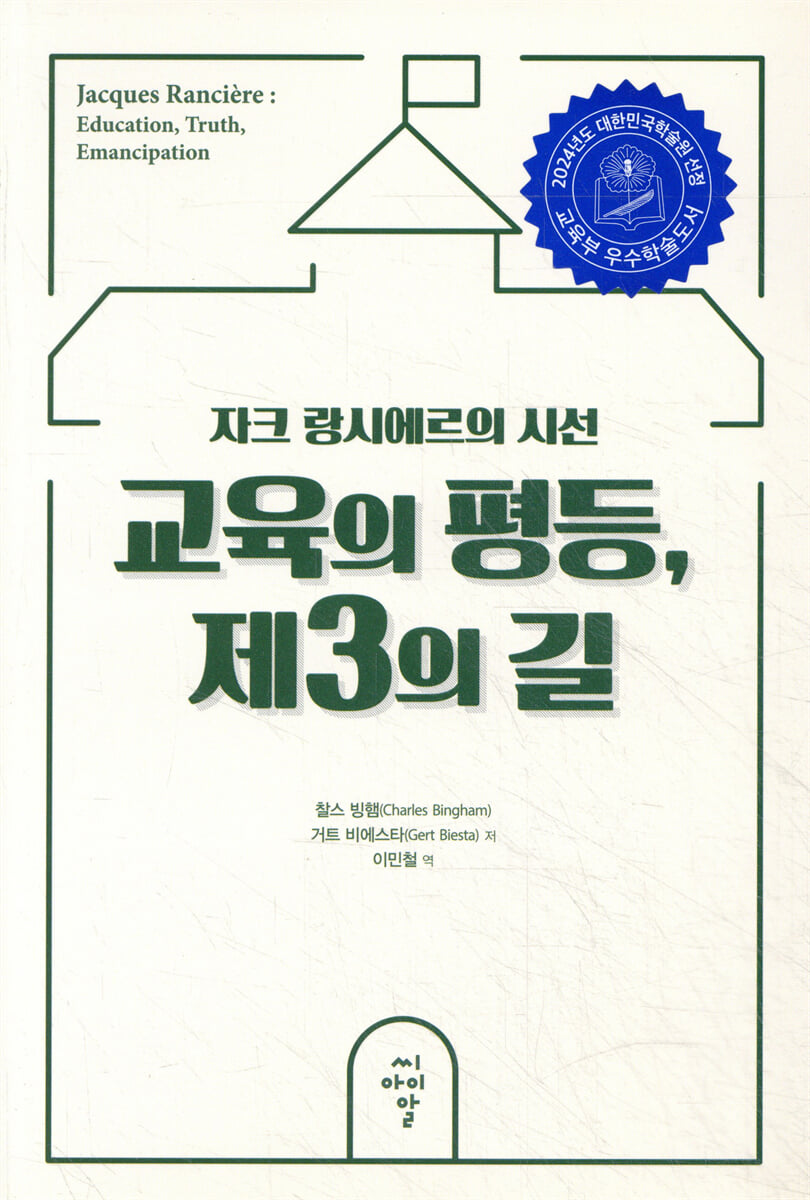
Equality in Education, the Third Way
 |
Description
Book Introduction
When it comes to teaching, teachers' explanations only prolong educational inequality.
Equality in education must be achieved through the will to enable students to develop their intellectual abilities on their own.
Rancière's New Perspective on Equal Education
The polarization of education and society is not a problem of yesterday or today.
The debate over whether we should teach content that is appropriate for each student's circumstances or whether we should teach the same content to all students regardless of their background continues endlessly, but no solution has been found.
However, these two opposing perspectives are the same in that they assume that inequality in education must be addressed toward a state of equality.
Unlike the two perspectives above, this book discusses a third perspective on equality in education, based on the work of the renowned French philosopher Rancière, The Ignorant Teacher.
According to this, the method of teaching by having the knowledgeable (the teacher) explain the educational content to the ignorant (the student) endlessly postpones equality in education.
Rancière found a way out of this ‘explanatory frame’ in the case of Joseph Jacotot.
Using Jacotot's example of 'universal teaching', he presents the principle of education that 'all people have equal intellectual abilities', and says that teachers should not explain what they know, but only play a role in encouraging students' will.
The teacher's job is to help students liberate their own intellectual abilities.
That is, this book sees the universal teaching for equality in education as making people realize that they are rational beings who can learn on their own through their intellectual ability and will.
Equality in education and learning are universal topics of interest not only to teachers, educational administrators, and other education professionals, but also to many others.
By understanding Rancière and the author's new perspective on education, we hope to broaden our perspective on what equal education is and how education should be conducted to achieve it.
Equality in education must be achieved through the will to enable students to develop their intellectual abilities on their own.
Rancière's New Perspective on Equal Education
The polarization of education and society is not a problem of yesterday or today.
The debate over whether we should teach content that is appropriate for each student's circumstances or whether we should teach the same content to all students regardless of their background continues endlessly, but no solution has been found.
However, these two opposing perspectives are the same in that they assume that inequality in education must be addressed toward a state of equality.
Unlike the two perspectives above, this book discusses a third perspective on equality in education, based on the work of the renowned French philosopher Rancière, The Ignorant Teacher.
According to this, the method of teaching by having the knowledgeable (the teacher) explain the educational content to the ignorant (the student) endlessly postpones equality in education.
Rancière found a way out of this ‘explanatory frame’ in the case of Joseph Jacotot.
Using Jacotot's example of 'universal teaching', he presents the principle of education that 'all people have equal intellectual abilities', and says that teachers should not explain what they know, but only play a role in encouraging students' will.
The teacher's job is to help students liberate their own intellectual abilities.
That is, this book sees the universal teaching for equality in education as making people realize that they are rational beings who can learn on their own through their intellectual ability and will.
Equality in education and learning are universal topics of interest not only to teachers, educational administrators, and other education professionals, but also to many others.
By understanding Rancière and the author's new perspective on education, we hope to broaden our perspective on what equal education is and how education should be conducted to achieve it.
- You can preview some of the book's contents.
Preview
index
Translator's Preface
Chapter 1: On the Ignorant Teacher
Chapter 2: The New Logic of Liberation
Chapter 3: The Image of the Child as Drawn by Rancière and Freire
Chapter 4: The Problem of Inclusion
Chapter 5: Pedagogy of Recognition
Chapter 6: The Truth of Education, the Truth of Liberation
Chapter 7: Learners, Students, and Speakers
Chapter 8 Conclusion: The World Is Not a School
Americas
References
Search
About the Author and Translator
Chapter 1: On the Ignorant Teacher
Chapter 2: The New Logic of Liberation
Chapter 3: The Image of the Child as Drawn by Rancière and Freire
Chapter 4: The Problem of Inclusion
Chapter 5: Pedagogy of Recognition
Chapter 6: The Truth of Education, the Truth of Liberation
Chapter 7: Learners, Students, and Speakers
Chapter 8 Conclusion: The World Is Not a School
Americas
References
Search
About the Author and Translator
GOODS SPECIFICS
- Date of issue: May 25, 2023
- Page count, weight, size: 336 pages | 604g | 152*224*22mm
- ISBN13: 9791168561465
- ISBN10: 1168561469
You may also like
카테고리
korean


korean

![GQ KOREA Mark (Monthly): December [2025]](http://librairie.coreenne.fr/cdn/shop/files/8ef265dbbfbf186523ed75ba7319009d.jpg?v=1765340328&width=3840)


