

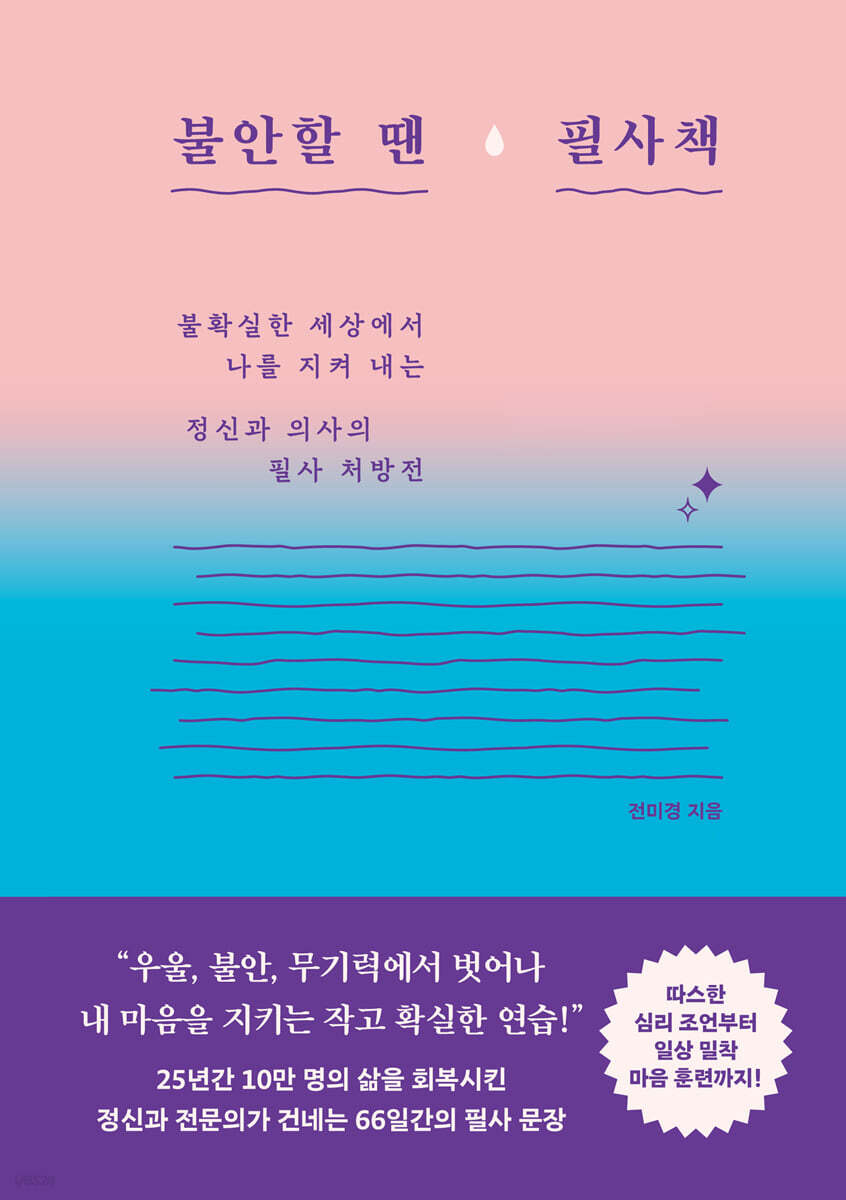
When you're anxious, a desperate book
 |
Description
Book Introduction
“Free from depression, anxiety and lethargy
“A small, sure practice to protect my heart!”
Restored the lives of 100,000 people over 25 years
66 days of handwritten sentences from a psychiatrist
Are you struggling to sleep due to feelings of depression and anxiety, a dull and listless routine, and complex thoughts that keep lingering in your mind? If so, it's time for you to "deathly resolve," not forced positivity or self-criticism.
The human brain begins to recover in amazing ways just by the act of writing.
This is because the brain areas that are activated when writing by hand are connected to areas that control emotions and memory.
《A Handbook for When You're Anxious》 is a practical yet special handbook written by psychiatrist Jeon Mi-kyung based on her clinical experience and psychological research.
The author has been researching self-esteem, depression, and addiction for 25 years, helping over 100,000 patients recover.
The book contains a 66-day transcription journey that goes beyond simply copying sentences and serves as a mental training program, from emotional acceptance to self-acceptance, daily recovery, and practicing self-confidence.
Take a slow look into your heart and write down at least one line a day, following the psychological affirmations recommended in the book.
A small heart that believes in the big, wide world that is you will lead you to a better tomorrow.
“A small, sure practice to protect my heart!”
Restored the lives of 100,000 people over 25 years
66 days of handwritten sentences from a psychiatrist
Are you struggling to sleep due to feelings of depression and anxiety, a dull and listless routine, and complex thoughts that keep lingering in your mind? If so, it's time for you to "deathly resolve," not forced positivity or self-criticism.
The human brain begins to recover in amazing ways just by the act of writing.
This is because the brain areas that are activated when writing by hand are connected to areas that control emotions and memory.
《A Handbook for When You're Anxious》 is a practical yet special handbook written by psychiatrist Jeon Mi-kyung based on her clinical experience and psychological research.
The author has been researching self-esteem, depression, and addiction for 25 years, helping over 100,000 patients recover.
The book contains a 66-day transcription journey that goes beyond simply copying sentences and serves as a mental training program, from emotional acceptance to self-acceptance, daily recovery, and practicing self-confidence.
Take a slow look into your heart and write down at least one line a day, following the psychological affirmations recommended in the book.
A small heart that believes in the big, wide world that is you will lead you to a better tomorrow.
- You can preview some of the book's contents.
Preview
index
Introduction: Believing in the big, wide world that is you
Chapter 1: How to Face Your Emotions
01 Feelings don't go away until they are understood.
02 The Courage to Admit Sensitivity
03 Day Anxiety is a sign that I don't trust myself yet.
How to Acknowledge Your Anger When You're Angry on the 4th
05 Sadness reveals the depth of love
If you don't feel any emotions on the 6th
What to do when emotions are running high on the 7th
The moment loneliness creeps in on the 8th
9 days of meaningless emptiness
10 days when everything feels like it's my fault
11-day emotional diary, a time to record myself every day
Chapter 2: Embracing the Imperfect Me
The illusion that you have to be perfect to be loved
13th When Other People's Eyes Trapped Me
14-Day Depression Isn't Laziness
People who constantly repeat their thoughts for 15 days
How to Reinterpret the Wounds of the 16th
Letting go of the words that hurt me on the 17th
Why You Feel Fear on the 18th
19th When regret eats me up
How do you view failure on the 20th?
The path led by the 21st
How to Recover from Failure on the 22nd
Chapter 3: A Time to Recover from a Weary and Tired Life
Stopping on the 23rd doesn't mean collapsing
How to Have a 24-Day Transition Time
When you feel like nothing you do on the 25th is enough
Save me from the digital world on the 26th
How to Escape Burnout in 27 Days
Why I'm still tired no matter how much I sleep for 28 days
On the 29th, the thought "I chose" changed me.
As the night deepens on the 30th, people are having trouble sleeping.
If you feel chest tightness and heavy body for no reason on the 31st
32 days Why am I so lethargic?
From 'I have to' to 'I want to' on the 33rd
Chapter 4: Living a Strong Life
Things That Change When You Record Your Gratitude for 34 Days
If you can't concentrate for 35 days and keep getting lost in your thoughts
36 days of forced laughter makes us feel more empty.
When you feel like you're spending the same day every day for 37 days
To you who are not feeling happy now, 38 days ago
39 days of practicing silence without relying on noise
It's okay if you're not always connected for 40 days.
How to get what you give in 41 days
What 42 days of direct experience leave in my life
43rd Sometimes it's okay to walk down an unfamiliar path.
Notice the small changes within you in 44 days
Chapter 5: Practice Persistence, Even in Small Things
A day sustained by 45 small rituals
46 days of repetition changes the brain
The Power of Small Acts in 47 Days
One ritual that saves me when I suddenly collapse on the 48th day
Practice 49 Days of Self-Care
The Miracle of 1 Percent Change That Transformed a 50-Day Depressed Patient
It's okay if you don't do it for 51 days
Even if it takes 52 days, if you don't stop
53 days when you feel like you have no talent
54 Things Weak-Willed People Need
55 days The body remembers the pattern
Chapter 6: Trust Me, Be Myself
The potential within me is still valid after 56 days.
The lie that "it'll get a little better" on the 57th day
58 days of what I really want
59 days The language within me builds me
It's not a 60-day incident, it's an exercise in changing the narrative.
61 days Even though it wasn't a perfect choice
62 days I am already a good enough person
Even after 63 days, there are times when distance is needed
64 days of post-traumatic growth
Life goes on even after 65 days of collapse.
I am bigger than the 66-day problem
Chapter 1: How to Face Your Emotions
01 Feelings don't go away until they are understood.
02 The Courage to Admit Sensitivity
03 Day Anxiety is a sign that I don't trust myself yet.
How to Acknowledge Your Anger When You're Angry on the 4th
05 Sadness reveals the depth of love
If you don't feel any emotions on the 6th
What to do when emotions are running high on the 7th
The moment loneliness creeps in on the 8th
9 days of meaningless emptiness
10 days when everything feels like it's my fault
11-day emotional diary, a time to record myself every day
Chapter 2: Embracing the Imperfect Me
The illusion that you have to be perfect to be loved
13th When Other People's Eyes Trapped Me
14-Day Depression Isn't Laziness
People who constantly repeat their thoughts for 15 days
How to Reinterpret the Wounds of the 16th
Letting go of the words that hurt me on the 17th
Why You Feel Fear on the 18th
19th When regret eats me up
How do you view failure on the 20th?
The path led by the 21st
How to Recover from Failure on the 22nd
Chapter 3: A Time to Recover from a Weary and Tired Life
Stopping on the 23rd doesn't mean collapsing
How to Have a 24-Day Transition Time
When you feel like nothing you do on the 25th is enough
Save me from the digital world on the 26th
How to Escape Burnout in 27 Days
Why I'm still tired no matter how much I sleep for 28 days
On the 29th, the thought "I chose" changed me.
As the night deepens on the 30th, people are having trouble sleeping.
If you feel chest tightness and heavy body for no reason on the 31st
32 days Why am I so lethargic?
From 'I have to' to 'I want to' on the 33rd
Chapter 4: Living a Strong Life
Things That Change When You Record Your Gratitude for 34 Days
If you can't concentrate for 35 days and keep getting lost in your thoughts
36 days of forced laughter makes us feel more empty.
When you feel like you're spending the same day every day for 37 days
To you who are not feeling happy now, 38 days ago
39 days of practicing silence without relying on noise
It's okay if you're not always connected for 40 days.
How to get what you give in 41 days
What 42 days of direct experience leave in my life
43rd Sometimes it's okay to walk down an unfamiliar path.
Notice the small changes within you in 44 days
Chapter 5: Practice Persistence, Even in Small Things
A day sustained by 45 small rituals
46 days of repetition changes the brain
The Power of Small Acts in 47 Days
One ritual that saves me when I suddenly collapse on the 48th day
Practice 49 Days of Self-Care
The Miracle of 1 Percent Change That Transformed a 50-Day Depressed Patient
It's okay if you don't do it for 51 days
Even if it takes 52 days, if you don't stop
53 days when you feel like you have no talent
54 Things Weak-Willed People Need
55 days The body remembers the pattern
Chapter 6: Trust Me, Be Myself
The potential within me is still valid after 56 days.
The lie that "it'll get a little better" on the 57th day
58 days of what I really want
59 days The language within me builds me
It's not a 60-day incident, it's an exercise in changing the narrative.
61 days Even though it wasn't a perfect choice
62 days I am already a good enough person
Even after 63 days, there are times when distance is needed
64 days of post-traumatic growth
Life goes on even after 65 days of collapse.
I am bigger than the 66-day problem
Detailed image

Into the book
After 66 days, our appearance may not have changed much.
But something will definitely change.
It is the gaze that looks directly at you.
Instead of condemnation, there will be understanding, instead of impatience, there will be patience, and instead of coldness, there will be warmth in those eyes.
And above all, a quiet conviction will settle deep within you that 'I am enough just as I am.'
In this uncertain and anxious world where there is nothing to hold on to, I hope these small but certain sentences will protect you.
--- From "Introduction"
“Doctor, I feel anxious for no reason.” This is the most common complaint I hear in the doctor’s office.
They say there is no reason, but there is a pattern.
Before a presentation, before a decision, before a new encounter, even in everyday life, I suffer from a premonition that 'something is going to go wrong.'
Psychologist Albert Bandura described this as 'self-efficacy.'
Anxiety increases when we lack confidence in our ability to handle the situation.
Anxious people do well ten times and make a mistake once, and only remember that one time.
It's like there's a filter in your mind that only picks out the negative things.
But the very fact that you are starting today with anxiety is proof of your strength.
--- 「Chapter 1.
From "How to Face the Emotions Within Me"
Every time sadness came, I just tried to shake it off quickly.
I tried to cover up my sadness by immersing myself in work and meeting people.
But sadness is proof of how deeply I loved.
It hurts because what you left was precious.
I will not rush into sadness.
I will allow you sufficient time to grieve.
--- 「Chapter 1.
From "How to Face the Emotions Within Me"
Try to distinguish between what is truly your responsibility and what is not.
It's not just your fault if your team is underperforming.
Just because you don't live up to your parents' expectations doesn't mean you're a bad child.
Other people's feelings and choices are their responsibility.
Try changing “I’m sorry” to “Thank you.”
Instead of saying “I’m sorry for keeping you waiting,” say “Thank you for waiting.”
If you change your words, your heart will feel a little lighter.
--- 「Chapter 1.
From "How to Face the Emotions Within Me"
In psychology, this is called 'rumination'.
It's like the brain keeps going on the same track, constantly repeating the same thoughts.
The phrase, “If only I had done it differently back then,” comes to mind dozens of times a day.
This is where depression and regret meet.
When mental rumination is added to the heaviness of depression, energy is consumed only by reliving the past.
It is important to redirect this energy.
When you change “If I had done it differently then” to “What should I do from now on,” the blocked energy starts to flow.
--- Chapter 2.
From "Embracing the Imperfect Me"
There was a person who did volunteer work for abandoned dogs.
At first, I started it to build up my resume, but after a few months, things changed.
Puppies who recognize you and wag their tails, moments when a dog that was scared slowly opens its heart.
“It was hard when I thought I was going because of my qualifications, but when I thought about going because I wanted to see these guys, I started looking forward to Saturday mornings.” When my perspective changed from “volunteer work that I have to do” to “care that I want to do,” the same act took on a completely different meaning.
People who recover from burnout have one thing in common: they regained their “choice.”
It doesn't have to be a big decision.
Small choices, like what to eat for lunch or what to take for a walk after work, add up to a boost in self-esteem.
--- Chapter 3.
From "A time to recover from a tiring and exhausting life"
Philosopher Albert Camus said in The Myth of Sisyphus:
“We must imagine Sisyphus happy.” As Sisyphus descends the mountain, he becomes aware of his fate.
And make it your own.
The rock still rolls down, but now it is 'his' rock.
It's not about accepting fate.
It is about making your own destiny.
Even when doing the same thing, people who say, "I can't stand it because it's unfair," and people who accept it and say, "This is my part," show a noticeably different recovery speed when experiencing burnout.
The difference wasn't the amount of work.
It was my attitude towards work and the meaning I found within it.
--- 「Chapter 3.
From "A time to recover from a tiring and exhausting life"
Complaints come naturally, but gratitude must be sought out.
At first, even one line was burdensome.
“I breathed again today.” It was so clichéd that it was embarrassing, but I still wrote it the next day and the day after that.
After about a month, things started to change little by little.
Things that were always there began to come into view one by one.
Gratitude doesn't change your life.
It just makes you see what you already have.
--- Chapter 4.
From "Living a Solid Life"
There are some interesting things to see in the clinic.
People who repeat small things over and over again last longer than those who set big goals.
Goals only give you strength initially, but small actions create identity.
The thought, 'I am a person who does ~ every day' changes your actions, and your actions change your life.
Waking up in the morning, eating a meal, asking someone how they are doing.
It may seem like nothing, but it's these things that keep us going.
There was a patient who couldn't get out of bed due to depression.
At first, I thought I'd just go to the end of the bed.
Then to the bathroom, then to the living room.
As I repeated small actions, I recovered before I knew it.
That you are here now.
That's the greatest thing.
--- Chapter 5.
From "Practice of continuing even small things"
Even if they experience the same divorce, some people remain stuck in the case even after 10 years, while others use the experience as a stepping stone for growth.
The difference was not the event, but the narrative.
Some people say, “That’s when everything fell apart,” while others say, “That experience made me who I am today.”
The meaning of suffering is not found after the event is over.
Right now, as I write that story, meaning is being created.
You are the author of your life.
You can't change what's already happened, but you can still choose how you spend it.
But something will definitely change.
It is the gaze that looks directly at you.
Instead of condemnation, there will be understanding, instead of impatience, there will be patience, and instead of coldness, there will be warmth in those eyes.
And above all, a quiet conviction will settle deep within you that 'I am enough just as I am.'
In this uncertain and anxious world where there is nothing to hold on to, I hope these small but certain sentences will protect you.
--- From "Introduction"
“Doctor, I feel anxious for no reason.” This is the most common complaint I hear in the doctor’s office.
They say there is no reason, but there is a pattern.
Before a presentation, before a decision, before a new encounter, even in everyday life, I suffer from a premonition that 'something is going to go wrong.'
Psychologist Albert Bandura described this as 'self-efficacy.'
Anxiety increases when we lack confidence in our ability to handle the situation.
Anxious people do well ten times and make a mistake once, and only remember that one time.
It's like there's a filter in your mind that only picks out the negative things.
But the very fact that you are starting today with anxiety is proof of your strength.
--- 「Chapter 1.
From "How to Face the Emotions Within Me"
Every time sadness came, I just tried to shake it off quickly.
I tried to cover up my sadness by immersing myself in work and meeting people.
But sadness is proof of how deeply I loved.
It hurts because what you left was precious.
I will not rush into sadness.
I will allow you sufficient time to grieve.
--- 「Chapter 1.
From "How to Face the Emotions Within Me"
Try to distinguish between what is truly your responsibility and what is not.
It's not just your fault if your team is underperforming.
Just because you don't live up to your parents' expectations doesn't mean you're a bad child.
Other people's feelings and choices are their responsibility.
Try changing “I’m sorry” to “Thank you.”
Instead of saying “I’m sorry for keeping you waiting,” say “Thank you for waiting.”
If you change your words, your heart will feel a little lighter.
--- 「Chapter 1.
From "How to Face the Emotions Within Me"
In psychology, this is called 'rumination'.
It's like the brain keeps going on the same track, constantly repeating the same thoughts.
The phrase, “If only I had done it differently back then,” comes to mind dozens of times a day.
This is where depression and regret meet.
When mental rumination is added to the heaviness of depression, energy is consumed only by reliving the past.
It is important to redirect this energy.
When you change “If I had done it differently then” to “What should I do from now on,” the blocked energy starts to flow.
--- Chapter 2.
From "Embracing the Imperfect Me"
There was a person who did volunteer work for abandoned dogs.
At first, I started it to build up my resume, but after a few months, things changed.
Puppies who recognize you and wag their tails, moments when a dog that was scared slowly opens its heart.
“It was hard when I thought I was going because of my qualifications, but when I thought about going because I wanted to see these guys, I started looking forward to Saturday mornings.” When my perspective changed from “volunteer work that I have to do” to “care that I want to do,” the same act took on a completely different meaning.
People who recover from burnout have one thing in common: they regained their “choice.”
It doesn't have to be a big decision.
Small choices, like what to eat for lunch or what to take for a walk after work, add up to a boost in self-esteem.
--- Chapter 3.
From "A time to recover from a tiring and exhausting life"
Philosopher Albert Camus said in The Myth of Sisyphus:
“We must imagine Sisyphus happy.” As Sisyphus descends the mountain, he becomes aware of his fate.
And make it your own.
The rock still rolls down, but now it is 'his' rock.
It's not about accepting fate.
It is about making your own destiny.
Even when doing the same thing, people who say, "I can't stand it because it's unfair," and people who accept it and say, "This is my part," show a noticeably different recovery speed when experiencing burnout.
The difference wasn't the amount of work.
It was my attitude towards work and the meaning I found within it.
--- 「Chapter 3.
From "A time to recover from a tiring and exhausting life"
Complaints come naturally, but gratitude must be sought out.
At first, even one line was burdensome.
“I breathed again today.” It was so clichéd that it was embarrassing, but I still wrote it the next day and the day after that.
After about a month, things started to change little by little.
Things that were always there began to come into view one by one.
Gratitude doesn't change your life.
It just makes you see what you already have.
--- Chapter 4.
From "Living a Solid Life"
There are some interesting things to see in the clinic.
People who repeat small things over and over again last longer than those who set big goals.
Goals only give you strength initially, but small actions create identity.
The thought, 'I am a person who does ~ every day' changes your actions, and your actions change your life.
Waking up in the morning, eating a meal, asking someone how they are doing.
It may seem like nothing, but it's these things that keep us going.
There was a patient who couldn't get out of bed due to depression.
At first, I thought I'd just go to the end of the bed.
Then to the bathroom, then to the living room.
As I repeated small actions, I recovered before I knew it.
That you are here now.
That's the greatest thing.
--- Chapter 5.
From "Practice of continuing even small things"
Even if they experience the same divorce, some people remain stuck in the case even after 10 years, while others use the experience as a stepping stone for growth.
The difference was not the event, but the narrative.
Some people say, “That’s when everything fell apart,” while others say, “That experience made me who I am today.”
The meaning of suffering is not found after the event is over.
Right now, as I write that story, meaning is being created.
You are the author of your life.
You can't change what's already happened, but you can still choose how you spend it.
--- Chapter 6.
From "Trust me, be myself"
From "Trust me, be myself"
Publisher's Review
“Just by writing down complex thoughts and feelings,
Life begins to recover in an amazing way!”
Don't waste your mind on unnecessary things
Time to quietly wake me up
We easily get carried away by our emotions or spend too much time thinking about unnecessary things.
Even people who appear fine on the outside live with countless worries and anxieties inside.
Sometimes, when it feels like we're barely hanging on, not really living, when no one seems to have our backs, and when we can't even be sure of ourselves, how can we restore our hearts and live as steadfast, unshaken by small things? Psychologist James Pennebaker, after 40 years of research, has discovered one simple yet powerful truth:
Just by writing down the thoughts and anxieties that come and go, life begins to recover.
Only after we write down the thoughts and feelings that have been tangled in our minds can we properly face ourselves.
Also, the brain areas that are activated when writing by hand are connected to areas that control emotions and memories, so handwriting is not just a simple copying, but the best training to soothe the mind.
From warm psychological advice to daily mind training,
The Psychiatrist's Most Special Handwritten Prescription
This book is the first handwritten book by Jeon Mi-kyung, a psychiatrist with 25 years of experience and bestselling author of books such as “You Are Stronger Than You Think” and “Don’t Hurt Me.”
The stories of patients I met in the clinic and sentences drawn from psychological research cases contain a step-by-step journey of recovery from daily life.
First, I take a moment to reflect on how I feel right now, and then I read “Warm Advice from a Psychiatrist” and take a closer look at my thoughts and feelings.
And I look forward to tomorrow, when I will change little by little, following today's psychological resolutions.
Finally, answer the questions in 'Today's Mind Prescription' and put one mission into practice in your daily life.
This four-step process will help you build a daily routine of accepting your emotions, self-acceptance, restoring your daily routine, and practicing trusting yourself.
It is not only a book full of warm comfort, but also the most practical handbook that will gradually change your life.
Also, according to neuroscience research, it takes an average of 66 days for a person to form a new habit.
That's why this book is composed of 66 articles.
You too can change!
66 days later, I will face the truth that 'I am a good person just the way I am'
quiet confidence
How will our lives change after 66 days of following the heart-health prescriptions presented in this book? The author explains.
“After 66 days, our appearance may not have changed much.
But the way you look at yourself will definitely have changed.
Instead of criticism, there will be understanding, instead of impatience, there will be waiting, and instead of coldness, there will be warmth in those eyes.” Through the desperate time of caring for our hearts and changing our inner selves, our lives will gradually recover like clothes getting wet in a light rain. The very small practice of not comparing yourself to others, controlling your emotions, and believing and loving yourself even though you are imperfect will broaden your world and make you a bigger and stronger person.
As the author says, I hope the writings in this book will become “small but certain sentences that will protect you in this uncertain and anxious world where there is nothing to hold on to.”
Life begins to recover in an amazing way!”
Don't waste your mind on unnecessary things
Time to quietly wake me up
We easily get carried away by our emotions or spend too much time thinking about unnecessary things.
Even people who appear fine on the outside live with countless worries and anxieties inside.
Sometimes, when it feels like we're barely hanging on, not really living, when no one seems to have our backs, and when we can't even be sure of ourselves, how can we restore our hearts and live as steadfast, unshaken by small things? Psychologist James Pennebaker, after 40 years of research, has discovered one simple yet powerful truth:
Just by writing down the thoughts and anxieties that come and go, life begins to recover.
Only after we write down the thoughts and feelings that have been tangled in our minds can we properly face ourselves.
Also, the brain areas that are activated when writing by hand are connected to areas that control emotions and memories, so handwriting is not just a simple copying, but the best training to soothe the mind.
From warm psychological advice to daily mind training,
The Psychiatrist's Most Special Handwritten Prescription
This book is the first handwritten book by Jeon Mi-kyung, a psychiatrist with 25 years of experience and bestselling author of books such as “You Are Stronger Than You Think” and “Don’t Hurt Me.”
The stories of patients I met in the clinic and sentences drawn from psychological research cases contain a step-by-step journey of recovery from daily life.
First, I take a moment to reflect on how I feel right now, and then I read “Warm Advice from a Psychiatrist” and take a closer look at my thoughts and feelings.
And I look forward to tomorrow, when I will change little by little, following today's psychological resolutions.
Finally, answer the questions in 'Today's Mind Prescription' and put one mission into practice in your daily life.
This four-step process will help you build a daily routine of accepting your emotions, self-acceptance, restoring your daily routine, and practicing trusting yourself.
It is not only a book full of warm comfort, but also the most practical handbook that will gradually change your life.
Also, according to neuroscience research, it takes an average of 66 days for a person to form a new habit.
That's why this book is composed of 66 articles.
You too can change!
66 days later, I will face the truth that 'I am a good person just the way I am'
quiet confidence
How will our lives change after 66 days of following the heart-health prescriptions presented in this book? The author explains.
“After 66 days, our appearance may not have changed much.
But the way you look at yourself will definitely have changed.
Instead of criticism, there will be understanding, instead of impatience, there will be waiting, and instead of coldness, there will be warmth in those eyes.” Through the desperate time of caring for our hearts and changing our inner selves, our lives will gradually recover like clothes getting wet in a light rain. The very small practice of not comparing yourself to others, controlling your emotions, and believing and loving yourself even though you are imperfect will broaden your world and make you a bigger and stronger person.
As the author says, I hope the writings in this book will become “small but certain sentences that will protect you in this uncertain and anxious world where there is nothing to hold on to.”
GOODS SPECIFICS
- Date of issue: November 21, 2025
- Format: Hardcover book binding method guide
- Page count, weight, size: 288 pages | 566g | 155*216*21mm
- ISBN13: 9791168273788
- ISBN10: 1168273781
You may also like
카테고리
korean


korean

![GQ KOREA Mark (Monthly): December [2025]](http://librairie.coreenne.fr/cdn/shop/files/8ef265dbbfbf186523ed75ba7319009d.jpg?v=1765340328&width=3840)


