

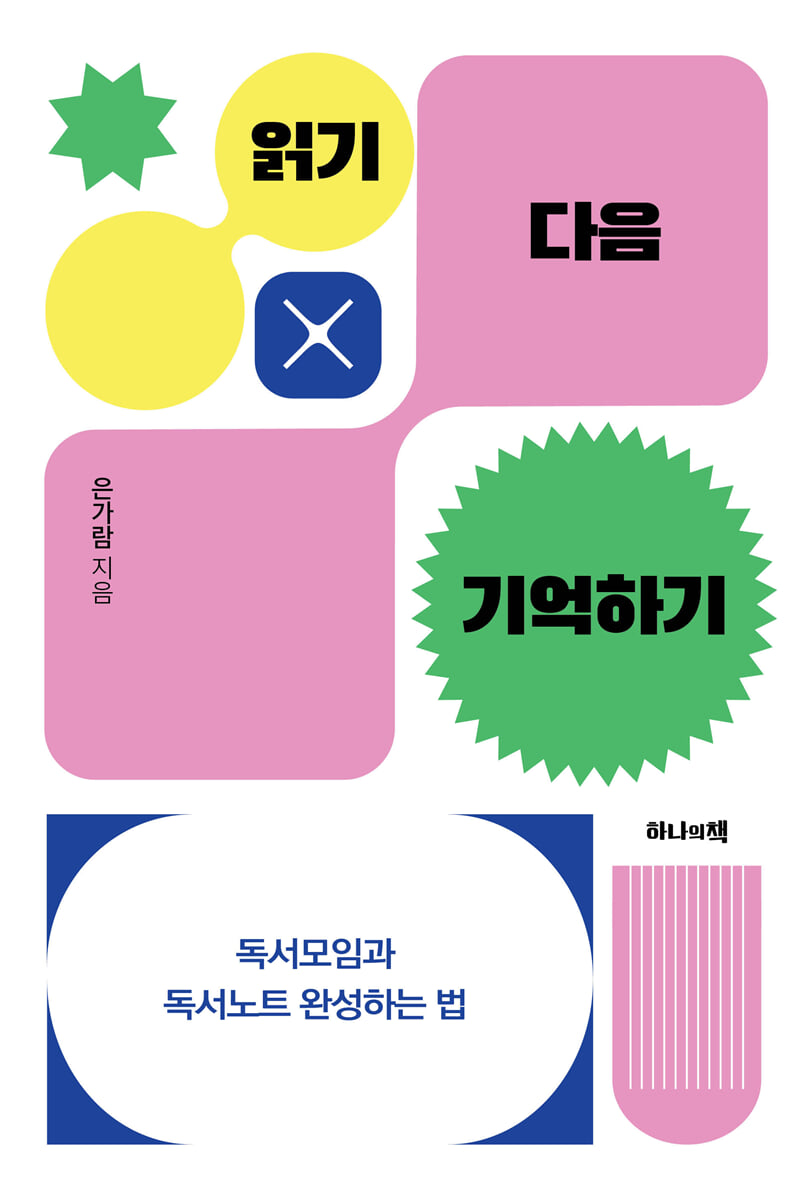
Read Next Remember
 |
Description
Book Introduction
The most practical book to complete a long-lasting reading
Reading books is enjoyable and meaningful, but as time goes by, it often becomes unclear what you learned from the book and what thoughts came to you.
"Read, Then Remember" starts from this very problem.
Since 2018, the author has run various reading groups and has read and discussed with hundreds of readers.
Based on that experience, I focused on the process of organizing what I read in my own words, recalling it, and sharing it with others, and included in this book the processes I studied to achieve 'memorable reading.'
"Read, Remember" is a guide that presents specific and practical ways to keep a book in your mind for a long time.
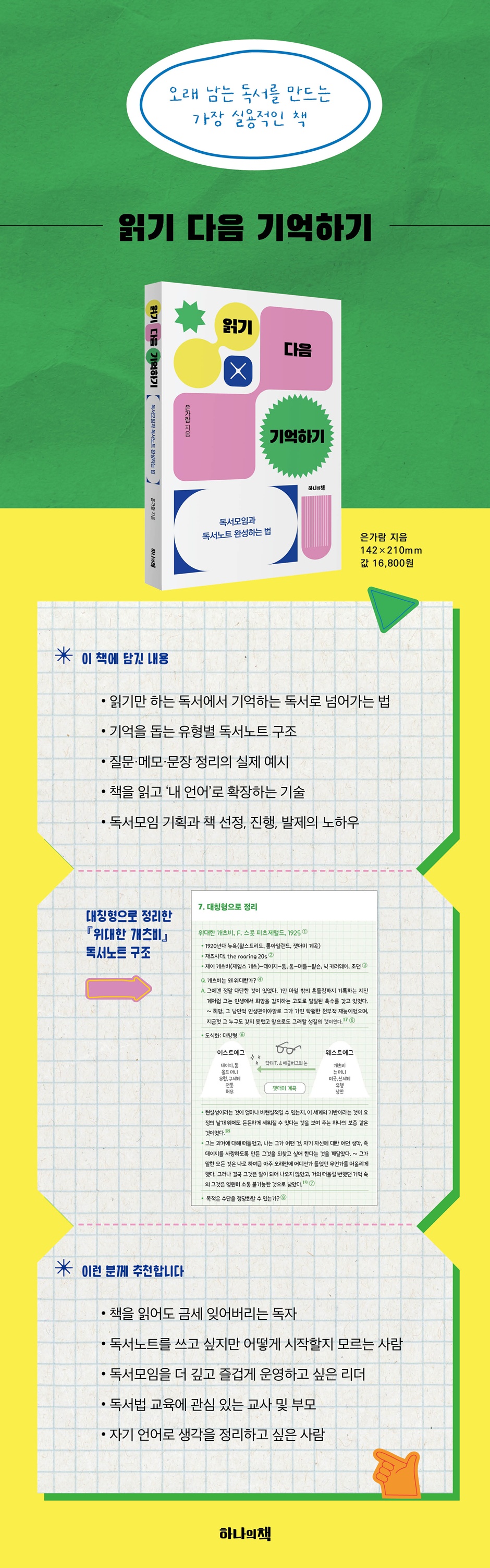
It contains a basic framework to help you read, organize, and remember books well, along with a design for the structure of reading notes, a recording method by type, and a question-centered reading method.
In particular, it includes examples of notes organized after actual reading and reading groups, so it is clear enough that even readers who are writing reading notes for the first time can follow along.
If you apply the author's guide, you will experience reading that not only brings joy to reading, but also sharpens your thoughts and deepens your memory.
Reading books is enjoyable and meaningful, but as time goes by, it often becomes unclear what you learned from the book and what thoughts came to you.
"Read, Then Remember" starts from this very problem.
Since 2018, the author has run various reading groups and has read and discussed with hundreds of readers.
Based on that experience, I focused on the process of organizing what I read in my own words, recalling it, and sharing it with others, and included in this book the processes I studied to achieve 'memorable reading.'
"Read, Remember" is a guide that presents specific and practical ways to keep a book in your mind for a long time.
It contains a basic framework to help you read, organize, and remember books well, along with a design for the structure of reading notes, a recording method by type, and a question-centered reading method.
In particular, it includes examples of notes organized after actual reading and reading groups, so it is clear enough that even readers who are writing reading notes for the first time can follow along.
If you apply the author's guide, you will experience reading that not only brings joy to reading, but also sharpens your thoughts and deepens your memory.
- You can preview some of the book's contents.
Preview
index
Introduction
Part 1: How to Read a Book: For the Moment You Discover a Book
How to Balance Your Reading
Where to Underline: Organize around Key Keywords
Patterns and Symbols: Finding Signs and Landmarks in a Work
Narrative Archetypes and Intertextuality: All Books Are Connected
Part 2: How to Read a Book: To Encounter a Book in Detail
5W1H: Six Keys to Storytelling
1. WHO: Finding Clues in People
The good, the bad, the weird/ Characters represent the group/ Characters are symbols/ Don't be fooled by the speaker
2. WHEN, WHERE: Finding Clues in Time and Space
Key to reading temporal background/Key to reading spatial background
3. WHAT, HOW, WHY: Finding Clues in Conflict, Method, and Reason
WHAT: The Key to Understanding Conflict
HOW: How is conflict resolved?
WHY: What was the story written for?
Ariadne's Red Thread
Part 3: How to Create Reading Notes: To Record Your Reading Experience
Structuring your reading notes to help you organize them
The process of recording a book to make it mine
1.
Organized in linear (list-like) format 『Do you like Brahms...』
2.
Slaughterhouse-Five: A Parallel Story
3.
Broken April, organized in a pyramid shape
4.
Pachinko organized in a hierarchical structure
5.
The Girl Left in the Circle
6.
Organized by center-periphery structure, 『Woman of the Sand』
7.
The Great Gatsby, organized symmetrically
8.
The Great Gatsby, organized radially
9.
The Moon and Sixpence: A Venn Diagram
10.
Sorted by keyword expansion: "Sweet and Bitter Chocolate"
11.
Freely organized 『The Embankment Blocking the Pacific』
Part 4 Reading Club Q&A
Q1.
How do you plan a reading group?
Q2.
What books should we choose for our reading club?
Q3.
How do I make a presentation?
Q4.
What should I be careful about when proceeding?
The text that appears
List of cited books
Appendix: Creating Reading Notes
Part 1: How to Read a Book: For the Moment You Discover a Book
How to Balance Your Reading
Where to Underline: Organize around Key Keywords
Patterns and Symbols: Finding Signs and Landmarks in a Work
Narrative Archetypes and Intertextuality: All Books Are Connected
Part 2: How to Read a Book: To Encounter a Book in Detail
5W1H: Six Keys to Storytelling
1. WHO: Finding Clues in People
The good, the bad, the weird/ Characters represent the group/ Characters are symbols/ Don't be fooled by the speaker
2. WHEN, WHERE: Finding Clues in Time and Space
Key to reading temporal background/Key to reading spatial background
3. WHAT, HOW, WHY: Finding Clues in Conflict, Method, and Reason
WHAT: The Key to Understanding Conflict
HOW: How is conflict resolved?
WHY: What was the story written for?
Ariadne's Red Thread
Part 3: How to Create Reading Notes: To Record Your Reading Experience
Structuring your reading notes to help you organize them
The process of recording a book to make it mine
1.
Organized in linear (list-like) format 『Do you like Brahms...』
2.
Slaughterhouse-Five: A Parallel Story
3.
Broken April, organized in a pyramid shape
4.
Pachinko organized in a hierarchical structure
5.
The Girl Left in the Circle
6.
Organized by center-periphery structure, 『Woman of the Sand』
7.
The Great Gatsby, organized symmetrically
8.
The Great Gatsby, organized radially
9.
The Moon and Sixpence: A Venn Diagram
10.
Sorted by keyword expansion: "Sweet and Bitter Chocolate"
11.
Freely organized 『The Embankment Blocking the Pacific』
Part 4 Reading Club Q&A
Q1.
How do you plan a reading group?
Q2.
What books should we choose for our reading club?
Q3.
How do I make a presentation?
Q4.
What should I be careful about when proceeding?
The text that appears
List of cited books
Appendix: Creating Reading Notes
Detailed image
Publisher's Review
Presenting a 'reading, organizing, and structuring process' that strengthens memory.
In an age where fast-paced content is the norm, reading books is not only difficult, but also difficult to remember.
Many readers worry about things like, “I don’t remember what I read,” or “I read so hard, but why don’t I learn more?”
The author noticed the importance of reading well and asking questions while discussing in a book club, and later studied the process of reading, organizing, and structuring for 'memorable reading.'
This book guides you through putting that structure into practice with ease.
For example, it helps readers understand by providing practical methods for reading and organizing 11 novels, including The Great Gatsby and The Moon and Sixpence.
In addition, we also introduce the 'world of reading together', where we operate a reading club and savor books more deeply through the know-how of reading and sharing together.
What this book contains
How to Move from Reading Just to Reading with Memory
Type-specific reading note structure to help you remember
Practical examples of questions, notes, and sentence organization
The art of reading books and expanding them into 'my language'
Know-how on planning, selecting books, conducting, and presenting reading club meetings
Includes a 'reading note form' that you can read and write immediately.
In an age where fast-paced content is the norm, reading books is not only difficult, but also difficult to remember.
Many readers worry about things like, “I don’t remember what I read,” or “I read so hard, but why don’t I learn more?”
The author noticed the importance of reading well and asking questions while discussing in a book club, and later studied the process of reading, organizing, and structuring for 'memorable reading.'
This book guides you through putting that structure into practice with ease.
For example, it helps readers understand by providing practical methods for reading and organizing 11 novels, including The Great Gatsby and The Moon and Sixpence.
In addition, we also introduce the 'world of reading together', where we operate a reading club and savor books more deeply through the know-how of reading and sharing together.
What this book contains
How to Move from Reading Just to Reading with Memory
Type-specific reading note structure to help you remember
Practical examples of questions, notes, and sentence organization
The art of reading books and expanding them into 'my language'
Know-how on planning, selecting books, conducting, and presenting reading club meetings
Includes a 'reading note form' that you can read and write immediately.
GOODS SPECIFICS
- Date of issue: December 1, 2025
- Page count, weight, size: 192 pages | 142*210*20mm
- ISBN13: 9791187600299
- ISBN10: 1187600296
You may also like
카테고리
korean


korean

![GQ KOREA Mark (Monthly): December [2025]](http://librairie.coreenne.fr/cdn/shop/files/8ef265dbbfbf186523ed75ba7319009d.jpg?v=1765340328&width=3840)


