

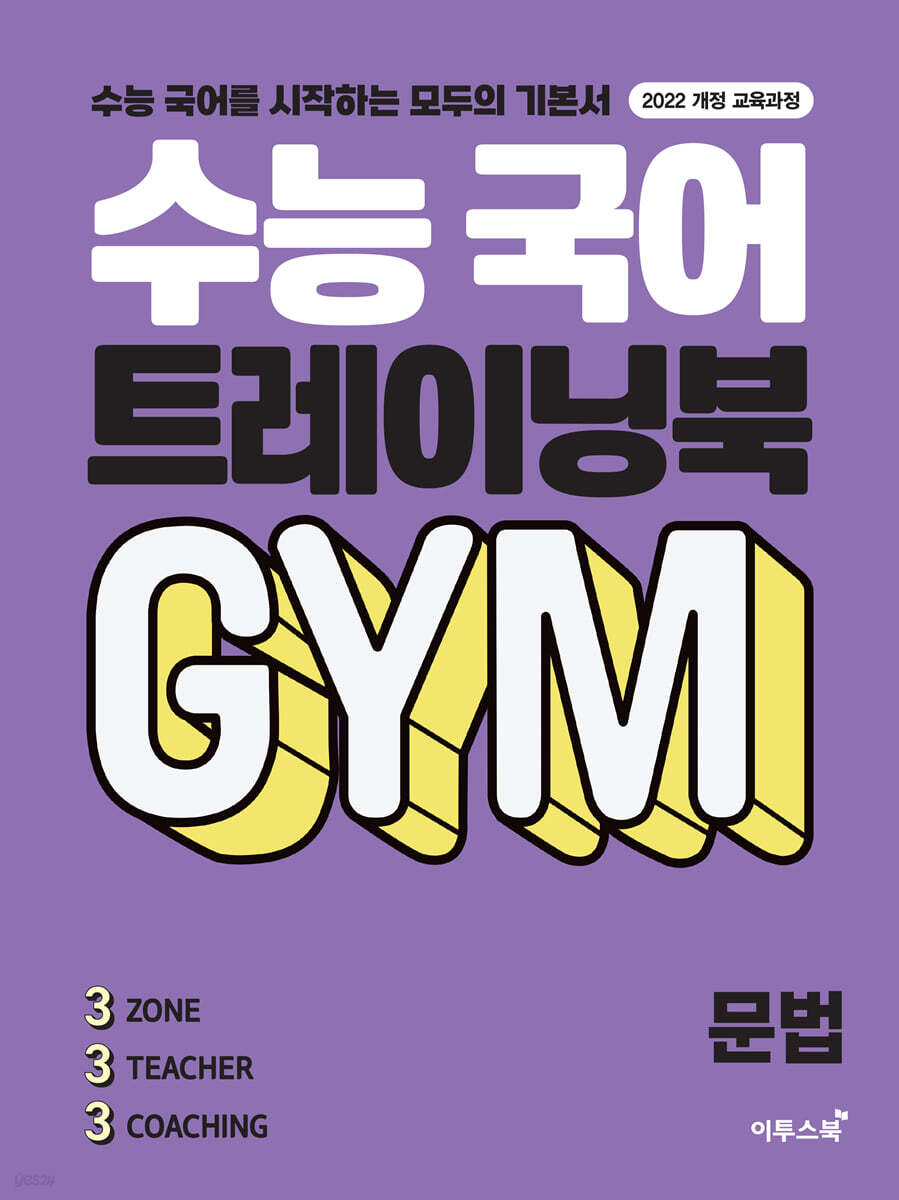
College Scholastic Ability Test Korean Language Training Book GYM Grammar (for 2026)
 |
Description
Book Introduction
100 core concepts for understanding grammar.
These are practical terms extracted from 10 years of past exam questions.
Let's train real college entrance exam grammar.
These are practical terms extracted from 10 years of past exam questions.
Let's train real college entrance exam grammar.
- You can preview some of the book's contents.
Preview
index
1.
word
001~004 Morphemes / Roots and Affixes / Compound Words / Derivative Words
005~007 Nouns / Pronouns / Numerals
008~010 Determiners / Adverbs / Particles
011~013 Interjections / Verbs / Adjectives
014~016 Stems and Suffixes / Main Verbs and Auxiliary Verbs / Verb Conjugation
017~020 Word Meaning Types and Relationships / Using the Korean Dictionary
021~024 Vocabulary System and Patterns / Changes in the Meaning of Words
2.
sentence
025~029 Sentence components / elements / subject / predicate / object
030~034 Number of digits of complement / adjective / adverb / independent word / predicate
035~037 Simple and compound sentences / connected sentences
038~042 Noun clause / Attributive clause / Adverb clause / Quotation clause / Descriptive clause
043~046 Subject honorific / Object honorific / Relative honorific / Concluding expression
047~048 tense/action
049~051 Negative expressions / Passive expressions / Causative expressions
052~054 Sentence Element Response / Ambiguous Sentence / Correct Expression
3.
Phonology
055~057 The nature and function of language / Phonetics / Consonant system
058~060 Vowel system / Syllable final sound rules / Palatalization
061~063 Nasalization / Voiced / Aspirated
064~066 Vowel assimilation / Initial sound law / Phonetic contraction
067~069 Phoneme omission/phoneme addition/intermediate sound phenomenon
070~074 Discourse components and functions / Expression style / Unity / Cohesion / Context
4.
Language regulations
075~078 Standard Language Rules ①~④
079~083 Standard Pronunciation ①~⑤
084~088 Korean spelling ①~⑤
089~090 Foreign word notation / Romanization
5.
History of the Korean language
091~094 Before the creation of Hunminjeongeum / Creation and operation principles / King Sejong's Hunminjeongeum
095~096 Middle Korean phonetics/words
097~098 Honorifics in Middle Korean / Interrogative Sentences and Time Expressions
099~100 Changes in Korean phonetics / Changes in vocabulary and grammar
word
001~004 Morphemes / Roots and Affixes / Compound Words / Derivative Words
005~007 Nouns / Pronouns / Numerals
008~010 Determiners / Adverbs / Particles
011~013 Interjections / Verbs / Adjectives
014~016 Stems and Suffixes / Main Verbs and Auxiliary Verbs / Verb Conjugation
017~020 Word Meaning Types and Relationships / Using the Korean Dictionary
021~024 Vocabulary System and Patterns / Changes in the Meaning of Words
2.
sentence
025~029 Sentence components / elements / subject / predicate / object
030~034 Number of digits of complement / adjective / adverb / independent word / predicate
035~037 Simple and compound sentences / connected sentences
038~042 Noun clause / Attributive clause / Adverb clause / Quotation clause / Descriptive clause
043~046 Subject honorific / Object honorific / Relative honorific / Concluding expression
047~048 tense/action
049~051 Negative expressions / Passive expressions / Causative expressions
052~054 Sentence Element Response / Ambiguous Sentence / Correct Expression
3.
Phonology
055~057 The nature and function of language / Phonetics / Consonant system
058~060 Vowel system / Syllable final sound rules / Palatalization
061~063 Nasalization / Voiced / Aspirated
064~066 Vowel assimilation / Initial sound law / Phonetic contraction
067~069 Phoneme omission/phoneme addition/intermediate sound phenomenon
070~074 Discourse components and functions / Expression style / Unity / Cohesion / Context
4.
Language regulations
075~078 Standard Language Rules ①~④
079~083 Standard Pronunciation ①~⑤
084~088 Korean spelling ①~⑤
089~090 Foreign word notation / Romanization
5.
History of the Korean language
091~094 Before the creation of Hunminjeongeum / Creation and operation principles / King Sejong's Hunminjeongeum
095~096 Middle Korean phonetics/words
097~098 Honorifics in Middle Korean / Interrogative Sentences and Time Expressions
099~100 Changes in Korean phonetics / Changes in vocabulary and grammar
Detailed image

Publisher's Review
A Korean language training book for the College Scholastic Ability Test that will help you develop real skills.
· Concept learning
Build your foundation with 100 essential concepts
_We've explained 100 essential concepts in detail so you can solve any grammar problem, helping you learn basic grammar concepts.
· Concept training
Focus on learning concepts through immersive (FLOW) exercises
_You can acquire essential concepts by collecting examples that apply essential concepts and practicing intensively, and develop problem-solving skills through example analysis.
· Warm-up
Practice applying concepts by solving modified problems from previous exams.
_You can practice applying the essential concepts you have learned and analyzing problems by solving modified versions of previous exam questions.
· Pumping-UP
Test your skills by solving past exam questions of medium difficulty.
_You can check your skills by solving mid-difficulty past exam questions based on the embodied concepts and understanding the concepts and content applied to the problems.
Bulk-UP
Improve your skills with high-difficulty, in-depth problems
_You can confirm that your basic skills have improved by solving complex fingerprint problems or advanced problems that cover difficult concepts, and prepare for the actual CSAT.
· Hard training
Final training to review concepts and test your skills
_You can review concepts and check your skills by solving various types of problems that cover previously learned concepts.
· Concept learning
Build your foundation with 100 essential concepts
_We've explained 100 essential concepts in detail so you can solve any grammar problem, helping you learn basic grammar concepts.
· Concept training
Focus on learning concepts through immersive (FLOW) exercises
_You can acquire essential concepts by collecting examples that apply essential concepts and practicing intensively, and develop problem-solving skills through example analysis.
· Warm-up
Practice applying concepts by solving modified problems from previous exams.
_You can practice applying the essential concepts you have learned and analyzing problems by solving modified versions of previous exam questions.
· Pumping-UP
Test your skills by solving past exam questions of medium difficulty.
_You can check your skills by solving mid-difficulty past exam questions based on the embodied concepts and understanding the concepts and content applied to the problems.
Bulk-UP
Improve your skills with high-difficulty, in-depth problems
_You can confirm that your basic skills have improved by solving complex fingerprint problems or advanced problems that cover difficult concepts, and prepare for the actual CSAT.
· Hard training
Final training to review concepts and test your skills
_You can review concepts and check your skills by solving various types of problems that cover previously learned concepts.
GOODS SPECIFICS
- Date of issue: October 31, 2024
- Page count, weight, size: 368 pages | 225*300*30mm
- ISBN13: 9791138927499
- ISBN10: 113892749X
- Reference book grades: 2nd year of middle school, 3rd year of middle school, 1st year of high school, 2nd year of high school
- Reference book usage semester: Common semester
- Reference book difficulty: Medium Reference book difficulty guide
You may also like
카테고리
korean


korean

![GQ KOREA Mark (Monthly): December [2025]](http://librairie.coreenne.fr/cdn/shop/files/8ef265dbbfbf186523ed75ba7319009d.jpg?v=1765340328&width=3840)


