

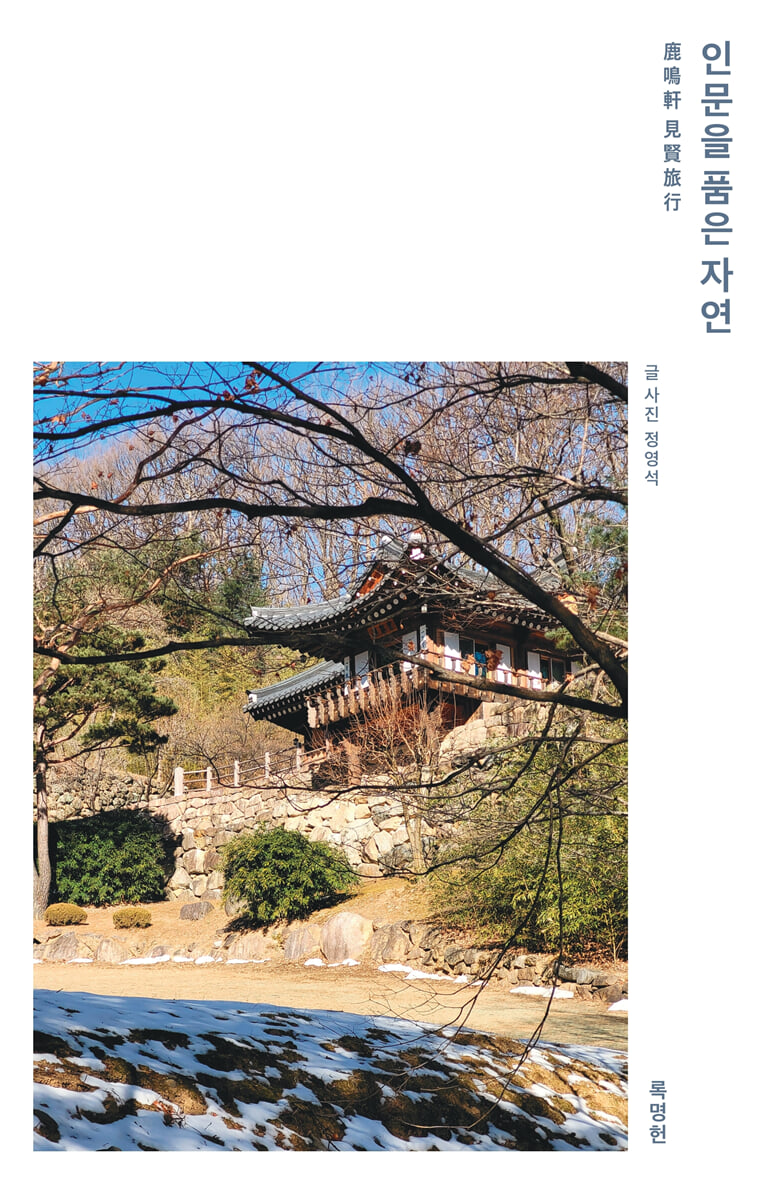
Nature embracing the humanities
 |
Description
Book Introduction
The beauty of nature is not beautiful on its own, but is revealed by people (美不自美因人而彰).
It is said that nature resonates only when it is imbued with the fragrance of humanity.
So Se-yang came to the pavilion Myeonangjeong (?仰亭) built by Song Soon and said, “Mountains and water are indifferent and will inevitably meet people and reveal themselves.
He asked, “If it weren’t for the brushes of Wang Xizhi and Su Dongpo, the Orchid Pavilion in Sanyin and the Red Cliffs in Huangzhou would have been nothing more than desolate and quiet watersides.”
When I visited Nanjing in Shaoxing, China, it was indeed like that.
The reason I travel to find a place to observe the sages and think about them is because I want to follow in the footsteps of the sages and make a new path known.
This is also the reason why Rokmyeongheon was built in the area where Busan Station and the cruise terminal are intertwined.
It is said that nature resonates only when it is imbued with the fragrance of humanity.
So Se-yang came to the pavilion Myeonangjeong (?仰亭) built by Song Soon and said, “Mountains and water are indifferent and will inevitably meet people and reveal themselves.
He asked, “If it weren’t for the brushes of Wang Xizhi and Su Dongpo, the Orchid Pavilion in Sanyin and the Red Cliffs in Huangzhou would have been nothing more than desolate and quiet watersides.”
When I visited Nanjing in Shaoxing, China, it was indeed like that.
The reason I travel to find a place to observe the sages and think about them is because I want to follow in the footsteps of the sages and make a new path known.
This is also the reason why Rokmyeongheon was built in the area where Busan Station and the cruise terminal are intertwined.
index
01 Baekse Cheongpung Ildu House 006
02 Yangdong Village and Donggang Seowon 016
03 Hoejae Dokrakdang and Oksan Seowon 026
04 Dosan Seodang Hakbong Jongtaek Imcheonggak 032
05 Danha Tongcheon-gil Bongpyeong Silla Stele Hongpae 040
06 Jikjisa Temple Sumisanbang Bangchojeong 046
07 Joseon Potters of Imari 052
08 Tsushima Island and Joseon Tongsinsa Mission 058
09 The final destination of the Joseon Tongsinsa was Tokyo's East Headquarters 068
10 The Birth of the Meiji Restoration, Hagi (萩) 076
11. Road to Songgwangsa Temple and Daewonsa Temple 082
12 Mihwangsa Temple and Daeheungsa Temple 090
13 Hwaeomsa Temple, Namwon Manboksa Temple, Jeopogi 098
14. Goryeo's temporary capital, Okju, Jindo 106
15 Danyang Silla Jeokseongbi and Ondalsanseong Fortress 114
16. Jehol Diary, Shenyang (盛京) 120
17. The Diary of the Journey to Rehe, Shanhaiguan (山海關) 124
18 Rehe Diary, Rehe Chengde (承德) 132
19 Muigugok and Muigyeongsa (武夷精舍) 134
20 Xiongnu Huns Mongols 144
21 Ulaanbaatar and the Lee Tae-jun Memorial Hall 148
22 Yeongdeok's Hidden Traditional Culture 156
23 Pohang Bunokjeong and Yonggyejeong 164
24 Seongbuk-dong Gilsangsa Simwoojang Suyeonsanbang 174
25 Park Tae-jun Memorial Hall and Bangudae Cheonjeon-ri Mural 180
26 Pieces of Architecture and Nature: Museum SAN 190
Beomeosa Temple's National Treasures and Treasures 202
02 Yangdong Village and Donggang Seowon 016
03 Hoejae Dokrakdang and Oksan Seowon 026
04 Dosan Seodang Hakbong Jongtaek Imcheonggak 032
05 Danha Tongcheon-gil Bongpyeong Silla Stele Hongpae 040
06 Jikjisa Temple Sumisanbang Bangchojeong 046
07 Joseon Potters of Imari 052
08 Tsushima Island and Joseon Tongsinsa Mission 058
09 The final destination of the Joseon Tongsinsa was Tokyo's East Headquarters 068
10 The Birth of the Meiji Restoration, Hagi (萩) 076
11. Road to Songgwangsa Temple and Daewonsa Temple 082
12 Mihwangsa Temple and Daeheungsa Temple 090
13 Hwaeomsa Temple, Namwon Manboksa Temple, Jeopogi 098
14. Goryeo's temporary capital, Okju, Jindo 106
15 Danyang Silla Jeokseongbi and Ondalsanseong Fortress 114
16. Jehol Diary, Shenyang (盛京) 120
17. The Diary of the Journey to Rehe, Shanhaiguan (山海關) 124
18 Rehe Diary, Rehe Chengde (承德) 132
19 Muigugok and Muigyeongsa (武夷精舍) 134
20 Xiongnu Huns Mongols 144
21 Ulaanbaatar and the Lee Tae-jun Memorial Hall 148
22 Yeongdeok's Hidden Traditional Culture 156
23 Pohang Bunokjeong and Yonggyejeong 164
24 Seongbuk-dong Gilsangsa Simwoojang Suyeonsanbang 174
25 Park Tae-jun Memorial Hall and Bangudae Cheonjeon-ri Mural 180
26 Pieces of Architecture and Nature: Museum SAN 190
Beomeosa Temple's National Treasures and Treasures 202
Publisher's Review
The travelogue of domestic and international historical sites, 『Nature Embracing Humanity』, makes us reflect on whether we have ever taken the time to visit historical sites and carefully observed with interest what kind of history is being passed down there.
The book provides detailed information on each historical site introduced in the book, including basic information on its historical value and historical significance, and the author's expert insight and level of expertise are evident in the descriptions of these historical sites and relics.
The book contains the friendly guidance and commentary of the on-site manager, so you can feel the vividness of the scene by reading it along with the photos.
“It’s nice that there aren’t many people coming today because the nearby restaurants are closed.
On days with few visitors like this, I wanted to open the warehouse door under the Sarangchae first.
I sneak in through the tightly closed door as if I were burglarizing it, and after taking the photo of the penis stone I wanted with luck, the manager approaches me.
When I tell him how I knew that, he asks how I knew, and gives me a detailed tour of the main house, the main hall, the storehouse, the shrine, the bedroom(?), the sarangchae, and the inner sarangchae.
“I enjoyed luxury.” - 01 Baekse Cheongpung Ildu Gotaek
In every ancient temple, there are stories handed down about great monks.
But even if you visit there, it is not easy to know that there is such a history.
Unless you try to find out or find out.
The story of Master Samyeong, which has been passed down at the thousand-year-old temple Jikjisa, is being introduced.
It is said that before Master Samyeong (1544.10.17~1610.8.26) became a monk, the sight of him sleeping on a rock in front of the Four Heavenly Kings Gate was seen by the head priest as a yellow dragon ascending to heaven, and he was taken as a disciple. During the Imjin War, he led the monk army, and when he went to the Edo shogunate as a member of the peace mission, he negotiated a deal that chilled the Tokugawa shogunate's liver and is still remembered for a long time.
When asked, “What mountain bird are you that you dare to come among a flock of phoenixes?” he is said to have replied, “I was once a crane playing in the green mountains, playing with the five-colored clouds, but I made a mistake and fell into the middle of a flock of chickens in the field.”
He left behind a poem titled “Gwigeuraesa” (歸去來辭), which reads, “I worked as an official for three days because I could not disobey the king’s orders, and I returned to the mountain in the middle of the night because I could not abandon my teacher’s teachings.”
- 06 Jikjisa Temple Sumisanbang Bangchojeong
Soon after, the author turns his steps to Japan, a country close yet far away, across the sea.
As I look around the massive Hizen Nagoya Castle (肥前名護屋城), which was built to invade Joseon and the Ming Dynasty, I am filled with mixed emotions.
The place where Toyotomi Hideyoshi built a castle with the same pronunciation as his hometown Nagoya and burned with ambition.
-Omitted- When Matsura Shigenobu, the lord of Hirado, who was at the forefront of the Imjin War, retreated, he brought along Korean potters, among whom were the potters of Jinhae Ungchon.
The white porcelain they made began to be exported in 1650 upon order from the Dutch East India Company, which led to the birth of Meissen porcelain in Germany.
It is unfortunate that at that time, only we and China had such self-production technology, but we did not pay attention to it.
-0 07 Joseon potters of Imari
And it introduces the history of Tsushima Island, which is about an hour and a half away from Busan by boat.
At Shuzenji Temple, which was founded by a nun who came over from Baekje, there is a monument to Choi Ik-hyeon, who died here, and a Suseon plaque with the seal of Kim Hak-jin, the Minister of War during the reign of King Heonjong.
The 1,500-year-old ginkgo tree, said to have been planted by a Baekje monk, has its center bent and hollowed out by lightning and a typhoon, but it still stands strong as a giant tree with a circumference of 12.5 meters and a height of 23 meters.
Princess Deokhye, the youngest daughter of Emperor Gojong, was taken to Japan, received a Japanese education, and was forced into a political marriage with So Takeyuki, the son of the lord of Tsushima Island, while having a lover whom Emperor Gojong had taken possession of.
Traces of her visit to Daema Island after her marriage remain in the form of a monument.
After her only daughter went missing, she suffered from aphasia and schizophrenia, which led to divorce. After 20 years of liberation, she finally returned to Korea in 1962 after many twists and turns.
The history of his past suffering remains as a sorrow for our people.
- 08 Tsushima Island and Joseon Tongsinsa Mission
In addition, we introduce the Tokyo East Headquarters, the final destination of the Joseon Tongsinsa's route to Japan, and you can learn about the relics of our Korean people that remain throughout Japan and their influence on Japan.
The Joseon Tongsinsa, dispatched 12 times over 200 years until 1811, were pioneers of Korea-Japan exchange who spread the Korean Wave in Japan, and this temple (Higashihoninji Temple in Tokyo) was their final destination.
It is said that the current head priest of Higashi Honganji Temple is Korean.
- 09 The final destination of the Joseon Tongsinsa was Tokyo's East Headquarters
The journey now turns towards Shenyang, China.
The author stated that he applied for the summer semester at Shenyang Normal University in 2019 because he wanted to discover traces of our painful history.
And we will guide you along the path of 『Yeolha Diary』 by Park Ji-won of Yeonam.
Taking advantage of the gap left by the Ming army as reinforcements for the Imjin War, Nurhazi, a Jurchen, established the Later Jin (Qing) and established its capital in Shenyang in 1625.
Nurhaci's eighth son, Hong Taiji, changed the name of the country to Qing and invaded Joseon, which was friendly with the Ming, taking 300,000 prisoners around the Nantap area of Shenyang - 16 Jehol Diary, Shenyang (盛京)
Departing from Shenyang, Yeonam passes through Sinmin and Beijin, then Jinju and reaches Shanhaiguan.
- 17 Jehol Diary, Shanhaiguan (山海關)
Shanhaiguan Pass is the eastern starting point of the Great Wall of China, and is also known as the place where Xu Fu set sail to find the elixir of life on the orders of Qin Shi Huang.
And then there are the sad legends handed down at the tomb of the maid of the Sadang clan and the unknown story of the meeting between Yeonam and the Tibetan monk Panseon at the Lama Mountain Lodge built by Emperor Qianlong.
The Mongolian travelogue in the latter half of the book catches the eye.
And I bow my head to the story of independence activist Lee Tae-jun, who is not widely known to us.
Since you've come all the way here, you should definitely visit the memorial hall of Mongolian independence activist Lee Tae-jun, who died while fighting for independence.
Lee Tae-jun, a native of Ham-an County, graduated from Severance Hospital and joined the Youth Student Association, a secret youth organization, at the recommendation of Ahn Chang-ho.
Afterwards, he went into exile in China, and after consulting with Kim Kyu-sik in Nanjing, he established the Dongui Guk in Mongolia (Golun) and supported the independence movement, but died at the age of 39.
In his travelogue of the Mongolian Desert, Mr. Yeo Un-hyeong wrote, “This tomb, the only one in this land, is a monument to the devotion and sacrifice of Joseon youth for the people of this land.”
- 21 Ulaanbaatar and Lee Tae-jun Memorial Hall
All the travel stories in the book contain the long history of our Korean people, a history of both glory and shame.
Although it does not contain all of our history, we can see that the criteria for determining travel destinations has always been to follow in the footsteps of our people.
The author is tracing back and confirming the traces of our ancestors that remain there one by one.
The author's impartial perspective and meticulous recording, which treat the truth of history as it is without regard for beauty or ugliness, leave a lasting impression.
In the preface, author Jeong Yong-seok states that this is a record of his travels to find a place to observe the virtues and reflect on them. ‘The Book of Observing the Virtue’ is about “Confucius said, ‘When you see the virtues of others, you should try to become like them, and when you see the wickedness of others, you should reflect on yourself.’
This is a passage from the Analects of Confucius, which says, “The Confucian scholar said, ‘Seeing the wise, he reflects on himself; seeing the unwise, he reflects on himself.”
In other words, it means the desire to emulate the good example of others.
The author's earnest desire to "follow the footsteps of our ancestors and create a new path to spread awareness" is fully expressed in his writing by writing about what he saw, heard, and felt while traveling to historical sites and heritage sites at home and abroad.
The author's eye for detail is also evident, as he is professional but not boring, interesting, and detailed without missing any hidden meaning.
The book provides detailed information on each historical site introduced in the book, including basic information on its historical value and historical significance, and the author's expert insight and level of expertise are evident in the descriptions of these historical sites and relics.
The book contains the friendly guidance and commentary of the on-site manager, so you can feel the vividness of the scene by reading it along with the photos.
“It’s nice that there aren’t many people coming today because the nearby restaurants are closed.
On days with few visitors like this, I wanted to open the warehouse door under the Sarangchae first.
I sneak in through the tightly closed door as if I were burglarizing it, and after taking the photo of the penis stone I wanted with luck, the manager approaches me.
When I tell him how I knew that, he asks how I knew, and gives me a detailed tour of the main house, the main hall, the storehouse, the shrine, the bedroom(?), the sarangchae, and the inner sarangchae.
“I enjoyed luxury.” - 01 Baekse Cheongpung Ildu Gotaek
In every ancient temple, there are stories handed down about great monks.
But even if you visit there, it is not easy to know that there is such a history.
Unless you try to find out or find out.
The story of Master Samyeong, which has been passed down at the thousand-year-old temple Jikjisa, is being introduced.
It is said that before Master Samyeong (1544.10.17~1610.8.26) became a monk, the sight of him sleeping on a rock in front of the Four Heavenly Kings Gate was seen by the head priest as a yellow dragon ascending to heaven, and he was taken as a disciple. During the Imjin War, he led the monk army, and when he went to the Edo shogunate as a member of the peace mission, he negotiated a deal that chilled the Tokugawa shogunate's liver and is still remembered for a long time.
When asked, “What mountain bird are you that you dare to come among a flock of phoenixes?” he is said to have replied, “I was once a crane playing in the green mountains, playing with the five-colored clouds, but I made a mistake and fell into the middle of a flock of chickens in the field.”
He left behind a poem titled “Gwigeuraesa” (歸去來辭), which reads, “I worked as an official for three days because I could not disobey the king’s orders, and I returned to the mountain in the middle of the night because I could not abandon my teacher’s teachings.”
- 06 Jikjisa Temple Sumisanbang Bangchojeong
Soon after, the author turns his steps to Japan, a country close yet far away, across the sea.
As I look around the massive Hizen Nagoya Castle (肥前名護屋城), which was built to invade Joseon and the Ming Dynasty, I am filled with mixed emotions.
The place where Toyotomi Hideyoshi built a castle with the same pronunciation as his hometown Nagoya and burned with ambition.
-Omitted- When Matsura Shigenobu, the lord of Hirado, who was at the forefront of the Imjin War, retreated, he brought along Korean potters, among whom were the potters of Jinhae Ungchon.
The white porcelain they made began to be exported in 1650 upon order from the Dutch East India Company, which led to the birth of Meissen porcelain in Germany.
It is unfortunate that at that time, only we and China had such self-production technology, but we did not pay attention to it.
-0 07 Joseon potters of Imari
And it introduces the history of Tsushima Island, which is about an hour and a half away from Busan by boat.
At Shuzenji Temple, which was founded by a nun who came over from Baekje, there is a monument to Choi Ik-hyeon, who died here, and a Suseon plaque with the seal of Kim Hak-jin, the Minister of War during the reign of King Heonjong.
The 1,500-year-old ginkgo tree, said to have been planted by a Baekje monk, has its center bent and hollowed out by lightning and a typhoon, but it still stands strong as a giant tree with a circumference of 12.5 meters and a height of 23 meters.
Princess Deokhye, the youngest daughter of Emperor Gojong, was taken to Japan, received a Japanese education, and was forced into a political marriage with So Takeyuki, the son of the lord of Tsushima Island, while having a lover whom Emperor Gojong had taken possession of.
Traces of her visit to Daema Island after her marriage remain in the form of a monument.
After her only daughter went missing, she suffered from aphasia and schizophrenia, which led to divorce. After 20 years of liberation, she finally returned to Korea in 1962 after many twists and turns.
The history of his past suffering remains as a sorrow for our people.
- 08 Tsushima Island and Joseon Tongsinsa Mission
In addition, we introduce the Tokyo East Headquarters, the final destination of the Joseon Tongsinsa's route to Japan, and you can learn about the relics of our Korean people that remain throughout Japan and their influence on Japan.
The Joseon Tongsinsa, dispatched 12 times over 200 years until 1811, were pioneers of Korea-Japan exchange who spread the Korean Wave in Japan, and this temple (Higashihoninji Temple in Tokyo) was their final destination.
It is said that the current head priest of Higashi Honganji Temple is Korean.
- 09 The final destination of the Joseon Tongsinsa was Tokyo's East Headquarters
The journey now turns towards Shenyang, China.
The author stated that he applied for the summer semester at Shenyang Normal University in 2019 because he wanted to discover traces of our painful history.
And we will guide you along the path of 『Yeolha Diary』 by Park Ji-won of Yeonam.
Taking advantage of the gap left by the Ming army as reinforcements for the Imjin War, Nurhazi, a Jurchen, established the Later Jin (Qing) and established its capital in Shenyang in 1625.
Nurhaci's eighth son, Hong Taiji, changed the name of the country to Qing and invaded Joseon, which was friendly with the Ming, taking 300,000 prisoners around the Nantap area of Shenyang - 16 Jehol Diary, Shenyang (盛京)
Departing from Shenyang, Yeonam passes through Sinmin and Beijin, then Jinju and reaches Shanhaiguan.
- 17 Jehol Diary, Shanhaiguan (山海關)
Shanhaiguan Pass is the eastern starting point of the Great Wall of China, and is also known as the place where Xu Fu set sail to find the elixir of life on the orders of Qin Shi Huang.
And then there are the sad legends handed down at the tomb of the maid of the Sadang clan and the unknown story of the meeting between Yeonam and the Tibetan monk Panseon at the Lama Mountain Lodge built by Emperor Qianlong.
The Mongolian travelogue in the latter half of the book catches the eye.
And I bow my head to the story of independence activist Lee Tae-jun, who is not widely known to us.
Since you've come all the way here, you should definitely visit the memorial hall of Mongolian independence activist Lee Tae-jun, who died while fighting for independence.
Lee Tae-jun, a native of Ham-an County, graduated from Severance Hospital and joined the Youth Student Association, a secret youth organization, at the recommendation of Ahn Chang-ho.
Afterwards, he went into exile in China, and after consulting with Kim Kyu-sik in Nanjing, he established the Dongui Guk in Mongolia (Golun) and supported the independence movement, but died at the age of 39.
In his travelogue of the Mongolian Desert, Mr. Yeo Un-hyeong wrote, “This tomb, the only one in this land, is a monument to the devotion and sacrifice of Joseon youth for the people of this land.”
- 21 Ulaanbaatar and Lee Tae-jun Memorial Hall
All the travel stories in the book contain the long history of our Korean people, a history of both glory and shame.
Although it does not contain all of our history, we can see that the criteria for determining travel destinations has always been to follow in the footsteps of our people.
The author is tracing back and confirming the traces of our ancestors that remain there one by one.
The author's impartial perspective and meticulous recording, which treat the truth of history as it is without regard for beauty or ugliness, leave a lasting impression.
In the preface, author Jeong Yong-seok states that this is a record of his travels to find a place to observe the virtues and reflect on them. ‘The Book of Observing the Virtue’ is about “Confucius said, ‘When you see the virtues of others, you should try to become like them, and when you see the wickedness of others, you should reflect on yourself.’
This is a passage from the Analects of Confucius, which says, “The Confucian scholar said, ‘Seeing the wise, he reflects on himself; seeing the unwise, he reflects on himself.”
In other words, it means the desire to emulate the good example of others.
The author's earnest desire to "follow the footsteps of our ancestors and create a new path to spread awareness" is fully expressed in his writing by writing about what he saw, heard, and felt while traveling to historical sites and heritage sites at home and abroad.
The author's eye for detail is also evident, as he is professional but not boring, interesting, and detailed without missing any hidden meaning.
GOODS SPECIFICS
- Date of issue: October 29, 2025
- Page count, weight, size: 208 pages | 522g | 161*240*15mm
- ISBN13: 9791193385272
- ISBN10: 119338527X
You may also like
카테고리
korean


korean

![GQ KOREA Mark (Monthly): December [2025]](http://librairie.coreenne.fr/cdn/shop/files/8ef265dbbfbf186523ed75ba7319009d.jpg?v=1765340328&width=3840)


