

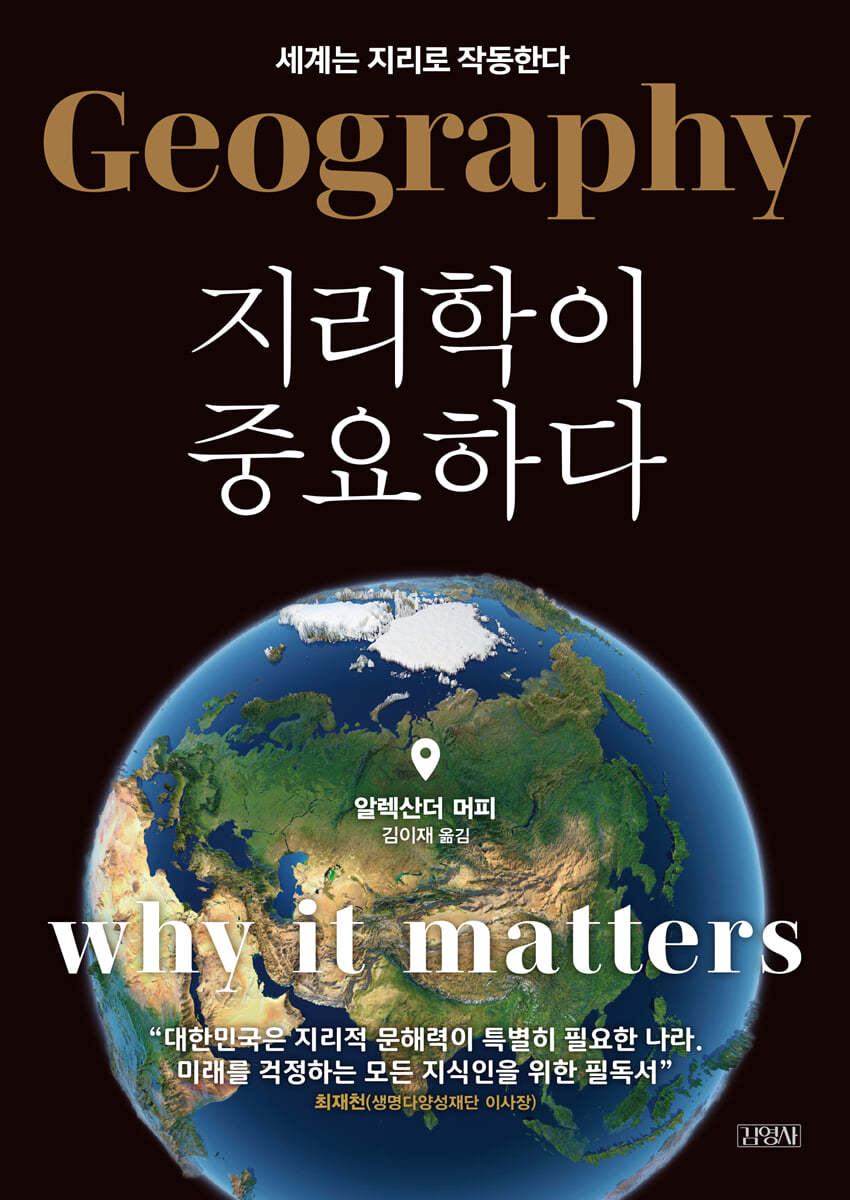
Geography is important
 |
Description
Book Introduction
How geography can help a world in crisis
Could this be a new answer?
“South Korea is a country that particularly needs geographical literacy.
A must-read for all intellectuals concerned about the future.
Choi Jae-cheon (Chairman of the Biodiversity Foundation)
Why did the US fail so massively in Afghanistan? How did Jeffrey Sachs's poverty-reduction project push people into crisis? Why does autonomous driving require geographic thinking? Geography illuminates how people, environments, and places are organized and interconnected, providing a foundation for understanding the world and a key to solving the complex problems we face today.
A book filled with geographical insights and solutions for navigating turbulent times, from climate change to pandemics, war, and economic inequality.
Could this be a new answer?
“South Korea is a country that particularly needs geographical literacy.
A must-read for all intellectuals concerned about the future.
Choi Jae-cheon (Chairman of the Biodiversity Foundation)
Why did the US fail so massively in Afghanistan? How did Jeffrey Sachs's poverty-reduction project push people into crisis? Why does autonomous driving require geographic thinking? Geography illuminates how people, environments, and places are organized and interconnected, providing a foundation for understanding the world and a key to solving the complex problems we face today.
A book filled with geographical insights and solutions for navigating turbulent times, from climate change to pandemics, war, and economic inequality.
- You can preview some of the book's contents.
Preview
index
Preface to the Korean edition
Chapter 1: The Nature and Various Perspectives of Geography
Chapter 2 What is space?
Chapter 3 What is a place?
Chapter 4 What are nature and society?
Chapter 5 Why do we need geography?
Going out
Further Reading
main
Image source
Search
Chapter 1: The Nature and Various Perspectives of Geography
Chapter 2 What is space?
Chapter 3 What is a place?
Chapter 4 What are nature and society?
Chapter 5 Why do we need geography?
Going out
Further Reading
main
Image source
Search
Into the book
“In the early 1850s, when no one could pinpoint the cause of a cholera outbreak in London, England, the physician John Snow began mapping the distribution of cholera deaths.
He discovered through mapping that most of the deaths were concentrated around a single well, and he presents this map as concrete evidence supporting the hypothesis that cholera was a waterborne disease.
“Analyzing the geographic distribution of a disease and its changes over time has become a fundamental tool in modern epidemiology.”
--- p.54
“There is a huge gap in the lives of people living in areas just across the border.
“The fate of a child born into a middle-class family in Paju, South Korea, is completely different from that of a child born in Kaesong, North Korea, just 25 kilometers away.”
--- p.70
“Only critical reflection on the region (meta-geographic reflection) can reveal our existing preconceptions and overcome stereotypes about specific regions.
The stereotypes that all of Mexico is dangerous, sub-Saharan Africa is disease-ridden, northern Canada is clean, and downtown Detroit is rife with violence are all just stereotypes.
In other words, critical geographical thinking about place is the best line of defense against the neglect or deliberate manipulation of how we represent other parts of the globe.”
--- p.122
“The reality is that more than a third of the parts in cars assembled in the United States come from Mexico, and cars assembled in Mexico contain many parts manufactured in the United States.
Therefore, if tariffs are imposed as President Trump proposes, it will inevitably have a very negative impact on both countries, both in terms of automobile production and job creation.”
--- p.139
“For centuries, world maps produced in North America and Europe adopted the Mercator projection.
This map, with the Atlantic Ocean in the center, was useful for navigation, but it had the problem of excessively distorting land areas (the polar regions were greatly enlarged and the equator was reduced).
“The spread of the Atlantic-centric world map, which makes Greenland appear larger than Africa and relegates East Asia to the periphery, has had the unintended effect of reinforcing Western-centrism.”
--- p.86
“A widely known failure is the Millennium Village Project, led by economist Jeffrey Sachs of Columbia University.
The project, which was implemented by pouring a lot of money and infrastructure into Detoo, Kenya, destroyed local traditions and disrupted local order.
“As many immigrants from nearby villages flocked to Detu at once, it lost its function as a transportation hub for nomads.”
--- p.149
“Knowing precise location information is just as important as knowing things like, ‘Indonesia has the world’s largest Muslim population,’ ‘The Amazon is home to the most biodiversity on Earth,’ ‘is the United States’ largest trading partner,’ ‘warmer oceans can make hurricanes more intense,’ ‘melting glaciers cause sea levels to rise, it’s winter in Europe when it’s summer in South Africa, and there are no mono-racial nations on Earth.’”
--- p.159
“The new geography education of the 21st century teaches us what it means to see the world through the eyes of someone who lives elsewhere.
“Thinking geographically can help us stop misunderstanding and blaming other places and people, which is an important first step toward avoiding conflict.”
He discovered through mapping that most of the deaths were concentrated around a single well, and he presents this map as concrete evidence supporting the hypothesis that cholera was a waterborne disease.
“Analyzing the geographic distribution of a disease and its changes over time has become a fundamental tool in modern epidemiology.”
--- p.54
“There is a huge gap in the lives of people living in areas just across the border.
“The fate of a child born into a middle-class family in Paju, South Korea, is completely different from that of a child born in Kaesong, North Korea, just 25 kilometers away.”
--- p.70
“Only critical reflection on the region (meta-geographic reflection) can reveal our existing preconceptions and overcome stereotypes about specific regions.
The stereotypes that all of Mexico is dangerous, sub-Saharan Africa is disease-ridden, northern Canada is clean, and downtown Detroit is rife with violence are all just stereotypes.
In other words, critical geographical thinking about place is the best line of defense against the neglect or deliberate manipulation of how we represent other parts of the globe.”
--- p.122
“The reality is that more than a third of the parts in cars assembled in the United States come from Mexico, and cars assembled in Mexico contain many parts manufactured in the United States.
Therefore, if tariffs are imposed as President Trump proposes, it will inevitably have a very negative impact on both countries, both in terms of automobile production and job creation.”
--- p.139
“For centuries, world maps produced in North America and Europe adopted the Mercator projection.
This map, with the Atlantic Ocean in the center, was useful for navigation, but it had the problem of excessively distorting land areas (the polar regions were greatly enlarged and the equator was reduced).
“The spread of the Atlantic-centric world map, which makes Greenland appear larger than Africa and relegates East Asia to the periphery, has had the unintended effect of reinforcing Western-centrism.”
--- p.86
“A widely known failure is the Millennium Village Project, led by economist Jeffrey Sachs of Columbia University.
The project, which was implemented by pouring a lot of money and infrastructure into Detoo, Kenya, destroyed local traditions and disrupted local order.
“As many immigrants from nearby villages flocked to Detu at once, it lost its function as a transportation hub for nomads.”
--- p.149
“Knowing precise location information is just as important as knowing things like, ‘Indonesia has the world’s largest Muslim population,’ ‘The Amazon is home to the most biodiversity on Earth,’ ‘is the United States’ largest trading partner,’ ‘warmer oceans can make hurricanes more intense,’ ‘melting glaciers cause sea levels to rise, it’s winter in Europe when it’s summer in South Africa, and there are no mono-racial nations on Earth.’”
--- p.159
“The new geography education of the 21st century teaches us what it means to see the world through the eyes of someone who lives elsewhere.
“Thinking geographically can help us stop misunderstanding and blaming other places and people, which is an important first step toward avoiding conflict.”
--- p.171
Publisher's Review
The fundamental force that moves the world,
Why is geography important!
The world is undergoing a period of upheaval, with the COVID-19 pandemic, heat waves, floods, and other extreme weather events, as well as increasing international conflicts and the Ukraine-Russia war.
The turbulent landscape of the world starkly illustrates how fragile the civilizations and societies we rely on are, and how closely interconnected we are.
Geography is at the heart of many of the crises we face, and the book Geography: Why It Matters, which proposes geographical thinking as a solution to overcome these crises, has been published.
Professor Alexander Murphy, a former president of the American Geographical Society and a leading authority in the field of geography who raised issues with the designation of the East Sea as the Sea of Japan, explains the definition and goals of geography as a discipline that studies the various characteristics of the Earth's surface, and emphasizes in this book that geography is a useful tool that integrates interdisciplinary achievements and provides practical solutions to real-world problems.
With the recent rise of geography, many books on the subject have been published, but most have focused on international issues from a geopolitical perspective. "Geography Matters" goes beyond geopolitics to introduce the essence of geography from a broader perspective. It explores what it means to view the world through a geographical lens, why it's important, and how geography can be applied. Its significance and value are evident.
How is geographical ignorance putting the planet in danger?
How can geography be the key to solving problems?
Professor Alexander Murphy uses vivid examples to illustrate how a lack of understanding and prejudice about geography has negatively impacted the world, and suggests how geography can provide an alternative.
-The places are connected
Why Donald Trump's Protectionist Tariffs Were Doomed to Fail
In the United States, geography departments disappeared from most prestigious universities in the late 1940s due to internal discord at Harvard University, and the neglect of geography in the United States prevented policymakers, including the president, from thinking geographically.
Former U.S. President Donald Trump argued for tariffs on Mexican cars in the name of protecting American jobs.
But already, more than a third of the auto parts assembled in the United States come from Mexico, and even Mexican cars contain American parts.
Trump's argument is superficial and politically motivated, completely lacking any understanding of the geographic interconnectedness of the United States and Mexico and the "international production network."
A pair of French button-up trousers travels a long journey from a Vietnamese garment factory to the suburbs of Washington, D.C.
These supply chains operate under various forms of foreign ownership and management, and various geographical factors influence the transport of goods, making them merely a part of a much more complex "international production network."
-The Curse of Geography
"A Wrong Choice Born from Ignorance and Prejudice About Geography"
The bigger problem is that even renowned intellectuals are not exempt from a lack of geographical knowledge and understanding.
Samuel Huntington's "clash of civilizations" theory, which lacks a geographical perspective, became the blueprint for America's policy toward Islam, and it became the fundamental cause of America's repeated failures in international affairs that it had devoted its heart and soul to, from the Vietnam War to the recent withdrawal from Iraq and Afghanistan.
Considering that the United States is the sole superpower with enormous influence on the world, its miscalculations and failures in international policy due to geographical ignorance are putting not only the United States but the entire world in danger.
One of the justifications for US intervention in Iraq was to prevent the establishment of a “radical Islamic empire stretching from Spain to Indonesia.”
This absurd American goal was based on the absurd assumption that a region so socially and culturally diverse would have enough commonalities to enable the emergence of a unified Islamic empire.
-The Earth is not flat
"The problem arises when we insist on the advanced countries' methods and overlook regional specificities."
The most obvious example of the consequences of overlooking geography is Jeffrey Sachs's 'Millennium Village Project'.
Designed to eradicate poverty in Kenya's Dettu region, the project, spearheaded by world-renowned economist Jeffrey Sachs, focused solely on injecting cash and infrastructure, ignoring geographic considerations.
Eventually, as nearby immigrants flocked in, the area lost its function as a transportation hub, and as the increased population disrupted order, people ended up living in worse conditions.
The result was the exact opposite of the original goal of eradicating poverty.
Efforts to pursue socioeconomic development and environmental sustainability in impoverished regions of the world often fail, often due to a simple-minded approach that ignores the unique circumstances of the region and assumes that all problems will be easily solved with good intentions._Main Text
-The Future of Geography
"Adapting to a Changing World with New Geospatial Technologies (GIS, GPS)"
As the world becomes increasingly connected and rapidly changing, geography is gaining more and more attention.
Geographic Information Systems (GIS), born from the remarkable advancements in geographic technology, provide previously unknown insights by visualizing geographic information.
From research into the pace of climate change to the spatial analysis needed for cutting-edge autonomous driving, GIS is becoming a vital tool for addressing pressing social and environmental challenges.
Using maps and cutting-edge GIS data, the author vividly illustrates the present and future of geography, a field that is experiencing a golden age of application across a wide range of industries, extending beyond the humanities.
Connected, automated, and shareable electric cars have the potential to fundamentally transform the spatial organization of cities, influencing patterns of wealth and poverty, the organization of economic activity, the demographic and ethnic composition of local populations, people's daily activity patterns, and even their sense of place.
Because these issues are all inherently geographic, the geographical perspectives and spatial analysis tools discussed in this book will help us understand and develop these diverse issues in a constructive way.
-Space is not a background, but a cause that creates events.
“The Geographical Background Behind Disease, Violence, and the Bombardment of War”
Recognizing the context and perspective behind a map is the essence of geographical literacy, or metageography.
Geographical thinking and insight help us to recognize our preconceived notions and dispel our stereotypes about other countries.
The author argues that all of Mexico is dangerous, sub-Saharan Africa is disease-ridden, northern Canada is pristine, and downtown Detroit is rife with violence—but when viewed through a geographical lens, these are all stereotypes.
Without critical thinking and geographical literacy, we are doomed to be geographically illiterate in a world where truth and lies are so intricately intertwined.
No matter how excellent a map is, it can only truly shine if it is preceded by geographical literacy—the ability to understand the hidden geographical context and correctly interpret the information.
No matter how excellent a map is, it is useless if there are no readers—that is, citizens with geographical literacy—who can understand and interpret the meaning and insights contained within it.
Geographic illiteracy leaves us with only a superficial understanding of the complex problems that arise in every part of the world, and prevents us from coming up with effective solutions.
_text
He who knows geography survives!
: An enchanting invitation to powerful and fascinating geography
Professor Murphy emphasizes that the most important power that geography gives us is geographical literacy.
Geography is not simply about memorizing regions, places, and specialties, but rather a process of developing the critical thinking and insight to solve complex problems.
In a global era of extreme uncertainty, geographic thinking is becoming an essential skill.
Overcoming geographical illiteracy is an urgent issue not only for elites such as government officials and policymakers, but also for ordinary citizens.
Citizens who do not understand the causes of the climate crisis and changes in the natural environment cannot properly refute fake news that claims that cold waves are evidence of global warming.
Overcoming geographical illiteracy determines the fate of a nation and, ultimately, becomes a matter of human survival.
Geography has now become an essential liberal arts discipline for properly understanding all phenomena occurring on Earth and elucidating complex realities.
In the turbulent 21st century, the geographical literacy taught in "Geography Matters" will be our greatest competitive edge for survival.
Why is geography important!
The world is undergoing a period of upheaval, with the COVID-19 pandemic, heat waves, floods, and other extreme weather events, as well as increasing international conflicts and the Ukraine-Russia war.
The turbulent landscape of the world starkly illustrates how fragile the civilizations and societies we rely on are, and how closely interconnected we are.
Geography is at the heart of many of the crises we face, and the book Geography: Why It Matters, which proposes geographical thinking as a solution to overcome these crises, has been published.
Professor Alexander Murphy, a former president of the American Geographical Society and a leading authority in the field of geography who raised issues with the designation of the East Sea as the Sea of Japan, explains the definition and goals of geography as a discipline that studies the various characteristics of the Earth's surface, and emphasizes in this book that geography is a useful tool that integrates interdisciplinary achievements and provides practical solutions to real-world problems.
With the recent rise of geography, many books on the subject have been published, but most have focused on international issues from a geopolitical perspective. "Geography Matters" goes beyond geopolitics to introduce the essence of geography from a broader perspective. It explores what it means to view the world through a geographical lens, why it's important, and how geography can be applied. Its significance and value are evident.
How is geographical ignorance putting the planet in danger?
How can geography be the key to solving problems?
Professor Alexander Murphy uses vivid examples to illustrate how a lack of understanding and prejudice about geography has negatively impacted the world, and suggests how geography can provide an alternative.
-The places are connected
Why Donald Trump's Protectionist Tariffs Were Doomed to Fail
In the United States, geography departments disappeared from most prestigious universities in the late 1940s due to internal discord at Harvard University, and the neglect of geography in the United States prevented policymakers, including the president, from thinking geographically.
Former U.S. President Donald Trump argued for tariffs on Mexican cars in the name of protecting American jobs.
But already, more than a third of the auto parts assembled in the United States come from Mexico, and even Mexican cars contain American parts.
Trump's argument is superficial and politically motivated, completely lacking any understanding of the geographic interconnectedness of the United States and Mexico and the "international production network."
A pair of French button-up trousers travels a long journey from a Vietnamese garment factory to the suburbs of Washington, D.C.
These supply chains operate under various forms of foreign ownership and management, and various geographical factors influence the transport of goods, making them merely a part of a much more complex "international production network."
-The Curse of Geography
"A Wrong Choice Born from Ignorance and Prejudice About Geography"
The bigger problem is that even renowned intellectuals are not exempt from a lack of geographical knowledge and understanding.
Samuel Huntington's "clash of civilizations" theory, which lacks a geographical perspective, became the blueprint for America's policy toward Islam, and it became the fundamental cause of America's repeated failures in international affairs that it had devoted its heart and soul to, from the Vietnam War to the recent withdrawal from Iraq and Afghanistan.
Considering that the United States is the sole superpower with enormous influence on the world, its miscalculations and failures in international policy due to geographical ignorance are putting not only the United States but the entire world in danger.
One of the justifications for US intervention in Iraq was to prevent the establishment of a “radical Islamic empire stretching from Spain to Indonesia.”
This absurd American goal was based on the absurd assumption that a region so socially and culturally diverse would have enough commonalities to enable the emergence of a unified Islamic empire.
-The Earth is not flat
"The problem arises when we insist on the advanced countries' methods and overlook regional specificities."
The most obvious example of the consequences of overlooking geography is Jeffrey Sachs's 'Millennium Village Project'.
Designed to eradicate poverty in Kenya's Dettu region, the project, spearheaded by world-renowned economist Jeffrey Sachs, focused solely on injecting cash and infrastructure, ignoring geographic considerations.
Eventually, as nearby immigrants flocked in, the area lost its function as a transportation hub, and as the increased population disrupted order, people ended up living in worse conditions.
The result was the exact opposite of the original goal of eradicating poverty.
Efforts to pursue socioeconomic development and environmental sustainability in impoverished regions of the world often fail, often due to a simple-minded approach that ignores the unique circumstances of the region and assumes that all problems will be easily solved with good intentions._Main Text
-The Future of Geography
"Adapting to a Changing World with New Geospatial Technologies (GIS, GPS)"
As the world becomes increasingly connected and rapidly changing, geography is gaining more and more attention.
Geographic Information Systems (GIS), born from the remarkable advancements in geographic technology, provide previously unknown insights by visualizing geographic information.
From research into the pace of climate change to the spatial analysis needed for cutting-edge autonomous driving, GIS is becoming a vital tool for addressing pressing social and environmental challenges.
Using maps and cutting-edge GIS data, the author vividly illustrates the present and future of geography, a field that is experiencing a golden age of application across a wide range of industries, extending beyond the humanities.
Connected, automated, and shareable electric cars have the potential to fundamentally transform the spatial organization of cities, influencing patterns of wealth and poverty, the organization of economic activity, the demographic and ethnic composition of local populations, people's daily activity patterns, and even their sense of place.
Because these issues are all inherently geographic, the geographical perspectives and spatial analysis tools discussed in this book will help us understand and develop these diverse issues in a constructive way.
-Space is not a background, but a cause that creates events.
“The Geographical Background Behind Disease, Violence, and the Bombardment of War”
Recognizing the context and perspective behind a map is the essence of geographical literacy, or metageography.
Geographical thinking and insight help us to recognize our preconceived notions and dispel our stereotypes about other countries.
The author argues that all of Mexico is dangerous, sub-Saharan Africa is disease-ridden, northern Canada is pristine, and downtown Detroit is rife with violence—but when viewed through a geographical lens, these are all stereotypes.
Without critical thinking and geographical literacy, we are doomed to be geographically illiterate in a world where truth and lies are so intricately intertwined.
No matter how excellent a map is, it can only truly shine if it is preceded by geographical literacy—the ability to understand the hidden geographical context and correctly interpret the information.
No matter how excellent a map is, it is useless if there are no readers—that is, citizens with geographical literacy—who can understand and interpret the meaning and insights contained within it.
Geographic illiteracy leaves us with only a superficial understanding of the complex problems that arise in every part of the world, and prevents us from coming up with effective solutions.
_text
He who knows geography survives!
: An enchanting invitation to powerful and fascinating geography
Professor Murphy emphasizes that the most important power that geography gives us is geographical literacy.
Geography is not simply about memorizing regions, places, and specialties, but rather a process of developing the critical thinking and insight to solve complex problems.
In a global era of extreme uncertainty, geographic thinking is becoming an essential skill.
Overcoming geographical illiteracy is an urgent issue not only for elites such as government officials and policymakers, but also for ordinary citizens.
Citizens who do not understand the causes of the climate crisis and changes in the natural environment cannot properly refute fake news that claims that cold waves are evidence of global warming.
Overcoming geographical illiteracy determines the fate of a nation and, ultimately, becomes a matter of human survival.
Geography has now become an essential liberal arts discipline for properly understanding all phenomena occurring on Earth and elucidating complex realities.
In the turbulent 21st century, the geographical literacy taught in "Geography Matters" will be our greatest competitive edge for survival.
GOODS SPECIFICS
- Publication date: October 7, 2022
- Format: Hardcover book binding method guide
- Page count, weight, size: 208 pages | 454g | 152*215*16mm
- ISBN13: 9788934940654
- ISBN10: 8934940654
You may also like
카테고리
korean


korean

![GQ KOREA Mark (Monthly): December [2025]](http://librairie.coreenne.fr/cdn/shop/files/8ef265dbbfbf186523ed75ba7319009d.jpg?v=1765340328&width=3840)


