

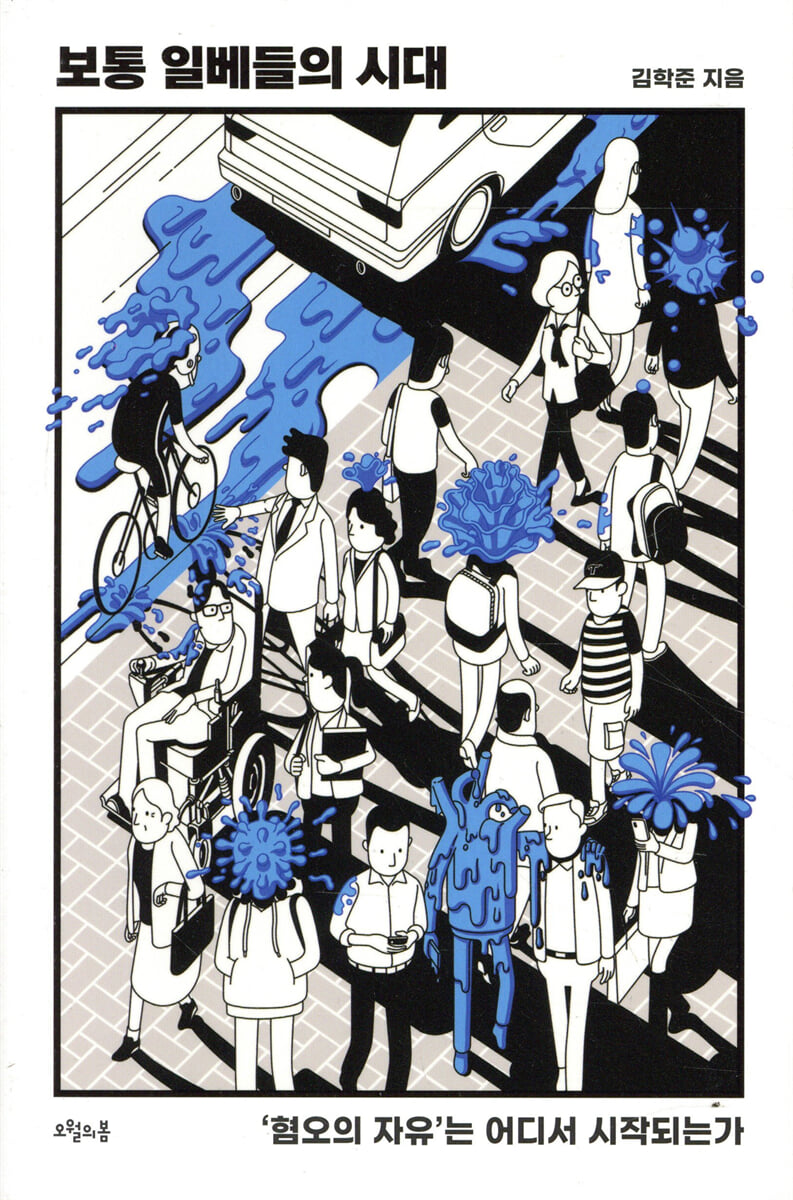
The era of Ilbe
 |
Description
Book Introduction
In the mid-2010s, Ilganbest Storage, which flooded the online world with hateful slurs in the name of "freedom of expression," brought about irreversible changes in the cyber public sphere.
The hateful messages that spread online disguised as humor with the word 'drip' have now reached the point where they are being spoken out by real politicians, more than 10 years after the creation of Ilbe. Along with the problematic calling out of 'Lee Dae-nam', voices of concern about the 'Ilbe-ization' of Korean society are also heard frequently.
Why, exactly, has its influence grown so much that the term "Ilbe-ization" has emerged? What exactly does the "shadow of Ilbe" permeate politics and society? What does the true face of Korean society revealed by Ilbe reveal? Is Ilbe truly an "old" story? The author, who garnered attention with a paper on Ilbe in 2014, when its social impact was at its peak, returns to discuss Ilbe eight years later, in this place where the politics of hate speech have risen.
The hateful messages that spread online disguised as humor with the word 'drip' have now reached the point where they are being spoken out by real politicians, more than 10 years after the creation of Ilbe. Along with the problematic calling out of 'Lee Dae-nam', voices of concern about the 'Ilbe-ization' of Korean society are also heard frequently.
Why, exactly, has its influence grown so much that the term "Ilbe-ization" has emerged? What exactly does the "shadow of Ilbe" permeate politics and society? What does the true face of Korean society revealed by Ilbe reveal? Is Ilbe truly an "old" story? The author, who garnered attention with a paper on Ilbe in 2014, when its social impact was at its peak, returns to discuss Ilbe eight years later, in this place where the politics of hate speech have risen.
- You can preview some of the book's contents.
Preview
index
Entering | Why Ilbe Again
Chapter 1: Ilbe's Genealogy: A Brief Cultural History of Cyberspace
1.
The Origins of Cyber Humor
2.
Was cyber public opinion progressive?
3.
The link between DC Inside and Ilbe
Chapter 2: Quantifying Hate: Analysis of Ilbe Data from 2011 to 2020
1.
Is Ilbe ruined?
2.
The hateful words that filled Ilbe
Chapter 3 Ilbe-like Hatred: The Others Within
1.
How Ilbe calls out typists
2.
Justification of hate
3.
Ilbe's enthusiasm and rituals
Chapter 4: Meeting Ilbe: Those Who Dream of "Ordinary Life"
1.
Anxiety and fear
2.
pent-up anger
3.
Shame, Conformity, and the Ordinary Narrative
Chapter 5: Misogyny and Meritocracy: Ilbe's Problem Isn't Unique
1.
Jang Dae-ho, the ideological type of Ilbe
2.
Is Ruliweb Ilbe's refuge?
Chapter 6: Conclusion: The Spread of Cold Enthusiasm and the Birth of Ilbe-style Politics
1.
broken promises
2.
Ilbe's mainstreaming
Going out | To fight against the age of hate
Acknowledgements
main
Chapter 1: Ilbe's Genealogy: A Brief Cultural History of Cyberspace
1.
The Origins of Cyber Humor
2.
Was cyber public opinion progressive?
3.
The link between DC Inside and Ilbe
Chapter 2: Quantifying Hate: Analysis of Ilbe Data from 2011 to 2020
1.
Is Ilbe ruined?
2.
The hateful words that filled Ilbe
Chapter 3 Ilbe-like Hatred: The Others Within
1.
How Ilbe calls out typists
2.
Justification of hate
3.
Ilbe's enthusiasm and rituals
Chapter 4: Meeting Ilbe: Those Who Dream of "Ordinary Life"
1.
Anxiety and fear
2.
pent-up anger
3.
Shame, Conformity, and the Ordinary Narrative
Chapter 5: Misogyny and Meritocracy: Ilbe's Problem Isn't Unique
1.
Jang Dae-ho, the ideological type of Ilbe
2.
Is Ruliweb Ilbe's refuge?
Chapter 6: Conclusion: The Spread of Cold Enthusiasm and the Birth of Ilbe-style Politics
1.
broken promises
2.
Ilbe's mainstreaming
Going out | To fight against the age of hate
Acknowledgements
main
Into the book
But Ilbe was different.
They freely used political parodies, including the Hankyoreh, and went around ‘certifying’ their youth, spreading the belief that they were truly awakened, first-class citizens.
From the surprise that people with conservative or far-right ideas actually exist, to the surprise that these conservatives are actually young, to the bewilderment that their actions are voluntary, to the shock that the blade of criticism and satire that was directed specifically at the progressive camp was pointed in the exact opposite direction, to the anger at the attack on democracy with democratic values like justice and fairness, Ilbe has become the epicenter of a great chaos in the Korean public sphere since its appearance.
--- p.8
From 2014, when the paper was published, to the 2020s, when this article is being written, Ilbe has experienced considerable ups and downs.
As we will discuss in depth in Chapter 2, which analyzes Ilbe data, Korean cyberspace has faced a huge rift with the rise of Megalia and TERF (Transgender Exclusionary Radical Feminism).
Communities such as Ilbe, Ruliweb, and Inven, which were once sworn enemies, formed a 'collaboration between the communist and the nationalist factions' under the banner of 'anti-feminism' and launched a fierce attack on the media, political parties, and businesses.
But as everyone knows, Ilbe's 'heyday' did not last long.
--- p.16
However, it is difficult to view this situation as the disappearance of Ilbe's influence.
No, Ilbe's influence has actually expanded.
… … Eventually, Lee Jun-seok, who had the ‘real record’ of being a 0-term veteran, became the leader of the conservative party and attempted political realignment through flashy gender divisions and hate speech, including the ‘abolition of the Ministry of Gender Equality and Family.’
If your dissertation still retains its vitality years after you wrote it, it is because of these points.
--- p.17~18
If this book has any value, it is as one of several fuses that help us understand the structure or origins of Ilbe-style hatred and dismantle the hateful incitement that currently seems so strong.
--- p.21
What is Ilbe?
As mentioned earlier, some saw it as the rise of Korean-style far-right ideology, others said it was a racist space like Japan's Zaitokukai (a group of citizens who do not allow special privileges for Koreans living in Japan) or the famous Japanese far-right online community Nichanneru (www.2ch.net), and still others said it was a space for homosocials based on misogyny.
However, before these points are established, what must be mentioned is the cultural and historical context of Ilbe's existence, that is, as a 'Korean online community'.
I will check this over and over again, but Ilbe is not a monster that suddenly appeared.
--- p.27
In a competitive system where the only criterion is the ability to make people laugh, ethical and moral standards are just cumbersome.
In a humor market where the goal is to capture the attention of more people and elicit more responses, any value other than 'fair competition' becomes ridiculous.
When the method of attracting more attention is called 'aggro', those who criticize it or lament the excessive competition for attention are called 'cheating scholars'.
--- p.69
Now, it is time to take a closer look at Ilbe's 'discourse structure'.
To this end, this chapter will conduct text analysis, a type of 'big data analysis'.
This analysis collected and used a total of 811,327 Ilbe posts from May 28, 2011, when the first Ilbe post was created, to December 31, 2020.
--- p.85~86
The second highest-rated topic was marriage.
This topic, which has a total of 8,239 posts, is not simply about expressing one's intentions, such as "I want to get married," or asking questions like "What should I do to get married?"
As you will see in the case study analysis of the three posts in the following chapters, quite a few users, especially married people, strongly discourage marriage to a 'kimchi girl' or even make comments like 'you have to beat her once every three days' even if you do get married.
Keywords like 'maid' are related to the self-mockery of Ilbe users who say that even if they get married, they will only become their wife's maid.
These claims foreshadow the "Pong Pong Man" or "Dishwashing Theory" that circulated online in the second half of 2021.
--- p.132
While they claim to be targeting the external enemy, North Korea, they actually express more cynicism and anger towards the internal enemy, the pro-North Korea faction.
Hatred toward the enemy within, combined with contempt for Honam, developed into May 18th revisionism.
They show a two-faced attitude, claiming that there was intervention by the North Korean military, or in other words, external forces, regarding the May 18th incident, while simultaneously dismissing it as a "riot" by "red herders" with a "rebellious spirit."
And above all, it pours out fierce criticism toward women as objects of familial inclusion.
In short, Ilbe-like hatred is directed at the internal others as entities that 'divide' Korean society.
They freely used political parodies, including the Hankyoreh, and went around ‘certifying’ their youth, spreading the belief that they were truly awakened, first-class citizens.
From the surprise that people with conservative or far-right ideas actually exist, to the surprise that these conservatives are actually young, to the bewilderment that their actions are voluntary, to the shock that the blade of criticism and satire that was directed specifically at the progressive camp was pointed in the exact opposite direction, to the anger at the attack on democracy with democratic values like justice and fairness, Ilbe has become the epicenter of a great chaos in the Korean public sphere since its appearance.
--- p.8
From 2014, when the paper was published, to the 2020s, when this article is being written, Ilbe has experienced considerable ups and downs.
As we will discuss in depth in Chapter 2, which analyzes Ilbe data, Korean cyberspace has faced a huge rift with the rise of Megalia and TERF (Transgender Exclusionary Radical Feminism).
Communities such as Ilbe, Ruliweb, and Inven, which were once sworn enemies, formed a 'collaboration between the communist and the nationalist factions' under the banner of 'anti-feminism' and launched a fierce attack on the media, political parties, and businesses.
But as everyone knows, Ilbe's 'heyday' did not last long.
--- p.16
However, it is difficult to view this situation as the disappearance of Ilbe's influence.
No, Ilbe's influence has actually expanded.
… … Eventually, Lee Jun-seok, who had the ‘real record’ of being a 0-term veteran, became the leader of the conservative party and attempted political realignment through flashy gender divisions and hate speech, including the ‘abolition of the Ministry of Gender Equality and Family.’
If your dissertation still retains its vitality years after you wrote it, it is because of these points.
--- p.17~18
If this book has any value, it is as one of several fuses that help us understand the structure or origins of Ilbe-style hatred and dismantle the hateful incitement that currently seems so strong.
--- p.21
What is Ilbe?
As mentioned earlier, some saw it as the rise of Korean-style far-right ideology, others said it was a racist space like Japan's Zaitokukai (a group of citizens who do not allow special privileges for Koreans living in Japan) or the famous Japanese far-right online community Nichanneru (www.2ch.net), and still others said it was a space for homosocials based on misogyny.
However, before these points are established, what must be mentioned is the cultural and historical context of Ilbe's existence, that is, as a 'Korean online community'.
I will check this over and over again, but Ilbe is not a monster that suddenly appeared.
--- p.27
In a competitive system where the only criterion is the ability to make people laugh, ethical and moral standards are just cumbersome.
In a humor market where the goal is to capture the attention of more people and elicit more responses, any value other than 'fair competition' becomes ridiculous.
When the method of attracting more attention is called 'aggro', those who criticize it or lament the excessive competition for attention are called 'cheating scholars'.
--- p.69
Now, it is time to take a closer look at Ilbe's 'discourse structure'.
To this end, this chapter will conduct text analysis, a type of 'big data analysis'.
This analysis collected and used a total of 811,327 Ilbe posts from May 28, 2011, when the first Ilbe post was created, to December 31, 2020.
--- p.85~86
The second highest-rated topic was marriage.
This topic, which has a total of 8,239 posts, is not simply about expressing one's intentions, such as "I want to get married," or asking questions like "What should I do to get married?"
As you will see in the case study analysis of the three posts in the following chapters, quite a few users, especially married people, strongly discourage marriage to a 'kimchi girl' or even make comments like 'you have to beat her once every three days' even if you do get married.
Keywords like 'maid' are related to the self-mockery of Ilbe users who say that even if they get married, they will only become their wife's maid.
These claims foreshadow the "Pong Pong Man" or "Dishwashing Theory" that circulated online in the second half of 2021.
--- p.132
While they claim to be targeting the external enemy, North Korea, they actually express more cynicism and anger towards the internal enemy, the pro-North Korea faction.
Hatred toward the enemy within, combined with contempt for Honam, developed into May 18th revisionism.
They show a two-faced attitude, claiming that there was intervention by the North Korean military, or in other words, external forces, regarding the May 18th incident, while simultaneously dismissing it as a "riot" by "red herders" with a "rebellious spirit."
And above all, it pours out fierce criticism toward women as objects of familial inclusion.
In short, Ilbe-like hatred is directed at the internal others as entities that 'divide' Korean society.
--- p.149
Publisher's Review
“I hope you don’t read this book as a story about a ‘small’ circle called Ilbe that has been ‘safely’ typed.
What we need to worry about is not problematizing the 'problematic group',
Because it is a transformation of the politics and social life that is unfolding now.
- Eom Ki-ho, cultural researcher (from the recommendation)
8 years after the thesis,
If Ilbe's influence had disappeared in the meantime
This book would not have been published
In 2014, a paper became a hot topic online.
It was “The Emotional Dynamics of Hatred and Enthusiasm in the Internet Community Ilbe Storage,” written by Kim Hak-jun for his master’s thesis in sociology.
The paper clearly presents how to understand Ilbe from a sociological perspective, encompassing quantitative methods that analyze all Ilbe posts and qualitative methods that involve in-depth interviews with 10 Ilbe users.
The paper, which maintains a balance of neither branding Ilbe as devils or monsters and otherizing it nor universalizing it by saying, “In fact, we are all Ilbe,” and draws the chilling conclusion that Ilbe is “the subject produced when the system operates most successfully,” is still an important reference for those who want to study or understand “problematic” online communities like Ilbe from a sociological perspective.
Eight years later, the author, who was building a career in data analysis, observed the development of big data analysis technology and the rapidly changing political and social landscape of Korean society, and decided to expand on the paper that dealt with Ilbe.
“In the process of the rise of feminism and backlash across cyberspace, criticisms are being raised against the so-called ‘men in their 20s’ as a new (or old) subject” and “social interest in young men who embody the discourse of ‘reverse discrimination’ is increasing,” and we are now faced with a reality where various aspects that we had anticipated since our 2014 research are actually appearing.
The logic of those who claim to protect the power of the winner-take-all and the 'freedom' of hatred or discrimination, and who bring up 'fairness' and 'justice' as the basis for this, is very similar to the logic of Ilbe, which was analyzed in the 2014 study.
It is difficult to find the 'gloriousness' of the past in Ilbe as a community itself, both quantitatively and qualitatively, but the problem is not whether Ilbe is 'prosperous' or not.
The author's concern is that "the content and expression of hatred that originated from DC Inside and was perfected by Ilbe, that is, hatred disguised as a joke," has spread widely, and that it has become "mixed with words like 'justice' and 'ability' to the point where it is difficult to distinguish between Ilbe and non-Ilbe."
"The Age of Ordinary Ilbe" is a detailed report by a sociologist who studied Ilbe during the period when Ilbe caused the greatest social shock with "deadbeats" and "binge eating rallies." He revisits Ilbe as the origin of those who talk about "freedom of hate" online today.
The extreme hate play that appeared on Ilbe
Is it really 'theirs'?
What exactly is Ilbe? What exactly is the phenomenon known as Ilbe? To answer, the author first traces the origins of cyber humor and Ilbe's lineage, tracing back to the Ttangji Ilbo and DC Inside.
When we understand that Ilbe is not a 'monster' that suddenly appeared from nowhere, or in other words, when we understand that the vicious game of hatred that unfolds on Ilbe is not 'theirs alone,' we will also be able to understand Ilbe as a social phenomenon.
To this end, the author discusses "laughter," the most powerful motivator for writing on online community bulletin boards and a form of capital in cyberspace. He explains the Ttangji Ilbo-style parody as the origin of Korean memes, and describes DC Inside as a place where it was further developed and developed.
Considering that the direct cause of Ilbe's birth was DC Inside's post deletion policy, a brief cultural history of cyberspace from the late 1990s to the 2010s, from Ddanzi to DC Inside to Ilbe, provides a starting point for understanding how Ilbe is a community that has 'developed' the 'tradition' of cyber culture in its own way.
Quantifying Hate: Analyzing Ilbe Data from 2011 to 2020
Now that we've looked at Ilbe's genealogy, it's time to take a closer look at what Ilbe is.
Who accesses Ilbe and when? What exactly are they passionate about? When is their enthusiasm at its peak? To find out, the author collected and analyzed a total of 811,327 posts from May 28, 2011, when the first post was posted, to December 31, 2020.
The discussion of data analysis thus conducted begins with basic explanations such as data preprocessing, and moves on to time series analysis and text analysis, quantifying disgust.
Time series analysis provides a clear picture of Ilbe's appearance by showing how many monthly Ilbe posts are created, what triggered Ilbe's rapid growth, why there were days with an explosive number of daily posts, and what the post creation patterns are on Ilbe.
Text analysis is the work of looking into it.
What proportion of all posts on Ilbe are filled with hate speech? Who are the specific targets of hate speech? How frequently and how much hate speech is posted? What are other users' reactions to it? What types of hate do they react most passionately to? By analyzing the "words" that have filled Ilbe over the past nine years, the author clearly identifies Ilbe's "enemies."
Ilbe-like hatred towards the typist within
The 'enemies' of Ilbe thus derived were Honam, women, and the progressive left.
Based on these analytical results, the author argues that “Ilbe-like hatred is directed at internal others as an entity that ‘divides’ Korean society.”
Therefore, we caution against placing Ilbe on the same level as internationally accepted far-right ideology, and emphasize the need to examine what kind of discussions actually take place on Ilbe.
The process of examining how Ilbe-like hatred is ignited, justified, and creates the uniquely Ilbe state of enthusiasm is described using 14 actual Ilbe posts as examples.
Based on the concepts of recognition and ignorance discussed by Axel Honneth, the analysis of posts directly demonstrates specific instances of Ilbe calling out others and justifying hatred, and unravels how this leads to Ilbe's unique enthusiasm and ritual.
Among these, cases 6-10, which discuss the anger involved in the process of Ilbe users justifying their hatred, show how hatred on Ilbe goes beyond 'play' and progresses to violent criticism, and thus leads to actual cyber violence such as 'exposing personal information'. This also reminds us of the social threat posed by the hate culture in cyberspace.
Those who dream of "ordinary" life, each for themselves, meet Ilbe.
Having identified Ilbe's "enemies" and deduced the logic of their hatred, the author now sets out to meet those who actually use such hateful expressions.
The ten Ilbe users the author met were men in their 20s and 30s with diverse backgrounds.
The author directly conveys the voices of Ilbe users and presents an interpretation based on the sociological theory of emotions.
Ilbe users the author met expressed two main concerns.
One is “anxiety due to the socio-economic crisis they face, or more precisely, anxiety about an uncertain future,” and the other is “anxiety stemming from the perceived collapse of the sphere of intimacy that could have resolved such economic crisis and isolation.”
However, the author analyzes that their anxiety was not externalized into anger that triggered resistance, but rather internalized, leading to the choice of a behavioral strategy called compliance.
The situation arises where negative emotions such as fear and anger caused by anxiety are not expressed socially but rather remain internalized, leading to “self-development (or self-hypnosis) in the name of active compliance and effort.”
But anger never goes away, and Ilbe is where the public anger that has been expelled gathers, and the anger of those who have chosen active compliance is distorted into hatred and directed at the others within.
This is how the hatred for the leftists/pro-North Korea people who constantly create ‘chaos’ in society, the hatred for the Honam region who dare to ‘riot’ instead of silently ‘complying’ with the ‘legitimate enforcement of law’ by the state, and the hatred for women who are ‘ignorant’ and ‘vanity’ and who brazenly ‘betray’ the promise of intimacy are completed.
So, what makes compliance possible? The author analyzes the "ordinary narrative" at work in the process of internalizing their anger.
Ilbe users constantly reduce their lives to the category of "ordinary," suppressing the specialness of their lives as much as possible and reconstructing them with the goal of becoming "prepared members of society."
By reconstructing the horrific past experiences one has gone through as experiences of 'overcoming' them, one restructures all suffering into the realm of the ordinary.
The problem is that the ordinary narrative doesn't just suppress its own suffering.
My suffering is ordinary, so how could it be any different if it were someone else's?
Now, suffering is something that ‘everyone’ experiences, and therefore there is no reason to talk about it or listen to it.
In the ordinary narrative, whatever pain it is, becomes a personal experience that can be simply absorbed inwardly and suppressed by oneself.
… … ‘Whining’ to be heard about one’s suffering is nothing more than admitting oneself to be weak, and this becomes a problem that falls on the individual who has failed in self-management.” (p. 258)
The common denominators of misogyny and meritocracy
Ilbe's problem isn't unique to it.
The author says that this ethics of each for himself meets another justification mechanism, meritocracy, along with the ordinary narrative, and leads to the contempt of losers and the deification of winners.
The mechanism that explains Ilbe's passionate hatred is none other than "the sense of contempt for the loser as a winner."
The author says that this explains “a lot of the intuition that makes us feel that certain words or actions are ‘Ilbe-like,’” but then suddenly asks:
But is this really Ilbe's unique mentality?
The author analyzes the two ideologies, hoping that if we can determine where the typicalities of Ilbe and non-Ilbe diverge and combine, we can also find clues to destroying hatred and hate speech.
As an ideological type of Ilbe, the analysis attempted to focus on Jang Dae-ho, the culprit of the 2019 Han River body incident, and as an ideological type of what is not Ilbe, the analysis attempted to focus on the online community Ruliweb, which is considered Ilbe's 'arch-rival'.
However, the author's prediction that it would be possible to derive an ideal type of something other than Ilbe was misplaced.
Just as we analyzed Ilbe, we meticulously examined Ruliweb through data analysis and post analysis, and found that Ruliweb, which pursued its own kind of 'political correctness' and called itself a politically 'progressive community', and therefore took the lead in fiercely denouncing and criticizing Ilbe's 'immorality' more than any other community, was also very similar to Ilbe in terms of misogyny and meritocracy.
To fight against the age of hate
The goal of this book is clear.
By understanding the structure and origins of Ilbe-style hatred, we can find ways to counter the current seemingly strong hate incitement.
The author says that in a society where people with Ilbe-like perceptions gather, “it is almost impossible to find anything public, political, or social,” and that in such a society, “there are only individuals, and in a very small society, individuals who are rational without context.”
The author, who interprets the hatred on Ilbe as an extreme cynicism toward society, defines their enthusiasm as a "cold enthusiasm" that does not create solidarity.
Cold enthusiasm is “a cold enthusiasm not only toward the ‘victims’ but also toward ‘us’, who are our colleagues and ‘perpetrators’, and it is a enthusiasm that is possible because the space called Ilbe itself is public, but its members remain in a private space, that is, in front of their computers and smartphones.”
Some attribute the hatred displayed by Ilbe with such enthusiasm to their inability to empathize, but in the author's view, there is no problem with Ilbe's ability to empathize itself.
The problem is that their sympathy always goes towards the ‘winner.’
The anger that was not expressed in the public sphere but was kept inside was violently expressed in cyberspace, which has become the backwater of society.
The core of Ilbe's mentality is to internalize the ordinary narrative and emphasize realistic conformity while recognizing that one can do nothing about it.
Therefore, Ilbe's hatred is directed at all subjects who reject the 'duty' of conformity and their resistance.
Ilbe's hatred towards women, Honam, and the left is, in fact, a fierce anger against 'non-conformity.'
Eight years after the paper, today's politics, which has gone so far as to seek to rally supporters through hate speech, has gone so far as to convince people that Ilbe-style hatred is "justified" and to accumulate experiences of "victory" based on it.
The era of Ilbe is usually an era of politics like that.
The value of this book lies in its role as a catalyst for dismantling this seemingly indomitable hate movement.
It is time to face the true face of Korean society, once again, as revealed by Ilbe over a decade ago.
What we need to worry about is not problematizing the 'problematic group',
Because it is a transformation of the politics and social life that is unfolding now.
- Eom Ki-ho, cultural researcher (from the recommendation)
8 years after the thesis,
If Ilbe's influence had disappeared in the meantime
This book would not have been published
In 2014, a paper became a hot topic online.
It was “The Emotional Dynamics of Hatred and Enthusiasm in the Internet Community Ilbe Storage,” written by Kim Hak-jun for his master’s thesis in sociology.
The paper clearly presents how to understand Ilbe from a sociological perspective, encompassing quantitative methods that analyze all Ilbe posts and qualitative methods that involve in-depth interviews with 10 Ilbe users.
The paper, which maintains a balance of neither branding Ilbe as devils or monsters and otherizing it nor universalizing it by saying, “In fact, we are all Ilbe,” and draws the chilling conclusion that Ilbe is “the subject produced when the system operates most successfully,” is still an important reference for those who want to study or understand “problematic” online communities like Ilbe from a sociological perspective.
Eight years later, the author, who was building a career in data analysis, observed the development of big data analysis technology and the rapidly changing political and social landscape of Korean society, and decided to expand on the paper that dealt with Ilbe.
“In the process of the rise of feminism and backlash across cyberspace, criticisms are being raised against the so-called ‘men in their 20s’ as a new (or old) subject” and “social interest in young men who embody the discourse of ‘reverse discrimination’ is increasing,” and we are now faced with a reality where various aspects that we had anticipated since our 2014 research are actually appearing.
The logic of those who claim to protect the power of the winner-take-all and the 'freedom' of hatred or discrimination, and who bring up 'fairness' and 'justice' as the basis for this, is very similar to the logic of Ilbe, which was analyzed in the 2014 study.
It is difficult to find the 'gloriousness' of the past in Ilbe as a community itself, both quantitatively and qualitatively, but the problem is not whether Ilbe is 'prosperous' or not.
The author's concern is that "the content and expression of hatred that originated from DC Inside and was perfected by Ilbe, that is, hatred disguised as a joke," has spread widely, and that it has become "mixed with words like 'justice' and 'ability' to the point where it is difficult to distinguish between Ilbe and non-Ilbe."
"The Age of Ordinary Ilbe" is a detailed report by a sociologist who studied Ilbe during the period when Ilbe caused the greatest social shock with "deadbeats" and "binge eating rallies." He revisits Ilbe as the origin of those who talk about "freedom of hate" online today.
The extreme hate play that appeared on Ilbe
Is it really 'theirs'?
What exactly is Ilbe? What exactly is the phenomenon known as Ilbe? To answer, the author first traces the origins of cyber humor and Ilbe's lineage, tracing back to the Ttangji Ilbo and DC Inside.
When we understand that Ilbe is not a 'monster' that suddenly appeared from nowhere, or in other words, when we understand that the vicious game of hatred that unfolds on Ilbe is not 'theirs alone,' we will also be able to understand Ilbe as a social phenomenon.
To this end, the author discusses "laughter," the most powerful motivator for writing on online community bulletin boards and a form of capital in cyberspace. He explains the Ttangji Ilbo-style parody as the origin of Korean memes, and describes DC Inside as a place where it was further developed and developed.
Considering that the direct cause of Ilbe's birth was DC Inside's post deletion policy, a brief cultural history of cyberspace from the late 1990s to the 2010s, from Ddanzi to DC Inside to Ilbe, provides a starting point for understanding how Ilbe is a community that has 'developed' the 'tradition' of cyber culture in its own way.
Quantifying Hate: Analyzing Ilbe Data from 2011 to 2020
Now that we've looked at Ilbe's genealogy, it's time to take a closer look at what Ilbe is.
Who accesses Ilbe and when? What exactly are they passionate about? When is their enthusiasm at its peak? To find out, the author collected and analyzed a total of 811,327 posts from May 28, 2011, when the first post was posted, to December 31, 2020.
The discussion of data analysis thus conducted begins with basic explanations such as data preprocessing, and moves on to time series analysis and text analysis, quantifying disgust.
Time series analysis provides a clear picture of Ilbe's appearance by showing how many monthly Ilbe posts are created, what triggered Ilbe's rapid growth, why there were days with an explosive number of daily posts, and what the post creation patterns are on Ilbe.
Text analysis is the work of looking into it.
What proportion of all posts on Ilbe are filled with hate speech? Who are the specific targets of hate speech? How frequently and how much hate speech is posted? What are other users' reactions to it? What types of hate do they react most passionately to? By analyzing the "words" that have filled Ilbe over the past nine years, the author clearly identifies Ilbe's "enemies."
Ilbe-like hatred towards the typist within
The 'enemies' of Ilbe thus derived were Honam, women, and the progressive left.
Based on these analytical results, the author argues that “Ilbe-like hatred is directed at internal others as an entity that ‘divides’ Korean society.”
Therefore, we caution against placing Ilbe on the same level as internationally accepted far-right ideology, and emphasize the need to examine what kind of discussions actually take place on Ilbe.
The process of examining how Ilbe-like hatred is ignited, justified, and creates the uniquely Ilbe state of enthusiasm is described using 14 actual Ilbe posts as examples.
Based on the concepts of recognition and ignorance discussed by Axel Honneth, the analysis of posts directly demonstrates specific instances of Ilbe calling out others and justifying hatred, and unravels how this leads to Ilbe's unique enthusiasm and ritual.
Among these, cases 6-10, which discuss the anger involved in the process of Ilbe users justifying their hatred, show how hatred on Ilbe goes beyond 'play' and progresses to violent criticism, and thus leads to actual cyber violence such as 'exposing personal information'. This also reminds us of the social threat posed by the hate culture in cyberspace.
Those who dream of "ordinary" life, each for themselves, meet Ilbe.
Having identified Ilbe's "enemies" and deduced the logic of their hatred, the author now sets out to meet those who actually use such hateful expressions.
The ten Ilbe users the author met were men in their 20s and 30s with diverse backgrounds.
The author directly conveys the voices of Ilbe users and presents an interpretation based on the sociological theory of emotions.
Ilbe users the author met expressed two main concerns.
One is “anxiety due to the socio-economic crisis they face, or more precisely, anxiety about an uncertain future,” and the other is “anxiety stemming from the perceived collapse of the sphere of intimacy that could have resolved such economic crisis and isolation.”
However, the author analyzes that their anxiety was not externalized into anger that triggered resistance, but rather internalized, leading to the choice of a behavioral strategy called compliance.
The situation arises where negative emotions such as fear and anger caused by anxiety are not expressed socially but rather remain internalized, leading to “self-development (or self-hypnosis) in the name of active compliance and effort.”
But anger never goes away, and Ilbe is where the public anger that has been expelled gathers, and the anger of those who have chosen active compliance is distorted into hatred and directed at the others within.
This is how the hatred for the leftists/pro-North Korea people who constantly create ‘chaos’ in society, the hatred for the Honam region who dare to ‘riot’ instead of silently ‘complying’ with the ‘legitimate enforcement of law’ by the state, and the hatred for women who are ‘ignorant’ and ‘vanity’ and who brazenly ‘betray’ the promise of intimacy are completed.
So, what makes compliance possible? The author analyzes the "ordinary narrative" at work in the process of internalizing their anger.
Ilbe users constantly reduce their lives to the category of "ordinary," suppressing the specialness of their lives as much as possible and reconstructing them with the goal of becoming "prepared members of society."
By reconstructing the horrific past experiences one has gone through as experiences of 'overcoming' them, one restructures all suffering into the realm of the ordinary.
The problem is that the ordinary narrative doesn't just suppress its own suffering.
My suffering is ordinary, so how could it be any different if it were someone else's?
Now, suffering is something that ‘everyone’ experiences, and therefore there is no reason to talk about it or listen to it.
In the ordinary narrative, whatever pain it is, becomes a personal experience that can be simply absorbed inwardly and suppressed by oneself.
… … ‘Whining’ to be heard about one’s suffering is nothing more than admitting oneself to be weak, and this becomes a problem that falls on the individual who has failed in self-management.” (p. 258)
The common denominators of misogyny and meritocracy
Ilbe's problem isn't unique to it.
The author says that this ethics of each for himself meets another justification mechanism, meritocracy, along with the ordinary narrative, and leads to the contempt of losers and the deification of winners.
The mechanism that explains Ilbe's passionate hatred is none other than "the sense of contempt for the loser as a winner."
The author says that this explains “a lot of the intuition that makes us feel that certain words or actions are ‘Ilbe-like,’” but then suddenly asks:
But is this really Ilbe's unique mentality?
The author analyzes the two ideologies, hoping that if we can determine where the typicalities of Ilbe and non-Ilbe diverge and combine, we can also find clues to destroying hatred and hate speech.
As an ideological type of Ilbe, the analysis attempted to focus on Jang Dae-ho, the culprit of the 2019 Han River body incident, and as an ideological type of what is not Ilbe, the analysis attempted to focus on the online community Ruliweb, which is considered Ilbe's 'arch-rival'.
However, the author's prediction that it would be possible to derive an ideal type of something other than Ilbe was misplaced.
Just as we analyzed Ilbe, we meticulously examined Ruliweb through data analysis and post analysis, and found that Ruliweb, which pursued its own kind of 'political correctness' and called itself a politically 'progressive community', and therefore took the lead in fiercely denouncing and criticizing Ilbe's 'immorality' more than any other community, was also very similar to Ilbe in terms of misogyny and meritocracy.
To fight against the age of hate
The goal of this book is clear.
By understanding the structure and origins of Ilbe-style hatred, we can find ways to counter the current seemingly strong hate incitement.
The author says that in a society where people with Ilbe-like perceptions gather, “it is almost impossible to find anything public, political, or social,” and that in such a society, “there are only individuals, and in a very small society, individuals who are rational without context.”
The author, who interprets the hatred on Ilbe as an extreme cynicism toward society, defines their enthusiasm as a "cold enthusiasm" that does not create solidarity.
Cold enthusiasm is “a cold enthusiasm not only toward the ‘victims’ but also toward ‘us’, who are our colleagues and ‘perpetrators’, and it is a enthusiasm that is possible because the space called Ilbe itself is public, but its members remain in a private space, that is, in front of their computers and smartphones.”
Some attribute the hatred displayed by Ilbe with such enthusiasm to their inability to empathize, but in the author's view, there is no problem with Ilbe's ability to empathize itself.
The problem is that their sympathy always goes towards the ‘winner.’
The anger that was not expressed in the public sphere but was kept inside was violently expressed in cyberspace, which has become the backwater of society.
The core of Ilbe's mentality is to internalize the ordinary narrative and emphasize realistic conformity while recognizing that one can do nothing about it.
Therefore, Ilbe's hatred is directed at all subjects who reject the 'duty' of conformity and their resistance.
Ilbe's hatred towards women, Honam, and the left is, in fact, a fierce anger against 'non-conformity.'
Eight years after the paper, today's politics, which has gone so far as to seek to rally supporters through hate speech, has gone so far as to convince people that Ilbe-style hatred is "justified" and to accumulate experiences of "victory" based on it.
The era of Ilbe is usually an era of politics like that.
The value of this book lies in its role as a catalyst for dismantling this seemingly indomitable hate movement.
It is time to face the true face of Korean society, once again, as revealed by Ilbe over a decade ago.
GOODS SPECIFICS
- Publication date: June 13, 2022
- Page count, weight, size: 384 pages | 486g | 140*210*30mm
- ISBN13: 9791168730250
- ISBN10: 1168730252
You may also like
카테고리
korean


korean

![GQ KOREA Mark (Monthly): December [2025]](http://librairie.coreenne.fr/cdn/shop/files/8ef265dbbfbf186523ed75ba7319009d.jpg?v=1765340328&width=3840)


