

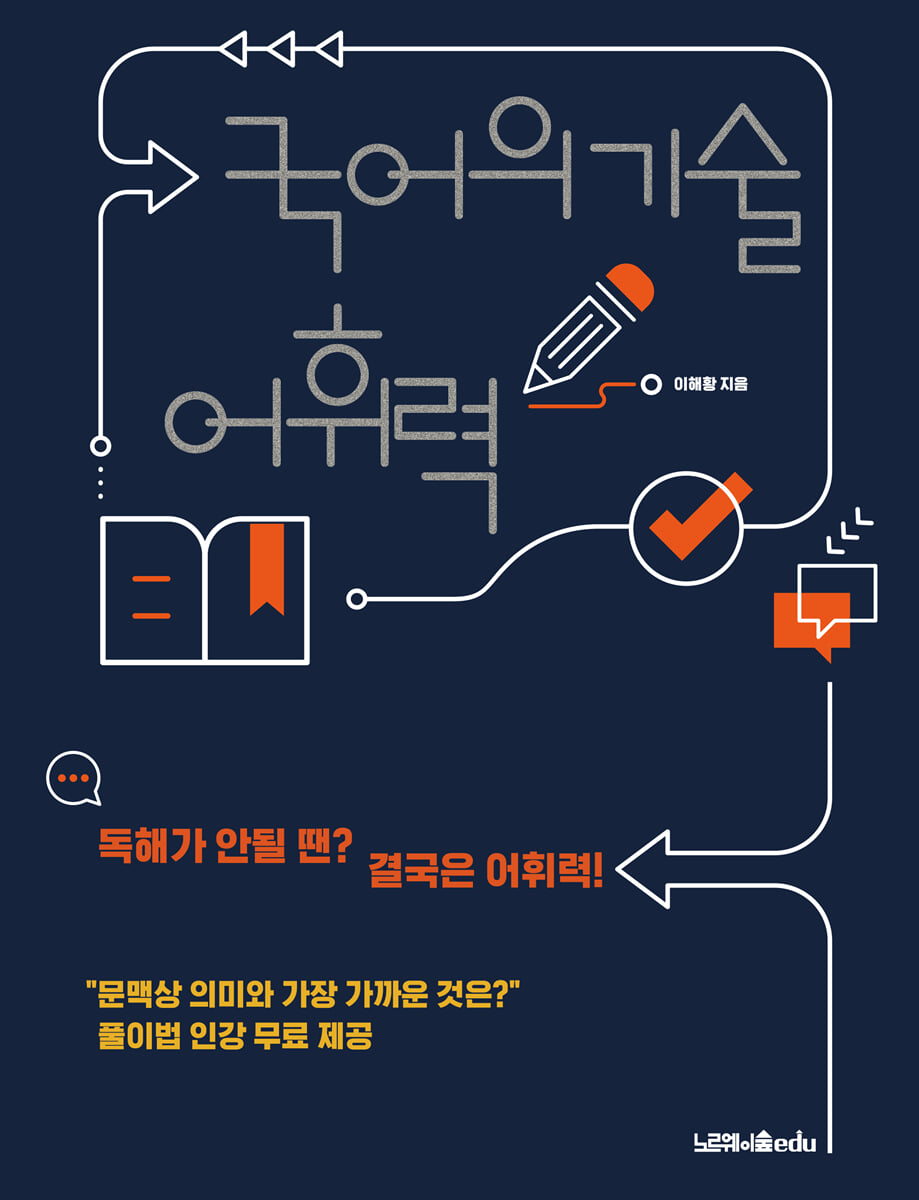
Technical vocabulary of the Korean language
 |
Description
Book Introduction
Author Lee Hae-Hwang of the [Korean Language Technology] series, which has sold over 1.8 million copies In-depth vocabulary guide, 『Vocabulary is Ultimate』, a completely revised edition of 『Korean Language Skills - Vocabulary』, published! Carefully select vocabulary important for non-literature reading and explain it sufficiently to ensure understanding. 『Korean Language Skills - Vocabulary』, a completely revised version of 『Korean Language Skills - Vocabulary in the End』, has been published. This book's unique structure is to provide direct help to test takers by systematically organizing the vocabulary that must be known by analyzing various past exam questions such as the CSAT and LEET into categories such as 'homonyms and polysemy', 'opposites that must be known in pairs', 'words that must be clearly distinguished', 'words that were crucial in solving problems', and 'homonyms that were/will be tested as problems'. In cases where the dictionary definition does not sufficiently explain the concept, [special lectures] are provided to help readers understand the comprehensive picture of the word. Also, the book was written to help students become familiar with the major concepts that are frequently tested or expected to be tested on exams, ranging from linguistics to philosophy, physics, biology, etc., using visual materials such as various pictures and diagrams to sufficiently explain them. Above all, the great appeal of this book is that it is written in a story-like manner so that even difficult concepts can be easily understood. |
- You can preview some of the book's contents.
Preview
index
Problems with existing vocabulary textbooks
Special features of this book
Test my vocabulary
1.
Vocabulary for accurate reading
001-010.
Homonyms and Polysemy: Determining Reading Accuracy - Part 1
001 Reduction
002 Investigation
003 prototype
004 Glass
005 Calling
006 comparison
007 Paradox
008 Electrical
009 threshold
010 bored
Note Test 01
011-020.
A word that was crucial in solving the problem
011 Be willing
012 Weddings, funerals, and ceremonies
013 January
014 Adsorption│Desorption
015 Songchuk
016 Weights and Measures
017 mold
018 You
019 Landlord│Tenant
020 Blood│'Hit It'
Note Test 02
021-030.
Homonyms and polysemy: Determining Reading Accuracy - 2
021 Politics
022 Ubiquity
023 Normal condition
024 thousand people
025 vanguard
026 Sublimation
027 Deficit
028 Bonds
029 Illustration
030 Condensed milk
Note Test 03
031-040.
Homonyms that were/will be presented as problems
031 transmission
032 symbol
033 code
Decision 034
035 Theory
036 Surface area
037 Premise
Exam 038
Target 039
040 composition
Note Test 04
041-050.
Opposite words that must be known in pairs
041 Dependent, subordinate vs. autonomous, subjective, independent, and self-reliant
042 Diachronic vs. Synchronic
043 Inevitable vs. Probable
044 Analog vs. Digital
045 Quantitative vs. Qualitative
046 Bottom-up vs. Top-down
047 Low-ranking official vs. high-ranking official
048 Complementary vs. Exclusive
049 Veins vs. Arteries
050 Discount Rate vs. Interest Rate
Note Test 05
051-060.
Words that must be clearly distinguished
051 Necessary vs. Sufficient Conditions
052 Defendant vs. Defendant
053 Example vs. Allegory
054 Collage vs. Montage
055 Rethink vs. Improve
056 Evidence vs. Refutation
057 Existence vs. Reality
058 Growth rate vs. (increase) rate
059 Humor vs. Satire
060 Symbol vs. Symbolic Word
Note Test 06
2.
Frequently appearing concepts on tests
061-101.
From linguistics to biology
061 segment
062 phonemes
063 Discriminatory
064 Simsang
065 Conflict
066 Staccato
067 Motive
068 beats
069 Whole tone = Semitone + Semitone
070 Light and shade
071 Perspective
072 Functionalism
073 Mental and physical problems
074 Utility
075 Limit
076 Collusion, Cartels
077 Externalities, External Effects
078 Investigation
079 A priori vs. empirical (a posteriori)
080 variable
Wave 081
082 Atoms vs. Elements
083 Longitude vs. Latitude
084 Epidermis vs. Dermis
085 mass
086 General Relativity
087 Paradigm
088 weight
089 Options, Futures
090 Catalyst
091 Logical Possibility
092 Valid reasoning, sound reasoning
093 Deduction, Induction
094 Contradiction
095 Law of Absurdity
096 Dilemma
097 Naturalism
098 Extension, Connotation
099 Art
100 photosensitivity
101 Antigen│Antibody
Note Test 07
※ Special Appendix - Table of Contents of 『Inquiry』
Lesson 1: Contextual meaning: Can 'worshipped' be replaced with 'believed in'?
Memorize 10 essential, frequently appearing words from Lesson 2
3rd lecture, inquiry, 67 questions on the solution method
4. Distinction and Distinction
Note test
Special features of this book
Test my vocabulary
1.
Vocabulary for accurate reading
001-010.
Homonyms and Polysemy: Determining Reading Accuracy - Part 1
001 Reduction
002 Investigation
003 prototype
004 Glass
005 Calling
006 comparison
007 Paradox
008 Electrical
009 threshold
010 bored
Note Test 01
011-020.
A word that was crucial in solving the problem
011 Be willing
012 Weddings, funerals, and ceremonies
013 January
014 Adsorption│Desorption
015 Songchuk
016 Weights and Measures
017 mold
018 You
019 Landlord│Tenant
020 Blood│'Hit It'
Note Test 02
021-030.
Homonyms and polysemy: Determining Reading Accuracy - 2
021 Politics
022 Ubiquity
023 Normal condition
024 thousand people
025 vanguard
026 Sublimation
027 Deficit
028 Bonds
029 Illustration
030 Condensed milk
Note Test 03
031-040.
Homonyms that were/will be presented as problems
031 transmission
032 symbol
033 code
Decision 034
035 Theory
036 Surface area
037 Premise
Exam 038
Target 039
040 composition
Note Test 04
041-050.
Opposite words that must be known in pairs
041 Dependent, subordinate vs. autonomous, subjective, independent, and self-reliant
042 Diachronic vs. Synchronic
043 Inevitable vs. Probable
044 Analog vs. Digital
045 Quantitative vs. Qualitative
046 Bottom-up vs. Top-down
047 Low-ranking official vs. high-ranking official
048 Complementary vs. Exclusive
049 Veins vs. Arteries
050 Discount Rate vs. Interest Rate
Note Test 05
051-060.
Words that must be clearly distinguished
051 Necessary vs. Sufficient Conditions
052 Defendant vs. Defendant
053 Example vs. Allegory
054 Collage vs. Montage
055 Rethink vs. Improve
056 Evidence vs. Refutation
057 Existence vs. Reality
058 Growth rate vs. (increase) rate
059 Humor vs. Satire
060 Symbol vs. Symbolic Word
Note Test 06
2.
Frequently appearing concepts on tests
061-101.
From linguistics to biology
061 segment
062 phonemes
063 Discriminatory
064 Simsang
065 Conflict
066 Staccato
067 Motive
068 beats
069 Whole tone = Semitone + Semitone
070 Light and shade
071 Perspective
072 Functionalism
073 Mental and physical problems
074 Utility
075 Limit
076 Collusion, Cartels
077 Externalities, External Effects
078 Investigation
079 A priori vs. empirical (a posteriori)
080 variable
Wave 081
082 Atoms vs. Elements
083 Longitude vs. Latitude
084 Epidermis vs. Dermis
085 mass
086 General Relativity
087 Paradigm
088 weight
089 Options, Futures
090 Catalyst
091 Logical Possibility
092 Valid reasoning, sound reasoning
093 Deduction, Induction
094 Contradiction
095 Law of Absurdity
096 Dilemma
097 Naturalism
098 Extension, Connotation
099 Art
100 photosensitivity
101 Antigen│Antibody
Note Test 07
※ Special Appendix - Table of Contents of 『Inquiry』
Lesson 1: Contextual meaning: Can 'worshipped' be replaced with 'believed in'?
Memorize 10 essential, frequently appearing words from Lesson 2
3rd lecture, inquiry, 67 questions on the solution method
4. Distinction and Distinction
Note test
Detailed image
.jpg)
Publisher's Review
- Author of the “Korean Language Technology” series, which has sold over 1.8 million copies
In-depth vocabulary guide, 『Vocabulary is Ultimate』, a completely revised edition of 『Korean Language Skills - Vocabulary』, published!
- Carefully select vocabulary important for non-literature reading and explain it sufficiently to ensure understanding.
An in-depth vocabulary guide by author Haehwang Lee, author of the "Korean Language Skills" series, which has sold over 1.8 million copies.
『Korean Language Skills - Vocabulary』, a completely revised version of 『Korean Language Skills - Vocabulary in the End』, has been published.
This book's unique structure is to provide direct help to test takers by systematically organizing the vocabulary that must be known by analyzing various past exam questions such as the CSAT and LEET into categories such as 'homonyms and polysemy', 'opposites that must be known in pairs', 'words that must be clearly distinguished', 'words that were crucial in solving problems', and 'homonyms that were/will be tested as problems'.
In cases where the dictionary definition does not sufficiently explain the concept, [special lectures] are provided to help readers understand the comprehensive picture of the word.
Also, the book was written to help students become familiar with the major concepts that are frequently tested or expected to be tested on exams, ranging from linguistics to philosophy, physics, biology, etc., using visual materials such as various pictures and diagrams to sufficiently explain them.
Actively utilize past exam questions from the CSAT/PSAT/LEET/Police Academy/Military Academy
In order to effectively learn vocabulary, it is important to understand how the vocabulary is used in various example sentences from previous exams.
Because you can learn vocabulary more accurately and vividly through context and context.
This book provides an average of more than 10 example sentences for each vocabulary word, helping learners learn vocabulary efficiently.
Even students who don't usually read much will find that their vocabulary will significantly improve if they study with this book, as they will be exposed to words in a three-dimensional way through numerous examples.
In-depth vocabulary guide, 『Vocabulary is Ultimate』, a completely revised edition of 『Korean Language Skills - Vocabulary』, published!
- Carefully select vocabulary important for non-literature reading and explain it sufficiently to ensure understanding.
An in-depth vocabulary guide by author Haehwang Lee, author of the "Korean Language Skills" series, which has sold over 1.8 million copies.
『Korean Language Skills - Vocabulary』, a completely revised version of 『Korean Language Skills - Vocabulary in the End』, has been published.
This book's unique structure is to provide direct help to test takers by systematically organizing the vocabulary that must be known by analyzing various past exam questions such as the CSAT and LEET into categories such as 'homonyms and polysemy', 'opposites that must be known in pairs', 'words that must be clearly distinguished', 'words that were crucial in solving problems', and 'homonyms that were/will be tested as problems'.
In cases where the dictionary definition does not sufficiently explain the concept, [special lectures] are provided to help readers understand the comprehensive picture of the word.
Also, the book was written to help students become familiar with the major concepts that are frequently tested or expected to be tested on exams, ranging from linguistics to philosophy, physics, biology, etc., using visual materials such as various pictures and diagrams to sufficiently explain them.
Actively utilize past exam questions from the CSAT/PSAT/LEET/Police Academy/Military Academy
In order to effectively learn vocabulary, it is important to understand how the vocabulary is used in various example sentences from previous exams.
Because you can learn vocabulary more accurately and vividly through context and context.
This book provides an average of more than 10 example sentences for each vocabulary word, helping learners learn vocabulary efficiently.
Even students who don't usually read much will find that their vocabulary will significantly improve if they study with this book, as they will be exposed to words in a three-dimensional way through numerous examples.
GOODS SPECIFICS
- Date of issue: March 7, 2024
- Page count, weight, size: 364 pages | 890g | 188*245*20mm
- ISBN13: 9791198654601
- ISBN10: 1198654600
You may also like
카테고리
korean


korean

![GQ KOREA Mark (Monthly): December [2025]](http://librairie.coreenne.fr/cdn/shop/files/8ef265dbbfbf186523ed75ba7319009d.jpg?v=1765340328&width=3840)


