

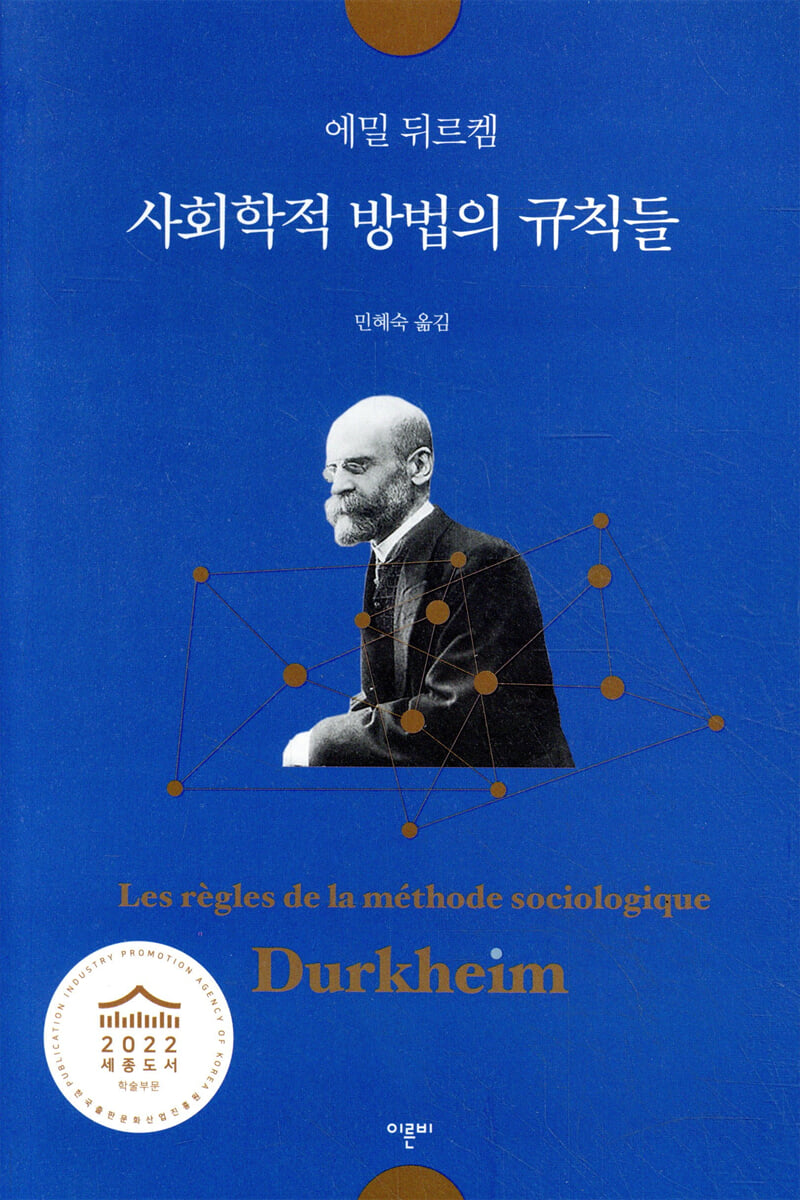
Rules of Sociological Method
 |
Description
Book Introduction
The most important theoretical work for understanding Durkheim's thought
The first translation of the French original has been published!
Today, scientific approaches based on data and statistics are a common research method for analyzing complex and diverse social phenomena.
Over 120 years ago, French sociologist Emile Durkheim pioneered the idea of sociology as an (empirical) science and presented a set of methodologies, which still provide profound insights for our times.
Durkheim is often cited as one of the three greatest scholars, along with Marx and Weber, who laid the foundations of modern sociology. This is also why, compared to the two, he has the strongest identity as a sociologist.
"Rules of Sociological Method" is one of Émile Durkheim's four major works, and it is a book that defines and discusses "social facts" (fait social), a concept that encapsulates his thoughts.
“The first and most important rule is to treat social facts as objects” (p. 79).
With this declarative proposition, Durkheim presented a bold, clear, and controversial sociological methodology, which he applied to the rest of his major works and used as a research framework.
That is, the study of the social fact of division of labor is 『Theory of Social Division of Labor』, the study of the social fact of suicide is 『Theory of Suicide』, and the study of the social fact of religion is 『The Primitive Forms of Religious Life』.
In that sense, 『Rules of Sociological Method』 is a very important theoretical work that serves as the basis for understanding Durkheim's thought.
Yet, until now, there has been no translation of the French original.
The translator who recently retranslated and published The Elementary Forms of Religious Life has once again wrestled with Durkheim's demanding style and long sentences to faithfully translate the original text.
The first translation of the French original has been published!
Today, scientific approaches based on data and statistics are a common research method for analyzing complex and diverse social phenomena.
Over 120 years ago, French sociologist Emile Durkheim pioneered the idea of sociology as an (empirical) science and presented a set of methodologies, which still provide profound insights for our times.
Durkheim is often cited as one of the three greatest scholars, along with Marx and Weber, who laid the foundations of modern sociology. This is also why, compared to the two, he has the strongest identity as a sociologist.
"Rules of Sociological Method" is one of Émile Durkheim's four major works, and it is a book that defines and discusses "social facts" (fait social), a concept that encapsulates his thoughts.
“The first and most important rule is to treat social facts as objects” (p. 79).
With this declarative proposition, Durkheim presented a bold, clear, and controversial sociological methodology, which he applied to the rest of his major works and used as a research framework.
That is, the study of the social fact of division of labor is 『Theory of Social Division of Labor』, the study of the social fact of suicide is 『Theory of Suicide』, and the study of the social fact of religion is 『The Primitive Forms of Religious Life』.
In that sense, 『Rules of Sociological Method』 is a very important theoretical work that serves as the basis for understanding Durkheim's thought.
Yet, until now, there has been no translation of the French original.
The translator who recently retranslated and published The Elementary Forms of Religious Life has once again wrestled with Durkheim's demanding style and long sentences to faithfully translate the original text.
- You can preview some of the book's contents.
Preview
index
Laying the cornerstone of liberation sociology
Preface to the First Edition
Preface to the Second Edition
introduction
Chapter 1: What Are Social Facts?
Chapter 2: Rules for the Observation of Social Facts
Chapter 3 Rules for Distinguishing Between Normal and Pathological Conditions
Chapter 4 Rules for Social Type Organization
Chapter 5: Rules for the Explanation of Social Facts
Chapter 6 Rules for Handling Sociological Evidence
conclusion
Preface to the English edition (2013)
Translator's Note
Émile Durkheim Chronology
Search
Preface to the First Edition
Preface to the Second Edition
introduction
Chapter 1: What Are Social Facts?
Chapter 2: Rules for the Observation of Social Facts
Chapter 3 Rules for Distinguishing Between Normal and Pathological Conditions
Chapter 4 Rules for Social Type Organization
Chapter 5: Rules for the Explanation of Social Facts
Chapter 6 Rules for Handling Sociological Evidence
conclusion
Preface to the English edition (2013)
Translator's Note
Émile Durkheim Chronology
Search
Detailed image

Into the book
If there is a science of society, it is not about expounding upon traditional prejudices, but about making us see things in a different way from ordinary people.
--- p.27
In fact, this discipline was born only when it was realized that social phenomena, even if they are not material objects, are real things that can be studied.
--- p.53
Of course, if that phenomenon is common, it can be said to be collective because it is forced to some extent.
But because it is general, it is not collective.
What is repeated in the individual is the state of the group.
Because the state of the group overwhelms the individual.
Because it is contained in the whole, it is also contained in each part, but because it is contained in each part, it does not exist in the whole.
--- p.71
By forming ideas in the way people commonly do, we will never discover laws that reveal reality.
On the contrary, ideas are like a veil placed between us and things, and the more we believe them to be transparent, the more they obscure the reality of things.
--- p.81
Everything given, everything offered, is a thing and an object of observation.
Treating phenomena as objects means treating them as data, and this is the starting point of science.
Social phenomena certainly exhibit these characteristics.
--- p.95
Social facts are not products of our will.
Rather, they determine our intentions from the outside.
Social facts are like molds that mold our behavior.
--- p.97
To know precisely what the most important problems are, the sociologist's first act should be to define the things he deals with.
This is the most important and essential condition of all evidence and proof.
--- p.105
We must abandon this still overly prevalent practice of arbitrarily judging institutions, practices, and moral norms.
The custom is to judge all social types indiscriminately as if the institutions and norms themselves were good or bad.
--- p.135
Nothing can be good indefinitely and without limitations.
The authority of moral conscience must not be excessively excessive.
Otherwise, no one can challenge it, and the conscience becomes too easily hardened into an immutable form.
--- p.151~152
Even if humans are excluded, society remains.
Therefore, we must seek an explanation of social life within the nature of society itself.
In fact, we recognize that society infinitely transcends the individual in time and space.
--- p.197
We attempted to establish that social phenomena can be scientifically treated without damaging any of their characteristics.
--- p.27
In fact, this discipline was born only when it was realized that social phenomena, even if they are not material objects, are real things that can be studied.
--- p.53
Of course, if that phenomenon is common, it can be said to be collective because it is forced to some extent.
But because it is general, it is not collective.
What is repeated in the individual is the state of the group.
Because the state of the group overwhelms the individual.
Because it is contained in the whole, it is also contained in each part, but because it is contained in each part, it does not exist in the whole.
--- p.71
By forming ideas in the way people commonly do, we will never discover laws that reveal reality.
On the contrary, ideas are like a veil placed between us and things, and the more we believe them to be transparent, the more they obscure the reality of things.
--- p.81
Everything given, everything offered, is a thing and an object of observation.
Treating phenomena as objects means treating them as data, and this is the starting point of science.
Social phenomena certainly exhibit these characteristics.
--- p.95
Social facts are not products of our will.
Rather, they determine our intentions from the outside.
Social facts are like molds that mold our behavior.
--- p.97
To know precisely what the most important problems are, the sociologist's first act should be to define the things he deals with.
This is the most important and essential condition of all evidence and proof.
--- p.105
We must abandon this still overly prevalent practice of arbitrarily judging institutions, practices, and moral norms.
The custom is to judge all social types indiscriminately as if the institutions and norms themselves were good or bad.
--- p.135
Nothing can be good indefinitely and without limitations.
The authority of moral conscience must not be excessively excessive.
Otherwise, no one can challenge it, and the conscience becomes too easily hardened into an immutable form.
--- p.151~152
Even if humans are excluded, society remains.
Therefore, we must seek an explanation of social life within the nature of society itself.
In fact, we recognize that society infinitely transcends the individual in time and space.
--- p.197
We attempted to establish that social phenomena can be scientifically treated without damaging any of their characteristics.
--- p.252
Publisher's Review
“The first and most important rule: Treat social facts as objects.”
Durkheim's bold, clear, and controversial sociological methodology
Laying the foundation of modern sociology by presenting scientific methodology
Today, scientific approaches based on data and statistics are a common research method for analyzing complex and diverse social phenomena.
Over 120 years ago, French sociologist Emile Durkheim pioneered sociology as an (empirical) science and presented a set of methodologies that still provide profound insights for our times.
Durkheim is often cited as one of the three greatest scholars, along with Marx and Weber, who laid the foundations of modern sociology. This is also why, compared to the two, he has the strongest identity as a sociologist.
He pondered deeply about what sociology's unique research subject and research method were, and arrived at the so-called 'observation of social facts.'
It was an attempt to find a way to move beyond philosophical idealism and use natural scientific methodology.
“Our rules do not presuppose any speculation or metaphysical concept concerning the origin of existence.
This principle requires that sociologists, when exploring unexplored areas of science, be in the same frame of mind as physicists, chemists, or physiologists.
“When a sociologist enters the social world, he must be conscious that he is entering an unknown world” (p. 38).
Durkheim's most important theoretical work, translated and published for the first time in French!
"Rules of Sociological Method" is one of Émile Durkheim's four major works, and it is a book that defines and discusses "social facts" (fait social), a concept that encapsulates his thoughts.
“The first and most important rule is to treat social facts as objects” (p. 79).
With this declarative proposition, Durkheim presented a bold, clear, and controversial sociological methodology, which he applied to the rest of his major works and used as a research framework.
That is, the study of the social fact of division of labor is 『Theory of Social Division of Labor』, the study of the social fact of suicide is 『Theory of Suicide』, and the study of the social fact of religion is 『The Primitive Forms of Religious Life』.
In that sense, 『Rules of Sociological Method』 is a very important theoretical work that serves as the basis for understanding Durkheim's thought.
Yet, until now, there has been no translation of the French original.
The translator who recently retranslated and published 『The Elementary Forms of Religious Life』 has once again wrestled with Durkheim's challenging writing style and long sentences to faithfully translate the original text (Based on his long experience in the field of education, the translator has also paid attention to Durkheim as an educator and is translating his hidden masterpiece 『Moral Education』).
What are social facts?
'Social facts' are all products created and generated through human social life and behavior.
Unlike the fixed and static feeling that the Korean word 'fact' or the English word 'fact' gives, the French word 'fait' is derived from the verb faire and has a dynamic and broad meaning (i.e., it has the meaning of making, creating, generating, cultivating, giving birth, acting, etc.).
Durkheim took this very social fact as the object of study and sought a methodology to establish sociology as an independent discipline.
Social facts exist outside of individuals, exert coercive power (influence, binding power) on individuals, are commonly imposed on all members of society, and exist independently of individuals.
This includes laws, traditions and customs, and countless other institutions such as family, religion, currency, and education.
“We can call any belief system and behavioral pattern established by a group an institution.
Therefore, sociology can be defined as follows:
“Sociology is the study of institutions, their creation, and their functions” (p. 52).
The unique characteristics of society lie within the combination of individuals.
Until Durkheim's time, the way sociologists explained social phenomena was teleological and psychological.
Comte, a leading figure in sociology, said that the goal of progress has driven social phenomena, while Spencer said that the formation of society moves toward realizing the nature of individuals.
This type of explanation rests on scientifically unprovable metaphysical propositions, such as progress or the realization of human nature.
The essential characteristic of a sociological phenomenon is the force (i.e., a social fact) that exerts pressure on individual consciousness from outside.
Sociological phenomena do not arise from the consciousness of individuals.
Sociology is not a derivative of psychology.
Even if individual people are excluded, society remains.
Therefore, we must seek an explanation of social life within the nature of society itself.
It cannot be denied that the elements that make up society are individual humans.
But the whole is different from the sum of its parts.
The properties of the whole are different from the properties of the parts that make up the whole.
So what's important is the combination.
Individuals combine to form society.
The unique characteristics of society are contained in the combination of individuals.
Treat and observe social phenomena as objects
Just as alchemy must become chemistry and astrology must become astronomy, so too must sociology observe social facts rather than analyze ideas and concepts.
Durkheim argued that social facts must be treated as objects in order to be observed, and this led to much misunderstanding and criticism.
However, Durkheim did not say that social facts are things in the material sense.
For sociology to be established as a science, social phenomena must be regarded and observed as objects, that is, as natural phenomena.
We should treat social phenomena as objects, not analyzing legal concepts but studying legal codes; not talking about what everyday life is but studying statistics on human behavior; not engaging in vague discussions about fashion but analyzing clothing.
To do this, we must thoroughly abandon preconceptions, define things precisely (definitions should not be ideas derived from the mind, but should clearly show the properties inherent in things), and minimize the risk that the human senses of observation will always fall into subjectivity.
Sociology recognizes that individual members are involved in the formation of social facts, and that there are immaterial elements in sociological phenomena, but it does not reduce them to psychological phenomena.
Such phenomena are understood through social facts such as collective consciousness, collective emotions, and collective representations.
In this sense, sociology is a different discipline from philosophy, natural science, and psychology, and its methods are absolutely sociological, different from those of these disciplines.
Durkheim's bold, clear, and controversial sociological methodology
Laying the foundation of modern sociology by presenting scientific methodology
Today, scientific approaches based on data and statistics are a common research method for analyzing complex and diverse social phenomena.
Over 120 years ago, French sociologist Emile Durkheim pioneered sociology as an (empirical) science and presented a set of methodologies that still provide profound insights for our times.
Durkheim is often cited as one of the three greatest scholars, along with Marx and Weber, who laid the foundations of modern sociology. This is also why, compared to the two, he has the strongest identity as a sociologist.
He pondered deeply about what sociology's unique research subject and research method were, and arrived at the so-called 'observation of social facts.'
It was an attempt to find a way to move beyond philosophical idealism and use natural scientific methodology.
“Our rules do not presuppose any speculation or metaphysical concept concerning the origin of existence.
This principle requires that sociologists, when exploring unexplored areas of science, be in the same frame of mind as physicists, chemists, or physiologists.
“When a sociologist enters the social world, he must be conscious that he is entering an unknown world” (p. 38).
Durkheim's most important theoretical work, translated and published for the first time in French!
"Rules of Sociological Method" is one of Émile Durkheim's four major works, and it is a book that defines and discusses "social facts" (fait social), a concept that encapsulates his thoughts.
“The first and most important rule is to treat social facts as objects” (p. 79).
With this declarative proposition, Durkheim presented a bold, clear, and controversial sociological methodology, which he applied to the rest of his major works and used as a research framework.
That is, the study of the social fact of division of labor is 『Theory of Social Division of Labor』, the study of the social fact of suicide is 『Theory of Suicide』, and the study of the social fact of religion is 『The Primitive Forms of Religious Life』.
In that sense, 『Rules of Sociological Method』 is a very important theoretical work that serves as the basis for understanding Durkheim's thought.
Yet, until now, there has been no translation of the French original.
The translator who recently retranslated and published 『The Elementary Forms of Religious Life』 has once again wrestled with Durkheim's challenging writing style and long sentences to faithfully translate the original text (Based on his long experience in the field of education, the translator has also paid attention to Durkheim as an educator and is translating his hidden masterpiece 『Moral Education』).
What are social facts?
'Social facts' are all products created and generated through human social life and behavior.
Unlike the fixed and static feeling that the Korean word 'fact' or the English word 'fact' gives, the French word 'fait' is derived from the verb faire and has a dynamic and broad meaning (i.e., it has the meaning of making, creating, generating, cultivating, giving birth, acting, etc.).
Durkheim took this very social fact as the object of study and sought a methodology to establish sociology as an independent discipline.
Social facts exist outside of individuals, exert coercive power (influence, binding power) on individuals, are commonly imposed on all members of society, and exist independently of individuals.
This includes laws, traditions and customs, and countless other institutions such as family, religion, currency, and education.
“We can call any belief system and behavioral pattern established by a group an institution.
Therefore, sociology can be defined as follows:
“Sociology is the study of institutions, their creation, and their functions” (p. 52).
The unique characteristics of society lie within the combination of individuals.
Until Durkheim's time, the way sociologists explained social phenomena was teleological and psychological.
Comte, a leading figure in sociology, said that the goal of progress has driven social phenomena, while Spencer said that the formation of society moves toward realizing the nature of individuals.
This type of explanation rests on scientifically unprovable metaphysical propositions, such as progress or the realization of human nature.
The essential characteristic of a sociological phenomenon is the force (i.e., a social fact) that exerts pressure on individual consciousness from outside.
Sociological phenomena do not arise from the consciousness of individuals.
Sociology is not a derivative of psychology.
Even if individual people are excluded, society remains.
Therefore, we must seek an explanation of social life within the nature of society itself.
It cannot be denied that the elements that make up society are individual humans.
But the whole is different from the sum of its parts.
The properties of the whole are different from the properties of the parts that make up the whole.
So what's important is the combination.
Individuals combine to form society.
The unique characteristics of society are contained in the combination of individuals.
Treat and observe social phenomena as objects
Just as alchemy must become chemistry and astrology must become astronomy, so too must sociology observe social facts rather than analyze ideas and concepts.
Durkheim argued that social facts must be treated as objects in order to be observed, and this led to much misunderstanding and criticism.
However, Durkheim did not say that social facts are things in the material sense.
For sociology to be established as a science, social phenomena must be regarded and observed as objects, that is, as natural phenomena.
We should treat social phenomena as objects, not analyzing legal concepts but studying legal codes; not talking about what everyday life is but studying statistics on human behavior; not engaging in vague discussions about fashion but analyzing clothing.
To do this, we must thoroughly abandon preconceptions, define things precisely (definitions should not be ideas derived from the mind, but should clearly show the properties inherent in things), and minimize the risk that the human senses of observation will always fall into subjectivity.
Sociology recognizes that individual members are involved in the formation of social facts, and that there are immaterial elements in sociological phenomena, but it does not reduce them to psychological phenomena.
Such phenomena are understood through social facts such as collective consciousness, collective emotions, and collective representations.
In this sense, sociology is a different discipline from philosophy, natural science, and psychology, and its methods are absolutely sociological, different from those of these disciplines.
GOODS SPECIFICS
- Publication date: October 5, 2021
- Page count, weight, size: 312 pages | 484g | 143*210*18mm
- ISBN13: 9791197014840
- ISBN10: 1197014845
You may also like
카테고리
korean


korean

![GQ KOREA Mark (Monthly): December [2025]](http://librairie.coreenne.fr/cdn/shop/files/8ef265dbbfbf186523ed75ba7319009d.jpg?v=1765340328&width=3840)


