

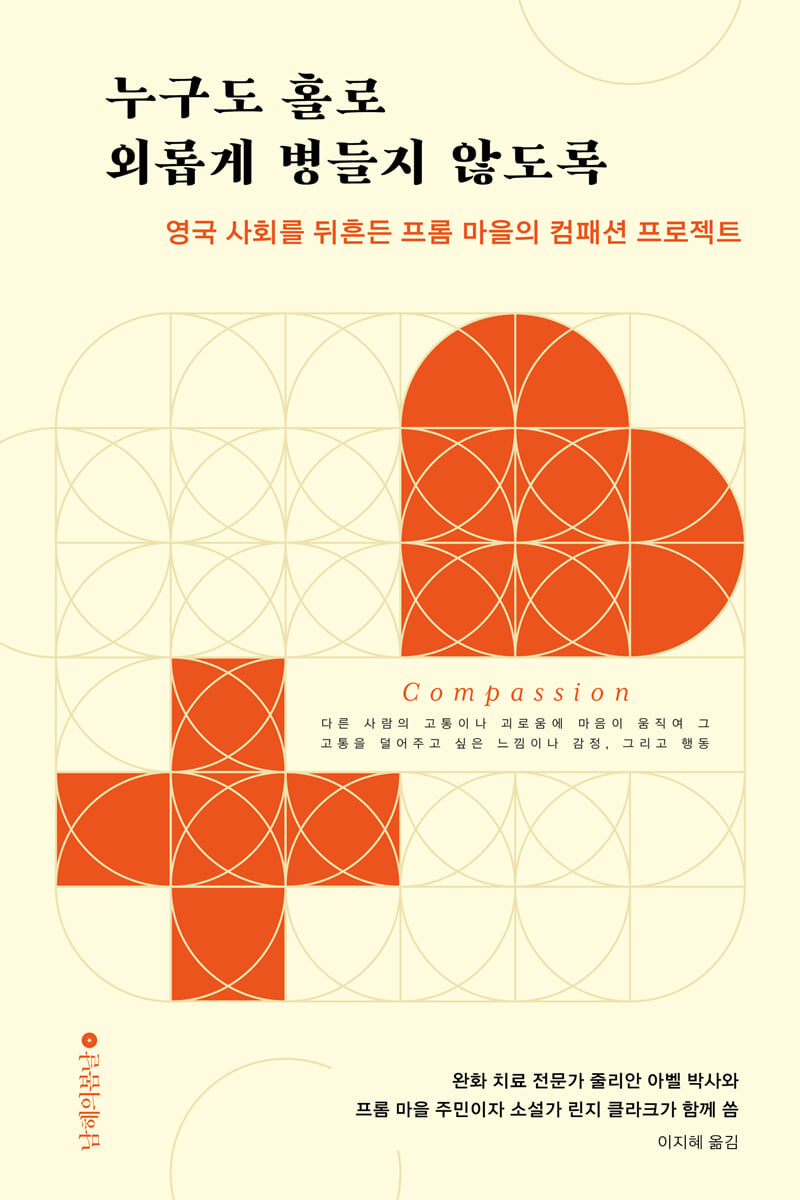
So that no one gets sick alone
 |
Description
Book Introduction
The village medical staff and residents joined forces
Overcoming loneliness and illness
The moving light and hope of the Compassion From Project
The recent COVID-19 pandemic has led to social isolation and loneliness emerging as serious social problems.
In an age where aging, social isolation, and loneliness lead to disease.
The British government has even appointed a 'Minister for Loneliness' and a 'Minister for Suicide Prevention', following research showing that the mental distress caused by social isolation is as harmful to health as smoking 15 cigarettes a day.
But something amazing happened in the small town of Frome in Somerset.
The medical staff at the village hospital, community developers, and residents created a network to connect villagers and build a system to care for the sick and lonely, which achieved the unexpected result of lowering the rate of hospitalizations in the local hospital emergency room for five years (2013-2018).
In 2018, Dr. Helen Kingston, a doctor at Frome, was invited to the British Prime Minister's residence to receive the Points of Light award on behalf of the Compassion Frome project.
Afterwards, British government officials, local government medical workers, broadcasting station officials, and even people from other countries such as Sweden and Austria began visiting this small town to benchmark it.
Thousands of community connectors protect your health and happiness.
Everyone wants to live a healthy and happy life.
However, aging, disease, and dying and death are things that no human being can avoid.
No matter how much medical technology advances and new drugs are developed, without healthy social relationships, people become isolated, exhausted, and lose their will to live.
This book says that the most important things for a healthy and happy life are ‘compassion’ and ‘a healthy network.’
Residents of "compassionate" communities, where people connect to form healthy networks, foster a sense of purpose and hope in life, and care for one another, smile more and are healthier.
In Fromm, there were health connectors connecting hospitals and patients, and over a thousand community connectors made up of local residents, connecting sick and isolated people and forming a network of caregivers.
The Compassion From Project has provided a solution to the NHS's (UK's National Health Service) concerns about its growing reliance on hospitals and the resulting cost burden.
By creating a model that significantly reduced emergency room admissions, we not only saved money, but also put the village community back at the center of the health care system, revitalizing the village and creating a more enjoyable and connected life for residents.
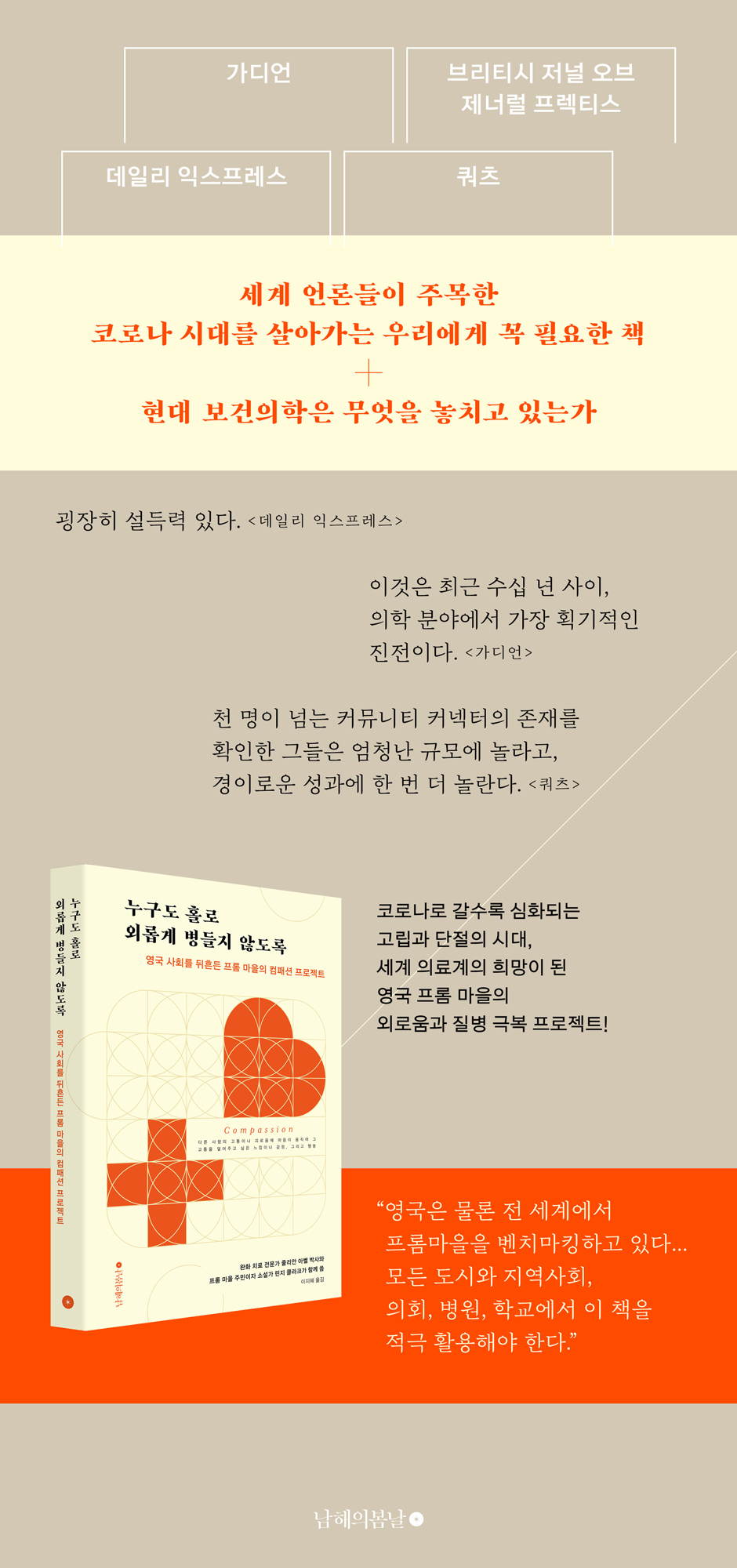
“In every city and community, library, council, clinic, hospital, hospice, school
“You should make active use of this book.”
The key to Fromm's community hospital's remarkable achievements was the role of the "Health Connector," which created various groups and connected people in need, and the "Community Connector," which was formed through the participation of residents.
It was also based on the support and assistance of the 'Independents for Fromm' party, which was launched to change the existing parliamentary structure.
The 'compassion practice' discussed in this book is not limited to the healthcare field, but is needed by all people in all fields.
In our individual lives, at work, in schools and hospitals, and in parliaments and nations, striving for a "compassion city" is the direction our society should take and will protect the health and happiness of each of us.
Overcoming loneliness and illness
The moving light and hope of the Compassion From Project
The recent COVID-19 pandemic has led to social isolation and loneliness emerging as serious social problems.
In an age where aging, social isolation, and loneliness lead to disease.
The British government has even appointed a 'Minister for Loneliness' and a 'Minister for Suicide Prevention', following research showing that the mental distress caused by social isolation is as harmful to health as smoking 15 cigarettes a day.
But something amazing happened in the small town of Frome in Somerset.
The medical staff at the village hospital, community developers, and residents created a network to connect villagers and build a system to care for the sick and lonely, which achieved the unexpected result of lowering the rate of hospitalizations in the local hospital emergency room for five years (2013-2018).
In 2018, Dr. Helen Kingston, a doctor at Frome, was invited to the British Prime Minister's residence to receive the Points of Light award on behalf of the Compassion Frome project.
Afterwards, British government officials, local government medical workers, broadcasting station officials, and even people from other countries such as Sweden and Austria began visiting this small town to benchmark it.
Thousands of community connectors protect your health and happiness.
Everyone wants to live a healthy and happy life.
However, aging, disease, and dying and death are things that no human being can avoid.
No matter how much medical technology advances and new drugs are developed, without healthy social relationships, people become isolated, exhausted, and lose their will to live.
This book says that the most important things for a healthy and happy life are ‘compassion’ and ‘a healthy network.’
Residents of "compassionate" communities, where people connect to form healthy networks, foster a sense of purpose and hope in life, and care for one another, smile more and are healthier.
In Fromm, there were health connectors connecting hospitals and patients, and over a thousand community connectors made up of local residents, connecting sick and isolated people and forming a network of caregivers.
The Compassion From Project has provided a solution to the NHS's (UK's National Health Service) concerns about its growing reliance on hospitals and the resulting cost burden.
By creating a model that significantly reduced emergency room admissions, we not only saved money, but also put the village community back at the center of the health care system, revitalizing the village and creating a more enjoyable and connected life for residents.
“In every city and community, library, council, clinic, hospital, hospice, school
“You should make active use of this book.”
The key to Fromm's community hospital's remarkable achievements was the role of the "Health Connector," which created various groups and connected people in need, and the "Community Connector," which was formed through the participation of residents.
It was also based on the support and assistance of the 'Independents for Fromm' party, which was launched to change the existing parliamentary structure.
The 'compassion practice' discussed in this book is not limited to the healthcare field, but is needed by all people in all fields.
In our individual lives, at work, in schools and hospitals, and in parliaments and nations, striving for a "compassion city" is the direction our society should take and will protect the health and happiness of each of us.
- You can preview some of the book's contents.
Preview
index
introduction
Introduction
Part 1: Warm Hearts: Stories of Compassion and Community
Chapter 1: Two Friends Encountered at the Hospital
Chapter 2 What is Compassion?
Chapter 3: A World Without Compassion
Chapter 4: Good Relationships Prevent Disease
Chapter 5: A Small Miracle at Prom
Part 2: Applying the Power of Compassion to Your Life
Chapter 6: A Life of Compassion
Chapter 7: Building a Network of Good Relationships That Change Your Life
Chapter 8: Practicing Compassion in Healthcare
Chapter 9: Practicing Compassion in a Broader Area
Chapter 10: The Politics of Compassion
The text that appears
Appendix 1 Compassion Community Declaration
Appendix 2 Compassion City Charter
Introduction
Part 1: Warm Hearts: Stories of Compassion and Community
Chapter 1: Two Friends Encountered at the Hospital
Chapter 2 What is Compassion?
Chapter 3: A World Without Compassion
Chapter 4: Good Relationships Prevent Disease
Chapter 5: A Small Miracle at Prom
Part 2: Applying the Power of Compassion to Your Life
Chapter 6: A Life of Compassion
Chapter 7: Building a Network of Good Relationships That Change Your Life
Chapter 8: Practicing Compassion in Healthcare
Chapter 9: Practicing Compassion in a Broader Area
Chapter 10: The Politics of Compassion
The text that appears
Appendix 1 Compassion Community Declaration
Appendix 2 Compassion City Charter
Detailed image
Into the book
The coronavirus has called into question many of the assumptions that underpin our way of life, particularly our presumptuous boast that nature is invincible against us.
Everyone is vulnerable to infection, and no one can guarantee survival.
The long-term impact of this anxiety on human psychology is so profound that no one can predict its potential to become a serious problem in the future.
But this virus has made us realize just how interconnected and deeply interdependent humanity is.
This has made us realize the immense resource of humanity and compassion that we can rely on in this time of crisis.
This book offers a practical example of hope, grounded in the innate human capacity for compassion, arguing that anyone can need a helping hand at any time, addressing issues that are deeply intertwined and impact every aspect of life.
Compassion is a value that provides a solid foundation for a better, more sustainable way of life.
--- p.9
From Medical Practice argues that it is not medicines that focus on curing disease that keep us healthy and happy, but good relationships that are the true source of well-being.
This argument not only put village communities back at the center of the health care system, but also created a model that significantly reduced emergency room admissions.
Perhaps compassion is the best medicine.
--- p.14
He decided to become a palliative care specialist for terminally ill patients.
And after working in that field for many years, I became convinced of this.
The best thing you can do to help someone who is dying is to teach them how important it is to love, laugh, and care for those caring for the dying, and to help them develop those skills.
And he argued that the biggest thing that helps us discover meaning in life is being with people we know and love, in places we know and love.
That may be why people with critical illnesses prefer to stay at home with their families.
But the family can't handle everything.
He knew how burdensome it was to have only close friends care for a terminally ill patient.
Death and dying, loss and care are things that every human being must experience.
And the shared experience of helping others—whether family, friends, neighbors, or caring individuals in the community—can change everyone's attitudes toward care.
--- pp.23-24
On 25 May 2018, Dr Helen Kingston, a doctor at From Medical Practice, was invited to 10 Downing Street to receive the award.
This is because the achievements of Dr. Helen Kingston and her team have been recognized as a result of this imagination.
Helen started Health Connections Mendip just five years ago with her colleague and community developer, Jenny Hartnoll.
The remarkable success of this project, later called the Compassion From Project, attracted the attention of the government.
From the outset, the program was designed to integrate primary health care with the creative resources of the Compassion community.
--- pp.33-34
Research by Professor Julian Holt-Lunstad's team has confirmed that healthy social relationships are a hallmark of longevity.
Broadening the scope, Susan Pinker emphasizes the therapeutic value of face-to-face social interaction, arguing in her book:
“If you neglect to maintain close contact with people who are important to you, you may be putting yourself at risk for health risks as serious as high blood pressure, obesity, or smoking a pack of cigarettes a day.”
--- pp.76-77
The value of healthy social relationships increases even when we or someone close to us is sick.
Their support means more than just conveying warm friendship.
Problems are often solved better in teams of people who volunteer to help than in individuals who struggle alone.
Their diverse knowledge can effectively guide people in need and help them receive appropriate medical services.
To put it more realistically, if multiple people help with shopping, cooking, and cleaning, while expressing love, laughter, and friendship, it can prevent caregivers from caring for patients alone, potentially harming their own health.
Even in the midst of grief, loss, and bereavement, shared experiences can improve the quality of life for everyone.
--- pp.82-83
She created a new two-hour training program tailored to the needs of the community and formed a team of neighborhood "community connectors."
The program first explained how the project aligned with health care provision and social welfare, and provided guidance on how to use a directory of local resources to help those in need.
The training started small, but as word spread and interest grew, more and more people joined.
Soon, over 1,000 community connectors were active in Frome and the surrounding area.
The term 'community connector' may sound a bit like a civil servant, but it simply refers to someone who effectively uses their friendly nature as a friend, neighbor, or acquaintance.
People trained as community connectors are widespread, both inside and outside of Prom.
They are the guardians of compassion in their communities.
--- pp.108-109
“Before, I only exchanged greetings with my neighbors, but we never spent time together.
Then, all of a sudden, I just stayed at home feeling listless.
People gathered around even though I didn't ask for help.
He came to our house every day, taking turns.
He came to check on me and see if I needed anything.
This was the first time in my life that something like this had happened.
All my life, I've only cared about my family and work.
After this experience, I became more humble and grateful.
People really cared.
I was so grateful that there were people who wanted to help others.
I also made a lot of friends.
I go out to the neighborhood often now.
Tell people that there is hope, that they are not alone.
I've made lifelong friends with people who have been through similar things to me.
This is the most important lesson I've learned.
The fact that when people are having a hard time, I will be there for them, and they will be there for me.
I feel like I have my life back.
--- pp.123-124
We see ourselves as individuals, but in fact we are plural.
Because humans are interdependent beings who receive care from those around them.
People form relationships that provide support, friendship, and the essentials of life.
The success of the Compassion From Project began with recognizing the vital role these networks play in our lives.
The next step is to discover and publicize the networks of mutual support in the village, while at the same time building more networks to meet new needs.
--- p.155
Dr. Helen Kingston tells the story of a patient who moved to Frome.
This patient came to Dr. Helen after being advised to re-fill the antidepressant medication he had been taking at the hospital in his new area.
In the process of asking why the prescription was needed, Dr. Helen learned that the patient had moved from the next town over because of domestic violence.
The patient was unable to decide where to live and was moving between the homes of acquaintances.
She came to the hospital because she needed more antidepressants, but more than that, she desperately needed help to end her nomadic life and get her life back on track.
In this situation, a typical medical model would have re-prescribed the medication and referred the patient to a social welfare agency.
It could then take weeks to resolve this patient's desperate housing needs.
The Compassion Community model takes a different approach.
In such cases, the next step is to directly find out the quickest way to support the patient.
After identifying the patient's needs, Helen looked up the Health Connections Mendip Directory and clicked on the "Housing/Homelessness" section.
You can immediately check out support for victims of domestic violence, advice and accommodation for the homeless, homeless counselling services, and accommodation provided by Mendip Borough Council.
And again, I clicked on the 'Poverty/Finance/Funding' section to see what urgent problems homeless people need to solve, and to find free food places and places that actually help.
--- pp.197-198
In societies that place a high value on compassion, individuals are encouraged to thrive and freely develop their talents and abilities within their communities.
When that happens, unexpected potential will be unleashed, leading to new ways of tackling problems that previously seemed unsolvable.
In such a compassionate environment, people's hearts are lifted and evidence of a sure hope is revealed.
When people working together like this change the world around them, the whole world will slowly begin to change.
--- p.281
Compassion Cities are communities that publicly identify, seek out, and help people in need.
Compassion Cities supports them and calls on key community sectors to help minimize the negative social, psychological, and medical impacts of illness, caregiving, and bereavement.
Recognize that it is everyone's responsibility to do this.
Local governments must strive to maintain and strengthen the best services for the most vulnerable among us, but they are not the only ones who are vulnerable.
Because serious personal crises, such as physical or mental illness, end-of-life, death, and loss, can strike anyone at any time during ordinary daily life.
Compassion City is a community that recognizes and addresses this social reality.
Everyone is vulnerable to infection, and no one can guarantee survival.
The long-term impact of this anxiety on human psychology is so profound that no one can predict its potential to become a serious problem in the future.
But this virus has made us realize just how interconnected and deeply interdependent humanity is.
This has made us realize the immense resource of humanity and compassion that we can rely on in this time of crisis.
This book offers a practical example of hope, grounded in the innate human capacity for compassion, arguing that anyone can need a helping hand at any time, addressing issues that are deeply intertwined and impact every aspect of life.
Compassion is a value that provides a solid foundation for a better, more sustainable way of life.
--- p.9
From Medical Practice argues that it is not medicines that focus on curing disease that keep us healthy and happy, but good relationships that are the true source of well-being.
This argument not only put village communities back at the center of the health care system, but also created a model that significantly reduced emergency room admissions.
Perhaps compassion is the best medicine.
--- p.14
He decided to become a palliative care specialist for terminally ill patients.
And after working in that field for many years, I became convinced of this.
The best thing you can do to help someone who is dying is to teach them how important it is to love, laugh, and care for those caring for the dying, and to help them develop those skills.
And he argued that the biggest thing that helps us discover meaning in life is being with people we know and love, in places we know and love.
That may be why people with critical illnesses prefer to stay at home with their families.
But the family can't handle everything.
He knew how burdensome it was to have only close friends care for a terminally ill patient.
Death and dying, loss and care are things that every human being must experience.
And the shared experience of helping others—whether family, friends, neighbors, or caring individuals in the community—can change everyone's attitudes toward care.
--- pp.23-24
On 25 May 2018, Dr Helen Kingston, a doctor at From Medical Practice, was invited to 10 Downing Street to receive the award.
This is because the achievements of Dr. Helen Kingston and her team have been recognized as a result of this imagination.
Helen started Health Connections Mendip just five years ago with her colleague and community developer, Jenny Hartnoll.
The remarkable success of this project, later called the Compassion From Project, attracted the attention of the government.
From the outset, the program was designed to integrate primary health care with the creative resources of the Compassion community.
--- pp.33-34
Research by Professor Julian Holt-Lunstad's team has confirmed that healthy social relationships are a hallmark of longevity.
Broadening the scope, Susan Pinker emphasizes the therapeutic value of face-to-face social interaction, arguing in her book:
“If you neglect to maintain close contact with people who are important to you, you may be putting yourself at risk for health risks as serious as high blood pressure, obesity, or smoking a pack of cigarettes a day.”
--- pp.76-77
The value of healthy social relationships increases even when we or someone close to us is sick.
Their support means more than just conveying warm friendship.
Problems are often solved better in teams of people who volunteer to help than in individuals who struggle alone.
Their diverse knowledge can effectively guide people in need and help them receive appropriate medical services.
To put it more realistically, if multiple people help with shopping, cooking, and cleaning, while expressing love, laughter, and friendship, it can prevent caregivers from caring for patients alone, potentially harming their own health.
Even in the midst of grief, loss, and bereavement, shared experiences can improve the quality of life for everyone.
--- pp.82-83
She created a new two-hour training program tailored to the needs of the community and formed a team of neighborhood "community connectors."
The program first explained how the project aligned with health care provision and social welfare, and provided guidance on how to use a directory of local resources to help those in need.
The training started small, but as word spread and interest grew, more and more people joined.
Soon, over 1,000 community connectors were active in Frome and the surrounding area.
The term 'community connector' may sound a bit like a civil servant, but it simply refers to someone who effectively uses their friendly nature as a friend, neighbor, or acquaintance.
People trained as community connectors are widespread, both inside and outside of Prom.
They are the guardians of compassion in their communities.
--- pp.108-109
“Before, I only exchanged greetings with my neighbors, but we never spent time together.
Then, all of a sudden, I just stayed at home feeling listless.
People gathered around even though I didn't ask for help.
He came to our house every day, taking turns.
He came to check on me and see if I needed anything.
This was the first time in my life that something like this had happened.
All my life, I've only cared about my family and work.
After this experience, I became more humble and grateful.
People really cared.
I was so grateful that there were people who wanted to help others.
I also made a lot of friends.
I go out to the neighborhood often now.
Tell people that there is hope, that they are not alone.
I've made lifelong friends with people who have been through similar things to me.
This is the most important lesson I've learned.
The fact that when people are having a hard time, I will be there for them, and they will be there for me.
I feel like I have my life back.
--- pp.123-124
We see ourselves as individuals, but in fact we are plural.
Because humans are interdependent beings who receive care from those around them.
People form relationships that provide support, friendship, and the essentials of life.
The success of the Compassion From Project began with recognizing the vital role these networks play in our lives.
The next step is to discover and publicize the networks of mutual support in the village, while at the same time building more networks to meet new needs.
--- p.155
Dr. Helen Kingston tells the story of a patient who moved to Frome.
This patient came to Dr. Helen after being advised to re-fill the antidepressant medication he had been taking at the hospital in his new area.
In the process of asking why the prescription was needed, Dr. Helen learned that the patient had moved from the next town over because of domestic violence.
The patient was unable to decide where to live and was moving between the homes of acquaintances.
She came to the hospital because she needed more antidepressants, but more than that, she desperately needed help to end her nomadic life and get her life back on track.
In this situation, a typical medical model would have re-prescribed the medication and referred the patient to a social welfare agency.
It could then take weeks to resolve this patient's desperate housing needs.
The Compassion Community model takes a different approach.
In such cases, the next step is to directly find out the quickest way to support the patient.
After identifying the patient's needs, Helen looked up the Health Connections Mendip Directory and clicked on the "Housing/Homelessness" section.
You can immediately check out support for victims of domestic violence, advice and accommodation for the homeless, homeless counselling services, and accommodation provided by Mendip Borough Council.
And again, I clicked on the 'Poverty/Finance/Funding' section to see what urgent problems homeless people need to solve, and to find free food places and places that actually help.
--- pp.197-198
In societies that place a high value on compassion, individuals are encouraged to thrive and freely develop their talents and abilities within their communities.
When that happens, unexpected potential will be unleashed, leading to new ways of tackling problems that previously seemed unsolvable.
In such a compassionate environment, people's hearts are lifted and evidence of a sure hope is revealed.
When people working together like this change the world around them, the whole world will slowly begin to change.
--- p.281
Compassion Cities are communities that publicly identify, seek out, and help people in need.
Compassion Cities supports them and calls on key community sectors to help minimize the negative social, psychological, and medical impacts of illness, caregiving, and bereavement.
Recognize that it is everyone's responsibility to do this.
Local governments must strive to maintain and strengthen the best services for the most vulnerable among us, but they are not the only ones who are vulnerable.
Because serious personal crises, such as physical or mental illness, end-of-life, death, and loss, can strike anyone at any time during ordinary daily life.
Compassion City is a community that recognizes and addresses this social reality.
--- pp.291-292
Publisher's Review
“Health and happiness depend on having a network of relationships that can provide the support you need.”
“Compassion is the best medicine.”
A small helping hand, started with good intentions, has the power to change not only the lives of others, but also your own.
Casey's case, which left her devastated when she suddenly lost her ability to walk due to acute rheumatoid arthritis, illustrates the chain reaction of how good intentions lead to greater good intentions and contribute to changing not only an individual's life but also the lives of members of a community.
A small act of kindness, a warm word, can have a saving power for someone.
It's only natural that if our society were filled with more individuals possessing this "compassion," it would become a better and happier place to live. However, are we, as individuals, and in our communities, truly embodying this seemingly obvious principle, worthy of an ethics textbook? And is it truly appropriate to rely on the goodwill of individuals to build such a compassionate society?
What makes Fromm's case so successful and surprising is the presence of over a thousand 'connectors'.
Connectors, such as 'health connectors' and 'community connectors', are the links that create this chain reaction of goodwill.
The secret to the success of this project was not simply waiting for the goodwill of individuals, but systematizing this goodwill through the education and deployment of "connectors."
Is a Compassion City possible in South Korea?
Is it possible to create a compassionate city like this in South Korea, the country with the highest suicide rate in the OECD?
Recently, local governments such as Seoul, Gwangju, and Incheon have been designating and promoting 'dementia-friendly villages' and seeking community-centered solutions.
In many cities and communities across South Korea, there are already people who are generously extending a helping hand with goodwill in their respective positions, such as small neighborhood childcare communities, civil society activities, and medical welfare cooperatives that are quietly operating in various places.
Our society already has sufficient resources.
These resources are interconnected and waiting to be utilized.
The important thing is to connect these resources and build a system.
This book will be an essential textbook for taking the first step toward creating a compassionate city and nation by utilizing the resources already at our fingertips.
“Compassion is the best medicine.”
A small helping hand, started with good intentions, has the power to change not only the lives of others, but also your own.
Casey's case, which left her devastated when she suddenly lost her ability to walk due to acute rheumatoid arthritis, illustrates the chain reaction of how good intentions lead to greater good intentions and contribute to changing not only an individual's life but also the lives of members of a community.
A small act of kindness, a warm word, can have a saving power for someone.
It's only natural that if our society were filled with more individuals possessing this "compassion," it would become a better and happier place to live. However, are we, as individuals, and in our communities, truly embodying this seemingly obvious principle, worthy of an ethics textbook? And is it truly appropriate to rely on the goodwill of individuals to build such a compassionate society?
What makes Fromm's case so successful and surprising is the presence of over a thousand 'connectors'.
Connectors, such as 'health connectors' and 'community connectors', are the links that create this chain reaction of goodwill.
The secret to the success of this project was not simply waiting for the goodwill of individuals, but systematizing this goodwill through the education and deployment of "connectors."
Is a Compassion City possible in South Korea?
Is it possible to create a compassionate city like this in South Korea, the country with the highest suicide rate in the OECD?
Recently, local governments such as Seoul, Gwangju, and Incheon have been designating and promoting 'dementia-friendly villages' and seeking community-centered solutions.
In many cities and communities across South Korea, there are already people who are generously extending a helping hand with goodwill in their respective positions, such as small neighborhood childcare communities, civil society activities, and medical welfare cooperatives that are quietly operating in various places.
Our society already has sufficient resources.
These resources are interconnected and waiting to be utilized.
The important thing is to connect these resources and build a system.
This book will be an essential textbook for taking the first step toward creating a compassionate city and nation by utilizing the resources already at our fingertips.
GOODS SPECIFICS
- Publication date: July 15, 2021
- Page count, weight, size: 296 pages | 380g | 140*210*20mm
- ISBN13: 9791185823737
- ISBN10: 1185823735
You may also like
카테고리
korean


korean

![GQ KOREA Mark (Monthly): December [2025]](http://librairie.coreenne.fr/cdn/shop/files/8ef265dbbfbf186523ed75ba7319009d.jpg?v=1765340328&width=3840)


