

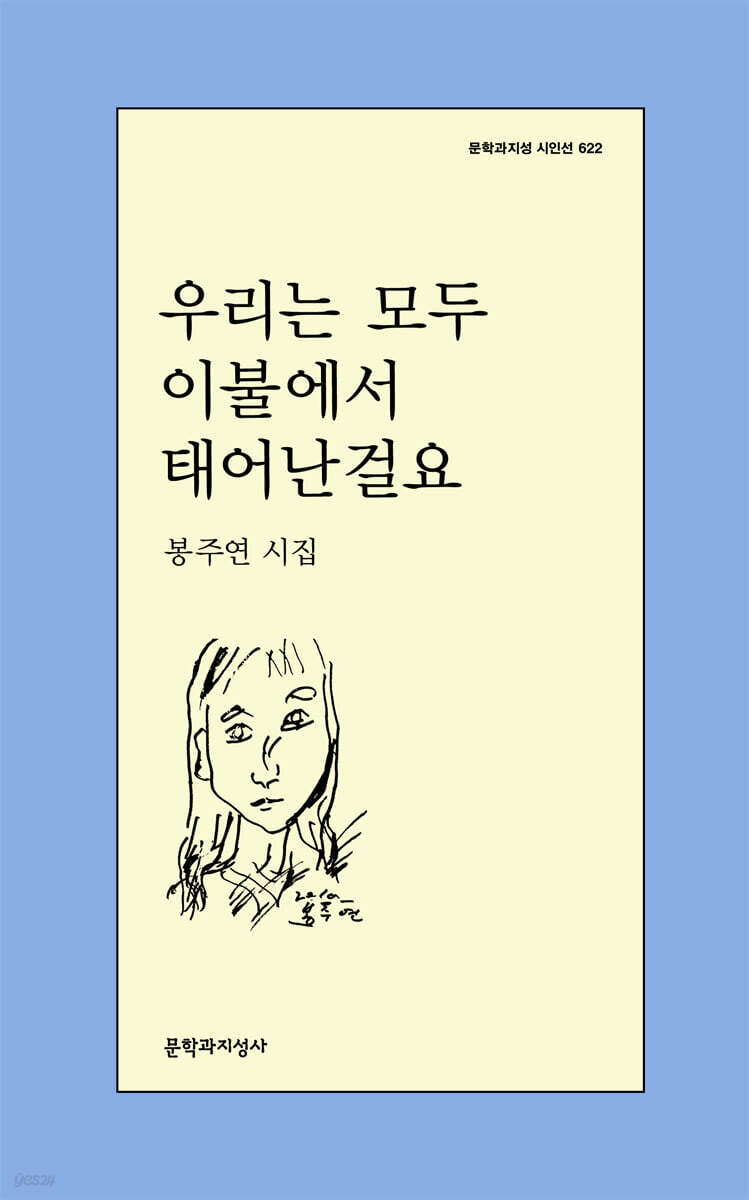
We are all born from blankets
 |
Description
Book Introduction
“If you summarize a person’s life, places remain.
Grow up well.”
The history of relationships quietly accumulated in every place I lived.
Our soft origins are grasped by the hand that sweeps the layers
A poet who unfolds a map of intimacy with delicate warmth
Bong Ju-yeon's second poetry collection
Bong Ju-yeon, who began her career as a writer through the 2023 『Modern Literature』 New Writer Recommendation, has published her second poetry collection 『We Were All Born from Blankets』 as the 622nd poetry collection of the Munhak-kwa-Jisung Poet Selection.
The poet, who poured out his boundless heart through his first poetry collection, “Two Letters to One Person” (Hyundae Munhak, 2024), reveals the addresses of the places his heart wanted to reach through this collection of 52 poems, divided into four parts, that meticulously capture the texture and details of life.
If you go out like that, you'll get cold.
It seems like there are spring days to regret morning and evening.
We rode the swings side by side at the playground late at night.
What are you doing here? You were nagging each other while competing to see who could climb higher.
I like to get under the table.
I even went under the grand piano in the hotel lobby.
I want a bunk bed.
Where did you learn that?
I was never a child who clearly stated what I wanted.
It's refreshing to see someone clearly state what they want.
We are all born from blankets.
In the sky, in flexibility.
―「Residence History」 section
Every place has a story.
Since we cannot float in the air without setting foot anywhere, we live our lives passing through many places, and in each place we stay, we leave traces of where we ate, slept, laughed, and talked.
The poet, who understands that this “world, made up of countless places, is made up of events” (“A Hand Made of Hands”), indicates the coordinates of places not by their location but by their history, and the poems written with those coordinates are not simply an “address book” that collects addresses, but are closer to an “address history” that includes the time experienced while living there.
By “including the surroundings in the category of places” (“This video is playing in picture in picture”), when addresses are read as individual histories rather than road names or lot numbers, the stories told by Bong Ju-yeon’s places “may be true even if they are not true” (“The Will to Identify Plants”).
In his world of poetry, “intimacy becomes a map” (“Dokdo Law”), so Bong Ju-yeon points to “heaven” [“dwelling history”] as our common origin, instead of “where we were born,” “where we grew up,” or “where our parents are.”
Because the sky has the power to “support the form of absence” (“Secret Light”), the “curtain” knows “what I do before I fall asleep” and “the expression I make when I fall asleep” (“Solidarity”), and the “tent” sees the “confession contained in the back of the neck” (“Neck”) rather than the “face of a doll.”
The poet looks into the spaces of the past one by one, as if he were “lying on a blanket and turning over photographs” (“Let there be no tomorrow, only darkness”), made of fabric that so intimately embraces us.
When “several photographs are superimposed” on a soft and gentle blanket, what “looks clearly” (“Protocol”) will be our “most beautiful time” (“Outline”), which our places have “watched over” all along.
Grow up well.”
The history of relationships quietly accumulated in every place I lived.
Our soft origins are grasped by the hand that sweeps the layers
A poet who unfolds a map of intimacy with delicate warmth
Bong Ju-yeon's second poetry collection
Bong Ju-yeon, who began her career as a writer through the 2023 『Modern Literature』 New Writer Recommendation, has published her second poetry collection 『We Were All Born from Blankets』 as the 622nd poetry collection of the Munhak-kwa-Jisung Poet Selection.
The poet, who poured out his boundless heart through his first poetry collection, “Two Letters to One Person” (Hyundae Munhak, 2024), reveals the addresses of the places his heart wanted to reach through this collection of 52 poems, divided into four parts, that meticulously capture the texture and details of life.
If you go out like that, you'll get cold.
It seems like there are spring days to regret morning and evening.
We rode the swings side by side at the playground late at night.
What are you doing here? You were nagging each other while competing to see who could climb higher.
I like to get under the table.
I even went under the grand piano in the hotel lobby.
I want a bunk bed.
Where did you learn that?
I was never a child who clearly stated what I wanted.
It's refreshing to see someone clearly state what they want.
We are all born from blankets.
In the sky, in flexibility.
―「Residence History」 section
Every place has a story.
Since we cannot float in the air without setting foot anywhere, we live our lives passing through many places, and in each place we stay, we leave traces of where we ate, slept, laughed, and talked.
The poet, who understands that this “world, made up of countless places, is made up of events” (“A Hand Made of Hands”), indicates the coordinates of places not by their location but by their history, and the poems written with those coordinates are not simply an “address book” that collects addresses, but are closer to an “address history” that includes the time experienced while living there.
By “including the surroundings in the category of places” (“This video is playing in picture in picture”), when addresses are read as individual histories rather than road names or lot numbers, the stories told by Bong Ju-yeon’s places “may be true even if they are not true” (“The Will to Identify Plants”).
In his world of poetry, “intimacy becomes a map” (“Dokdo Law”), so Bong Ju-yeon points to “heaven” [“dwelling history”] as our common origin, instead of “where we were born,” “where we grew up,” or “where our parents are.”
Because the sky has the power to “support the form of absence” (“Secret Light”), the “curtain” knows “what I do before I fall asleep” and “the expression I make when I fall asleep” (“Solidarity”), and the “tent” sees the “confession contained in the back of the neck” (“Neck”) rather than the “face of a doll.”
The poet looks into the spaces of the past one by one, as if he were “lying on a blanket and turning over photographs” (“Let there be no tomorrow, only darkness”), made of fabric that so intimately embraces us.
When “several photographs are superimposed” on a soft and gentle blanket, what “looks clearly” (“Protocol”) will be our “most beautiful time” (“Outline”), which our places have “watched over” all along.
- You can preview some of the book's contents.
Preview
index
Poet's words
Part 1
Park design drawings | Tomorrow, not tomorrow, only darkness | Site history | Decline | Stair landing | Will to identify plants | Plant identification ability | Fish do it on their own | Sense of privacy and cohabitation | If we lived closer, we could each have half a watermelon | Prosperity | A hand that is kind | The light of an outstretched hand | Adaptation | Sunlight rights and slant restrictions
Part 2
Dokdo Law | Residence History | Nokcheon | Campsite Design Drawings | Power Outage Design Drawings | Art Museum Tour Speed | Bouquet of Cut Flowers | Boundary | Harmful Pranks | Beneficial Jokes | Solidarity | Faith | Pyeongtaek Anjeong-ri Tailor Shop | This video is playing in picture-in-picture | [1st Step] [9th Step] [12th Step] | Cheongjin | Close with a Closed Curve
Part 3
Fox's Earlobe | Interlocking | Sense of Distance | Apple | Concession | Extension | The Time for Sharing Fruit is Determined | Sports Day | School Closing Ceremony | Glance at the Scenery | Guest House | Elevation | Sunset | Protocol | Ujeon
Part 4
A good stone for water skimming | Outline | Replaceable person | Transparency | Outline
commentary
I'm here, you're there · Ha Hyuk-jin
Part 1
Park design drawings | Tomorrow, not tomorrow, only darkness | Site history | Decline | Stair landing | Will to identify plants | Plant identification ability | Fish do it on their own | Sense of privacy and cohabitation | If we lived closer, we could each have half a watermelon | Prosperity | A hand that is kind | The light of an outstretched hand | Adaptation | Sunlight rights and slant restrictions
Part 2
Dokdo Law | Residence History | Nokcheon | Campsite Design Drawings | Power Outage Design Drawings | Art Museum Tour Speed | Bouquet of Cut Flowers | Boundary | Harmful Pranks | Beneficial Jokes | Solidarity | Faith | Pyeongtaek Anjeong-ri Tailor Shop | This video is playing in picture-in-picture | [1st Step] [9th Step] [12th Step] | Cheongjin | Close with a Closed Curve
Part 3
Fox's Earlobe | Interlocking | Sense of Distance | Apple | Concession | Extension | The Time for Sharing Fruit is Determined | Sports Day | School Closing Ceremony | Glance at the Scenery | Guest House | Elevation | Sunset | Protocol | Ujeon
Part 4
A good stone for water skimming | Outline | Replaceable person | Transparency | Outline
commentary
I'm here, you're there · Ha Hyuk-jin
Into the book
To the old people, puppet shows were a joke.
Dolls caught by the neck.
For the person moving the puppets behind the tent, the only thing that mattered was the tail.
The audience will see the doll's face, but anyone who sees the back of its neck will want to be the person hidden behind the tent forever.
After the puppet show, people gather their hearts and gather to talk about stories they have kept hidden from each other for a long time.
Something has changed between them, and they no longer tie their hair in front of each other.
Confession is not in the heart, but in the back of the neck.
--- From "Neck"
May you fall into a deep sleep without even dreaming.
Even after receiving such kindness, I feel guilty on nights when I can't sleep.
When I open an old storybook, it smells like home.
Whose love did you receive to come here?
Between two soft legs.
A voice rings out from above the palace.
A tree branch stretched out into a small room where there was no need to remember the contents.
The room becomes the whole world.
The lights go out.
Typing, sewing, gardening… …
Things you can do with your eyes closed.
[… … ]
When I opened my eyes again, the plugged-in fan was spinning and the kitchen lights were on.
I closed the veranda door that had been slightly open, turned off the kitchen light, and lay down on the bed.
The table was back in its place.
Where did your sleep go last night?
--- From the "Power Failure Design Drawing"
Even low-resolution raindrops leave marks on the window glass.
Summer has no pockets
The wall draws in the scenery.
I don't think it's the destination that determines the direction you walk.
It's just walking along the wall.
The wall guides us in a way that does not show the entire landscape.
[… … ]
Is the tempo right?
What we watched the longest was each other's viewing speed.
In a building where no one gets lost even though the direction changes so many times
I'm confident I won't get lost today.
Turn the corner.
At an exhibition, it feels like it's over once you turn back the way you came.
Weren't there any protesters on the way back?
It could just be that the noise hasn't made it around the corner.
When I turn around to smell good, there are always purple flowers
The reverse is not true.
--- From "Art Museum Viewing Speed"
There are times when I feel like I can't stand not taking care of something.
I don't even have the confidence to raise animals and there aren't any plants on the veranda.
Call someone over and prepare dinner.
Seat people at a narrow table where stew is boiling.
After you finish eating, I'll dig out your ears.
Make a pillow out of a blanket.
A room filled with the smell of vegetable broth.
When I think of someone, a small room follows me in the background.
After eating, my hands and feet feel warm.
If you cut the stem diagonally, the flower will live longer.
A raw fish to keep you alive.
The flower shop in the apartment complex sells potted plants that live a long time even without watering, and the flower shop in the airport sells the most wreaths.
Even if you forget someone, a room comes with you
I forgot about the room, I've already seen so much.
I understand why you shouldn't invite people to your home without permission.
Before the celebration had even cooled down, one of the largest stems was broken.
--- From "Bouquet of Cut Flowers"
How long do you have to sit in front of a stepping stone before you see someone slipping their foot?
They know how to lean on each other even with their elbows.
He picks stones without even being able to properly float a water bottle.
Let's wait until the stone grows.
Even ordinary gravel, if grown well, can become a good stone for water skimming.
I think about what I can do while the stone grows.
The speed of the trail slows down as the number of lovers increases.
They lower their bodies and lower themselves further while taking pictures of each other.
Looking into the liquid crystal display, this is you, this is me.
Everyone on the riverbank seems to enjoy the fall.
Dolls caught by the neck.
For the person moving the puppets behind the tent, the only thing that mattered was the tail.
The audience will see the doll's face, but anyone who sees the back of its neck will want to be the person hidden behind the tent forever.
After the puppet show, people gather their hearts and gather to talk about stories they have kept hidden from each other for a long time.
Something has changed between them, and they no longer tie their hair in front of each other.
Confession is not in the heart, but in the back of the neck.
--- From "Neck"
May you fall into a deep sleep without even dreaming.
Even after receiving such kindness, I feel guilty on nights when I can't sleep.
When I open an old storybook, it smells like home.
Whose love did you receive to come here?
Between two soft legs.
A voice rings out from above the palace.
A tree branch stretched out into a small room where there was no need to remember the contents.
The room becomes the whole world.
The lights go out.
Typing, sewing, gardening… …
Things you can do with your eyes closed.
[… … ]
When I opened my eyes again, the plugged-in fan was spinning and the kitchen lights were on.
I closed the veranda door that had been slightly open, turned off the kitchen light, and lay down on the bed.
The table was back in its place.
Where did your sleep go last night?
--- From the "Power Failure Design Drawing"
Even low-resolution raindrops leave marks on the window glass.
Summer has no pockets
The wall draws in the scenery.
I don't think it's the destination that determines the direction you walk.
It's just walking along the wall.
The wall guides us in a way that does not show the entire landscape.
[… … ]
Is the tempo right?
What we watched the longest was each other's viewing speed.
In a building where no one gets lost even though the direction changes so many times
I'm confident I won't get lost today.
Turn the corner.
At an exhibition, it feels like it's over once you turn back the way you came.
Weren't there any protesters on the way back?
It could just be that the noise hasn't made it around the corner.
When I turn around to smell good, there are always purple flowers
The reverse is not true.
--- From "Art Museum Viewing Speed"
There are times when I feel like I can't stand not taking care of something.
I don't even have the confidence to raise animals and there aren't any plants on the veranda.
Call someone over and prepare dinner.
Seat people at a narrow table where stew is boiling.
After you finish eating, I'll dig out your ears.
Make a pillow out of a blanket.
A room filled with the smell of vegetable broth.
When I think of someone, a small room follows me in the background.
After eating, my hands and feet feel warm.
If you cut the stem diagonally, the flower will live longer.
A raw fish to keep you alive.
The flower shop in the apartment complex sells potted plants that live a long time even without watering, and the flower shop in the airport sells the most wreaths.
Even if you forget someone, a room comes with you
I forgot about the room, I've already seen so much.
I understand why you shouldn't invite people to your home without permission.
Before the celebration had even cooled down, one of the largest stems was broken.
--- From "Bouquet of Cut Flowers"
How long do you have to sit in front of a stepping stone before you see someone slipping their foot?
They know how to lean on each other even with their elbows.
He picks stones without even being able to properly float a water bottle.
Let's wait until the stone grows.
Even ordinary gravel, if grown well, can become a good stone for water skimming.
I think about what I can do while the stone grows.
The speed of the trail slows down as the number of lovers increases.
They lower their bodies and lower themselves further while taking pictures of each other.
Looking into the liquid crystal display, this is you, this is me.
Everyone on the riverbank seems to enjoy the fall.
--- From "Good Stones for Water Skimming"
Publisher's Review
“Some places are like people, and you have to accept when it’s time to leave.”
To love countless 'me's' that are no longer 'me'
Today's grown-up 'me', walking briskly toward a new home
The smell of a lot of effort goes into a small person.
There are elementary schools, kindergartens, and small cram schools lined up.
The smell of sunshine filled the air as the children poured out after school.
A foreign land becomes your hometown.
I sat on the living room floor where my luggage was spread out in a mess.
You've come to a different place in half a day.
It takes a long time to decide to change rather than to change.
When asked where my family came from, I struggled with whether to say where I was born, where I grew up, or where my parents live.
When you summarize a person's life, places remain.
Grow up well.
―「Residence History」 section
There are children in every place.
[… … ] The child may have grown up in a place that is not in his memory.
Sweating profusely and putting in all kinds of effort.
These are the only typists I've ever encountered.
A little person who was once me, but is no longer me.
―From the acceptance speech for the 2023 『Modern Literature』 New Writer Recommendation
If we examine his poems, including his debut work “Dwelling History” which contains the title of this collection, we can see that “for Bong Ju-yeon’s poetic subject, ‘deplacement’ of existence, that is, moving, is an inevitable fate” (Ha Hyeok-jin, commentary on “I am here, you are there”).
Leaving a place where various relationships and memories have accumulated is bound to be difficult, so we always wish that “this place wouldn’t push me away” (“Fish Knows What They Do”), but “a spark that starts in one place must end in that place” (“Sunlight Rights Slant Restriction”), so we must willingly put out the fire of our foolishness and set out on our journey.
Any stay is ultimately just a part of a long journey, and permanent stay is impossible.
“Moving requires new habits” (“Adaptation”), so moving inevitably requires adaptation, and adaptation leads to growth.
At this time, the characters in Bong Ju-yeon's poems do not particularly admire the "me" that remains in each place they have left behind, the children who have changed their bodies and breathing to fit their new destinations, and the "little people" who "made every effort" to "decide to change," nor do they look back with expressionless faces.
He only says one calm and warm word, “Grow up well” [「Growing History」], while tracing his own main power that has become his ‘growth power’.
The reason their farewells to the past are firm and affectionate is because their attitude toward accepting the inevitability of separation is far from giving up or resignation.
In the poem, the characters leave their places with regret, knowing that they can only “feel the room real after leaving it” (“Park Design”), and they tear down places filled with memories with burden, knowing that “if it’s too big to tear down, it’s too big to keep” (“Adaptation”).
“To love this house as I did today/when I open the front door tomorrow” [Location History], Bong Ju-yeon’s poetic subjects are always ready to leave for “the farthest place love can go” (“A Hand Made of Hands”).
“The mere presence of stairs will draw people to this place.”
Climbing up and down the stairs with the belief that the scenery will be different each day
At the end of it all, the warmth of a round table awaits.
[… … ] As you climb the spiral staircase, one day it becomes a record store, another day it becomes a living room, and another day it becomes a used bookstore.
The feeling of putting the book you want to buy in an inconspicuous corner and coming back to get it the next day.
And yet, unable to buy it, I put it back in a deeper corner.
I believe that shadows can appear next to me or in front of me, but they always appear behind me.
We grew up misunderstanding each other.
―The "staircase" section
The fact that it has both the immobility of a facility attached to a building or slope and the mobility of a platform for pedestrian movement.
The fact that the 'stairs' that frequently appears throughout Bong Ju-yeon's poetry is often compared to the 'present' is not unrelated to this characteristic.
The stairs, which are located between the place where one takes one's step to start and the place where one ends, seem to speak of the present as a time precariously placed between the past and the future, waiting to disappear. However, there is something else the poet wants to reveal through the metaphor of the stairs.
We must live in the present, stepping firmly on each step.
That is, “there is no other choice but to live here and now” (“If we lived closer, we could each share half a watermelon”).
Up or down.
The stairs, which only assume movement in these two directions, resemble the monotonous partings of our lives rather than the dramatic ones.
Therefore, the belief that the place we reach by stairs could be “a record store one day, a living room another day, and a used bookstore another day” might be a kind of “misunderstanding” (“Staircase”).
However, as literary critic Ha Hyuk-jin, who wrote the commentary for this collection of poems, points out, “this blindness” is “the result of the times we have lived through and the places we have experienced,” and in itself “can become the destination of life.”
If we can faithfully sense each moment's emotions by "believing straight away" and "doing our best" (from "Haerujil"), if we can discover small unfamiliarities on our own by immersing ourselves in the present, then moving up the stairs is never just a repetitive movement.
When the actual scenery we face at the top of the stairs no longer matters, even if it ends up looking predictable, we can be “genuinely surprised” (“Harmful Joke”), and blindness becomes truth.
As we continue to migrate and settle, our strong faith, which can be seen as “stairs imprinted on our bodies” (“External Story”), will one day place a “table” at the end of the last flight of stairs where we can share warmth with each other for a moment.
It is impossible to say for sure whether “your hands and feet will be warm after eating” (“A Bouquet of Cut Flowers”) with “yesterday, tomorrow, and you gathered at the table” (“Intimate Light”), but “to know if it will really be warm, there is really no choice but to sit down at that table” (“Protocol”).
We sit around the table, postponing the inevitable farewell and anticipating new encounters each day, “eating very slowly, until the very end, because we want to stay with people for a long time” (“Glancing at the Scenery”).
Poet's words
Even though I heard five times that there was a rock there
I stumbled and fell in the same place.
Then you started to cover the place where I was going to fall with moist dirt.
August 2025
Bong Joo-yeon
To love countless 'me's' that are no longer 'me'
Today's grown-up 'me', walking briskly toward a new home
The smell of a lot of effort goes into a small person.
There are elementary schools, kindergartens, and small cram schools lined up.
The smell of sunshine filled the air as the children poured out after school.
A foreign land becomes your hometown.
I sat on the living room floor where my luggage was spread out in a mess.
You've come to a different place in half a day.
It takes a long time to decide to change rather than to change.
When asked where my family came from, I struggled with whether to say where I was born, where I grew up, or where my parents live.
When you summarize a person's life, places remain.
Grow up well.
―「Residence History」 section
There are children in every place.
[… … ] The child may have grown up in a place that is not in his memory.
Sweating profusely and putting in all kinds of effort.
These are the only typists I've ever encountered.
A little person who was once me, but is no longer me.
―From the acceptance speech for the 2023 『Modern Literature』 New Writer Recommendation
If we examine his poems, including his debut work “Dwelling History” which contains the title of this collection, we can see that “for Bong Ju-yeon’s poetic subject, ‘deplacement’ of existence, that is, moving, is an inevitable fate” (Ha Hyeok-jin, commentary on “I am here, you are there”).
Leaving a place where various relationships and memories have accumulated is bound to be difficult, so we always wish that “this place wouldn’t push me away” (“Fish Knows What They Do”), but “a spark that starts in one place must end in that place” (“Sunlight Rights Slant Restriction”), so we must willingly put out the fire of our foolishness and set out on our journey.
Any stay is ultimately just a part of a long journey, and permanent stay is impossible.
“Moving requires new habits” (“Adaptation”), so moving inevitably requires adaptation, and adaptation leads to growth.
At this time, the characters in Bong Ju-yeon's poems do not particularly admire the "me" that remains in each place they have left behind, the children who have changed their bodies and breathing to fit their new destinations, and the "little people" who "made every effort" to "decide to change," nor do they look back with expressionless faces.
He only says one calm and warm word, “Grow up well” [「Growing History」], while tracing his own main power that has become his ‘growth power’.
The reason their farewells to the past are firm and affectionate is because their attitude toward accepting the inevitability of separation is far from giving up or resignation.
In the poem, the characters leave their places with regret, knowing that they can only “feel the room real after leaving it” (“Park Design”), and they tear down places filled with memories with burden, knowing that “if it’s too big to tear down, it’s too big to keep” (“Adaptation”).
“To love this house as I did today/when I open the front door tomorrow” [Location History], Bong Ju-yeon’s poetic subjects are always ready to leave for “the farthest place love can go” (“A Hand Made of Hands”).
“The mere presence of stairs will draw people to this place.”
Climbing up and down the stairs with the belief that the scenery will be different each day
At the end of it all, the warmth of a round table awaits.
[… … ] As you climb the spiral staircase, one day it becomes a record store, another day it becomes a living room, and another day it becomes a used bookstore.
The feeling of putting the book you want to buy in an inconspicuous corner and coming back to get it the next day.
And yet, unable to buy it, I put it back in a deeper corner.
I believe that shadows can appear next to me or in front of me, but they always appear behind me.
We grew up misunderstanding each other.
―The "staircase" section
The fact that it has both the immobility of a facility attached to a building or slope and the mobility of a platform for pedestrian movement.
The fact that the 'stairs' that frequently appears throughout Bong Ju-yeon's poetry is often compared to the 'present' is not unrelated to this characteristic.
The stairs, which are located between the place where one takes one's step to start and the place where one ends, seem to speak of the present as a time precariously placed between the past and the future, waiting to disappear. However, there is something else the poet wants to reveal through the metaphor of the stairs.
We must live in the present, stepping firmly on each step.
That is, “there is no other choice but to live here and now” (“If we lived closer, we could each share half a watermelon”).
Up or down.
The stairs, which only assume movement in these two directions, resemble the monotonous partings of our lives rather than the dramatic ones.
Therefore, the belief that the place we reach by stairs could be “a record store one day, a living room another day, and a used bookstore another day” might be a kind of “misunderstanding” (“Staircase”).
However, as literary critic Ha Hyuk-jin, who wrote the commentary for this collection of poems, points out, “this blindness” is “the result of the times we have lived through and the places we have experienced,” and in itself “can become the destination of life.”
If we can faithfully sense each moment's emotions by "believing straight away" and "doing our best" (from "Haerujil"), if we can discover small unfamiliarities on our own by immersing ourselves in the present, then moving up the stairs is never just a repetitive movement.
When the actual scenery we face at the top of the stairs no longer matters, even if it ends up looking predictable, we can be “genuinely surprised” (“Harmful Joke”), and blindness becomes truth.
As we continue to migrate and settle, our strong faith, which can be seen as “stairs imprinted on our bodies” (“External Story”), will one day place a “table” at the end of the last flight of stairs where we can share warmth with each other for a moment.
It is impossible to say for sure whether “your hands and feet will be warm after eating” (“A Bouquet of Cut Flowers”) with “yesterday, tomorrow, and you gathered at the table” (“Intimate Light”), but “to know if it will really be warm, there is really no choice but to sit down at that table” (“Protocol”).
We sit around the table, postponing the inevitable farewell and anticipating new encounters each day, “eating very slowly, until the very end, because we want to stay with people for a long time” (“Glancing at the Scenery”).
Poet's words
Even though I heard five times that there was a rock there
I stumbled and fell in the same place.
Then you started to cover the place where I was going to fall with moist dirt.
August 2025
Bong Joo-yeon
GOODS SPECIFICS
- Date of issue: August 31, 2025
- Page count, weight, size: 148 pages | 214g | 128*205*10mm
- ISBN13: 9788932044347
You may also like
카테고리
korean


korean

![ELLE 엘르 스페셜 에디션 A형 : 12월 [2025]](http://librairie.coreenne.fr/cdn/shop/files/b8e27a3de6c9538896439686c6b0e8fb.jpg?v=1766436872&width=3840)


