

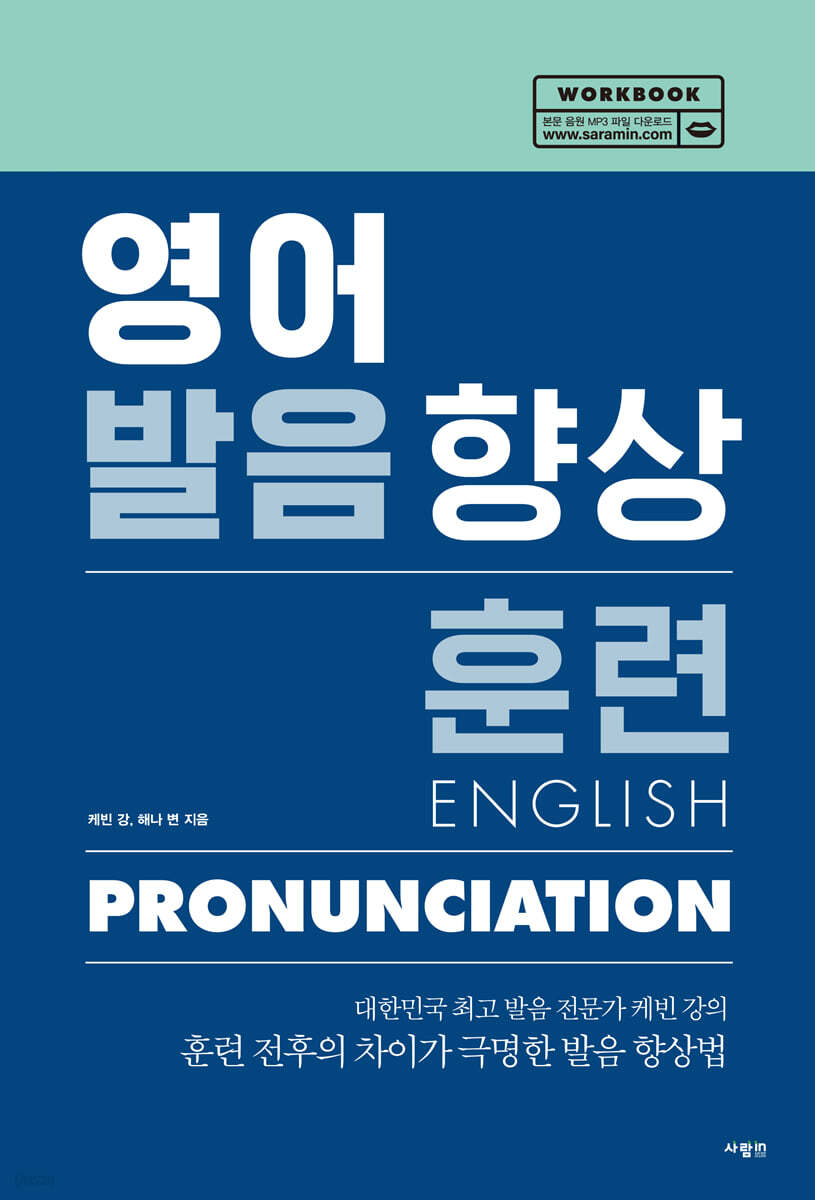
English pronunciation improvement training
 |
Description
Book Introduction
A training book that improves English pronunciation with a clear difference before and after training.
My first impression of English was determined by pronunciation! Only with good pronunciation can I speak accurately and fluently, as intended.
However, I think that after puberty, an adult's English pronunciation is already set in stone and cannot improve.
But let's throw away that prejudice now.
Kevin Kang, Korea's top pronunciation expert, will teach you 'pronunciation theory' and a sophisticated 'training' course that will be effective just by following along, so you can achieve both accuracy and fluency in English.
The author, based on his experience correcting his own English pronunciation with a strong Korean accent, focuses on the areas that Koreans find most difficult to correct.
As you practice, your pronunciation will become more natural and your confidence in English will increase.
My first impression of English was determined by pronunciation! Only with good pronunciation can I speak accurately and fluently, as intended.
However, I think that after puberty, an adult's English pronunciation is already set in stone and cannot improve.
But let's throw away that prejudice now.
Kevin Kang, Korea's top pronunciation expert, will teach you 'pronunciation theory' and a sophisticated 'training' course that will be effective just by following along, so you can achieve both accuracy and fluency in English.
The author, based on his experience correcting his own English pronunciation with a strong Korean accent, focuses on the areas that Koreans find most difficult to correct.
As you practice, your pronunciation will become more natural and your confidence in English will increase.
- You can preview some of the book's contents.
Preview
index
Author's Note
Why should I train my English pronunciation?
It's structured like this
Practice your pronunciation like this
Introduction Understanding English Pronunciation
Why is English pronunciation important?
Two factors that improve the delivery of English speech: accuracy and fluency.
Chapter 1 Speaking English Fluently
Unit 1 Diagnostic Assessment
Self-Diagnosis Checklist
Unit 2 How to Read English Sentences in Sentences
Listen up
What is break reading in English?
In English, everyone has a different way of reading!
5 Rules for Reading in Breaks
Reading with appropriate pauses and speaking at a steady pace
Listening Practice 1
Listening Practice 2
Unit 3 Intonation
Listen up
What is intonation?
Three changes in key word intonation
Note: In-depth study of intonation
Listening Practice 1
Listening Practice 2
Unit 4: Eliminating Koreans' Chronic Problems: "Eu" and "I"
Listen up
What if 'uh, this' is inserted?
Pronounce without 'eu, i'
Note: Pronunciation of [∫], [], [t∫], [d]
Note: Pronunciation of the past tense of verbs -ed
Listening Practice 1
Listening Practice 2
Chapter 2: Understanding the Uneven Rhythm of English
Unit 5 Stress
Listen up
What is English stress?
Identifying the strength of the position
Note: Words that are used as both nouns and verbs but have the same stress
Listening Practice
Unit 6 Diphthong Rhythm Training
Listen up
What is a diphthong?
Note: English cannot end with '애'
Listening Practice 1
Listening Practice 2
Unit 7 English Rhythm Training
Listen up
The rhythm of English
Content words
Function words
Listening Practice 1
Listening Practice 2
Chapter 3: Speaking and Listening Naturally
Unit 8 Understanding the Different Sound Changes of T and D
Listen up
The different sounds of t and d
flap
- Dictation Drill 1
- Dictation Drill 2
Note: Differences between American and British pronunciation of t & d
glottal stop
- Dictation Drill 1
- Dictation Drill 2
When the English letter t is silent
- Dictation Drill 1
- Dictation Drill 2
- Dictation Drill 3
Other [t, d] cases where they change depending on the surrounding sound
- Dictation Drill 1
- Dictation Drill 2
- Dictation Drill 3
- Dictation Drill 4
- Dictation Drill 5
Listening Practice
Unit 9 Understanding English Consonants
Listen and follow along
English pronunciation
The sound is never just one!
liaison phenomenon
Listening Practice
Chapter 4: Field Training
1.
Aesop's Fables, "The Milkmaid and Her Pail"
2.
Traditional fairy tale, The Honest Woodman
3.
Casual Self Introduction (Friends or University)
4.
Things that I like
5.
Things I dislike
6.
Self Introduction in Business
7.
Strengths and Weaknesses (in a Job Interview)
8.
Life Tips_How to sleep better
9.
Product Launch_ZBots
10.
Informational Speech_Faux Meat
11.
News Script
12.
Speech: “Love is more powerful than hate.”
supplement
1. Training on the words that Koreans have the most difficulty understanding and pronouncing.
1) Pronunciation: The most common mistakes made
2) Stress: The most frequently misspelled words
2 Training words with different stresses for nouns and verbs
1) When the meaning of a word changes 'completely' depending on the stress position
2) When the meaning of the noun/verb does not change significantly
Why should I train my English pronunciation?
It's structured like this
Practice your pronunciation like this
Introduction Understanding English Pronunciation
Why is English pronunciation important?
Two factors that improve the delivery of English speech: accuracy and fluency.
Chapter 1 Speaking English Fluently
Unit 1 Diagnostic Assessment
Self-Diagnosis Checklist
Unit 2 How to Read English Sentences in Sentences
Listen up
What is break reading in English?
In English, everyone has a different way of reading!
5 Rules for Reading in Breaks
Reading with appropriate pauses and speaking at a steady pace
Listening Practice 1
Listening Practice 2
Unit 3 Intonation
Listen up
What is intonation?
Three changes in key word intonation
Note: In-depth study of intonation
Listening Practice 1
Listening Practice 2
Unit 4: Eliminating Koreans' Chronic Problems: "Eu" and "I"
Listen up
What if 'uh, this' is inserted?
Pronounce without 'eu, i'
Note: Pronunciation of [∫], [], [t∫], [d]
Note: Pronunciation of the past tense of verbs -ed
Listening Practice 1
Listening Practice 2
Chapter 2: Understanding the Uneven Rhythm of English
Unit 5 Stress
Listen up
What is English stress?
Identifying the strength of the position
Note: Words that are used as both nouns and verbs but have the same stress
Listening Practice
Unit 6 Diphthong Rhythm Training
Listen up
What is a diphthong?
Note: English cannot end with '애'
Listening Practice 1
Listening Practice 2
Unit 7 English Rhythm Training
Listen up
The rhythm of English
Content words
Function words
Listening Practice 1
Listening Practice 2
Chapter 3: Speaking and Listening Naturally
Unit 8 Understanding the Different Sound Changes of T and D
Listen up
The different sounds of t and d
flap
- Dictation Drill 1
- Dictation Drill 2
Note: Differences between American and British pronunciation of t & d
glottal stop
- Dictation Drill 1
- Dictation Drill 2
When the English letter t is silent
- Dictation Drill 1
- Dictation Drill 2
- Dictation Drill 3
Other [t, d] cases where they change depending on the surrounding sound
- Dictation Drill 1
- Dictation Drill 2
- Dictation Drill 3
- Dictation Drill 4
- Dictation Drill 5
Listening Practice
Unit 9 Understanding English Consonants
Listen and follow along
English pronunciation
The sound is never just one!
liaison phenomenon
Listening Practice
Chapter 4: Field Training
1.
Aesop's Fables, "The Milkmaid and Her Pail"
2.
Traditional fairy tale, The Honest Woodman
3.
Casual Self Introduction (Friends or University)
4.
Things that I like
5.
Things I dislike
6.
Self Introduction in Business
7.
Strengths and Weaknesses (in a Job Interview)
8.
Life Tips_How to sleep better
9.
Product Launch_ZBots
10.
Informational Speech_Faux Meat
11.
News Script
12.
Speech: “Love is more powerful than hate.”
supplement
1. Training on the words that Koreans have the most difficulty understanding and pronouncing.
1) Pronunciation: The most common mistakes made
2) Stress: The most frequently misspelled words
2 Training words with different stresses for nouns and verbs
1) When the meaning of a word changes 'completely' depending on the stress position
2) When the meaning of the noun/verb does not change significantly
Detailed image
.jpg)
Publisher's Review
This is my thought before encountering 『English Pronunciation Improvement Training』, which said, "You can't pronounce it."
This pronunciation training book, designed by Korea's top pronunciation expert based on his own pronunciation correction experience, expands training beyond individual pronunciation to words, phrases, sentences, and paragraphs, allowing you to experience improved pronunciation.
Check and correct your English pronunciation
How would a native English speaker hear my English pronunciation? To speak English accurately, you must first understand your current situation.
To this end, I have included a recording of 'My English Pronunciation' in the training course of this book.
Additionally, it provides native speaker evaluations based on pronunciation samples from ordinary Koreans, allowing you to more accurately understand your current pronunciation status, while also helping you learn new pronunciation techniques through comparative analysis of Korean and English pronunciation.
Learn and practice the basic rules for producing English sounds and the various patterns for combining sounds.
Even long English sentences begin with individual pronunciations.
Korean and English have completely different sound systems, so if you speak English like Korean, it will be difficult for native speakers to understand.
To speak English accurately and understand what others are saying, you must first know the differences in sounds and pronounce them correctly.
So, Korea's top pronunciation expert will teach you the differences between Korean and English sounds, and then train you word-phrase-sentence-paragraph.
After correcting the most common mistakes Koreans make and building a solid foundation in pronunciation, you'll be able to speak with a smooth, rhythmic tone like a native speaker.
Improve your English pronunciation by focusing on pronunciation analysis and pronunciation points.
The reason why we have poor English pronunciation is because we cannot naturally produce the changes in sound when speaking quickly.
Learning how sounds change like this will not only help you speak more naturally, but will also improve your listening skills.
To this end, we expand from word-phrase training to 'practical training' that includes various texts, and train pronunciation by applying the concepts of pronunciation, linking, intonation, paused reading, and rhythm that we have learned so far.
In particular, we focus on pronunciation analysis and pronunciation points, and train you to embody the native speaker accent through shadowing, so your pronunciation becomes more natural and you can hear words you couldn't hear before.
This pronunciation training book, designed by Korea's top pronunciation expert based on his own pronunciation correction experience, expands training beyond individual pronunciation to words, phrases, sentences, and paragraphs, allowing you to experience improved pronunciation.
Check and correct your English pronunciation
How would a native English speaker hear my English pronunciation? To speak English accurately, you must first understand your current situation.
To this end, I have included a recording of 'My English Pronunciation' in the training course of this book.
Additionally, it provides native speaker evaluations based on pronunciation samples from ordinary Koreans, allowing you to more accurately understand your current pronunciation status, while also helping you learn new pronunciation techniques through comparative analysis of Korean and English pronunciation.
Learn and practice the basic rules for producing English sounds and the various patterns for combining sounds.
Even long English sentences begin with individual pronunciations.
Korean and English have completely different sound systems, so if you speak English like Korean, it will be difficult for native speakers to understand.
To speak English accurately and understand what others are saying, you must first know the differences in sounds and pronounce them correctly.
So, Korea's top pronunciation expert will teach you the differences between Korean and English sounds, and then train you word-phrase-sentence-paragraph.
After correcting the most common mistakes Koreans make and building a solid foundation in pronunciation, you'll be able to speak with a smooth, rhythmic tone like a native speaker.
Improve your English pronunciation by focusing on pronunciation analysis and pronunciation points.
The reason why we have poor English pronunciation is because we cannot naturally produce the changes in sound when speaking quickly.
Learning how sounds change like this will not only help you speak more naturally, but will also improve your listening skills.
To this end, we expand from word-phrase training to 'practical training' that includes various texts, and train pronunciation by applying the concepts of pronunciation, linking, intonation, paused reading, and rhythm that we have learned so far.
In particular, we focus on pronunciation analysis and pronunciation points, and train you to embody the native speaker accent through shadowing, so your pronunciation becomes more natural and you can hear words you couldn't hear before.
GOODS SPECIFICS
- Publication date: December 12, 2022
- Page count, weight, size: 288 pages | 698g | 170*250*16mm
- ISBN13: 9788960499744
- ISBN10: 8960499749
You may also like
카테고리
korean


korean

![GQ KOREA Mark (Monthly): December [2025]](http://librairie.coreenne.fr/cdn/shop/files/8ef265dbbfbf186523ed75ba7319009d.jpg?v=1765340328&width=3840)


