

The Miracle of Attachment Parenting for Children Ages 0-5
 |
Description
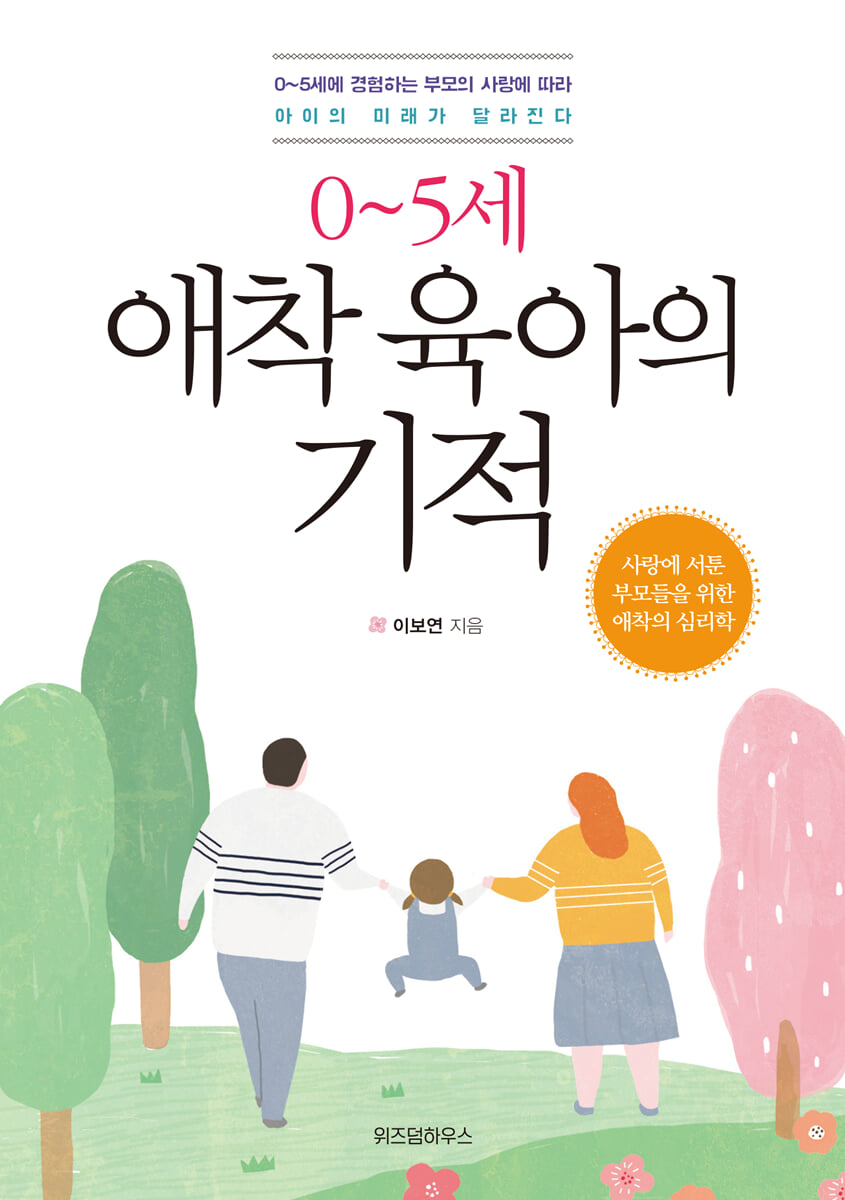
Book Introduction
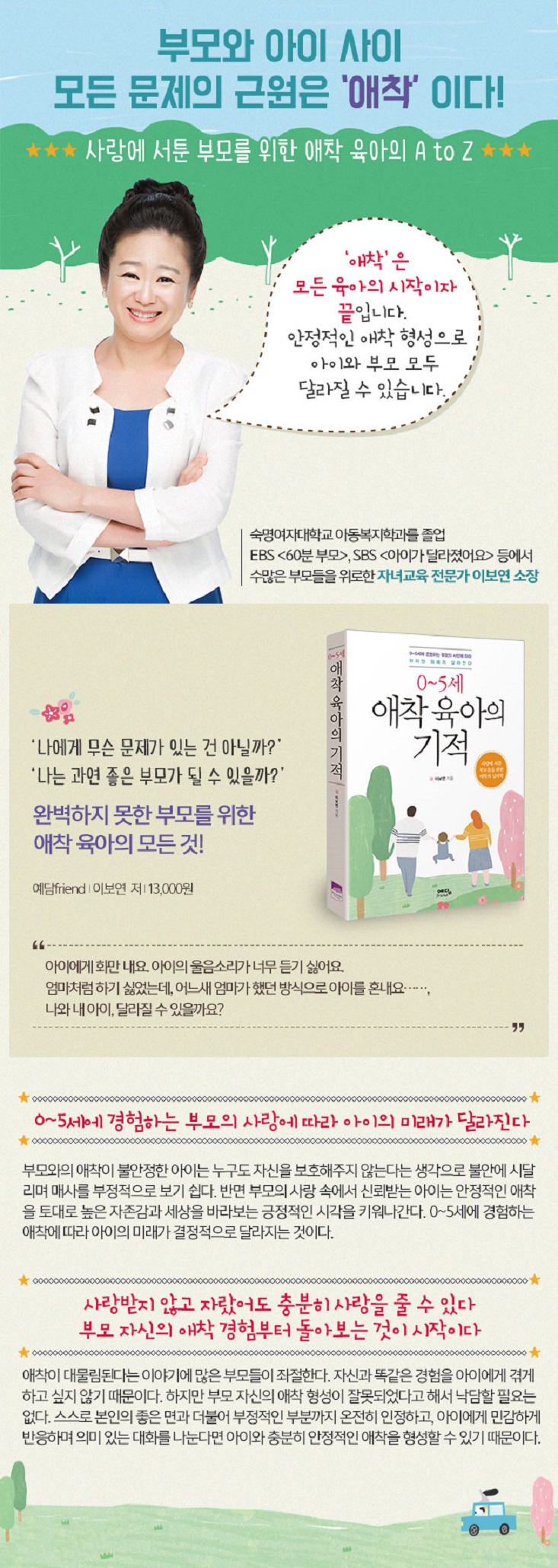
The root of all problems between parents and children is attachment.
Attachment is an important concept in parenting that all parents must know.
Director Lee Bo-yeon, a child education expert, covers methods for forming stable attachments based on theories and counseling materials she has researched over the years, and even includes know-how for improving children's problem behaviors through attachment.
Children who have formed positive attachments do not feel fear when placed in new environments, but rather explore the objects and people around them and attempt to interact in a healthy way.
On the other hand, for children who have formed insecure attachment relationships, the world is a scary and fearful place, so they try not to leave their parents or create their own world.
Additionally, attachments formed between the ages of 0 and 5 play a key role in forming a child's 'internal working model'.
Our internal working model is our perspective on ourselves, others, and the world. Even when we experience the same thing, we perceive it differently depending on our internal working model.
For example, when a pedestrian runs over them, a person with a positive internal working model will dismiss it as someone else's mistake, while a person with a negative internal working model will ignore them and interpret it as an intentional act.
In other words, the attachment between parents and children formed between the ages of 0 and 5 determines everything from the child's interpersonal relationships to their attitude toward life.
Attachment is an important concept in parenting that all parents must know.
Director Lee Bo-yeon, a child education expert, covers methods for forming stable attachments based on theories and counseling materials she has researched over the years, and even includes know-how for improving children's problem behaviors through attachment.
Children who have formed positive attachments do not feel fear when placed in new environments, but rather explore the objects and people around them and attempt to interact in a healthy way.
On the other hand, for children who have formed insecure attachment relationships, the world is a scary and fearful place, so they try not to leave their parents or create their own world.
Additionally, attachments formed between the ages of 0 and 5 play a key role in forming a child's 'internal working model'.
Our internal working model is our perspective on ourselves, others, and the world. Even when we experience the same thing, we perceive it differently depending on our internal working model.
For example, when a pedestrian runs over them, a person with a positive internal working model will dismiss it as someone else's mistake, while a person with a negative internal working model will ignore them and interpret it as an intentional act.
In other words, the attachment between parents and children formed between the ages of 0 and 5 determines everything from the child's interpersonal relationships to their attitude toward life.
- You can preview some of the book's contents.
Preview
index
Prologue│All About Attachment Between Parents and Children
PART 1 Attachment is the instinct and reason for life.
Attachment is an instinct
A reasonable obsession with mother
Trust and security toward parents and the world
Curiosity toward the world, attachment behavior
A healthy self that overcomes anxiety is built on attachment.
PART 2 The One Condition That Determines a Child's Life: Attachment
As a child grows, so should attachment.
Until the age of three, parents are the child's whole world and universe.
Between the ages of three and five, the eyes that see the world are perfected.
Two conditions for strengthening the seed of the mind
In a child's heart, even a broken tree can grow again.
PART 3: The Temperature of the Relationship Between Parents and Children Determines Attachment
Is my attachment with my child okay?
How can we change our child's mind?
The first condition for secure attachment is parental sensitivity.
The second condition for secure attachment: meaningful conversation.
To parents who have a hard time because their child does not follow their heart
PART 4 Parents, Reflect on Your Attachment Experience
Parents' attachment experiences shape their children's lives.
Parents are the mirror of their children.
The Ghost of the Cradle: Why Raising Children Well Doesn't Go as Planned
How to Break the Chain of Misplaced Attachment
Time to look at myself as I am, not as a parent.
PART 5: Reflect on Your Attachment with Your Child
Misinterpretation between parents and children ruins children.
Things You Should Never Say to Your Child
PART 6 Can My Child and I Be Different?
You are a great parent if you believe things can change.
A child who always whines and asks to be hugged
A child who frequently engages in risky behavior
A child who is obsessive and hates change
A child who is irritable and overly angry
A child who is listless and listless
A child who is overly obedient and considerate
PART 1 Attachment is the instinct and reason for life.
Attachment is an instinct
A reasonable obsession with mother
Trust and security toward parents and the world
Curiosity toward the world, attachment behavior
A healthy self that overcomes anxiety is built on attachment.
PART 2 The One Condition That Determines a Child's Life: Attachment
As a child grows, so should attachment.
Until the age of three, parents are the child's whole world and universe.
Between the ages of three and five, the eyes that see the world are perfected.
Two conditions for strengthening the seed of the mind
In a child's heart, even a broken tree can grow again.
PART 3: The Temperature of the Relationship Between Parents and Children Determines Attachment
Is my attachment with my child okay?
How can we change our child's mind?
The first condition for secure attachment is parental sensitivity.
The second condition for secure attachment: meaningful conversation.
To parents who have a hard time because their child does not follow their heart
PART 4 Parents, Reflect on Your Attachment Experience
Parents' attachment experiences shape their children's lives.
Parents are the mirror of their children.
The Ghost of the Cradle: Why Raising Children Well Doesn't Go as Planned
How to Break the Chain of Misplaced Attachment
Time to look at myself as I am, not as a parent.
PART 5: Reflect on Your Attachment with Your Child
Misinterpretation between parents and children ruins children.
Things You Should Never Say to Your Child
PART 6 Can My Child and I Be Different?
You are a great parent if you believe things can change.
A child who always whines and asks to be hugged
A child who frequently engages in risky behavior
A child who is obsessive and hates change
A child who is irritable and overly angry
A child who is listless and listless
A child who is overly obedient and considerate
Detailed image
Into the book
Likewise, all animals, including humans, have innate behaviors that they must perform for survival even if they are not taught to do so.
This behavior is called 'instinct'.
There are physical instincts that are absolutely necessary for living as living beings who eat, drink, and breathe, and there are also unique instincts that appear according to the characteristics of the species.
Herbivores like zebras and antelopes, who must live in a safari where the law of the jungle is the rule, must run to survive as soon as they are born, so they try to stand up on their own. Sea turtles also have the instinct to run for their lives toward the sea as soon as they hatch from their eggs.
Human babies are no exception. In addition to eating and drinking, they are born with other important instincts necessary for survival, and one of them is 'attachment'.
---p.18
The internal working model is composed of three levels: first, the internal working model directed at myself ("What kind of person am I?"); second, the internal working model directed at others ("What kind of person is the other person?"); and third, the internal working model directed at the world ("What is the world like?").
These internal operating models begin to form after birth and change or are re-created throughout life.
However, the first internal working model formed becomes the basis for the internal working models formed later, so the internal working model formed in childhood has the greatest influence throughout life.
In particular, the internal operating model formed by a child from birth until the age of three or at the latest five, when attachment to parents is most important, has a decisive influence on the formation of the child's personality and interpersonal relationships.
---p.102
Parental insensitivity leads to inconsistent parenting.
If you don't know what the problem is, your approach to solving it will easily change depending on your mood or surroundings.
Sensitive parents sometimes guide their children's growth and development by providing guidance on what they "should" do rather than what they want, helping them understand the rules and encouraging and practicing their children to explore and manipulate on their own.
This allows the child to perceive the world as a predictable and safe place.
However, if there are no consistent parenting rules and the solution changes depending on the parent's mood or the child's tantrum, the child will not only feel unsafe in the relationship with the parent, but will also feel fearful of the world.
---pp.145-146
Events that occur before the ages of three to five, in particular, have a strong influence on the formation and change of internal working models.
At the same time, this period is still in the early stages of forming an internal operating model, so there is still a lot of room for change.
However, after the age of five, when the internal working model is complete, children do not change easily unless they have repeated powerful experiences.
In other words, if the internal working model is formed positively, it means that even if there is some stress after the age of five, it can be endured well, but if the internal working model is formed negatively, it is not easily changed no matter how hard you try.
---p.153
Another aspect of parenting sensitivity is the ability to know when to intervene and when to leave things alone.
Even for the same behavior, intervention may vary depending on the child's level of development.
It's okay to just watch toddlers trying to put on their shoes on their own with a very serious look on their face.
Since this child is currently in the process of acquiring autonomy, the mother's role is sufficient simply by providing a few encouraging words from the child's side.
However, it is a mistake to be insensitive and scold a child who is sleepy, tired, and irritable for not putting on his or her shoes.
A sensitive mother can clearly distinguish between what her child can and cannot do, and what must and must not do, depending on his developmental level.
---p.168
But this is where all the problems begin.
The biggest reason parents and children form insecure attachments is that they repeatedly use problematic communication styles in their daily lives without even realizing it.
If your child is exhibiting behavioral problems, it is important to first examine what your child is saying and doing without even realizing it.
There are some common types of communication methods that parents use that cause anxiety in their children.
This behavior is called 'instinct'.
There are physical instincts that are absolutely necessary for living as living beings who eat, drink, and breathe, and there are also unique instincts that appear according to the characteristics of the species.
Herbivores like zebras and antelopes, who must live in a safari where the law of the jungle is the rule, must run to survive as soon as they are born, so they try to stand up on their own. Sea turtles also have the instinct to run for their lives toward the sea as soon as they hatch from their eggs.
Human babies are no exception. In addition to eating and drinking, they are born with other important instincts necessary for survival, and one of them is 'attachment'.
---p.18
The internal working model is composed of three levels: first, the internal working model directed at myself ("What kind of person am I?"); second, the internal working model directed at others ("What kind of person is the other person?"); and third, the internal working model directed at the world ("What is the world like?").
These internal operating models begin to form after birth and change or are re-created throughout life.
However, the first internal working model formed becomes the basis for the internal working models formed later, so the internal working model formed in childhood has the greatest influence throughout life.
In particular, the internal operating model formed by a child from birth until the age of three or at the latest five, when attachment to parents is most important, has a decisive influence on the formation of the child's personality and interpersonal relationships.
---p.102
Parental insensitivity leads to inconsistent parenting.
If you don't know what the problem is, your approach to solving it will easily change depending on your mood or surroundings.
Sensitive parents sometimes guide their children's growth and development by providing guidance on what they "should" do rather than what they want, helping them understand the rules and encouraging and practicing their children to explore and manipulate on their own.
This allows the child to perceive the world as a predictable and safe place.
However, if there are no consistent parenting rules and the solution changes depending on the parent's mood or the child's tantrum, the child will not only feel unsafe in the relationship with the parent, but will also feel fearful of the world.
---pp.145-146
Events that occur before the ages of three to five, in particular, have a strong influence on the formation and change of internal working models.
At the same time, this period is still in the early stages of forming an internal operating model, so there is still a lot of room for change.
However, after the age of five, when the internal working model is complete, children do not change easily unless they have repeated powerful experiences.
In other words, if the internal working model is formed positively, it means that even if there is some stress after the age of five, it can be endured well, but if the internal working model is formed negatively, it is not easily changed no matter how hard you try.
---p.153
Another aspect of parenting sensitivity is the ability to know when to intervene and when to leave things alone.
Even for the same behavior, intervention may vary depending on the child's level of development.
It's okay to just watch toddlers trying to put on their shoes on their own with a very serious look on their face.
Since this child is currently in the process of acquiring autonomy, the mother's role is sufficient simply by providing a few encouraging words from the child's side.
However, it is a mistake to be insensitive and scold a child who is sleepy, tired, and irritable for not putting on his or her shoes.
A sensitive mother can clearly distinguish between what her child can and cannot do, and what must and must not do, depending on his developmental level.
---p.168
But this is where all the problems begin.
The biggest reason parents and children form insecure attachments is that they repeatedly use problematic communication styles in their daily lives without even realizing it.
If your child is exhibiting behavioral problems, it is important to first examine what your child is saying and doing without even realizing it.
There are some common types of communication methods that parents use that cause anxiety in their children.
---p.296
Publisher's Review
'Is there something wrong with me?', 'Can I really be a good parent?'
Everything You Need to Know About Attachment Parenting for Parents Who Are Clumsy at Loving It
When parents become furious at their child's small mistakes or become more annoyed than worried when their child cries, they begin to feel a parenting crisis.
"Is there something wrong with me?", "Can I really be a good parent?" A book has been published that offers solutions to parenting problems through psychological analysis using attachment relationships as a clue for parents who are beginning to fundamentally contemplate parenting.
It is 『The Miracle of Attachment Parenting for Children Aged 0-5』 published by Yedam Friend.
What is the problem between parents and children?
The author of this book points to 'insecure attachment relationships' as the root of the problem.
Children depend on their parents, and parents respond appropriately to this, creating a special relationship. The trust that forms between parents and children in this process is attachment.
Children with insecure attachments to their parents are prone to anxiety and negative perceptions of everything, believing that no one is protecting them.
On the other hand, children who are trusted by their parents develop high self-esteem and a positive view of the world based on a stable attachment.
A child's future is decidedly determined by the attachment they experience between the ages of 0 and 5.
The attachment relationship with parents experienced between the ages of 0 and 5 determines a child's future.
Humans have a longer infancy period than any other animal, and are more fragile than any other animal, so they must depend on others to survive.
Because of this, children are born with a special instinct called 'attachment', separate from eating and sleeping.
Unlike other instincts, attachment is an interaction that requires the other person's response.
For example, if a child cries because he or she is hungry, the parent should accept that signal and satisfy the child's need by giving the child a bottle.
Through this process, the child not only relieves his hunger but also develops a sense of security.
For a child, an attachment figure is an object of unconditional will necessary for survival.
The relationships formed with attachment figures during the child's growth process affect the child's entire life.
Children who have formed positive attachments do not feel fear when placed in new environments, but rather explore the objects and people around them and attempt to interact in a healthy way.
On the other hand, for children who have formed insecure attachment relationships, the world is a scary and fearful place, so they try not to leave their parents or create their own world.
Additionally, attachments formed between the ages of 0 and 5 play a key role in forming a child's 'internal working model'.
Our internal working model is our perspective on ourselves, others, and the world. Even when we experience the same thing, we perceive it differently depending on our internal working model.
For example, when a pedestrian runs over them, a person with a positive internal working model will dismiss it as someone else's mistake, while a person with a negative internal working model will ignore them and interpret it as an intentional act.
In other words, the attachment between parents and children formed between the ages of 0 and 5 determines everything from the child's interpersonal relationships to their attitude toward life.
Even if you grew up without love, you can still give enough love.
It starts with parents looking back on their own attachment experiences.
When the attachment between parents and children is unstable, it often reveals problems with the parents' childhood experiences, especially those with their own parents.
Parents also failed to form a stable attachment with their children.
Expectations and frustrations about parenting often stem from one's own experiences growing up.
The author seeks the reason why things don't go the way he wants to raise his child in 'Ghosts of the Cradle'.
If we go back to the parents' parents, we can see that the lack of attachment due to incorrect parenting methods and situations is being passed down.
Many parents are frustrated by the idea that attachment is inherited.
Because I don't want my child to go through the same experiences I did.
However, there is no need to be discouraged if parents themselves have formed attachments incorrectly.
If you fully acknowledge your own good and bad sides, respond sensitively to your child, and engage in meaningful conversations, you can form a sufficiently stable attachment with your child.
Everything You Need to Know About Attachment Parenting for Parents Who Are Clumsy at Loving It
When parents become furious at their child's small mistakes or become more annoyed than worried when their child cries, they begin to feel a parenting crisis.
"Is there something wrong with me?", "Can I really be a good parent?" A book has been published that offers solutions to parenting problems through psychological analysis using attachment relationships as a clue for parents who are beginning to fundamentally contemplate parenting.
It is 『The Miracle of Attachment Parenting for Children Aged 0-5』 published by Yedam Friend.
What is the problem between parents and children?
The author of this book points to 'insecure attachment relationships' as the root of the problem.
Children depend on their parents, and parents respond appropriately to this, creating a special relationship. The trust that forms between parents and children in this process is attachment.
Children with insecure attachments to their parents are prone to anxiety and negative perceptions of everything, believing that no one is protecting them.
On the other hand, children who are trusted by their parents develop high self-esteem and a positive view of the world based on a stable attachment.
A child's future is decidedly determined by the attachment they experience between the ages of 0 and 5.
The attachment relationship with parents experienced between the ages of 0 and 5 determines a child's future.
Humans have a longer infancy period than any other animal, and are more fragile than any other animal, so they must depend on others to survive.
Because of this, children are born with a special instinct called 'attachment', separate from eating and sleeping.
Unlike other instincts, attachment is an interaction that requires the other person's response.
For example, if a child cries because he or she is hungry, the parent should accept that signal and satisfy the child's need by giving the child a bottle.
Through this process, the child not only relieves his hunger but also develops a sense of security.
For a child, an attachment figure is an object of unconditional will necessary for survival.
The relationships formed with attachment figures during the child's growth process affect the child's entire life.
Children who have formed positive attachments do not feel fear when placed in new environments, but rather explore the objects and people around them and attempt to interact in a healthy way.
On the other hand, for children who have formed insecure attachment relationships, the world is a scary and fearful place, so they try not to leave their parents or create their own world.
Additionally, attachments formed between the ages of 0 and 5 play a key role in forming a child's 'internal working model'.
Our internal working model is our perspective on ourselves, others, and the world. Even when we experience the same thing, we perceive it differently depending on our internal working model.
For example, when a pedestrian runs over them, a person with a positive internal working model will dismiss it as someone else's mistake, while a person with a negative internal working model will ignore them and interpret it as an intentional act.
In other words, the attachment between parents and children formed between the ages of 0 and 5 determines everything from the child's interpersonal relationships to their attitude toward life.
Even if you grew up without love, you can still give enough love.
It starts with parents looking back on their own attachment experiences.
When the attachment between parents and children is unstable, it often reveals problems with the parents' childhood experiences, especially those with their own parents.
Parents also failed to form a stable attachment with their children.
Expectations and frustrations about parenting often stem from one's own experiences growing up.
The author seeks the reason why things don't go the way he wants to raise his child in 'Ghosts of the Cradle'.
If we go back to the parents' parents, we can see that the lack of attachment due to incorrect parenting methods and situations is being passed down.
Many parents are frustrated by the idea that attachment is inherited.
Because I don't want my child to go through the same experiences I did.
However, there is no need to be discouraged if parents themselves have formed attachments incorrectly.
If you fully acknowledge your own good and bad sides, respond sensitively to your child, and engage in meaningful conversations, you can form a sufficiently stable attachment with your child.
GOODS SPECIFICS
- Date of issue: May 3, 2016
- Page count, weight, size: 296 pages | 460g | 148*210*20mm
- ISBN13: 9791186117484
- ISBN10: 1186117486
You may also like
카테고리
korean


korean

![GQ KOREA Mark (Monthly): December [2025]](http://librairie.coreenne.fr/cdn/shop/files/8ef265dbbfbf186523ed75ba7319009d.jpg?v=1765340328&width=3840)


