

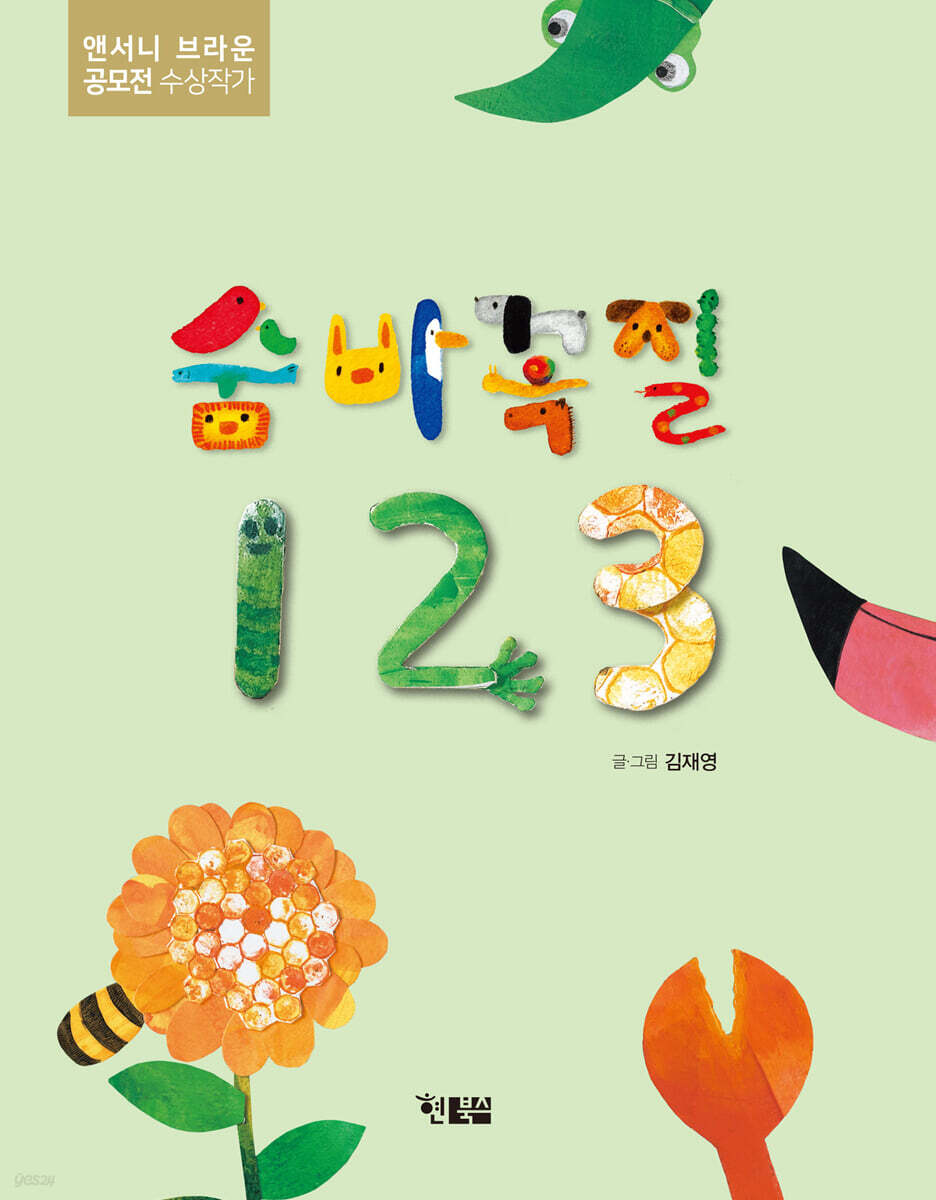
Hide and Seek 1 2 3
 |
Description
Book Introduction
Number picture books included in textbooks: 『Hide and Seek ㄱㄴㄷ』, 『Hide and Seek ㅏㅑㅓㅕ』
A creative plan that expresses numbers like a shape game
A smart number picture book with a striking design sense!
The revised edition of the number book 『Hide and Seek 1 2 3』 by author Kim Jae-young, who is already familiar to readers through 『Hide and Seek ㄱㄴㄷ』 and 『Hide and Seek ㅏㅑㅓㅕ』 being included in textbooks, has been published.
This is a number game book by the author who became known as a picture book author after winning an award at the Anthony Brown Picture Book Contest for “Hide and Seek GND.”
This is an original picture book created by an author who is also an elementary school teacher after much thought on 'how can children learn numbers as a fun game?'
A creative plan that expresses numbers like a shape game
A smart number picture book with a striking design sense!
The revised edition of the number book 『Hide and Seek 1 2 3』 by author Kim Jae-young, who is already familiar to readers through 『Hide and Seek ㄱㄴㄷ』 and 『Hide and Seek ㅏㅑㅓㅕ』 being included in textbooks, has been published.
This is a number game book by the author who became known as a picture book author after winning an award at the Anthony Brown Picture Book Contest for “Hide and Seek GND.”
This is an original picture book created by an author who is also an elementary school teacher after much thought on 'how can children learn numbers as a fun game?'
- You can preview some of the book's contents.
Preview
Detailed image
Publisher's Review
Learning numbers while playing hide-and-seek
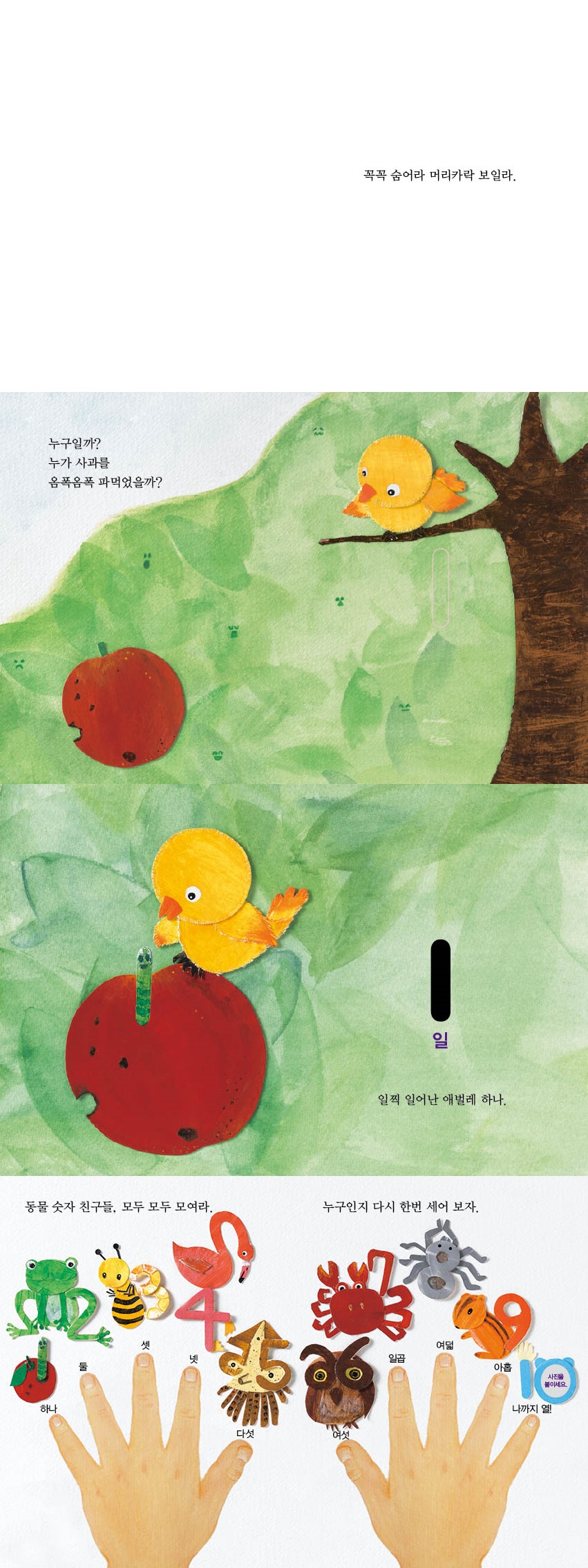
《Hide and Seek 1 2 3》 is a play book designed to help children learn numbers by playing hide and seek with animals through holes made between the pages of the book.
The most striking feature is the number-shaped holes.
When the hole is on the right, the numbers are clearly visible against the black background behind them, but when it is on the left, they naturally disappear into the animal shape along with the background color in front.
At this time, the child becomes interested in how the picture changes because of the holes and naturally touches the holes with his or her hands. The educational effect of this book lies in the fact that the child can recognize numbers by touching them through the holes.
'Hide well.
Begin by saying, "I see hair," and then draw children into the play. Then ask, "Who is it?" and have the child think about the answer.
If you turn the page out of curiosity, the answer will come out as 'an early riser'.
Children can check whether their guesses are correct by looking at the small hints hidden in the picture and turning the page to see the hidden animals through the holes.
Children perceive this process as fun play and learn numbers naturally.
Also, the process of discovering the number 1 on the body of a caterpillar hiding in an apple, the number 2 on a frog's leg, the number 3 on a bee's wing, the number 4 on a flamingo's leg, the number 5 on a squid's body, the number 6 on an owl's eye, the number 7 on a crab's pincers, the number 8 on a spider's body, and the number 9 hidden in a squirrel's tail allows you to play hide-and-seek while turning the pages of the book.
As children playfully flip through this book from beginning to end, they will learn that as numbers increase, the quantity also increases, and they will naturally learn the quantitative concept of the corresponding numbers.
And at the end, organize the numbers from 1 to 10 and review all the numbers you have learned so far.
An integrated picture book that teaches numbers and vocabulary at the same time.
This book uses a variety of onomatopoeia and mimetic words, such as ompok ompok, poljak poljak, buzzing, sook, jjuuk jjuuk, dolmang dolmang, shaking, swishing, and olmang jolmang, to add to the joy of reading for children.
Also, by using words that start with syllables that correspond to the number names, such as '1-early, 2-here and there, 3-three-three-five, 4-lovely, 5-up and down, 6-heavy, 7-rustling, 8-palpitating, 9-corner to corner,' it was fun to naturally connect numbers and vocabulary.
This book allows children to learn numbers and vocabulary simultaneously through play, develop observation and concentration skills, and enhance imagination and creativity by predicting what will happen next.
If this training is repeated, the child will be able to discover numbers hidden in all objects, which will become another form of play.
The picture on the last page shows that a child's imagination can expand infinitely.
《Hide and Seek 1 2 3》 is a play book designed to help children learn numbers by playing hide and seek with animals through holes made between the pages of the book.
The most striking feature is the number-shaped holes.
When the hole is on the right, the numbers are clearly visible against the black background behind them, but when it is on the left, they naturally disappear into the animal shape along with the background color in front.
At this time, the child becomes interested in how the picture changes because of the holes and naturally touches the holes with his or her hands. The educational effect of this book lies in the fact that the child can recognize numbers by touching them through the holes.
'Hide well.
Begin by saying, "I see hair," and then draw children into the play. Then ask, "Who is it?" and have the child think about the answer.
If you turn the page out of curiosity, the answer will come out as 'an early riser'.
Children can check whether their guesses are correct by looking at the small hints hidden in the picture and turning the page to see the hidden animals through the holes.
Children perceive this process as fun play and learn numbers naturally.
Also, the process of discovering the number 1 on the body of a caterpillar hiding in an apple, the number 2 on a frog's leg, the number 3 on a bee's wing, the number 4 on a flamingo's leg, the number 5 on a squid's body, the number 6 on an owl's eye, the number 7 on a crab's pincers, the number 8 on a spider's body, and the number 9 hidden in a squirrel's tail allows you to play hide-and-seek while turning the pages of the book.
As children playfully flip through this book from beginning to end, they will learn that as numbers increase, the quantity also increases, and they will naturally learn the quantitative concept of the corresponding numbers.
And at the end, organize the numbers from 1 to 10 and review all the numbers you have learned so far.
An integrated picture book that teaches numbers and vocabulary at the same time.
This book uses a variety of onomatopoeia and mimetic words, such as ompok ompok, poljak poljak, buzzing, sook, jjuuk jjuuk, dolmang dolmang, shaking, swishing, and olmang jolmang, to add to the joy of reading for children.
Also, by using words that start with syllables that correspond to the number names, such as '1-early, 2-here and there, 3-three-three-five, 4-lovely, 5-up and down, 6-heavy, 7-rustling, 8-palpitating, 9-corner to corner,' it was fun to naturally connect numbers and vocabulary.
This book allows children to learn numbers and vocabulary simultaneously through play, develop observation and concentration skills, and enhance imagination and creativity by predicting what will happen next.
If this training is repeated, the child will be able to discover numbers hidden in all objects, which will become another form of play.
The picture on the last page shows that a child's imagination can expand infinitely.
GOODS SPECIFICS
- Date of issue: September 3, 2024
- Format: Hardcover book binding method guide
- Page count, weight, size: 48 pages | 150*190*15mm
- ISBN13: 9791157414123
- ISBN10: 1157414125
- KC Certification: Certification Type: Conformity Confirmation
You may also like
카테고리
korean


korean

![GQ KOREA Mark (Monthly): December [2025]](http://librairie.coreenne.fr/cdn/shop/files/8ef265dbbfbf186523ed75ba7319009d.jpg?v=1765340328&width=3840)


